Preparation is the key to success in any interview. In this post, we’ll explore crucial Thermal Management and Cooling Systems interview questions and equip you with strategies to craft impactful answers. Whether you’re a beginner or a pro, these tips will elevate your preparation.
Questions Asked in Thermal Management and Cooling Systems Interview
Q 1. Explain the difference between conduction, convection, and radiation heat transfer.
Heat transfer, the movement of thermal energy, occurs through three primary mechanisms: conduction, convection, and radiation. Let’s break them down:
Conduction: This is the transfer of heat through direct contact. Imagine holding a hot cup of coffee – the heat transfers from the cup to your hand. Materials vary in their ability to conduct heat; metals are excellent conductors, while materials like wood or air are poor conductors (insulators). The rate of conduction is governed by Fourier’s Law:
Q = -kA(dT/dx), where Q is heat flow, k is thermal conductivity, A is the area, and dT/dx is the temperature gradient.Convection: This involves heat transfer through the movement of fluids (liquids or gases). Think of boiling water – the hot water rises, carrying heat away from the bottom of the pot, while cooler water sinks to replace it. This is natural convection. Forced convection involves using a fan or pump to actively circulate the fluid, speeding up heat transfer. The effectiveness of convection is often characterized by a convection coefficient (h).
Radiation: This is the transfer of heat through electromagnetic waves. It doesn’t require a medium; the sun’s heat reaches us through the vacuum of space. All objects radiate heat; the amount depends on their temperature and surface properties, as described by the Stefan-Boltzmann Law:
Q = εσA(T⁴ - Ts⁴), where ε is emissivity, σ is the Stefan-Boltzmann constant, A is the area, T is the object’s temperature, and Ts is the surrounding temperature.
In thermal management, understanding these three modes is crucial for designing effective cooling systems. For example, a heatsink uses conduction to transfer heat from a component to its fins, convection to transfer heat from the fins to the surrounding air, and radiation plays a minor role, especially at higher temperatures.
Q 2. Describe different types of heat sinks and their applications.
Heat sinks are passive devices designed to enhance heat dissipation from electronic components or other heat-generating sources. Their effectiveness lies in their large surface area, which increases the rate of heat transfer to the surrounding environment through convection and radiation.
Finned Heat Sinks: These are the most common type, featuring numerous extended surfaces (fins) to increase surface area. The fins can be designed in various shapes (e.g., straight, pin, louvered) to optimize airflow and heat transfer. They’re used widely in electronics, from CPUs to power transistors.
Plate Heat Sinks: These are simple, flat plates with a large surface area, often used for less powerful components or where space is limited. They are efficient for applications with good airflow.
Liquid Cooling Heat Sinks: These use a liquid coolant (like water or a specialized fluid) to directly absorb heat from the component. A pump circulates the coolant to a radiator for dissipation. These are crucial for high-power applications like servers and GPUs.
Vapor Chamber Heat Sinks: These utilize phase-change cooling, effectively spreading heat across a large area. A liquid evaporates to absorb heat, then condenses in a cooler region, releasing the heat. They’re ideal for high heat flux applications, providing uniform temperature distribution.
The choice of heat sink depends on factors like the amount of heat to be dissipated, the available space, the cost constraints, and the ambient conditions.
Q 3. What are the key considerations in selecting a cooling fluid?
Selecting a cooling fluid involves considering several key properties:
Thermal Conductivity: A high thermal conductivity ensures efficient heat transfer from the component to the fluid. Water is a good choice, while oils are less effective.
Specific Heat Capacity: This represents the amount of heat a fluid can absorb per unit mass per degree of temperature change. A higher specific heat capacity allows the fluid to carry more heat before its temperature increases significantly.
Viscosity: Low viscosity reduces pumping power requirements and minimizes pressure drop in the cooling system. High viscosity can lead to increased energy consumption and potential flow problems.
Boiling Point and Freezing Point: The fluid must remain in its liquid phase under operating conditions. For high-temperature applications, fluids with high boiling points are required.
Chemical Compatibility: The fluid must be compatible with the materials used in the cooling system to avoid corrosion or degradation. For example, specialized coolants are used in automotive applications to prevent corrosion in the radiator.
Cost and Environmental Impact: The cost of the fluid and its environmental impact should also be considered. Water is a readily available and environmentally friendly option.
For example, in data centers, water is frequently used in direct-to-chip cooling systems due to its high thermal conductivity and specific heat capacity. In high-performance computing, specialized coolants with high boiling points might be necessary for managing extreme heat generation.
Q 4. How do you determine the thermal resistance of a component?
Thermal resistance (Rth) quantifies a component’s ability to impede heat flow. It’s defined as the temperature difference across the component divided by the heat flow through it: Rth = ΔT / Q. The units are usually Kelvin per watt (K/W) or degrees Celsius per watt (°C/W).
Determining the thermal resistance depends on the component’s geometry and material properties. For simple geometries, analytical solutions exist. For complex geometries, numerical methods like Finite Element Analysis (FEA) or Computational Fluid Dynamics (CFD) are often employed.
Example: Consider a silicon chip with a known thermal conductivity (k), thickness (L), and cross-sectional area (A). Its thermal resistance due to conduction can be calculated as: Rth,conduction = L / (kA). However, this is a simplified model; actual thermal resistance might include contributions from contact resistance, thermal interface material resistance, and convection resistance from the surrounding environment.
In practice, manufacturers often provide thermal resistance data in datasheets. Experimental methods, such as measuring temperature differences and heat flow under controlled conditions, can also be used to determine thermal resistance.
Q 5. Explain the concept of thermal impedance.
Thermal impedance (Zth) is a measure of a component’s resistance to heat flow, taking into account both the thermal resistance and the thermal capacitance (Cth). It’s especially relevant for transient (time-varying) heat transfer scenarios, where the temperature response isn’t instantaneous.
Thermal impedance considers the effect of thermal inertia—a material’s ability to store heat. A component with high thermal capacitance will take longer to heat up or cool down compared to one with low thermal capacitance. Thermal impedance is often expressed as a function of time or frequency.
The relationship between thermal impedance and thermal resistance is similar to the relationship between electrical impedance and electrical resistance. Electrical resistance is a measure of the opposition to the flow of current; thermal resistance is a measure of the opposition to the flow of heat. Electrical impedance considers the phase relationship between current and voltage, while thermal impedance considers transient behavior.
In practical terms, thermal impedance is crucial for understanding a component’s temperature response during power surges or cyclical operation. It’s used in designing cooling systems capable of handling dynamic heat loads.
Q 6. What are the common methods for measuring temperature?
Numerous methods exist for measuring temperature, each with its own advantages and limitations. Common methods include:
Thermocouples: These are based on the Seebeck effect, generating a voltage proportional to the temperature difference between two dissimilar metals. They are relatively inexpensive, wide-ranging, and robust, making them suitable for various applications.
Resistance Temperature Detectors (RTDs): These sensors use the change in electrical resistance of a metal (usually platinum) with temperature. They offer high accuracy and stability, but are more expensive than thermocouples.
Thermistors: These are semiconductor devices exhibiting a large change in resistance with temperature. They are highly sensitive, small in size, and relatively inexpensive, but their accuracy can be affected by self-heating.
Infrared (IR) Thermometers: These non-contact sensors measure temperature by detecting the infrared radiation emitted by an object. They are useful for measuring the temperature of moving or inaccessible objects but their accuracy is impacted by surface emissivity and ambient conditions.
Data Acquisition Systems (DAQ): These systems combine various sensors (including those mentioned above) with signal conditioning and data logging capabilities for accurate and comprehensive temperature measurements and data analysis.
The choice of method depends on factors such as accuracy requirements, temperature range, cost, and the accessibility of the measurement location. For instance, thermocouples are often used in harsh environments, while RTDs are preferred for precision measurements in controlled settings. IR thermometers provide a contactless solution suitable for moving parts or hot surfaces.
Q 7. Describe your experience with CFD software (e.g., ANSYS Fluent, COMSOL).
I have extensive experience using ANSYS Fluent for Computational Fluid Dynamics (CFD) simulations in thermal management. I’ve employed it to model and analyze various cooling systems, including:
Air cooling of electronic components: Simulating airflow patterns and heat transfer within enclosures to optimize heat sink designs and fan placement. This involved setting up the geometry, meshing the domain, defining boundary conditions (inlet velocity, ambient temperature), solving the governing equations (Navier-Stokes and energy equations), and post-processing the results (temperature distributions, velocity fields, pressure drops).
Liquid cooling systems: Modeling the flow of coolants (water, specialized fluids) through microchannels or larger channels, predicting pressure drop, temperature rise, and heat transfer coefficients. This required accurate material property inputs and careful consideration of turbulence models.
Optimization studies: Using Design of Experiments (DOE) and optimization algorithms to explore the design space and identify optimal parameters for improved cooling performance. For example, I optimized the fin geometry of a heatsink to minimize the component’s maximum temperature.
My experience includes mesh independence studies to ensure the accuracy and reliability of my simulation results. I am proficient in using Fluent’s various turbulence models (k-ε, k-ω SST) and heat transfer models to accurately predict the thermal behavior of systems. I also possess experience in validating the CFD results using experimental data, thus improving the reliability and accuracy of the simulation and its predictions.
Q 8. How do you validate CFD simulation results?
Validating CFD (Computational Fluid Dynamics) simulation results is crucial for ensuring the accuracy and reliability of thermal management designs. It’s not a single step but a multi-faceted process involving several checks and comparisons. We aim to build confidence in the model’s ability to predict real-world behavior.
Grid Independence Study: We refine the mesh (the computational grid) progressively, running simulations at different mesh densities. If the results converge (i.e., show little change with increased mesh refinement), it indicates the solution is mesh-independent and less susceptible to numerical errors.
Experimental Validation: This is the gold standard. We compare simulation results against experimental data obtained from physical testing of a prototype or a similar system. Discrepancies are analyzed to identify potential sources of error in either the simulation or the experiment.
Code Verification: We ensure the CFD software is functioning correctly by running known benchmark cases with established solutions. This helps identify any potential bugs or issues within the software itself.
Qualitative Comparisons: We visually inspect flow patterns, temperature distributions, and other parameters to see if they align with our expectations based on engineering principles and experience. Inconsistencies may point to errors in the model or boundary conditions.
Uncertainty Quantification: We account for uncertainties in input parameters (e.g., material properties, boundary conditions) and propagate these uncertainties through the simulation to estimate the range of possible outcomes. This gives us a more realistic understanding of the simulation’s limitations.
For example, in designing a cooling system for a server rack, we might use experimental data from thermocouples placed on individual components to validate the simulated temperature distributions within the rack. Any significant deviations would prompt a re-evaluation of the model’s assumptions and parameters.
Q 9. Explain the concept of forced convection and natural convection.
Convection is the mode of heat transfer that occurs due to fluid motion. The driving force behind this motion differentiates forced and natural convection.
Forced Convection: This involves the use of external means to move the fluid, such as fans or pumps. The fluid flow is primarily driven by an external pressure difference. This results in faster heat transfer rates compared to natural convection because the fluid velocity is higher. Think of a computer CPU cooler with a fan actively blowing air over the heat sink. The higher the fan speed, the more efficient the cooling.
Natural Convection: Here, fluid motion is driven by buoyancy forces arising from density differences caused by temperature variations. Hotter, less dense fluid rises, while cooler, denser fluid sinks. This process is slower and less efficient than forced convection but occurs naturally without any external assistance. A common example is the heat dissipation from a radiator. The warm air near the radiator becomes less dense and rises, creating a natural convection current.
In many real-world cooling systems, we see a combination of both forced and natural convection. For instance, a server rack might use fans for forced convection, but natural convection also plays a role in the overall heat transfer process.
Q 10. What are the different types of fans used in cooling systems?
The choice of fan depends heavily on factors like airflow requirements, noise levels, power consumption, and the overall system design.
Axial Fans: These fans move air parallel to the axis of rotation, generating a high airflow at relatively low pressure. They are commonly used in applications where high airflow is needed, such as cooling server racks or large electronic systems. They are typically less expensive than centrifugal fans.
Centrifugal Fans: These fans move air perpendicular to the axis of rotation. They create higher pressure than axial fans and are suitable for applications requiring higher pressure and potentially less airflow. This is often the case in smaller, more confined spaces.
Crossflow Fans: These are a hybrid of axial and centrifugal designs; air flows across the fan blades and partially along the axis. This configuration strikes a balance between pressure and airflow, often employed in situations where both are needed.
DC Brushless Fans: These fans use electronic commutation for higher efficiency, better control over speed, and longer lifespans than AC fans. They are prevalent in applications where precise control and energy efficiency are critical.
EC (Electronically Commutated) Fans: These are a sophisticated type of DC brushless fan that offers advanced features such as speed control via a PWM signal, integrated sensors for monitoring speed, current and temperature, and often quieter operation.
Choosing the right fan involves careful consideration of the system’s specific needs and constraints. Noise and efficiency are also paramount, with EC fans often preferred in sensitive environments.
Q 11. Describe your experience with thermal testing and analysis.
My experience in thermal testing and analysis spans over [Number] years, encompassing a variety of projects involving electronic components, power supplies, and server systems. I’m proficient in both experimental and analytical techniques.
Experimental Testing: I’ve conducted numerous thermal tests using techniques like infrared thermography, thermocouples, and flow meters. I’m experienced in designing and setting up thermal test chambers to simulate various environmental conditions (temperature, humidity, etc.). This allows us to obtain crucial data for validation of simulation results. For instance, in one project, we used infrared cameras to map the temperature distribution on the surface of a high-power LED array to identify hotspots and optimize the cooling design.
Analytical Techniques: I’m adept at using various thermal analysis software packages (e.g., ANSYS, COMSOL) to simulate heat transfer in electronic systems. I can build detailed models, incorporating factors such as convection, conduction, and radiation. For example, I used Finite Element Analysis (FEA) to predict the thermal performance of a new heatsink design for a high-performance CPU.
Data Analysis and Reporting: I can effectively analyze thermal data, identify trends, and generate comprehensive reports for stakeholders. This includes presenting findings and recommendations based on both simulation and experimental data.
I always prioritize meticulous documentation of test procedures, results, and analysis. Thorough documentation is crucial for reproducibility and maintaining data integrity, particularly valuable in a regulatory environment.
Q 12. How do you design a thermal management system for a high-power electronic component?
Designing a thermal management system for a high-power electronic component requires a systematic approach that considers the component’s power dissipation, operating environment, and performance requirements.
Power Dissipation Analysis: The first step involves accurately determining the component’s power dissipation under various operating conditions. This might involve analyzing datasheets, performing electrical tests, or running simulations.
Selection of Cooling Technique: Based on the power dissipation and required operating temperature, we select the appropriate cooling technique. This might include air cooling (natural or forced convection), liquid cooling, or a combination of both. For high-power components, liquid cooling is frequently necessary.
Heat Sink Design: For air cooling, the choice and design of a heat sink is critical. This involves considering materials, fin geometry, surface area, and airflow patterns. Simulations and optimization techniques are crucial in ensuring the heat sink is effective.
Fluid Dynamics Analysis: For liquid cooling or systems with fans, we employ CFD to analyze fluid flow and heat transfer. The aim is to optimize fluid paths to maximize cooling efficiency while minimizing pressure drop.
Thermal Interface Material (TIM): We carefully select a TIM with appropriate thermal conductivity to effectively transfer heat from the component to the heat sink. A good TIM is critical for minimizing thermal resistance.
Thermal Testing and Validation: We conduct experimental tests to validate the performance of the designed thermal management system. This involves measuring temperatures, airflow, and pressure drop under various operating conditions.
For example, designing a cooling system for a high-power laser diode might involve using a micro-channel liquid cooling system, a high-performance heat sink, and precise temperature control mechanisms.
Q 13. What are the challenges of cooling high-density electronics?
Cooling high-density electronics presents significant challenges due to the high power dissipation within a small volume, leading to increased temperatures and potential reliability issues.
Increased Thermal Density: The close proximity of components exacerbates thermal interference, creating hotspots and hindering efficient heat dissipation. The limited space constrains the size and effectiveness of cooling solutions.
Complex Airflow Management: Efficient airflow distribution within a dense system is difficult. Airflow obstructions and dead zones can significantly reduce cooling effectiveness.
Higher Power Consumption: Increased component density often means higher overall power consumption, requiring more sophisticated cooling techniques to manage the additional heat generation.
Higher Cost: Solutions for high-density systems often necessitate advanced technologies, such as liquid cooling or microfluidic cooling, which can be significantly more expensive than traditional air cooling.
Packaging and Component Placement: Careful design of the electronics packaging and placement of components is crucial for optimizing airflow and minimizing thermal gradients.
Strategies for addressing these challenges include using advanced cooling technologies (like liquid cooling or two-phase cooling), optimizing component placement, employing advanced thermal interface materials, and utilizing CFD simulations for design optimization. Careful thermal design is critical to ensure the reliability and performance of high-density electronic systems.
Q 14. Explain the concept of thermal runaway.
Thermal runaway is a dangerous phenomenon that occurs when the heat generated by a component exceeds its ability to dissipate heat, leading to a rapid and uncontrolled temperature increase. This positive feedback loop can result in component failure or even catastrophic system damage. Imagine a snowball rolling downhill, gathering more snow as it goes – its size (temperature) increases exponentially.
Several factors can contribute to thermal runaway:
Increased internal resistance: As the temperature of a component rises, its internal resistance typically increases, leading to even higher power dissipation and further temperature increase.
Exothermic chemical reactions: In some systems, high temperatures can trigger exothermic reactions that release more heat, accelerating the runaway process.
Inadequate cooling: Insufficient cooling capacity can fail to remove the generated heat, exacerbating the temperature rise.
Mitigation strategies include using components with inherently better thermal stability, employing robust cooling systems, incorporating thermal fuses or over-temperature protection circuits, and carefully designing the system to prevent hotspots.
The consequences of thermal runaway can be severe, leading to component damage, fire hazards, or system failures. Preventing thermal runaway is a critical consideration in the design of any electronic system, particularly those with high-power components.
Q 15. How do you ensure the reliability of a thermal management system?
Ensuring the reliability of a thermal management system is paramount for the longevity and performance of any product. It involves a multi-faceted approach encompassing design, material selection, testing, and ongoing monitoring. Think of it like building a sturdy bridge – you wouldn’t just throw some planks together; you’d carefully consider the load, the materials’ strength, and perform rigorous testing.
- Robust Design: We start with a thorough thermal analysis, using simulation tools like ANSYS or FloTHERM to predict temperature distributions and identify potential hotspots. This helps us optimize component placement, select appropriate heat sinks, and ensure adequate airflow.
- High-Quality Materials: Choosing durable and thermally conductive materials is crucial. This includes not only the heat sink material (e.g., aluminum, copper) but also the thermal interface materials (TIMs) which fill microscopic gaps between components, maximizing heat transfer. We meticulously test the TIMs for their long-term stability and performance under various conditions.
- Rigorous Testing: Extensive testing is non-negotiable. This involves subjecting the system to various environmental conditions – high temperatures, low temperatures, humidity, vibration – to identify any weaknesses and ensure continued performance under stress. We use accelerated life testing to predict long-term reliability.
- Redundancy and Fail-safes: In critical applications, we might incorporate redundancy in the cooling system, such as using multiple fans or heat pipes. Fail-safe mechanisms, such as automatic shutdowns at critical temperatures, are also implemented to protect against catastrophic failures.
- Monitoring and Maintenance: Even after deployment, monitoring system temperatures is vital. This might involve sensors and remote monitoring systems that alert us to any anomalies, allowing for proactive maintenance and preventing potential failures.
Career Expert Tips:
- Ace those interviews! Prepare effectively by reviewing the Top 50 Most Common Interview Questions on ResumeGemini.
- Navigate your job search with confidence! Explore a wide range of Career Tips on ResumeGemini. Learn about common challenges and recommendations to overcome them.
- Craft the perfect resume! Master the Art of Resume Writing with ResumeGemini’s guide. Showcase your unique qualifications and achievements effectively.
- Don’t miss out on holiday savings! Build your dream resume with ResumeGemini’s ATS optimized templates.
Q 16. What are the different types of thermal interface materials (TIMs)?
Thermal Interface Materials (TIMs) are crucial for efficient heat transfer between components. They fill microscopic gaps and surface irregularities, preventing air gaps that hinder heat dissipation. Imagine trying to glue two slightly uneven surfaces together – the TIM acts as that perfect filler, ensuring a strong thermal connection.
- Thermal Grease: A common and cost-effective option, but requires careful application to avoid air pockets. Its viscosity changes with temperature, potentially affecting long-term performance.
- Thermal Pads: Pre-applied sheets of thermally conductive material, offering ease of application but potentially less effective than grease for very small gaps or uneven surfaces.
- Phase-Change Materials (PCMs): These materials melt at a specific temperature, providing excellent thermal conductivity once melted. They’re particularly useful in applications with varying temperatures.
- Gap Fillers: These materials offer high thermal conductivity and are especially suitable for filling larger gaps between components.
- Thermal Adhesives: Used for permanently bonding components while also providing excellent thermal conductivity. The choice depends on the application and required long-term stability.
Q 17. What are the key performance indicators (KPIs) for a thermal management system?
Key Performance Indicators (KPIs) for a thermal management system are crucial for assessing its effectiveness and ensuring optimal performance. They provide a quantitative measure of how well the system is managing heat. These metrics are like a report card for your cooling system, showing areas for improvement or celebrating successes.
- Junction Temperature: The temperature of the semiconductor die is the most critical KPI. Exceeding the maximum junction temperature can lead to component failure.
- Case Temperature: The temperature of the component’s outer casing; it gives an indication of the overall thermal performance.
- Heat Flux: The rate of heat transfer per unit area; a higher heat flux indicates more efficient heat dissipation.
- Thermal Resistance: A measure of how well a component or system resists heat flow; lower thermal resistance is desirable.
- Mean Time To Failure (MTTF): Predicts the lifespan of the system under typical operating conditions. A higher MTTF indicates greater reliability.
- Power Consumption of Cooling System: An important aspect to consider as high power consumption can impact overall system efficiency.
Q 18. Describe your experience with different thermal simulation tools.
My experience with thermal simulation tools is extensive. I’ve worked extensively with ANSYS Icepak, FloTHERM, and COMSOL Multiphysics, applying them to a wide range of applications, from designing cooling solutions for high-performance computing systems to optimizing thermal management in automotive electronics. Each tool has its strengths and weaknesses, and the choice often depends on the specific application and available resources.
- ANSYS Icepak: Excellent for electronics cooling, providing detailed CFD simulations of airflow and heat transfer in complex geometries. I’ve used it to optimize fan placement and heat sink design in servers and data centers.
- FloTHERM: User-friendly and efficient for quick thermal analysis, especially for electronics applications. I’ve used it extensively for initial design assessments and parametric studies.
- COMSOL Multiphysics: A more general-purpose tool, capable of handling coupled physics simulations (e.g., thermal and fluid flow, electromagnetics). It’s particularly useful for analyzing complex phenomena and non-standard geometries but has a higher learning curve.
In my projects, I typically start with a simpler tool like FloTHERM for preliminary analysis and then move to a more sophisticated tool like ANSYS Icepak for detailed simulations and optimization. This iterative process ensures efficient use of resources and accurate results.
Q 19. How do you manage thermal budgets in product design?
Managing thermal budgets in product design involves carefully allocating the allowable temperature rise for each component within the system. It’s like managing a household budget – you have a limited amount of resources (cooling capacity) and need to allocate them wisely to avoid exceeding the limits (maximum temperatures).
The process typically begins with identifying the power dissipation of each component and estimating its temperature rise. This involves using thermal simulation tools and experimental data. Next, we determine the maximum allowable temperature for each component, considering material limitations and reliability constraints. Finally, we develop a cooling strategy that ensures all component temperatures remain within their limits. This may involve using heat sinks, fans, liquid cooling, or a combination of these methods. Trade-offs are inevitable and are resolved by prioritizing the most critical components and adjusting the cooling strategy accordingly. Throughout this process, continuous monitoring and iteration is crucial to achieve optimal results and stay within the thermal budget.
Q 20. Explain the importance of proper airflow management in cooling systems.
Proper airflow management is crucial for effective cooling, especially in systems with forced convection. Imagine trying to extinguish a fire with a weak fan; simply directing air isn’t enough to be effective. Strategic airflow management ensures that the cooling air reaches the heat-generating components efficiently.
- Airflow Pathways: Designing efficient pathways for airflow to pass over heat-generating components is essential. This may involve strategically placed vents, fans, and heat sinks.
- Airflow Obstructions: Minimizing airflow obstructions is key. Careful component placement and the use of appropriate mounting techniques can help prevent airflow restrictions. In servers and data centers, for example, cable management plays a key role in minimizing obstructions.
- Fan Selection: The type, size, and location of fans significantly impact airflow effectiveness. Selecting fans with appropriate airflow and static pressure characteristics is critical.
- Airflow Simulation: CFD simulations help in optimizing airflow patterns and identifying potential bottlenecks or areas of inefficient cooling. They allow for virtual prototyping and adjustments before committing to physical prototypes.
Q 21. How do you address thermal challenges in different environmental conditions?
Addressing thermal challenges in different environmental conditions is a critical aspect of designing reliable thermal management systems. A system that performs perfectly in a lab might fail miserably in a desert or a freezing arctic region. This requires careful consideration of various factors.
- Temperature Extremes: Systems need to function reliably under both high and low temperatures. This might involve selecting materials with appropriate temperature ranges, using thermally conductive materials to minimize temperature gradients and designing the system for thermal expansion and contraction.
- Humidity: High humidity can affect the performance of electronic components and increase corrosion. Proper sealing and material selection are essential to mitigate this risk. We might use conformal coatings to protect sensitive components from moisture.
- Altitude: Air density decreases with altitude, affecting the effectiveness of air cooling. This must be considered when designing systems for high-altitude applications, often requiring more powerful fans or alternative cooling solutions.
- Dust and Debris: Accumulation of dust and debris can restrict airflow and reduce cooling effectiveness. Proper filtration and regular maintenance are necessary in such environments.
- Vibration and Shock: These factors can affect the integrity of the system, potentially causing damage to components or disrupting airflow. Robust design and the use of vibration-dampening materials can mitigate these risks.
Designing for extreme environmental conditions requires a thorough understanding of the environment and the use of appropriate design practices and materials. Rigorous testing under simulated environmental conditions is essential to ensure the system’s reliability and performance.
Q 22. What are some common thermal management failures and how to prevent them?
Thermal management failures often stem from inadequate heat dissipation, leading to overheating and component damage. Common failures include premature component failure due to excessive temperatures, system instability, and even catastrophic events like fires. Preventing these issues requires a multi-pronged approach.
- Accurate Thermal Modeling: Employing sophisticated thermal simulation software (like ANSYS Fluent or COMSOL) to predict temperature distributions under various operating conditions is crucial. This allows for proactive design adjustments before physical prototyping.
- Proper Heat Transfer Mechanisms: Understanding and leveraging the three modes of heat transfer – conduction, convection, and radiation – is essential. This involves selecting appropriate materials with high thermal conductivity (for conduction), optimizing airflow (for convection), and using effective radiative surfaces (for radiation).
- Component Placement and Orientation: Strategic placement of heat-generating components, maintaining adequate spacing for airflow, and orienting components to maximize heat dissipation are vital for effective cooling.
- Redundancy and Fail-safes: Implementing backup cooling systems or safety mechanisms (like thermal fuses or emergency shutdowns) can mitigate the impact of failures and prevent catastrophic events.
- Thorough Testing and Validation: Rigorous testing under various environmental conditions and load profiles is critical to verify the effectiveness of the thermal management system and identify potential weaknesses.
For example, in designing a server rack, neglecting airflow management can lead to hot spots, causing hard drive failures and system crashes. Implementing proper ventilation, fans, and heat sinks, along with robust thermal simulation, can prevent this.
Q 23. How do you select appropriate boundary conditions for thermal simulations?
Selecting appropriate boundary conditions for thermal simulations is critical for accurate results. Incorrect boundary conditions can lead to significant errors in predicted temperatures, potentially compromising the design’s reliability and safety.
- Temperature Boundary Conditions: These specify a fixed temperature at a surface. For example, a constant ambient temperature of 25°C might be applied to the outer surfaces of an enclosure.
- Heat Flux Boundary Conditions: These specify the rate of heat flow into or out of a surface. This is often used to model heat sources like electronic components.
- Convective Boundary Conditions: These model heat transfer due to fluid flow. They require specifying the convective heat transfer coefficient (h) and the bulk fluid temperature. The coefficient (h) depends on the fluid properties, flow velocity, and geometry. Accurate determination of ‘h’ is crucial for realistic simulation.
- Radiative Boundary Conditions: These model heat transfer through radiation. They involve specifying the surface emissivity and the surrounding temperatures or radiative properties of the environment. View factors (which account for the geometry of the radiating surfaces) are crucial for accurately capturing radiative effects.
Consider a laptop design. For simulation, you might specify a constant temperature at the bottom surface representing the desk on which it sits (temperature boundary condition), define heat fluxes from the CPU and GPU (heat flux boundary condition), account for airflow over the chassis using a convective heat transfer coefficient and ambient air temperature (convective boundary condition), and model radiation heat transfer from the laptop’s surfaces to the surrounding room (radiative boundary condition).
Q 24. Describe your experience with different types of heat exchangers.
My experience encompasses various heat exchanger types, each suited for different applications. Here are a few examples:
- Air-cooled Heat Sinks: These are extensively used for electronics cooling, relying on conduction from the heat source to the fins and convection from the fins to the surrounding air. I’ve worked on optimizing fin geometries and airflow patterns to enhance their effectiveness.
- Liquid-cooled Heat Sinks: These offer significantly higher heat transfer rates than air-cooled systems. I have experience with microchannel heat sinks, which utilize small channels to maximize the surface area for heat transfer, often coupled with pumped liquids like water or specialized coolants.
- Plate Heat Exchangers: These are compact and efficient for applications involving liquid-to-liquid heat transfer. I’ve worked on designs incorporating different plate configurations and flow patterns to optimize heat transfer and pressure drop.
- Evaporative Coolers: For high heat loads or situations where minimizing temperature is critical, I have experience with evaporative cooling techniques, where heat is transferred by vaporizing a liquid coolant. This is commonly employed in data centers and industrial processes.
In one project, we needed to cool a high-power laser system. Air cooling was insufficient, so we designed and implemented a liquid-cooled heat exchanger using a custom-engineered microchannel heat sink and a closed-loop coolant system. This significantly improved the system’s reliability and performance.
Q 25. Explain your understanding of the finite element method (FEM) for thermal analysis.
The Finite Element Method (FEM) is a powerful numerical technique used extensively in thermal analysis. It works by dividing the problem domain (the object being analyzed) into smaller, simpler elements (like triangles or tetrahedra).
Here’s a breakdown:
- Discretization: The first step is to create a mesh, dividing the geometry into numerous elements. Mesh density is critical; finer meshes offer higher accuracy but increase computational cost.
- Governing Equations: The governing equation for heat transfer, usually the heat equation, is then applied to each element. This equation relates temperature, thermal conductivity, heat generation, and heat flux.
- Element Equations: The governing equation is simplified and applied to each element, resulting in a set of algebraic equations.
- Assembly: These element equations are assembled into a global system of equations that describes the temperature distribution across the entire domain.
- Solution: This large system of equations is solved numerically using sophisticated algorithms to find the temperature at each node in the mesh.
- Post-processing: Finally, the results are post-processed to visualize temperature distributions, heat fluxes, and other relevant parameters.
Software packages like ANSYS, COMSOL, and Abaqus use FEM to perform thermal simulations. The accuracy of the results depends heavily on the mesh quality, boundary conditions, and material properties.
Q 26. How do you integrate thermal management considerations into the product lifecycle?
Integrating thermal management into the product lifecycle is crucial for success. It shouldn’t be an afterthought but a core consideration from the initial design phase through manufacturing and even end-of-life.
- Concept Phase: Early thermal simulations and design reviews help identify potential thermal challenges and guide design choices. This proactive approach avoids costly redesigns later.
- Design Phase: Detailed thermal models are created and refined, exploring different design options and optimizing the cooling strategy. Material selection, component placement, and airflow management are all carefully considered.
- Prototyping and Testing: Prototypes are built and rigorously tested to validate the thermal model and identify any unforeseen issues. Experimental data can then inform further refinements.
- Manufacturing Phase: Thermal management considerations must be integrated into the manufacturing process to ensure consistent performance. This includes verifying component tolerances and ensuring proper assembly.
- End-of-Life: Considerations for the disposal or recycling of the product and its thermal management components should be incorporated to minimize environmental impact.
For instance, in a previous project developing a high-performance server, we integrated thermal management into each stage. Early simulations helped determine optimal fan placement, leading to a more efficient and cost-effective design compared to a trial-and-error approach.
Q 27. How do you handle conflicting requirements in thermal design (e.g., cost vs. performance)?
Balancing conflicting requirements in thermal design, such as cost versus performance, is a common challenge. It often requires a systematic approach involving trade-off analyses and iterative design improvements.
- Define Clear Requirements and Priorities: The first step is to clearly define the performance goals and cost constraints. This may involve prioritizing certain aspects over others depending on the application’s criticality.
- Pareto Analysis: Identifying the 20% of design factors contributing to 80% of the thermal performance can help focus efforts on the most impactful areas. This can help identify cost-effective ways to improve thermal performance.
- Trade-off Analysis: Evaluate different design options, quantifying the impact of each on both performance and cost. This may involve using cost models alongside thermal simulations.
- Iterative Design: The design process is often iterative, refining the design based on simulation results, experimental data, and cost analyses. This allows for a balanced solution that meets both performance and cost targets.
In one instance, we had to design a cooling system for a mobile device with stringent size and cost limitations. Through iterative design, using different heat sink materials and optimizing airflow paths, we reached a design that met thermal requirements while staying within the budget constraints.
Q 28. What are the latest trends in thermal management technology?
The field of thermal management is constantly evolving, driven by the demand for higher-power, smaller, and more efficient electronic devices.
- Advanced Materials: New materials with enhanced thermal conductivity, such as carbon nanotubes and graphene, are being explored for use in heat sinks and other thermal management components. These offer the potential for significant performance improvements.
- Two-Phase Cooling: Techniques involving boiling and condensation are becoming increasingly prevalent, particularly for high-heat-flux applications. These offer substantially higher heat transfer rates compared to single-phase cooling.
- Miniaturization: Developing smaller and more efficient cooling solutions is vital for portable electronics. This includes microchannel heat sinks, thermoelectric coolers, and other compact cooling technologies.
- AI and Machine Learning: AI and ML are being utilized to optimize thermal designs, predict thermal performance more accurately, and even control cooling systems in real-time.
- Sustainable Cooling: There’s a growing emphasis on sustainable and environmentally friendly cooling solutions, including the use of natural refrigerants and energy-efficient cooling techniques.
For example, the adoption of liquid cooling in high-performance computing is gaining traction, pushing the boundaries of what’s possible in terms of power density and performance. The integration of AI to optimize the control strategies is a significant development that improves efficiency and reduces energy consumption.
Key Topics to Learn for Thermal Management and Cooling Systems Interview
- Fundamentals of Heat Transfer: Conduction, convection, and radiation – understanding the principles and their applications in various cooling systems.
- Types of Cooling Systems: Air cooling, liquid cooling, vapor compression refrigeration, thermoelectric cooling – know their advantages, disadvantages, and suitable applications.
- Heat Sink Design and Optimization: Explore different fin designs, materials, and thermal interface materials for efficient heat dissipation. Understand the impact of surface area and airflow.
- Fluid Dynamics in Cooling Systems: Analyze pressure drops, flow rates, and pump selection for optimal system performance. Consider laminar and turbulent flow regimes.
- Thermal Modeling and Simulation: Familiarize yourself with software tools used for thermal analysis (e.g., ANSYS, COMSOL) and their application in predicting system behavior.
- Thermodynamic Cycles: Understand the principles behind refrigeration cycles (e.g., Rankine, vapor-compression) and their efficiency parameters.
- Practical Applications: Consider examples like automotive cooling, electronics cooling, data center cooling, and HVAC systems to demonstrate your understanding of real-world applications.
- Troubleshooting and Problem-Solving: Be prepared to discuss approaches to diagnose and resolve thermal management issues in different systems. Think about root cause analysis techniques.
- Materials Science in Thermal Management: Understand the thermal properties of various materials and their selection criteria for different cooling applications.
- Emerging Technologies: Stay updated on advancements in thermal management such as two-phase cooling, microchannel cooling, and advanced heat transfer fluids.
Next Steps
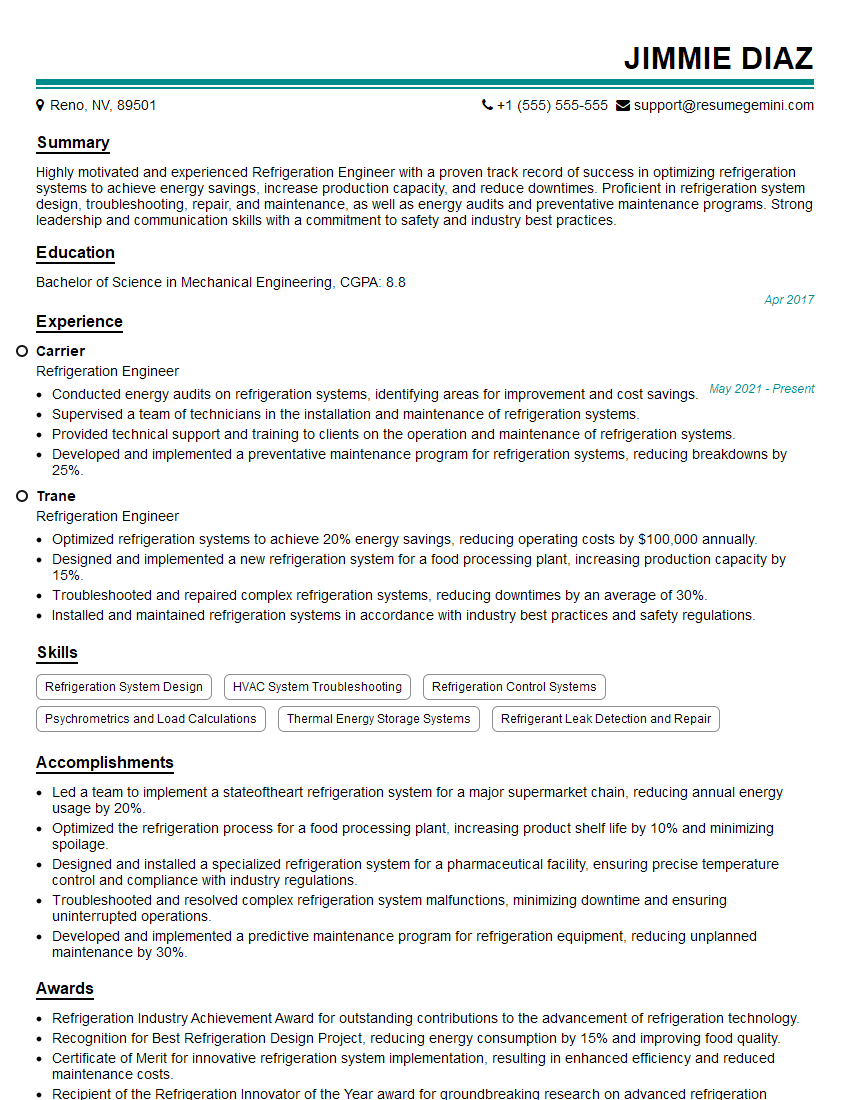
Mastering Thermal Management and Cooling Systems opens doors to exciting career opportunities in diverse industries. A strong understanding of these principles is highly valued, leading to greater job security and advancement potential. To maximize your chances of landing your dream role, it’s crucial to present your skills effectively. Creating an ATS-friendly resume is essential for getting past applicant tracking systems and into the hands of hiring managers. ResumeGemini is a trusted resource to help you build a professional and impactful resume that showcases your expertise. We provide examples of resumes tailored to Thermal Management and Cooling Systems to guide you through the process.
Explore more articles
Users Rating of Our Blogs
Share Your Experience
We value your feedback! Please rate our content and share your thoughts (optional).
What Readers Say About Our Blog
Very informative content, great job.
good