The thought of an interview can be nerve-wracking, but the right preparation can make all the difference. Explore this comprehensive guide to Thermodynamic Modeling interview questions and gain the confidence you need to showcase your abilities and secure the role.
Questions Asked in Thermodynamic Modeling Interview
Q 1. Explain the difference between enthalpy and internal energy.
Internal energy (U) and enthalpy (H) are both state functions representing the total energy of a system, but they differ in how they account for work done by or on the system. Internal energy encompasses all the microscopic energy within a system – kinetic energy of molecules, potential energy from intermolecular forces, etc. Enthalpy, on the other hand, adds the product of pressure and volume (PV) to the internal energy: H = U + PV. This additional term accounts for the work done by the system against the surrounding pressure during expansion or contraction. Think of it like this: if you’re heating a balloon, you’re increasing its internal energy (molecules move faster). But the balloon also expands, doing work against atmospheric pressure. Enthalpy captures both the internal energy increase and the work done during this expansion. In constant pressure processes, the change in enthalpy directly reflects the heat transferred to or from the system. This makes enthalpy particularly useful for analyzing many common chemical reactions.
Q 2. Describe the three laws of thermodynamics.
The three laws of thermodynamics are fundamental principles governing energy and entropy in physical systems. They are:
- The Zeroth Law: If two thermodynamic systems are each in thermal equilibrium with a third, then they are in thermal equilibrium with each other. This might seem obvious, but it establishes the concept of temperature as a consistent measure of thermal equilibrium. Imagine three blocks of metal: if block A is the same temperature as block B, and block B is the same temperature as block C, then block A and block C are also at the same temperature.
- The First Law: Energy cannot be created or destroyed, only transferred or changed from one form to another. This is the law of conservation of energy. In a closed system, the change in internal energy (ΔU) is equal to the heat added (Q) minus the work done by the system (W):
ΔU = Q - W. This means that the total energy remains constant; energy might be converted from, say, chemical energy into heat or work, but the total amount stays the same. - The Second Law: The total entropy of an isolated system can only increase over time, or remain constant in ideal cases where the system is in a steady state or undergoing a reversible process. Entropy is a measure of disorder or randomness. This law explains why some processes are spontaneous and others are not, even if they don’t violate the first law. For example, heat naturally flows from hot to cold, not the other way around; this increases the overall entropy of the universe.
- The Third Law: The entropy of a perfect crystal at absolute zero temperature is zero. This provides a baseline for measuring entropy. At absolute zero, there is only one possible microstate (arrangement of molecules), so the disorder (entropy) is zero. This law is important in low-temperature thermodynamics and in calculating absolute entropy values.
Q 3. What is Gibbs free energy and how is it used in thermodynamic modeling?
Gibbs free energy (G) is a thermodynamic potential that measures the maximum reversible work that may be performed by a thermodynamic system at a constant temperature and pressure. It’s defined as: G = H - TS, where H is enthalpy, T is temperature, and S is entropy. In thermodynamic modeling, Gibbs free energy is crucial for determining the spontaneity and equilibrium of a process. A negative change in Gibbs free energy (ΔG < 0) indicates a spontaneous process (it will occur without external intervention), while a positive change (ΔG > 0) indicates a non-spontaneous process (it requires external energy input). A ΔG = 0 indicates the system is at equilibrium. Gibbs free energy is widely used in chemical equilibrium calculations, phase equilibrium predictions, and determining reaction feasibility. For example, in chemical reaction modeling, calculating ΔG helps determine the equilibrium constant and the extent of a reaction at a given temperature and pressure.
Q 4. Explain the concept of entropy and its significance.
Entropy (S) is a thermodynamic property that measures the degree of disorder or randomness in a system. A higher entropy value indicates greater disorder. Imagine a deck of cards: a perfectly ordered deck has low entropy, while a shuffled deck has high entropy. The significance of entropy lies in its role in determining the spontaneity of processes. The second law of thermodynamics states that the total entropy of an isolated system always increases over time (or remains constant in reversible processes). This means that systems naturally tend towards states of higher disorder. Entropy is crucial in many areas, including chemical reactions, phase transitions (melting, boiling), and understanding the direction of natural processes. For instance, ice melting is spontaneous because it leads to an increase in entropy (more disordered liquid water).
Q 5. How do you apply the ideal gas law in real-world scenarios?
The ideal gas law, PV = nRT (where P is pressure, V is volume, n is the number of moles, R is the ideal gas constant, and T is temperature), is a simplified model, but it provides a reasonable approximation for many real-world gases under specific conditions. Its applications include:
- Predicting gas behavior in engines: In internal combustion engines, the ideal gas law can be used to estimate the pressure and volume changes during the combustion cycle, helping optimize engine design.
- Modeling atmospheric processes: Meteorology uses the ideal gas law to understand and predict weather patterns, modeling the behavior of air masses at different altitudes and temperatures.
- Designing industrial processes: Chemical engineers use the ideal gas law to design and optimize various industrial processes involving gases, such as gas storage, transportation, and reaction systems.
- Analyzing gas mixtures: While not perfect, it can estimate the behavior of gas mixtures, enabling predictions about their overall pressure and volume.
It’s crucial to remember that the accuracy of the ideal gas law depends on the conditions. It works best for gases at low pressures and high temperatures, where intermolecular forces are negligible.
Q 6. What are the limitations of the ideal gas law?
The ideal gas law has limitations because it assumes that:
- Gas molecules have negligible volume: Real gas molecules occupy space, and at high pressures, this volume becomes significant.
- Intermolecular forces are negligible: Real gas molecules interact with each other through attractive (e.g., van der Waals forces) and repulsive forces. These forces become more important at lower temperatures and higher pressures.
- Gas molecules undergo perfectly elastic collisions: Real gas collisions are not always perfectly elastic; some energy is lost as heat.
These assumptions break down at high pressures and low temperatures, leading to significant deviations from the ideal gas law. Under such conditions, more sophisticated equations of state, which take into account molecular interactions and volume, are necessary.
Q 7. Describe different equations of state (e.g., van der Waals, Peng-Robinson).
Equations of state (EOS) are mathematical models that describe the relationship between pressure, volume, temperature, and the number of moles of a substance. The ideal gas law is the simplest EOS, but many others exist to better represent the behavior of real gases. Some examples include:
- Van der Waals EOS: This EOS introduces two parameters (a and b) to account for intermolecular forces and the finite volume of gas molecules.
(P + a(n/V)²)(V - nb) = nRT. The ‘a’ parameter represents the attractive forces, and ‘b’ represents the excluded volume. It provides a better approximation than the ideal gas law, especially at moderate pressures and temperatures. - Peng-Robinson EOS: A more sophisticated cubic EOS, the Peng-Robinson equation is widely used in the petroleum industry for modeling hydrocarbon systems. It uses two temperature-dependent parameters to improve accuracy, especially for predicting phase equilibria (liquid-vapor transitions).
- Redlich-Kwong EOS: Another cubic EOS that offers improved accuracy over the van der Waals EOS for certain applications.
The choice of EOS depends on the specific system and the desired accuracy. For instance, the van der Waals equation is relatively simple to use, but the Peng-Robinson equation may be necessary for precise calculations involving complex mixtures at high pressures.
Q 8. Explain the concept of fugacity and its importance in thermodynamic calculations.
Fugacity is a thermodynamic property that represents the effective partial pressure of a component in a mixture. Think of it as the ‘escaping tendency’ of a molecule. For an ideal gas, fugacity is equal to its partial pressure. However, for real gases and liquids, intermolecular forces and non-ideal behavior mean the actual pressure doesn’t accurately reflect the molecule’s desire to escape. Fugacity corrects for these deviations, allowing us to use familiar ideal-gas relationships in non-ideal situations.
Its importance lies in accurately calculating equilibrium conditions in non-ideal systems. For instance, in designing a chemical reactor, we need to know the equilibrium composition of the gas mixture. Using partial pressure directly would lead to significant errors if the gases are non-ideal. By using fugacity, we obtain a much more accurate prediction.
Example: Consider a high-pressure reaction involving methane. At high pressures, methane deviates significantly from ideal gas behavior. Using fugacity instead of partial pressure in the equilibrium constant expression will give a much more accurate prediction of the methane conversion at equilibrium.
Q 9. How do you calculate the equilibrium constant for a chemical reaction?
The equilibrium constant (K) for a chemical reaction quantifies the relationship between the concentrations (or activities) of reactants and products at equilibrium. It’s a crucial value for predicting the extent of a reaction under specific conditions. For the generic reaction:
aA + bB <=> cC + dD
where a, b, c, and d are stoichiometric coefficients, the equilibrium constant in terms of activities is:
K = (aCc * aDd) / (aAa * aBb)
Activities (ai) represent the effective concentrations of the species, considering deviations from ideality. For ideal gases, activity is equal to partial pressure; for ideal solutions, it’s equal to the molar fraction. For non-ideal systems, activity coefficients are incorporated to correct for these deviations.
Calculation Steps:
1. **Determine the balanced chemical equation.**
2. **Determine the activities of the reactants and products at equilibrium.** This might involve experimental measurements or calculations using equations of state or activity coefficient models.
3. **Substitute the activities into the equilibrium constant expression and calculate K.**
Q 10. Describe different types of thermodynamic processes (e.g., isothermal, adiabatic, isobaric).
Thermodynamic processes are changes in a system’s state. Several types are characterized by specific constraints:
- Isothermal Process: Constant temperature. Heat transfer occurs to maintain a constant temperature. Think of a reaction occurring in a large water bath.
- Adiabatic Process: No heat exchange with the surroundings. The system is perfectly insulated. A rapid expansion of a gas is often approximated as adiabatic.
- Isobaric Process: Constant pressure. The system is open to the atmosphere, or pressure is actively controlled. Many reactions in open containers occur under isobaric conditions.
- Isochoric Process (or Isovolumetric): Constant volume. The system is in a rigid container. A reaction in a sealed bomb calorimeter is isochoric.
- Isentropic Process: Constant entropy. This is an ideal process where there is no change in disorder or randomness within the system. A reversible adiabatic process is isentropic.
Understanding these process types is essential for analyzing and modeling various systems, like engine cycles or chemical reactors.
Q 11. What is the significance of phase diagrams in thermodynamic modeling?
Phase diagrams are graphical representations of the equilibrium conditions between different phases (solid, liquid, gas) of a substance or mixture as a function of temperature, pressure, and composition. They are indispensable tools in thermodynamic modeling because they visually depict the regions of stability for each phase and the transitions between them.
Significance:
1. Predicting phase behavior: Knowing the temperature and pressure, the phase diagram immediately shows the stable phase(s).
2. Determining phase transitions: The lines and points on the diagram indicate the conditions under which phase transitions occur (e.g., melting, boiling, sublimation).
3. Designing separation processes: Phase diagrams guide the design of separation techniques like distillation and crystallization by identifying optimal operating conditions.
4. Understanding material properties: Phase diagrams reveal information about material properties, such as melting point, boiling point, and solid-state transformations. For example, the iron-carbon phase diagram helps metallurgists understand the properties of steel.
Q 12. Explain how you would model a multi-component system.
Modeling multi-component systems is more complex than single-component systems because interactions between the components influence thermodynamic properties. Several approaches exist:
- Equation of State (EOS) Methods: EOS models, such as the Peng-Robinson or Soave-Redlich-Kwong equations, predict the PVT (pressure-volume-temperature) behavior of mixtures. They require mixing rules to account for the interactions between components.
- Activity Coefficient Models: These models, such as NRTL (Non-Random Two-Liquid) or UNIQUAC (Universal Quasi-Chemical), describe the non-ideality of liquid mixtures through activity coefficients, which represent the deviation from ideal solution behavior. They are particularly useful for liquid-phase equilibria calculations.
- Gibbs Energy Minimization: This method directly minimizes the Gibbs free energy of the system to find the equilibrium composition. It’s computationally intensive but can handle complex systems with multiple phases.
The choice of method depends on the specific system, the accuracy required, and the available data. Often, a combination of methods is used. For instance, one could use an EOS for the vapor phase and an activity coefficient model for the liquid phase.
Q 13. What are activity coefficients and how are they used?
Activity coefficients correct for deviations from ideal solution behavior. In an ideal solution, the components interact with each other in the same way they interact with themselves. However, in real solutions, intermolecular forces cause deviations from this ideal behavior.
The activity coefficient (γi) of component i modifies the concentration (or mole fraction, xi) to give the activity (ai):
ai = γi * xi
Activity coefficients are typically determined experimentally or estimated using activity coefficient models (like those mentioned in the previous answer). They are crucial for accurate calculations of equilibrium constants, phase equilibria, and other thermodynamic properties in non-ideal solutions. For example, when calculating the equilibrium constant for a reaction in a liquid solution, one must use activities (corrected for non-ideality) instead of just concentrations.
Q 14. Explain the concept of chemical potential.
Chemical potential (μi) is a measure of the change in Gibbs free energy of a system when a small amount of component i is added at constant temperature and pressure. It represents the ‘escaping tendency’ or ‘driving force’ for a component to move from one phase to another or from one location to another. At equilibrium, the chemical potential of each component is equal in all phases.
Significance:
1. Equilibrium conditions: Equilibrium is achieved when the chemical potential of each component is the same in all phases present.
2. Phase transitions: The chemical potential difference drives phase transitions. For example, a substance will melt if the chemical potential of the liquid phase is lower than that of the solid phase.
3. Transport processes: Chemical potential gradients drive mass transport processes, such as diffusion and osmosis.
Example: Consider water diffusing across a semipermeable membrane. Water will move from the region of higher chemical potential (higher concentration) to the region of lower chemical potential (lower concentration) until equilibrium is reached.
Q 15. Describe different methods for determining thermodynamic properties.
Determining thermodynamic properties involves a combination of experimental measurements and theoretical models. Experimentally, we can use techniques like calorimetry (measuring heat changes), pVT measurements (pressure, volume, temperature relationships), and spectroscopy (analyzing the interaction of matter with electromagnetic radiation) to directly obtain properties like enthalpy, entropy, and specific heat capacity. These direct measurements are crucial for validating theoretical models.
Theoretically, we leverage equations of state (EoS), which are mathematical relationships describing the behavior of fluids (gases and liquids). Popular EoS include the ideal gas law (a simplification for low-pressure gases), the Peng-Robinson equation, and the Soave-Redlich-Kwong equation, each with increasing complexity to account for non-ideal behaviors. Furthermore, statistical thermodynamics uses statistical mechanics to relate microscopic properties (like molecular interactions) to macroscopic thermodynamic properties. Activity coefficient models, like the NRTL and UNIQUAC models, are particularly useful for calculating thermodynamic properties of mixtures, especially when significant deviations from ideality are expected.
- Example: Determining the enthalpy of vaporization of water could involve using a calorimeter to measure the heat required to vaporize a known mass of water at a constant temperature.
- Example: Predicting the equilibrium vapor pressure of a mixture of hydrocarbons at a given temperature might involve using the Peng-Robinson EoS with interaction parameters obtained from experimental data.
Career Expert Tips:
- Ace those interviews! Prepare effectively by reviewing the Top 50 Most Common Interview Questions on ResumeGemini.
- Navigate your job search with confidence! Explore a wide range of Career Tips on ResumeGemini. Learn about common challenges and recommendations to overcome them.
- Craft the perfect resume! Master the Art of Resume Writing with ResumeGemini’s guide. Showcase your unique qualifications and achievements effectively.
- Don’t miss out on holiday savings! Build your dream resume with ResumeGemini’s ATS optimized templates.
Q 16. How do you handle non-ideal behavior in thermodynamic calculations?
Real-world fluids rarely behave ideally. The ideal gas law, while convenient, is only accurate under very specific conditions (low pressure and high temperature). Non-ideal behavior arises from intermolecular forces and the finite volume of molecules. To account for this, we employ activity coefficients (for liquid mixtures) and fugacity coefficients (for gases) in our calculations. Activity coefficients correct for deviations from Raoult’s law, which describes ideal solution behavior. Fugacity coefficients correct for deviations from the ideal gas law.
The choice of model depends on the specific system. For simple systems, the Peng-Robinson equation of state may suffice. For more complex systems, particularly mixtures with strong interactions, activity coefficient models like NRTL (Non-Random Two-Liquid) or UNIQUAC (Universal Quasichemical) might be necessary. These models incorporate parameters that reflect the intermolecular interactions. Sometimes, a combination of an EoS and an activity coefficient model is used (e.g., using an EoS for the vapor phase and an activity coefficient model for the liquid phase in a vapor-liquid equilibrium calculation).
Example: Calculating the vapor-liquid equilibrium of a mixture of ethanol and water would require an activity coefficient model like NRTL because of strong interactions between these molecules. A simple equation of state would not be accurate.Q 17. Explain your experience with thermodynamic simulation software (e.g., Aspen Plus, HYSYS).
I have extensive experience with Aspen Plus and HYSYS, using them for various thermodynamic modeling tasks, including process simulation, design, and optimization. In Aspen Plus, I’m proficient in selecting appropriate thermodynamic models (e.g., Peng-Robinson, NRTL, UNIQUAC) based on the specific components and conditions. I’ve used it to simulate various processes such as distillation columns, reactors, and heat exchangers. HYSYS provides similar capabilities and I’ve utilized its features for dynamic simulations and steady-state analysis.
For example, in a recent project involving the design of a cryogenic air separation unit, I used Aspen Plus to model the different stages of the process, predicting the composition, temperature, and pressure profiles of the various streams. This involved selecting appropriate thermodynamic models that accurately captured the behavior of gases at low temperatures. I used HYSYS in another project to study the transient response of a reactor to changes in feed conditions, aiding in the design of advanced process control systems.
Q 18. How do you validate your thermodynamic models?
Model validation is crucial to ensure the reliability of our results. This involves comparing model predictions to experimental data. We use various statistical measures such as the average absolute deviation (AAD) and the root mean square deviation (RMSD) to quantify the agreement between the model and the experimental data. The quality of experimental data is also essential for validating models.
For example, if we’re modeling the vapor-liquid equilibrium of a binary mixture, we would compare the model-predicted equilibrium compositions and pressures to experimentally measured values at various temperatures. If the deviations are significant, we would refine the model – perhaps by using a more sophisticated equation of state or activity coefficient model, or adjusting interaction parameters based on experimental data. A visual comparison (e.g., plotting experimental versus model-predicted values) can also help identify potential inconsistencies or areas where the model is not accurate.
Q 19. Describe your experience with different thermodynamic databases.
My experience encompasses various thermodynamic databases including NIST Chemistry WebBook, DIPPR, and Dortmund Data Bank. Each database has its strengths and weaknesses. The NIST Chemistry WebBook is a valuable resource for fundamental thermodynamic properties of pure substances. DIPPR offers a comprehensive collection of evaluated data for a wide range of chemicals and mixtures, often including parameters for various equations of state. The Dortmund Data Bank specializes in experimental data for mixtures, particularly those of industrial relevance. The selection of a database depends on the specific needs of the project and the availability of relevant data for the compounds of interest.
For example, in a project involving the design of a chemical process involving a mixture of uncommon refrigerants, I relied heavily on the DIPPR database to obtain the necessary thermodynamic parameters for the chosen equation of state, ensuring accurate process simulation. In another project involving organic compounds, the Dortmund Data Bank proved particularly useful because it included many experimental measurements for mixtures of those compounds. The NIST Chemistry WebBook is frequently consulted for fundamental property values to verify database consistency.
Q 20. How do you handle uncertainties in thermodynamic data?
Uncertainty in thermodynamic data is inherent and must be carefully considered. Databases typically report uncertainty estimates associated with each property value. When using these data, we must propagate this uncertainty through our calculations using methods like Monte Carlo simulations or sensitivity analysis. This provides a range of possible outcomes rather than a single deterministic result, giving a more realistic representation of the model predictions. Moreover, we conduct careful literature review and source evaluation to assess the quality of the data we use in our modeling.
For instance, when using a particular equation of state with parameters from a database, we consider the reported uncertainties in those parameters and use uncertainty propagation techniques to determine the uncertainty in the predicted properties, presenting the final results along with their associated uncertainties. This helps decision-makers to understand the level of confidence they should have in the predictions and can be crucial for risk assessment in process design. Furthermore, it can guide additional experimentation to reduce uncertainties in critical parameters.
Q 21. Explain your approach to solving a complex thermodynamic problem.
My approach to solving a complex thermodynamic problem involves a structured, iterative process. First, I thoroughly define the problem, identifying the key objectives, constraints, and relevant properties. Then, I gather and assess the available data, selecting the most reliable sources and considering the associated uncertainties. I then select an appropriate thermodynamic model or combination of models based on the nature of the system and the available data. This involves careful consideration of factors like the temperature and pressure ranges, the composition of the system, and the level of non-ideality expected.
Next, I perform the calculations, using appropriate software and validating the results. A key part of this step is iterative refinement – checking for inconsistencies, assessing the sensitivity of the results to changes in input parameters, and adjusting the model if necessary. Finally, I critically evaluate the results, considering the uncertainties and limitations of the model, and present the findings in a clear and concise manner, emphasizing the strengths and limitations of the analysis. This frequently involves comparison to simpler models or simplified cases to ensure the consistency of the results.
For example, in optimizing the energy efficiency of a complex chemical reactor system, I would start by simplifying the problem to understand the individual contributions of different factors. Then, I’d gradually add complexity to the model to better capture the interactions and eventually obtain an optimized process design. This iterative approach is crucial for tackling intricate problems in thermodynamic modeling.
Q 22. Describe a time you had to troubleshoot a thermodynamic model.
During a project modeling a geothermal power plant, our initial Rankine cycle model significantly underestimated the plant’s efficiency. We initially suspected an error in the steam property correlations. Troubleshooting involved a systematic approach:
- Data Validation: We meticulously checked the input parameters, ensuring accurate values for temperature, pressure, and mass flow rates. We compared our data with manufacturer specifications and field measurements.
- Model Verification: We simplified the model, focusing on individual components (turbine, condenser, pump) and validated each component’s performance against known thermodynamic relationships. This helped isolate the problem to the turbine model.
- Equation Review: The turbine model used an isentropic efficiency approximation. We examined the efficiency value and its source. It turned out this value was outdated and underestimated losses due to friction and other irreversibilities. We updated the efficiency value with a more realistic one based on literature data specific to the turbine type.
- Sensitivity Analysis: After correcting the turbine efficiency, we conducted a sensitivity analysis to determine the impact of other parameters on the overall model’s accuracy. This helped us understand the uncertainties and limitations of the model.
This multi-step approach pinpointed the source of the discrepancy and resulted in a significantly improved model, matching field data more closely. The key takeaway was the value of combining data validation, model verification, careful equation selection, and sensitivity analysis in troubleshooting thermodynamic models.
Q 23. How do you optimize a thermodynamic process?
Optimizing a thermodynamic process aims to maximize efficiency or minimize energy consumption while meeting process goals. The methods employed depend on the specific process, but generally involve these steps:
- Defining Objectives and Constraints: Clearly state the desired outcome (e.g., maximum power output, minimum fuel consumption) and any limitations (e.g., temperature limits, pressure constraints).
- Process Analysis: Thoroughly analyze the process using thermodynamic principles (e.g., energy balances, entropy balances). Identify major sources of energy loss or inefficiency (e.g., irreversibilities in expansion/compression processes, heat losses).
- Optimization Techniques: Employ optimization algorithms (e.g., linear programming, nonlinear programming) to determine the optimal operating parameters. This might involve adjusting temperatures, pressures, or flow rates to minimize entropy generation or maximize work output. For example, using numerical methods to find the optimal operating point for a power cycle.
- Simulation and Validation: Use thermodynamic simulation software to model the process under different operating conditions and evaluate the impact of optimization strategies. Validate the results against experimental data or real-world performance.
- Iterative Improvement: Optimization is often an iterative process. Refinement based on simulation results and experimental data is crucial for achieving near-optimal performance.
For example, in optimizing a refrigeration cycle, we might use an optimization algorithm to determine the optimal refrigerant charge and evaporator temperature to minimize energy consumption while maintaining the desired cooling capacity.
Q 24. What are the key considerations for designing a thermodynamic experiment?
Designing a thermodynamic experiment requires careful consideration of several factors:
- Objectives: Define the specific goals of the experiment clearly. What thermodynamic properties or relationships are you trying to measure or validate?
- System Selection: Choose a system that is appropriate for the objectives. Consider the complexity of the system, the ease of measurement, and the availability of suitable equipment.
- Instrumentation: Select accurate and reliable instruments capable of measuring the relevant thermodynamic properties (e.g., temperature, pressure, volume, heat flow). Ensure appropriate calibration and accuracy checks.
- Experimental Procedure: Develop a detailed, step-by-step procedure to minimize error and ensure reproducibility. This includes specifying the initial and final states of the system, the measurement protocol, and data acquisition methods.
- Error Analysis: Identify potential sources of error (e.g., instrument limitations, heat losses, uncertainties in material properties) and quantify their impact on the results. Use statistical methods to analyze the data and assess the uncertainty in the measurements.
- Safety: Prioritize safety considerations throughout the experiment. Identify potential hazards (e.g., high pressures, high temperatures, toxic substances) and implement appropriate safety precautions.
For instance, designing an experiment to measure the enthalpy of vaporization of a liquid would involve careful selection of a calorimeter, precise temperature control, and rigorous accounting for heat losses to ensure accurate results.
Q 25. Explain your understanding of thermodynamic cycles (e.g., Rankine, Brayton).
Thermodynamic cycles are sequences of thermodynamic processes that return a system to its initial state. Two prominent examples are:
- Rankine Cycle: The Rankine cycle is the foundation of most steam power plants. It involves four main processes: (1) Isentropic expansion of high-pressure steam in a turbine, generating power. (2) Constant-pressure heat rejection in a condenser, condensing the steam into liquid water. (3) Isentropic compression of liquid water by a pump, increasing its pressure. (4) Constant-pressure heat addition in a boiler, converting liquid water back into high-pressure steam. The efficiency of a Rankine cycle is affected by factors like boiler pressure and temperature, condenser pressure, and turbine isentropic efficiency.
- Brayton Cycle: The Brayton cycle is the basis for most gas turbine engines and some power generation systems. It consists of four processes: (1) Isentropic compression of air in a compressor. (2) Constant-pressure heat addition in a combustor, increasing the air temperature. (3) Isentropic expansion of hot gases in a turbine, generating power. (4) Constant-pressure heat rejection to the atmosphere. The efficiency of a Brayton cycle is influenced by the pressure ratio of the compressor and turbine, as well as the maximum and minimum cycle temperatures.
Understanding these cycles allows for the analysis and optimization of power generation systems, improving their overall efficiency and minimizing environmental impact.
Q 26. Describe your experience with different types of reactors (e.g., CSTR, PFR).
My experience includes modeling and analyzing various reactor types, particularly CSTRs and PFRs, crucial in chemical engineering applications:
- Continuous Stirred Tank Reactor (CSTR): A CSTR is characterized by perfect mixing, ensuring uniform concentration and temperature throughout the reactor. Modeling involves mass and energy balances considering reaction kinetics and heat transfer. The design equations are typically ordinary differential equations (ODEs).
Example: dC/dt = F/V(Cin - C) + r(C,T)whereCis concentration,Fis volumetric flow rate,Vis reactor volume,Cinis inlet concentration, andris the reaction rate. - Plug Flow Reactor (PFR): A PFR involves flow in a plug-like fashion with no radial mixing. Modeling requires solving partial differential equations (PDEs) that account for changes in concentration and temperature along the reactor length.
Example: dC/dz = r(C,T) / uwherezis axial position anduis flow velocity.
Choosing between a CSTR and PFR depends on the reaction kinetics, desired product distribution, and operational considerations. I’ve used these models extensively in simulating chemical processes, optimizing reactor design, and predicting reactor performance under different operating conditions.
Q 27. How do you incorporate heat transfer into your thermodynamic models?
Incorporating heat transfer into thermodynamic models is crucial for realistic simulations. It involves considering heat conduction, convection, and radiation. Methods include:
- Energy Balances with Heat Transfer Terms: Modify energy balance equations to include terms representing heat transfer rates. For instance, in a reactor model, this might involve adding a term representing heat loss to the surroundings via convection.
- Heat Transfer Coefficients: Employ appropriate heat transfer coefficients (convective, conductive, radiative) based on the geometry, materials, and flow conditions. These coefficients are often determined experimentally or estimated from correlations.
- Computational Fluid Dynamics (CFD): For complex geometries and flow patterns, CFD simulations can be utilized to accurately predict temperature distributions and heat transfer rates. CFD solves the Navier-Stokes equations along with energy equations and is a powerful tool for resolving heat transfer.
- Finite Element/Volume Methods: Numerical methods such as finite element or finite volume methods can be used to discretize the energy equations and solve for temperature profiles in the system.
For example, modeling a heat exchanger requires accounting for heat transfer between the hot and cold streams, typically using correlations for heat transfer coefficients and the log mean temperature difference (LMTD) method.
Q 28. Describe your experience with advanced thermodynamic concepts (e.g., statistical thermodynamics, irreversible thermodynamics).
My work has involved the application of advanced thermodynamic concepts:
- Statistical Thermodynamics: I’ve used statistical thermodynamics to predict macroscopic properties (e.g., enthalpy, entropy, free energy) from microscopic interactions. This is particularly useful when dealing with complex systems, such as polymer solutions or biological systems, where classical thermodynamics might not be sufficient. It provides valuable insights into the relationship between the molecular structure and thermodynamic behavior of materials.
- Irreversible Thermodynamics: I have experience in applying irreversible thermodynamics to model systems far from equilibrium. This is essential for understanding and optimizing processes involving significant irreversibilities, like chemical reactors, combustion engines, or even biological processes. Concepts like entropy production rate are used to quantify the extent of irreversibility and guide optimization strategies. It provides a framework for analyzing transport processes like diffusion and heat transfer under non-equilibrium conditions.
For instance, I’ve used statistical mechanics to model the thermodynamic properties of a liquid mixture, and irreversible thermodynamics to analyze the efficiency of a membrane separation process. These advanced techniques enhance the accuracy and predictive power of thermodynamic models.
Key Topics to Learn for Thermodynamic Modeling Interview
- Fundamental Laws of Thermodynamics: A solid grasp of the Zeroth, First, Second, and Third Laws is paramount. Understand their implications and how they are applied in various modeling scenarios.
- Thermodynamic Properties and Equations of State: Master the relationships between pressure, volume, temperature, and internal energy. Familiarize yourself with common equations of state (e.g., ideal gas law, van der Waals equation) and their limitations.
- Phase Equilibria: Understand phase diagrams, Gibbs phase rule, and the calculation of equilibrium conditions for various systems (e.g., vapor-liquid, liquid-liquid, solid-liquid).
- Thermodynamic Cycles: Analyze and model different thermodynamic cycles (e.g., Rankine, Brayton, Carnot) and their efficiency. Understand the impact of real-world factors on cycle performance.
- Chemical Thermodynamics: If applicable to the role, understand concepts like Gibbs free energy, chemical potential, and equilibrium constants. Be prepared to discuss applications in reaction engineering or process design.
- Modeling Software and Techniques: Familiarity with relevant software packages (e.g., Aspen Plus, ChemCAD) and numerical methods used in thermodynamic modeling will be beneficial. Showcase your problem-solving skills by discussing approaches to model complex systems.
- Practical Applications: Be prepared to discuss real-world applications of thermodynamic modeling in your chosen field, such as process optimization, energy efficiency improvements, or new product development. Highlight your understanding of how theoretical concepts translate into practical solutions.
Next Steps
Mastering thermodynamic modeling opens doors to exciting and impactful careers in various sectors, including energy, chemical engineering, and materials science. To enhance your job prospects, it’s crucial to present your skills effectively. Building an ATS-friendly resume is key to getting your application noticed by recruiters. ResumeGemini can help you craft a compelling and optimized resume that showcases your expertise in thermodynamic modeling. They provide examples of resumes tailored to this field to guide you in creating a professional document that highlights your unique qualifications. Take the next step toward your dream career by leveraging the power of a well-crafted resume.

Process Engineer Resume Sample

Chemical Engineer Resume Sample

Chemical Process Engineer Resume Sample

Reservoir Engineer Resume Sample

Power Systems Engineer Resume Sample

Environmental Engineer Resume Sample

Production Engineer Resume Sample
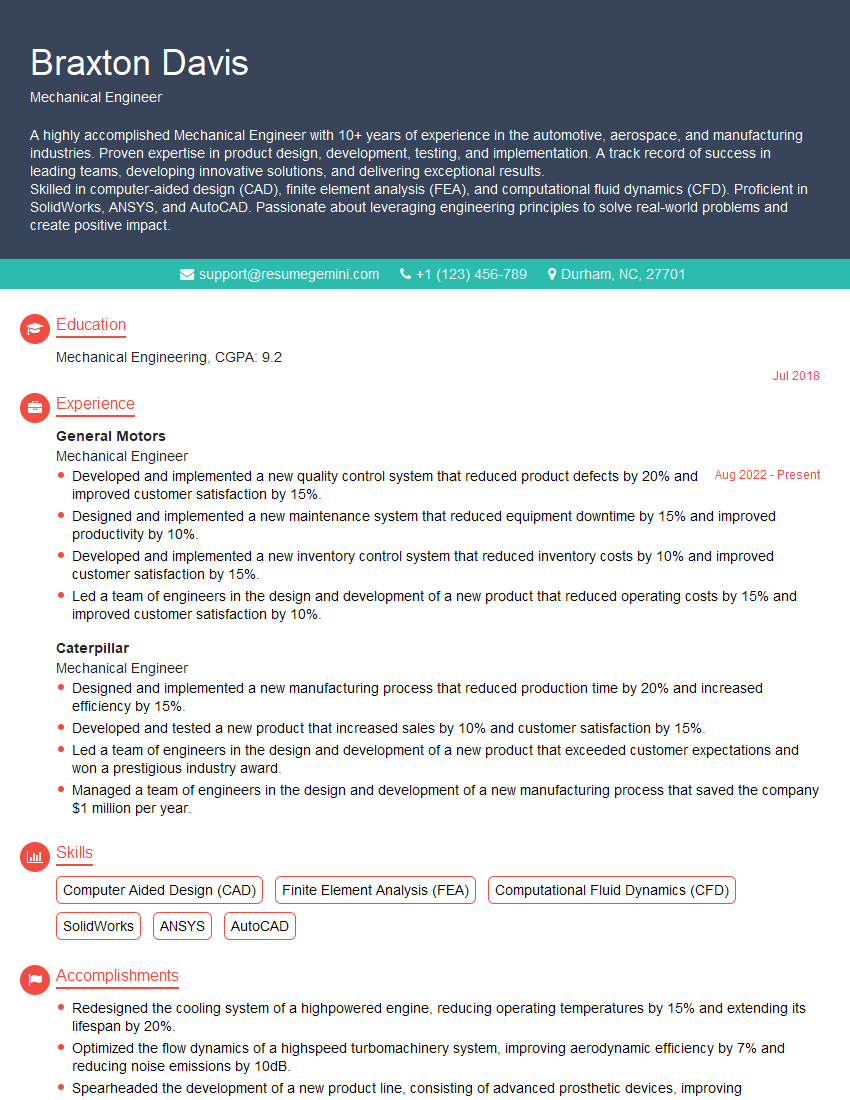
Mechanical Engineer Resume Sample

Refrigeration Engineer Resume Sample

Petroleum Engineer Resume Sample

Energy Systems Engineer Resume Sample

Materials Scientist Resume Sample
Explore more articles
Users Rating of Our Blogs
Share Your Experience
We value your feedback! Please rate our content and share your thoughts (optional).
What Readers Say About Our Blog
Very informative content, great job.
good