Cracking a skill-specific interview, like one for Thermodynamic property calculation, requires understanding the nuances of the role. In this blog, we present the questions you’re most likely to encounter, along with insights into how to answer them effectively. Let’s ensure you’re ready to make a strong impression.
Questions Asked in Thermodynamic property calculation Interview
Q 1. Explain the concept of thermodynamic properties and their importance.
Thermodynamic properties describe the state of a system in terms of its energy and how that energy changes with respect to its surroundings. Think of it like a detailed physical description of a material, but focusing on its energy characteristics. These properties are crucial in various fields, including chemical engineering, power generation, materials science, and environmental engineering, because they dictate how systems behave under different conditions. For example, knowing the thermodynamic properties of a refrigerant is essential for designing efficient air conditioning systems.
Understanding thermodynamic properties allows us to predict things like the amount of energy required to boil water, the temperature at which a substance will freeze, or the pressure required for a gas to liquefy. This knowledge is fundamental to process optimization, energy efficiency calculations, and the design of new technologies.
Q 2. What are the different types of thermodynamic properties (extensive, intensive)? Give examples.
Thermodynamic properties are categorized into two main types: extensive and intensive. An extensive property depends on the amount of matter present. Think of it like the total weight of a bag of flour: if you double the amount of flour, you double the weight. Examples include:
- Volume (V): The space occupied by a substance.
- Mass (m): The amount of matter in a substance.
- Internal Energy (U): The total energy within a substance.
- Enthalpy (H): Heat content at constant pressure (we’ll discuss this further in the next question).
An intensive property is independent of the amount of matter. Imagine the temperature of that bag of flour: whether you have a small handful or the whole bag, the temperature remains the same (assuming uniform temperature). Examples include:
- Temperature (T): A measure of average kinetic energy.
- Pressure (P): Force per unit area.
- Density (ρ): Mass per unit volume.
- Specific Volume (v): Volume per unit mass.
- Entropy (S): A measure of disorder (we’ll discuss this further in the next question).
Q 3. Define enthalpy, entropy, and Gibbs free energy. How are they related?
Enthalpy (H) represents the total heat content of a system at constant pressure. It’s a crucial property for understanding energy changes during chemical reactions and phase transitions. Think of it as the total energy a system possesses, including its internal energy and the work done by or on the system due to pressure changes. It’s often expressed as H = U + PV (where U is internal energy, P is pressure, and V is volume).
Entropy (S) measures the randomness or disorder of a system. High entropy means a high degree of disorder. Imagine a neatly stacked deck of cards (low entropy) versus a shuffled deck (high entropy). In thermodynamics, entropy dictates the spontaneity of processes. A process will tend to proceed spontaneously in the direction of increasing total entropy.
Gibbs Free Energy (G) determines the spontaneity of a process at constant temperature and pressure. It’s defined as G = H – TS (where T is temperature). If the change in Gibbs Free Energy (ΔG) is negative, the process is spontaneous; if positive, it’s non-spontaneous; and if zero, the system is at equilibrium. It essentially tells us whether a reaction or process will occur naturally under specific conditions.
These three properties are interconnected. Enthalpy contributes to Gibbs Free Energy directly, while entropy’s contribution is temperature-dependent. Understanding their relationship is essential for predicting the behavior of thermodynamic systems.
Q 4. Describe the ideal gas law and its limitations.
The Ideal Gas Law is a simplified equation of state describing the behavior of an ideal gas. An ideal gas is a theoretical gas composed of randomly moving point particles with no interparticle interactions. The law is expressed as:
PV = nRT
Where:
- P = Pressure
- V = Volume
- n = Number of moles
- R = Ideal gas constant
- T = Temperature
This equation is incredibly useful for many practical applications, particularly for gases at low pressures and high temperatures. However, it has limitations. Real gases deviate from ideal behavior at high pressures and low temperatures because the assumptions of negligible interparticle forces and particle volume are no longer valid. Intermolecular forces cause attractions and repulsions between gas molecules, affecting their behavior and leading to deviations from the Ideal Gas Law.
Q 5. Explain the concept of compressibility factor and its application.
The compressibility factor (Z) is a dimensionless quantity that accounts for the deviation of real gases from ideal gas behavior. It’s defined as:
Z = PV/nRT
For an ideal gas, Z = 1. When Z > 1, the gas is more compressible than an ideal gas (the repulsive forces dominate); when Z < 1, it’s less compressible (attractive forces dominate). The compressibility factor is crucial in engineering applications, particularly in petroleum and chemical processing. It allows engineers to accurately predict the properties of gases under various conditions where the Ideal Gas Law fails. For instance, in designing high-pressure pipelines, we need accurate calculations of gas density and volume, and the compressibility factor ensures the accuracy of these calculations.
Q 6. How do you calculate the specific heat capacity of a substance?
Specific heat capacity (cp or cv) represents the amount of heat required to raise the temperature of one unit mass of a substance by one degree Celsius (or Kelvin). There are two types: cp (specific heat at constant pressure) and cv (specific heat at constant volume).
There are several methods to determine specific heat capacity. One common method is experimental calorimetry. In this method, a known mass of a substance is heated (or cooled) in a calorimeter, and the temperature change is measured. The specific heat capacity can be calculated using the following formula:
c = Q / (mΔT)
Where:
- c = specific heat capacity
- Q = heat added or removed
- m = mass of the substance
- ΔT = change in temperature
Other methods include using theoretical models and computational techniques based on molecular structure and interatomic forces. Advanced techniques like Differential Scanning Calorimetry (DSC) can accurately measure heat flow during phase transitions and determine specific heat capacity curves across a wide temperature range.
Q 7. Describe different methods for determining thermodynamic properties (e.g., experimental, theoretical).
Determining thermodynamic properties can be done through experimental and theoretical methods. Experimental methods involve direct measurements using equipment like calorimeters, pressure-volume-temperature (PVT) apparatus, and spectroscopic techniques. For example, a calorimeter directly measures the heat absorbed or released during a process. PVT apparatus measure volume changes with pressure and temperature changes, allowing determination of compressibility factor and other properties.
Theoretical methods involve using equations of state (like the Ideal Gas Law or more complex models like the Peng-Robinson equation) and computational simulations (like molecular dynamics or Monte Carlo simulations). These methods rely on fundamental physical principles and molecular models to predict thermodynamic properties. Often, experimental data is used to calibrate or validate theoretical models.
The choice of method depends on factors like the substance, accuracy required, available resources, and the range of conditions under investigation. In practice, a combined approach often offers the most reliable results, where experimental data are used to parameterize or validate theoretical models, improving prediction accuracy and extrapolating properties beyond experimentally accessible conditions.
Q 8. Explain the concept of fugacity and its significance in real gas calculations.
Fugacity is a thermodynamic property that represents the effective partial pressure of a real gas. Unlike ideal gases, real gases experience intermolecular forces and deviate from the ideal gas law. Fugacity accounts for these deviations, allowing us to apply thermodynamic principles, such as equilibrium calculations, to real gas systems. Think of it as the ‘escaping tendency’ of a component in a mixture. A higher fugacity means the component is more likely to escape or move from its current state.
Its significance in real gas calculations is crucial because it allows us to use equations developed for ideal gases with a simple modification. For example, in the ideal gas law, pressure is used, but in real gas systems, we replace pressure with fugacity to obtain accurate results.
For example, consider a mixture of methane and ethane in a high-pressure reservoir. Using the ideal gas law would significantly underestimate the pressure exerted by each component, but using fugacity corrects for intermolecular interactions and predicts the pressure accurately.
Q 9. How do you use thermodynamic property diagrams (e.g., T-s, P-v, h-s diagrams)?
Thermodynamic property diagrams, such as T-s (temperature-entropy), P-v (pressure-volume), and h-s (enthalpy-entropy) diagrams, are invaluable visual tools. They allow us to quickly visualize the state of a substance, follow thermodynamic processes, and determine property changes.
For instance, a T-s diagram shows the relationship between temperature and entropy. We can use it to track the thermodynamic states during a process, such as the expansion of steam in a turbine. The area under the curve on the T-s diagram represents the heat transfer during the process. Similarly, a P-v diagram illustrates the relationship between pressure and volume, useful in analyzing piston-cylinder systems. The area under the curve here represents the work done.
The h-s diagram, also known as a Mollier diagram, is particularly useful for steam cycles. It allows for rapid determination of enthalpy and entropy, critical parameters in Rankine cycle analysis. These diagrams allow for quick estimations and visual analysis that can be much faster and insightful than complex calculations.
Q 10. Describe the different thermodynamic cycles (e.g., Rankine, Carnot, Brayton).
Several thermodynamic cycles model various power generation and refrigeration systems. Let’s examine three key examples:
- Carnot Cycle: This is a theoretical cycle representing the most efficient heat engine possible operating between two temperature reservoirs. It consists of four reversible processes: isothermal expansion, adiabatic expansion, isothermal compression, and adiabatic compression. While highly efficient in theory, it is practically unattainable due to the irreversibilities inherent in real-world processes.
- Rankine Cycle: This cycle is the foundation for most steam power plants. It involves four processes: heating water in a boiler (constant pressure), adiabatic expansion through a turbine, condensation in a condenser (constant pressure), and adiabatic compression by a pump. The Rankine cycle uses a working fluid (typically water) that undergoes phase changes during the cycle.
- Brayton Cycle: This cycle forms the basis of gas turbine engines and many jet engines. It consists of four processes: adiabatic compression, constant pressure heat addition, adiabatic expansion, and constant pressure heat rejection. Unlike the Rankine cycle, the Brayton cycle primarily uses a gaseous working fluid throughout the cycle, which avoids phase transitions.
Each cycle has its unique advantages and limitations, with the choice depending on the application and available technology.
Q 11. Explain the concept of phase equilibrium and how it relates to thermodynamic properties.
Phase equilibrium describes the state where multiple phases of a substance (e.g., solid, liquid, gas) coexist in thermodynamic equilibrium. This means there’s no net change in the amount of each phase over time. The thermodynamic properties at this equilibrium point are unique and are determined by factors like temperature, pressure, and composition.
For example, the triple point of water (0.01°C and 611.657 Pa) is a phase equilibrium point where ice, liquid water, and water vapor coexist in equilibrium. At this specific temperature and pressure, the Gibbs free energy of all three phases is equal. The Gibbs phase rule (F = C – P + 2) helps predict the number of degrees of freedom (F) in a system with ‘C’ components and ‘P’ phases. This rule shows how temperature and pressure (or composition) define the equilibrium conditions.
Thermodynamic properties like enthalpy, entropy, and Gibbs free energy are crucial in defining and predicting phase equilibrium. Changes in these properties drive phase transitions, and their values at the equilibrium point characterize the coexistence of phases.
Q 12. How do you calculate the equilibrium constant for a chemical reaction?
The equilibrium constant (K) for a chemical reaction quantifies the relative amounts of reactants and products at equilibrium. It is related to the standard Gibbs free energy change (ΔG°) of the reaction through the equation:
K = exp(-ΔG°/RT)
where R is the ideal gas constant and T is the temperature in Kelvin. The ΔG° can be calculated from the standard Gibbs free energies of formation of the reactants and products. For reactions involving gases, partial pressures are often used to express the equilibrium constant (Kp). For reactions in solution, concentrations (activities) are used (Kc).
Example: Consider the reaction: A + B <=> C. If the equilibrium concentrations of A, B, and C are [A]eq, [B]eq, and [C]eq respectively, then the equilibrium constant Kc would be:
Kc = [C]eq / ([A]eq[B]eq)
It’s important to note that the equilibrium constant is temperature-dependent and changes as temperature varies.
Q 13. Discuss the application of thermodynamic properties in chemical reaction equilibrium.
Thermodynamic properties are fundamental in determining the equilibrium position of chemical reactions. The Gibbs free energy change (ΔG) is the key parameter. A negative ΔG indicates a spontaneous reaction (products favored), while a positive ΔG indicates a non-spontaneous reaction (reactants favored). At equilibrium, ΔG = 0.
By analyzing the enthalpy change (ΔH) and entropy change (ΔS) of the reaction (ΔG = ΔH – TΔS), we can predict how temperature affects the equilibrium constant. Exothermic reactions (ΔH < 0) are favored at lower temperatures, while endothermic reactions (ΔH > 0) are favored at higher temperatures. Reactions with a positive ΔS are favored at higher temperatures.
Understanding this relationship allows us to optimize reaction conditions for maximum product yield. For example, in the Haber-Bosch process for ammonia synthesis (N2 + 3H2 <=> 2NH3), high pressure and moderate temperatures are used to maximize ammonia production because the reaction is exothermic and involves a decrease in the number of gas molecules.
Q 14. Explain the concept of activity and activity coefficient.
In real solutions, components don’t always behave ideally. Activity (a) and activity coefficient (γ) are correction factors that account for deviations from ideality. Activity represents the effective concentration of a component in a solution, reflecting its actual chemical potential, whereas concentration represents the nominal amount. The activity is defined as:
a = γ * x
where ‘x’ is the mole fraction of the component. The activity coefficient (γ) represents the deviation of the component’s behavior from ideal solution behavior. For ideal solutions, γ = 1, meaning activity equals the mole fraction.
Activity coefficients are crucial for accurate thermodynamic calculations in non-ideal solutions, especially at high concentrations. They are often determined experimentally or through correlations based on solution models (e.g., Debye-Hückel theory for ionic solutions). Using activities instead of concentrations in equilibrium expressions allows us to apply thermodynamic principles to non-ideal systems, leading to more accurate predictions of reaction equilibrium and other properties.
Q 15. Describe the different methods for calculating thermodynamic properties of mixtures.
Calculating thermodynamic properties of mixtures is crucial in various engineering applications. The method chosen depends heavily on the nature of the mixture and the desired accuracy. Broadly, we can categorize the approaches into ideal and non-ideal models.
- Ideal Mixture Models: These models assume that the interactions between different components in the mixture are negligible. They are simpler to use but less accurate for real-world systems. A common example is Raoult’s Law, where the partial pressure of each component is proportional to its mole fraction and vapor pressure.
Pi = xiPisat(where Pi is the partial pressure, xi is the mole fraction, and Pisat is the saturation pressure). - Non-Ideal Mixture Models: These models account for the intermolecular interactions within the mixture. They are more complex but provide better accuracy for real systems. Examples include:
- Activity Coefficient Models: These models use activity coefficients to correct for deviations from ideality. Popular models include the Margules, van Laar, Wilson, NRTL, and UNIQUAC equations. The choice depends on the system’s complexity and available data.
- Equation of State (EOS) Methods: EOS like the Peng-Robinson, Soave-Redlich-Kwong (SRK), and Cubic-Plus-Association (CPA) equations can predict thermodynamic properties (pressure, volume, enthalpy, entropy) for both liquids and gases, often accounting for non-ideal behavior. These are particularly useful for high-pressure systems.
- Excess Property Methods: This method focuses on experimental data of excess properties like excess enthalpy and excess volume. These are then used to correct the ideal mixture calculations. This is suitable when reliable experimental data is available.
The selection of the appropriate method involves considering the accuracy required, the availability of experimental data, the complexity of the mixture, and computational resources.
Career Expert Tips:
- Ace those interviews! Prepare effectively by reviewing the Top 50 Most Common Interview Questions on ResumeGemini.
- Navigate your job search with confidence! Explore a wide range of Career Tips on ResumeGemini. Learn about common challenges and recommendations to overcome them.
- Craft the perfect resume! Master the Art of Resume Writing with ResumeGemini’s guide. Showcase your unique qualifications and achievements effectively.
- Don’t miss out on holiday savings! Build your dream resume with ResumeGemini’s ATS optimized templates.
Q 16. Explain how you would determine the thermodynamic properties of a non-ideal gas.
Determining the thermodynamic properties of a non-ideal gas requires going beyond the ideal gas law (PV=nRT). The deviations from ideality stem from intermolecular forces and the finite volume occupied by gas molecules. Several approaches exist:
- Equations of State (EOS): As mentioned before, EOS like Peng-Robinson or SRK are effective. These equations introduce parameters that account for intermolecular forces and molecular size. Solving the EOS for given temperature and pressure allows one to obtain the gas’s molar volume, compressibility factor (Z), and subsequently, other properties like enthalpy and entropy.
- Compressibility Factor Charts: For quick estimations, especially when dealing with low to moderate pressures, compressibility factor (Z) charts provide a visual approach. Z=PV/nRT; deviation from Z=1 indicates non-ideal behavior.
- Virial Equations: These equations express the compressibility factor as a power series of the molar density. While more accurate than simple EOS at moderate pressures, they often require more complex calculations and data fitting.
For instance, let’s say we have methane at 150 bar and 300K. Using an EOS like Peng-Robinson, we can input the temperature, pressure, and methane’s critical properties to calculate the molar volume, Z, and then use this information to compute enthalpy and entropy using appropriate thermodynamic relationships.
Q 17. Describe the use of thermodynamic property software (e.g., Aspen Plus, ProMax).
Thermodynamic property software like Aspen Plus and ProMax are indispensable tools for process engineers. They offer a comprehensive suite of capabilities for simulating and optimizing chemical processes. Their use extends to:
- Phase Equilibrium Calculations: Predicting vapor-liquid, liquid-liquid, and solid-liquid equilibria for complex mixtures. This is critical for designing separation processes such as distillation and extraction.
- Thermodynamic Property Prediction: Calculating enthalpy, entropy, Gibbs free energy, and other properties for pure components and mixtures, using various EOS and activity coefficient models.
- Process Simulation: Modeling entire chemical plants or processes, allowing engineers to evaluate different designs and optimize operations. This includes predicting stream compositions, temperatures, pressures, and energy requirements.
- Data Regression: Fitting experimental data to thermodynamic models to generate parameters for the software to use in future calculations.
For example, in designing a refinery, Aspen Plus can simulate the entire distillation column network, predicting the compositions and energy requirements for each stage. This allows engineers to optimize the design for maximum efficiency.
Q 18. How do you handle missing thermodynamic data in your calculations?
Missing thermodynamic data is a common challenge. Handling it requires a combination of strategies:
- Literature Search: The most straightforward approach is to search for reliable data in scientific databases, handbooks, and journal articles. Several databases provide compiled thermodynamic data.
- Group Contribution Methods: If data is unavailable, group contribution methods (like UNIFAC, ASOG) estimate properties based on the functional groups present in the molecule. These are approximate but provide valuable estimations when experimental data is scarce.
- Property Estimation Software: Many software packages offer built-in estimation capabilities. These methods frequently employ group contribution methods or correlations to predict missing properties.
- Extrapolation/Interpolation: If data is available for similar compounds or at nearby conditions, interpolation or extrapolation (with caution) may be used; however, this should only be used with a strong understanding of the limitations.
- Experimental Measurement: As a last resort, performing experimental measurements may be necessary, though this is the most time-consuming and expensive option.
The choice of method depends on the available resources, the accuracy required, and the nature of the missing data.
Q 19. Explain the concept of residual properties and their importance.
Residual properties represent the difference between the actual thermodynamic properties of a substance and its corresponding ideal values. In essence, they quantify the deviation from ideal behavior.
- Significance: They are crucial because they provide insights into the non-ideal interactions present in a system. This information is fundamental for accurately predicting phase equilibria, designing separation processes, and modeling thermodynamic behavior in various engineering applications.
- Calculation: Residual properties (e.g., residual enthalpy, residual entropy, residual Gibbs free energy) are typically calculated using equations of state or activity coefficient models. For instance, residual enthalpy, HR, is given by HR = H – Hideal, where H is the actual enthalpy and Hideal is the enthalpy of the ideal gas at the same conditions.
- Example: In a gas mixture, attractive forces between molecules will lead to a negative residual enthalpy (the actual enthalpy is lower than the ideal enthalpy), implying that work has to be done to overcome these forces to separate the components. Conversely, repulsive forces can lead to positive residual enthalpies.
Understanding residual properties is vital for accurate process modeling and simulation, especially in high-pressure systems or systems involving complex molecular interactions.
Q 20. Describe the different methods used for estimating thermodynamic properties.
Several methods exist for estimating thermodynamic properties when experimental data is limited or unavailable.
- Group Contribution Methods: These methods break down a molecule into its constituent functional groups and use tabulated group contributions to estimate properties like boiling point, critical properties, and activity coefficients. UNIFAC and ASOG are well-known examples.
- Corresponding States Methods: These methods relate the properties of a substance to those of a reference substance (often a simple fluid) using reduced properties (e.g., reduced temperature, reduced pressure). They are particularly useful when data for similar molecules is available.
- Statistical Mechanics: More sophisticated methods use statistical mechanics to predict properties from molecular interactions. Molecular dynamics and Monte Carlo simulations fall into this category, requiring detailed knowledge of the intermolecular potential energy functions.
- Empirical Correlations: These are simpler methods based on correlations between available experimental data and relevant properties. Their reliability is often limited to the range of data used for developing the correlations.
The choice of method often involves trade-offs between accuracy, computational cost, and data availability.
Q 21. How would you approach troubleshooting discrepancies between calculated and experimental thermodynamic properties?
Troubleshooting discrepancies between calculated and experimental thermodynamic properties often involves a systematic approach.
- Data Verification: First, rigorously check the experimental data for accuracy and consistency. Errors in measurement or data reporting can lead to significant discrepancies.
- Model Selection: Evaluate the suitability of the chosen thermodynamic model (EOS or activity coefficient model). A model may be inappropriate for the specific system or conditions. Consider alternative models or parameters.
- Parameter Estimation: If using a model with adjustable parameters, ensure that the parameters are properly determined or obtained from reliable sources. Inaccurate parameters can lead to significant errors.
- Computational Errors: Carefully check the calculations for any numerical or programming errors. This includes verifying the accuracy of input values and ensuring convergence of iterative calculations.
- System Complexity: Acknowledge the limitations of thermodynamic models. For complex systems, simplifying assumptions may not be valid. Consider incorporating additional factors, such as non-idealities or kinetic effects, if necessary.
- Experimental Conditions: Ensure that the experimental conditions (temperature, pressure, composition) are accurately reflected in the calculations. Even slight deviations can result in noticeable differences.
By systematically investigating each of these aspects, you can progressively narrow down the source of discrepancies and improve the accuracy of your calculations.
Q 22. Discuss the limitations of various thermodynamic models and correlations.
Thermodynamic models and correlations, while invaluable tools, possess inherent limitations stemming from simplifying assumptions about the behavior of real substances. No model perfectly captures the complexity of intermolecular forces and molecular interactions.
Equation of State (EOS) limitations: Cubic EOS like Peng-Robinson or Soave-Redlich-Kwong are widely used for their relative simplicity, but they often struggle to accurately predict properties near the critical point or in highly non-ideal regions. Their accuracy also depends heavily on the availability of accurate parameters specific to the substance being modeled.
Correlations’ limitations: Empirical correlations, developed from experimental data, are often limited to specific temperature and pressure ranges. Extrapolating beyond these ranges can lead to significant errors. Furthermore, correlations may not accurately represent the behavior of mixtures unless specifically developed for that mixture.
Activity coefficient models: These models, used for mixtures, rely on assumptions about the interactions between different components. While models like NRTL and UNIQUAC are quite robust, they might fail to accurately predict behavior for highly non-ideal or complex mixtures. The accuracy depends on the fitting parameters obtained from experimental data.
Ignoring non-ideal effects: Many models assume ideal gas or ideal solution behavior, which is often not the case in real-world systems. Deviations from ideality can significantly impact the accuracy of predictions, especially at high pressures or concentrations.
Understanding these limitations is crucial for selecting the appropriate model for a specific application and interpreting results critically. It’s often necessary to consider multiple models and compare their predictions to experimental data to ensure accuracy.
Q 23. How do you apply thermodynamic principles to optimize process efficiency?
Thermodynamic principles are fundamental to optimizing process efficiency by identifying and minimizing energy losses. The core concept revolves around maximizing the useful work extracted from a system while minimizing energy consumption.
First Law of Thermodynamics (Energy Conservation): Analyzing energy balances across a process helps identify where energy is lost as heat or work, allowing for targeted improvements. For example, insulating pipes to reduce heat loss or using more efficient compressors can significantly improve efficiency.
Second Law of Thermodynamics (Entropy): This law highlights the irreversibilities within a process, such as friction or heat transfer across a large temperature difference. By reducing these irreversibilities (increasing process efficiency), we can enhance overall performance. Optimizing heat exchanger designs and minimizing pressure drops in pipes are examples of applying this principle.
Exergy Analysis: This advanced technique quantifies the maximum useful work that can be obtained from a system and identifies sources of exergy destruction (irreversibilities). It provides a more detailed picture of where improvements are most impactful. For example, pinch point analysis in heat exchanger networks is based on exergy principles.
Consider the example of a chemical reactor. By optimizing temperature, pressure, and residence time based on thermodynamic considerations, we can maximize the yield of the desired product while minimizing energy consumption and waste generation.
Q 24. Explain how thermodynamic principles are used in designing heat exchangers.
Heat exchangers are designed based on the principles of heat transfer and thermodynamics. The goal is to transfer heat efficiently from a hot fluid to a cold fluid. Key thermodynamic concepts include:
Heat Transfer Rate: The rate of heat transfer is governed by the temperature difference, the area of heat transfer surface, and the overall heat transfer coefficient (U). Designing the geometry of the heat exchanger (e.g., shell and tube, plate and frame) impacts the heat transfer area and U.
Log Mean Temperature Difference (LMTD): For counter-current and parallel-flow heat exchangers, the LMTD method is used to calculate the average temperature difference driving the heat transfer. This is crucial for determining the required heat transfer area.
Effectiveness-NTU method: This method is particularly useful for complex heat exchangers where the LMTD method is difficult to apply. It uses the concept of effectiveness (ratio of actual heat transfer to maximum possible heat transfer) and number of transfer units (NTU, a measure of heat exchanger size) to determine the heat exchanger performance.
Thermodynamic properties: The specific heat capacities of the fluids involved are essential for calculating the required heat transfer rate. The properties of the fluids also influence the pressure drop and flow dynamics within the heat exchanger, which in turn impact design choices.
A well-designed heat exchanger minimizes pressure drop, maximizes heat transfer area, and employs materials that provide high thermal conductivity and corrosion resistance. Thermodynamic principles ensure the heat exchanger operates efficiently and effectively.
Q 25. Discuss the use of thermodynamics in the design and analysis of power plants.
Thermodynamics plays a central role in the design and analysis of power plants, which aim to convert heat energy into mechanical work. The key thermodynamic cycles used are Rankine (for steam power plants) and Brayton (for gas turbine power plants).
Rankine Cycle: This cycle involves heating water to produce steam, expanding the steam through a turbine to generate work, condensing the steam, and pumping the water back into the boiler. Thermodynamic analysis helps determine the optimum operating pressures and temperatures to maximize efficiency and power output. Carnot efficiency sets an upper limit.
Brayton Cycle: This cycle uses a compressor, a combustion chamber, and a turbine. Thermodynamic analysis is critical for selecting appropriate compressor and turbine designs, optimizing the combustion process, and evaluating the efficiency of the cycle.
Thermodynamic property calculations: Accurate determination of the properties of steam and gases at various points in the cycle is essential for performance evaluation and optimization. Steam tables and software packages are used extensively for this purpose.
Component design and optimization: Thermodynamic principles guide the design of individual components like turbines, compressors, and condensers to minimize losses and maximize performance.
Improving the efficiency of power plants is crucial for reducing fuel consumption and environmental impact. Advanced thermodynamic analysis methods, such as exergy analysis, are increasingly used to identify areas for improvement and optimize the overall performance of the plant.
Q 26. Explain the role of thermodynamics in refrigeration and air conditioning systems.
Refrigeration and air conditioning systems rely heavily on thermodynamic principles, primarily the reversed Rankine cycle (vapor-compression cycle) and related cycles. The core objective is to move heat from a cold reservoir (the space to be cooled) to a hot reservoir (the surroundings).
Refrigerant properties: The choice of refrigerant is crucial. Thermodynamic properties like enthalpy and entropy at various stages of the cycle determine the system’s performance and efficiency. Environmental considerations also dictate the selection process, moving towards more sustainable refrigerants.
Vapor-compression cycle: This cycle involves compressing a refrigerant vapor, condensing it at high pressure, expanding it through an expansion valve, and evaporating it at low pressure. Thermodynamic analysis helps optimize the pressure ratios and temperature differences to achieve the desired cooling effect with maximum efficiency.
Heat transfer: Efficient heat transfer is critical in both the evaporator (heat absorption) and the condenser (heat rejection). Thermodynamic principles guide the design of these components to maximize heat transfer rates while minimizing pressure drops.
Coefficient of Performance (COP): This is a measure of the system’s efficiency, representing the ratio of cooling effect to work input. Thermodynamic analysis is used to calculate and optimize the COP.
Designing efficient and environmentally friendly refrigeration and air conditioning systems requires a deep understanding of the thermodynamic principles governing the refrigeration cycle and the properties of the refrigerants.
Q 27. Describe a situation where you had to use thermodynamic principles to solve a complex problem. Focus on the method used.
During a project involving the design of a high-pressure natural gas pipeline, we encountered a challenge in accurately predicting the pressure drop and temperature changes along the pipeline. The pipeline transported natural gas over long distances under varying environmental conditions.
The initial approach used a simplified model assuming ideal gas behavior, but this proved inaccurate due to the high pressure and the presence of non-ideal components in the natural gas mixture. The solution involved a multi-step process:
Choosing an appropriate Equation of State: We abandoned the ideal gas law and selected the Peng-Robinson equation of state (EOS), which accounts for non-ideal gas behavior and is suitable for the pressure and temperature ranges involved. We used software to calculate the gas properties (density, enthalpy, etc.) based on the Peng-Robinson EOS.
Implementing a thermodynamic model: We developed a numerical model using MATLAB that iteratively solved the conservation equations (mass, momentum, and energy) along the pipeline, using the Peng-Robinson EOS to obtain the necessary thermodynamic properties at each point. The model considered the changes in elevation, pipe diameter, and heat transfer with the environment. The code incorporated numerical methods such as the finite difference method.
Validating the model: We compared our model’s predictions with experimental data from similar pipelines, adjusting model parameters as needed to improve accuracy. This iterative process of comparison and refinement ensured the model reliably predicted pressure and temperature profiles.
The accurate prediction of pressure drop and temperature changes was crucial for ensuring the safe and efficient operation of the pipeline, avoiding pressure surges and ensuring sufficient gas flow. The success of this project demonstrated the importance of carefully selecting an appropriate thermodynamic model and using robust numerical methods to solve complex engineering problems.
Key Topics to Learn for Thermodynamic Property Calculation Interview
- Equation of State (EOS): Understanding different EOS models (e.g., ideal gas law, van der Waals, Peng-Robinson) and their applicability to various substances and conditions. Practical application: Selecting the appropriate EOS for a specific process simulation.
- Thermodynamic Charts and Tables: Proficiency in using pressure-enthalpy, temperature-entropy, and other property diagrams to determine thermodynamic properties. Practical application: Analyzing thermodynamic cycles and processes.
- Property Relations: Mastering the relationships between different thermodynamic properties (e.g., Maxwell relations, Gibbs free energy) and their derivations. Practical application: Solving problems involving changes in state and phase transitions.
- Partial Molar Properties: Understanding the concept of partial molar properties and their significance in mixtures. Practical application: Calculating thermodynamic properties of mixtures and solutions.
- Thermodynamic Cycles: Analyzing various thermodynamic cycles (e.g., Rankine, Carnot, Brayton) and calculating their efficiency and performance. Practical application: Designing and optimizing power generation systems.
- Phase Equilibria: Understanding phase diagrams and phase transitions, including calculations involving vapor-liquid equilibrium (VLE) and other phase equilibria. Practical application: Designing separation processes.
- Heat and Mass Transfer Principles: Connecting thermodynamic principles with heat and mass transfer concepts. Practical application: Analyzing and optimizing energy efficient processes.
- Software and Tools: Familiarity with thermodynamic property calculation software (mentioning specific software is avoided to remain general). Practical application: Efficiently performing calculations and simulations.
Next Steps
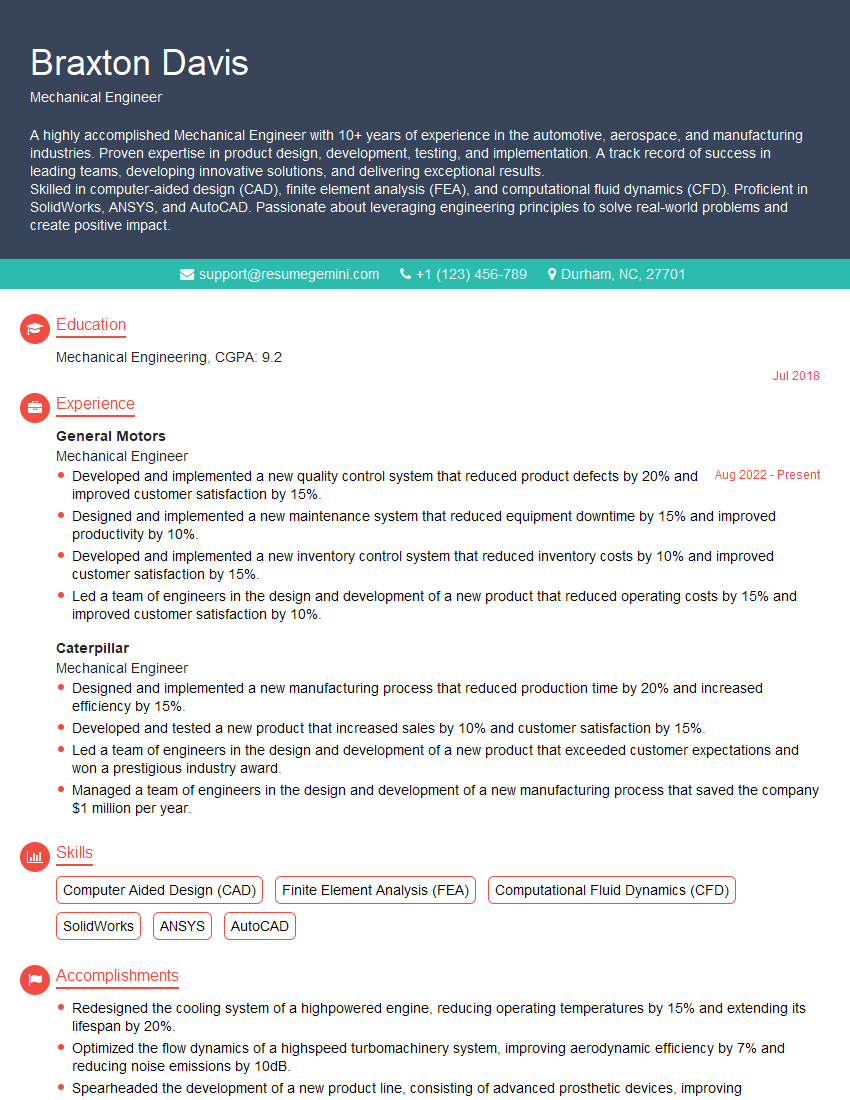
Mastering thermodynamic property calculation is crucial for a successful career in numerous engineering fields, opening doors to exciting opportunities in process design, energy systems, and research. To maximize your job prospects, create an ATS-friendly resume that highlights your skills and experience effectively. ResumeGemini is a trusted resource to help you build a professional and impactful resume. We provide examples of resumes tailored to thermodynamic property calculation to guide you in showcasing your expertise. Invest the time to craft a compelling resume; it’s your first impression and a critical step in landing your dream job.






Explore more articles
Users Rating of Our Blogs
Share Your Experience
We value your feedback! Please rate our content and share your thoughts (optional).
What Readers Say About Our Blog
Very informative content, great job.
good