The thought of an interview can be nerve-wracking, but the right preparation can make all the difference. Explore this comprehensive guide to Tissue Disaggregation interview questions and gain the confidence you need to showcase your abilities and secure the role.
Questions Asked in Tissue Disaggregation Interview
Q 1. Explain the principles of enzymatic tissue disaggregation.
Enzymatic tissue disaggregation relies on the use of enzymes to break down the extracellular matrix (ECM) that holds cells together in tissues. These enzymes, typically proteases, selectively target specific components of the ECM, such as collagen, laminin, and fibronectin. This targeted breakdown allows for the gentle separation of individual cells or small cell clusters, preserving cell viability and function, unlike harsher mechanical methods.
Imagine a brick wall: the bricks represent individual cells, and the mortar holding them together is the ECM. Mechanical methods are like using a sledgehammer to break the wall – effective, but potentially damaging. Enzymatic methods are more like carefully removing the mortar with a chisel, allowing the bricks to be separated intact.
Q 2. Describe the differences between mechanical and enzymatic tissue disaggregation methods.
Mechanical and enzymatic disaggregation methods differ significantly in their approach and outcomes. Mechanical methods, such as mincing, homogenization, or trituration, physically disrupt the tissue architecture using force. This is fast but often damages cells and can lead to significant cell death. Enzymatic methods, on the other hand, use specific enzymes to selectively degrade the ECM, resulting in a gentler and more precise cell separation with higher cell viability.
- Mechanical: Faster, less expensive, but can damage cells and generate cell debris.
- Enzymatic: Slower, more expensive, but gentler, preserves cell viability better, and allows for more specific cell isolation.
A good analogy would be comparing using a blender (mechanical) to carefully peeling an orange (enzymatic). The blender quickly pulverizes everything, while peeling preserves the segments.
Q 3. What are the advantages and disadvantages of using collagenase for tissue disaggregation?
Collagenase is a widely used enzyme in tissue disaggregation due to its ability to degrade collagen, a major component of the ECM in many tissues.
- Advantages: High efficiency in degrading collagen, relatively high cell viability, commercially available in various forms (e.g., types I, II, IV, etc.).
- Disadvantages: Can be expensive, requires optimization of concentration and incubation time for each tissue type to avoid over-digestion and cell damage, can have batch-to-batch variability, and may require the addition of other enzymes for complete disaggregation.
For instance, while effective for liver tissue, the optimal collagenase concentration might be significantly different for brain tissue due to the differences in ECM composition. Overuse can lead to cell membrane damage, while underuse leaves tissue clumps undigested.
Q 4. How do you choose the appropriate enzyme for a specific tissue type?
Enzyme selection depends critically on the specific tissue type and the desired outcome. Different tissues have varying ECM compositions. For example, connective tissues are rich in collagen, requiring collagenases, while tissues with high levels of laminin might benefit from the inclusion of lamininases. The goal is to choose enzymes that target the predominant ECM components of the specific tissue without damaging the cells of interest.
A thorough literature review is crucial. Researchers often consult published protocols for their specific tissue type. It’s also common to start with a cocktail of enzymes, often including collagenase, hyaluronidase (for hyaluronic acid), and dispase (for basement membranes), and then optimizing the mixture through experimentation.
Q 5. Describe the process of optimizing enzyme concentration and incubation time for efficient tissue disaggregation.
Optimizing enzyme concentration and incubation time is crucial for efficient and gentle tissue disaggregation. Too high a concentration or too long an incubation time can lead to over-digestion, resulting in cell damage. Conversely, insufficient enzyme or short incubation times will result in incomplete disaggregation. Optimization typically involves a series of experiments, systematically varying the enzyme concentration and incubation time while assessing the resulting cell yield and viability.
A common approach involves preparing a range of enzyme concentrations (e.g., 0.5 mg/ml, 1 mg/ml, 2 mg/ml) and incubating samples for various durations (e.g., 30 min, 60 min, 90 min). The optimal conditions are those that yield the highest number of viable, single cells. Microscopic examination and cell counting are essential for evaluating the results.
Q 6. Explain the importance of controlling temperature and pH during tissue disaggregation.
Temperature and pH are critical parameters that influence enzyme activity. Enzymes have optimal temperature and pH ranges, outside of which their activity is reduced or even lost. Maintaining appropriate temperature and pH is therefore essential to ensure efficient and controlled tissue disaggregation while minimizing cell damage. Most commonly, enzymatic digestions are performed at 37°C (body temperature) and at a pH that is close to physiological (around 7.4). However, the optimal conditions will vary depending on the specific enzyme and tissue type.
Think of it like baking a cake. You need the correct temperature and ingredients (enzymes, pH) to get the best result. Too high a temperature or wrong pH ‘burns’ your cells.
Q 7. How do you assess the efficiency of tissue disaggregation?
Assessing the efficiency of tissue disaggregation involves evaluating both the degree of tissue breakdown and the viability and functionality of the isolated cells. Several methods can be employed:
- Microscopic examination: Visual inspection under a microscope to assess the degree of tissue breakdown and the presence of single cells versus clumps.
- Cell counting: Using a hemocytometer or automated cell counter to quantify the number of cells obtained.
- Viability assays: Such as trypan blue exclusion or MTT assays, to determine the percentage of viable cells.
- Flow cytometry: To analyze cell populations and assess the expression of specific markers, useful for checking cell purity post disaggregation.
The choice of method depends on the specific application and the desired level of detail.
Q 8. Describe methods for quantifying cell yield after tissue disaggregation.
Quantifying cell yield after tissue disaggregation is crucial for downstream applications. We need to know how many viable cells we’ve successfully isolated. This is typically done using a combination of techniques.
Cell counting with a hemocytometer: This is a classic method where a sample of the cell suspension is loaded onto a specialized counting chamber and cells are counted under a microscope. This gives a direct count of total cells, both viable and non-viable.
Automated cell counters: These instruments use image analysis to rapidly count cells and often provide additional information like cell size and viability. Examples include the Countess or NucleoCounter.
Viability assays: These assays differentiate between live and dead cells. Trypan blue exclusion is a common example; live cells exclude the dye, while dead cells take it up. This allows us to calculate the percentage of viable cells in our total yield.
Flow cytometry: This technique provides detailed information about cell populations and can be used to quantify specific cell types, giving you the yield of your target cell population. It offers higher throughput than manual counting.
The choice of method depends on the application, budget, and the level of detail required. For instance, a simple hemocytometer count might suffice for a small-scale experiment, whereas flow cytometry would be preferred for complex experiments requiring precise quantification of specific cell subsets.
Q 9. What are the potential challenges associated with tissue disaggregation, and how can they be addressed?
Tissue disaggregation presents several challenges. One major hurdle is achieving a balance between effective tissue breakdown and preserving cell viability and function.
Cell damage: Harsh disaggregation methods can physically damage cells, leading to decreased yield and altered cellular properties.
Enzyme degradation: Enzymatic disaggregation is effective but can lead to enzyme-induced cell damage if not carefully controlled.
Tissue heterogeneity: Different tissues have varying structures and cellular compositions, requiring tailored disaggregation protocols.
Addressing these challenges requires optimization. Careful selection of enzymes and mechanical forces, optimization of incubation times and temperatures, and the use of protective agents are all crucial. For example, we might use a milder enzyme concentration or shorter incubation time to reduce cell damage. Using specialized buffers containing protease inhibitors can also help prevent enzyme-induced cell damage. Careful experimentation and optimization are necessary to establish a protocol that maximizes yield and minimizes cell damage for a specific tissue type.
Q 10. How do you prevent cell damage during tissue disaggregation?
Preventing cell damage during tissue disaggregation is paramount. It requires a multifaceted approach focusing on minimizing mechanical stress and enzymatic degradation.
Gentle mechanical methods: Instead of aggressive homogenization, techniques like gentle enzymatic digestion or careful mincing are preferred for delicate tissues.
Optimal enzyme concentration and incubation time: Excessive enzyme concentration or prolonged incubation can damage cells. Titration experiments help determine the optimal conditions for complete disaggregation with minimal cell damage.
Temperature control: Maintaining the appropriate temperature during the entire process is vital, as extreme temperatures can denature proteins and damage cells. We often use a controlled-temperature water bath or incubator.
Use of protective agents: Adding agents like serum or specialized buffers that help stabilize cell membranes and protect against oxidative stress can significantly improve cell viability.
Careful handling: Gentle pipetting and avoiding vigorous shaking or vortexing minimize mechanical stress on the cells.
For example, when working with delicate brain tissue, we would prioritize gentle enzymatic digestion with DNase to avoid shear stress, using a very low speed homogenizer if absolutely necessary.
Q 11. Explain the role of filtration in tissue disaggregation workflows.
Filtration plays a vital role in cleaning up the cell suspension after tissue disaggregation. It removes undigested tissue debris, clumps of cells, and other contaminants.
Removal of debris: Filtration ensures that only single cells or small cell aggregates pass through to the downstream applications. This is particularly important for applications such as flow cytometry or cell sorting, where debris can clog equipment or interfere with analysis.
Enhancing cell purity: By removing large debris, filtration helps enhance the purity of the cell population.
Filter choice is important: The pore size of the filter is critical; choosing the appropriate size is essential for removing contaminants while minimizing cell loss. Common pore sizes range from 40μm to 70μm, depending on the application and tissue type. Larger pore sizes remove large debris while preserving more cells, but at the cost of less purity. Smaller pore sizes, while providing better purity, run the risk of clogging and cell loss.
For example, a 70μm filter might be appropriate for removing large tissue chunks from a cell suspension, while a 40μm filter could be used for a more refined cleanup before flow cytometry.
Q 12. Describe different types of mechanical disaggregation techniques (e.g., mincing, homogenization).
Mechanical disaggregation techniques physically break down tissue into smaller pieces. These techniques are often used in conjunction with enzymatic methods for optimal disaggregation.
Mincing: This involves finely chopping the tissue using scalpels, scissors, or other sharp instruments. It’s a simple method but can be labor-intensive and may not completely disaggregate the tissue.
Homogenization: This employs a homogenizer—a device that uses mechanical forces like shearing, grinding, or sonication to break down tissue. There are various types, including blade homogenizers, which use rotating blades to shear the tissue; pestle and mortar; and ultrasonic homogenizers which use sound waves. These methods are more efficient than mincing but risk causing damage to cells if not carefully controlled.
Sieving/Filtration: This process follows mechanical disaggregation to separate cell suspensions from undigested tissue.
The choice of method depends on the tissue type and desired outcome. For example, mincing might be suitable for initially breaking down larger tissue samples prior to enzymatic digestion, while homogenization could be used to generate a single-cell suspension for a specific application. However, mechanical methods can be rather harsh, leading to more cell damage. This must be considered.
Q 13. What are the safety precautions necessary when working with enzymes for tissue disaggregation?
Enzymes are powerful tools for tissue disaggregation, but they require careful handling due to their potential hazards.
Personal protective equipment (PPE): Always wear appropriate PPE, including gloves, lab coats, and eye protection when handling enzymes. This protects against accidental skin or eye contact.
Proper disposal: Enzymes should be disposed of according to institutional guidelines. Often this involves specific containers for enzymatic waste.
Safe handling practices: Avoid generating aerosols when handling enzymes. Use gentle pipetting techniques to prevent splashing.
Enzyme inactivation: After the disaggregation process, the enzymatic activity needs to be carefully inactivated to prevent further cell damage or interference with downstream applications. This typically involves adjusting the pH or adding specific inhibitors.
Training and awareness: Proper training on the safe handling of enzymes is essential. Familiarization with safety data sheets (SDS) for each enzyme is crucial.
For example, when using collagenase, a common enzyme in disaggregation, it’s crucial to inactivate it after the digestion process is complete to prevent continued digestion of the cells. We may add an enzyme inhibitor like EDTA to chelate the calcium ions essential for collagenase activity.
Q 14. How do you handle and store tissues before disaggregation to maintain cell viability?
Proper handling and storage of tissues before disaggregation are vital for maintaining cell viability and obtaining accurate results.
Immediate processing: Ideally, tissues should be processed as quickly as possible after collection to minimize cell death and degradation. The faster we process tissue, the more likely it is that cells will be viable.
Appropriate storage media: Tissues can be temporarily stored in a sterile solution such as ice-cold PBS (Phosphate Buffered Saline) or specialized tissue culture media containing appropriate supplements (like antibiotics) on ice until processing. However, long-term storage is better achieved via freezing.
Cryopreservation: For long-term storage, cryopreservation using controlled-rate freezing and storage in liquid nitrogen is recommended. This involves using cryoprotective agents to minimize ice crystal formation during freezing, protecting cells from damage.
Sterile techniques: Aseptic techniques are crucial throughout the handling and storage process to prevent contamination with microorganisms.
For example, a small biopsy sample taken for analysis may be stored in ice-cold PBS for several hours until processing, whereas larger samples of animal tissue intended for cryopreservation would be transported on ice and then processed for freezing with appropriate cryoprotective agents.
Q 15. Describe your experience with different types of tissue disaggregation equipment.
My experience encompasses a wide range of tissue disaggregation equipment, from basic enzymatic methods to advanced technologies. I’m proficient with various mechanical disaggregation tools like homogenizers (e.g., Dounce homogenizers, Ultra-Turrax), which are excellent for breaking down tissues with minimal cell damage. I’ve also extensively used enzymatic digestion techniques employing enzymes like collagenase, trypsin, and dispase, carefully tailoring the enzyme cocktail and incubation conditions depending on the tissue type and the desired cell yield and viability. Furthermore, I have experience with automated systems for larger-scale tissue processing, which offer higher throughput and improved reproducibility compared to manual methods. For example, I’ve worked with the gentleMACS dissociator for its precise and gentle cell isolation capabilities. My choice of equipment always depends on the specific application, balancing the need for efficient disaggregation with the preservation of cell integrity and function.
For instance, when working with delicate brain tissue, enzymatic digestion with a gentleMACS dissociator is preferred to minimize neuronal damage, while tougher tissues like liver might require a more robust mechanical approach followed by enzymatic treatment. Understanding the limitations and strengths of each tool is crucial for optimal results.
Career Expert Tips:
- Ace those interviews! Prepare effectively by reviewing the Top 50 Most Common Interview Questions on ResumeGemini.
- Navigate your job search with confidence! Explore a wide range of Career Tips on ResumeGemini. Learn about common challenges and recommendations to overcome them.
- Craft the perfect resume! Master the Art of Resume Writing with ResumeGemini’s guide. Showcase your unique qualifications and achievements effectively.
- Don’t miss out on holiday savings! Build your dream resume with ResumeGemini’s ATS optimized templates.
Q 16. Explain your experience with quality control measures in tissue disaggregation.
Quality control in tissue disaggregation is paramount. It involves a multi-step process ensuring the final cell suspension meets the required specifications for downstream applications. This begins with careful tissue selection and handling; we rigorously document the source, storage conditions, and any pre-processing steps. During the disaggregation process itself, we monitor parameters such as temperature, enzyme concentration, and digestion time to optimize yield and viability. Post-disaggregation, we perform rigorous quality checks, which may include:
- Cell viability assessment: Using trypan blue exclusion or similar methods to determine the percentage of live cells.
- Cell count: Using a hemocytometer or automated cell counter to quantify the number of cells obtained.
- Cell size and morphology analysis: Using flow cytometry or microscopy to assess cell integrity and to eliminate potential debris.
- Purity assessment: Depending on the application, this may involve identifying and quantifying specific cell types using immunofluorescence or other techniques.
Any deviation from established protocols is documented and thoroughly investigated. Maintaining meticulous records ensures traceability and allows us to identify potential issues and improve our procedures over time. Think of it like baking a cake; each ingredient and step is essential to achieve the desired outcome. Similarly, each step in tissue disaggregation impacts the final product, requiring precise control and documentation.
Q 17. How do you troubleshoot issues encountered during tissue disaggregation?
Troubleshooting tissue disaggregation problems often involves a systematic approach. If cell yield is low, I examine several factors. Firstly, I check the enzyme concentration and digestion time; insufficient enzyme or short incubation periods might lead to incomplete tissue breakdown. Secondly, I assess the mechanical steps, ensuring the tissue was properly minced to allow for efficient enzyme penetration. If cell viability is low, the possible reasons include over-digestion or improper handling of the tissue. Over-digestion is often indicated by an increase in cell debris and the formation of small cell fragments. I might also check the temperature of the process. Sometimes, the tissue might be inherently difficult to disaggregate, requiring optimization of the enzymatic cocktail or the inclusion of additional reagents, such as DNase, to reduce viscosity. I meticulously document all troubleshooting steps and results, incorporating this knowledge into subsequent protocols.
A systematic approach, like a flow chart, can help to pinpoint the problem quickly: Low cell yield -> Check enzyme concentration & time -> Check tissue mincing quality -> Optimize protocol. Low cell viability -> Check for over-digestion -> Check temperature -> Adjust protocol. This systematic approach allows for rapid and efficient resolution of issues, minimizing experimental delays.
Q 18. Describe your experience with different types of cell separation techniques following disaggregation.
Following tissue disaggregation, cell separation techniques are often needed to isolate specific cell populations for research or clinical use. My experience includes several methods, each with its strengths and weaknesses:
- Density gradient centrifugation: This technique separates cells based on their density, using gradients like Percoll or Ficoll. I’ve used this to isolate peripheral blood mononuclear cells (PBMCs).
- Magnetic-activated cell sorting (MACS): This method uses magnetic beads conjugated to specific antibodies to isolate target cells. I’ve employed MACS to isolate various immune cell populations, for example, CD4+ T cells.
- Fluorescence-activated cell sorting (FACS): A powerful technique that uses fluorescently labeled antibodies to sort cells based on multiple surface markers simultaneously. I’ve utilized FACS for isolating highly purified cell populations, often for research purposes.
The choice of cell separation technique hinges on factors like cell type, desired purity, and the volume of the sample. For instance, MACS is ideal for large-scale isolation of specific cell populations, while FACS offers higher purity and the ability to sort cells based on multiple markers simultaneously.
Q 19. How do you document your tissue disaggregation procedures and results?
Meticulous documentation is essential for reproducibility and regulatory compliance. Our laboratory uses a combination of electronic and paper-based records. We maintain detailed protocols for each tissue disaggregation procedure, including the tissue source, processing steps, reagents used (with lot numbers), equipment, and any modifications made to standard operating procedures (SOPs). Results are recorded in electronic lab notebooks (ELNs), which contain images (microscopy, flow cytometry), data tables, and relevant analysis. This information allows complete traceability of the samples and enables a comprehensive review of any experimental outcomes. Furthermore, we create detailed reports summarizing the disaggregation process, including cell yield, viability, and purity. These reports are essential for downstream analysis and for reporting to collaborators or regulatory bodies.
Consider this analogy: a detailed recipe for a culinary dish, complete with ingredient lists, instructions, and images of the finished product ensures anyone can successfully replicate it. Our documentation serves the same purpose; it assures that any experiment can be repeated and validated by others.
Q 20. What are the regulatory considerations for processing tissues for research or clinical use?
Regulatory considerations for processing tissues, particularly for research or clinical use, are stringent and vary depending on the location and the intended application. In many jurisdictions, adherence to Good Laboratory Practice (GLP) and Good Manufacturing Practice (GMP) guidelines is mandatory. These guidelines dictate rigorous record-keeping, quality control measures, and stringent procedures to ensure the safety and integrity of the processed tissues. For clinical applications, adherence to Institutional Review Board (IRB) guidelines and compliance with relevant national and international regulations like those from the FDA or EMA are mandatory. Proper informed consent procedures must be followed for human tissues. Proper documentation, including chain of custody, is essential. Any deviation from standard operating procedures must be thoroughly documented and justified. Furthermore, depending on the type of tissue, additional regulations might apply concerning infectious agents and biohazard safety.
Ignoring these regulatory requirements can have severe consequences, including research invalidation, project delays, and legal penalties.
Q 21. How do you ensure the sterility of your tissue disaggregation process?
Maintaining sterility throughout the tissue disaggregation process is critical to prevent contamination and ensure the integrity of the cells. We employ a multi-layered approach that begins with the use of sterile equipment and reagents. All instruments, including surgical instruments for tissue harvesting, are sterilized appropriately, usually via autoclaving. The working area is prepared aseptically, often using a laminar flow hood to minimize airborne contamination. We use sterile solutions, including enzyme solutions, and work with sterile containers. Throughout the procedure, we adhere to strict aseptic techniques, such as wearing sterile gloves and gowns. Post-disaggregation, the final cell suspension is typically filtered using sterile filters with appropriate pore sizes to remove any remaining tissue debris or contaminants. Regular monitoring for sterility through microbiological assays is performed, and any indication of contamination results in immediate termination of the process and complete retesting.
Imagine a surgeon performing a delicate operation – similar precautions are necessary during tissue disaggregation. Sterility safeguards the integrity of the cells, the success of the subsequent experiments, and the safety of any personnel involved.
Q 22. Describe your experience with different types of tissues (e.g., cardiac, liver, brain) and their specific disaggregation requirements.
Tissue disaggregation, the process of breaking down tissue into individual cells, requires a tailored approach depending on the tissue’s unique structure and properties. Cardiac tissue, for instance, is highly organized with strong cell-to-cell connections, requiring more aggressive enzymatic and mechanical dissociation. Liver tissue, while also relatively robust, can be disaggregated using gentler techniques leveraging collagenases and other enzymes that specifically target the extracellular matrix. Brain tissue, however, is extremely delicate and requires very gentle methods, often employing enzymatic digestion with a focus on minimizing cell damage. My experience encompasses all three tissue types, and I’ve developed protocols ranging from using simple mechanical methods like gentle pipetting for some neural tissues to complex combinations of enzymatic digestion (e.g., collagenase, trypsin, dispase) and mechanical disruption (e.g., using gentle homogenizers) for more challenging tissues like cardiac muscle.
- Cardiac Tissue: Requires strong enzymes (e.g., collagenase type II) and often mechanical disruption using a gentle homogenizer.
- Liver Tissue: Responds well to collagenase digestion, potentially with the addition of other enzymes depending on the research question.
- Brain Tissue: Extremely sensitive; requires gentle enzymatic digestion, often with papain, and minimal mechanical disruption.
The choice of enzymes, their concentration, digestion time, and the addition of mechanical dissociation steps are all critical parameters that are optimized for each tissue type to maximize cell viability and yield while preserving cell function and morphology.
Q 23. How do you validate a new tissue disaggregation protocol?
Validating a new tissue disaggregation protocol is a crucial step to ensure its reproducibility and reliability. This involves a multi-faceted approach focusing on both the efficiency of the disaggregation and the quality of the resulting cells. We first assess the yield, determining the number of cells obtained from a given tissue weight. Then we evaluate cell viability using techniques like trypan blue exclusion or MTT assays. Furthermore, we analyze cell morphology via microscopy to ensure the cells maintain their structural integrity. Finally, the functionality of the cells is assessed depending on the downstream application; for instance, if the cells are used for cell culture, we assess their ability to proliferate and maintain a healthy phenotype. A key aspect of validation is rigorous documentation, ensuring that the protocol can be easily reproduced by other researchers. A control group using a well-established disaggregation protocol for the same tissue type is also critical for comparison.
For example, when validating a new protocol for isolating immune cells from lymph nodes, we would compare the yield and purity of specific cell populations (e.g., T cells, B cells) obtained from our new protocol against those from an established protocol, using flow cytometry for quantification and characterization. Any significant difference would necessitate further optimization or modification of the new protocol.
Q 24. Explain your understanding of Good Laboratory Practices (GLP) as they relate to tissue processing.
Good Laboratory Practices (GLPs) are a set of standardized guidelines aimed at ensuring the quality and integrity of non-clinical laboratory studies. In the context of tissue processing and disaggregation, GLPs ensure the data generated is reliable, reproducible, and trustworthy. This involves meticulous record-keeping, detailed documentation of all reagents, equipment, and procedures, and a well-defined chain of custody for the tissues from procurement to final analysis. Strict adherence to SOPs (Standard Operating Procedures) is critical, and all personnel involved must be properly trained and qualified. Regular equipment calibration and maintenance are mandatory, and any deviations from established protocols must be meticulously documented and justified. Essentially, GLPs create a system of checks and balances that minimize errors and bias, leading to reliable and dependable research outcomes. Failing to adhere to GLPs not only impacts the credibility of the research but may have significant regulatory consequences in some scenarios.
Imagine a GLP violation, such as failing to properly label a reagent. This could lead to incorrect results and potentially jeopardize the entire study. GLPs are a vital part of producing high-quality data which directly translates to reliable research findings.
Q 25. What are the ethical considerations involved in tissue disaggregation research?
Ethical considerations in tissue disaggregation research are paramount. The primary concern is ensuring the ethical procurement and use of human or animal tissue. This necessitates adherence to strict guidelines and regulations, including informed consent for human tissue and appropriate ethical review board approvals for animal studies. The ‘3Rs’ – Replacement, Reduction, and Refinement – should always be prioritized in animal research, seeking to minimize the number of animals used, replace animal models with alternative methods whenever possible, and refine procedures to minimize pain and distress. Additionally, data privacy and confidentiality must be strictly maintained, particularly when dealing with human tissue samples. It’s also important to consider potential biases that could impact the study, such as ensuring equitable representation across different demographics (in human studies) to avoid skewed results.
A prime example would be the rigorous ethical review required before using human tissue samples from surgical procedures. The consent process must explicitly state the use of the tissue for research, and patient anonymity should be guaranteed throughout the study.
Q 26. Describe your proficiency with flow cytometry and its role in assessing disaggregation outcomes.
Flow cytometry is an indispensable tool in assessing the outcome of tissue disaggregation. It allows us to characterize the resulting cell suspension, evaluating both the quantity and quality of the cells. By labeling the cells with specific fluorescent antibodies targeting various cell surface markers, we can identify and quantify different cell populations. This is crucial to determine the efficiency and specificity of the disaggregation process. For instance, if we’re isolating immune cells from a tissue sample, we can use flow cytometry to determine the percentage of T cells, B cells, macrophages, and other immune cell types in our resulting cell suspension. We can also assess the viability of cells using fluorescent dyes such as 7-AAD or DAPI. The data obtained helps optimize the disaggregation protocol to maximize the yield of the desired cell population while minimizing cell death and contamination.
In a practical application, we might use flow cytometry to assess the purity of a neuronal cell population after disaggregating brain tissue. We can use specific antibodies to distinguish neurons from glial cells and assess the success of our purification.
Q 27. Explain your familiarity with various cell viability assays and their application in post-disaggregation analysis.
Several cell viability assays are used to assess the success of tissue disaggregation and the health of the resulting cells. Trypan blue exclusion is a simple and widely used method where the dye penetrates only cells with compromised membranes, indicating cell death. MTT (3-(4,5-dimethylthiazol-2-yl)-2,5-diphenyltetrazolium bromide) assay is another colorimetric method that measures mitochondrial activity, reflecting metabolically active and viable cells. Resazurin reduction assay is a similar colorimetric assay measuring cell metabolic activity. These assays provide quantitative data on the percentage of viable cells within the cell suspension. The choice of assay depends on the research question and the type of cells being analyzed. For example, when isolating primary cells from tissue, where maintaining cell function is critical, MTT or Resazurin would be more suitable than trypan blue, which simply assesses membrane integrity.
When comparing two different disaggregation protocols, for example, we’d perform a viability assay like MTT on the resultant cell suspensions to quantitatively compare the number of live cells produced by each protocol. This would inform us which protocol leads to a higher yield of viable cells.
Key Topics to Learn for Tissue Disaggregation Interview
- Enzymatic Disaggregation: Understanding the mechanisms of various enzymes (e.g., collagenase, trypsin, dispase) used in tissue dissociation, including their optimal conditions and limitations.
- Mechanical Disaggregation: Mastering techniques such as mincing, sieving, and filtration, and their applications in different tissue types. Consider the impact of mechanical forces on cell viability and function.
- Chemical Disaggregation: Exploring the use of chelating agents (e.g., EDTA) and their role in disrupting cell-cell and cell-matrix interactions. Analyze the advantages and disadvantages of chemical methods.
- Cell Viability and Recovery: Understanding methods for assessing cell viability post-disaggregation (e.g., Trypan blue exclusion) and optimizing protocols to maximize cell yield and functionality.
- Applications in Research: Discuss the role of tissue disaggregation in various research areas, including cell culture, drug discovery, and regenerative medicine. Consider specific examples.
- Applications in Clinical Settings: Explore the use of tissue disaggregation in clinical procedures, such as cell therapy and tissue transplantation. Understand the specific challenges and considerations in these contexts.
- Troubleshooting and Optimization: Develop problem-solving skills related to common issues encountered during tissue disaggregation, such as low cell yield, poor cell viability, and clumping. Be prepared to discuss strategies for optimization.
- Instrumentation and Technology: Familiarize yourself with various instruments and technologies used in tissue disaggregation, including automated systems and their advantages.
Next Steps
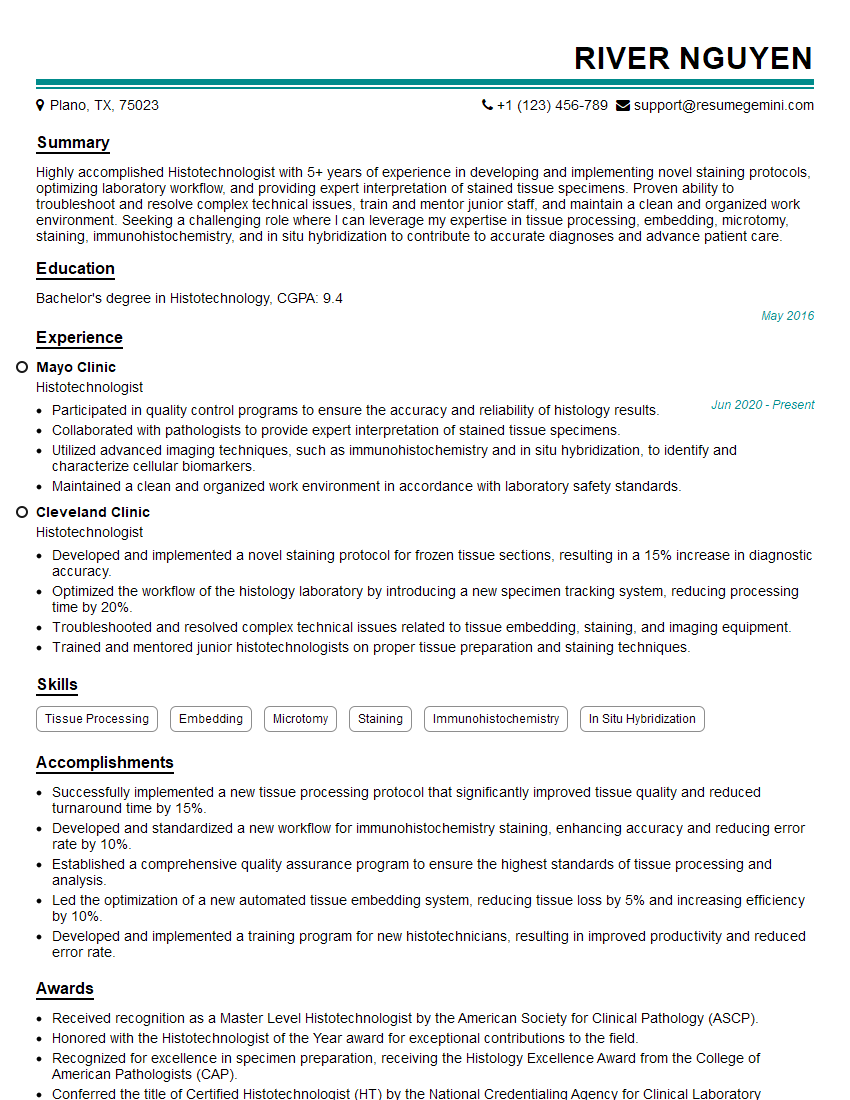
Mastering tissue disaggregation techniques is crucial for career advancement in biomedical research, cell therapy, and related fields. A strong understanding of these techniques will significantly enhance your prospects and make you a highly competitive candidate. To maximize your job search success, create an ATS-friendly resume that highlights your skills and experience effectively. ResumeGemini is a trusted resource that can help you build a professional and impactful resume tailored to the specific requirements of Tissue Disaggregation-focused roles. Examples of resumes tailored to this field are available to help you get started.
Explore more articles
Users Rating of Our Blogs
Share Your Experience
We value your feedback! Please rate our content and share your thoughts (optional).