The right preparation can turn an interview into an opportunity to showcase your expertise. This guide to Track and Signal Maintenance interview questions is your ultimate resource, providing key insights and tips to help you ace your responses and stand out as a top candidate.
Questions Asked in Track and Signal Maintenance Interview
Q 1. Explain the different types of track defects and their potential consequences.
Track defects can range from minor irregularities to severe safety hazards. Understanding their types and consequences is crucial for preventing derailments and ensuring safe train operation.
- Gauge Irregularities: This refers to deviations from the standard distance between the rails. Even small variations can cause wheel flange contact, leading to derailment risk. Think of it like walking on a slightly uneven path – a small imperfection might cause a stumble, a large one a fall.
- Alignment Defects: These are deviations from the straight line or planned curve of the track. Severe misalignments can cause derailment due to excessive lateral forces on the wheels. Imagine driving a car on a road with sudden, sharp bends.
- Level Defects: This involves variations in track elevation. Excessive dips or rises create uncomfortable riding conditions and can cause wheel slippage or derailment, similar to driving over a bumpy road.
- Ballast Issues: Problems with the ballast (the crushed stone supporting the track) like fouling (accumulation of debris) or degradation can reduce track stability and increase the risk of derailment. Imagine the foundation of a house settling unevenly.
- Broken Rails: This is a catastrophic defect. A broken rail can cause immediate derailment and serious damage. It’s the equivalent of a bridge collapsing.
The consequences of these defects can range from minor delays due to speed restrictions to major accidents causing fatalities and significant infrastructure damage.
Q 2. Describe the process of inspecting track geometry.
Track geometry inspection involves precisely measuring the track’s alignment, level, and gauge using specialized equipment. This ensures the track conforms to the stringent safety standards.
The process typically involves using a track geometry car, sometimes called a rail grinder, which travels along the track collecting data. Sensors measure various parameters, including:
- Gauge: The distance between the inner sides of the running rails.
- Alignment: The straightness or curvature of the track.
- Level: The elevation of the track.
- Cross-level: The difference in elevation between the two rails.
- Twist: The rotational deviation of the track.
This data is then analyzed to identify any defects exceeding pre-defined tolerances. A track geometry report is generated, which highlights areas requiring attention. This report allows for targeted maintenance, optimizing resource allocation and minimizing disruption.
Q 3. What are the common causes of signal failures?
Signal failures can stem from various causes, broadly categorized into equipment malfunctions and environmental factors.
- Equipment Malfunctions: These can include faulty relays, wiring problems, issues with signal lamps, or problems with the signal’s power supply. Ageing components, improper maintenance, and manufacturing defects all contribute to equipment failures.
- Environmental Factors: Harsh weather conditions, such as extreme temperatures, heavy rain, snow, or ice, can affect signal operation. Lightning strikes can also cause damage to the signal system. The elements are a major concern in the long-term reliability of the system.
- Vandalism or Accidental Damage: Acts of vandalism or accidental damage to the signalling equipment can disrupt its functionality. This highlights the need for robust security measures.
Each of these causes can lead to various signal malfunctions, such as incorrect signal displays, signal failure, or complete system shutdowns, all of which directly impact safety and operational efficiency.
Q 4. How do you troubleshoot a signal malfunction?
Troubleshooting a signal malfunction requires a systematic approach. It starts with safety procedures, always ensuring the area is secured before any work begins.
- Isolate the Problem: Determine which signal or part of the system is malfunctioning. Identify the specific symptoms – incorrect signal aspect, failure to illuminate, etc.
- Check Power Supply: Verify that the signal is receiving the correct power. A simple voltage check can often quickly identify a power issue.
- Inspect Wiring and Connections: Look for loose connections, broken wires, or signs of corrosion. This is often a significant source of problems.
- Test Components: Using specialized testing equipment, test individual components such as relays, lamps, and circuits. Systematic testing is crucial to narrow down the source of the fault.
- Consult Schematics and Documentation: Refer to the signaling system’s schematics and documentation to understand the circuit configuration and troubleshoot the problem effectively.
- Replace Faulty Components: Once the faulty component is identified, replace it with a known good one.
Detailed record-keeping of the troubleshooting process, including the identified fault and corrective actions taken, is vital for maintaining system records and informing future maintenance.
Q 5. Explain the principles of track circuiting.
Track circuiting is a vital safety system used to detect the presence or absence of trains on a section of track. It uses electrical circuits embedded within the track to achieve this.
The basic principle is that a closed circuit indicates an occupied track section, while an open circuit means the section is unoccupied. This information is then used by the signaling system to control train movements, preventing collisions. Imagine it as a simple on/off switch – train present (on), track clear (off).
The system typically consists of:
- Rails as Conductors: The running rails act as the conductors of the electrical circuit.
- Insulated Joints: These isolate adjacent track sections, defining the boundaries of each track circuit.
- Track Circuits: These are the electrical circuits that monitor each section.
- Relays: These electromechanical switches interpret the state of the track circuit (occupied/unoccupied) and send this information to the signaling system.
Different types of track circuits exist, each using different methods to detect train presence, such as AC or DC systems, to accommodate specific track characteristics and environmental conditions.
Q 6. Describe the different types of railway signaling systems.
Railway signaling systems vary considerably in complexity and technology. They are broadly classified based on several factors such as the level of automation, the type of signaling used, and the geographic area they operate in.
- Absolute Permissive Blocking (APB): This is a simple system that uses signals to control train movements on a single track. Each block section can only be occupied by one train at a time.
- Automatic Block Signaling (ABS): This is more sophisticated system that automatically controls train movements based on train detection. It utilizes track circuits to detect the presence of trains, ensuring a safe distance between them.
- Centralized Traffic Control (CTC): This system allows a central operator to control and monitor train movements over a large network of tracks from a central location. It enhances efficiency and allows for more effective traffic management.
- Automatic Train Control (ATC): This system automatically regulates train speed, enforcing speed limits and ensuring trains stop if they exceed permitted speeds or approach signals indicating a stop. This is a crucial safety feature, particularly in high-speed rail systems.
- European Train Control System (ETCS): This is a modern, high-performance signaling system which is becoming a standard in Europe and beyond. It uses digital communication technology for train control, allowing for improved capacity and flexibility.
The choice of system depends on factors such as the density of traffic, the speed of trains, and the overall complexity of the rail network.
Q 7. What safety measures are essential during track maintenance?
Safety during track maintenance is paramount. Stringent procedures and practices are implemented to ensure the safety of both workers and the public.
- Rule 1: Track Protection: The most critical aspect is protecting the work area. This often involves implementing track protection systems, like temporary speed restrictions, or complete track closures using block sections.
- Personal Protective Equipment (PPE): Workers must wear appropriate PPE, including high-visibility clothing, safety helmets, gloves, and safety footwear. This minimizes the risk of injury from moving trains or other hazards.
- Lookout Personnel: Trained personnel are assigned as lookouts to monitor approaching trains, warning workers of any potential danger. Communication is key – clear signals and procedures are critical.
- Safe Work Practices: Strict adherence to safe work practices, such as proper lifting techniques and use of tools, is mandatory. Regular safety briefings and training are essential to ensure everyone understands the protocols.
- Emergency Procedures: Emergency procedures should be established and practiced regularly. Everyone working on the track must know how to react in case of an emergency or a train approaching unexpectedly.
- Competent Supervision: Competent and experienced supervisors are responsible for overseeing work, ensuring procedures are followed and safety is maintained throughout the maintenance process.
A robust safety culture, where everyone feels empowered to raise safety concerns, is essential to prevent accidents.
Q 8. How do you ensure compliance with railway safety regulations?
Ensuring compliance with railway safety regulations is paramount in track and signal maintenance. It’s not just about following rules; it’s about fostering a safety culture. We achieve this through a multi-pronged approach.
- Strict adherence to the rule book: This includes understanding and applying all relevant national and international safety standards, operating procedures, and company-specific policies. For instance, we meticulously follow the procedures for working near energized railway lines, always employing lockout/tagout procedures and maintaining a safe working distance.
- Regular safety audits and inspections: We conduct routine inspections of our tools, equipment, and work areas to identify potential hazards. These audits are documented and corrective actions are promptly implemented and tracked. Think of it as a preventative health check for our railway infrastructure.
- Comprehensive training and competency assessments: Our team receives ongoing training on safety protocols, emergency response, and the safe use of machinery. Regular competency assessments ensure that everyone is proficient and up-to-date. A recent training session focused on the updated regulations for working near high-speed lines.
- Incident reporting and investigation: We maintain a robust incident reporting system. Any near-miss or accident is thoroughly investigated to determine the root cause and prevent similar incidents in the future. We use this data to continually improve our safety practices.
- Proactive risk management: We identify and assess potential hazards before commencing any work. We develop and implement control measures, such as permits-to-work systems and risk assessments to mitigate these risks.
Ultimately, safety is a collective responsibility, and everyone in the team plays a vital role in upholding the highest safety standards.
Q 9. Explain the use of various track maintenance tools and equipment.
Various tools and equipment are used in track maintenance, each designed for specific tasks. Imagine a well-equipped toolbox, each tool having its purpose.
- Tamper: This is a powerhouse machine used for lifting and aligning track components. Different tampers exist for various track types and conditions, ensuring optimal track geometry.
- Track measuring instruments: We use sophisticated instruments like laser track geometry cars to measure alignment, level, and gauge accurately, allowing for precise corrective actions. This is like a precise ruler ensuring the railway line is perfectly straight.
- Welding equipment: This includes thermite welding units for joining rails, which provide a strong and continuous rail for smoother operation.
- Ballast cleaning equipment: Machines like ballast regulators and excavators help clean and redistribute ballast, ensuring proper drainage and support for the track structure.
- Hand tools: Essential hand tools, such as wrenches, hammers, and measuring tapes are crucial for smaller repairs and inspections, acting as our trusty everyday tools.
- Specialized lifting equipment: Cranes and other heavy lifting equipment are essential when handling heavy rail sections or components.
The choice of equipment depends on the specific task. For example, a small repair might only require hand tools, while major track realignment would necessitate a tamper and other heavy machinery.
Q 10. Describe your experience with track welding techniques.
My experience with track welding encompasses both thermite welding and flash butt welding techniques. Thermite welding is a chemical process that produces molten metal to fuse rail ends, providing a strong and lasting joint. Flash butt welding uses electric resistance to heat and join the rail ends, offering a higher production rate.
I’m proficient in both techniques, including preparation, execution, and quality control checks. We employ strict quality checks to ensure the welds meet the required standards, ensuring the structural integrity of the track. These checks include visual inspections and often non-destructive testing methods, such as ultrasonic testing.
For example, on a recent project involving the renewal of a heavily used section of mainline track, we employed flash butt welding for its efficiency, allowing us to complete the work quickly and efficiently, minimizing service disruptions. In other situations, where access was limited or the environment required it, thermite welding has been the preferred choice due to its adaptability.
Q 11. What is your experience with ballast cleaning and maintenance?
Ballast cleaning and maintenance is critical for optimal track performance and longevity. Ballast, the crushed stone supporting the track, needs regular attention to maintain its drainage capabilities and structural support.
My experience includes using a variety of equipment, from ballast cleaners that sift and remove fines, to excavators which are essential for the excavation and redistribution of ballast. We also utilize ballast regulators that create a consistent ballast profile under the sleepers.
A key aspect of ballast maintenance is understanding the specific characteristics of the ballast, such as its gradation and cleanliness, that influence its performance. Regular inspections and laboratory testing are essential to determine the need for maintenance or replacement. For instance, we recently encountered a section of track with poor drainage due to clogged ballast. Using a ballast cleaning machine, followed by redistribution of the cleaned ballast, restored proper drainage, significantly extending the life of the track structure.
Q 12. How do you handle emergency situations during track maintenance?
Handling emergency situations during track maintenance requires a swift, organized, and systematic approach. Our priority is always the safety of personnel and the prevention of further damage.
- Immediate evacuation: If a hazard presents itself, our primary step is to immediately evacuate the area and ensure the safety of all personnel involved.
- Emergency response plan activation: We activate our pre-defined emergency response plan, informing relevant authorities and contacting emergency services as needed.
- Damage assessment: After securing the scene, a thorough assessment of the damage is conducted to determine the extent of the problem.
- Repair and mitigation: Temporary repairs are conducted to ensure operational safety, while long-term solutions are planned and executed as quickly as possible.
- Documentation: We thoroughly document the event, including the cause, the actions taken, and the outcome. This information is critical for future risk mitigation and improving our emergency response protocols.
For example, during a recent incident where a rail fractured unexpectedly, our team followed the emergency protocol, resulting in the safe evacuation of personnel and the timely initiation of repairs. The subsequent investigation helped us understand the cause of the fracture and implement improvements to our inspection procedures.
Q 13. Explain the process of installing and maintaining switches and crossings.
Installing and maintaining switches and crossings—the critical points where trains change tracks—demands precision and expertise. These components experience high levels of stress and wear, requiring careful attention.
Installation involves precise alignment and secure fastening of the switch points and crossings. We use heavy machinery and specialized tools for accurate placement and adjustment. The process begins with a thorough site preparation, followed by the careful positioning and fixing of the components.
Maintenance involves regular inspections for wear and tear, lubrication of moving parts, and the adjustment of mechanisms to ensure smooth operation and safety. We often employ diagnostic tools to identify potential problems before they escalate. A common issue is the build-up of debris, which we address through regular cleaning. We also address issues with the point machines and signalling systems associated with these elements. A recent project involved the replacement of an aging set of points and crossings on a busy commuter line, a project demanding meticulous planning and execution to minimize service disruptions.
Q 14. Describe your understanding of track drainage systems.
Effective track drainage is crucial to prevent water damage and maintain track stability. Water accumulation can lead to ballast degradation, frost heave, and even washouts, causing major disruptions.
Track drainage systems typically involve a combination of features:
- Ballast drainage: Well-graded ballast allows for efficient water percolation. Regular ballast cleaning is vital to maintain this permeability.
- Sub-ballast drainage: A layer of porous material beneath the ballast can improve drainage.
- Cross-drains: These are installed under the track to carry water away from the ballast and track.
- Ditches and culverts: These structures collect and direct surface water away from the track.
Understanding the local hydrological conditions is essential in designing and maintaining an effective drainage system. For example, in areas with high rainfall or poor soil conditions, we employ more robust drainage strategies, such as installing additional cross-drains or wider ditches. Regular inspections are vital to identify and address blockages or erosion.
Q 15. How do you perform routine inspections of signaling equipment?
Routine inspections of signaling equipment are crucial for ensuring safe and efficient railway operations. These inspections are typically a blend of visual checks and more in-depth testing, following a pre-defined checklist tailored to the specific type of equipment.
A typical visual inspection would involve checking for obvious damage like corrosion, loose connections, or broken components on signal lamps, relays, and control cabinets. We’d look for signs of vegetation encroachment that could interfere with the operation of signals or sensors. We’d also check the condition of the wiring and cabling for any signs of wear or damage.
Beyond visual inspection, we use specialized testing equipment. For example, a multimeter is essential for verifying voltage levels and continuity in circuits. Specialized testers might be used to examine the functionality of individual components within the signaling system. These tests ensure that the signals are accurately reflecting track occupancy and are correctly communicating with the control center. A detailed record is always kept after each inspection, highlighting any issues found and the actions taken to rectify them.
For instance, during a recent inspection, we discovered a loose connection in a signal relay. A simple tightening resolved the issue, preventing a potential signal failure that could have caused significant delays or safety hazards.
Career Expert Tips:
- Ace those interviews! Prepare effectively by reviewing the Top 50 Most Common Interview Questions on ResumeGemini.
- Navigate your job search with confidence! Explore a wide range of Career Tips on ResumeGemini. Learn about common challenges and recommendations to overcome them.
- Craft the perfect resume! Master the Art of Resume Writing with ResumeGemini’s guide. Showcase your unique qualifications and achievements effectively.
- Don’t miss out on holiday savings! Build your dream resume with ResumeGemini’s ATS optimized templates.
Q 16. What are the different types of signal failures and their troubleshooting methods?
Signal failures can range from minor glitches to complete system outages, each with its own unique troubleshooting approach. Some common types include:
- Lamp Failures: A simple burned-out bulb is easily replaced. Troubleshooting involves visually inspecting the lamp and its connections.
- Relay Malfunctions: Relays are electromechanical switches. Malfunctions can stem from worn contacts, coil failure, or power supply problems. Troubleshooting includes using a multimeter to check coil voltage and contact continuity.
- Circuit Breaker Trips: These protect the system from overloads. Troubleshooting involves identifying the cause of the overload (e.g., short circuit, excessive current draw) and fixing the underlying problem.
- Sensor Failures: Track circuits or axle counters that detect train occupancy can malfunction due to damage or faulty wiring. Troubleshooting involves checking the sensor’s output signal, the integrity of the track circuit, and the associated wiring.
- Software Glitches: In modern computerized signaling systems, software errors can cause unexpected behavior. Troubleshooting requires skilled technicians and may involve system diagnostics and software updates.
The troubleshooting methodology generally involves a systematic approach: first visually inspecting the equipment, then checking power supplies and connections, followed by more detailed component testing using specialized tools. Detailed records are kept throughout the process, aiding in future analysis and preventative maintenance. We use a ‘divide and conquer’ approach, isolating sections of the system to pinpoint the exact fault location quickly and efficiently. This prevents unnecessary work and ensures minimal disruption to services.
Q 17. Explain the role of interlocking systems in railway signaling.
Interlocking systems are the brains of railway signaling, ensuring safe train movements by preventing conflicting routes. They are crucial for avoiding collisions and derailments. Think of them as a sophisticated system of logic gates that only allows trains to proceed if the track ahead is clear and there’s no risk of conflict with another train.
Imagine a railway junction. An interlocking system prevents two trains from entering the same section of track simultaneously. It achieves this by mechanically or electronically linking the signals and points (switches). Only when the points are correctly set and the track ahead is clear will the signal allow a train to proceed. If a train occupies a section, signals to other trains entering that section are automatically set to stop.
The system operates based on predefined rules and logic, ensuring that routes are set safely and conflicts are avoided. This robust system prevents human error from leading to disastrous consequences and is a cornerstone of railway safety.
Q 18. Describe your experience with using computerized maintenance management systems (CMMS).
I have extensive experience with CMMS (Computerized Maintenance Management Systems), specifically using [Mention Specific CMMS Software, e.g., IBM Maximo or SAP PM]. These systems are invaluable for managing the maintenance of signaling and track infrastructure. They help streamline processes, from scheduling preventative maintenance to tracking repairs and managing inventory.
In my previous role, we used CMMS to schedule regular inspections of all our signaling equipment, track components, and rolling stock. The system generated work orders automatically based on predefined schedules and equipment history. It also allowed us to track the status of each work order, the materials used, and the time spent on repairs. This significantly improved our efficiency and helped us better allocate resources. The data provided by the CMMS allowed us to identify trends and patterns in equipment failures, which greatly informed our predictive maintenance strategies, reducing downtime and minimizing expensive emergency repairs. For example, by analyzing historical data on relay failures, we identified a batch of relays with a higher than average failure rate, allowing us to proactively replace them before any significant disruptions occurred.
Q 19. How do you manage and interpret track alignment data?
Track alignment data is crucial for maintaining track geometry and ensuring safe and smooth train operation. We use various tools and techniques to collect and interpret this data.
Data collection often involves using specialized equipment such as track geometry cars. These cars use lasers, accelerometers, and other sensors to measure track parameters like alignment (straightness), level (elevation), gauge (distance between rails), and cross-level (difference in elevation between the two rails).
The data collected is then analyzed using specialized software. This software generates reports that visualize the track alignment, highlighting areas that deviate from the desired specifications. We look for things like excessive curvature, changes in elevation, and gauge variations. These deviations can lead to wheel wear, train derailments, or reduced train speed. Based on this analysis, we develop targeted maintenance plans to rectify these issues, usually involving track tamping, shimming, or realignment.
For example, if the alignment data shows a significant curve deviation, we will adjust the ballast and realign the track to meet the required specifications. The software helps us create precise plans for these adjustments, ensuring accurate and efficient track maintenance.
Q 20. What is your understanding of the various types of track fasteners?
Track fasteners are critical components that secure the rails to the sleepers (ties), ensuring the integrity of the track structure. Several types are used, each with its own advantages and disadvantages:
- Dog spikes: These are simple, robust metal spikes driven into the sleepers, securing the rail baseplates. They are relatively inexpensive and easy to install but can be prone to loosening over time.
- Screw spikes: These screws offer superior holding power and are less likely to loosen compared to dog spikes. They allow for easier track adjustments but are more expensive and require specialized tools for installation.
- Clip fasteners: These use clips that clamp the rail to the sleeper, offering good holding power and allowing for easy rail replacement. They are less prone to loosening but can be more complex to install.
- Elastic fasteners: These incorporate an elastic element that helps to absorb vibrations and shocks, reducing track wear and noise. They are more complex and expensive but offer better track stability and reduce maintenance needs.
The choice of fastener depends on factors like track type, traffic volume, and environmental conditions. For high-speed lines, elastic fasteners are often preferred for their superior performance and reduced maintenance needs. In areas with heavy traffic, robust screw spikes or clips may be selected to ensure long-term track stability. Selecting the appropriate fastener is critical in maintaining track safety and longevity.
Q 21. Explain the importance of proper track gauging.
Proper track gauging is paramount for ensuring safe and efficient train operations. Track gauge refers to the distance between the inner faces of the two rails. This distance must be precisely maintained to ensure that train wheels run smoothly and safely on the track. Inconsistent gauge can lead to derailments, wheel damage, and track wear.
Maintaining the correct gauge is a continuous process, involving regular inspections and adjustments. Deviations from the standard gauge can occur due to thermal expansion and contraction, traffic loading, or ground settlement. We use specialized tools to measure gauge at regular intervals along the track. If deviations are detected, they must be corrected by adjusting the rail positions using shims or other techniques. Failure to maintain proper gauge can result in severe consequences, from minor discomfort to major accidents.
Imagine a train running on a track with an inconsistent gauge. The wheels would experience uneven forces, leading to increased wear and tear and potentially causing the train to derail. Precise gauging is a fundamental aspect of track maintenance, directly impacting both safety and operational efficiency.
Q 22. Describe your experience with different types of rail materials.
My experience encompasses a wide range of rail materials, each with its own strengths and weaknesses. Understanding these nuances is critical for effective track maintenance and life-cycle management.
Steel Rails: The most common type, varying in hardness and chemistry (e.g., carbon content) to suit different traffic loads and speeds. I’ve worked extensively with heat-treated rails offering improved wear resistance and longer lifespan. For example, I oversaw a project where we replaced sections of track with higher-carbon steel rails, resulting in a significant reduction in rail failures and maintenance costs.
Concrete Sleepers: These offer superior longevity and stability compared to wooden sleepers, especially in high-speed rail environments. I’ve been involved in projects evaluating different concrete mixes and designs to optimize their performance under varying soil conditions and temperature extremes.
Composite Materials: Newer composite materials are increasingly being used in track components like fasteners and sleepers. These materials offer potential advantages in terms of weight reduction, corrosion resistance, and improved vibration damping. I’ve participated in trials evaluating the long-term performance and cost-effectiveness of these innovative materials.
Fasteners: The variety here is vast! From traditional clips and bolts to more advanced systems incorporating elastomeric pads for improved damping and reduced noise. Proper fastener selection is crucial for maintaining gauge and minimizing track degradation. I’ve encountered scenarios where improper fastener maintenance led to derailment risks, highlighting the importance of regular inspection and timely replacement.
Q 23. How do you manage and mitigate risks associated with track maintenance?
Risk management in track maintenance is paramount for safety and operational efficiency. My approach involves a multi-layered strategy:
Hazard Identification and Assessment: Regular inspections using various methods (visual, ultrasonic testing, etc.) help pinpoint potential hazards like rail defects, sleeper damage, and ballast fouling. Risk assessment matrices are used to prioritize these issues.
Mitigation Strategies: These range from simple repairs (e.g., replacing a damaged sleeper) to more complex interventions (e.g., track stabilization or complete track renewals). Specific mitigation strategies are tailored to the identified risks. For instance, in areas prone to ground subsidence, we implement improved drainage systems and ballast consolidation techniques.
Safety Procedures: Stringent safety protocols are implemented during all maintenance activities. This includes proper signaling, worker training, and the use of Personal Protective Equipment (PPE). I’ve always emphasized a zero-tolerance approach to safety violations.
Contingency Planning: Emergency response plans are developed and regularly tested to handle unforeseen events such as derailments or unexpected track failures. This involves clear communication channels and readily available resources.
Data Analysis: Tracking maintenance data helps identify trends, predict future failures, and optimize maintenance schedules. This data-driven approach improves efficiency and reduces risks.
Q 24. What is your experience with track renewal projects?
I have extensive experience in track renewal projects, from planning and design to execution and commissioning. These projects are usually large-scale undertakings requiring meticulous planning and coordination.
Project Planning: This involves detailed surveys, design optimization, material procurement, and resource allocation. For example, I once managed a project that required replacing 5 kilometers of track, necessitating careful phasing to minimize disruption to train services.
Execution: This phase includes removing the existing track, installing new components (rails, sleepers, ballast, etc.), and ensuring proper alignment and geometry. Precise surveying and track laying techniques are essential to achieve optimal performance.
Commissioning: This entails verifying the quality of work, conducting thorough inspections, and ensuring compliance with safety regulations. Once the track meets all the standards, it’s ready for operation. I’ve always used strict quality control procedures to ensure the longevity and safety of the renewed track.
Challenges: These projects often face tight deadlines, budget constraints, and potential weather-related delays. Effective communication, risk management, and proactive problem-solving are crucial for successful completion.
Q 25. Describe your understanding of the principles of track stabilization.
Track stabilization focuses on enhancing the structural integrity and long-term performance of the track structure. It involves techniques that improve the support provided to the rails, reducing deformation and improving ride quality. The principles are rooted in soil mechanics and structural engineering.
Ballast Management: Proper ballast cleaning and consolidation are crucial. Fouling (contamination with fine materials) reduces drainage and weakens the support structure. Regular cleaning and the use of techniques like dynamic compaction improve ballast performance.
Subgrade Improvement: If the subgrade (soil beneath the ballast) is weak, it can lead to track settlement and instability. Techniques like soil stabilization (using lime, cement, or other additives), deep drainage, and geotechnical solutions are used to improve subgrade strength.
Sleeper Selection and Placement: The type and spacing of sleepers significantly impact track stability. Concrete sleepers generally provide better stability than wooden sleepers. Proper placement and alignment are essential.
Drainage: Effective drainage is crucial to prevent water accumulation, which can lead to erosion, frost heave, and instability. Cross-drains, ditches, and other drainage solutions are incorporated into the track design.
Q 26. Explain the process of conducting a thorough track inspection.
A thorough track inspection involves a systematic process using a combination of methods to identify potential defects and assess track condition. The goal is to ensure safety, prevent failures, and maintain optimal performance.
Visual Inspection: This is the most common method, involving a visual examination of the track structure for signs of wear, damage, or defects. Experienced inspectors can detect subtle signs of problems, such as misalignment or rail corrugation. I’ve often incorporated checklists and standardized reporting procedures.
Ultrasonic Testing: This non-destructive technique uses ultrasonic waves to detect internal rail defects such as cracks and head checks. This helps identify problems not visible to the naked eye.
Gauge Measurement: Ensuring the correct track gauge (distance between rails) is critical for safe train operation. Regular gauge measurements are performed using specialized tools.
Ballast Condition Assessment: Inspecting the ballast for fouling, drainage issues, and proper depth is crucial for evaluating the overall support provided to the track structure.
Reporting and Documentation: All findings from the inspection are meticulously documented and reported, outlining identified defects, their severity, and recommended corrective actions. This data informs maintenance planning and prioritization.
Q 27. How do you prioritize track maintenance tasks?
Prioritizing track maintenance tasks is crucial for optimizing resource allocation and ensuring safety. I typically employ a risk-based approach.
Risk Assessment: Using data from inspections and previous failures, I identify potential hazards and their associated risks. This assessment considers the severity of potential consequences and the likelihood of failure.
Criticality of Track Sections: High-traffic sections or those with a history of failures are given higher priority. Locations near curves or switches are also usually considered high-risk.
Maintenance History: Track sections nearing the end of their planned maintenance cycle receive higher priority. This helps prevent unforeseen breakdowns and costly repairs.
Resource Availability: The available resources (personnel, equipment, budget) are also considered when setting priorities. Sometimes, delaying less critical tasks might be necessary.
Software and Planning Tools: Specialized software and planning tools are used to analyze the collected data and schedule maintenance work efficiently, taking into account various constraints and priorities.
Q 28. What are your strategies for improving track maintenance efficiency?
Improving track maintenance efficiency requires a holistic approach focusing on various aspects of the process.
Predictive Maintenance: Implementing predictive maintenance techniques using sensors, data analytics, and machine learning algorithms helps anticipate potential failures and schedule maintenance proactively, minimizing downtime and improving overall efficiency. I’ve seen significant improvements in this area using advanced data analysis techniques.
Optimized Maintenance Schedules: Developing optimized maintenance schedules using historical data and predictive modeling can improve resource allocation and reduce maintenance costs. Proper planning minimizes disruptions to train operations.
Technological Advancements: Embracing new technologies, like automated inspection systems and robotic track maintenance equipment, can greatly enhance efficiency and improve safety by minimizing human involvement in hazardous tasks. I am always researching and evaluating new technologies.
Improved Communication and Collaboration: Effective communication between maintenance crews, engineers, and train operators is vital for optimizing maintenance schedules and minimizing delays. A streamlined communication process improves overall workflow.
Training and Development: Investing in the training and development of maintenance personnel is essential for improving their skills, ensuring safety, and promoting efficient work practices. Well-trained personnel are more effective and less prone to errors.
Key Topics to Learn for Track and Signal Maintenance Interview
- Track Geometry and Alignment: Understanding track components, surveying techniques, and the impact of misalignment on train operations. Practical application: Diagnosing and rectifying track defects using appropriate tools and methods.
- Ballast and Substructure Maintenance: Knowledge of ballast composition, drainage systems, and subgrade stability. Practical application: Assessing ballast condition and implementing effective maintenance strategies to prevent track settling and ensure safe operations.
- Signal System Fundamentals: Understanding different signaling systems (e.g., color light, absolute permissive blocking), their components, and their functions. Practical application: Troubleshooting signal malfunctions and performing preventative maintenance.
- Railway Switching Systems: Knowledge of points, crossings, and switch machines, including their operation and maintenance. Practical application: Inspecting and maintaining switching systems to ensure safe and efficient train movements.
- Safety Regulations and Procedures: Understanding relevant safety regulations, procedures, and best practices for track and signal maintenance. Practical application: Implementing safe work practices and complying with all relevant regulations.
- Troubleshooting and Problem-Solving: Developing effective strategies for identifying, diagnosing, and resolving issues related to track and signal systems. Practical application: Using diagnostic tools and applying problem-solving techniques to minimize downtime and ensure operational efficiency.
- Documentation and Reporting: Understanding the importance of accurate record-keeping and reporting of maintenance activities. Practical application: Maintaining detailed records of inspections, repairs, and maintenance tasks.
Next Steps
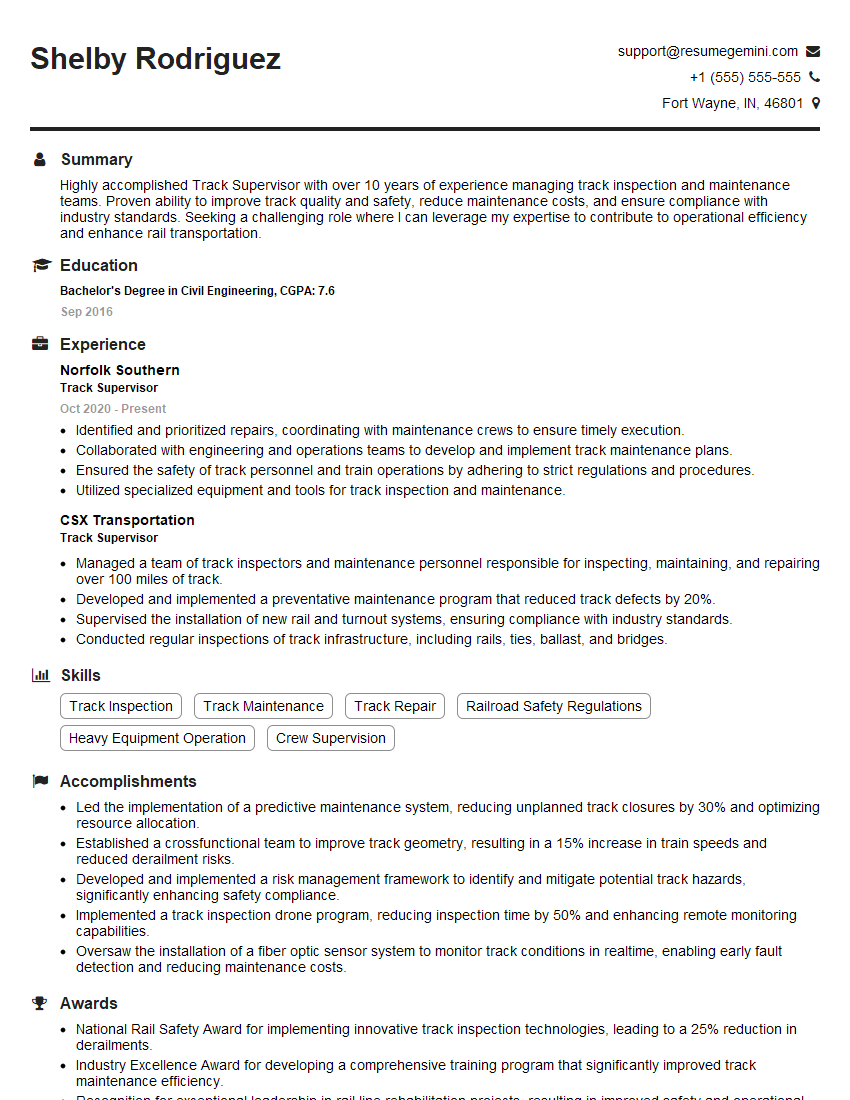
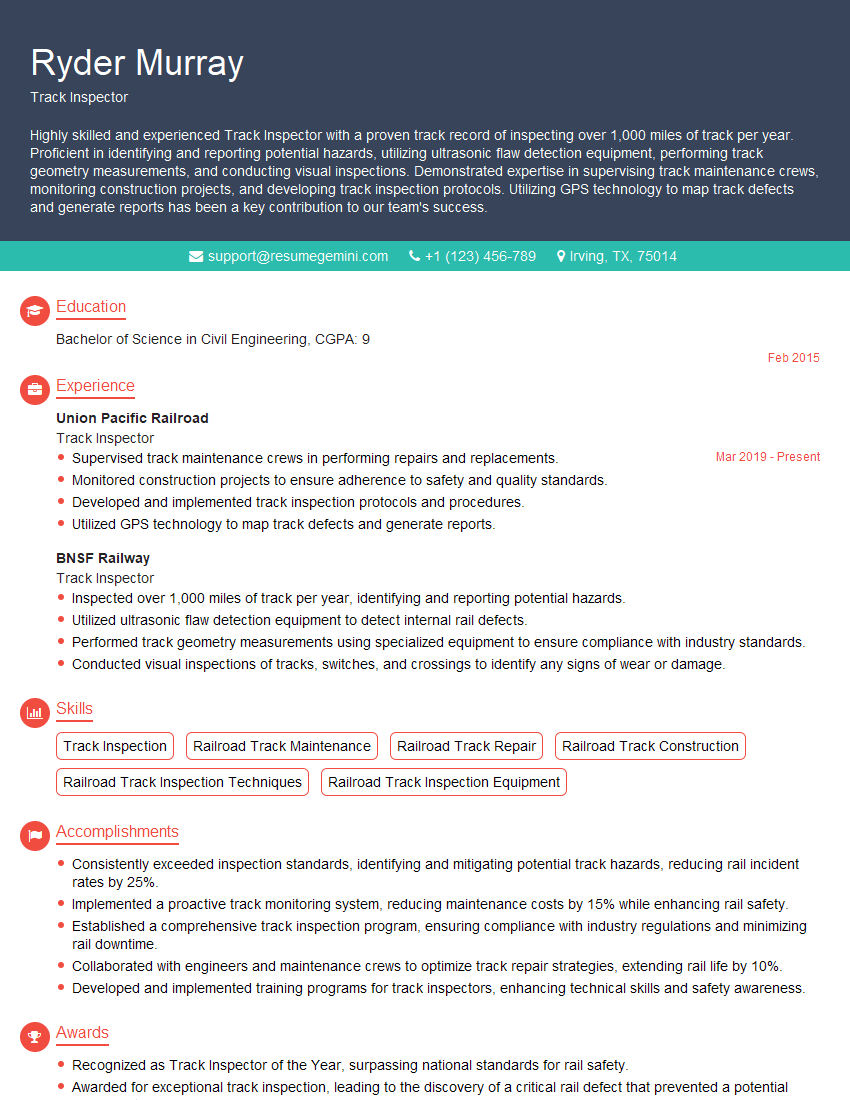
Mastering Track and Signal Maintenance opens doors to a rewarding career with excellent growth potential in a vital industry. As you prepare for interviews, a strong, ATS-friendly resume is crucial for making a positive first impression. ResumeGemini is a valuable resource to help you craft a professional and impactful resume that showcases your skills and experience. They offer examples of resumes tailored to Track and Signal Maintenance to help you get started. Invest time in building a compelling resume – it’s your first step toward securing your dream job.




Explore more articles
Users Rating of Our Blogs
Share Your Experience
We value your feedback! Please rate our content and share your thoughts (optional).
What Readers Say About Our Blog
Very informative content, great job.
good