Cracking a skill-specific interview, like one for Traditional Retouching, requires understanding the nuances of the role. In this blog, we present the questions you’re most likely to encounter, along with insights into how to answer them effectively. Let’s ensure you’re ready to make a strong impression.
Questions Asked in Traditional Retouching Interview
Q 1. Explain the difference between dodging and burning in traditional darkroom techniques.
Dodging and burning are fundamental darkroom techniques used to control the tonal values in a photograph. Think of them as selective lightening and darkening, respectively. Dodging involves preventing light from reaching certain areas of the photographic paper during the printing process, resulting in lighter tones. Burning is the opposite; it involves increasing the exposure to specific areas, leading to darker tones.
Imagine you’re printing a portrait. The subject’s face might be slightly underexposed. You would dodge the rest of the print while allowing more light to hit the face during printing to brighten it. Conversely, if a background area is too bright, you’d burn it to darken it selectively.
In practice, dodging is often done using a hand or a piece of card to momentarily block light from particular areas while burning utilizes the same methods, but the light is allowed to hit the selected area for a longer duration. The degree of dodging and burning is controlled by the duration and intensity of the blocking or exposure.
Q 2. Describe your experience with various types of traditional retouching tools (e.g., brushes, pencils, airbrushes).
My experience with traditional retouching tools spans decades. I’ve worked extensively with a wide range of materials, each with its unique properties and applications. For example, fine sable brushes are ideal for delicate work like softening harsh lines or blending tonal transitions. These brushes allow for precise control and are crucial for creating smooth, natural-looking retouches.
Graphite pencils, ranging in hardness from H to B, offer different degrees of opacity. Hard pencils (H) are perfect for fine detail work and subtle corrections, while softer pencils (B) provide more intense shading. I find that using different grades of pencil for various aspects of a retouch is critical. For instance, a hard pencil might be used to sketch in a missing detail before working up the tones with a softer pencil.
Airbrushes, while demanding more technical skill, are invaluable for achieving smooth, even gradations of tone, especially when dealing with large areas needing adjustment. They are a fantastic tool for blending and creating soft, seamless transitions of color and tone, and are essential for certain large-scale retouches. This precision is crucial when dealing with significant damage or altering tone across large portions of an image.
Q 3. How do you approach color correction in traditional film retouching?
Color correction in traditional film retouching is a meticulous process. It relies heavily on the understanding of color theory and the careful manipulation of dyes and pigments. Unlike digital correction, it’s not a matter of a simple slider adjustment. I primarily approach it in two ways. First, I assess the overall color balance of the print, looking for areas that are too warm, too cool, or oversaturated.
Then, I employ color masking techniques, applying dyes and pigments selectively, layering them to achieve a balanced and accurate representation of the original colors. This could involve applying a thin, overall wash of color to correct the overall balance, followed by spot corrections with more precise application of color, for instance, using a fine brush dipped in a diluted dye to adjust the color of skin tones.
This layered approach is akin to painting, building up the color gradually to avoid harsh transitions. The goal is not to create a new color, but rather to subtly correct existing ones, maintaining a realistic look. Choosing the right papers and dyes plays a huge role in achieving this. The paper’s receptiveness to dyes is crucial to ensure subtle color corrections without creating muddy tones or ruining fine detail.
Q 4. Explain your process for repairing tears and scratches on photographs.
Repairing tears and scratches is a challenging aspect of traditional retouching, requiring patience and skillful manipulation of materials. My approach involves a multi-step process. First, I carefully clean the damaged area, ensuring no loose particles are present that might interfere with adhesion. Then, I use a fine, sharp blade to carefully lift the torn edges, only as much as needed to create a flat surface. This prevents further damage.
Next, I might use tissue paper, often adhered with an archival adhesive, to fill the tear and create a stable base. This is followed by careful in-painting or repainting of the missing areas using watercolors or dyes to precisely match the surrounding tones and textures. I also might employ techniques such as applying thin layers of the same dye or pigment to even out the area, ensuring a uniform texture across the repair. If it is a scratch, a similar process would be undertaken but without the need for lifting torn edges. The filling materials and colors used are chosen to match the texture and color of the photograph, ensuring that the repair is as subtle and inconspicuous as possible.
Q 5. How do you handle dust and debris during the traditional retouching process?
Dust and debris are the nemesis of traditional retouching. The slightest particle can show up prominently in the finished print, especially under magnification. My approach to dust control begins with a meticulously clean work environment. I use a HEPA filter vacuum regularly to remove dust from surfaces and the air. Furthermore, I use only clean tools and brushes, and regularly clean them with specialized brushes, ensuring they are completely free of dust and debris before starting work. Keeping the surrounding environment dust-free reduces the incidence of unwanted dust.
During retouching, I use a soft brush (such as a badger hair brush) to carefully remove any dust that might settle on the photograph. This must be done gently to avoid scratching the emulsion. If a particle is stubbornly stuck, I might use a very gentle air puff to remove it. Ultimately, the key is meticulousness. It’s better to invest extra time ensuring a clean environment and regularly removing dust, rather than having to correct any contaminations after the print is completed.
Q 6. What are the advantages and disadvantages of using traditional retouching methods compared to digital methods?
Traditional and digital retouching methods both have their strengths and weaknesses. Traditional methods offer a unique tactile experience and a sense of immediacy. The control of materials and the ability to subtly blend colors and textures is unmatched. It allows for incredibly fine, nuanced control over tone and texture. Additionally, the process provides a direct connection with the original image, adding to the authenticity and the overall experience.
However, traditional retouching is time-consuming and requires a high level of skill. Mistakes are harder to undo, and the process is not easily reproducible. On the other hand, digital retouching provides efficiency and ease of correction. It offers non-destructive editing and infinite opportunities to refine and improve work. It’s also easy to replicate and share images.
Ultimately, the choice depends on the project, personal preference, and the desired aesthetic. For some projects, the subtle artistry and historical connection of traditional methods are paramount; for others, the speed and flexibility of digital techniques are more appropriate.
Q 7. Describe your experience with different types of photographic papers and their impact on retouching.
The choice of photographic paper significantly impacts the retouching process. Different papers have varying textures, surface finishes, and color responses to dyes and pigments. For instance, fiber-based papers, such as traditional silver gelatin papers, often have a more textured surface and can be more challenging to retouch compared to resin-coated papers, which generally possess a smoother surface.
The paper’s contrast grade also influences how the retouching will appear. A high-contrast paper will accentuate tonal differences, making subtle retouches more visible, while a low-contrast paper might make them harder to see. Moreover, some papers are more receptive to certain dyes and pigments than others, affecting the final color balance. This responsiveness needs to be considered to effectively execute color corrections and prevent unexpected results.
For example, a warm-toned paper might require a different approach to color correction than a cool-toned paper. My experience involves extensive testing and familiarization with various papers to understand their individual properties and how to best adapt my retouching techniques to maximize the paper’s potential. This knowledge ensures the final result harmonizes with the paper’s inherent characteristics, creating the desired look and feel.
Q 8. How do you determine the appropriate level of retouching for a specific image?
Determining the appropriate level of retouching is a crucial first step, a balance between enhancing the image and preserving its authenticity. It’s guided by the image’s purpose and the client’s expectations. For example, a portrait intended for a family heirloom requires a gentler approach than a fashion photograph for a magazine, where more dramatic alterations might be acceptable. I consider several factors:
- Intended Use: A photograph intended for archival purposes will receive minimal retouching, focusing on preserving the original image. A commercial image, however, might involve more extensive work to meet branding requirements.
- Image Condition: Heavily damaged images might require more intervention to restore them, whereas images with minor imperfections might only need subtle enhancements.
- Client Preferences: Open communication with the client is key. I discuss the possibilities and limitations of traditional retouching, presenting different options and their implications before beginning work.
Ultimately, the goal is to improve the image’s quality and impact while maintaining its integrity and artistic merit. I strive for a natural, unforced look, avoiding overly processed results.
Q 9. What are the ethical considerations involved in traditional photo retouching?
Ethical considerations in traditional photo retouching are paramount. The core principle is to be transparent and honest about the extent of any alterations. Manipulating an image to mislead or deceive is unethical. This includes:
- Misrepresentation: Altering an image to create a false impression of reality is unacceptable. For instance, drastically changing someone’s appearance without their consent in a portrait is unethical.
- Consent: Always obtain the informed consent of the subject before making significant alterations to their image. They should know what changes will be made and have the right to approve or reject them.
- Attribution: If significant retouching is performed, it’s essential to acknowledge this in any accompanying documentation or metadata. This maintains transparency and avoids misrepresenting the original image.
- Preservation of the original: I always make sure to archive the original, untouched negative or print to preserve the original work and maintain a record of the image’s history.
Maintaining ethical practices builds trust and upholds the integrity of the profession. It’s about responsible use of this powerful medium, respecting both the subject and the art form itself.
Q 10. Describe your experience with different types of photographic negatives (e.g., film, glass plates).
My experience encompasses various photographic negatives, each presenting unique challenges and opportunities.
- Film Negatives: I’ve worked extensively with various film formats, from 35mm to large-format sheet film. The delicate nature of these requires careful handling to avoid scratching or damaging the emulsion. The grain structure influences the retouching approach; fine-grained films allow for more subtle work, while coarser-grained films necessitate a bolder touch.
- Glass Plate Negatives: Working with glass plate negatives, often dating back to the late 19th and early 20th centuries, requires extra caution. Their fragility demands gentle handling and specialized cleaning techniques. The process of retouching these delicate plates necessitates a steady hand and meticulous attention to detail to avoid causing damage.
Understanding the specific characteristics of each negative type is crucial for successful retouching. For example, the density and contrast of a glass plate negative will inform the choice of materials and techniques used during the retouching process. I always adapt my methods to suit the specific type of negative.
Q 11. How do you maintain the archival quality of original photographs during retouching?
Maintaining archival quality during retouching is vital. It involves employing techniques and materials that won’t damage the original photograph and will ensure its longevity. My approach involves:
- Careful Handling: Always using clean, acid-free gloves and tools to prevent contamination or damage.
- Archival-Quality Materials: Employing only archival-grade pigments, paints, and solvents that won’t fade or degrade over time. This includes using pigmented inks rather than dye-based ones for any digital reproduction.
- Minimizing Contact: Using techniques like masking to limit direct contact between the retouching materials and the original image.
- Proper Storage: After retouching, I carefully store the original photograph in acid-free sleeves and archival-quality boxes in a cool, dark, and dry environment.
By adhering to these methods, I ensure that the original photograph retains its historical value and aesthetic qualities for generations to come. The preservation of the original is as important as the retouching itself.
Q 12. Explain your process for preparing an image for reproduction after traditional retouching.
Preparing a traditionally retouched image for reproduction requires a meticulous process, ensuring that the enhancements are accurately captured without introducing new artifacts.
- High-Resolution Scanning: If the retouched image is on a print or negative, high-resolution scanning is crucial to capture all details. The resolution should be significantly higher than the intended final output.
- Color Correction and Adjustment: Fine-tuning the colors and contrast in the digital image to match the original look, ensuring consistency across the entire picture.
- Digital Cleaning: Although minimal, a digital clean-up might be required to address any minor blemishes not corrected traditionally.
- File Format Selection: Saving the final image in a lossless format like TIFF to preserve image quality. This will ensure that the quality is not compromised through compression when sending to the printer.
- Proofing: Before final reproduction, a test print is always produced to verify color accuracy and ensure everything looks correct.
The goal is to create a digital representation that faithfully reflects the quality and nuance of the traditional retouching work.
Q 13. How do you handle color fading and discoloration in traditional retouching?
Color fading and discoloration are common issues in older photographs. My approach involves carefully assessing the extent of the damage and selecting the appropriate technique. This often includes:
- Careful Cleaning: Gently removing surface dirt and debris before beginning any retouching. This prevents the introduction of further impurities.
- Color Matching: Using archival-grade pigments or paints to carefully match the existing colors, blending the retouching seamlessly with the original image. This requires a keen eye for color and detail.
- Graduated Toning: For more extensive discoloration, graduated toning techniques might be employed to subtly reintroduce lost color. This is particularly useful in restoring faded portraits.
- Retouching on a Scan: In some cases, minor color correction can be done digitally after scanning, but I always aim for the least invasive, most traditional methods first.
The key is to be subtle and to restore the photograph’s original colors, rather than creating a dramatically altered look. I strive to preserve the historical appearance of the image as far as possible. The aim isn’t to make the image look ‘new’ but to restore what has been lost to time.
Q 14. Describe your experience with masking techniques in traditional retouching.
Masking techniques are essential for precise retouching. They allow for targeted alterations without affecting surrounding areas. In traditional retouching, masking can be achieved in several ways:
- Opaque Masking: Using thin sheets of opaque paper (like tissue paper) to mask areas that shouldn’t be retouched. This is particularly useful for protecting delicate details while working on larger areas.
- Fluid Masking: Using masking fluids, liquid latex solutions that create precise masks on the photographic print. This is used for isolating fine details or working on complicated shapes.
- Cut-out Masking: For complex shapes, the mask can be meticulously cut from thin card or film, allowing for precise control. This is a time-consuming but accurate method for delicate work.
The choice of masking technique depends on the complexity of the retouching task and the sensitivity of the image. Masking ensures clean and controlled edits, helping to maintain the integrity of the original photograph while effectively correcting flaws.
Q 15. What are some common challenges you face when performing traditional retouching, and how do you overcome them?
Traditional retouching, while rewarding, presents unique challenges. One major hurdle is the inherent limitations of working directly on the photographic print. Unlike digital retouching, you can’t easily undo mistakes. A misplaced brushstroke can be incredibly difficult to correct. Another common issue is achieving consistent tone and color across the entire print, especially on larger formats. The subtle changes in lighting, paper texture, and even the humidity in the room can affect the application of pigments or media. Finally, dealing with damage like tears, scratches, or fading requires careful planning and a variety of techniques.
To overcome these, I employ a multi-pronged approach. Firstly, thorough preparation is key. I assess the print meticulously, plan my corrections, and always practice on a test area first. Secondly, I use a variety of tools and materials — high-quality brushes, specialized pencils, airbrushes – each chosen for its specific properties. For example, I might use a fine sable brush for delicate work and a broader one for larger areas. I also carefully control my environment, ensuring consistent lighting and a stable temperature to minimize variation. For significant damage, I might use tissue overlays and careful in-painting to seamlessly integrate the repair.
Career Expert Tips:
- Ace those interviews! Prepare effectively by reviewing the Top 50 Most Common Interview Questions on ResumeGemini.
- Navigate your job search with confidence! Explore a wide range of Career Tips on ResumeGemini. Learn about common challenges and recommendations to overcome them.
- Craft the perfect resume! Master the Art of Resume Writing with ResumeGemini’s guide. Showcase your unique qualifications and achievements effectively.
- Don’t miss out on holiday savings! Build your dream resume with ResumeGemini’s ATS optimized templates.
Q 16. How do you ensure consistent results across multiple prints using traditional methods?
Consistency across multiple prints is paramount. In traditional retouching, achieving this requires meticulous record-keeping and a standardized workflow. I typically create a detailed plan for each retouching project, outlining the specific techniques and materials I will be using. I also create detailed notes documenting my process, including color mixing ratios and brush techniques. This ensures that every print receives the same treatment.
For example, if I’m removing a distracting element from a portrait, I’ll document the exact color blending I used to seamlessly match the surrounding skin tones. This documentation allows me to replicate the process with precision on subsequent prints. Furthermore, careful preparation of the materials—ensuring consistent pigment concentration and using a consistent approach to applying the medium—is crucial for achieving identical results.
Q 17. How do you adapt your traditional retouching skills to various image formats and printing techniques?
Adapting to various image formats and printing techniques is a crucial aspect of my work. The process for retouching a platinum print is fundamentally different from retouching a gelatin silver print due to their distinct textures and sensitivities. Similarly, the techniques for a large-format print differ from those for a contact print.
For example, a faded gelatin silver print may require carefully applying a toning solution to restore contrast. A platinum print, being more delicate, may require a more delicate approach using watercolor or pastel. Understanding the chemical and physical properties of different photographic processes is key. Furthermore, I need to consider the final presentation – whether the print will be framed under glass or displayed in a portfolio. This will guide my choices in materials and techniques to ensure that the retouching is compatible with the intended display method and stands the test of time.
Q 18. What are your preferred methods for sharpening images using traditional methods?
Sharpening in traditional retouching is a delicate balance between enhancing detail and avoiding an unnatural, harsh look. My preferred methods include using fine-tipped pencils or specialized sharpening tools to carefully add detail to areas that lack crispness. I often start with a very light touch, building up the detail gradually.
The process involves observing the image carefully to identify areas that need sharpening. This usually means areas out of focus or lacking fine detail such as hair, eyes, or edges of clothing. For example, to sharpen a slightly blurry eye, I might use a very fine graphite pencil to gently emphasize the iris details, building up the contrast to define the shape and increase the perceived sharpness. The key is subtlety; over-sharpening can result in a very artificial look.
Q 19. How do you create seamless transitions while retouching?
Creating seamless transitions is the hallmark of skilled traditional retouching. This requires a deep understanding of color mixing and blending techniques. The most crucial aspect is to carefully match the surrounding tones and textures. I achieve seamless transitions by gradually blending colors and textures using soft brushes and carefully graded application of media.
For instance, when retouching a scratch on a portrait, I wouldn’t simply fill the scratch with a uniform color. Instead, I would carefully analyze the surrounding skin tones and textures, mixing pigments to create a gradual transition that matches the shading and highlights. This requires patience and a keen eye for detail to ensure that the repair is visually invisible.
Q 20. Explain your knowledge of different types of archival materials and their suitability for retouched prints.
Archival materials are crucial for preserving retouched prints. My knowledge encompasses a range of materials, including different types of paper (rag paper, cotton fiber paper), mounting boards (acid-free boards), and protective encapsulants. The choice of materials directly impacts the longevity and preservation of the artwork.
For example, I often use 100% rag paper for its inherent stability and resistance to acid degradation. Acid-free mounting boards prevent the print from being damaged by acidic materials. For ultimate protection, I might consider encapsulating the print in archival-quality Mylar to protect it from environmental factors and handling. Using archival materials ensures that the retouched print not only looks its best but will remain intact for generations.
Q 21. Describe your experience working with clients to determine the scope and goals of a retouching project.
Working with clients requires clear communication and a collaborative approach. I begin by having an in-depth conversation to understand their vision for the project. This involves discussing the condition of the print, the desired outcome, and any specific areas they’d like addressed.
For example, a client might want to remove blemishes from a family portrait or restore a faded historical photograph. I’d carefully assess the print, outlining the possibilities and limitations of traditional retouching. We’d then collaborate to establish realistic expectations regarding the outcome and agree on a budget and timeline. Throughout the process, I maintain open communication, providing updates and seeking client feedback to ensure the final product meets their needs and expectations.
Q 22. How do you manage your time effectively when working on multiple traditional retouching projects?
Effective time management in traditional retouching, where each project demands meticulous attention, hinges on meticulous planning and prioritization. I begin by assessing the complexity and timeline requirements for each project. I then create a prioritized schedule, allotting specific time blocks for different tasks. For example, a larger project might be broken down into stages: initial assessment, preparatory work (like cleaning negatives), detailed retouching, and final touches. Smaller projects can be interspersed between these stages to maintain momentum and prevent burnout. Utilizing a project management system, even a simple checklist, is invaluable for tracking progress and staying on track. Furthermore, I avoid multitasking, focusing intensely on one project at a time to maintain quality and accuracy. Regular breaks are crucial to prevent fatigue, which can significantly impact the precision needed for traditional retouching.
Q 23. What are the key differences between retouching black and white and color photographs?
Retouching black and white and color photographs, while sharing the core principles of careful manipulation, differs significantly in approach. Black and white retouching focuses heavily on tonal range and contrast manipulation. The goal is to achieve a pleasing balance of light and shadow, enhancing textures and details through careful dodging and burning techniques. For instance, I might carefully burn the background to draw attention to the subject’s face. Color retouching, on the other hand, involves managing color balance, saturation, and correcting color casts. This requires a nuanced understanding of color theory and careful adjustments to achieve a natural and harmonious look. I might use color separation techniques or careful application of dyes to rectify color imbalances, while simultaneously managing the tonal balance to retain texture and depth. While both require precision, the artistic considerations differ drastically, demanding a distinct skillset in each.
Q 24. How do you maintain the integrity of the original image while implementing retouching?
Maintaining the integrity of the original image is paramount in traditional retouching. It’s not about creating a perfect, artificial image, but rather enhancing the photograph’s existing qualities and rescuing it from damage. My approach focuses on subtle corrections that enhance the original photographer’s intent. For instance, instead of drastically altering a person’s appearance, I would subtly reduce blemishes or wrinkles in a way that maintains the natural texture and look of the skin. This involves careful observation and selection of tools, avoiding heavy-handed manipulations. My philosophy is always to ‘less is more’; minor adjustments that subtly improve the image are more effective than significant alterations that overshadow the original capture. This requires patience and a keen eye for detail, coupled with a deep understanding of the image’s historical context, if available.
Q 25. What is your experience with restoring damaged or faded photos?
Restoring damaged or faded photographs is a significant part of my work. This involves a multi-step process that begins with a careful assessment of the damage. Tears and creases might require delicate mending with archival-quality materials, before retouching begins. For faded photos, I utilize careful techniques to replenish the lost color or tonal range, employing strategies such as applying color to faded areas very carefully and subtly, matching tones from undamages sections. Sometimes, I might even use specialized software to scan the photograph and digitally enhance it, using the scan as a guide for the traditional work. However, I always prioritize the traditional approach, applying digital assistance only as a guide to inform my physical actions. The goal is not to create a perfect, digitally enhanced version, but to rejuvenate the original, preserving its character and soul. I’ve successfully restored numerous antique family portraits and historical images, returning them to a state that preserves their historical value and sentimental attachment.
Q 26. Describe your process for evaluating the condition of a photograph before commencing retouching.
Evaluating a photograph’s condition before commencing retouching is crucial. My assessment begins with a visual inspection, noting any tears, creases, scratches, stains, or fading. I examine the substrate (the material the photograph is printed on) for brittleness or discoloration. Under even lighting, I carefully evaluate the tonal range, observing the highlights and shadows. I also check for any unusual color casts or overall imbalances. For valuable or fragile photographs, I might use magnification to observe details not visible to the naked eye. Documentation at this stage is critical: I take high-resolution photographs of the image, noting the areas of damage and their severity. This allows me to track my progress, compare before-and-after results, and most importantly, justify my methodology and choices during the restoration process. This careful pre-assessment is essential for planning the right approach to restoration and avoids making irreversible errors.
Q 27. What software (if any) do you use in conjunction with your traditional retouching techniques?
While my work is fundamentally traditional, I utilize digital tools in a supporting role. I might use a high-resolution scanner to create a digital copy of the photograph, which acts as a reference during the retouching process. This is especially helpful for large-format photographs or when assessing subtle details. Software like Photoshop can assist in identifying subtle color imbalances or analyzing tonal ranges, but it’s important to note that I only use digital tools as a supplementary guide. The core of my work remains entirely analog—the actual manipulation and improvement of the photograph itself is always done physically. It’s crucial to maintain the balance between technological assistance and the tactile artistry that is inherent in traditional retouching.
Q 28. How do you stay current with trends and advancements in traditional photo retouching?
Staying current in traditional retouching requires a multi-faceted approach. I regularly attend workshops and conferences focused on photographic restoration and archival techniques, learning from master retouchers and exchanging knowledge with peers. I also actively engage with online communities and forums dedicated to traditional photography and retouching. Studying the work of renowned historical and contemporary retouchers provides valuable insight and inspiration. Critically, I immerse myself in the study of historical photographic processes and materials, deepening my understanding of the nuances of different photographic techniques, which are essential to perform effective and sensitive restorations. By continually learning and refining my skills, I ensure that I am prepared to handle any challenge, preserving the legacy of photographic history one image at a time.
Key Topics to Learn for Traditional Retouching Interview
- Understanding Color Theory and its Application: Mastering color correction, balancing, and grading techniques crucial for achieving realistic and aesthetically pleasing results. Practical application includes adjusting skin tones, correcting color casts, and enhancing overall image vibrancy.
- Mastering Airbrushing and Blending Techniques: Develop proficiency in seamlessly blending textures and removing blemishes, wrinkles, and other imperfections. This includes understanding different brush techniques and opacity control for achieving natural-looking results. Explore variations in airbrushing styles for different photographic genres.
- Image Manipulation and Restoration: Learn advanced techniques for repairing damaged or deteriorated photographs, including techniques for removing scratches, tears, and other artifacts. Explore methods for restoring old photos to their original glory while preserving their historical integrity.
- Working with Different Media: Gain experience working with a variety of media, including photographic prints, negatives, and digital files. Understanding the nuances of each medium is crucial for adapting techniques and achieving optimal results.
- Understanding Composition and Aesthetics: Beyond technical skills, interviewers assess your artistic eye. Demonstrate your understanding of visual balance, contrast, and leading lines. Discuss how you improve the overall aesthetic of an image through retouching.
- Problem-Solving and Troubleshooting: Be prepared to discuss challenges you’ve encountered during retouching and how you creatively overcame them. This demonstrates your problem-solving abilities and adaptability.
Next Steps
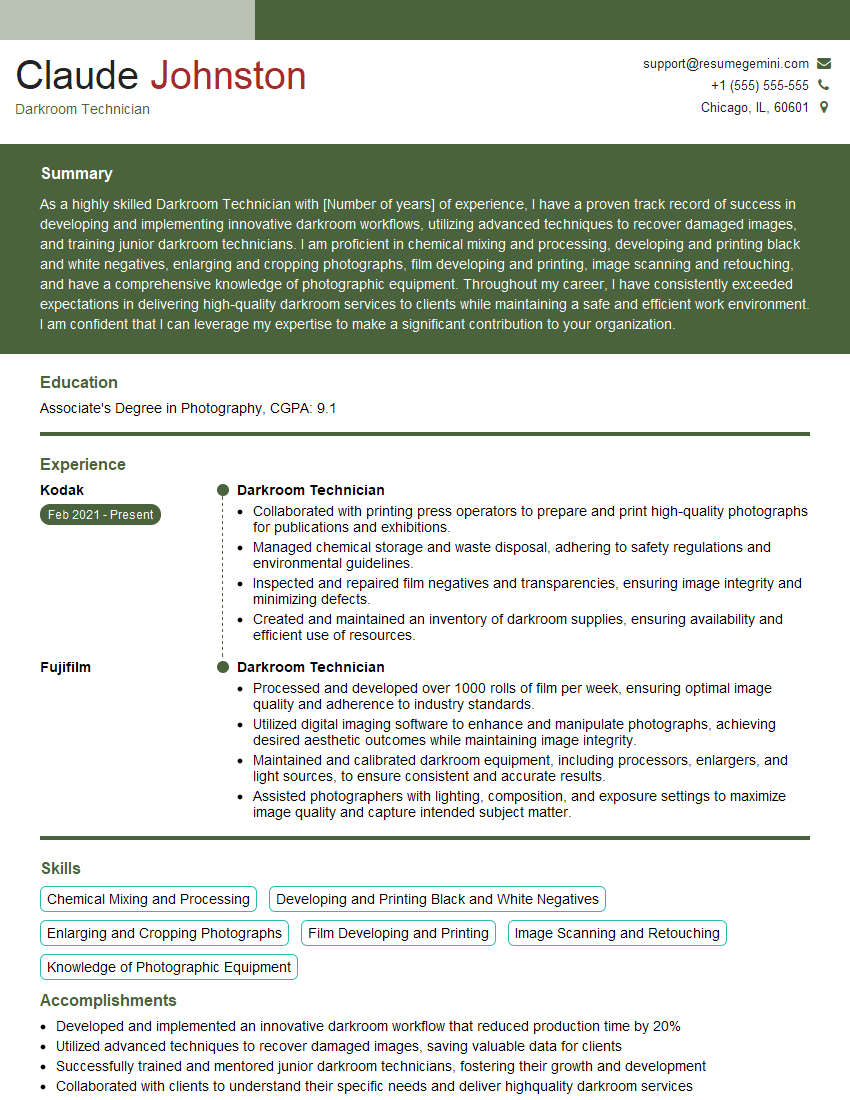
Mastering Traditional Retouching opens doors to exciting opportunities in photography, advertising, publishing, and more. It demonstrates a high level of skill and attention to detail, highly valued in today’s competitive job market. To significantly improve your chances of landing your dream role, creating a strong, ATS-friendly resume is crucial. ResumeGemini is a trusted resource that can help you build a professional and impactful resume. They provide examples of resumes tailored specifically to Traditional Retouching professionals, allowing you to craft a document that showcases your skills effectively and grabs the attention of recruiters. Take the next step towards a successful career; build your best resume with ResumeGemini.
Explore more articles
Users Rating of Our Blogs
Share Your Experience
We value your feedback! Please rate our content and share your thoughts (optional).
What Readers Say About Our Blog
Very informative content, great job.
good