Interviews are opportunities to demonstrate your expertise, and this guide is here to help you shine. Explore the essential Transmission Line Protection interview questions that employers frequently ask, paired with strategies for crafting responses that set you apart from the competition.
Questions Asked in Transmission Line Protection Interview
Q 1. Explain the principle of distance protection.
Distance protection is a transmission line protection scheme that measures the impedance between the relay location and the fault point. It operates on the principle that the impedance seen by the relay changes significantly when a fault occurs on the protected line. Imagine a long electrical cable; the closer a fault is to the relay, the lower the impedance measured. By comparing the measured impedance to pre-defined zones, the relay can determine the location of the fault and trip the circuit breaker accordingly.
The measurement is usually done using voltage and current transformers (VTs and CTs) which provide scaled-down representations of the line’s voltage and current. The relay then calculates the impedance using these signals. The accuracy of this calculation depends on the accuracy of the VT and CTs as well as the relay’s algorithm.
Q 2. Describe different types of distance relays and their applications.
Several types of distance relays exist, each with its strengths and applications:
- Impedance Relays: These relays directly measure the impedance to the fault. They are simple and reliable but can be sensitive to source impedance variations.
- Reactance Relays: These relays measure only the reactive component of the impedance. They are less sensitive to variations in source impedance compared to impedance relays and are often used to improve the selectivity of protection schemes.
- Mho Relays: These relays use a circular impedance characteristic and are well-suited for long transmission lines where the impedance changes significantly along the line. They offer good sensitivity and can prevent tripping for faults outside the protected zone.
- Offset Mho Relays: These relays are a modification of the mho relay. By offsetting the impedance characteristic, the relay can provide better discrimination between in-zone and out-zone faults.
- Distance Relays with directional elements: Most distance relays incorporate directional elements, preventing the relay from operating for faults that originate in the opposite direction of the protected line segment. This directional feature increases the reliability and selectivity of the protection system.
Applications of these relays vary depending on the line characteristics and system configuration. For example, impedance relays might be suitable for short lines with relatively constant impedance, while mho relays are better suited for long lines with varying impedance.
Q 3. What are the advantages and disadvantages of using digital protection relays?
Digital protection relays have revolutionized transmission line protection, offering significant advantages over their electromechanical predecessors:
- Enhanced Functionality: They can perform advanced calculations, including adaptive protection algorithms, allowing for better fault identification and faster clearing times.
- Increased Accuracy: Digital relays offer higher accuracy in measuring voltage and current, leading to improved selectivity and reliability.
- Self-Diagnostics: They perform continuous self-tests and provide diagnostic information to aid in maintenance and troubleshooting. This reduces downtime and improves overall system reliability.
- Flexibility and Adaptability: Their settings can be easily modified and adapted to changing system conditions. This is crucial in a dynamic power grid.
- Communication Capabilities: Digital relays can communicate with other protection devices and SCADA systems, enabling advanced monitoring and control.
However, there are also some disadvantages:
- Higher Initial Cost: Digital relays are generally more expensive than electromechanical relays.
- Complexity: Their sophisticated algorithms and extensive functionalities can make them more complex to configure and maintain.
- Cybersecurity Concerns: Digital relays are susceptible to cybersecurity threats, requiring robust security measures to protect them from malicious attacks.
Q 4. How does a differential protection scheme work for transmission lines?
Differential protection is based on the principle of current balance. Current transformers (CTs) are installed at both ends of the transmission line. Under normal operating conditions, the currents entering and leaving the line are essentially equal. The differential relay compares the currents measured by the CTs at both ends. If there is a significant difference (indicating a fault within the protected zone), the relay trips the circuit breakers at both ends, isolating the faulted section.
To account for minor current imbalances due to CT inaccuracies and load currents, a percentage bias is often implemented. The relay allows a small difference in the measured currents before tripping. This prevents unwanted tripping due to minor imbalances.
A practical example would be a 100MVA transmission line protected by a differential scheme. If a fault occurs, the current flowing into the line won’t equal the current flowing out, which is detected by the CTs and the differential relay will isolate the faulted section.
Q 5. Explain the concept of impedance and its role in transmission line protection.
Impedance (Z) is the opposition to the flow of current in an electrical circuit. It’s a complex quantity composed of resistance (R) and reactance (X), represented as Z = R + jX, where ‘j’ is the imaginary unit.
In transmission line protection, impedance plays a crucial role. Distance protection relays directly measure the impedance between the relay location and the fault point. By comparing the measured impedance to pre-defined zones, the relay determines the fault location. A low impedance indicates a fault close to the relay, while a high impedance suggests a fault further away. Understanding the impedance characteristics of the transmission line, including its resistance, inductance and capacitance, is vital for proper setting and operation of distance protection relays. For instance, the length of the protected line directly influences the impedance that will be seen by the relay for different fault locations.
Q 6. What are the common types of faults in transmission lines?
Transmission lines are susceptible to several types of faults, including:
- Phase-to-ground faults (single-line-to-ground): One phase of the transmission line comes into contact with the ground.
- Phase-to-phase faults: Two phases of the transmission line come into contact with each other.
- Phase-to-phase-to-ground faults: Two phases and the ground are shorted.
- Three-phase faults: All three phases are shorted together.
The severity and impact of these faults vary depending on their type and location. Phase-to-ground faults are the most common, while three-phase faults are the most severe, often leading to the most extensive damage and power outages.
Q 7. Describe the coordination between different protection schemes on a transmission line.
Coordination between different protection schemes on a transmission line is crucial to ensure selective tripping, minimizing the extent of outages during faults. It involves setting the operating characteristics of each protection scheme (such as time delays and tripping zones) such that the closest protection device to the fault operates first, while more distant devices remain unaffected. This prevents cascading outages and improves the overall system’s reliability and stability.
For instance, consider a transmission line with distance protection at both ends and backup protection (like a directional overcurrent relay). The distance relays have faster operating times and are set to trip for faults within their respective zones. The backup overcurrent relay is set with a longer time delay to only operate if the distance relays fail to clear the fault. This hierarchical approach ensures that the fault is cleared quickly and effectively, minimizing service disruption.
Effective coordination often involves detailed time-current curves and coordination studies, leveraging software tools to simulate various fault scenarios and ensure appropriate settings are in place.
Q 8. How do you test and commission a protection relay?
Testing and commissioning a protection relay is a critical process ensuring reliable operation. It involves a series of tests, both in the lab and in the field, verifying the relay’s correct function and its proper integration within the overall protection system.
Laboratory Testing: This stage involves verifying the relay’s functionality under various simulated fault conditions. We use specialized test sets that inject precise currents and voltages, mimicking different types of faults like phase-to-ground, phase-to-phase, and three-phase faults. The relay’s response – trip time, operating characteristics – is carefully monitored and compared to the manufacturer’s specifications. This helps to identify any malfunctions or deviations before field deployment.
Field Testing: Once the relay is installed, we conduct field tests to validate its performance in the actual system. This involves energizing the protection zone and performing injections, either through dedicated test equipment or by using controlled switching operations. We also use secondary injection testing, injecting low-level currents into the relay’s current transformers and potential transformers to check the relay’s response. These tests need to be coordinated with system operators to minimize disruption.
Commissioning: This involves integrating the relay into the overall protection system. We verify the correct communication with other relays and the control center, ensuring seamless data exchange. The protection settings are also thoroughly reviewed and documented to confirm they are optimized for the specific line parameters and operating conditions. We also ensure proper coordination with the backup protection schemes.
Example: Imagine testing a distance relay. We would simulate different fault locations along the transmission line, checking if the relay correctly identifies the fault distance and trips within the defined time frame. A failure to do so necessitates further investigation and possibly relay replacement or setting adjustments.
Q 9. Explain the concept of protection system settings and their importance.
Protection system settings are the parameters that define how a protection relay responds to different fault conditions. These settings essentially determine the sensitivity, speed, and selectivity of the protection scheme. They are crucial for ensuring the system’s stability and security.
Importance: Incorrect settings can lead to several issues. Under-reaching settings might not detect faults, resulting in prolonged outages and potential damage to equipment. On the other hand, over-reaching settings could lead to unnecessary trips, causing instability and service interruptions. Therefore, optimized settings are crucial for balancing protection and system stability. Settings must account for factors such as the line’s impedance, fault current levels, and the coordination with adjacent protection zones.
Examples of Settings: For a distance relay, these would include the reach (distance to the fault), time setting, and operating characteristics (e.g., mho, impedance). For a differential relay, settings involve the percentage differential current and the time delay. These settings are usually determined through detailed calculations and simulations, considering the line characteristics, transformer ratings, and coordination with neighboring protection zones.
Practical Application: Imagine a long transmission line. We carefully calculate the distance relay settings to ensure the relay trips only for faults within its designated protection zone, avoiding nuisance trips caused by faults on neighboring lines. The coordination with backup protection ensures that if a primary protection fails, a backup protection will operate to isolate the fault.
Q 10. What is the role of communication in modern transmission line protection systems?
Communication plays a pivotal role in modern transmission line protection systems, enabling faster fault detection, improved system monitoring, and enhanced coordination between protection devices. It facilitates the transfer of data between protection relays, the control center, and other system components.
Role of Communication: Communication allows for advanced functionalities such as:
- Faster Fault Clearing: Relays can communicate with each other, enabling faster tripping decisions. For example, a scheme like a pilot protection scheme uses high-speed communication to detect and clear faults much faster than traditional protection systems.
- Remote Monitoring and Control: Operators can remotely monitor the status of protection relays and the entire system, allowing for proactive maintenance and quick responses to faults.
- Improved Coordination: Communication aids in seamless coordination between different protection zones and devices. This ensures that only the affected section of the system is isolated, minimizing the extent of power outages.
- Advanced Fault Location: Some communication-based protection schemes utilize advanced algorithms to pinpoint the exact location of faults, allowing for targeted repairs and reduced downtime.
Example: A modern substation may use IEC 61850 communication protocol, allowing seamless data exchange between various intelligent electronic devices (IEDs), including protection relays, measurement devices, and control systems. This enhanced communication allows for integrated protection, control, and monitoring functions.
Q 11. Describe the function of a backup protection scheme.
A backup protection scheme is a secondary protection system that operates if the primary protection fails to clear a fault. It’s designed to ensure system security and prevent extensive damage in case of primary protection malfunctions or failures.
Function: Its purpose is to isolate faulted sections of the transmission line when the primary protection fails to operate correctly. This could be due to relay malfunction, communication failures, or incorrect settings. The backup protection aims to provide redundancy and increase the overall reliability of the protection system. It needs to be carefully coordinated with the primary protection to avoid overlapping operations and ensure selective tripping.
Example: Consider a transmission line protected by distance protection as the primary protection. A backup protection scheme might involve a circuit breaker with a time-delayed overcurrent relay. If the distance protection fails to operate during a fault, the backup overcurrent relay will eventually trip the circuit breaker to clear the fault, albeit with a longer time delay. Different backup schemes can be implemented; some are local (within the substation), while others may involve distant protection schemes, which would require more advanced communication systems.
Q 12. What are the challenges in protecting long transmission lines?
Protecting long transmission lines presents unique challenges due to their increased length, higher impedances, and the propagation of travelling waves. These challenges impact the design and implementation of effective protection schemes.
Challenges:
- Increased Travel Time: The time it takes for a fault signal to reach the protection relay increases with distance, impacting the speed of fault clearing. This necessitates the use of high-speed communication systems or advanced protection schemes like pilot protection.
- High Impedance: The high impedance of long lines can affect the sensitivity of conventional protection schemes. Distance relays, which measure the impedance to the fault, need to be carefully set to avoid under-reaching.
- Travelling Waves: Long lines are prone to travelling waves that can trigger false operations of protection relays. Sophisticated algorithms and wave traps are often used to mitigate these effects.
- Communication Issues: Reliable and high-speed communication is essential for coordinating protection devices across long distances. Communication failures can compromise the effectiveness of the protection system.
Mitigation Strategies: Solutions include using high-speed communication systems, employing advanced protection schemes like pilot protection or distance protection with adaptive algorithms, and implementing robust communication infrastructure with backup systems.
Q 13. Explain the concept of power system stability and its relation to protection.
Power system stability refers to the ability of the system to maintain synchronism between generators following a disturbance. Protection systems play a crucial role in ensuring stability by quickly isolating faults and preventing cascading failures.
Relation to Protection: A stable power system is essential for reliable power supply. Protection systems contribute to stability by:
- Rapid Fault Clearing: Quick isolation of faults minimizes the impact on system frequency and voltage, reducing the risk of cascading outages and maintaining stability.
- Preventing Cascading Failures: By selectively isolating only the affected part of the system, protection schemes prevent the propagation of faults to other parts of the network.
- Coordination with Other Control Systems: Modern protection systems often communicate with other control systems, such as automatic generation control (AGC), to coordinate responses and enhance overall stability.
Example: A fault on a transmission line can cause a sudden drop in voltage and frequency. Fast-acting protection relays isolate the fault, preventing a larger-scale collapse of the power system. Without quick fault clearing, the disturbance could propagate, potentially leading to a system-wide blackout.
Q 14. What are the different types of communication protocols used in protection systems?
Various communication protocols are used in protection systems, each with its strengths and weaknesses. The choice of protocol depends on factors like speed requirements, reliability needs, and cost constraints.
Types of Communication Protocols:
- IEC 61850: This is a widely used standard for communication in substations. It offers high-speed, reliable communication and supports interoperability between different vendors’ equipment.
- Modbus: A simple and widely adopted protocol, often used for monitoring and control applications. It’s not as fast as IEC 61850 but offers good reliability and is relatively easy to implement.
- DNP3: Another popular protocol commonly used in power system applications, offering features like security and redundancy. It provides a good balance between speed, reliability, and complexity.
- Ethernet: A common networking protocol that is increasingly being used in protection systems, particularly for high-bandwidth applications. It’s often combined with other protocols like IEC 61850 for more robust solutions.
- Optical fiber communication: Used for long distance communication to overcome the limitations of traditional copper wire communication for high speed data transfer and immunity to electromagnetic interference.
Example: A modern substation might use IEC 61850 for high-speed communication between protection relays and the control center, while Modbus might be used for communicating with older equipment or for simpler monitoring tasks. The choice of protocol is carefully considered based on the specific requirements of the protection system.
Q 15. How does a breaker failure protection scheme work?
Breaker failure protection is a crucial backup scheme in transmission line protection. It’s designed to operate when a circuit breaker fails to trip during a fault, preventing widespread damage and cascading outages. Imagine a scenario where a fault occurs, but the breaker intended to isolate it remains closed. This is where breaker failure protection steps in.
This protection typically involves monitoring the current and/or voltage at the breaker’s terminals. If a fault persists for a predetermined time after the primary protection should have operated (e.g., a distance protection relay), and the breaker hasn’t opened, the breaker failure scheme will initiate a trip command from a backup relay, usually targeting other breakers in the system to isolate the faulty line. This might involve tripping breakers on either side of the faulty breaker to completely isolate the faulted section.
Different schemes exist; some utilize a timer to detect breaker failure, while others use more sophisticated logic based on fault current levels and durations. The key is redundancy – a safety net preventing the catastrophic consequences of a stuck breaker.
Career Expert Tips:
- Ace those interviews! Prepare effectively by reviewing the Top 50 Most Common Interview Questions on ResumeGemini.
- Navigate your job search with confidence! Explore a wide range of Career Tips on ResumeGemini. Learn about common challenges and recommendations to overcome them.
- Craft the perfect resume! Master the Art of Resume Writing with ResumeGemini’s guide. Showcase your unique qualifications and achievements effectively.
- Don’t miss out on holiday savings! Build your dream resume with ResumeGemini’s ATS optimized templates.
Q 16. Explain the importance of protective relay coordination studies.
Protective relay coordination studies are absolutely vital for ensuring the reliable and safe operation of a power system. Think of it as the choreography for your power system’s defense against faults. These studies analyze the operating times of all protective relays in a system to ensure that the correct relays operate in the proper sequence to isolate faults quickly and efficiently, preventing damage and maintaining system stability. Without proper coordination, you risk:
- Incorrect Relay Operation: Multiple relays tripping simultaneously, causing unnecessary outages.
- Delayed Fault Clearance: Faults persisting longer than necessary, leading to equipment damage and potential safety hazards.
- Cascading Outages: A single fault causing a chain reaction of failures across the entire system.
These studies involve detailed simulations using specialized software, considering relay settings, protection zone configurations, and communication delays. The goal is to achieve selective tripping – isolating the fault with the minimum disruption to the rest of the system.
Q 17. What are the safety precautions to be taken while working on transmission line protection equipment?
Safety is paramount when working on transmission line protection equipment. High voltages are involved, and even seemingly minor mistakes can lead to serious injury or death. Here’s a non-exhaustive list of essential precautions:
- Lockout/Tagout Procedures: Always follow strict lockout/tagout procedures to ensure the equipment is de-energized and cannot be accidentally re-energized.
- Personal Protective Equipment (PPE): Wear appropriate PPE, including safety glasses, insulated gloves, arc flash suits (where necessary), and safety footwear.
- Grounding: Properly ground all equipment before commencing work to eliminate the risk of unexpected energization.
- Voltage Testing: Verify that the equipment is indeed de-energized using appropriate voltage testing instruments.
- Training and Competency: Only trained and authorized personnel should work on these systems.
- Permit-to-Work Systems: Adhere to formalized permit-to-work systems, documenting all tasks and safety checks.
- Emergency Response Plan: Ensure an emergency response plan is in place and understood by all personnel.
Safety should never be compromised. It’s not just a set of rules; it’s a mindset and a culture that must be consistently upheld.
Q 18. Describe the different types of protective relay settings.
Protective relay settings are the parameters that determine how a relay responds to different fault conditions. These settings are crucial for achieving selective and reliable protection. They’re typically adjusted to match the characteristics of the specific line or equipment being protected. Common settings include:
- Time Delay (T): The time delay before the relay trips, allowing for coordination with other relays.
- Current Setting (I): The minimum fault current required to trigger the relay.
- Voltage Setting (V): The minimum voltage required to trigger the relay (often used in distance protection).
- Impedance Setting (Z): The impedance level that triggers the relay (used in distance protection).
- Directional Setting: Determines the direction of the fault current; the relay will only trip if the fault is in a predefined direction.
- Sensitivity Setting: How responsive the relay is to small fault currents.
Incorrect settings can lead to misoperation or failure to trip during a fault, so careful planning and testing are crucial.
Q 19. What is the role of a protective relay in fault location?
Protective relays play a vital role in fault location by providing crucial information about the fault’s location and characteristics. While they primarily focus on tripping to isolate the fault, some relays provide additional information. For example, distance protection relays measure the impedance to the fault, and this impedance, along with line parameters, allows for an estimation of the fault’s distance from the relay.
Other types of relays may provide data on fault current magnitude and direction. This information, along with data from other relays and other system monitoring tools, is used by sophisticated fault location algorithms to pinpoint the exact location of the fault. This aids in faster restoration and reduces downtime.
The speed and accuracy of fault location is essential for minimizing the impact of outages and ensuring system stability.
Q 20. Explain the concept of zone protection and its applications.
Zone protection is a fundamental concept in transmission line protection. It divides a transmission line or equipment into several zones, each protected by a separate relay or protection scheme. These zones are typically arranged in an overlapping manner. The idea is that each zone is responsible for protecting its segment and also part of its neighboring segments, ensuring a backup protection scheme.
For example, a line might have three zones: Zone 1 provides immediate protection of the segment closest to the relay; Zone 2 covers a larger area, acting as a backup for Zone 1 and covering part of the adjacent segments; and Zone 3 provides wide-area backup protection. The zones can also extend to neighboring substations or equipment. This multi-layered approach ensures high reliability and helps prevent cascading outages.
Applications include distance protection, pilot protection (for long lines), and backup protection schemes.
Q 21. How do you troubleshoot a malfunctioning protection relay?
Troubleshooting a malfunctioning protection relay requires a systematic and careful approach. It’s a process of elimination, combining diagnostic tools and sound engineering knowledge.
Here’s a potential step-by-step approach:
- Safety First: De-energize the circuit and follow all safety procedures before starting any troubleshooting.
- Review Relay Logs and Events: Check the relay’s internal logs for any fault recordings, error messages, or unusual events that might indicate the problem’s source.
- Inspect Physical Connections: Check for loose connections, damaged wires, or any signs of physical damage to the relay or its associated circuitry.
- Verify Settings: Compare the relay’s current settings against the intended settings. An incorrect setting can cause malfunction.
- Conduct Tests: Use relay testing equipment to check the relay’s operational characteristics, comparing the results to the manufacturer’s specifications.
- Check Input Signals: Verify that the relay is receiving the correct input signals (e.g., current and voltage transformers) from the protected equipment.
- Consult Documentation: Refer to the relay’s technical documentation for fault diagnosis guidance and troubleshooting procedures.
- Seek Expert Assistance: If the problem persists, consider contacting the relay manufacturer’s technical support team or a qualified protection engineer.
Remember, thorough documentation is vital throughout the process. Proper record-keeping aids in future troubleshooting and system maintenance.
Q 22. Describe the impact of harmonics on protection system performance.
Harmonics, which are multiples of the fundamental power frequency (typically 50Hz or 60Hz), significantly impact protection system performance. They introduce distortion into the current and voltage waveforms, leading to inaccurate measurements by protection relays. This inaccuracy can cause several problems:
- False Tripping: Harmonics can trigger overcurrent relays to operate unnecessarily, leading to unnecessary outages. Imagine a scenario where high levels of 5th or 7th harmonics are present. A protection relay designed for a sinusoidal waveform might misinterpret the harmonic distortion as a fault current, resulting in a false trip.
- Delayed Tripping: Conversely, harmonics can mask actual fault currents, leading to delayed tripping or even a failure to trip at all. A significant harmonic component might saturate the current transformer (CT), making the relay underestimate the actual fault current, leading to slow or no response during actual fault conditions.
- Maloperation of Distance Protection: Distance protection relays rely on accurate measurement of impedance. Harmonics can distort the impedance measurements, leading to incorrect operation. In a transmission line, a high level of harmonic current could lead the distance protection relay to believe a fault is closer than it actually is, potentially causing a wider power outage than needed.
- Increased Relay Wear and Tear: Continuous exposure to harmonic distortion can stress the protection relays, leading to faster deterioration and potential malfunctions.
Mitigating these effects often involves using harmonic filters in the power system, selecting protection relays with good harmonic rejection capabilities, and employing sophisticated digital relays capable of advanced signal processing and harmonic filtering techniques.
Q 23. What are the different types of current transformers and their applications in protection systems?
Current Transformers (CTs) are vital components in protection systems, measuring the current flowing through a transmission line or other equipment. Several types exist:
- Wound-type CTs: These are the most common type, consisting of a primary winding (usually a few turns of heavy conductor) and a secondary winding (many turns of finer wire) wound around a ferromagnetic core. The ratio between primary and secondary currents is fixed (e.g., 100:5). They are reliable and robust but can saturate under high fault currents, impacting accuracy.
- Bar-type CTs: These use a conductor bar as the primary winding. The secondary winding is wrapped around the bar, offering a simpler and often more compact design suitable for lower current applications. Their saturation behavior can differ from wound-type CTs.
- Electronic CTs: These use sensors and signal processing to measure the current without a traditional core. They offer several advantages, including better linearity and immunity to saturation. They are crucial in applications with high levels of harmonics, offering a less distortion-prone solution.
Applications depend on the CT type and the specific protection scheme. Wound-type CTs are used extensively for primary protection functions like overcurrent and distance protection. Bar-type CTs may be used in applications requiring smaller physical size or lower currents. Electronic CTs are gaining popularity due to their advantages in handling harmonics and their superior accuracy.
Q 24. What are the different types of voltage transformers and their applications in protection systems?
Voltage Transformers (VTs), similar to CTs, are essential for measuring voltage in protection systems. Several types are available:
- Wound-type VTs: These are traditional transformers with primary and secondary windings, offering voltage transformation with a fixed ratio. Their accuracy is critical for protection schemes requiring precise voltage measurements. These are suitable for most protection applications where accuracy is important, for example, distance protection.
- Capacitor Voltage Transformers (CVTs): These use a capacitor to step down the voltage, then use a smaller, more efficient transformer to further reduce the voltage to a safe level. They are commonly used for measuring high voltages because they are compact and can easily handle high voltages.
- Optical Voltage Transformers (OVTs): These utilize optical fiber technology for voltage measurement, often offering advantages in terms of isolation, increased safety, and improved noise immunity. They are becoming increasingly popular due to their benefits but might have higher cost.
Applications vary based on the voltage level and desired characteristics. Wound-type VTs are used extensively in most applications, whilst CVTs are preferred for high-voltage applications. OVTs are becoming more prominent in modern substations due to their unique advantages.
Q 25. Explain the concept of pilot protection schemes for transmission lines.
Pilot protection schemes enhance the reliability and speed of transmission line protection by using communication channels to exchange information between the relays at both ends of the line. This communication allows the relays to make a more informed decision about the presence and location of a fault.
There are several types of pilot schemes, including:
- Phase-comparison protection: This method compares the phase angles of the fault currents at both ends. A fault will cause a phase difference between the currents; If this difference exceeds a threshold, the relay trips.
- Differential protection: This compares the total current entering the line with the total current leaving the line. In a healthy line, these currents should be almost equal. A significant difference indicates a fault within the protected zone.
- Distance protection with pilot communication: This combines the directional and distance measurement capabilities of distance protection with the communication capabilities of pilot schemes. The pilot communication aids in improving the accuracy of fault location and prevents tripping due to external faults.
The choice of communication channel (power line carrier, fiber optics, microwave) depends on the line length, terrain, and cost considerations. Pilot schemes provide faster tripping times, improved selectivity, and reduce the risk of false tripping compared to conventional protection methods.
Q 26. What are the considerations for selecting protection relays for a specific application?
Selecting the right protection relay is crucial for reliable and efficient grid operation. Several factors must be considered:
- Fault Current Levels: The relay must be rated to withstand the expected fault currents without damage.
- System Configuration: The type of protection scheme (e.g., overcurrent, differential, distance) and the specific needs of the system will dictate the type of relay needed.
- Operating Voltage: The relay must be compatible with the system voltage level.
- Harmonic Content: The relay should possess adequate immunity to harmonic distortion, which are prevalent in modern power systems.
- Communication Capabilities: For pilot protection schemes or integration with supervisory control and data acquisition (SCADA) systems, suitable communication interfaces are essential.
- Relay Settings: Setting the relay parameters such as time delays, current or voltage thresholds is crucial for proper operation and coordination with other protection relays.
- Maintenance Requirements: It’s vital to select relays with minimal maintenance needs to reduce operational costs and downtime.
- Budget and Cost of Ownership: Choosing an appropriate balance between initial cost and long-term operational expenses.
Failure to consider these factors can result in inadequate protection, leading to increased outage times and potential damage to equipment.
Q 27. Describe your experience with different protection relay manufacturers and their products.
Throughout my career, I’ve had extensive experience with several major protection relay manufacturers, including Siemens, ABB, GE, and Schneider Electric. I’ve worked with their various product lines, including numerical relays for both protection and measurement applications. For instance, I’ve worked with Siemens’ SIPROTEC family and ABB’s Relion protection relays for different substation automation projects. My experience includes testing, configuration, and commissioning of these relays within complex transmission line protection schemes, and I’m familiar with their respective strengths and limitations in terms of functionality, communication protocols, and cybersecurity features. I’ve observed that each manufacturer focuses on specific technologies and offers unique features such as advanced algorithms for fault detection and advanced communication protocols for improved integration. This knowledge allows me to select the best-suited protection equipment for specific application requirements, optimizing performance and reliability.
Q 28. Explain how you would approach the design of a protection scheme for a new transmission line.
Designing a protection scheme for a new transmission line is a systematic process involving several steps:
- System Study: This involves analyzing the line’s electrical characteristics (length, impedance, capacitance), fault current levels, and system topology to understand the potential fault scenarios. This is a crucial step to define the scope and needs of the new line.
- Protection Philosophy Definition: Choosing the appropriate protection scheme (e.g., distance protection, pilot protection, combined schemes) based on line length, impedance, and cost. For example, a long transmission line might need a combination of distance and pilot protection schemes for fast and accurate fault clearing.
- Relay Selection: Selecting suitable protection relays based on the chosen protection scheme, fault current levels, harmonic content, and communication requirements. A modern digital relay, for instance, might be favored for its advanced features in harmonic filtering and communication capabilities.
- Relay Coordination: Ensuring that the protection relays at different locations along the line coordinate correctly to ensure that the correct protection devices trip in case of a fault. Relay coordination is crucial for optimizing the protection scheme to provide fast and selective fault clearing.
- Communication Infrastructure Design: If a pilot protection scheme or other communication-based schemes are selected, designing the necessary communication infrastructure (fiber optics, power line carrier, etc.) is crucial. The communication needs to be reliable and fast for efficient protection operation.
- Testing and Commissioning: Rigorous testing and commissioning are essential to verify the proper operation of the protection scheme before energizing the line. This involves testing the relays, communication links, and the overall protection system.
Thorough planning, considering all aspects of the electrical system and potential fault conditions, and using modern protection technologies ensure the reliability and security of the new transmission line.
Key Topics to Learn for Transmission Line Protection Interview
- Distance Protection Schemes: Understand the principles of impedance, reactance, and mho relaying. Explore their application in various transmission line configurations and the challenges in accurately measuring impedance on long lines.
- Differential Protection: Grasp the fundamentals of comparing currents at both ends of the line. Analyze the impact of pilot wire communication and current transformer inaccuracies on relay performance. Consider practical applications in various transmission line configurations.
- Overcurrent Protection: Familiarize yourself with different types of overcurrent relays (inverse time, definite time) and their settings. Discuss the coordination of overcurrent protection with other protection schemes to ensure selectivity and minimize tripping during faults.
- Pilot Protection Schemes: Learn about various communication methods used in pilot protection (power line carrier, fiber optics) and their impact on the speed and reliability of protection. Analyze the advantages and disadvantages of different pilot wire schemes.
- Fault Location Techniques: Understand the methods used to locate faults on transmission lines, including impedance-based methods and traveling wave techniques. Discuss the importance of accurate fault location for rapid restoration of service.
- Protective Relay Coordination: Master the principles of coordinating various protection schemes to ensure selectivity and minimize cascading trips. Understand the use of time-current curves and their application in achieving proper coordination.
- Power System Stability and Protection Interaction: Explore how protection schemes interact with power system stability. Discuss the impact of protection system malfunctions on system stability and the importance of reliable protection.
- Numerical Relays and their Applications: Understand the functioning of numerical relays and their advantages over electromechanical relays. Explore their advanced features, such as adaptive protection and fault recording capabilities.
- Protection of Series Compensated Lines: Learn about the specific challenges in protecting series compensated lines and the unique protection schemes employed to overcome them.
- Protection System Testing and Commissioning: Familiarize yourself with the procedures for testing and commissioning transmission line protection systems, ensuring proper functionality and compliance with standards.
Next Steps
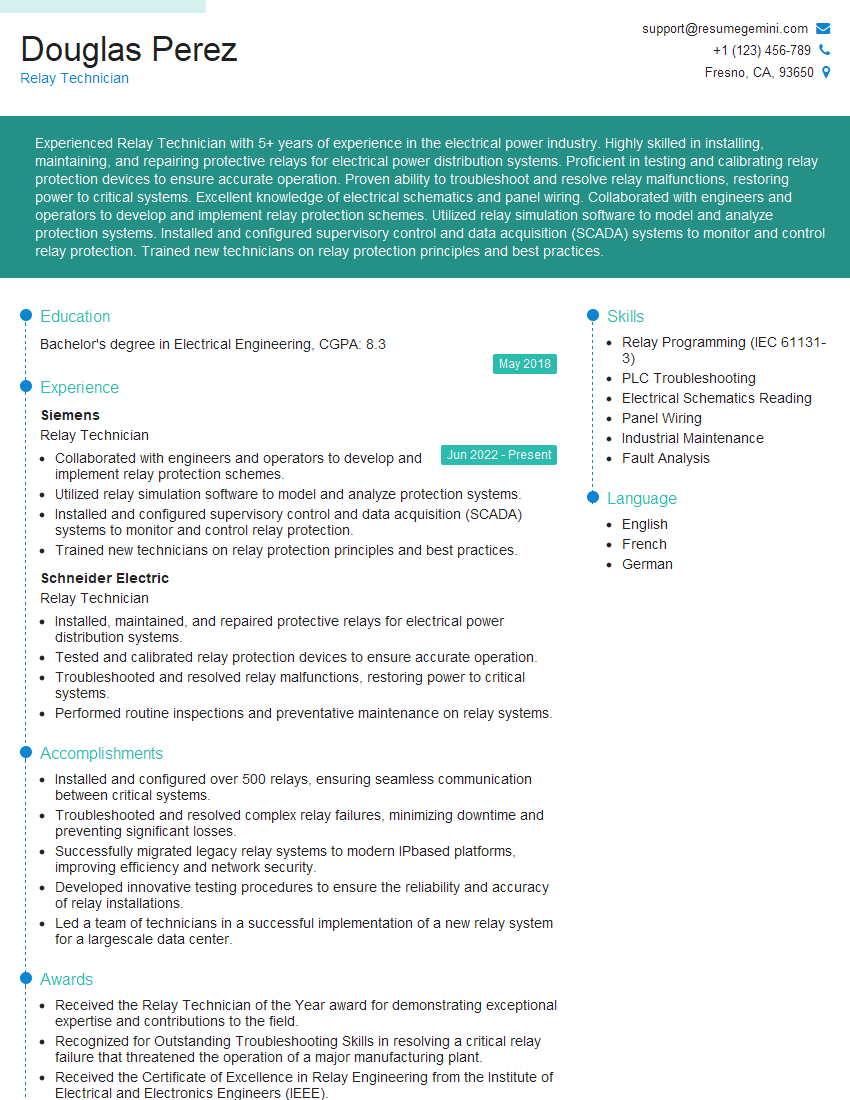
Mastering Transmission Line Protection significantly enhances your career prospects in the power systems industry, opening doors to specialized roles and leadership positions. An ATS-friendly resume is crucial for maximizing your chances of getting noticed by recruiters. To create a compelling and effective resume that highlights your skills and experience in Transmission Line Protection, we strongly recommend using ResumeGemini. ResumeGemini provides a user-friendly platform and offers examples of resumes tailored to Transmission Line Protection to guide you through the process. Invest time in crafting a professional resume – it’s your first impression and a key to unlocking your career potential.
Explore more articles
Users Rating of Our Blogs
Share Your Experience
We value your feedback! Please rate our content and share your thoughts (optional).
What Readers Say About Our Blog
Very informative content, great job.
good