Unlock your full potential by mastering the most common Trapeze Artist interview questions. This blog offers a deep dive into the critical topics, ensuring you’re not only prepared to answer but to excel. With these insights, you’ll approach your interview with clarity and confidence.
Questions Asked in Trapeze Artist Interview
Q 1. Describe your experience with different trapeze techniques.
My trapeze experience encompasses a wide range of techniques, from the fundamental basics to advanced maneuvers. I’ve mastered various catches, including the simple catch, the double catch, and the three-person catch. I’m proficient in different swings – the basic pendulum swing, the controlled backward swing, and the dynamic forward swing, each requiring precise body control and timing. Furthermore, I’m skilled in various dismounts, ensuring safe and graceful exits from the trapeze. I’ve also honed my skills in various aerial transitions, including the ‘flyaway’, the ‘planche’, and various twists and turns, all executed with precision and control. Think of learning the alphabet of trapeze, then constructing increasingly complex sentences and paragraphs of movement. Each technique builds upon the previous ones, creating a beautiful, flowing vocabulary.
For instance, mastering the ‘planche’ requires incredible core strength and balance. It’s like holding a plank but suspended in mid-air! It takes months, even years, of diligent practice to achieve perfect form and control.
Q 2. What safety procedures do you follow during trapeze practice and performance?
Safety is paramount in trapeze artistry. Our practice and performance protocols adhere strictly to established safety standards. Before each practice session, we meticulously inspect all equipment, checking for wear and tear on ropes, straps, and bars. We also ensure that all safety nets are correctly positioned and secure. During practice, we always have a qualified spotter present to guide and assist, and we use safety mats to cushion potential falls. During performances, we have a dedicated safety crew overseeing all aspects of the apparatus and performance area. Regular maintenance and rigorous inspections are crucial in preventing accidents. For instance, we always conduct a detailed equipment check before each show, including a tension test on the ropes and a visual inspection for any signs of wear.
Furthermore, consistent communication between performers is key. During routines, verbal cues and physical signals are used to confirm readiness and position. This ensures everyone is aware of their position and the actions of others, minimizing the chance of collisions or missed catches.
Q 3. Explain your understanding of spotter techniques and their importance.
Spotter techniques are indispensable in trapeze. Spotters provide critical support and guidance, ensuring safety and enabling performers to push their limits while minimizing risks. Their role involves anticipating potential falls, being positioned to provide a safe landing, and offering verbal cues to guide the performer during challenging maneuvers. Effective spotters need exceptional reflexes, strength, and an understanding of the specific skills being practiced. They are there to catch the performer during a missed catch, to guide them into a safe position, and to provide psychological support.
Imagine a tightrope walker; the spotter is analogous to the safety net, providing security and minimizing the risk of a fall. The difference is that a skilled spotter is proactive, anticipating needs and correcting potential errors before they become dangerous.
Q 4. How do you maintain your physical fitness for trapeze artistry?
Maintaining peak physical condition is essential for trapeze artists. My training regimen involves a balanced approach incorporating strength training, cardiovascular exercises, and flexibility work. Strength training focuses on building core strength, upper body power, and lower body stability – crucial for holding poses, executing catches, and controlling swings. Cardiovascular exercises enhance stamina and endurance, vital for high-energy performances. Finally, consistent stretching and flexibility training improve range of motion and prevent injuries.
I incorporate exercises like pull-ups, squats, deadlifts, and planks into my strength training routines. For cardiovascular fitness, I regularly engage in running, swimming, and cycling. Yoga and Pilates are integral for flexibility and core stability. The overall goal is to ensure my body can handle the demands of the training and performance, minimizing the risk of injury. I believe that preventative measures are the key to a long and successful career.
Q 5. Detail your experience with various trapeze apparatus (e.g., single, double, triple trapeze).
My experience extends to various trapeze apparatus. I’m comfortable working with single, double, and triple trapeze, each presenting unique challenges. The single trapeze requires precise body control and balance, focusing on individual skills. The double trapeze involves intricate timing and coordination with a partner, demanding trust and impeccable communication. The triple trapeze adds a further layer of complexity, requiring synchronized movements between three artists, enhancing the dynamic and visual impact of the routine.
Each apparatus requires a different skill set and approach. The single trapeze emphasizes individual strength and control, while the double and triple trapeze build upon that foundation, emphasizing teamwork, timing, and precision. The transition between different apparatus requires adapting to shifting weight distribution, momentum, and the dynamic interaction between performers.
Q 6. How do you handle unexpected events or equipment malfunctions during a performance?
Unexpected events are an inherent part of live performance. My training emphasizes improvisation and quick thinking. If equipment malfunctions, the first priority is safety. We have established procedures for such situations, including immediate cessation of the routine and secure evacuation of the performers. We have backup equipment readily available, and our team is trained to quickly assess and address equipment issues. If a performer experiences an unexpected event, such as a missed catch, we rely on our training and communication to safely navigate the situation, prioritizing a safe landing and minimizing the risk of injury. Years of practice help us to react efficiently and effectively to a range of unexpected situations.
For example, during a recent performance, one of the ropes unexpectedly loosened. My partner and I immediately reacted, altering the planned sequence to safely dismount the trapeze. Our quick response and the immediate action of the stage crew avoided any injury or disruption to the show. It’s these unpredictable events that challenge us to continuously refine our skills and preparedness.
Q 7. Describe your experience with choreography and creating trapeze routines.
Choreography is a vital aspect of trapeze artistry. Creating routines involves translating a creative vision into a series of precise movements. I’ve collaborated extensively with choreographers and fellow performers to design routines that are visually captivating and technically challenging. This process involves combining elements of acrobatics, dance, and storytelling to create a narrative for the audience. The choreography needs to consider not only the technical skill required, but also the flow of movement and the emotional impact it will have on the audience.
For instance, in designing a routine based on the theme of ‘flight’, we would consider movements that evoke the grace of soaring birds, the power of wind, and the freedom of the open sky. The sequence of tricks and transitions would follow a structured arc, building in complexity and emotional intensity. Often, a great deal of experimentation is involved; we might spend hours fine-tuning a single transition or perfecting the timing of a specific trick to achieve the desired fluidity and effect.
Q 8. How do you work effectively with a team (in a flying trapeze act)?
Effective teamwork in a flying trapeze act is paramount to safety and a successful performance. It’s not just about physical coordination; it’s about unwavering trust and precise communication. We rely on a deep understanding of each other’s strengths, weaknesses, and timing.
- Trust and Communication: Before every catch, there’s an unspoken acknowledgment of readiness. A simple nod, a shared glance – these nonverbal cues are crucial. Verbal communication, while less frequent during the actual act, is essential during practice and rehearsals to iron out any timing issues or clarify adjustments.
- Rehearsal and Practice: We spend countless hours rehearsing, perfecting not just individual skills, but the intricate choreography that binds us together. We start with basic elements and slowly increase difficulty, always prioritizing safety.
- Shared Responsibility: Everyone on the team shares responsibility for the overall success – and safety – of the performance. If one person falters, it affects the entire act. This understanding fosters a strong sense of collective responsibility and mutual support.
- Adaptability: During a performance, the unexpected can happen. A slight miscalculation, a change in wind, even a momentary lapse in concentration – these require us to adapt on the fly, relying on our instincts and our trust in one another to compensate.
For example, in a triple-somersault catch, the timing between the flyer’s release, the catcher’s positioning, and the safety net’s placement is crucial. A split-second delay could have disastrous consequences. Years of relentless practice and meticulous choreography reduce the margin of error.
Q 9. What is your understanding of center of gravity and its role in trapeze performance?
Center of gravity (CG) is the point where an object’s weight is evenly distributed. In trapeze, understanding and manipulating your CG is essential for executing controlled movements, maintaining balance, and performing graceful transitions. It’s the key to success in almost every aspect of trapeze performance.
Imagine your body as a seesaw. Your CG is the fulcrum. By shifting your weight, you can control your rotation and trajectory. For instance, to execute a backward somersault, you need to shift your CG towards your head, initiating the rotation. Then, you gradually shift it back to land securely in the catcher’s hands.
Poor CG control leads to instability and increases the risk of accidents. A wobbly swing or an uncontrolled rotation can be dangerous. Mastering your CG allows for precise and controlled movements, enhancing both safety and the aesthetic quality of your performance.
Q 10. How do you manage stage fright or performance anxiety?
Stage fright, or performance anxiety, is a common experience for even seasoned trapeze artists. We combat it through a combination of preparation, mental strategies, and experience.
- Thorough Rehearsal: The more prepared we are, the less anxiety we feel. Rehearsing not just the physical aspects, but also the mental visualization of the performance helps greatly.
- Visualization and Positive Self-Talk: I visualize successful performances in my mind, focusing on the positive aspects and replacing negative thoughts with affirmative ones. I tell myself, ‘I’m ready,’ ‘I’ve trained for this,’ and ‘I can do this.’
- Deep Breathing and Relaxation Techniques: Before a performance, I use deep breathing exercises and mindfulness techniques to calm my nerves and center myself.
- Experience: Over time, experience builds confidence. The more you perform, the less daunting it becomes.
Even though I have years of experience, there will always be a level of adrenaline before a performance. But instead of viewing this as fear, I interpret it as excitement—focused energy that enhances my performance.
Q 11. Explain the importance of body conditioning for trapeze artistry.
Body conditioning is fundamental to trapeze artistry. It’s not just about looking good; it’s about possessing the strength, flexibility, and endurance required for the demanding physical feats involved. Without proper conditioning, you risk injury and limit your potential.
- Strength Training: We focus on building upper body strength, core strength, and grip strength. This is crucial for holding onto the trapeze bar, executing swings, and catching partners.
- Flexibility and Mobility: Flexibility is essential for performing complex maneuvers. We incorporate stretching, yoga, and other flexibility exercises into our training routines.
- Cardiovascular Fitness: Trapeze requires significant cardiovascular endurance. We incorporate cardio workouts to maintain stamina throughout lengthy performances.
- Injury Prevention: Proper conditioning reduces the risk of injuries from the strenuous nature of the sport.
For example, strong core muscles are crucial for controlling your body position during rotations and swings, preventing injuries and enabling more complex maneuvers. Lack of core strength can lead to poor control, increased risk of falls, and decreased ability to perform advanced skills.
Q 12. Describe your experience with different types of trapeze swings and catches.
My experience encompasses various trapeze styles, from the classic single trapeze to the more intricate double and triple trapeze acts, incorporating various catches and swings.
- Single Trapeze: This is the foundation, allowing me to develop fundamental skills like swings, releases, and catches.
- Double Trapeze: Working with a partner requires precise timing, trust, and excellent communication. Catches involving multiple flips and rotations are complex and require significant skill and coordination.
- Triple Trapeze: This is the most complex, involving three people performing synchronized maneuvers. It requires an advanced level of teamwork, timing, and trust.
- Types of Catches: I’m proficient in various catches, including simple catches, single and multiple somersault catches, and seated catches, each demanding different levels of skill and coordination.
- Swings: I’ve mastered a range of swings, from basic pendulum swings to more advanced inverted swings and various rotational techniques.
Each type of swing and catch requires different body mechanics and demands a precise understanding of momentum, trajectory, and balance. For instance, a triple somersault catch requires incredibly precise timing between the flyer, catchers, and spotters.
Q 13. How do you adapt your performance to different venues or audiences?
Adapting to different venues and audiences is a crucial skill. The size of the venue, the audience’s familiarity with trapeze, and even the stage’s lighting can affect our performance.
- Venue Considerations: The height of the rigging, the distance from the stage to the audience, and the overall acoustics of the space all influence our choreography and performance style.
- Audience Engagement: We adapt our performance to engage the audience, whether it’s a sophisticated crowd in a theatre or a family-friendly audience at a fair. We adjust our energy and presentation to suit the atmosphere.
- Technical Adjustments: Lighting adjustments might necessitate altered hand signals or modified timing for safety and visual impact. A smaller space may demand a reduced complexity in our routines.
For example, in a small, intimate setting, we might perform a more subdued, elegant routine. In a large arena, our choreography might be more dynamic and energetic to reach a broader audience.
Q 14. What is your understanding of the risks associated with trapeze work and how do you mitigate them?
Trapeze work inherently involves significant risks, including falls, collisions, and injuries. Mitigating these risks is our top priority.
- Rigging Safety: Regular inspections of the rigging and equipment are critical. Proper weight limits are strictly adhered to, and safety checks are conducted before each performance.
- Warm-up and Conditioning: Thorough warm-up routines prepare the body for the physical demands of the performance. Maintaining excellent physical condition minimizes the risk of injury.
- Spotters and Safety Nets: Spotters play a vital role in catching flyers if they miss a catch and safety nets are properly positioned and maintained to prevent serious injury.
- Rehearsals and Practice: Repeated rehearsals and rigorous practice help improve technique and coordination, reducing the likelihood of accidents.
- Risk Assessment and Contingency Planning: We assess potential risks for each performance and develop contingency plans to address various scenarios, including equipment failure or unexpected circumstances.
Despite all the precautions, there’s always an element of risk. Our commitment to safety is unwavering. Every precaution is taken, and we are highly focused on safety during practice and performance.
Q 15. Describe your experience with solo and group performances.
My experience spans both solo and group trapeze performances. Solo work demands intense focus on individual strength, precision, and artistry. I’ve performed several solo acts, including a challenging ‘triple back flip’ routine that requires immense upper body strength and precise timing. Group performances, on the other hand, necessitate flawless coordination, trust, and communication with my fellow artists. A memorable example is our group routine, ‘The Celestial Dance,’ which involves complex interweaving and coordinated throws, relying on intricate timing and perfect communication amongst the five of us.
- Solo: Emphasizes personal skill, creativity, and physical prowess.
- Group: Prioritizes teamwork, synchronization, and reliance on fellow performers.
Career Expert Tips:
- Ace those interviews! Prepare effectively by reviewing the Top 50 Most Common Interview Questions on ResumeGemini.
- Navigate your job search with confidence! Explore a wide range of Career Tips on ResumeGemini. Learn about common challenges and recommendations to overcome them.
- Craft the perfect resume! Master the Art of Resume Writing with ResumeGemini’s guide. Showcase your unique qualifications and achievements effectively.
- Don’t miss out on holiday savings! Build your dream resume with ResumeGemini’s ATS optimized templates.
Q 16. How do you maintain proper form and prevent injuries?
Maintaining proper form and injury prevention are paramount. This begins with a rigorous training regime focusing on strength, flexibility, and endurance. We incorporate activities like weight training, plyometrics, yoga, and Pilates to build and maintain strength and flexibility in key areas. Before each practice and performance, I perform a thorough warm-up routine, focusing on dynamic stretching and joint mobilization. Crucially, I listen to my body. If I feel pain, I stop and address it immediately. Additionally, I regularly consult with a physical therapist and sports medicine specialist for guidance on injury prevention and rehabilitation.
- Consistent Training: Building strength and flexibility is key.
- Warm-up and Cool-down: Essential for preventing injuries.
- Proper Technique: Correct form minimizes strain.
- Rest and Recovery: Allowing the body time to heal.
Q 17. How do you communicate effectively with your team and director?
Effective communication is the bedrock of successful trapeze work. With my team, it’s a combination of verbal and non-verbal cues. Before each performance, we run through the routine meticulously, identifying potential points of friction and ensuring everyone is on the same page. During performances, we use eye contact, hand signals, and subtle body language to adjust to unexpected situations or minor timing discrepancies. Clear communication with the director is crucial too. This involves regular meetings to discuss the choreography, the overall artistic vision, and feedback. This process of open feedback allows for continuous refinement of our routines.
- Pre-performance Briefing: Discussing potential issues and solutions.
- Non-Verbal Communication: Using hand signals and eye contact during performances.
- Regular Meetings: Open communication with director for feedback.
Q 18. What is your experience with rehearsals and refining routines?
Rehearsals are the heart of our work. We start with the basic elements of each routine, focusing on individual techniques and building up to complex sequences. We use video recordings to analyze our performance, identify areas for improvement, and fine-tune the synchronization. The process involves constant refinement. For instance, in our ‘Grand Finale’ routine, we initially had difficulties with the timing of a specific catch. By slowing it down, practicing it repeatedly, and using slow-motion video analysis, we finally achieved seamless execution. This iterative process of refinement transforms our initial concept into a polished and breathtaking performance.
- Step-by-step Progression: From individual skills to complex routines.
- Video Analysis: Identifying areas for improvement.
- Iterative Refinement: Continuous tweaking for perfection.
Q 19. What specific muscle groups are most important to train for trapeze?
Several key muscle groups are critical for trapeze. Strong shoulders, back, and core muscles are essential for dynamic movements and stability. The latissimus dorsi (lats), trapezius (traps), and rhomboids are vital for pulling movements. A strong core (rectus abdominis, obliques, and transverse abdominis) provides stability and control during spins, twists, and catches. Leg strength is also crucial, particularly in the quadriceps and hamstrings, for strong leg presses during catches and for maintaining balance. We also focus on grip strength in our hands and forearms for secure holds. A comprehensive training program addresses all these areas.
- Upper Body: Shoulders, back, and arms for strength and pulling power.
- Core: For stability and control.
- Legs: For strength and balance.
- Grip Strength: Essential for secure holds.
Q 20. How do you troubleshoot and solve problems during a trapeze routine?
Troubleshooting during a routine requires quick thinking, adaptability, and trust. If a catch is missed, for example, pre-determined backup procedures are vital. We have practiced recovery strategies that maintain safety and allow the routine to continue smoothly, minimizing disruption to the audience. This necessitates clear communication and coordinated responses from every member of the team. Occasionally, unforeseen technical issues, such as a malfunctioning harness, might occur. In these scenarios, we have protocols for immediate response, including signaling to the stage crew or adjusting the routine to avoid risky maneuvers. Safety is always the top priority.
- Backup Procedures: Safety protocols for missed catches.
- Communication: Signaling each other and the stage crew.
- Adaptability: Adjusting the routine to overcome unforeseen issues.
Q 21. Describe your experience with different types of trapeze music and its effect on performance.
Music plays a vital role in setting the mood and enhancing the emotional impact of our performances. We’ve used a variety of styles, from classical to contemporary, depending on the routine’s theme and mood. For example, our dramatic piece, ‘Shadows and Light,’ is accompanied by a melancholic orchestral piece that intensifies the emotional depth of the choreography. Conversely, our upbeat and celebratory finale uses vibrant, fast-paced music to energize the performance and convey joy. The music’s tempo, rhythm, and dynamics directly influence our timing and movements. A careful selection and effective integration of music elevate the artistic experience, creating a richer and more engaging performance.
- Musical Variety: Utilizing different styles to complement different routines.
- Emotional Impact: Music amplifies the mood and storyline.
- Synchronization: Music influences timing and precision.
Q 22. How do you handle criticism and feedback on your performance?
Criticism is crucial for growth in trapeze artistry. I approach feedback constructively, focusing on the actionable insights. I listen carefully, ask clarifying questions, and avoid getting defensive. For instance, if a coach points out a slight hesitation in my release, I analyze the video footage, practice drills to improve my timing, and perhaps adjust my grip or body positioning. I view criticism as an opportunity to refine my technique and enhance my performance.
I maintain a professional demeanor, even when receiving harsh criticism, because understanding the reasoning behind the feedback is more important than the tone of delivery. I prioritize building strong relationships with my coaches and fellow artists, fostering an environment where constructive criticism is welcomed and valued.
Q 23. What is your approach to learning new trapeze skills and techniques?
Learning new trapeze skills involves a multifaceted approach combining dedicated practice, expert guidance, and meticulous analysis. I start with foundational elements, breaking down complex maneuvers into smaller, manageable steps. For example, learning a new catch requires mastering the individual components: the throw, the flight path, and the catch itself. Each is practiced separately before integration.
- Progressive Training: I gradually increase the difficulty, starting with simpler variations and progressing to the complete skill.
- Visual Learning: Observing experienced performers and analyzing video recordings helps me understand proper technique and identify areas for improvement.
- Physical Conditioning:Maintaining peak physical condition (strength, flexibility, and endurance) is critical. I tailor my training to the demands of the specific skill.
- Seeking Feedback: Regular feedback from experienced coaches helps identify weaknesses and refine my technique.
Q 24. Describe a time you had to overcome a challenging technical aspect in a trapeze routine.
During rehearsals for a triple-somersault catch, I struggled with maintaining body alignment during the rotation. The landing was consistently off-balance and risky. I used a systematic approach to address this:
- Identified the Problem: Through video analysis and feedback from my coach, I pinpointed the problem – a slight twist in my body during the final rotation.
- Experimentation and Modification: I tried different approaches to correct the twist, including adjustments to my body posture before the somersault, and slight changes to my momentum during the rotation.
- Repetitive Practice:I practiced the corrected technique repetitively, focusing on maintaining perfect alignment. I started with slow-motion practice to emphasize precision and gradually increased the speed.
- Collaboration: I collaborated with my partner to ensure our timing and synchronization remained impeccable. We practiced the routine section by section until flawless execution.
- Success: Gradually, the issue was resolved through dedicated practice and close attention to detail, resulting in a safe and confident performance.
Q 25. How do you manage your time effectively during rehearsals and performances?
Effective time management during rehearsals and performances is critical. I utilize several strategies:
- Detailed Schedules: I create detailed daily schedules that allocate specific time slots for warm-up, practicing individual skills, working on routines, and rest periods.
- Prioritization: I prioritize tasks based on their importance and urgency. For example, I focus more on challenging aspects of routines during peak energy hours.
- Efficient Practice: I eliminate unnecessary downtime during practice sessions. I focus intently, avoiding distractions and utilizing every minute effectively.
- Pre-performance Checklist: Before performances, I use a checklist to ensure everything is properly prepared (costume, equipment, etc.), to minimize stress and maximize focus.
- Physical Recovery: Adequate rest and recovery are crucial. I ensure I get enough sleep and incorporate stretching and recovery exercises into my schedule.
Q 26. What is your experience with teaching or coaching trapeze?
I have extensive experience teaching and coaching trapeze, primarily focusing on beginner and intermediate students. My teaching philosophy centers on building a solid foundation and progressively introducing more complex techniques. I emphasize safety protocols and proper technique at every stage of learning. I use a combination of demonstrations, verbal instructions, and hands-on guidance. I create a supportive and encouraging environment, fostering confidence and progress among my students. My students have progressed to successfully perform various routines, demonstrating my effectiveness as a coach.
Q 27. Describe your knowledge of trapeze equipment maintenance and safety checks.
Trapeze equipment maintenance and safety are paramount. My knowledge encompasses regular inspections for wear and tear, ensuring all connections are secure and free from damage, and verifying that all safety harnesses and lines are intact and properly adjusted. I understand the critical role of proper rigging and the importance of adhering to safety regulations. I am familiar with the necessary safety checks that must be conducted before each performance or practice session. I regularly inspect ropes for fraying, cracks, or any signs of weakness, and ensure the correct knots are used for secure rigging. Any damaged equipment is immediately taken out of service and reported for repair or replacement. I understand the impact of proper maintenance on safety and the longevity of the equipment.
Q 28. What are your career goals within the field of trapeze artistry?
My career goals involve continuous improvement as a performer and furthering my involvement in the trapeze community. I aim to master increasingly complex routines, push creative boundaries, and potentially choreograph and direct shows. I also aspire to contribute to the safety and advancement of the art form by developing innovative teaching techniques and advocating for improved safety standards. I would love to combine my performance skills with my passion for teaching to mentor and guide aspiring trapeze artists, thus contributing to the next generation of performers.
Key Topics to Learn for Trapeze Artist Interview
- System Architecture: Understand the underlying architecture of Trapeze Artist, including its modules and how they interact. Consider the data flow and the different components involved.
- Data Modeling and Management: Explore how data is structured and managed within Trapeze Artist. Focus on practical applications like data import/export, data cleansing, and data validation.
- Reporting and Analytics: Master the techniques for generating reports and analyzing data within the system. Think about how you’d use this functionality to solve real-world problems and extract key insights.
- Integration with other systems: Familiarize yourself with how Trapeze Artist integrates with other software and databases. Understanding API interactions and data exchange protocols is crucial.
- Troubleshooting and Problem Solving: Practice diagnosing and resolving common issues within Trapeze Artist. Develop a structured approach to troubleshooting, focusing on identifying root causes and implementing effective solutions.
- Security Considerations: Understand the security implications of working with Trapeze Artist and best practices for data protection and access control.
- Customization and Configuration: Explore the possibilities for customizing Trapeze Artist to meet specific business needs. This could involve configuring settings, creating custom reports, or extending functionality.
Next Steps
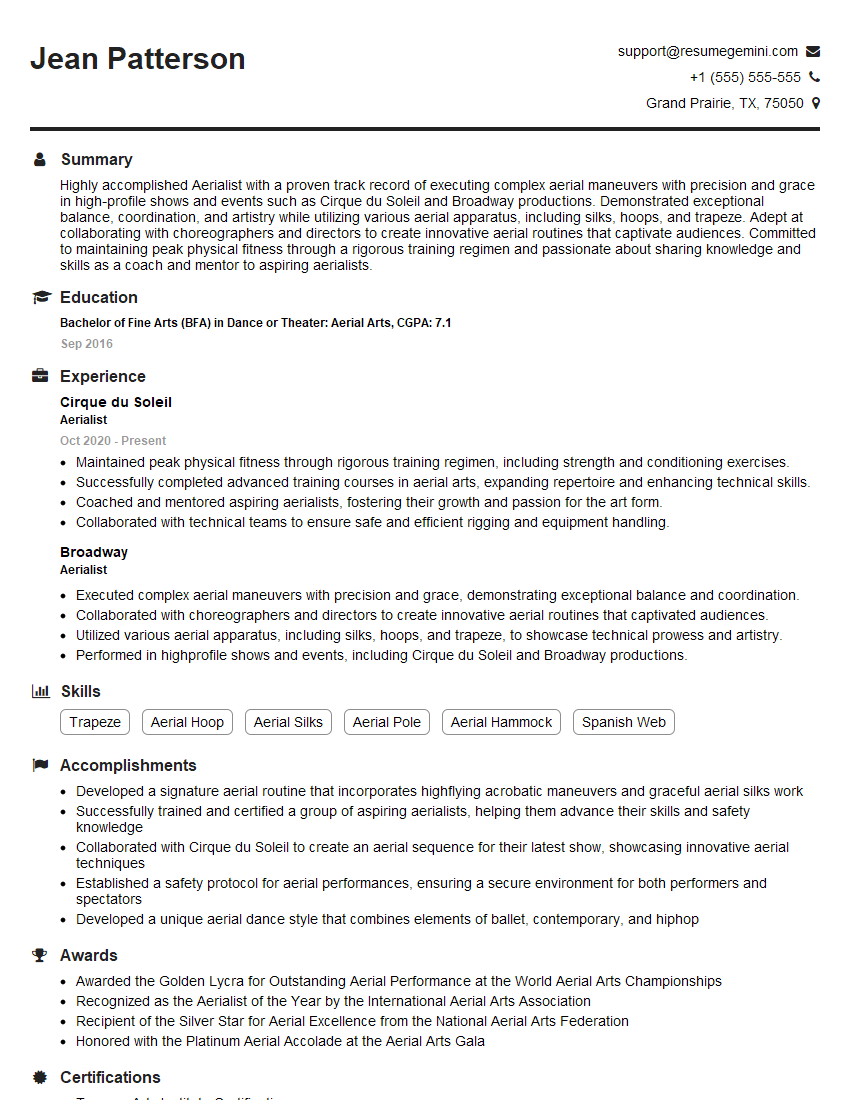
Mastering Trapeze Artist opens doors to exciting opportunities in transportation planning and management. To maximize your job prospects, creating a strong, ATS-friendly resume is essential. This is where ResumeGemini can be a valuable ally. ResumeGemini provides a streamlined and effective way to build a professional resume that showcases your skills and experience. We offer examples of resumes tailored to Trapeze Artist to help you create a compelling application. Take advantage of these resources and make your application stand out!
Explore more articles
Users Rating of Our Blogs
Share Your Experience
We value your feedback! Please rate our content and share your thoughts (optional).
What Readers Say About Our Blog
Very informative content, great job.
good