Cracking a skill-specific interview, like one for Trapping and Imposition, requires understanding the nuances of the role. In this blog, we present the questions you’re most likely to encounter, along with insights into how to answer them effectively. Let’s ensure you’re ready to make a strong impression.
Questions Asked in Trapping and Imposition Interview
Q 1. Explain the concept of trapping in print production.
Trapping in print production is a crucial technique used to prevent unsightly gaps between colors or ink that can appear where two colors meet. Imagine two colored blocks printed next to each other. If the ink isn’t perfectly aligned (which is nearly impossible with high-speed printing), you can see a small white gap between them. Trapping is the process of intentionally overlapping the colors to compensate for this misregistration, ensuring a clean, seamless result. Think of it like adding a tiny buffer zone between colors. This prevents the undesirable ‘knockout’ effect where a color completely disappears where it meets another.
Q 2. What are the different types of trapping techniques?
Several trapping techniques exist, each with its advantages and disadvantages. The most common are:
- Spread Trapping: The most common method. It expands the lighter color into the darker color. This is generally preferred when the darker color is more important, to ensure it maintains its integrity. Think of it like the darker color ‘spreading’ into its neighbour.
- Choke Trapping: The opposite of spread trapping. The darker color is expanded into the lighter color. This is less often used as it’s more likely to result in unwanted color shifts in the lighter area.
- No Trapping (Knockout): This means no overlap occurs between the colors. It’s used only when perfect registration is guaranteed (e.g., digital printing with high-precision machines), or when a precise knockout effect is intentionally desired.
- Advanced Trapping Methods: These involve sophisticated algorithms within prepress software. They analyze the colors and their proximity to determine the optimal trapping amount based on factors like ink density and color contrast. They offer more precise control and are extremely beneficial for complex designs.
Q 3. Describe the process of creating a trapping profile.
Creating a trapping profile involves setting parameters for how colors will overlap during printing. This is often done within RIP software or dedicated prepress applications. The process includes:
- Color Space Selection: Define whether you’ll work in CMYK, RGB, or another color space. CMYK is standard for offset printing.
- Trapping Method Selection: Choose the type of trapping (spread, choke, or advanced).
- Tolerance Definition: Specify the amount of overlap in points or percentage. A value too high can lead to undesirable color shifts, while a value too low can cause gaps. This often requires experimentation.
- Color Pair Settings: Define trapping amounts for specific color combinations. For example, you may choose different trapping values for cyan over magenta versus yellow over black. This provides finer control and addresses potential misregistration issues.
- Testing: Test the profile on a proof to ensure the trapping is effective and visually appealing before sending to press.
Professional prepress operators often create detailed trapping profiles specific to their press equipment and inks to ensure optimal results.
Q 4. How do you handle trapping issues with different color spaces?
Handling trapping issues with different color spaces requires careful consideration. For offset printing, the work must be in CMYK because that’s what the printing presses use. If you start with RGB, conversion to CMYK is necessary *before* trapping. This conversion can sometimes alter color appearance, potentially affecting trapping parameters. Ideally, designs should be created in CMYK from the start. The trapping profile should be configured for the target CMYK space. Software allows for specific adjustments to accommodate variations between different color spaces and printers.
Q 5. What are the advantages and disadvantages of different trapping methods?
The advantages and disadvantages of different trapping methods vary depending on the specific job. Here’s a summary:
- Spread Trapping:
- Advantages: Preserves the integrity of darker colors, generally produces a visually cleaner result.
- Disadvantages: Can lead to slight color shifts in the lighter color.
- Choke Trapping:
- Advantages: Minimizes color shifts in the darker color.
- Disadvantages: More likely to cause noticeable color shifts in the lighter color, often undesirable.
- No Trapping:
- Advantages: Accurate color reproduction if registration is perfect.
- Disadvantages: Very risky without perfect registration, leading to unacceptable gaps.
- Advanced Trapping:
- Advantages: Highly precise, adapts to various situations, less risk of human error.
- Disadvantages: Requires specialized software and expertise; may require more processing time.
Q 6. Explain the role of imposition in the printing process.
Imposition is the process of arranging printed pages in a specific order on a larger sheet before printing. Think of it as a puzzle where the pieces are individual pages and the final image is a press sheet. The goal is to optimize the printing process by maximizing sheet usage, minimizing waste, and ensuring pages are in the correct sequence for easy finishing (folding, binding).
For instance, a book might have pages arranged to fold and bind perfectly once printed.
Q 7. What are the key considerations when imposing a job for different printing methods (e.g., offset, digital)?
Imposition differs significantly depending on the printing method. Key considerations include:
- Offset Printing: Imposition must consider the sheet size, the number of pages per sheet (often multiples of four or eight), and the orientation to optimize ink distribution and reduce waste. Gripper margins are crucial to ensure the press sheet feeds correctly.
- Digital Printing: Usually less stringent than offset printing, as digital presses often handle smaller sheets. The primary focus remains on page order and efficient use of the sheet, but the constraints of the press are less restrictive.
- Large Format Printing: Imposition is crucial in optimizing the arrangement of large format images across several sheets to achieve the final desired size and orientation, often requiring tiling and adjustments to compensate for print head movements.
Imposition software plays a critical role, generating imposition plans that take all these factors into account. The choice of imposition depends heavily on the specifics of the print job and the printing process.
Q 8. How do you ensure proper imposition for different paper sizes and orientations?
Ensuring proper imposition across various paper sizes and orientations involves meticulous planning and utilizing the software’s capabilities. The key is to understand the relationship between your individual pages, the final sheet size, and the printing process. You need to accurately define the media dimensions (width and height) within the imposition software. This includes specifying the bleed (the extra area printed beyond the trim line to account for cutting variations), margins, and the orientation (portrait or landscape) for both the individual pages and the final sheet. For example, if you’re working with a booklet, you’ll need to account for the folding process and ensure that pages are correctly placed to avoid misalignment after printing and binding. Different software packages offer tools like pre-defined imposition templates for common sizes and orientations, making this process much easier. If dealing with a non-standard size, you’ll manually define the sheet size and then arrange the pages accordingly.
Imagine arranging puzzle pieces: Each piece is a page, and the puzzle itself is the final printed sheet. The size and shape of each piece (page) and their arrangement (imposition) need to perfectly fit into the space of the puzzle (sheet).
Q 9. Describe the process of creating an imposition plan using software.
Creating an imposition plan in software typically involves these steps: First, you import your individual pages (usually PDF files). The software then allows you to select the output sheet size and orientation. Next, you choose an imposition scheme. This could be a simple arrangement like a two-up (two pages per sheet) or a more complex one, like a booklet imposition, which involves folding and stitching. Most software offers a selection of pre-built schemes, simplifying this step. Then you fine-tune the arrangement, paying close attention to bleed and margins. Many software packages offer a visual preview, allowing you to see how the final sheet will look before sending it to print. Finally, you can generate a final imposition PDF, ready for the printer. The process is similar to using a sophisticated digital collage tool with specific constraints determined by your printing requirements and paper specifications.
Example using a hypothetical command (varies significantly based on the software used): impose -input pages.pdf -output finalSheet.pdf -scheme booklet -size 8.5x11Q 10. What are the common imposition software packages?
Several popular imposition software packages exist, catering to various needs and budgets. Some prominent examples include:
- Adobe Acrobat Pro: Offers robust imposition features within its extensive PDF editing capabilities.
- Imposition software specifically designed for print: Examples such as (Note: I cannot provide specific product names due to not endorsing any one product). These often have more advanced features geared towards professional print workflows.
- Prepress workflow software: These sophisticated suites offer integrated imposition modules alongside other prepress functions, including color management and proofing.
The choice depends on factors like budget, existing workflow, and the complexity of the imposition tasks.
Q 11. Explain the concept of imposition workflow automation.
Imposition workflow automation involves integrating imposition software with other systems to streamline the entire process. This typically involves connecting imposition software with a digital asset management system (DAM) or a print management information system (MIS). This automation reduces manual intervention, minimizing errors and accelerating turnaround times. Instead of manually importing files and selecting imposition schemes, the system can automatically pull files from a DAM, apply pre-defined imposition templates based on job specifications, and send the final imposition file to the printer or prepress workflow. Imagine an assembly line—each step, from receiving the files to sending them for print, is automated, making the process far more efficient.
Q 12. How do you handle imposition challenges with complex page layouts?
Complex page layouts can present significant imposition challenges. For example, dealing with multi-column layouts, irregular page sizes, or pages with significant bleed areas often requires careful planning and attention to detail. Software’s ‘n-up’ features (placing multiple pages on a single sheet) can help with standard arrangements, but complex layouts might necessitate custom imposition templates. Consider using imposition software with advanced features, allowing for manual adjustments and precise control over page placement. You might need to create custom templates or use scripting capabilities to precisely control page placement. One strategy is to break down the complex page into simpler elements, impose these separately, and then combine them in a final step. It’s like constructing a complex model from smaller, manageable modules.
Q 13. How do you check for errors in imposition?
Error checking in imposition is crucial to prevent costly reprints. Before sending to print, carefully review the generated imposition PDF. Use tools within the imposition software to check for:
- Correct page order: Ensure pages are in the right sequence.
- Accurate bleeds and margins: Verify that bleeds are sufficient and margins are as specified.
- Correct orientation: Check that all pages are oriented correctly (portrait or landscape).
- No overlapping pages: Ensure no pages overlap or are misaligned.
- Correct sheet size: Verify that the final sheet size matches the specifications.
Some software provides tools to automatically detect potential errors. A print proof, even a low-resolution digital proof, is also advisable before committing to a large print run.
Q 14. What are the best practices for creating efficient and accurate imposition?
Creating efficient and accurate imposition requires a systematic approach:
- Understanding print specifications: Know your paper size, orientation, finishing requirements (folding, binding), and bleed specifications.
- Using appropriate software: Choose software capable of handling your complexity needs.
- Creating templates: Develop reusable templates for common jobs to reduce setup time.
- Thorough error checking: Perform multiple checks before sending to print.
- Collaboration: Communicate effectively with printers and designers to ensure a smooth process.
- Workflow automation: Utilize automation tools where feasible to streamline the process.
Following these best practices can significantly reduce errors and improve efficiency. Think of it as following a well-defined recipe—measuring the ingredients accurately, using the right tools, and carefully checking the outcome before serving.
Q 15. Explain the relationship between trapping and imposition.
Trapping and imposition are two crucial processes in pre-press preparation for printing, closely intertwined but distinct. Imposition refers to arranging pages of a document in a specific order on a printing sheet to optimize printing efficiency and minimize waste. Trapping, on the other hand, is the process of creating overlaps between adjacent color areas to prevent unwanted gaps or misregistration between colors during printing. Think of imposition as the blueprint of how pages are arranged, and trapping as the insurance policy against color discrepancies.
The relationship lies in that the imposition dictates where the trapping needs to occur. If two colors meet on the edge of a page, the imposition shows that those colors will be adjacent on the printing sheet, necessitating trapping to prevent a gap. Therefore, effective trapping relies heavily on accurate imposition information.
Career Expert Tips:
- Ace those interviews! Prepare effectively by reviewing the Top 50 Most Common Interview Questions on ResumeGemini.
- Navigate your job search with confidence! Explore a wide range of Career Tips on ResumeGemini. Learn about common challenges and recommendations to overcome them.
- Craft the perfect resume! Master the Art of Resume Writing with ResumeGemini’s guide. Showcase your unique qualifications and achievements effectively.
- Don’t miss out on holiday savings! Build your dream resume with ResumeGemini’s ATS optimized templates.
Q 16. How does the choice of trapping method affect imposition?
The trapping method chosen significantly impacts the imposition process. For instance, using spread trapping, where the overlapping color is spread across both colors, requires more careful consideration of imposition, as the spread may affect the registration marks and page edges. With choke trapping, where one color is slightly reduced, the imposition needs to account for this reduction to avoid unwanted color shifts at page boundaries. No trapping, while simpler, requires higher precision printing and potentially more waste if misregistration occurs. Therefore, the imposition software needs to be aware of the trapping method selected to make necessary adjustments to the sheet layout.
For example, if you are using spread trapping for a booklet with lots of two-color spreads, you might need extra space on the imposition to accommodate that spread, compared to a choke trap or no trap approach. In short, the trapping method informs the exact specifications required for the imposition.
Q 17. What are the common issues faced in trapping and imposition and how do you resolve them?
Common issues in trapping and imposition include misregistration (colors not aligning precisely), incorrect page order, insufficient bleed allowance, and improper trapping settings. For instance, an incorrect imposition may lead to pages being printed out of order or upside down. Incorrect bleed settings can result in content being cut off after trimming. Poor trapping settings might leave gaps between colors or result in unwanted color shifts.
- Misregistration: Solved by ensuring accurate calibration of printing equipment, proper setup of imposition software, and appropriate trapping techniques.
- Incorrect Page Order: Solved by meticulously verifying the imposition plan, often using imposition software preview.
- Insufficient Bleed: Solved by increasing the bleed allowance in the design and imposition software before printing.
- Improper Trapping Settings: Solved by consulting the printer’s specifications and using appropriate trapping methods and values in your prepress software.
Proactive problem-solving involves thorough proofing at each stage: a digital proof before imposition and a final color proof after imposition, allowing you to catch errors before printing a large run.
Q 18. How do you ensure consistent color across different pages in an imposed job?
Maintaining consistent color across different pages in an imposed job necessitates meticulous color management throughout the process. This starts with using a consistent color profile for all design files, typically a printer-specific profile. The imposition software should then respect this profile, ensuring that color adjustments made during imposition don’t introduce unwanted variations. Accurate calibration of the printing press is also vital, regularly checking and adjusting color settings to keep them consistent across different sections of the print sheet.
Using a standardized color space like CMYK, rather than RGB, is a key factor. A workflow including soft proofing can greatly reduce the likelihood of surprises. Furthermore, a test print of a few pages representing the color variations across the job helps to validate the consistency of the color reproduction.
Q 19. Describe the process of creating a imposition for a booklet.
Creating an imposition for a booklet involves several steps. First, you need to determine the page count and the size of the final booklet. Next, you decide on the sheet size and orientation that optimally accommodates the pages while minimizing waste. Then, you use imposition software to arrange the pages correctly according to a specific layout (typically a ‘signature’ for efficient folding). This layout will consider the printing sequence (e.g. the first page will be on the last sheet), and correct page orientation for proper binding.
For example, a 16-page booklet might be imposed on a sheet with two sets of 8-page signatures, each folding in half and then in half again. The software will automatically arrange the pages to achieve this, and importantly ensure the proper orientation and order for the folded pages. It’s a complex process that requires careful attention and often iterative refinement to achieve an efficient, waste-minimizing solution.
Q 20. Explain the differences between imposition for sheetfed and webfed printing.
Imposition for sheetfed and webfed printing differs significantly due to the fundamental differences in the printing presses. Sheetfed presses print on individual sheets, requiring imposition that optimizes the usage of these sheets. This usually involves smaller sheets and more focused imposition configurations, maximizing the number of pages per sheet. Webfed presses, on the other hand, print on a continuous roll of paper, necessitating a different approach. Imposition for webfed printing often involves larger, more continuous layouts and focuses on the efficient use of the web width. The imposition accounts for the web’s continuous nature, with pages arranged in a repeating pattern across the width.
In sheetfed, you might be focused on a few pages per sheet and how they are best arranged to get the least amount of waste. In webfed, you might be considering a longer run, focusing on a repeating pattern across the web to accommodate a massive print job.
Q 21. How do you handle imposition for jobs with bleeds and special finishing requirements?
Handling bleeds and special finishing requirements during imposition requires careful planning and precise execution. Bleeds, the extra area printed beyond the trim line, require sufficient allowance in the imposition to prevent content loss after trimming. The imposition needs to accommodate this extra space. Special finishing, such as die-cutting, perforations, or folding, needs to be accounted for in the imposition process. Specific marks and guidelines, often created by the imposition software, are essential to guide the finishing process. For example, die-cutting requires accurate placement of die-cutting marks in the imposition, ensuring that the die-cutting process happens precisely where it is supposed to. Any errors in the placement of these marks will result in incorrectly cut final products.
The imposition software often offers tools to create these marks, and careful collaboration with the finishing department is critical for confirming that the placement and dimensions of these marks are appropriate for the finishing equipment being used.
Q 22. How do you verify the accuracy of your trapping and imposition settings?
Verifying the accuracy of trapping and imposition settings is crucial for a successful print job. It involves a multi-step process combining pre-flight checks, test prints, and careful visual inspection.
Firstly, I always perform a thorough pre-flight check using my imposition software. This involves verifying that all pages are correctly placed, that bleed and margins are accurate, and that the imposition settings (e.g., sheet size, number of pages per sheet, orientation) match the job specifications. This often involves using the software’s built-in proofing features to generate a PDF representation of the final imposed sheet.
Secondly, I generate a test print. This doesn’t need to be a full-scale print; a smaller-scale proof is often sufficient to identify major problems. This proof allows me to visually inspect the trapping (checking for gaps or overlaps between colors) and the overall imposition, ensuring correct page order and alignment. Any discrepancies found at this stage can be corrected before printing the final job, saving time and resources.
Finally, I carefully examine the test print for any inconsistencies. I pay close attention to areas where trapping is crucial, such as fine lines or small text close to color boundaries. I also check for any misalignments or page sequencing errors. This visual inspection allows for a final quality assurance check before proceeding to the full print run.
Q 23. Explain your experience with different imposition software features (e.g., imposition presets, imposition guides).
My experience encompasses a wide range of imposition software features. I’m proficient with using both preset imposition templates and custom imposition guides, depending on the complexity and specific requirements of the project. Preset templates are extremely useful for common job types, like brochures or booklets, offering a quick and efficient way to create an imposition. They save considerable time, especially for repetitive tasks.
However, for jobs with unique specifications or complex layouts, I rely heavily on custom imposition guides. This allows me to precisely control the placement of each page, ensuring accurate registration and minimizing waste. I’ve worked extensively with tools that allow for the creation of custom imposition schemes based on different page sizes, orientations, and binding styles. For instance, I might use guides to create a unique imposition for a multi-panel leaflet with varying image sizes and text blocks or for a gatefold brochure requiring specific page folding order and accurate alignment.
I also have experience with advanced features such as automated imposition tools for jobs with a large number of pages and the ability to generate imposition reports, detailing the page arrangement and overall sheet layout for easy reference and communication with printers.
Q 24. How do you optimize the imposition to minimize paper waste?
Minimizing paper waste during imposition is paramount from both a cost and environmental perspective. This involves a combination of efficient imposition techniques and software features.
The first strategy is to select the most efficient sheet size. For example, using a standard sheet size that requires minimal trimming will reduce waste compared to using a custom size. Choosing the correct imposition scheme, such as nesting multiple pages on a single sheet, is critical. Software often provides tools to optimize the placement of pages to maximize the use of sheet space. For example, some software allows you to ‘nudge’ individual pages within the imposition to fill gaps, improving efficiency.
Furthermore, I always review and adjust the bleed and margin settings. Precise control over bleed reduces the need for large trimming allowances, thus minimizing material wastage. I would also use imposition software’s built-in optimization features that help automatically arrange pages to minimize blank space and optimize sheet usage. For example, using the software’s ‘automatic nesting’ function often results in less waste compared to manual imposition.
Finally, thorough planning and pre-flight checks are essential. This includes accurate assessment of the number of pages, careful selection of sheet size, and understanding of the project’s specific requirements before initiating the imposition process. This proactive approach prevents costly errors and unnecessary paper consumption.
Q 25. How do you troubleshoot common errors related to trapping and imposition?
Troubleshooting trapping and imposition errors requires a systematic approach. I typically start by reviewing the imposition settings in the software, ensuring they accurately reflect the job specifications. This often reveals simple mistakes like incorrect page order, misaligned margins, or inaccurate bleed settings.
If the problem persists, I check the imposition proof for any visual discrepancies. Looking for misaligned pages, gaps between colors, or incorrect page numbers provides visual clues about the root cause. For instance, a consistent gap between two colors across several pages might point towards an issue with the trapping settings, perhaps needing adjustment of the trap amount or type.
Next, I verify the print file itself. This might involve inspecting the file for any inconsistencies or errors. Are the images correctly sized and positioned? Are there any missing or corrupted elements? A pre-flight check of the print-ready PDF can often identify potential problems at this stage. For more complex issues, I may involve the print shop directly, providing them with all the relevant files and settings so they can assess if the issue is related to their equipment or the imposition/trapping file itself.
Documenting each troubleshooting step helps track the process and allows for faster identification of the problem in future projects. Using a combination of technical skills, problem-solving approach and communication helps to overcome various obstacles encountered with trapping and imposition issues.
Q 26. Describe your experience with color management in relation to trapping and imposition.
Color management is inextricably linked to trapping and imposition, especially in projects involving multiple colors or special inks. Inaccurate color management can lead to unexpected color shifts, banding, or trapping issues. I ensure that all images and colors are properly profiled and managed within the workflow, utilizing color profiles that match the printing press’s capabilities.
For example, I would ensure that all colors are converted to a CMYK profile appropriate for the printing press, and that the trapping settings consider the potential color shifts between inks. This often involves using a color management system (CMS) to control the color space conversion throughout the entire process. Understanding the nuances of different color spaces (like RGB and CMYK) and how they interact is essential for preventing color-related issues.
Furthermore, I’ll often create a color-managed imposition proof, ensuring that the colors in the proof accurately represent the final printed output. This helps prevent surprises when the final job is printed, allowing me to catch any inconsistencies in the color before printing a large run.
I also work closely with the print shop to verify their color profiles and ensure that our color management systems align. This collaborative approach eliminates misunderstandings and minimizes potential color differences between the proof and the final printed result.
Q 27. How do you ensure that your trapping and imposition settings are compatible with the printing press?
Ensuring compatibility between trapping and imposition settings and the printing press is crucial for a successful print job. This involves understanding the specific capabilities and limitations of the press, as well as communicating effectively with the print shop.
Firstly, I obtain the press specifications, including the type of press, sheet size capabilities, and color profile information. This data informs the imposition settings, ensuring that the chosen sheet size and page configuration are compatible with the press. If the press has limitations on the size or number of sheets it can handle, then the imposition must adapt accordingly.
Secondly, I communicate with the print shop about the trapping settings. Certain presses require specific trapping techniques, depending on their printing technology and the type of inks used. I make sure that the trapping settings used in the imposition are suitable for the press and ensure it aligns with any specific recommendations from the printer. I might discuss the type of trapping (e.g., spread, choke, or custom trapping) needed to achieve the desired result and avoid any printing defects.
Finally, I always provide the print shop with a detailed imposition proof and a comprehensive list of my settings. This allows them to verify the compatibility of the imposition and trapping settings before proceeding with the print run. Open communication and collaboration is key to prevent compatibility issues and ensure a successful print job.
Q 28. How would you approach a project requiring complex imposition and tight deadlines?
Approaching a project with complex imposition and tight deadlines requires a strategic and organized approach. The key is careful planning and effective time management. I’d start by thoroughly understanding the project’s requirements, including the page count, sheet size, binding style, and any special finishing requirements. This detailed understanding will guide the imposition process.
Next, I would break down the imposition process into smaller, manageable tasks. This could involve creating a detailed imposition plan, outlining the steps required for each stage of the process. I also leverage the imposition software’s automation features to streamline repetitive tasks, significantly reducing the overall time required. For instance, using automated nesting features helps speed up the placement of numerous pages on the sheet.
Simultaneously, I would utilize pre-flight checks at each stage of the process to identify potential issues early on. This proactive approach prevents costly errors and delays caused by problems that only surface near the deadline. For example, a quick pre-flight check after completing the basic imposition would allow for faster identification of any errors and makes correction easier and faster than when closer to the deadline.
Finally, communication with the print shop is crucial to maintain transparency and to address any unforeseen issues promptly. By establishing clear communication channels and providing regular updates, any potential problems can be addressed quickly, and the project can be delivered on time despite the complex requirements.
Key Topics to Learn for Trapping and Imposition Interview
- Color Trapping Techniques: Understanding different trapping methods (e.g., spread, choke, no trap) and their application based on printing processes and substrate. Consider the practical implications of each choice on print quality and registration.
- Imposition Workflow and Planning: Mastering the process of arranging pages for efficient printing, including understanding imposition schemes for different press types (e.g., sheetfed, web). Practice planning imposition for various page counts and formats.
- Prepress Considerations for Trapping and Imposition: Explore the role of software (e.g., Adobe Acrobat, imposition software) in creating accurate and efficient trapping and imposition workflows. Learn about preflighting and quality control checks.
- Troubleshooting Common Trapping and Imposition Issues: Develop problem-solving skills to identify and rectify issues like incorrect trapping, misregistration, and improper page sequencing. Practice diagnosing and fixing common errors.
- Understanding Color Management in Relation to Trapping: Learn how color profiles and color spaces affect trapping results. Understand the importance of maintaining consistency throughout the workflow.
- Different Types of Printing Processes and their Impact: Explore how offset, digital, and flexographic printing impact trapping and imposition requirements. Understand the nuances of each method.
Next Steps
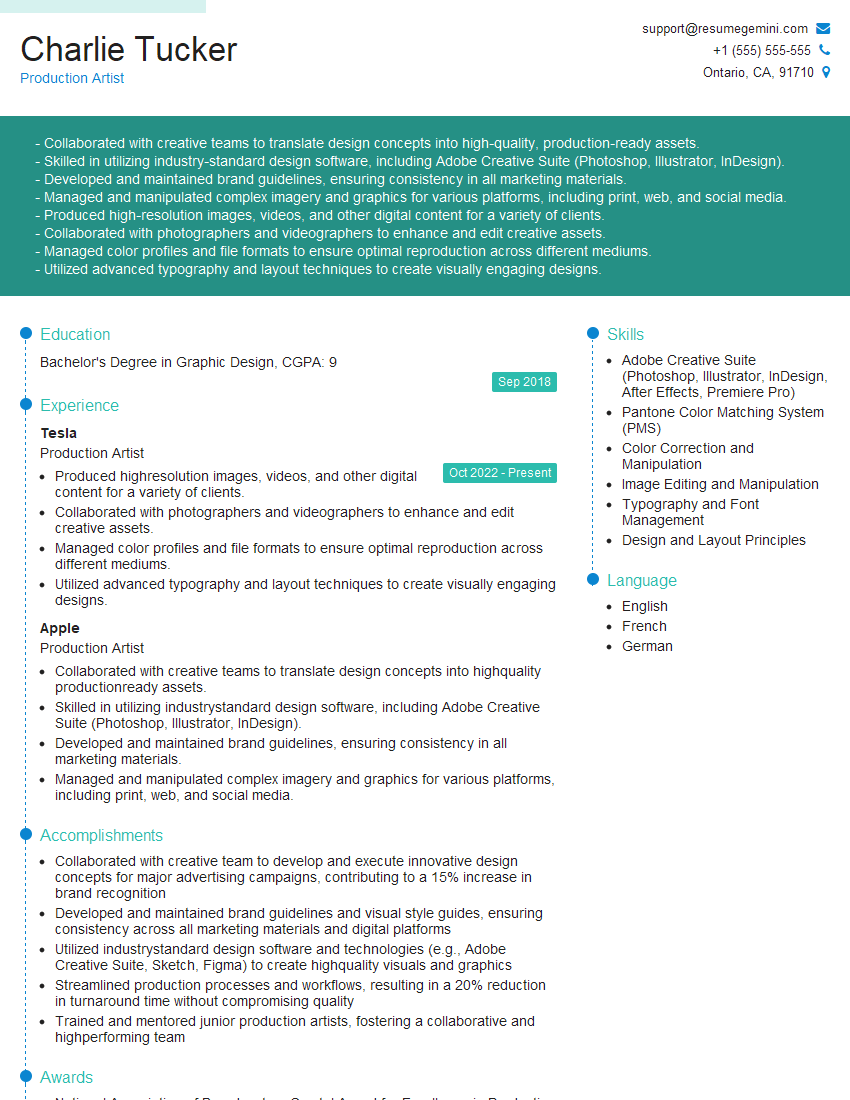
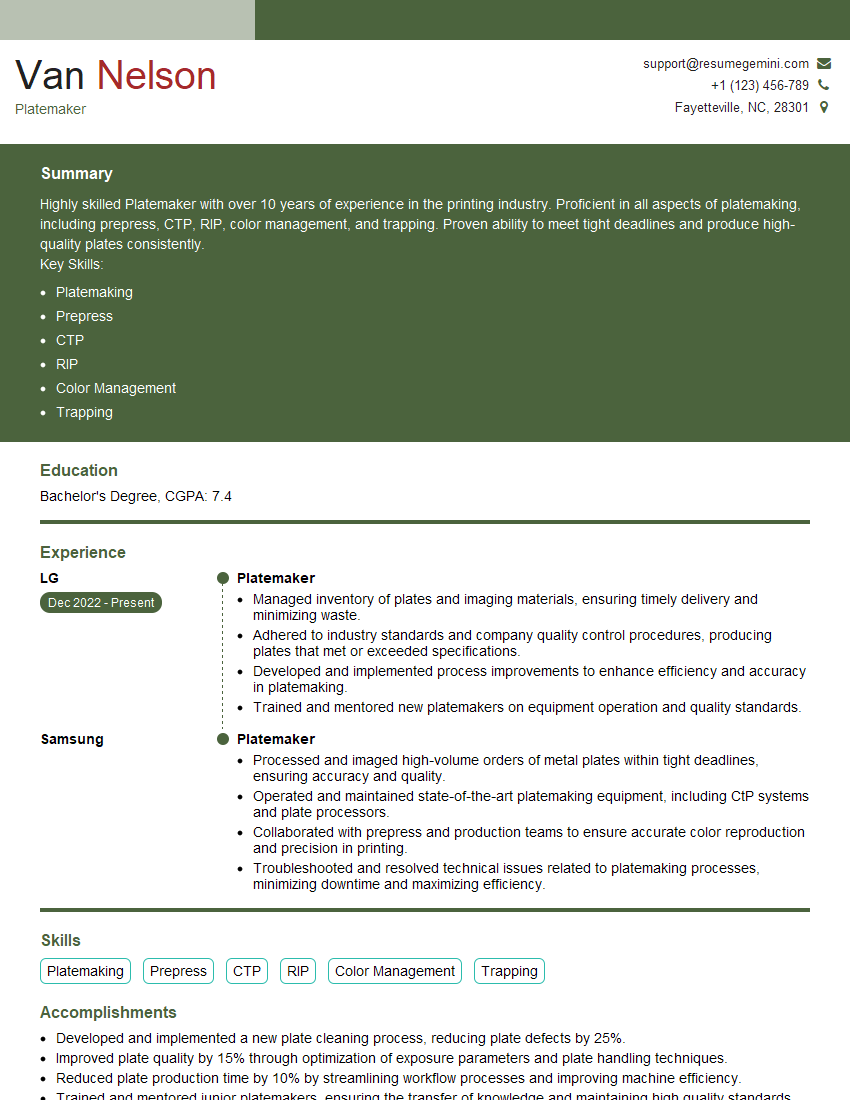
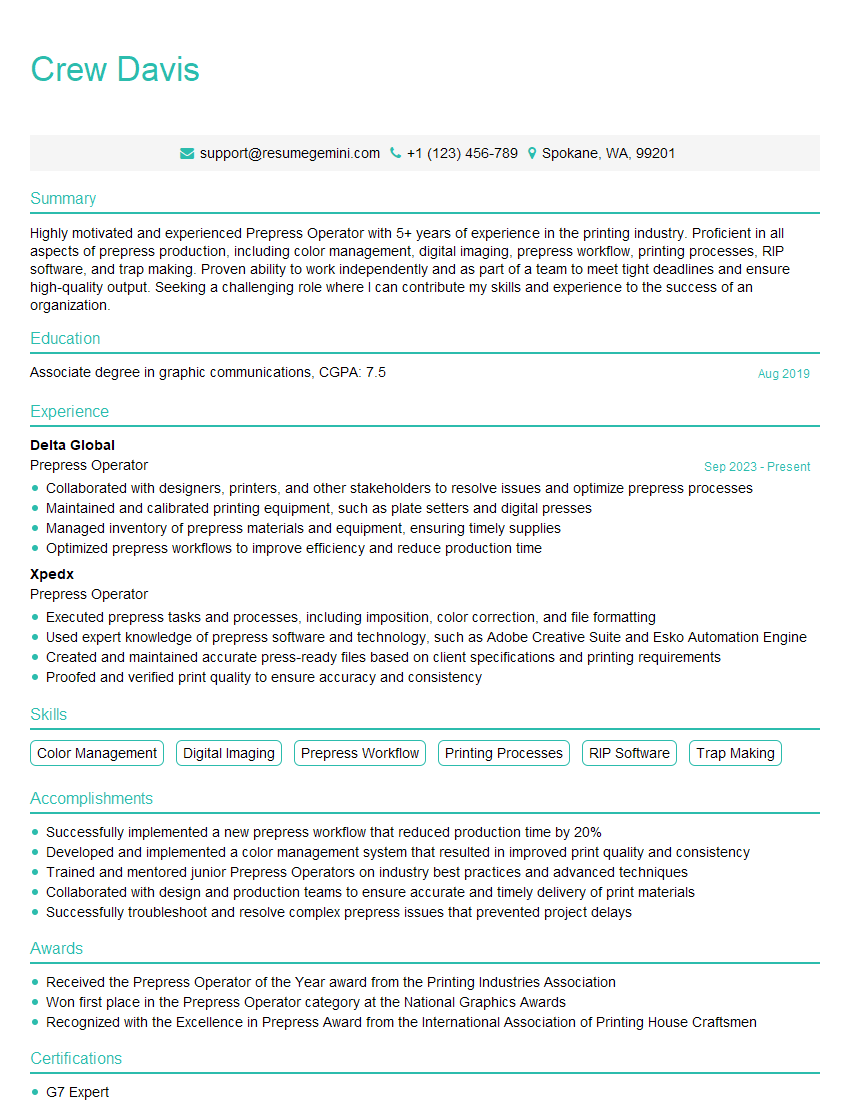
Mastering Trapping and Imposition is crucial for career advancement in the printing and publishing industries. A strong understanding of these concepts demonstrates technical proficiency and attention to detail, qualities highly sought after by employers. To significantly improve your job prospects, creating an ATS-friendly resume is vital. ResumeGemini can help you craft a compelling resume that highlights your skills and experience effectively. ResumeGemini provides examples of resumes tailored to Trapping and Imposition roles, ensuring your application stands out from the competition. Take the next step towards your dream career; build a powerful resume with ResumeGemini today.


Explore more articles
Users Rating of Our Blogs
Share Your Experience
We value your feedback! Please rate our content and share your thoughts (optional).
What Readers Say About Our Blog
Very informative content, great job.
good