Interviews are more than just a Q&A session—they’re a chance to prove your worth. This blog dives into essential Troubleshooting Deburring Issues interview questions and expert tips to help you align your answers with what hiring managers are looking for. Start preparing to shine!
Questions Asked in Troubleshooting Deburring Issues Interview
Q 1. Explain the different methods of deburring.
Deburring, the process of removing sharp edges and projections (burrs) from machined parts, employs various methods, each suited to different materials, geometries, and production volumes. The choice depends on factors like burr size, material hardness, part complexity, and desired surface finish.
- Manual Deburring: This involves using hand tools like files, deburring tools, abrasive stones, and scrapers. It’s ideal for small-scale production or intricate parts where precision is paramount. Think of a jeweler carefully finishing a delicate piece.
- Mechanical Deburring: This utilizes automated machines such as vibratory finishing, centrifugal barrel finishing, or brush deburring. Vibratory finishing uses media in a vibrating tub to gently remove burrs; centrifugal barrel finishing is similar but uses centrifugal force; brush deburring employs rotating brushes to knock away burrs. These methods are excellent for high-volume production of simpler parts.
- Chemical Deburring: This electrochemical process uses chemical solutions to dissolve or etch away burrs. It’s effective for delicate parts or hard-to-reach areas but requires careful control of the chemical process to avoid damaging the part. Imagine carefully cleaning a circuit board.
- Electrochemical Deburring (ECD): A more precise chemical method using an electrical current to remove burrs selectively. It provides excellent control and finish but can be costly and requires specialized equipment.
- Thermal Deburring: This involves heating the part to soften the burrs, followed by a process like tumbling or brushing to remove the softened material. This can be useful for specific materials that are difficult to deburr by other methods.
Q 2. Describe your experience troubleshooting burr-related issues in a manufacturing setting.
In my previous role, we experienced inconsistent deburring quality on a high-volume aluminum casting. Initially, the burrs on the critical mating surfaces were causing assembly issues, leading to rejects and production delays. We started by investigating the root cause, analyzing the machining process and tooling. We discovered that tool wear was contributing to the excessive burr formation.
We implemented a solution involving: 1) A more rigorous tool maintenance schedule, including regular sharpening and replacement. 2) Optimization of the machining parameters (speeds, feeds, and depths of cut) to minimize burr generation. 3) Introduction of a vibratory finishing stage after machining, with carefully chosen media and process parameters to effectively remove the burrs without causing damage to the surface. This multi-pronged approach significantly improved deburring quality, reducing rejects by 75% and improving overall production efficiency.
Q 3. What are the common causes of burrs on machined parts?
Burrs are primarily formed during machining operations. Several factors can contribute to their generation:
- Tool wear: Worn or dull cutting tools are a major culprit, creating ragged edges and significant burrs.
- Improper machining parameters: Incorrect speeds, feeds, and depths of cut can lead to excessive material deformation and burr formation. Think of trying to cut a piece of wood with a dull saw; you’ll get more splinters (burrs).
- Material properties: The material’s ductility and hardness play a role. More ductile materials tend to form larger burrs.
- Workholding issues: Inadequate clamping or vibration during machining can cause the workpiece to move, resulting in uneven cuts and burrs.
- Tool geometry: The geometry of the cutting tool influences the type and size of the burr generated. For example, incorrect rake angle can create larger burrs.
- Chip formation: The way the material chips away during machining can affect burr formation. Long continuous chips can create more burrs compared to broken chips.
Q 4. How do you determine the acceptable level of burrs for a specific application?
Defining acceptable burr levels depends heavily on the application. For example, a burr on a cosmetic part visible to the naked eye might be unacceptable, while a tiny burr on a hidden component of a complex machine might be perfectly tolerable.
We determine acceptable levels through a combination of:
- Drawing specifications: Engineering drawings often specify maximum allowable burr heights or sizes.
- Functional requirements: The intended use dictates the level of surface finish and therefore burr tolerance. For instance, mating surfaces requiring tight tolerances will have much stricter burr limits.
- Safety considerations: Sharp burrs pose a safety hazard, so acceptable levels might be based on preventing injury.
- Testing and analysis: We may use various inspection tools, like microscopes, to accurately measure burrs and assess their impact on functionality.
Often, a thorough risk assessment is performed to weigh the cost of achieving extremely low burr levels against the potential consequences of exceeding those levels.
Q 5. What quality control measures do you use to ensure consistent deburring?
Consistent deburring quality relies on robust quality control measures throughout the process. These include:
- In-process inspection: Regular checks during the deburring process allow for early detection and correction of any issues. This prevents large batches of defective parts. Think of a quality check at each stage of an assembly line.
- Statistical process control (SPC): Monitoring key process parameters (e.g., media type, vibratory time, chemical concentration) using SPC charts helps identify trends and variations, enabling proactive adjustments to maintain consistency.
- Operator training: Well-trained operators are crucial for consistent manual deburring, ensuring they use the right tools and techniques.
- Calibration of measuring instruments: Regular calibration of measuring devices ensures accurate assessment of burr size and surface finish.
- Sampling and inspection: Random sampling of finished parts for inspection against predetermined acceptance criteria ensures the overall quality meets requirements.
- Documentation: Detailed records of the deburring process, including parameters and inspection results, provide traceability and facilitate continuous improvement.
Q 6. How do you select the appropriate deburring method for a given material and part geometry?
Selecting the right deburring method is critical for efficiency and quality. The choice depends on several factors:
- Material: Hard materials like hardened steel might require mechanical or electrochemical deburring, while softer materials like aluminum can be deburred more easily using manual or vibratory methods.
- Part geometry: Complex geometries or hard-to-reach areas may necessitate manual deburring or chemical methods. Simple parts lend themselves well to automated methods.
- Burr size and location: Small burrs can be removed by vibratory finishing, while larger burrs might need more aggressive methods like brushing or milling.
- Production volume: High-volume production benefits from automated methods, while smaller volumes might justify manual methods.
- Surface finish requirements: Methods like chemical or electrochemical deburring offer finer surface finishes than mechanical methods.
- Cost considerations: Manual deburring is labor-intensive, while automated methods require upfront investment in equipment. Chemical methods may have associated chemical disposal costs.
A thorough analysis of these factors is necessary to select the most appropriate and cost-effective deburring method.
Q 7. Describe your experience with automated deburring systems.
I’ve extensive experience with automated deburring systems, including vibratory finishing machines, centrifugal barrel finishing systems, and robotic deburring cells. Automated systems offer significant advantages in terms of consistency, productivity, and reduced labor costs, particularly for high-volume production.
My experience includes:
- Programming and optimizing automated deburring cells: This involves selecting appropriate media, defining process parameters (time, speed, media mix), and troubleshooting issues related to part loading, processing, and unloading. I’ve used both proprietary software and PLC programming for this.
- Implementing and maintaining automated deburring systems: This encompasses aspects like preventative maintenance, troubleshooting malfunctions, and improving overall equipment effectiveness (OEE). I have experience with various types of equipment, including those from different manufacturers.
- Integrating automated deburring systems into existing production lines: This involves careful planning and coordination to ensure seamless integration and workflow optimization.
- Evaluating the performance of automated systems and making improvements: This often involves data analysis to identify bottlenecks, optimize parameters, and improve efficiency.
Automating deburring processes not only enhances productivity but also consistently delivers high-quality results, reducing scrap and rework.
Q 8. How do you identify and resolve issues related to inconsistent deburring quality?
Inconsistent deburring quality manifests as burrs of varying sizes and shapes across parts. This often stems from issues within the deburring process itself. To identify the root cause, we need a systematic approach. First, we’d carefully inspect the parts, documenting the inconsistencies. This involves noting the location, size, and type of burrs – are they sharp, ragged, or rounded? Then, we’d analyze the deburring method – is it manual, automated, chemical, or a combination? For manual methods, we’d evaluate tool condition, operator skill, and consistency of technique. For automated methods, we’d examine machine settings, tooling wear, and the part presentation mechanism. For chemical deburring, bath concentration, time, and temperature need careful scrutiny. Often, inconsistent clamping or part orientation in automated systems contributes to this problem.
Resolving the issue involves addressing the identified root cause. This might involve retraining operators, replacing worn tools, adjusting machine parameters (e.g., speed, feed rate, pressure), recalibrating automated systems, or optimizing the chemical deburring bath. A control chart could be implemented to monitor deburring quality and identify trends over time, allowing for proactive adjustments to prevent inconsistencies from arising.
Q 9. Explain the relationship between deburring and surface finish.
Deburring and surface finish are intimately related; deburring is a crucial step in achieving the desired surface finish. Burrs, which are sharp edges or projections left after machining, are surface imperfections that negatively impact the final surface quality. They can affect the aesthetics of the part, reduce its fatigue strength, and hinder its functionality (especially in applications requiring smooth surfaces or tight tolerances). Effective deburring removes these imperfections, leading to a smoother, more consistent surface finish. The type of deburring method used will also influence the final surface texture. For instance, using a fine abrasive media in vibratory deburring will leave a finer surface finish compared to a coarser media or a manual method. The desired surface finish will determine which deburring method is optimal.
Q 10. What are the safety precautions associated with different deburring methods?
Safety is paramount in deburring. Different methods present unique hazards. For manual deburring, the primary risks include cuts and abrasions from sharp burrs or tools. Proper personal protective equipment (PPE) is crucial—this includes safety glasses, gloves (cut-resistant if necessary), and possibly a face shield depending on the operation. Additionally, ensuring good lighting and a well-organized workspace is vital. With automated deburring (e.g., using robotic systems or high-speed deburring wheels), the hazards include entanglement, crushing injuries from moving parts, and exposure to high-velocity particles. These systems require strict adherence to lockout/tagout procedures during maintenance and thorough operator training. For chemical deburring, the main concerns are chemical burns, inhalation hazards, and environmental impact. Proper ventilation is vital, and operators must wear appropriate respiratory protection and chemical-resistant clothing. Proper disposal of chemical solutions is also critical. A thorough understanding of the Safety Data Sheets (SDS) for all chemicals and processes is a prerequisite.
Q 11. How do you measure the effectiveness of a deburring process?
Measuring the effectiveness of a deburring process involves both qualitative and quantitative assessments. Qualitative assessment involves visual inspection using magnification tools (microscopes, magnifying glasses) to evaluate burr removal and surface smoothness. We’d check for uniformity across the parts. Quantitative assessments are essential for objectivity. This could involve:
- Surface roughness measurement using profilometers or surface roughness testers (Ra values).
- Burr height measurement using optical or contact methods (measuring instruments such as CMMs or microscopes).
- Dimensional inspection to ensure deburring hasn’t altered part dimensions beyond acceptable tolerances.
- Statistical Process Control (SPC) charts to track key metrics over time and to identify trends indicative of problems.
The choice of method depends on the part’s requirements and available resources. A combination of these methods typically provides a comprehensive evaluation.
Q 12. What are the economic considerations related to deburring processes?
Economic considerations in deburring center around balancing cost and quality. The initial investment in equipment (manual tools, automated systems, chemical baths) is a major factor. Operating costs, including tooling and maintenance for automated systems, chemical consumption (for chemical deburring), and labor costs (especially for manual deburring) are all crucial considerations. The efficiency of the deburring process directly affects production time and throughput. Inefficient methods can lead to significant delays and increased production costs. The cost of rework or rejection due to inadequate deburring is also substantial. Therefore, careful process selection—weighing up upfront investment costs against operational costs and the potential for scrap and rework—is vital for maximizing profitability.
Q 13. How do you troubleshoot issues with manual deburring tools?
Troubleshooting manual deburring often involves pinpointing the tool, the technique, or the operator. First, we inspect the tool for damage or wear – dull tools are inefficient and can cause inconsistent results. Replacement or sharpening is needed. Next, we evaluate the operator’s technique. Are they applying consistent pressure and angles? Improper techniques can lead to uneven burr removal or even part damage. Retraining might be necessary. If the burrs are consistently left in specific locations, the part’s design or fixturing may need review— perhaps adjustments to work holding or jig design are needed to provide better access for the tool. Finally, consider the material—some materials are harder to deburr and may require different tools or techniques. A systematic evaluation of tool, technique, and operator skill, coupled with an examination of the part itself, helps solve the problem.
Q 14. Describe your experience with chemical deburring processes.
My experience with chemical deburring encompasses various methods, including acid etching and alkaline solutions. I’ve worked with different chemistries, understanding their strengths and limitations. For instance, acid etching is effective for delicate parts and intricate geometries but requires careful control of parameters to prevent over-etching. Alkaline solutions are often preferred for less sensitive materials. A key aspect of successful chemical deburring is process optimization—determining the optimal bath concentration, temperature, and immersion time to achieve the desired burr removal without damaging the base material. Careful monitoring of the bath’s condition, including pH and concentration, is crucial for maintaining consistent results. Safety protocols, including proper ventilation, PPE, and waste disposal, are strictly adhered to. Furthermore, environmental considerations related to waste management are a critical aspect of any chemical deburring process I manage.
Q 15. How do you handle burrs on complex or delicate parts?
Handling burrs on complex or delicate parts requires a nuanced approach. We can’t simply use aggressive methods that might damage the part. Instead, we employ gentler techniques like hand deburring with specialized tools, such as miniature files, deburring tools, or abrasive media blasting with fine grit. For intricate internal features, we might use specialized brushes, flexible abrasive sticks, or even electro-chemical deburring, which is a very precise method. The key is careful selection of the method based on the part’s geometry and material.
For example, imagine a miniature gear with thin teeth. A power deburring method would likely destroy the gear. Hand deburring with a fine-tipped tool, under magnification if necessary, would be the only safe and effective choice. We also prioritize fixturing to ensure consistent results and protect the parts during the process. Proper fixturing holds the part securely and consistently, minimizing the risk of accidental damage during deburring.
Career Expert Tips:
- Ace those interviews! Prepare effectively by reviewing the Top 50 Most Common Interview Questions on ResumeGemini.
- Navigate your job search with confidence! Explore a wide range of Career Tips on ResumeGemini. Learn about common challenges and recommendations to overcome them.
- Craft the perfect resume! Master the Art of Resume Writing with ResumeGemini’s guide. Showcase your unique qualifications and achievements effectively.
- Don’t miss out on holiday savings! Build your dream resume with ResumeGemini’s ATS optimized templates.
Q 16. What are the different types of burrs?
Burrs are essentially sharp edges or projections left on a workpiece after a machining process like cutting, drilling, or stamping. They come in various forms:
- Rolling Burrs: These are formed by the workpiece material being displaced and rolled over the edge.
- Sheared Burrs: Created by a shearing action, these are typically thin and jagged.
- Fractured Burrs: Resulting from material fracture, these are irregular and often brittle.
- Extrusion Burrs: Formed by the material being forced out from the edges during processes like punching.
Understanding the type of burr is crucial because it dictates the most effective deburring method. A rolling burr might respond well to a simple tumbling process, while a fractured burr might require more careful hand deburring to avoid further damage.
Q 17. How do you optimize a deburring process for increased efficiency?
Optimizing a deburring process focuses on maximizing throughput while maintaining quality. This involves several strategies:
- Process Selection: Choosing the right deburring method (e.g., vibratory finishing, media blasting, electrochemical deburring) based on part geometry, material, and required surface finish.
- Tooling Optimization: Selecting the appropriate tools (e.g., brushes, stones, cutters) and ensuring they’re properly maintained and replaced when necessary. Dull tools extend processing time and reduce quality.
- Automation: Automating the deburring process whenever feasible, using robotics or automated systems. This significantly improves consistency and increases throughput.
- Process Parameter Optimization: Fine-tuning parameters like media size, media concentration (for vibratory finishing), pressure (for blasting), and time. Experimentation and data analysis are crucial here.
- Work Cell Layout: Efficient work cell design minimizes material handling and maximizes workflow. A lean approach focused on reducing waste is key.
For instance, in a vibratory finishing process, adjusting the media type, size, and media-to-part ratio can significantly influence the deburring rate and surface finish. We use statistical methods to identify the optimal parameters for our specific needs.
Q 18. Describe your experience with statistical process control (SPC) in deburring.
Statistical Process Control (SPC) is integral to maintaining consistent deburring quality. We use control charts (e.g., X-bar and R charts) to monitor key process variables such as burr height, surface roughness, and cycle time. By tracking these parameters over time, we can identify trends and potential problems before they escalate into significant quality issues. Control limits help us quickly detect deviations from the process mean, alerting us to potential problems with the deburring equipment, media wear, or operator technique.
For example, a sudden increase in burr height on our control chart could indicate that the vibratory finishing media is worn out and needs replacing, or that a machine needs recalibration. SPC helps us move from reactive to proactive quality control. We also use capability analysis to verify that our deburring process is capable of meeting the required specifications consistently.
Q 19. How do you investigate and resolve customer complaints related to deburring issues?
Investigating customer complaints regarding deburring begins with a thorough understanding of the issue. We gather detailed information from the customer, including photos, part numbers, and specific complaints about the burrs. This is often followed by a thorough visual inspection of the affected parts using microscopes if necessary. We then systematically examine the process: We review process parameters, check tooling, inspect the deburring equipment, and look at the raw material to determine if there were any flaws that caused the problem.
Root cause analysis (RCA) tools like 5 Whys or fishbone diagrams may be employed to identify the underlying causes. Once the root cause is identified, we implement corrective actions and validate those actions through retesting. This information is then documented in a Corrective Action Report (CAR) and shared with the customer.
Q 20. What are the potential consequences of inadequate deburring?
Inadequate deburring can have serious consequences:
- Safety Hazards: Sharp burrs can cause injuries to workers handling the parts or to end-users of the product.
- Functional Issues: Burrs can interfere with the proper functioning of mechanical parts, causing malfunctions or premature wear.
- Aesthetic Problems: Burrs detract from the product’s appearance, especially in industries where surface finish is critical.
- Assembly Difficulties: Burrs can hinder assembly processes, leading to increased production time and costs.
- Reduced Product Life: Burrs can act as stress concentrators, leading to early failure of components.
In short, inadequate deburring can have a significant impact on safety, functionality, cost, and overall product quality.
Q 21. Explain the importance of proper tooling and fixture selection in deburring.
Proper tooling and fixture selection are paramount for effective and consistent deburring. The wrong tools can damage parts or fail to remove burrs completely, leading to rework or scrap. Fixtures ensure parts are held securely and consistently during deburring, eliminating variability and improving repeatability.
For instance, using a stiff brush for deburring a delicate part might damage the surface. Similarly, improper fixturing can lead to inconsistent burr removal, resulting in parts with varying levels of surface finish. We select tooling based on factors such as part geometry, material, and required surface finish, and we design fixtures to hold the parts securely and present the burr consistently to the deburring tool. This methodical approach ensures the process is efficient and high quality.
Q 22. How do you improve the cycle time of a deburring process?
Improving the cycle time of a deburring process involves a multifaceted approach focusing on efficiency and optimization. It’s not just about speeding up individual steps, but streamlining the entire process.
Automation: Replacing manual deburring with automated systems like robotic deburring cells or vibratory finishing significantly reduces cycle time. For example, a robot can consistently deburr hundreds of parts per hour, far exceeding manual capabilities.
Process Optimization: Analyzing each step of the deburring process – from part handling to cleaning – to identify bottlenecks is crucial. This might involve simplifying part fixtures, optimizing tool paths for automated systems, or improving the efficiency of cleaning methods. For instance, switching to a more efficient cleaning solution or implementing a better drying system can save considerable time.
Tooling Selection: Using the right deburring tools for the job is paramount. Selecting tools that are optimized for the material and the specific burr type can dramatically speed up the process. For example, using a specialized deburring tool instead of a general-purpose one can reduce the number of passes required.
Material Selection: If feasible, choosing materials that are less prone to burr formation can simplify and speed up the deburring process. This upstream approach reduces the time spent on deburring later in the process.
Operator Training: Well-trained operators are more efficient. Providing thorough training on proper techniques and the use of specialized tools leads to faster and more consistent results.
By systematically addressing these areas, we can significantly reduce the overall cycle time and improve productivity.
Q 23. Describe your experience with root cause analysis in a deburring context.
Root cause analysis in deburring is crucial for preventing recurring problems. My approach involves a structured methodology, often using the 5 Whys technique or a Fishbone diagram. For example, if parts are consistently coming out with insufficient deburring, I wouldn’t just address the immediate symptom (poor deburring). I’d delve deeper.
Let’s say the initial finding is ‘insufficient deburring.’ I’d then ask ‘Why?’ repeatedly:
- Why 1: The deburring tool is worn.
- Why 2: The tool isn’t being replaced frequently enough.
- Why 3: The maintenance schedule is inadequate.
- Why 4: The maintenance personnel haven’t received proper training.
- Why 5: The training program lacks sufficient practical exercises.
This process helps identify the underlying cause – inadequate training – allowing me to implement targeted solutions, such as creating a comprehensive training manual with hands-on sessions, instead of just replacing the tool.
I also use data analysis techniques. Tracking metrics such as deburring time, reject rates, and tool wear provides insights into potential issues, allowing for proactive interventions.
Q 24. What are some common mistakes to avoid when deburring?
Common mistakes in deburring often lead to inconsistent results, increased reject rates, and damage to parts. Some key mistakes to avoid include:
Using incorrect tools or techniques: Applying excessive force or using inappropriate tools for the material or burr type can damage the part or leave behind incomplete deburring.
Insufficient training: Operators lacking proper training may use inefficient techniques, leading to longer cycle times and inconsistent results.
Ignoring safety precautions: Deburring can involve sharp tools and rotating machinery; neglecting safety protocols can lead to injuries.
Poor part handling and fixturing: Improperly holding or fixing parts during deburring can lead to inconsistent results or damage.
Neglecting preventative maintenance: Ignoring tool maintenance can lead to premature tool wear, reducing deburring efficiency and quality.
Lack of process control: Without proper monitoring of the deburring process, inconsistencies in quality are likely to go unnoticed until it’s too late.
Avoiding these common pitfalls through proper training, process control, and meticulous attention to detail is essential for achieving high-quality deburring consistently.
Q 25. How do you train others on proper deburring techniques?
Training others on proper deburring techniques is a crucial aspect of ensuring consistent quality and safety. My approach involves a blended learning strategy, combining theoretical instruction with extensive hands-on practice.
Classroom instruction: This covers the theory behind deburring, different deburring methods, tool selection, safety protocols, and quality control checks. I emphasize the importance of understanding the material properties and burr characteristics.
Hands-on training: This is where trainees learn by doing. I start with demonstrations on various materials and burr types, showcasing best practices. Then, supervised practice sessions allow them to develop their skills under my guidance. I provide individualized feedback and address their specific challenges.
On-the-job training: Once trainees have mastered the basics, I encourage them to deburr parts under my supervision. This allows them to gain experience in a real-world setting and to address any specific challenges they might encounter.
Assessment and feedback: Regular assessments and feedback sessions help track progress, identify areas requiring further improvement, and provide ongoing support.
This multi-faceted approach ensures that trainees develop a thorough understanding of proper deburring techniques, enhancing both their skills and the overall quality of the deburring process.
Q 26. Describe a time you had to significantly improve a deburring process.
In a previous role, we were struggling with inconsistent deburring quality on a high-volume production line, resulting in high reject rates. The existing manual process was slow, prone to errors, and unreliable. The cycle time was excessively long and the quality was inconsistent. Our initial reject rate was around 15%.
My solution involved a three-pronged approach:
Process Analysis: I thoroughly analyzed the current process, identifying bottlenecks and inefficiencies. This involved studying the tools used, the operator techniques, and the overall workflow.
Automation Implementation: We implemented a robotic deburring cell equipped with specialized tooling. This addressed the inconsistency issue and drastically reduced cycle time.
Operator Retraining: We retrained the operators on the new system, focusing on quality control and maintenance procedures. The training also covered data logging and troubleshooting.
The results were remarkable. We reduced our reject rate from 15% to under 2%, significantly improved cycle time, and increased overall production efficiency. This project demonstrated the power of a systematic approach to process improvement, combining technological advancements with focused operator training.
Q 27. How do you stay current with the latest advancements in deburring technology?
Staying current with the latest advancements in deburring technology is essential for maintaining a competitive edge. I achieve this through several methods:
Industry Publications and Journals: I regularly read industry publications and journals that focus on manufacturing and machining technologies. This keeps me updated on the latest research and innovations.
Trade Shows and Conferences: Attending trade shows and conferences allows me to interact with industry experts, see new technologies in action, and learn about the latest trends.
Online Resources and Webinars: I utilize various online resources, including webinars and manufacturer websites, to learn about new products and techniques. This is a convenient way to stay informed about new developments.
Networking: Networking with other professionals in the field through industry groups and online forums allows for the exchange of knowledge and insights.
Continuing Education: I actively participate in continuing education opportunities such as workshops and specialized courses, to deepen my knowledge and skills.
This multi-pronged strategy ensures I remain abreast of the latest trends and technologies in deburring, enabling me to contribute effectively to process optimization and problem-solving.
Q 28. What are your strengths and weaknesses related to deburring?
My strengths in deburring lie in my deep understanding of the processes, my analytical skills for root cause analysis, and my ability to train and mentor others. I am adept at identifying inefficiencies, implementing improvements, and using data to drive decision-making. My experience with various deburring technologies, both manual and automated, makes me highly versatile.
A potential area for development is my experience with some of the newer, more specialized deburring technologies. While I am proficient in many established techniques, expanding my expertise in this area would further enhance my skillset. I actively seek opportunities to learn about these emerging methods through the avenues mentioned previously.
Key Topics to Learn for Troubleshooting Deburring Issues Interview
- Deburring Processes: Understanding various deburring methods (mechanical, chemical, electrochemical) and their applications in different industries.
- Defect Identification: Mastering the ability to visually inspect parts and identify common deburring defects like burrs, flash, and surface imperfections. This includes understanding the root causes of these defects.
- Process Parameters: Knowing how to adjust parameters such as pressure, speed, and tooling to optimize the deburring process and minimize defects. This includes understanding the impact of different materials on process parameters.
- Tooling and Equipment: Familiarity with various deburring tools (e.g., brushes, media, cutters) and equipment, including their maintenance and proper usage. Troubleshooting malfunctions in these tools.
- Material Science Basics: Understanding the properties of different materials and how they affect the deburring process. This includes knowledge of material hardness, machinability, and surface finish requirements.
- Quality Control: Implementing and interpreting quality control measures to ensure consistent deburring results and meet specifications. This includes understanding statistical process control (SPC) techniques.
- Troubleshooting Methodologies: Applying systematic troubleshooting approaches such as the 5 Whys or Pareto analysis to identify and resolve deburring issues efficiently.
- Safety Procedures: Understanding and adhering to relevant safety regulations and procedures for operating deburring equipment and handling materials.
- Preventive Maintenance: Understanding the importance of preventive maintenance schedules for deburring equipment and how to implement them effectively.
Next Steps
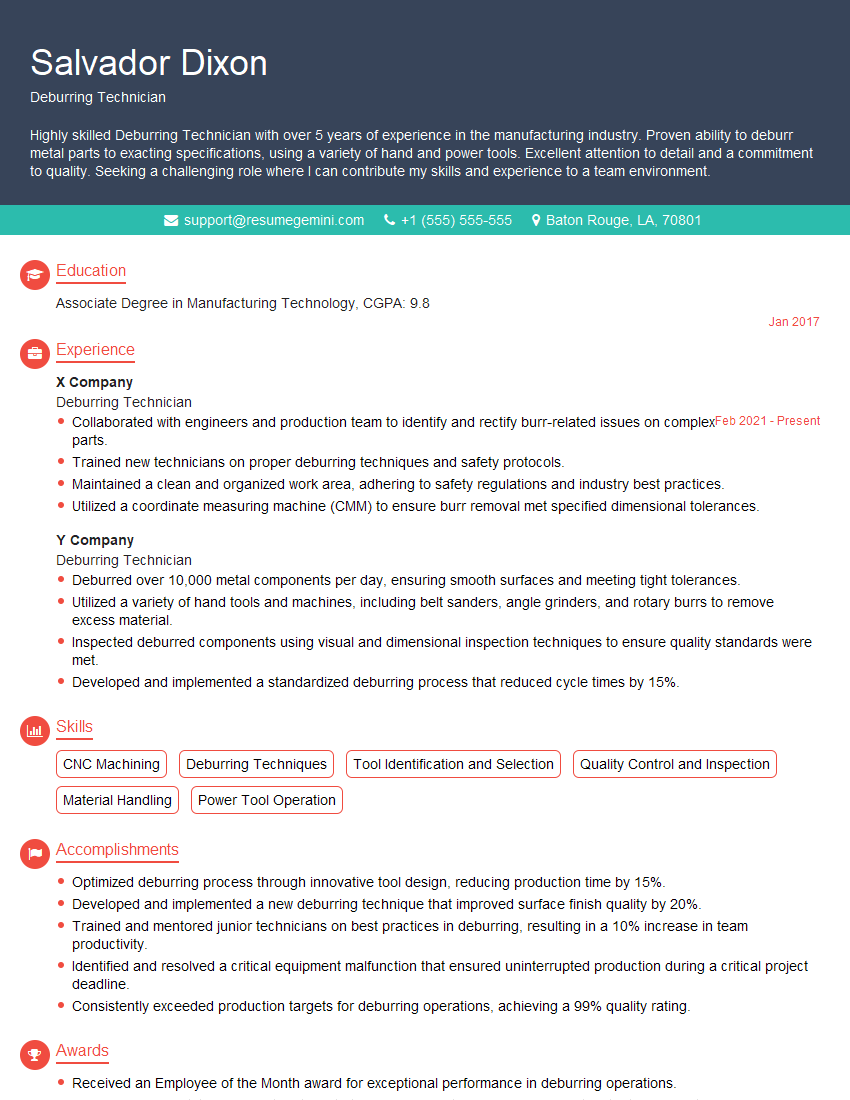
Mastering troubleshooting in deburring significantly enhances your problem-solving skills and demonstrates a crucial skillset highly valued in manufacturing and engineering roles. This expertise directly translates to increased efficiency, reduced waste, and improved product quality – all leading to career advancement opportunities. To maximize your job prospects, focus on crafting an ATS-friendly resume that highlights your skills and experience effectively. ResumeGemini is a trusted resource that can help you build a powerful, professional resume tailored to the specific requirements of your target roles. Examples of resumes tailored to Troubleshooting Deburring Issues are available for your review, showcasing how to present your expertise in the most compelling way.




Explore more articles
Users Rating of Our Blogs
Share Your Experience
We value your feedback! Please rate our content and share your thoughts (optional).
What Readers Say About Our Blog
Very informative content, great job.
good