Interviews are more than just a Q&A session—they’re a chance to prove your worth. This blog dives into essential Understanding of customs regulations interview questions and expert tips to help you align your answers with what hiring managers are looking for. Start preparing to shine!
Questions Asked in Understanding of customs regulations Interview
Q 1. Explain the difference between Harmonized System (HS) codes and tariff classifications.
The Harmonized System (HS) and tariff classifications are closely related but distinct. Think of the HS as the foundation, a globally standardized system of names and numbers used to classify traded products. It provides a six-digit code for every product. Tariff classifications, on the other hand, build upon the HS. Each country then takes the six-digit HS code and adds its own national-specific digits to create a more detailed classification, determining the specific duty rates and regulations for that product within that country. So, the HS code is the international standard, while the tariff classification is the country-specific application of that standard.
Example: A six-digit HS code for ‘coffee’ might be 090111. The US might then add its own digits to create a more precise tariff classification, potentially differentiating between different types of coffee beans. This ensures that a specific type of coffee faces the correct tariffs, based on the country’s specific rules.
Q 2. Describe the process of classifying goods under the Harmonized System.
Classifying goods under the HS is a multi-step process. It usually begins with identifying the product’s description and its essential characteristics. Then, you consult the HS Nomenclature, a detailed book that organizes products systematically. The process involves carefully reading the descriptions and notes within the HS to determine the most accurate classification. It often requires an understanding of the product’s material composition, manufacturing process, and intended use. If there is ambiguity, legal interpretations and rulings might be necessary, and you should seek guidance from customs authorities or a customs broker.
Step-by-step example: Imagine classifying a wooden chair. You would look for the section related to ‘furniture,’ then check the more specific categories until you find the precise classification that best matches the chair’s material and construction. You’ll likely consult headings, subheadings, and accompanying notes. The process requires close attention to detail because one wrong digit can lead to significant financial implications.
Q 3. What are the key elements of a customs declaration?
A customs declaration is a crucial document submitted to customs authorities when importing or exporting goods. It’s like a detailed inventory listing everything that’s being moved across borders. Key elements include:
- Shipper and Consignee Information: Full details of both the exporter and importer.
- Detailed Description of Goods: Precise description, quantity, and HS code for each item.
- Country of Origin: Where the goods were manufactured or produced.
- Incoterms: Defines the responsibilities of the buyer and seller regarding delivery.
- Value of Goods: The declared value for customs purposes – often used to calculate duties and taxes.
- Mode of Transport: How the goods are being shipped (sea, air, land).
- Supporting Documents: Commercial invoice, packing list, certificates of origin, etc.
Accuracy is paramount; errors can cause delays and penalties.
Q 4. What are the potential penalties for customs violations?
Penalties for customs violations can be severe and vary significantly based on the nature and severity of the violation, as well as the country’s regulations. Common penalties can include:
- Financial Penalties: Fines significantly exceeding the value of the goods involved.
- Seizure of Goods: Confiscation of the goods in question.
- Criminal Charges: In cases of fraud or serious violations, criminal prosecution can result in imprisonment.
- Import/Export Restrictions: Future import/export privileges might be suspended or revoked.
- Legal Fees and Costs: The importer or exporter might bear the costs of legal proceedings.
Example: Underdeclaring the value of imported goods to avoid paying higher duties is a serious offense that can lead to substantial penalties. This highlights the critical importance of accurate and honest reporting.
Q 5. Explain the concept of ‘Rules of Origin’ and their importance in international trade.
Rules of Origin (ROO) determine the origin of a product, which is crucial in international trade. They specify the criteria used to identify where a product has been produced, essentially proving that it’s ‘made in’ a specific country or region. This is important for many reasons:
- Trade Preferences: Many free trade agreements grant preferential tariffs (lower or zero duties) only to goods originating from member countries.
- Non-Tariff Barriers: Some countries restrict or prohibit imports of certain products unless they meet specific ROO requirements.
- Trade Statistics: Accurate origin determination contributes to reliable trade data.
- Consumer Protection: Consumers might place a value on the origin of products based on quality, ethical concerns, or branding.
ROO are often determined based on where the product was substantially transformed, using criteria such as where the final assembly took place or the value added in different locations. For example, a product partially manufactured in one country and fully assembled in another might be considered originating in the latter country under the value-added criteria.
Q 6. How do free trade agreements impact customs duties?
Free Trade Agreements (FTAs) significantly impact customs duties by reducing or eliminating them on goods traded between participating countries. FTAs create preferential tariff rates or even duty-free access for qualifying goods, stimulating trade by lowering costs for importers and exporters. Think of it as a special deal that member countries make amongst themselves, simplifying cross-border commerce. The impact is substantial, making products more competitive and fostering economic growth within the participating nations.
Example: Under the USMCA (United States-Mexico-Canada Agreement), many goods traded between the US, Mexico, and Canada now face significantly reduced or eliminated tariffs, compared to imports from outside the trade bloc.
Q 7. What are the different types of customs duties and taxes?
There’s a variety of customs duties and taxes, which often depend on the country and the type of goods. Some common examples include:
- Ad Valorem Duties: A percentage of the goods’ value.
- Specific Duties: A fixed amount per unit of goods (e.g., per kilogram or per item).
- Compound Duties: A combination of ad valorem and specific duties.
- Anti-Dumping Duties: Applied to goods sold below their normal market value to protect domestic industries.
- Countervailing Duties: Imposed to offset government subsidies in the exporting country.
- Value Added Tax (VAT) or Goods and Services Tax (GST): Indirect taxes levied on the value added at each stage of production and distribution.
- Import Excise Taxes: Taxes imposed specifically on certain imported goods.
Understanding these different types of taxes is essential to accurately calculate the total cost of importing or exporting goods.
Q 8. Explain the process of obtaining a customs bond.
Obtaining a customs bond is crucial for importers and brokers to ensure compliance with customs regulations. It’s essentially a financial guarantee that you will pay any duties, taxes, or penalties owed to the customs agency. The process varies slightly depending on the country, but generally involves these steps:
- Determine the type of bond needed: Different types exist, such as single-entry bonds (for a single transaction), continuous bonds (for multiple transactions), and specific bonds (for particular activities).
- Choose a surety company: These companies act as guarantors, vouching for your ability to meet your financial obligations. You’ll need to provide financial information to the surety company for assessment.
- Complete the bond application: This will require information about your business, the type of goods you import/export, and the bond amount (determined by the customs agency based on your estimated import/export value).
- Pay the bond premium: The surety company charges a premium for issuing the bond – this is a percentage of the bond amount and covers their risk.
- Submit the application and supporting documents to the customs agency: This typically includes the completed application form, proof of business registration, financial statements, and the surety bond itself.
- Receive approval and bond number: Once approved, you’ll receive a bond number, which you’ll need to provide when importing or exporting goods.
For example, a small business importing furniture might need a continuous bond, allowing them to handle multiple shipments without needing a new bond each time. A large corporation might require a more complex bond structure tailored to their specific trade activities. Failure to secure the appropriate bond can result in significant delays and penalties.
Q 9. Describe your experience with customs audits.
I’ve been involved in numerous customs audits throughout my career, both as an importer and as a consultant advising businesses on compliance. Audits can range from targeted reviews of specific transactions to comprehensive examinations of a company’s entire import/export history. My experience has taught me the crucial role of meticulous record-keeping. For example, one audit involved a client who had inadvertently misclassified some goods. While the error wasn’t intentional, it led to underpayment of duties. The thoroughness of their documentation, despite the error, allowed us to quickly rectify the situation and minimize the penalties. On the other hand, poor record-keeping can significantly complicate an audit and increase the likelihood of substantial penalties. In another case, a lack of clear documentation meant we spent weeks reconstructing the transactions. It highlighted the value of a robust documentation system, making future audits significantly easier and reducing potential financial liabilities. My approach to audits focuses on proactive preparation – ensuring all documentation is readily accessible and accurate.
Q 10. How do you stay updated on changes in customs regulations?
Staying updated in the dynamic world of customs regulations is paramount. I employ a multi-pronged approach:
- Subscription to relevant industry publications and newsletters: These provide regular updates on changes in regulations, rulings, and best practices.
- Active monitoring of government websites: Customs agencies frequently publish updates, announcements, and new regulations on their websites.
- Attendance at industry conferences and webinars: These offer invaluable opportunities for networking and learning about the latest trends and challenges.
- Engagement with customs brokers and legal experts: These professionals can provide insights into complex regulations and offer guidance on compliance strategies.
- Utilizing specialized software and databases: Many software solutions offer updates on customs regulations and assist in classifying products and generating necessary documentation.
Think of it like learning a new language; consistent engagement and various learning methods are necessary to become truly fluent.
Q 11. What are some common challenges faced in international trade compliance?
International trade compliance presents a unique set of challenges. Some common hurdles include:
- Classification of goods: Determining the correct Harmonized System (HS) code for products is critical, but can be complex and often requires expert knowledge. Incorrect classification can lead to significant penalties.
- Rules of origin: Establishing the origin of goods for preferential tariff treatment (like free trade agreements) is crucial, but the criteria can be intricate and require careful documentation.
- Sanctions and embargoes: Compliance with international sanctions and embargoes is essential, and requires careful screening of trading partners and goods.
- Documentation requirements: Accurate and complete documentation is crucial, but different countries have different requirements, increasing the complexity.
- Currency fluctuations: Changes in exchange rates can impact the cost of imports and exports, creating challenges in financial planning.
- Customs valuation: Determining the correct value of goods for customs purposes is vital and can be complex, involving various methods and adjustments.
Each challenge requires a unique problem-solving approach, often involving consultation with experts and leveraging available technology to minimize risks.
Q 12. How would you handle a discrepancy between your import documentation and customs requirements?
Discrepancies between import documentation and customs requirements are a common issue. My approach involves:
- Immediate identification and assessment: First, thoroughly assess the nature and extent of the discrepancy.
- Thorough review of documentation: Examine all relevant documents (invoices, packing lists, certificates of origin, etc.) to pinpoint the source of the problem.
- Communication with customs officials: Contact customs authorities to explain the situation and seek clarification or potential solutions.
- Amendment or correction of documentation: If possible, correct the error and submit the amended documentation. This may involve contacting the supplier for clarification or correction.
- Negotiation with customs: In some cases, negotiation may be necessary to reach a mutually acceptable resolution. This might involve paying additional duties or penalties, or seeking an alternative classification.
- Documentation of all communication and actions: Maintain a detailed record of all steps taken, including communication with customs and any agreements reached.
For example, if a product’s description on the invoice doesn’t fully match the HS code description, I would immediately contact the supplier to clarify the details and rectify the discrepancy. Clear and efficient communication with the customs authorities is critical in minimizing potential delays and penalties.
Q 13. What is the importance of accurate record-keeping in customs compliance?
Accurate record-keeping is the cornerstone of customs compliance. Think of it as the foundation of a building; if it’s weak, the entire structure is at risk. Comprehensive records provide:
- Evidence of compliance: During audits, records demonstrate adherence to regulations, minimizing the risk of penalties.
- Support for claims: Detailed records are crucial for supporting claims related to customs valuation, classification, or duty drawbacks.
- Improved efficiency: Well-organized records streamline processes, facilitating quick access to information during audits or other customs-related matters.
- Reduced risks: Accurate record-keeping minimizes the risk of errors and omissions, lowering the chance of penalties.
- Enhanced internal control: A strong record-keeping system provides better oversight of import/export operations, identifying potential weaknesses and areas for improvement.
Maintaining a system with clear documentation of all import/export transactions, including invoices, packing lists, commercial documents, and any correspondence with customs authorities, provides peace of mind and helps in mitigating potential risks.
Q 14. Explain the process of filing a customs protest.
Filing a customs protest is a formal process used to challenge a customs agency’s decision. It’s a crucial mechanism for addressing potential injustices or errors made during the import/export process. The process generally involves:
- Review of the customs decision: Carefully review the customs decision to understand the reasons for the action.
- Determine grounds for protest: Identify valid grounds for challenging the decision, such as incorrect classification, valuation errors, or procedural irregularities.
- Prepare a formal protest: Draft a detailed and well-supported protest outlining the reasons for the challenge and providing evidence to support your claims.
- File the protest within the specified timeframe: Each country has specific deadlines for filing protests, so it’s crucial to adhere to these timelines.
- Submit required documentation: Include all relevant supporting documents, such as invoices, certificates of origin, and any evidence supporting your claims.
- Await the customs agency’s response: The customs agency will review the protest and issue a decision.
- Consider further legal action: If the protest is unsuccessful, further legal action might be considered, such as appealing to a higher court.
It’s important to note that successful protests require meticulous preparation and compelling evidence. Seeking legal counsel is often beneficial, especially for complex cases. Filing a protest is a serious step, and needs to be undertaken strategically.
Q 15. How familiar are you with different customs procedures (e.g., drawback, temporary import)?
I possess extensive familiarity with a wide range of customs procedures. These procedures are crucial for the smooth flow of goods across international borders and are often complex, varying significantly between countries. Some key procedures I’m highly proficient in include:
- Drawback: This allows importers to recover duties paid on imported goods that are subsequently exported, either in their original form or after processing. For example, an importer of raw materials used in manufacturing a final product for export could claim a drawback on the initial import duties.
- Temporary Importation: This allows the temporary entry of goods into a country without the payment of duties, under the condition that they are re-exported within a specified timeframe. A common example is bringing in exhibition materials for a trade show. The goods are used temporarily and then returned to their country of origin, avoiding permanent import taxes.
- In-bond Transit: This allows goods to move under customs control from one point to another within a country or between countries without being subject to import duties until they reach their final destination. Imagine a large shipment of goods that needs to be transported across several countries before reaching its ultimate buyer.
- Free Trade Agreements (FTA) Utilization: I’m experienced in leveraging the preferential tariff rates offered under various FTAs to minimize duties. This requires meticulous documentation and understanding of the rules of origin to prove the product qualifies.
My understanding extends beyond simply knowing the procedures; I understand the legal and logistical implications of each, including documentation requirements, timelines, and potential penalties for non-compliance.
Career Expert Tips:
- Ace those interviews! Prepare effectively by reviewing the Top 50 Most Common Interview Questions on ResumeGemini.
- Navigate your job search with confidence! Explore a wide range of Career Tips on ResumeGemini. Learn about common challenges and recommendations to overcome them.
- Craft the perfect resume! Master the Art of Resume Writing with ResumeGemini’s guide. Showcase your unique qualifications and achievements effectively.
- Don’t miss out on holiday savings! Build your dream resume with ResumeGemini’s ATS optimized templates.
Q 16. Describe your experience using Automated Commercial Environment (ACE) or similar systems.
I have extensive experience utilizing the Automated Commercial Environment (ACE) system, the U.S. Customs and Border Protection’s (CBP) primary electronic system for processing import and export transactions. My proficiency includes:
- Filing entries: I am adept at preparing and submitting accurate and complete entry documentation electronically through ACE, including the various entry types (e.g., formal, informal).
- Managing bonds: I understand the different types of customs bonds and their role in ensuring compliance. I can effectively manage and track bond activities within ACE.
- Tracking shipments: ACE provides real-time tracking capabilities, and I proficiently utilize these tools to monitor the status of shipments and proactively identify and address potential delays.
- Using ACE reporting features: I utilize ACE’s reporting functionalities to generate various reports for compliance, auditing, and data analysis.
My experience extends beyond simply data entry. I understand how ACE integrates with other systems and how to troubleshoot errors. I can handle complex scenarios and utilize ACE effectively to mitigate risks and ensure efficient clearance of goods.
Q 17. What is your understanding of the World Customs Organization (WCO) and its role?
The World Customs Organization (WCO) is the only intergovernmental body exclusively dedicated to customs matters. Its primary role is to harmonize customs policies and procedures globally. Think of it as a global standard-setter for customs practices. This promotes international trade facilitation and security by:
- Developing international standards and recommendations: The WCO creates standardized customs codes and procedures, promoting consistency across countries. This simplifies trade and makes it more predictable.
- Enhancing customs cooperation: It fosters cooperation among customs administrations worldwide, sharing best practices and combating customs fraud. This strengthens global trade security.
- Providing technical assistance: The WCO helps developing countries strengthen their customs administrations through training and capacity building, fostering more efficient and effective customs systems.
- Promoting the implementation of the Revised Kyoto Convention: This international agreement is a core framework for modernizing customs procedures, streamlining the flow of goods, and enhancing compliance.
My understanding of the WCO is crucial because many customs regulations and procedures are influenced by its standards and recommendations. Keeping abreast of the WCO’s activities is essential for staying current with global best practices in customs compliance.
Q 18. How would you determine the correct tariff classification for a new product?
Determining the correct tariff classification for a new product is a crucial step in international trade, directly impacting the applicable duties and taxes. It requires a meticulous approach. I would use the following steps:
- Analyze the product’s physical characteristics and intended use: This includes materials, design, functionality, and any other relevant attributes.
- Consult the Harmonized System (HS) Nomenclature: The HS is a globally standardized system of names and numbers used to classify traded products. It’s a hierarchical structure, starting broadly and becoming increasingly specific.
- Review Explanatory Notes: The official Explanatory Notes to the HS offer detailed descriptions and interpretations of the HS headings and subheadings, offering guidance on classification ambiguities.
- Utilize Online Resources: Many customs administrations provide online search tools and databases that allow you to search for the correct HS code based on the product description.
- Seek Expert Opinion: If uncertainty remains, seek a binding ruling from the relevant customs authority. A binding ruling guarantees a specific classification for the product, offering certainty.
For example, classifying a ‘smartwatch’ requires careful consideration of its components (electronics, straps, etc.) and functionality (communication, fitness tracking). Improper classification can lead to disputes and financial penalties.
Q 19. What are some strategies for minimizing customs duties and taxes?
Minimizing customs duties and taxes involves a multi-faceted strategy focused on compliance and strategic planning:
- Free Trade Agreements (FTAs): Utilize FTAs to benefit from reduced or eliminated duties on goods that meet specific origin requirements. Thorough understanding of rules of origin is crucial.
- Tariff Engineering: This involves modifying a product’s design or manufacturing process to qualify for a lower tariff rate under a different HS code. It requires careful analysis of the HS classification.
- Duty Drawback Programs: Take advantage of drawback schemes to recover duties paid on imported goods that are subsequently used in exported products.
- Customs Valuation Strategies: Ensure that the declared value of the goods is accurate and reflects the transaction value to avoid disputes over valuation and associated duties.
- Proper Documentation: Maintaining accurate and complete documentation is crucial for supporting your claims and avoiding penalties. This includes invoices, certificates of origin, and other required documentation.
It’s important to note that all strategies must comply with customs regulations. Aggressive or fraudulent approaches can result in severe penalties.
Q 20. Explain the importance of Incoterms® rules in international trade.
Incoterms® rules are a set of standardized trade terms published by the International Chamber of Commerce (ICC). They define the responsibilities of buyers and sellers in international transactions, specifically regarding the delivery of goods. They’re crucial because they clarify who is responsible for which costs and risks associated with transporting goods from the seller to the buyer. This reduces ambiguity and potential disputes.
For example, using Incoterms® like CIF (Cost, Insurance, and Freight) or FOB (Free on Board) clarifies who arranges shipping, insurance, and bears the risks associated with goods in transit. This is especially important for customs clearance because the Incoterms® stipulate where the responsibility for customs clearance lies – often it’s on the buyer (importing party) or the seller (exporting party).
Incoterms® are essential for creating legally sound contracts and determining where liability falls should issues arise in transit or during customs clearance. They play a vital role in understanding the customs obligations of each party.
Q 21. Describe your experience with different modes of transportation and their impact on customs clearance.
Experience with different modes of transportation is vital in customs clearance, as each has unique implications for documentation and procedures. My experience encompasses:
- Ocean Freight: This involves navigating various shipping documents (e.g., Bills of Lading, packing lists), understanding the role of freight forwarders, and managing potential port delays or inspections.
- Air Freight: Air freight is generally faster but often more expensive. The documentation requirements are similar but with a higher emphasis on speed and accuracy, often involving advanced electronic data exchange.
- Road Freight: Road freight often involves crossing multiple borders, requiring careful coordination of customs procedures in each country. Understanding the specific regulations for each transit country is critical.
- Rail Freight: Rail freight can be an efficient way to transport goods over long distances, but it often requires coordination with multiple carriers and adherence to customs regulations across different jurisdictions.
Each mode impacts customs clearance differently because of varied documentation, transit times, and potential risks. Understanding these nuances and proactively planning for potential challenges is key to efficient and compliant customs processing.
Q 22. How do you handle complex customs issues involving multiple countries?
Handling complex customs issues spanning multiple countries requires a systematic approach. Think of it like navigating a complex international road trip – you need a detailed map (understanding of each country’s regulations), a reliable vehicle (a strong customs brokerage or in-house team), and a clear route plan (a well-defined import/export strategy).
Firstly, we begin by thoroughly identifying all relevant regulations for each country involved. This includes understanding tariffs, duties, prohibited and restricted goods, documentation requirements, and any specific trade agreements in place. For example, a shipment moving from China to the EU via the US will have distinct regulations for each leg of the journey. We meticulously check for inconsistencies and potential conflicts between these regulations. Next, we develop a comprehensive compliance plan, outlining the necessary documentation, processes, and timelines. This plan would address potential obstacles and include contingency measures. We may utilize specialized software for managing documentation and tracking shipments across borders. Finally, we establish strong communication channels with customs authorities and our clients in each country, ensuring transparency and proactively addressing any potential problems.
Consider a scenario involving the import of electronic components from several Asian countries into the European Union. We’d need to navigate different customs codes, potentially different preferential trade agreements with different Asian nations, and then the EU’s Generalized System of Preferences (GSP) or other trade agreements, alongside the EU’s overall customs regulations.
Q 23. What is your experience with customs valuation?
Customs valuation is the process of determining the transaction value of goods for customs purposes – it’s the foundation for calculating duties and taxes. It’s like determining the fair market price of a product to ensure everyone pays their fair share. My experience encompasses various valuation methods, including the transaction value (the actual price paid), the transaction value of identical goods, the transaction value of similar goods, and deductive and computed valuation methods, as outlined in the World Customs Organization (WCO) guidelines. I have extensive experience working with various documentation, including commercial invoices, packing lists, contracts, and other supporting documents to justify the declared value.
A key aspect of my work involves identifying and mitigating potential valuation disputes with customs authorities. I’ve successfully resolved several disputes by providing robust documentation and justifying the declared value through thorough analysis of comparable transactions and market conditions. For example, I once successfully defended a client against an undervaluation claim by presenting detailed market research showing that their declared value accurately reflected prevailing market prices for similar goods.
Q 24. Explain your understanding of anti-dumping and countervailing duties.
Anti-dumping and countervailing duties are trade defense mechanisms used to protect domestic industries from unfair foreign competition. Think of them as safety nets for local businesses.
- Anti-dumping duties are imposed when a foreign company sells goods in another country at a price significantly lower than its home market price (dumping), often to gain market share. It’s like selling goods below cost to undercut the competition.
- Countervailing duties are imposed when a foreign company receives government subsidies that give it an unfair competitive advantage. It’s like giving one runner a head start in a race.
Understanding these duties requires knowledge of international trade law and investigations initiated by trade authorities. I have extensive experience reviewing investigations, assessing the likelihood of duty imposition, and advising clients on mitigation strategies. For example, I once assisted a client in navigating an anti-dumping investigation by providing evidence demonstrating that their pricing practices were fair and in line with market norms.
Q 25. How would you assess the compliance risk of a specific product or transaction?
Assessing compliance risk involves identifying potential customs violations associated with a specific product or transaction. It’s a proactive risk management process, like a pre-flight check for an airplane. We utilize a structured approach which includes:
- Product Classification: Correctly classifying the product using the Harmonized System (HS) code is crucial. An incorrect classification can lead to incorrect duty assessments.
- Rules of Origin: Determining the origin of goods is essential for preferential tariff treatment. Errors can lead to significant financial penalties.
- Sanctions and Export Controls: Verifying compliance with all relevant export controls and sanctions regulations is vital, particularly if the product or transaction involves restricted or dual-use goods.
- Valuation: Ensuring the declared value is accurate and justified by appropriate documentation prevents undervaluation or overvaluation issues.
- Documentation Review: We thoroughly review all necessary documentation to ensure completeness, accuracy, and compliance with all relevant regulations.
For instance, when assessing a shipment of electronic components, we would carefully examine the HS code to ensure it is accurate, check for restricted parts, and confirm compliance with any applicable export controls. The higher the risk, the more stringent the compliance measures need to be.
Q 26. Describe your experience with export controls and sanctions regulations.
Export controls and sanctions regulations are designed to prevent the proliferation of weapons of mass destruction, protect national security, and uphold human rights. They are complex and ever-changing. My experience includes advising clients on compliance with various export control regimes such as those administered by the U.S. Department of Commerce (EAR) and the State Department (ITAR), as well as complying with international sanctions such as those imposed by the UN, EU and OFAC.
This includes conducting due diligence on end-users, reviewing export licenses and authorizations, and developing internal compliance programs. I have successfully navigated numerous complex transactions involving restricted technologies and items subject to sanctions. For example, I once assisted a client in securing an export license for a sensitive technology by preparing a detailed application and working closely with the relevant authorities to demonstrate that the export would not pose a national security risk.
Q 27. What are your strategies for ensuring ongoing customs compliance within an organization?
Ensuring ongoing customs compliance requires a multi-faceted approach. Think of it as maintaining a well-oiled machine. It’s not a one-time fix, but a continuous process. Key strategies include:
- Regular Training: Providing regular training to staff on changes in customs regulations and best practices is vital. Keeping everyone up-to-date is crucial.
- Internal Audits: Conducting periodic internal audits to identify and address potential compliance gaps is a proactive measure. These audits would evaluate procedures and documentation.
- Record Keeping: Maintaining accurate and complete records of all import and export transactions is essential for demonstrating compliance. This includes both physical and electronic records.
- Technology: Leveraging customs compliance software can streamline processes, automate tasks, and improve accuracy. This allows for better tracking and improved accuracy.
- Continuous Monitoring: Staying informed about changes in customs regulations and actively monitoring compliance performance is key. Subscription to trade publications and engagement with customs authorities are key aspects.
By implementing these strategies, organizations can minimize the risk of customs violations and maintain a strong reputation for compliance.
Q 28. How would you address a situation where a shipment is delayed due to customs issues?
When a shipment is delayed due to customs issues, immediate and decisive action is critical. It’s like dealing with a flat tire during a road trip – you need to assess the situation, find the solution, and get back on track. My approach involves:
- Identify the Issue: First, we determine the exact cause of the delay. This might involve reviewing customs documentation for inconsistencies or contacting the relevant customs authorities for clarification.
- Gather Information: We gather all relevant information, including the shipment tracking number, customs documents, and any communication with customs officials.
- Develop a Solution: Depending on the issue, the solution might involve providing additional documentation, correcting errors in existing documents, or appealing a customs decision.
- Communicate with Stakeholders: We keep our client and all relevant parties informed of the situation and the steps being taken to resolve it. Transparency builds trust.
- Monitor Progress: We track the progress of the shipment closely and take necessary steps to expedite its release. This might include engaging a customs broker or representative.
For example, if a shipment is delayed due to missing documentation, we would quickly locate and provide the missing documents to the customs authorities and proactively follow up to ensure timely release. A crucial aspect is proper documentation from the outset to prevent such delays.
Key Topics to Learn for Understanding of Customs Regulations Interview
- International Trade Laws & Agreements: Understand the fundamental principles governing international trade, including key agreements like WTO rules and specific bilateral or regional agreements. Consider the impact of these agreements on customs procedures.
- Tariff Classification & Harmonized System (HS): Master the art of correctly classifying goods using the HS Code. Practice applying the rules of interpretation to ensure accurate classification and avoid costly mistakes.
- Customs Valuation: Learn the different methods of determining the customs value of imported goods and how to apply them correctly. Understand the implications of undervaluation or overvaluation.
- Rules of Origin: Grasp the importance of determining the origin of goods and how it impacts duties, tariffs, and trade preferences. Be prepared to discuss different methods for determining origin.
- Customs Procedures & Documentation: Familiarize yourself with the various customs procedures, including entry processes, bond requirements, and necessary documentation (e.g., invoices, packing lists, certificates of origin).
- Import & Export Controls & Sanctions: Understand the regulations surrounding the import and export of controlled goods, including sanctions and embargoes. Be able to identify potential compliance issues.
- Customs Audits & Investigations: Learn about the customs audit process and how to prepare for potential investigations. Understand best practices for record-keeping and compliance.
- Free Trade Zones & Special Economic Zones: Understand the benefits and regulations associated with operating within free trade zones or special economic zones.
- Customs Duties & Taxes: Calculate and understand the various duties and taxes applicable to imported goods. Be prepared to discuss different duty rates and exemptions.
- Problem-Solving & Case Studies: Practice applying your knowledge to hypothetical scenarios involving customs compliance issues. Develop your analytical skills to identify and resolve potential problems.
Next Steps
Mastering customs regulations is crucial for a successful and rewarding career in international trade, logistics, and compliance. A strong understanding of these regulations opens doors to exciting opportunities and positions you as a valuable asset in any organization dealing with global commerce. To maximize your job prospects, create an ATS-friendly resume that highlights your skills and experience effectively. ResumeGemini is a trusted resource to help you build a professional and impactful resume. We provide examples of resumes tailored to Understanding of customs regulations to guide you. Take the next step towards your dream career today!
International Trade Specialist Resume Sample
International Logistics Manager Resume Sample
Regulatory Affairs Manager Resume Sample
Compliance Manager Resume Sample
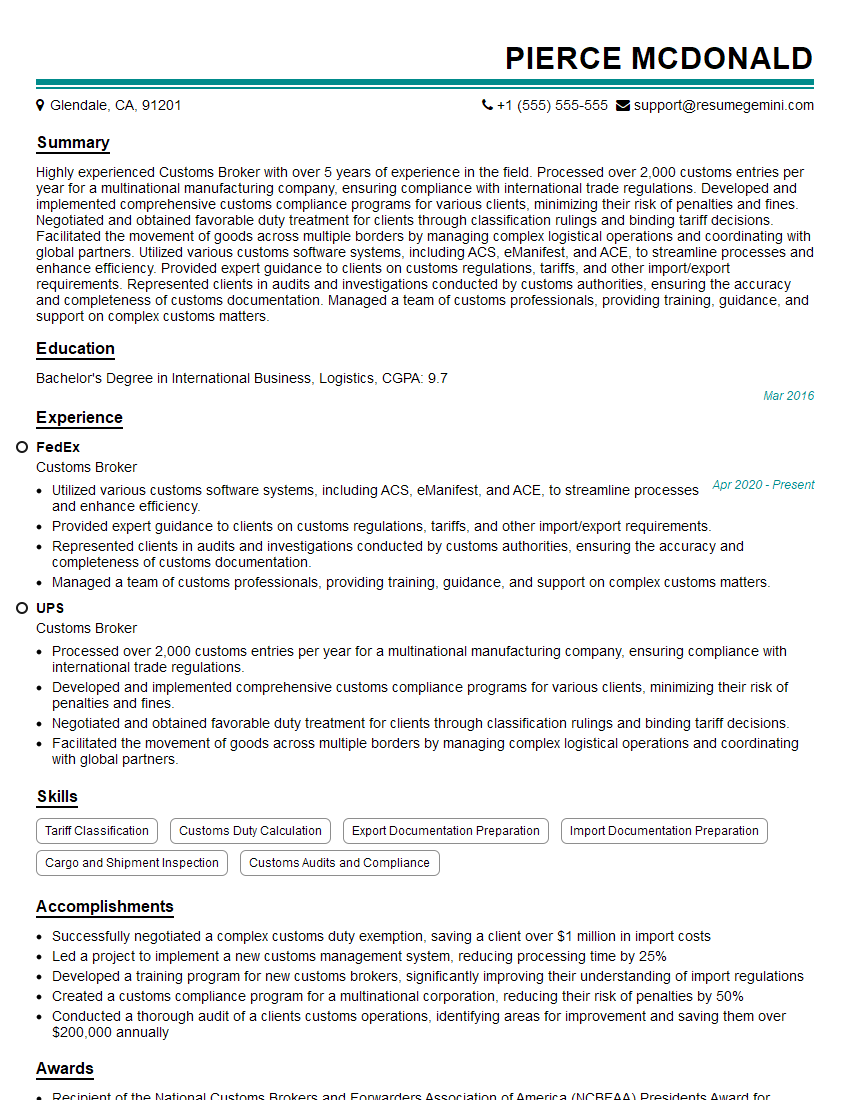
Customs Broker Resume Sample
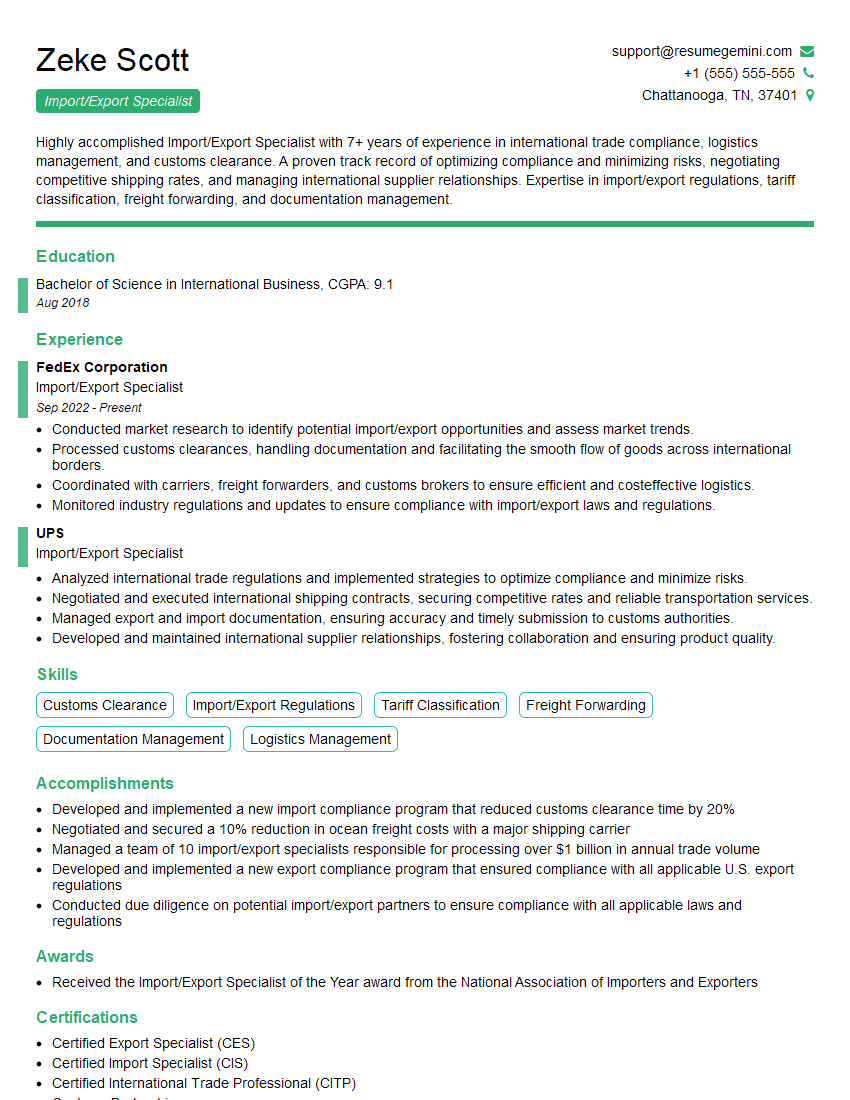
Import/Export Specialist Resume Sample
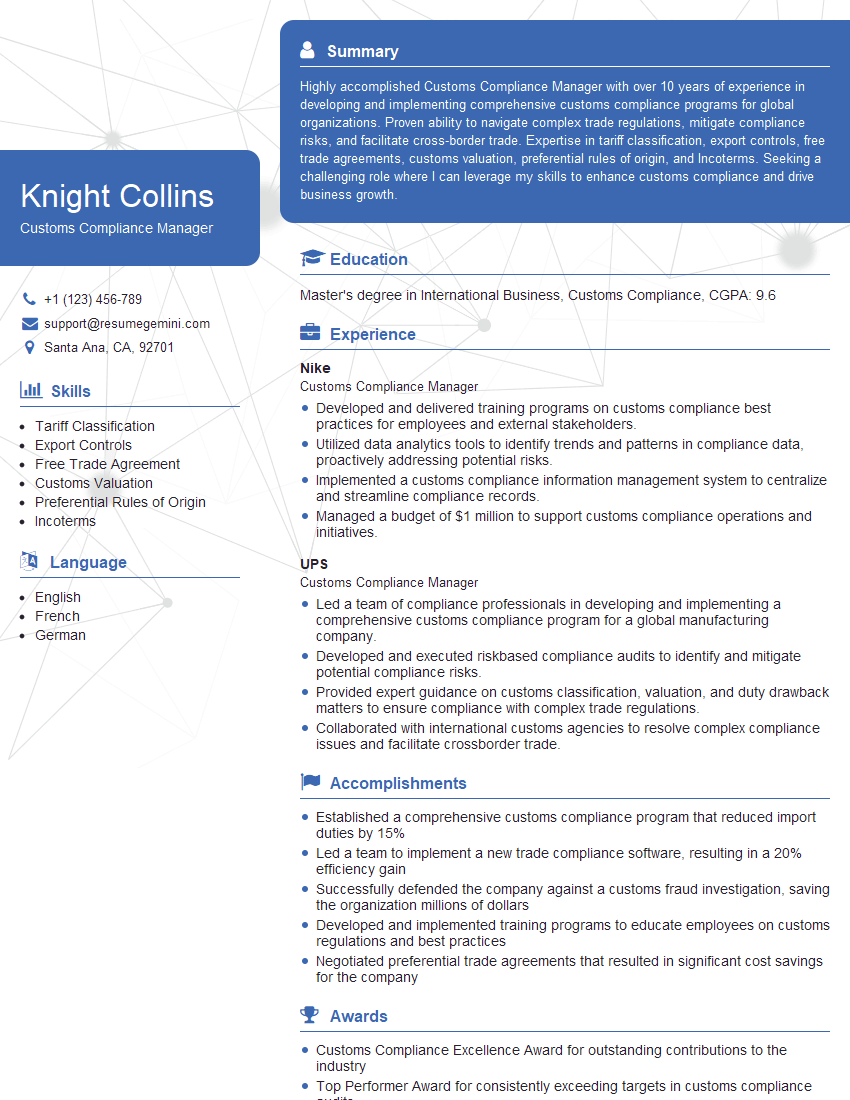
Customs Compliance Manager Resume Sample
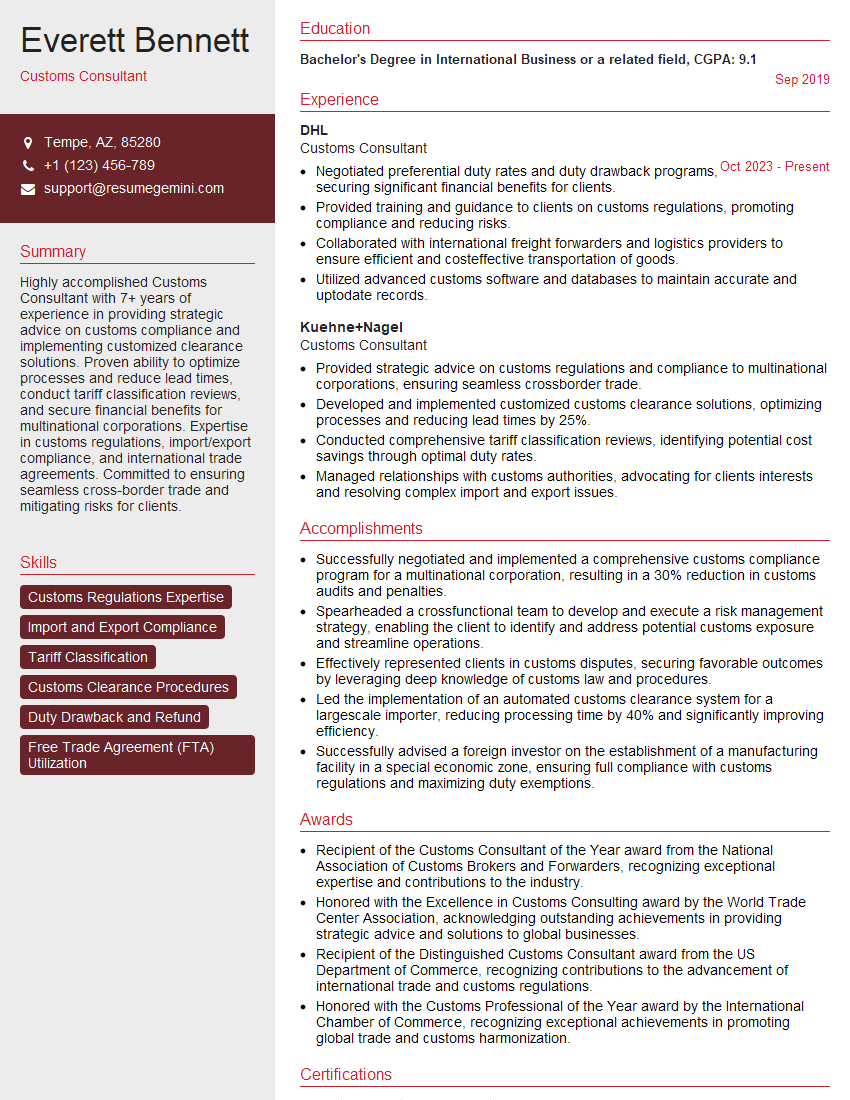
Customs Consultant Resume Sample
Import Specialist Resume Sample
Export Specialist Resume Sample
Freight Forwarder Resume Sample
Explore more articles
Users Rating of Our Blogs
Share Your Experience
We value your feedback! Please rate our content and share your thoughts (optional).
What Readers Say About Our Blog
Attention music lovers!
Wow, All the best Sax Summer music !!!
Spotify: https://open.spotify.com/artist/6ShcdIT7rPVVaFEpgZQbUk
Apple Music: https://music.apple.com/fr/artist/jimmy-sax-black/1530501936
YouTube: https://music.youtube.com/browse/VLOLAK5uy_noClmC7abM6YpZsnySxRqt3LoalPf88No
Other Platforms and Free Downloads : https://fanlink.tv/jimmysaxblack
on google : https://www.google.com/search?q=22+AND+22+AND+22
on ChatGPT : https://chat.openai.com?q=who20jlJimmy20Black20Sax20Producer
Get back into the groove with Jimmy sax Black
Best regards,
Jimmy sax Black
www.jimmysaxblack.com
Hi I am a troller at The aquatic interview center and I suddenly went so fast in Roblox and it was gone when I reset.
Hi,
Business owners spend hours every week worrying about their website—or avoiding it because it feels overwhelming.
We’d like to take that off your plate:
$69/month. Everything handled.
Our team will:
Design a custom website—or completely overhaul your current one
Take care of hosting as an option
Handle edits and improvements—up to 60 minutes of work included every month
No setup fees, no annual commitments. Just a site that makes a strong first impression.
Find out if it’s right for you:
https://websolutionsgenius.com/awardwinningwebsites
Hello,
we currently offer a complimentary backlink and URL indexing test for search engine optimization professionals.
You can get complimentary indexing credits to test how link discovery works in practice.
No credit card is required and there is no recurring fee.
You can find details here:
https://wikipedia-backlinks.com/indexing/
Regards
NICE RESPONSE TO Q & A
hi
The aim of this message is regarding an unclaimed deposit of a deceased nationale that bears the same name as you. You are not relate to him as there are millions of people answering the names across around the world. But i will use my position to influence the release of the deposit to you for our mutual benefit.
Respond for full details and how to claim the deposit. This is 100% risk free. Send hello to my email id: lukachachibaialuka@gmail.com
Luka Chachibaialuka
Hey interviewgemini.com, just wanted to follow up on my last email.
We just launched Call the Monster, an parenting app that lets you summon friendly ‘monsters’ kids actually listen to.
We’re also running a giveaway for everyone who downloads the app. Since it’s brand new, there aren’t many users yet, which means you’ve got a much better chance of winning some great prizes.
You can check it out here: https://bit.ly/callamonsterapp
Or follow us on Instagram: https://www.instagram.com/callamonsterapp
Thanks,
Ryan
CEO – Call the Monster App
Hey interviewgemini.com, I saw your website and love your approach.
I just want this to look like spam email, but want to share something important to you. We just launched Call the Monster, a parenting app that lets you summon friendly ‘monsters’ kids actually listen to.
Parents are loving it for calming chaos before bedtime. Thought you might want to try it: https://bit.ly/callamonsterapp or just follow our fun monster lore on Instagram: https://www.instagram.com/callamonsterapp
Thanks,
Ryan
CEO – Call A Monster APP
To the interviewgemini.com Owner.
Dear interviewgemini.com Webmaster!
Hi interviewgemini.com Webmaster!
Dear interviewgemini.com Webmaster!
excellent
Hello,
We found issues with your domain’s email setup that may be sending your messages to spam or blocking them completely. InboxShield Mini shows you how to fix it in minutes — no tech skills required.
Scan your domain now for details: https://inboxshield-mini.com/
— Adam @ InboxShield Mini
support@inboxshield-mini.com
Reply STOP to unsubscribe
Hi, are you owner of interviewgemini.com? What if I told you I could help you find extra time in your schedule, reconnect with leads you didn’t even realize you missed, and bring in more “I want to work with you” conversations, without increasing your ad spend or hiring a full-time employee?
All with a flexible, budget-friendly service that could easily pay for itself. Sounds good?
Would it be nice to jump on a quick 10-minute call so I can show you exactly how we make this work?
Best,
Hapei
Marketing Director
Hey, I know you’re the owner of interviewgemini.com. I’ll be quick.
Fundraising for your business is tough and time-consuming. We make it easier by guaranteeing two private investor meetings each month, for six months. No demos, no pitch events – just direct introductions to active investors matched to your startup.
If youR17;re raising, this could help you build real momentum. Want me to send more info?
Hi, I represent an SEO company that specialises in getting you AI citations and higher rankings on Google. I’d like to offer you a 100% free SEO audit for your website. Would you be interested?
Hi, I represent an SEO company that specialises in getting you AI citations and higher rankings on Google. I’d like to offer you a 100% free SEO audit for your website. Would you be interested?