The thought of an interview can be nerve-wracking, but the right preparation can make all the difference. Explore this comprehensive guide to Understanding of Digital Printing Technology interview questions and gain the confidence you need to showcase your abilities and secure the role.
Questions Asked in Understanding of Digital Printing Technology Interview
Q 1. Explain the difference between offset and digital printing.
Offset and digital printing are two fundamentally different methods for mass production of printed materials. Offset printing, a traditional method, is an indirect process where the image is first transferred to a plate (usually aluminum) and then to a rubber blanket before finally being printed onto the substrate. This indirect transfer allows for high-volume, consistent printing at a lower cost per unit. Digital printing, on the other hand, is a direct process. The image is printed directly onto the substrate from a digital file, eliminating the need for plates and intermediary steps.
Think of it like this: offset printing is like using a stencil to paint a wall – efficient for large areas. Digital printing is like using a spray can – precise for smaller details and quicker for customized images. The core difference lies in their production methods: indirect (offset) versus direct (digital).
Q 2. Describe the various digital printing technologies (e.g., inkjet, toner-based).
Digital printing encompasses several technologies, each with its own strengths and weaknesses. Two major categories are inkjet and toner-based printing:
- Inkjet Printing: This technology uses tiny nozzles to spray liquid ink onto the substrate. There are several variations, including piezoelectric inkjet (where pressure variations eject ink) and thermal inkjet (where heat vaporizes ink to propel it). Inkjet is versatile and can handle a wide range of substrates, from paper and cardstock to textiles and even some plastics. Examples include large-format printers used for signage and smaller printers for photos.
- Toner-Based Printing: These devices use powdered toner, similar to what’s found in most office laser printers, to create images. The toner is electrostatically charged and fused onto the substrate using heat and pressure. Toner-based printing is generally known for its high resolution and sharp text, often used for high-quality documents and business cards.
Beyond these, other technologies exist, such as electrophotographic printing and solid ink printing, each with specific application areas. The choice of technology largely depends on the desired print quality, the substrate type, the volume needed, and the budget.
Q 3. What are the advantages and disadvantages of digital printing compared to offset printing?
Digital and offset printing each possess unique advantages and disadvantages:
| Feature | Digital Printing | Offset Printing |
|---|---|---|
| Cost per unit | Higher for small runs, lower for large runs | Lower for large runs, higher for small runs |
| Setup cost | Low | High (plate making) |
| Turnaround time | Fast | Slow |
| Customization | High | Low |
| Variable data printing | Easy | Difficult |
| Print Quality | Generally high, depending on technology | Very high, especially for large runs |
| Substrate versatility | High | Lower |
In essence, digital printing excels in short runs, customization, and speed, while offset printing shines in high-volume, consistent production at a lower cost per unit. The best choice depends on the specific project requirements.
Q 4. How does color management work in digital printing?
Color management in digital printing is a critical process ensuring consistent color reproduction across different devices and media. It involves several steps:
- Color Profile Creation: A color profile (e.g., ICC profile) is a mathematical description of a device’s color characteristics. It helps translate the color values from the digital file to the output device.
- Color Space Conversion: The original color data (often in RGB) needs to be converted into a color space suitable for the printing process (usually CMYK). This conversion is guided by the color profiles of the input and output devices.
- Proofing: Soft proofs and hard proofs (test prints) are used to verify the color accuracy before mass production. This allows for adjustments to ensure the printed output matches the desired colors.
- Device Calibration: Regular calibration of printers and other devices ensures that their color characteristics remain consistent over time. This helps avoid color drifts and maintains accuracy.
Software plays a crucial role by managing color conversions and simulating the final printed output. Effective color management ensures that the printed product looks as intended on different monitors and printers.
Q 5. Explain the importance of color profiles (e.g., ICC profiles).
Color profiles, often ICC (International Color Consortium) profiles, are essential for accurate color reproduction in digital printing. They act as a translator between different devices, mapping the color space of one device (e.g., a monitor) to another (e.g., a printer). Without color profiles, the same digital image might appear significantly different on various devices because each device has unique color characteristics.
Imagine trying to match paint colors without any reference. Color profiles provide that reference, ensuring that the same color value translates consistently across the entire printing workflow. They are crucial for achieving accurate and consistent color output, especially in projects where color fidelity is paramount, such as high-end photography and branding materials.
Q 6. What are common print finishing techniques used after digital printing?
Numerous print finishing techniques enhance the appearance, durability, and functionality of digitally printed products. These techniques are applied after the printing process itself:
- Cutting and Trimming: Precisely cutting printed sheets to the desired size and shape.
- Folding and Creasing: Folding leaflets, brochures, and other materials. Creasing helps ensure sharp folds.
- Binding: Methods like saddle-stitch binding (for booklets), perfect binding (for books), or spiral binding are used to create finished products.
- Laminating: Applying a protective film to enhance durability and water resistance.
- Embossing and Debossing: Creating raised or indented designs to add texture and visual appeal.
- Spot UV Coating: Applying a glossy UV coating to specific areas to highlight design elements.
The choice of finishing techniques depends on the type of printed material and the desired aesthetic and functional properties. For instance, lamination is often chosen for outdoor signage to protect it from the elements.
Q 7. Describe your experience with different types of substrates used in digital printing.
My experience encompasses a wide range of substrates used in digital printing. I’ve worked with various types of paper, from lightweight papers for flyers to heavier cardstocks for business cards and packaging. I’m also familiar with working with synthetic materials such as vinyl for banners and stickers, textiles for fabric printing, and even specialized substrates like metallic papers and canvas for fine art prints.
Each substrate demands a different approach in terms of ink selection, print settings, and finishing techniques. For example, printing on canvas requires different inks and settings than printing on photo paper to achieve optimal results. Understanding the properties of each substrate is key to producing high-quality, long-lasting prints. I have hands-on experience troubleshooting issues arising from substrate incompatibility and optimizing print parameters for various materials.
Q 8. How do you troubleshoot common print quality issues (e.g., banding, color inconsistencies)?
Troubleshooting print quality issues like banding and color inconsistencies in digital printing requires a systematic approach. Think of it like diagnosing a car problem – you need to check various components before finding the culprit.
Banding, those unsightly horizontal streaks across the print, often stems from problems with the printhead, ink supply, or media. I start by checking the printhead nozzles for clogs; a simple cleaning cycle might resolve the issue. If not, I’d inspect the ink lines for air bubbles or kinks. Uneven ink distribution can also be caused by incorrect printhead pressure or a faulty ink cartridge. Finally, the substrate itself could be the problem; perhaps it’s too absorbent or has a textured surface causing inconsistent ink absorption.
Color inconsistencies can arise from various sources: miscalibration of the printer, incorrect color profiles, or issues with the RIP software. First, I’d verify the color profile is correctly assigned and up-to-date. Then, I’d perform a printer calibration to ensure accurate color reproduction. If the problem persists, I’d examine the RIP settings; incorrect color management settings can significantly affect the final output. Finally, I’d check the source file for color inconsistencies, ensuring it’s in the correct color space (e.g., CMYK for print).
A practical example: I once encountered banding on a large-format print. After checking the printhead and ink supply, I discovered the media was slightly warped, causing uneven ink distribution. Replacing the media immediately solved the problem.
Q 9. Explain your understanding of RIP software and its role in digital printing.
RIP software, or Raster Image Processor, is the unsung hero of digital printing. Think of it as the translator between your digital design file and the printer. It takes the vector or bitmap image, processes it according to the printer’s specifications, and creates the instructions the printer needs to accurately reproduce the image.
Its role involves several crucial steps: color management (ensuring accurate color reproduction across different devices), image processing (resizing, sharpening, and other adjustments), rasterization (converting vector graphics into a raster image that the printer understands), and print workflow management (managing color profiles, job queuing, and printer settings).
For example, without a RIP, your printer wouldn’t know how to interpret the complex data within a PDF file or accurately reproduce the colors specified in your design. The RIP ensures that the final printed output matches your design intent as closely as possible.
Different RIP software packages offer varying features and capabilities, some specialized for specific printer types or applications. Choosing the right RIP is crucial for optimizing print quality and efficiency.
Q 10. Describe your experience with different digital printing workflows.
My experience encompasses various digital printing workflows, each with its own unique characteristics and challenges. I’ve worked with:
- Traditional offset-like workflows: These involve pre-press stages such as trapping, proofing, and color separation, often using dedicated software like Adobe Acrobat and other prepress tools. This workflow emphasizes accuracy and consistency, especially for high-volume jobs.
- Direct-to-garment (DTG) workflows: This involves designing directly for apparel, using specialized software and pre-treatment techniques. Quality control here focuses on fabric type, ink adhesion, and ensuring a soft, durable print.
- Large format workflows: Involving designs for banners, posters, and signage, these require careful attention to scaling, image resolution, and media choice. Workflow here is streamlined using large format RIP software capable of managing large print files.
- Web-to-print workflows: Here, the customer uploads their file online, and the whole process, from ordering to delivery is automated. This demands robust file handling and automated job processing to ensure consistency and quality across diverse user-generated content.
Each workflow demands a different skill set and attention to detail, and my expertise covers a broad spectrum of these approaches.
Q 11. How do you ensure color accuracy and consistency across different print runs?
Maintaining color accuracy and consistency across print runs is paramount. It’s like baking a cake – you need the same recipe and ingredients every time to get the same result. My approach involves a multi-faceted strategy:
- Color profiling and calibration: Regularly calibrating the printer and using ICC profiles ensures accurate color reproduction. Think of these profiles as the recipe for your printer, tailoring the output to specific media and ink combinations.
- Proofing: Soft proofing (on-screen) and hard proofing (physical prints) help catch discrepancies early. This is like doing a test bake before making a large batch of cakes.
- Standardized workflow: Maintaining consistent settings for RIP software, media handling, and ink usage minimizes variations. It’s about following the recipe precisely.
- Color management system (CMS): Implementing a robust CMS throughout the entire workflow, from design to printing, guarantees consistency regardless of the devices and software involved. This system acts as your quality control supervisor.
By consistently following these steps, I ensure that the final product matches the original design intent, regardless of the number of print runs.
Q 12. What are some common file formats used in digital printing?
Digital printing uses a variety of file formats, each suited to different applications. The most common include:
- PDF (Portable Document Format): The industry standard, offering excellent compatibility and print quality. It’s highly versatile and suitable for a wide range of printing applications.
- TIFF (Tagged Image File Format): Excellent for high-resolution images, often used for large format printing. Its ability to preserve image data without compression makes it ideal for preserving quality.
- JPEG (Joint Photographic Experts Group): A common image format, but generally avoided for high-quality print due to its lossy compression.
- EPS (Encapsulated PostScript): Vector-based format, ideal for illustrations and logos that need to be scaled without losing quality.
- AI (Adobe Illustrator): A native vector file format for Adobe Illustrator, often used for complex designs.
The choice of format depends on the complexity of the design, the desired print quality, and the capabilities of the printer and RIP software. It’s important to always verify file compatibility before initiating the printing process.
Q 13. Explain your experience with pre-flighting and preparing files for digital printing.
Pre-flighting and preparing files for digital printing are crucial steps to prevent errors and ensure high-quality output. It’s like meticulously preparing ingredients before baking a cake – you wouldn’t want to discover missing ingredients halfway through.
Pre-flighting involves checking the file for potential issues such as missing fonts, embedded images, incorrect color profiles, and low resolution images. I use dedicated preflighting software or tools integrated within applications like Adobe Acrobat to automatically scan files for these issues.
File preparation includes tasks like converting images to the correct color space (CMYK for print), embedding fonts, flattening layers, and adjusting resolution. I’ll also check for bleed and margins, ensuring the final print meets the desired specifications. For large format printing, I meticulously verify that the resolution is high enough to avoid pixelation and ensure crisp, clear images.
For example, I recently encountered a file missing embedded fonts. Had this gone unnoticed, the print would have shown incorrect fonts, requiring a costly reprint. My preflighting process immediately identified this issue, allowing for timely correction.
Q 14. How do you manage print jobs and ensure timely delivery?
Managing print jobs and ensuring timely delivery requires efficient organization and communication. It’s like running a well-oiled kitchen – every order needs to be processed smoothly and efficiently.
My approach involves using a job management system, typically software integrated with the RIP software or a separate project management tool. This system allows me to track job status, prioritize tasks based on deadlines, and manage resources effectively. I also maintain clear communication with clients, providing regular updates on job progress and addressing any questions or concerns promptly.
I prioritize jobs based on their deadlines and urgency. I also allocate resources strategically, ensuring that the right printer, media, and personnel are available when needed. Detailed job tracking allows me to quickly identify potential delays and proactively address them.
Accurate scheduling and efficient resource allocation are key to consistently meeting deadlines and delivering high-quality prints on time. This ensures client satisfaction and builds trust in my expertise.
Q 15. Describe your experience with print cost estimation and budgeting.
Accurate print cost estimation is crucial for profitability in the digital printing industry. It involves a multifaceted approach considering various factors beyond just the cost of ink and paper. My experience encompasses developing detailed cost models that account for:
- Material Costs: This includes the type and quantity of paper, ink, or toner used, factoring in current market prices and potential bulk discounts.
- Labor Costs: I assess the time required for pre-press preparation, machine operation, finishing (cutting, binding, etc.), and quality control. This involves understanding individual operator efficiency and machine downtime.
- Equipment Costs: This incorporates depreciation, maintenance, and repair costs of the digital printing equipment. I analyze usage rates to accurately distribute these costs across print jobs.
- Overhead Costs: These include rent, utilities, software licenses, and administrative expenses, which are allocated proportionally to each print job.
- Profit Margin: Finally, a healthy profit margin is built into the cost estimate, ensuring the business remains viable and profitable.
For example, I once developed a spreadsheet-based cost model for a large-scale direct mail campaign. By meticulously tracking all the above-mentioned costs for several pilot runs, I was able to accurately predict costs for the full campaign, saving the client significant money and ensuring timely delivery.
Career Expert Tips:
- Ace those interviews! Prepare effectively by reviewing the Top 50 Most Common Interview Questions on ResumeGemini.
- Navigate your job search with confidence! Explore a wide range of Career Tips on ResumeGemini. Learn about common challenges and recommendations to overcome them.
- Craft the perfect resume! Master the Art of Resume Writing with ResumeGemini’s guide. Showcase your unique qualifications and achievements effectively.
- Don’t miss out on holiday savings! Build your dream resume with ResumeGemini’s ATS optimized templates.
Q 16. What is your experience with different types of inks and toners?
My experience with inks and toners spans several technologies and applications. I’m proficient with various types, including:
- CMYK (Cyan, Magenta, Yellow, Black): The standard four-color process used in most digital printing. I understand the nuances of different CMYK ink formulations, such as pigment-based inks (more durable, vibrant colors) versus dye-based inks (brighter, but less water-resistant).
- Specialty Inks: I have experience working with white ink for printing on dark substrates, fluorescent inks for eye-catching designs, and metallic inks for luxurious finishes. Understanding the specific properties and limitations of each is critical for achieving desired results.
- Toner: I’m familiar with the various types of toner used in laser printing, including different particle sizes and compositions that affect image sharpness, durability, and color consistency.
- UV-curable inks: These inks harden upon exposure to ultraviolet light, offering exceptional durability and fast drying times, ideal for applications requiring immediate handling or outdoor use.
For instance, I once helped a client choose the right ink for a high-volume outdoor banner campaign. After analyzing their specific requirements for weather resistance and longevity, I recommended a UV-curable ink that met their needs and significantly improved the print’s overall lifespan.
Q 17. How do you maintain and troubleshoot digital printing equipment?
Maintaining and troubleshooting digital printing equipment requires a systematic approach combining preventative maintenance and proactive problem-solving. My approach includes:
- Preventative Maintenance: Regularly scheduled cleaning of print heads, rollers, and other components is essential. This includes replacing worn parts before they cause significant issues. I also adhere to manufacturer’s recommended maintenance schedules and perform regular calibrations.
- Troubleshooting: When problems occur, I use a diagnostic approach. This starts with identifying the error message or symptom (e.g., streaks, banding, color inconsistencies). I systematically check the obvious causes – ink levels, paper jams, connectivity issues – before moving to more complex internal components. Documentation is crucial for tracking problems and solutions.
- Software Diagnostics: Many modern digital printing machines have advanced software for diagnostics. I’m adept at utilizing these tools to identify underlying hardware or software problems.
- Parts Replacement: I have experience in safely replacing worn or defective components, understanding the importance of following manufacturer guidelines for safety and warranty compliance.
I recall an instance where a printer started producing faded colors. Through systematic troubleshooting, I identified a clogged print head, successfully cleaned it, and restored the print quality. Documentation of this process allowed us to avoid similar issues in the future.
Q 18. What safety procedures do you follow when operating digital printing equipment?
Safety is paramount when operating digital printing equipment. My safety procedures include:
- Proper Training: I always ensure I’m thoroughly trained on the specific equipment I operate, including safety protocols and emergency procedures.
- Personal Protective Equipment (PPE): I utilize appropriate PPE, including safety glasses and gloves, when handling inks, toners, or other chemicals.
- Safe Handling of Materials: I follow safe practices for handling paper, ink cartridges, and other consumables, avoiding spills and ensuring proper disposal of waste materials.
- Electrical Safety: I ensure the equipment is properly grounded and that power cords are not damaged or frayed.
- Emergency Procedures: I’m familiar with emergency procedures, including fire safety and the location of emergency shut-off switches.
I always emphasize a cautious and careful approach. For example, I never attempt repairs without proper training or authorization. I believe safety isn’t just a procedure; it’s a mindset that should guide every step of the process.
Q 19. Explain your understanding of variable data printing.
Variable data printing (VDP) is a powerful technique allowing for personalized content on each printed piece within a single print run. This contrasts with traditional printing where every piece is identical. My understanding of VDP includes:
- Data Integration: VDP requires seamless integration of a database containing variable information (names, addresses, product details, etc.) with the print design.
- Software Solutions: I’m familiar with various VDP software solutions that automate the personalization process, handling the merging of data and design templates.
- Applications: I understand the vast range of VDP applications, including personalized mail campaigns, customized brochures, and transactional documents (invoices, statements).
- Data Security: A key consideration is protecting the sensitive data used in VDP. I’m mindful of data privacy regulations and employ secure data handling practices.
For example, I recently worked on a project personalizing thousands of direct mail pieces for a retail company. Using VDP, each piece featured the recipient’s name and showcased products tailored to their past purchase history, significantly improving the campaign’s response rate.
Q 20. What is your experience with print automation and workflow software?
Automation and workflow software are critical for efficient and cost-effective digital printing. My experience includes working with various systems to:
- Prepress Automation: Automating tasks like imposition (arranging pages for printing), color management, and trapping (preventing gaps between colors).
- Print Job Scheduling: Optimizing print job sequencing to minimize downtime and improve turnaround times.
- Workflow Management: Utilizing software to manage the entire printing workflow, from job submission to finishing and delivery, tracking progress and identifying bottlenecks.
- Integration with MIS (Management Information Systems): Connecting the printing workflow with other business systems for better inventory management and order tracking.
For instance, in a previous role, I implemented a new workflow system that reduced production time by 20% and minimized errors by improving job tracking and automated quality checks.
Q 21. Describe your experience with quality control procedures in digital printing.
Rigorous quality control is essential to ensure consistent, high-quality output in digital printing. My experience includes:
- Pre-press Checks: Thoroughly reviewing files for resolution, color accuracy, and proper formatting before sending them to the printer.
- Proofing: Creating physical or digital proofs to verify color accuracy and overall design before the full print run begins.
- Process Monitoring: Regularly monitoring the printing process to identify potential issues early on.
- Post-press Inspection: Carefully inspecting the finished prints for defects like misregistration, smudging, or inconsistencies.
- Color Calibration: Maintaining consistent color profiles across different printing equipment and ensuring accurate color representation.
In one project, implementing a more rigorous proofing system prevented a costly reprint by identifying a critical color issue before the full print run started, saving the company both time and resources.
Q 22. How do you handle customer requests and resolve print-related issues?
Handling customer requests and resolving print-related issues is a crucial aspect of digital printing. My approach is systematic and focuses on clear communication and problem-solving. First, I carefully listen to the customer’s needs, clarifying any ambiguities to ensure I fully understand their requirements. This involves discussing their desired outcome, budget, and timeline. Then, I assess the feasibility of their request, considering factors like file compatibility, print resolution, and material suitability.
If an issue arises during the printing process, I use a troubleshooting methodology. This might involve checking the print settings, inspecting the print file for errors, or examining the printer’s hardware for malfunctions. I document every step taken to solve the issue and keep the customer informed of the progress. For example, if a color mismatch occurs, I’d examine the color profiles, check for inconsistencies in the source file, and recalibrate the printer as needed. Finally, I ensure customer satisfaction by following up to address any lingering concerns and confirm their overall happiness with the final product. A happy customer is the best advertisement.
Q 23. Describe your experience with different types of digital printing presses.
My experience encompasses a range of digital printing presses, each with its unique strengths and applications. I’ve worked extensively with:
- Inkjet Printers: These are versatile and handle a wide variety of media, from standard paper to canvas and specialty substrates. I’m proficient in operating both large-format inkjet printers for banners and posters, and smaller-format printers for business cards and brochures. I understand the intricacies of different ink types, such as dye-based and pigment-based inks, and their impact on print longevity and color vibrancy.
- Laser Printers: I have experience with both monochrome and color laser printers, particularly those used for high-volume printing jobs requiring precision and consistency. I’m familiar with managing toner levels, calibrating color settings, and performing preventative maintenance. Laser printing excels in producing sharp text and graphics, ideal for documents and marketing materials.
- Solid Ink Printers: These printers utilize wax-like ink sticks that are melted and then precisely jetted onto the page. They provide excellent color accuracy and are becoming increasingly popular for applications requiring rich color and high image quality.
My experience allows me to select the most appropriate press for a given project, maximizing print quality and efficiency.
Q 24. What is your understanding of the environmental impact of digital printing?
The environmental impact of digital printing is a critical consideration. While digital printing generally uses less energy and water than traditional offset printing, it still has an environmental footprint. Key aspects to consider include:
- Ink and Toner Consumption: The production and disposal of inks and toners require careful management. Many manufacturers are now producing more environmentally friendly, biodegradable options. Opting for these reduces the overall environmental burden.
- Energy Consumption: Modern digital presses are becoming more energy-efficient, but optimizing printer settings and employing power-saving modes can significantly minimize energy usage.
- Waste Management: Proper disposal of cartridges, paper scraps, and other consumables is essential. Many printers now have options for recycling components.
- Material Selection: Utilizing recycled paper and environmentally certified substrates helps to lessen the environmental impact of the printing process as a whole.
In my work, I strive to minimize environmental impact by selecting environmentally conscious printing materials and implementing responsible waste management practices.
Q 25. How do you stay updated on the latest trends and technologies in digital printing?
Staying updated in the rapidly evolving field of digital printing requires a multi-pronged approach. I regularly:
- Attend industry conferences and trade shows: These events offer invaluable opportunities to learn about the latest technologies and network with industry professionals.
- Read industry publications and journals: Publications such as Printing Impressions and WhatTheyThink provide detailed insights into new developments and trends.
- Follow industry blogs and websites: Many companies and experts share their knowledge and insights online, offering a wealth of information.
- Participate in online courses and webinars: Online learning platforms offer courses covering specific aspects of digital printing technology.
- Network with other professionals: Engaging in discussions with colleagues and experts helps to broaden my understanding and stay informed about the latest advancements.
This proactive approach allows me to stay at the forefront of technological advancements and best practices.
Q 26. Describe your experience working with different types of printing software (e.g., Adobe Acrobat, Photoshop).
I’m highly proficient in a variety of printing software, including:
- Adobe Acrobat: I use Acrobat extensively for preparing PDF files for print, ensuring proper color management, ensuring correct imposition, and optimizing files for different printers and output devices.
- Adobe Photoshop: My Photoshop skills are vital for image editing, color correction, and preparing high-resolution images for printing. I’m adept at optimizing images for print resolution, ensuring accurate color reproduction, and managing color profiles to avoid discrepancies between the digital representation and the final printed output.
- Other RIP Software (Raster Image Processors): I have experience with various RIP software packages, crucial for controlling color, optimizing print quality, and managing the output of large-format printers. RIP software helps translate digital files into instructions that the printer understands.
My software expertise ensures smooth workflow, accurate color reproduction, and efficient print production.
Q 27. What is your understanding of different print resolutions and their impact on print quality?
Print resolution directly impacts print quality. It’s measured in dots per inch (dpi) and represents the number of individual ink droplets or toner particles placed within one inch. A higher dpi generally results in sharper, more detailed prints.
For example, a 300 dpi image will be significantly clearer and more detailed than a 72 dpi image, especially noticeable in text and fine lines. However, very high resolutions might not always be necessary. Often, a resolution of 300 dpi is sufficient for high-quality prints. Selecting an unnecessarily high resolution can increase file size and processing time without significantly improving visual quality.
Different printing methods have different optimal resolutions. Large format printers might use lower dpi due to the print area size, whereas high-quality photo printers might use much higher dpi for fine detail reproduction. Understanding these nuances is crucial to optimize print quality and efficiency.
Q 28. Explain your experience with large format digital printing.
I have extensive experience in large-format digital printing, encompassing various applications and techniques. My experience includes working with wide-format inkjet printers to produce:
- Banners and Signage: I’m proficient in creating eye-catching banners and signs for various events and businesses, utilizing different materials like vinyl, fabric, and paper depending on the application and environment.
- Posters and Displays: I’ve produced high-impact posters and displays for trade shows, conferences, and marketing campaigns, ensuring vibrant color reproduction and sharp image quality.
- Wall Murals and Backdrops: Creating large-scale wall murals and backdrops requires careful planning and precise printing techniques, and I’m skilled in handling these large-scale projects effectively.
- Vehicle Wraps: Designing and printing vehicle wraps involves specialized techniques and materials. My experience includes ensuring precise alignment and color consistency across the vehicle’s curves and surfaces.
Large-format printing requires attention to detail and precision in handling materials and software. My expertise ensures high-quality, professional results for even the most demanding projects.
Key Topics to Learn for Understanding of Digital Printing Technology Interview
- Digital Printing Processes: Understand the fundamental differences between various digital printing methods (e.g., inkjet, toner-based, UV inkjet) including their strengths, weaknesses, and applications.
- Color Management and Profiles: Grasp the importance of color profiles (e.g., ICC profiles) in achieving color accuracy across different devices and workflows. Be prepared to discuss color space conversions and troubleshooting color discrepancies.
- Image Processing and Prepress: Familiarize yourself with image preparation techniques for digital printing, including resolution, file formats (e.g., PDF, TIFF), and the role of preflighting in ensuring print quality.
- Substrate Selection and Handling: Demonstrate knowledge of different printing substrates (e.g., paper types, textiles, plastics) and their suitability for various digital printing technologies. Understand the implications of substrate choice on print quality and durability.
- Workflow and Automation: Discuss different digital printing workflows, including file submission, job tracking, and color management processes. Understand the role of automation in streamlining print production.
- Troubleshooting and Quality Control: Be prepared to discuss common issues encountered in digital printing (e.g., banding, color inconsistencies, registration problems) and describe strategies for troubleshooting and quality control.
- Print Finishing and Binding: Understand various finishing techniques (e.g., cutting, folding, laminating) and their impact on the final product. Be familiar with different binding methods for various applications.
- Sustainability and Environmental Impact: Discuss environmentally friendly practices within digital printing, such as ink selection, waste reduction strategies, and responsible substrate choices.
- Industry Software and Applications: Showcase familiarity with relevant software and applications commonly used in digital printing workflows, highlighting your practical experience.
Next Steps
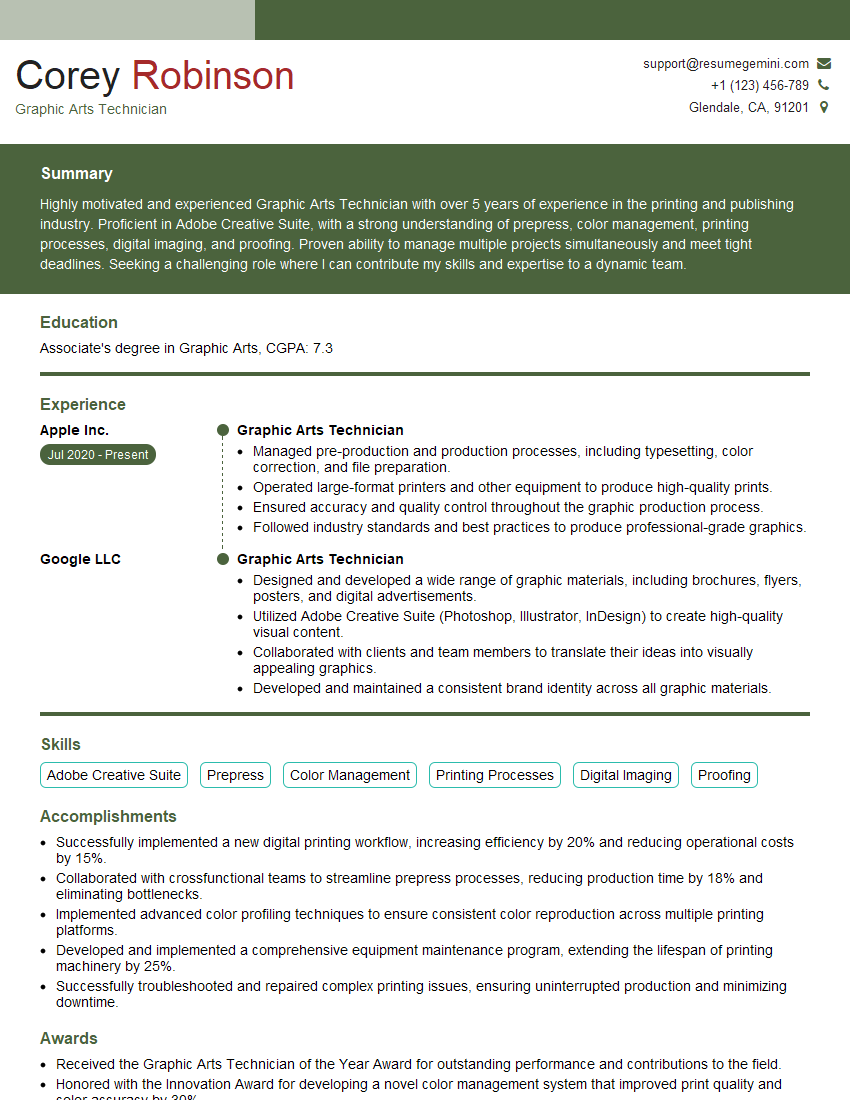
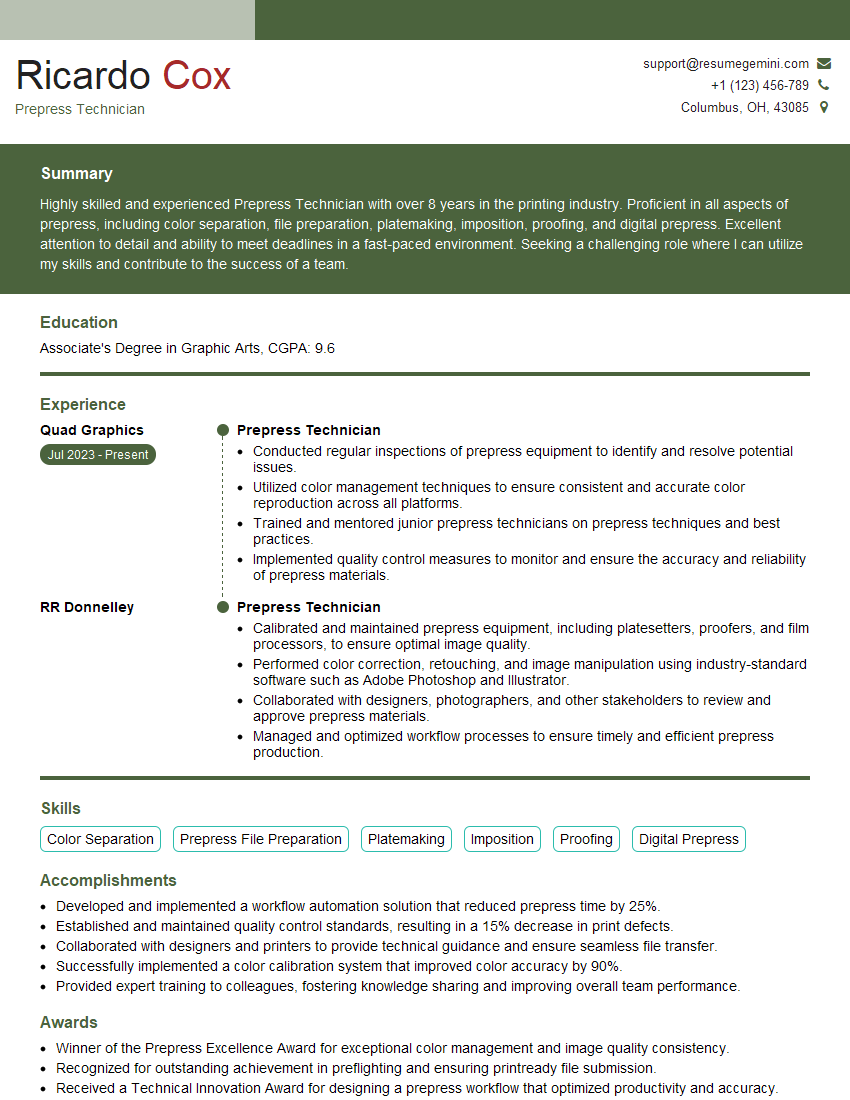
Mastering digital printing technology opens doors to exciting career opportunities in a rapidly growing industry. A strong understanding of these concepts will significantly enhance your interview performance and job prospects. To further boost your chances, crafting an ATS-friendly resume is crucial. ResumeGemini is a trusted resource that can help you create a compelling and effective resume that highlights your skills and experience. ResumeGemini provides examples of resumes tailored to Understanding of Digital Printing Technology, ensuring your application stands out from the competition.

Explore more articles
Users Rating of Our Blogs
Share Your Experience
We value your feedback! Please rate our content and share your thoughts (optional).
What Readers Say About Our Blog
Very informative content, great job.
good