The right preparation can turn an interview into an opportunity to showcase your expertise. This guide to Understanding of Garment Patterns and Specifications interview questions is your ultimate resource, providing key insights and tips to help you ace your responses and stand out as a top candidate.
Questions Asked in Understanding of Garment Patterns and Specifications Interview
Q 1. Explain the difference between a sloper and a block pattern.
Both slopers and block patterns are foundational garment patterns, but they differ significantly in their level of detail and intended use. Think of a sloper as a blank canvas and a block pattern as a slightly more defined sketch.
A sloper is a basic, un-styled pattern that closely follows the body’s curves. It’s essentially a two-dimensional representation of a person’s body shape, created using measurements and drafting techniques. It serves as the foundation for all subsequent patterns, similar to a master blueprint. It’s highly personalized and specific to the individual’s measurements. You wouldn’t sew directly from a sloper; it’s a tool.
A block pattern, on the other hand, is a more developed pattern that incorporates basic design elements like ease (added looseness for comfort), seam allowances, and potentially even simple shaping details like darts. It’s still a foundational pattern but includes some design considerations, making it a step closer to a finished garment pattern than a sloper. While it can be personalized, it often starts with standard body measurements and can be adjusted or graded more easily than a sloper.
In essence: a sloper is the raw base; a block is the base with some stylistic additions and allowances for fit.
Q 2. Describe the process of grading a pattern.
Grading a pattern involves systematically increasing or decreasing its size to create different sizes for production. This is crucial for offering a wide range of sizes to consumers. It’s a precise process requiring careful attention to detail.
The process typically involves:
- Identifying Grading Lines: These lines run along areas of the pattern where the size needs to change. They are often placed strategically along the center front, center back, and side seams.
- Determining Grade Rules: This involves deciding how much the pattern needs to be increased or decreased in key areas (e.g., across the bust, waist, hip). These rules are based on standard body measurement differences across sizes.
- Using Grading Tools: This can range from manual techniques like using rulers and curves to specialized software that automate the grading process. Software is often preferred for efficiency and accuracy, particularly for complex garments.
- Checking and Adjusting: After grading, it’s critical to review the graded patterns to ensure that the proportions remain balanced across sizes. Adjustments might be needed to maintain the intended garment shape and fit.
For example, you might add 1/2 inch to the waistline, 1 inch to the hip, and 3/4 inch to the sleeve length when moving from a size small to a size medium pattern. Each garment will have its unique grading rules, often determined through fit testing.
Q 3. How do you identify and correct pattern distortions?
Pattern distortions are imperfections that appear in a pattern piece, preventing the garment from fitting correctly. Identifying and correcting these distortions is critical to achieving a well-fitting garment.
Common distortions include:
- Uneven Seams: This might be due to inaccurate cutting or drafting. They result in an asymmetrical or poorly fitting garment.
- Twisted Grain: The fabric’s grain is not aligned properly on the pattern piece. This can cause pulling or twisting in the finished garment.
- Distorted Shapes: The pattern might be oddly stretched or compressed in certain areas, causing bulges or puckers.
Correction Techniques:
- Trueing the Pattern: Carefully compare the pattern pieces and check for symmetry. Adjustments can involve adding or removing small sections to restore balance and evenness. Smoothing out curves with a French curve is vital here.
- Grain Line Correction: Redraw the pattern pieces to ensure the grain lines are properly aligned. This is usually indicated on a pattern.
- Redrafting Portions: In severe cases, you may need to redraft parts of the pattern or even the entire piece to eliminate major distortions. This might involve returning to the original measurements and drafting techniques.
Careful examination of the pattern and understanding the relationship between the pattern pieces are key to identifying and fixing these issues. Often, a muslin mockup (see question 6) is an invaluable tool for revealing pattern distortions before cutting expensive fabrics.
Q 4. What are the key considerations when selecting fabric for a specific garment pattern?
Fabric selection is paramount; the wrong fabric can ruin even the most well-designed pattern. Key considerations include:
- Fiber Content: Natural fibers (cotton, linen, silk) drape differently than synthetics (polyester, nylon). The chosen fiber will heavily influence the garment’s drape, texture, and overall look. A stiff fabric isn’t suitable for a flowing dress, for example.
- Weight: Heavier fabrics like denim require more robust construction and might not be suitable for delicate garments. Lighter fabrics are easier to handle but might be prone to wrinkling.
- Drape: The way a fabric hangs and flows is crucial. Flowy fabrics work well for garments with loose shapes; structured fabrics are better suited to tailored designs.
- Stretch: The amount of stretch in a fabric must align with the pattern’s design. Patterns designed for stretchy fabrics won’t work well with non-stretch fabrics and vice versa.
- Weave: Different weaves, such as twill, satin, or plain weave, affect the fabric’s texture and how it interacts with light. This influences the garment’s final appearance and the sewing process.
- Pattern Design: The pattern itself will inherently suggest suitable fabric choices. A tailored jacket pattern will call for a structured fabric, while a flowing maxi dress pattern will work best with soft, drapey materials.
For instance, a tailored pants pattern would need a stable, non-stretchy fabric like a medium-weight twill, whereas a fitted t-shirt pattern would benefit from a knit fabric with good stretch.
Q 5. Explain the importance of seam allowances in pattern making.
Seam allowances are the extra fabric added to the edges of pattern pieces before sewing. They are crucial for several reasons:
- Seaming: They provide the necessary fabric for creating strong and neat seams. Without them, the seam allowance would be too small, leading to weak, insecure seams.
- Accuracy: They provide space for accurate seam finishing techniques (e.g., overlocking, zigzagging) preventing fraying.
- Ease: Seam allowances contribute to the overall ease of a garment. They allow for some adjustment during construction and help the garment fit properly.
- Adjustments: They offer the flexibility to make adjustments to the fit after the garment has been sewn. It’s easier to let out a seam by removing fabric from the seam allowance than to add fabric.
- Finishing: Different seam finishes require varying amounts of seam allowance, ensuring a high quality finish.
Standard seam allowances range from 1/4 inch to 5/8 inch, depending on the garment and fabric type. The seam allowance should always be clearly indicated on the pattern.
Q 6. How do you create a muslin mock-up and what is its purpose?
A muslin mock-up is a trial version of a garment made from inexpensive muslin fabric. It’s like a test run before committing to the final fabric.
The process involves:
- Cutting the Muslin: The pattern is cut out from the muslin fabric, including seam allowances.
- Constructing the Mock-up: The muslin pieces are sewn together using basic seams, following the pattern instructions. It doesn’t need to be perfectly finished; the focus is on fit and shaping.
- Fitting the Mock-up: The mock-up is tried on to assess the fit. Adjustments are made directly to the muslin by pinning, cutting, or adding fabric as needed. These changes are then transferred back to the paper pattern.
- Adjusting the Pattern: Once the fit is satisfactory, the alterations made on the muslin are transferred back to the paper pattern. This revised pattern is then used to cut the final fabric.
Purpose: The main purpose is to identify any fit problems *before* cutting expensive fabric. It allows for adjustments to be made without wasting materials. It is an efficient and cost-effective method for ensuring a proper fit. Think of it as insurance against a poorly-fitting final garment.
Q 7. Describe your experience with different pattern making software.
I have extensive experience with several pattern-making software packages, including industry-standard programs like Pattern Design, OptiTex, and CAD systems that are specifically used within apparel factories.
My proficiency extends beyond basic pattern creation; I am comfortable utilizing the advanced features of these programs for grading, marker making, and generating production-ready patterns. I understand the intricacies of each platform and can adapt to new software quickly. For example, OptiTex has excellent tools for 3D visualization and virtual fitting which help refine pattern designs before production, reducing risks and improving efficiency. Pattern Design on the other hand, excels in it’s ease of use for manual pattern drafting in a digital environment. The experience across these different programs allows me to adapt quickly and select the most appropriate software for any given project and production workflow. I’m also adept at using freehand drawing software like Adobe Illustrator as a supplementary tool for pattern creation and modifications.
Q 8. How do you interpret technical specifications for garment construction?
Interpreting technical garment specifications requires a systematic approach. It’s like reading a recipe, but for clothing. The specifications detail every aspect of the garment’s construction, from fabric type and quantity to stitch details and measurements. I begin by carefully reviewing all sections – fabric composition, colorways, measurements (e.g., garment length, sleeve length, chest circumference), seam allowances, construction techniques (e.g., type of stitching, button placement), and any special finishes or details (e.g., zippers, pockets, embroidery).
For example, a specification might state: “Fabric: 100% cotton poplin, 45″ wide. Seam Allowance: 5/8″. Stitch Type: 301 (straight stitch).” I then cross-reference this information with the pattern pieces to ensure consistency. Any discrepancies or ambiguities are clarified with the designer or pattern maker before proceeding. This ensures the final garment matches the design intent.
My process involves breaking down the specifications into manageable steps. I create a checklist to ensure I haven’t missed any crucial details. Using a spreadsheet to organize this information helps maintain accuracy and streamline the pattern-making process. This methodical approach minimizes errors and ensures efficiency in garment construction.
Q 9. Explain the difference between a flat pattern and a draped pattern.
Flat pattern making and draped pattern making are two distinct approaches to creating garment patterns. Think of flat pattern making as drawing a blueprint on paper, while draped pattern making is like sculpting the design directly onto a mannequin.
Flat pattern making starts with a basic block (a foundation pattern) which is then manipulated to achieve the desired garment shape. This method is precise and allows for accurate grading (sizing) of patterns. It’s ideal for structured garments and mass production where consistency is crucial. Design modifications are made by adjusting the pattern pieces directly.
Draped pattern making involves draping fabric directly onto a dress form to create the garment’s shape. This is more intuitive and allows for more organic, flowing designs. It’s especially suitable for flowing fabrics and unstructured designs. Once the desired shape is achieved, the fabric is taken off the form and the pattern is traced directly from the draped fabric. However, grading and maintaining consistent sizing can be challenging.
In my experience, many designers blend both techniques, using draping to establish the initial design aesthetic and then using flat pattern making techniques to refine the design and ensure accurate grading.
Q 10. How do you handle fit issues during the pattern making process?
Addressing fit issues during pattern making is an iterative process. It’s a bit like sculpting – you constantly refine the shape until it fits perfectly. I typically start by creating a muslin mock-up, a test garment made from inexpensive fabric. This allows me to identify areas of looseness, tightness, or distortion before cutting into the final fabric.
Once I’ve identified fit issues, I make adjustments to the pattern pieces. For example, if the sleeve is too tight, I might add width to the sleeve cap or increase the ease in the sleeve circumference. If the garment is too long, I shorten the pattern piece. These adjustments are made using various pattern making techniques such as pivoting, slashing and spreading, or adding or subtracting wedges.
Each adjustment is documented and tested in subsequent muslins until a satisfactory fit is achieved. This might involve several rounds of fitting and adjusting. Accurate measurement and precise cutting are key to minimizing fit problems in the first place.
I regularly use digital pattern making software which allows for efficient and precise adjustments. These programs allow for virtual fitting and adjustments before cutting the pattern, reducing fabric waste and the number of iterations necessary.
Q 11. Describe your experience with different types of pattern pieces.
My experience encompasses a wide range of pattern pieces, from basic shapes like rectangles and circles for simple garments, to complex curved and shaped pieces for intricate designs. I’m proficient in creating patterns for various garment types, including:
- Basic bodice pieces: Front, back, and sleeves. These are the foundation of many garments.
- Pants pieces: Front, back, and waistband. Understanding the grainlines and fitting considerations are vital here.
- Skirt pieces: Front, back, and waistband. The shaping of these pieces varies depending on the skirt style (A-line, pleated, etc.).
- Collar pieces: These can range from simple to highly intricate designs. I have experience with many styles such as notched, shawl, and Peter Pan collars.
- Sleeve variations: Set-in sleeves, raglan sleeves, kimono sleeves – each has specific pattern requirements.
- Pocket pieces: Different pocket styles (patch, welt, inseam) require different pattern shapes and construction techniques.
I’m familiar with how the different pattern pieces interact to form the final garment, and I consider factors like grain direction, ease allowances, and seam allowances for each part of the garment to ensure the end result looks professional and fits properly.
Q 12. How do you ensure accuracy in pattern measurements?
Accuracy in pattern measurements is paramount. Inaccurate measurements lead to ill-fitting garments. My approach to ensuring accuracy is multifaceted:
- Precise measuring tools: I use calibrated measuring tapes, rulers, and other tools to ensure consistent measurements.
- Proper measuring techniques: I follow standardized measuring techniques to obtain accurate body measurements and garment measurements.
- Double-checking measurements: I always double-check all measurements to minimize errors.
- Using a pattern grading system: For creating multiple sizes, a consistent grading system ensures that proportion and fit are maintained across different sizes.
- Digital pattern making software: Many programs offer in-built measurement checking and grading tools, which improves efficiency and reduces the risk of errors.
For instance, I would meticulously record body measurements, ensuring I measure along the correct curves and bone structures. I would then use these measurements, alongside standard block patterns, to accurately create the initial garment pattern. The use of a digital pattern making software is extremely helpful when making multiple sizes.
Q 13. Explain your understanding of pattern notations and markings.
Pattern notations and markings are crucial for communicating information to the pattern cutter, sewer, and grader. They act as instructions embedded in the pattern. These markings might include:
- Notches: Small cuts along the edge of a pattern piece indicating matching points during assembly.
- Grainlines: Lines indicating the direction of the fabric warp and weft. Following grainlines is essential for proper fit and drape.
- Seam allowances: Markings indicating the distance from the edge of the pattern piece where the seam will be sewn. These are usually marked with a consistent allowance (e.g., 5/8 inch).
- Dart markings: Indicating where darts are to be sewn, contributing to the shaping of the garment.
- Button and buttonhole markings: Precisely marking the location of buttons and buttonholes.
- Pocket markings: Indicating placement and shape for pockets.
- Pleat or gather markings: Indicating the placement and size of pleats or gathers.
I use a consistent system of markings that is clear and unambiguous. This allows for ease of communication and reduces errors. Understanding these markings ensures that the garment is constructed correctly. The accuracy of the garment directly depends upon how properly and clearly the pattern is marked.
Q 14. How do you account for ease and shrinkage in pattern making?
Ease and shrinkage are crucial factors in pattern making. Ignoring them leads to ill-fitting garments. Ease refers to the extra fabric added to the pattern to allow for comfortable movement and a relaxed fit. Shrinkage refers to the reduction in fabric dimensions after washing or cleaning. Different fabrics have different shrinkage properties, and this must be accounted for to prevent the finished garment from becoming too small.
I add ease to the pattern based on the garment style and the fabric’s drape. For example, a closely fitted garment will have less ease than a loose-fitting one. For structured fabrics, less ease may be required, while flowing fabrics might require more to account for their drape. The ease is added during the initial stages of design in the construction of the pattern and can be adjusted as needed through fitting.
To account for shrinkage, I pre-shrink the fabric before cutting the pattern. This involves washing and drying the fabric according to the manufacturer’s instructions, then allowing it to dry completely before cutting. Then, the pattern pieces will be cut from the fabric. The amount of shrinkage varies across fabric types, so consulting the fabric manufacturer’s guidelines for shrinkage percentages is crucial. This pre-shrinking step helps to prevent shrinkage of the finished garment after the fact.
Q 15. Describe the process of creating a pattern from a sketch or design.
Creating a garment pattern from a sketch involves translating a two-dimensional design into a three-dimensional form. This process blends artistic vision with technical precision. It begins with draping (for advanced techniques) or using a sloper (a basic block pattern), which acts as the foundation.
The Process:
- Sketch Analysis: Carefully studying the design sketch to understand its silhouette, key features (e.g., darts, pleats, gathers), and desired fit.
- Measurements & Sizing: Gathering body measurements relevant to the garment style and creating a size chart for multiple sizes. This is crucial for proper fit.
- Sloper/Draping: Using a basic block pattern (sloper) or draping fabric on a dress form to create the initial shape. Draping is a more intuitive approach, allowing for shaping and adjustments directly on the mannequin.
- Pattern Drafting/Adjustments: Using the sloper or draped form, creating individual pattern pieces (e.g., front bodice, back bodice, sleeves). This may involve adding design details, making adjustments for ease, and ensuring proper balance and proportions.
- Pattern Grading: Scaling the pattern to create different sizes, ensuring consistent proportions across the size range. This step usually uses specialized software or manual methods.
- Testing & Refinements: Creating a muslin (test garment) to assess the fit and make any necessary adjustments to the pattern. Multiple iterations are common to perfect the fit.
- Final Pattern: Once the fit is satisfactory, creating the final pattern pieces, which are then ready for cutting and construction.
Example: Let’s say we’re designing a fitted sheath dress. I’d start with a basic bodice sloper, then adjust it to incorporate princess seams (for shaping), add darts at the bust and waist, and extend it downwards to create the skirt portion. Muslin testing would then reveal any needed adjustments, perhaps widening the shoulder straps or slightly altering the waistline.
Career Expert Tips:
- Ace those interviews! Prepare effectively by reviewing the Top 50 Most Common Interview Questions on ResumeGemini.
- Navigate your job search with confidence! Explore a wide range of Career Tips on ResumeGemini. Learn about common challenges and recommendations to overcome them.
- Craft the perfect resume! Master the Art of Resume Writing with ResumeGemini’s guide. Showcase your unique qualifications and achievements effectively.
- Don’t miss out on holiday savings! Build your dream resume with ResumeGemini’s ATS optimized templates.
Q 16. How do you manage changes and revisions to a garment pattern?
Managing pattern revisions is crucial for successful garment production. Changes can arise from fit issues, design modifications, or production needs. A well-organized system ensures accuracy and minimizes errors.
Methods:
- Version Control: Each revision should be clearly labeled and dated (e.g., ‘Sheath Dress v1.1,’ ‘Sheath Dress v1.2’), preserving previous versions. This prevents accidental overwriting of earlier corrections and enables a track record.
- Digital Pattern Making Software: Programs like Gerber Accumark or Optitex help manage changes by enabling digital annotation, marking modifications, and creating layers of revisions. This makes it easy to revert to previous versions and makes collaboration smoother.
- Detailed Documentation: Recording all changes, whether manually or digitally. This includes both written notes explaining the changes and clearly marked adjustments on the pattern pieces themselves. A change log is incredibly helpful for tracking modifications and ensuring consistency.
- Sample Testing: After each significant change, making a new test garment (muslin) to verify the alterations before moving to production. This ensures the changes improve the garment and avoids costly errors during mass production.
- Communication: Maintaining clear communication among designers, pattern makers, and production teams is crucial when managing revisions. Effective collaboration minimizes misinterpretations and ensures everyone is working with the same updated version.
Example: During testing of a pant pattern, I discovered the inseam was too tight. Rather than directly altering the pattern, I created a new version, documented the change (‘Increased inseam by 0.5 inches’), and created a new muslin to validate the alteration before updating the main pattern file. This ensured I could easily revert if the alteration proved unsatisfactory.
Q 17. What are your experiences with different types of closures and fastenings?
Closures and fastenings are critical for garment functionality and aesthetics. My experience covers a wide range.
Types and Applications:
- Zippers: Used extensively in various garments, from dresses to pants. Selection depends on garment type (invisible, metal, plastic, separating), desired aesthetic, and stress points.
- Buttons & Buttonholes: Classic and versatile, suitable for a variety of garments. Buttonhole placement and button size affect the garment’s appearance and ease of use.
- Hook & Eye Closures: Often used for delicate garments or as a supplementary closure for dresses and jackets.
- Snaps: Small, convenient, and commonly used for shirts, children’s wear, and accessories.
- Velcro: Easy to use and highly functional, especially in children’s clothing and athletic wear, but may not be considered elegant in all garments.
- Ties & Belts: Offer a more decorative closure, commonly found in dresses, robes, and wraps.
- Drawstrings: Used primarily for pants, bags, and hoodies, offering adjustable fit.
Example: For a tailored jacket, I’d select a high-quality separating zipper for the front closure and consider using hook and eye closures at the top for a refined finish and added security. For a casual shirt, I might prefer buttons and buttonholes, paying close attention to the placement and size to achieve a balanced and pleasing appearance.
Q 18. Explain your knowledge of different types of garment construction techniques.
Garment construction techniques significantly influence a garment’s quality, durability, and overall appearance. My expertise spans several methods.
Techniques:
- Seams: French seams, flat-felled seams, bound seams—the choice depends on the fabric weight, garment type, and desired aesthetic. French seams are excellent for sheer fabrics, while flat-felled seams are durable for workwear.
- Darts: Used to shape garments and provide a fitted silhouette. The placement and shape of darts are crucial for achieving the desired effect.
- Pleats & Gathers: Add volume and texture to garments; pleats are crisp and geometric, while gathers are softer and more organic.
- Facing & Interfacing: Used to finish raw edges, provide structure and support (interfacing), and create clean lines. Choosing the right interfacing is crucial for achieving a desired effect.
- Linings: Often used in jackets and coats to enhance comfort, durability, and appearance.
- Pocketing: Various pocketing techniques exist, each offering different benefits in terms of functionality and aesthetics. The pocket style should be chosen considering the garment’s overall style.
Example: For a high-end blouse, I’d employ French seams for a neat and clean finish, use interfacing to support the collar and cuffs, and possibly incorporate carefully placed darts for shaping.
Q 19. Describe your understanding of industrial pattern making processes.
Industrial pattern making involves scaling up the design process to meet the demands of mass production. It requires sophisticated software and streamlined processes.
Processes:
- Computer-Aided Design (CAD): Digital pattern making software like Gerber Accumark or Lectra Modaris are extensively used to create, manipulate, and grade patterns efficiently. These systems offer automation for tasks like grading, nesting (optimizing fabric usage), and marker making.
- Automated Cutting: Large automated cutting tables using specialized software are used to cut multiple layers of fabric simultaneously, significantly increasing efficiency.
- Spreaders & Markers: Large tables on which fabric layers are spread and patterns (markers) are laid out to maximize fabric yield.
- Grading: Automated grading is crucial for creating consistent sizing across a product line. This ensures the pattern pieces are proportionally correct across all sizes.
- Production Planning: Integrating pattern making with production planning ensures materials are ordered on time, and the manufacturing process flows smoothly.
Example: In a large apparel company, I would use CAD software to create the initial pattern, grade it to multiple sizes, and generate a marker to optimize fabric use. This marker would then be used by an automated cutting machine to cut numerous garment pieces efficiently.
Q 20. How do you troubleshoot common pattern making problems?
Troubleshooting pattern making issues often involves careful observation and a systematic approach.
Common Problems & Solutions:
- Poor Fit: Analyzing the muslin fit carefully, noting areas of tightness or looseness. Adjustments to darts, seam allowances, or overall pattern shape might be required. Measuring the muslin and comparing it to the design specifications is often helpful.
- Pattern Distortion: Ensure the pattern pieces have been cut and assembled accurately. Check for errors in grainlines, seam allowances, or markings.
- Fabric Issues: Consider the fabric’s properties (stretch, drape, shrinkage). Different fabrics might require adjustments to the pattern or construction techniques.
- Uneven Seams: Ensure the pattern pieces are properly aligned during sewing and the seam allowance is consistent.
- Incorrect Grainlines: Check that the grainlines on the pattern pieces are aligned correctly with the fabric’s lengthwise and crosswise grain to ensure proper drape and hang.
Example: If a skirt is too tight around the hips, I’d add a seam allowance to the hip area, creating a slight curve along the pattern edge to provide extra room. A test garment (muslin) after the alteration will ensure that the correction addresses the fit issue.
Q 21. Explain your experience with pattern making for different garment types (e.g., dresses, pants, jackets).
My pattern making experience encompasses a wide range of garment types, each requiring a unique approach.
Garment Types & Considerations:
- Dresses: The approach varies depending on the style (A-line, sheath, fit-and-flare). Considerations include darts, princess seams, waistline shaping, and skirt construction.
- Pants: Accurate measurements are crucial. Considerations include crotch depth, rise, leg width, and pocket placement. Different pants styles (e.g., skinny jeans, wide-leg trousers) require different pattern adaptations.
- Jackets: Tailoring techniques and interfacing are critical for achieving a well-structured garment. Considerations include shoulder shaping, collar construction, sleeve set-in, and closure mechanisms.
- Blouses/Shirts: Darts, ease, and collar/cuff construction are key. The style (e.g., button-down, wrap top) significantly impacts the pattern design.
Example: When creating a pattern for tailored trousers, I’d prioritize accurate measurements for the waist, hips, and inseam. The pattern would incorporate shaping in the waist and hips, possibly using darts or princess seams depending on the desired silhouette. I’d carefully plan the pocket placement and use appropriate interfacing to support the waistband and other structural elements.
Q 22. How do you maintain organization and accuracy in your pattern making process?
Maintaining organization and accuracy in pattern making is paramount. It’s like building a house – a shaky foundation leads to a wobbly structure. My process begins with meticulous planning. I always start with a detailed sketch and measurements, creating a comprehensive technical drawing before touching any fabric. This initial step significantly minimizes errors.
Next, I utilize a digital pattern making software (e.g., Pattern Design Software, Optitex) to create my initial pattern pieces. This allows for easy modifications, precise measurements, and the ability to save and revise versions. I always label each pattern piece clearly with its name, size, and any specific notes. For example, a sleeve pattern would be labeled ‘Sleeve_Size_Medium_v2’ clearly indicating any revisions. I also utilize a color-coding system for different pattern pieces which aids in assembly. Finally, a thorough test run on a sample fabric is crucial to catch any inconsistencies before mass production.
This organized approach not only ensures accuracy but also speeds up the process, reducing material waste and improving efficiency. Think of it like a chef meticulously preparing ingredients before starting to cook – the preparation is crucial to the final result.
Q 23. Describe your experience working with different types of fabrics and their impact on pattern design.
Experience with diverse fabrics is crucial for a pattern maker. Different fabrics drape, stretch, and react to stitching differently. A pattern designed for a crisp cotton will not work well on a flowing silk. For instance, a lightweight chiffon requires more ease and wider seam allowances to accommodate its drape. Conversely, a heavy wool might require less ease and narrower seams to maintain structure.
Working with fabrics like denim requires considering its weight and potential for shrinkage. This necessitates adjustments in seam allowances and the choice of stitching methods. Similarly, stretch fabrics, such as lycra, necessitate creating patterns with ease and incorporating stretch percentages into the pattern design to account for their expansion and contraction during wear. I adapt my pattern-making techniques based on the fabric’s characteristics – from the initial grading to the final adjustments. Understanding the unique properties of each fabric directly impacts the final garment’s fit and quality.
- Lightweight Fabrics: Silk, chiffon, voile require more ease and wider seam allowances.
- Medium-weight Fabrics: Cotton, linen, poplin need moderate ease and standard seam allowances.
- Heavyweight Fabrics: Wool, denim, canvas require less ease and potentially narrower seam allowances.
- Stretch Fabrics: Lycra, spandex require careful consideration of stretch percentages and ease.
Q 24. How do you translate design ideas into functional patterns?
Translating design ideas into functional patterns requires a blend of artistic vision and technical skill. It’s like translating a poem into a different language while retaining its essence. I begin by deconstructing the design. I analyze the silhouette, identifying key features such as seams, darts, and gathers. From the design sketch, I create a basic block pattern (a foundation pattern for a specific body type) that serves as the starting point.
Then, using draping or digital techniques, I manipulate the block pattern to incorporate the desired design elements. For example, if the design includes puffed sleeves, I’d increase the sleeve cap height and add gathers. I then add seam allowances, notches, and other construction details necessary for garment assembly. Throughout this process, I regularly test and refine the pattern on sample fabrics, ensuring it meets the design intent while remaining functional and wearable. This iterative process allows for adjustments and refinements, guaranteeing a high-quality final product.
Q 25. What are your experiences with pattern making for plus-size or petite sizing?
My experience with plus-size and petite sizing has taught me the importance of body-specific pattern adaptations. It’s not just about scaling up or down the measurements; it’s about understanding how different body types require distinct pattern adjustments. For example, plus-size patterns may need wider armholes and more ease in the bust and hip areas to accommodate a fuller figure, while petite patterns require shorter lengths and more adjusted proportions to fit a smaller frame.
Creating patterns for these size ranges involves utilizing different grading systems and incorporating additional ease to ensure comfort and a flattering fit. I often use slopers (basic blocks) for different size ranges to ensure consistency across all sizes. Plus-size patterns often need adjustments in areas like the shoulder slope, back width, and bust darts. Petite patterns might need adjustments to sleeve length, overall length, and the positioning of darts. It’s a detailed process that involves understanding body measurements and proportions and making intelligent adjustments accordingly.
Q 26. How familiar are you with different grading systems?
I am familiar with various grading systems, including both manual and computer-aided methods. Understanding these systems is crucial for ensuring consistent sizing across different sizes. Manual grading involves making proportional adjustments to the pattern pieces using a ruler and other tools. This method allows for precise control but can be time-consuming.
Computer-aided grading utilizes specialized software (e.g., Pattern Design Software) to automate the grading process. This increases efficiency and accuracy, especially when working with multiple sizes. Different grading systems have their own specific algorithms and rules, which I understand and apply effectively depending on the client’s requirements. The most common methods include proportional grading (where measurements are proportionally increased or decreased), and non-proportional grading (where specific areas are adjusted based on body type). Understanding these nuances is key to creating consistently fitting garments.
Q 27. Explain how you ensure consistency in the pattern-making process across different sizes.
Consistency in pattern making across different sizes is achieved through a combination of meticulous techniques and the use of appropriate grading systems. This is crucial for maintaining the design integrity and ensuring a consistent fit across the size range. I always start with a well-constructed base pattern or sloper. This serves as the foundation for all sizes.
I employ a standardized grading system—either manual or digital—to scale the pattern proportionally. The system I use ensures that the proportions remain consistent as the size changes. Regular checks and test runs are essential during the grading process to identify and correct any discrepancies or deviations from the design specifications. For example, I might create a sample garment in different sizes to verify the fit and make necessary tweaks. Thorough documentation of every step, including grading specifications, helps maintain accuracy and consistency across different production runs and projects.
Q 28. Describe your experience collaborating with designers and production teams.
Collaboration is essential in garment production. I’ve worked closely with designers to translate their artistic visions into functional patterns. This involves understanding their design language, discussing technical feasibility, and offering constructive feedback on pattern design. Open communication is key to bridging the gap between creative design and technical realization.
With production teams, I collaborate to optimize patterns for manufacturing. This includes ensuring the patterns are suitable for the chosen production methods (e.g., cutting, sewing), minimizing fabric waste, and incorporating any necessary modifications for efficiency. I also provide comprehensive technical specifications, including accurate measurements, seam allowances, and construction details. This ensures consistency and quality throughout the manufacturing process. For instance, I’ve worked on projects where I provided pattern adjustments to streamline production and reduce material waste by 15%, demonstrating the value of effective collaboration.
Key Topics to Learn for Understanding of Garment Patterns and Specifications Interview
- Pattern Drafting Techniques: Understanding different pattern drafting methods (e.g., sloper, draping, flat pattern making), their applications, and advantages/disadvantages.
- Pattern Alterations and Grading: Practical skills in adjusting patterns for different sizes and body types, including grading techniques and understanding fit adjustments.
- Reading and Interpreting Technical Specifications: Ability to decipher technical sketches, measurements, and construction details on technical packages. This includes understanding seam allowances, markings, and notations.
- Fabric Selection and its Impact on Pattern: Knowledge of how fabric properties (drape, stretch, weight) influence pattern design and construction methods. Understanding the need for pattern adjustments based on fabric type.
- Understanding Construction Details: Familiarity with various garment construction techniques (e.g., seams, darts, closures, pockets) and how they are represented in patterns and specifications.
- Pattern Making Software and Technology: Experience with CAD software for pattern making (optional, but beneficial for some roles) and understanding of digital pattern making processes.
- Quality Control and Fit Analysis: Identifying potential issues in patterns and specifications that could lead to fit problems or manufacturing challenges. Understanding quality control processes related to patterns.
- Problem-solving related to pattern discrepancies: Ability to analyze and troubleshoot issues arising from pattern discrepancies, misinterpretations, or manufacturing challenges.
Next Steps
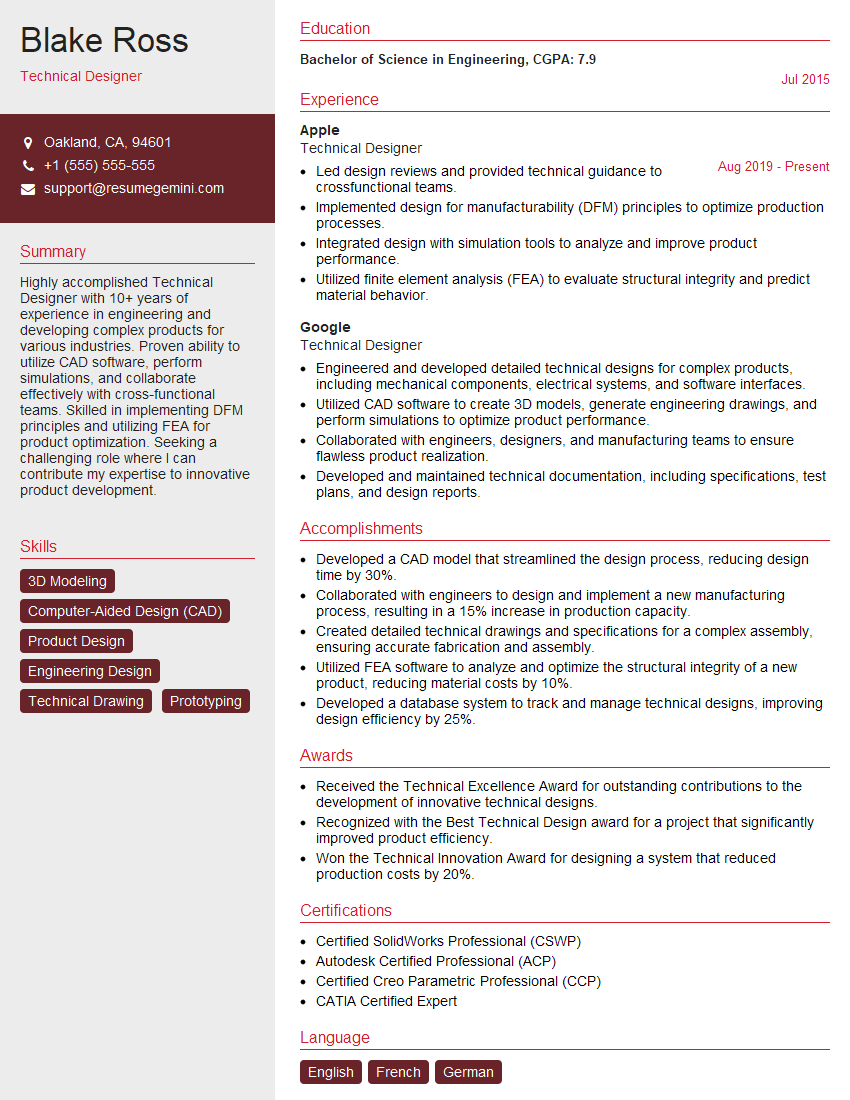
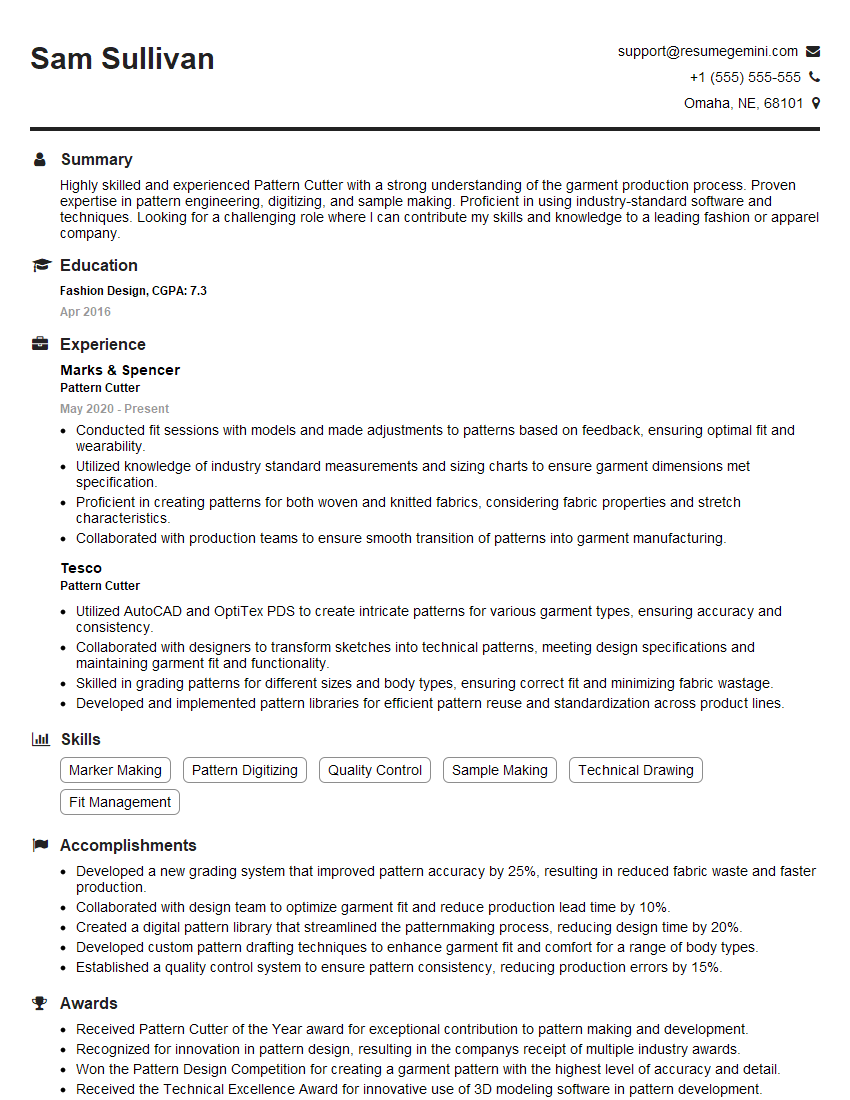
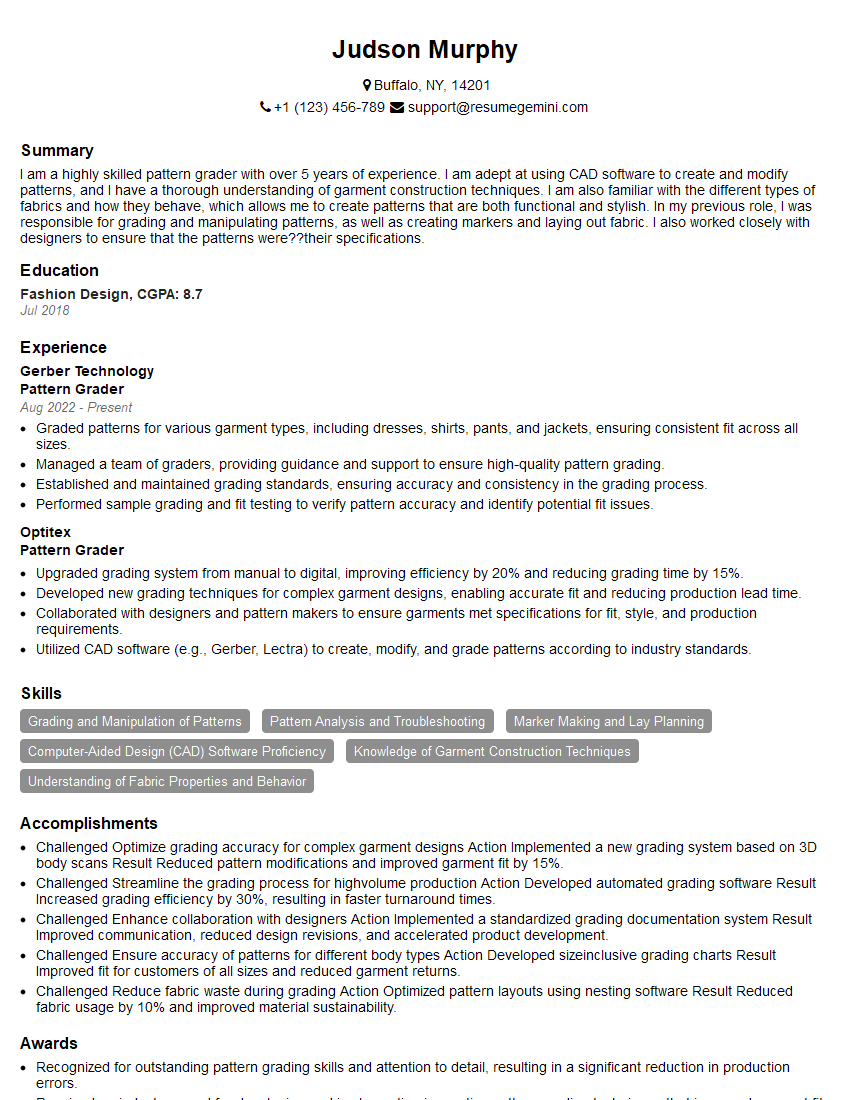
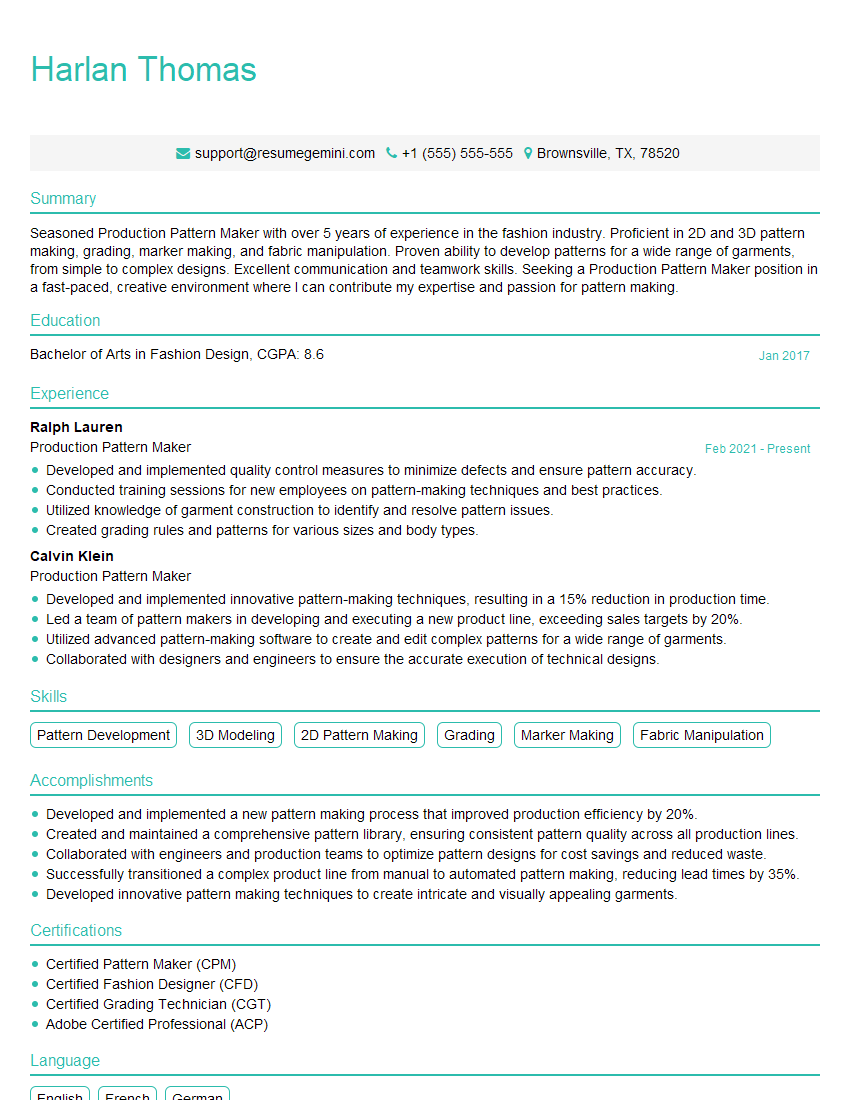
Mastering the understanding of garment patterns and specifications is crucial for career advancement in the fashion and apparel industry. A strong grasp of these concepts demonstrates technical proficiency and problem-solving skills highly valued by employers. To maximize your job prospects, create an ATS-friendly resume that highlights your skills and experience effectively. ResumeGemini is a trusted resource that can help you build a professional resume tailored to your specific skills and experience. Examples of resumes tailored to demonstrating expertise in Understanding of Garment Patterns and Specifications are available to help guide your resume creation process.



Explore more articles
Users Rating of Our Blogs
Share Your Experience
We value your feedback! Please rate our content and share your thoughts (optional).
What Readers Say About Our Blog
Very informative content, great job.
good