The right preparation can turn an interview into an opportunity to showcase your expertise. This guide to Understanding of web design principles interview questions is your ultimate resource, providing key insights and tips to help you ace your responses and stand out as a top candidate.
Questions Asked in Understanding of web design principles Interview
Q 1. Explain the difference between UI and UX design.
UI (User Interface) and UX (User Experience) design are often confused, but they are distinct yet interconnected disciplines. Think of it like this: UI is the what, while UX is the how and why.
UI design focuses on the visual aspects of an interface – the buttons, colors, typography, images, and overall layout. It’s about creating a visually appealing and intuitive interface that is easy to navigate. A good UI designer ensures that the interface is aesthetically pleasing and user-friendly, making interactions smooth and efficient. For instance, a UI designer would choose the specific fonts, colors, and button styles for a website.
UX design, on the other hand, encompasses the entire user journey. It considers the user’s overall experience with the product or service, from initial discovery to final interaction. This includes user research, information architecture, interaction design, usability testing, and overall satisfaction. A good UX designer would focus on making the website easy to use, achieving the user’s goals efficiently, and leaving a positive impression. For example, a UX designer would map out the user flow, conduct usability tests, and determine how information is organized on the website for optimal user comprehension and navigation.
In essence, UI is a subset of UX. A successful product requires both excellent UI and UX design working in harmony.
Q 2. Describe your process for designing a website’s user flow.
Designing a website’s user flow is a crucial step in creating a positive user experience. My process typically involves the following:
- Understanding User Goals: I begin by clearly defining the users and their goals. What are they trying to achieve on the website? This often involves user research, competitor analysis, and defining user personas.
- Mapping the User Journey: I then create user journey maps, visually representing the steps a user takes to achieve their goals. This involves identifying pain points and potential areas for improvement.
- Creating User Flows: Based on the user journey maps, I develop user flows, which are more detailed diagrams showing the specific steps and interactions a user will take within the website. These often use wireframes or flowcharts.
- Prototyping and Testing: I create low-fidelity prototypes to visualize the user flow and then conduct usability testing with real users to identify any friction points or areas that need improvement. This iterative process helps refine the user flow until it’s optimized for ease of use.
- Refinement and Iteration: Based on the testing feedback, I refine the user flow and user interface, making adjustments to ensure a seamless and efficient user experience. This is a cyclical process; I continuously test, refine, and iterate.
For example, if I’m designing a user flow for an e-commerce website, I’d map out the steps involved in purchasing an item: browsing products, adding to cart, checkout, and payment confirmation. I’d look for areas where users might get stuck or frustrated and work to simplify those processes.
Q 3. What are the principles of Gestalt design and how do they apply to web design?
Gestalt principles are rules of human perception that describe how we visually organize elements into groups or unified wholes. These principles are essential in web design because they influence how users perceive and interact with a website’s layout and content.
- Proximity: Elements placed close together are perceived as a group. For example, grouping related content in modules or cards.
- Similarity: Similar elements are perceived as related. Using consistent typography, colors, and spacing for similar content.
- Closure: We tend to complete incomplete shapes or forms. Using implied lines or shapes to create visual interest and guide the user’s eye.
- Continuity: The eye tends to follow lines or curves. Using visual lines to guide the user’s eye through the page and create a sense of flow.
- Figure/Ground: We perceive elements as either figures (objects) or ground (background). Using contrast to make important elements stand out from the background.
Applying these principles in web design improves usability and visual appeal. For instance, using consistent spacing and visual cues to group related navigation elements improves clarity and helps users find what they need quickly. Using a clear visual hierarchy with distinct figure/ground relationships ensures important content is easily identifiable.
Q 4. How do you ensure website accessibility for users with disabilities?
Website accessibility is crucial to ensure inclusivity and make the website usable for everyone, including people with disabilities. This is achieved through adherence to WCAG (Web Content Accessibility Guidelines).
My approach involves:
- Semantic HTML: Using appropriate HTML tags (e.g.,
<header>,<nav>,<main>,<article>) to structure the content logically and provide context for assistive technologies. - Alternative Text for Images: Providing descriptive alternative text (
altattributes) for all images, allowing screen readers to convey the image’s content to visually impaired users. - Keyboard Navigation: Ensuring all interactive elements (buttons, links, forms) are accessible using only the keyboard, enabling users with motor impairments to navigate the website effectively.
- Color Contrast: Using sufficient color contrast between text and background colors to ensure readability for users with low vision.
- Captions and Transcripts: Providing captions for videos and transcripts for audio content to benefit hearing-impaired users.
- ARIA Attributes: Using ARIA (Accessible Rich Internet Applications) attributes to enhance the accessibility of dynamic content and widgets that aren’t inherently accessible.
Regular accessibility audits and testing with assistive technologies are essential to ensure the website meets accessibility standards. Tools like WAVE and Lighthouse can help identify accessibility issues.
Q 5. Explain the importance of responsive web design.
Responsive web design is the practice of designing websites that adapt their layout and content to different screen sizes and devices (desktops, tablets, smartphones). It’s crucial for ensuring a consistent and optimal user experience across all platforms.
The benefits include:
- Improved User Experience: Users enjoy a consistent and optimized experience regardless of the device they use.
- Increased Reach: More users can access the website easily, leading to wider reach and engagement.
- Better SEO: Search engines favor responsive websites, improving the website’s ranking in search results.
- Cost-Effective: Maintaining a single responsive website is often more cost-effective than managing separate websites for different devices.
Responsive design is typically achieved using techniques such as fluid grids, flexible images, and media queries (CSS). Media queries allow applying different styles based on screen size, orientation, and device capabilities. For example, a media query might adjust the column layout on smaller screens to create a single-column design instead of a multi-column layout for desktop screens.
Q 6. What are some common usability testing methods?
Usability testing helps evaluate the usability of a website and identify areas for improvement. Several methods exist, each offering different insights:
- Moderated Usability Testing: A researcher observes users as they interact with the website, asking questions and guiding them through tasks. This provides qualitative data and allows for in-depth understanding of user behavior and challenges.
- Unmoderated Usability Testing: Users complete tasks independently, typically recording their screen and audio. This approach is less expensive and more scalable, offering a broader range of user perspectives, providing quantitative data.
- A/B Testing: Two different versions of a website are compared to determine which performs better based on key metrics such as conversion rates or task completion times. This involves quantitative analysis.
- Heuristic Evaluation: Experts evaluate the website based on established usability principles (heuristics). This can identify potential problems quickly and efficiently.
- Card Sorting: Participants organize information cards into categories to inform information architecture and navigation design. This is primarily useful in the early stages of a project.
The choice of method depends on the project’s scope, budget, and the type of data required. Often, a combination of methods provides a comprehensive understanding of user behavior and website usability.
Q 7. How do you handle design feedback and criticism?
Handling design feedback and criticism is a crucial part of the design process. It’s an opportunity to learn and improve. My approach involves:
- Active Listening: I carefully listen to the feedback without interruption, trying to understand the perspective of the person providing it. Asking clarifying questions can be crucial.
- Empathy and Understanding: I try to understand the reasoning behind the feedback, even if I don’t agree initially. Sometimes, feedback comes from a different perspective and understanding that perspective is essential.
- Objective Evaluation: I assess the validity of the feedback, considering whether it aligns with the project goals and user needs. Not all feedback is equally relevant or actionable.
- Collaboration and Discussion: I engage in a constructive discussion with the person providing the feedback, explaining my design choices and exploring potential solutions. This often leads to better outcomes than simply accepting or rejecting feedback outright.
- Documentation and Iteration: I document the feedback received and incorporate the valid points into the design iterations. This process allows for continual refinement and improvement.
It’s important to remember that feedback is subjective. While striving to incorporate useful feedback, it is equally important to maintain the integrity of the design and avoid compromising the overall user experience.
Q 8. Describe your experience with wireframing and prototyping.
Wireframing and prototyping are crucial stages in the web design process. Wireframing is the initial blueprint, a low-fidelity representation of the website’s structure and functionality. Think of it as the skeletal framework before adding muscles and skin. It typically uses simple shapes and placeholders to map out page layouts and user flows. Prototyping, on the other hand, takes this a step further, creating a more interactive, higher-fidelity representation. It allows for testing user interactions and navigating between pages, giving a more realistic feel of the final product.
In my experience, I’ve used wireframing to quickly iterate on different page layouts, exploring various options before committing to a specific design. For example, when designing an e-commerce website, I might create several wireframes to compare the effectiveness of different product display layouts. Once I’ve settled on a structure, I move to prototyping, creating interactive mockups to test user navigation and the overall user experience. This helps identify potential usability issues early in the process, saving time and resources down the line. I utilize tools like Figma and Adobe XD for both wireframing and prototyping, leveraging their capabilities to create both simple and highly interactive prototypes.
Q 9. What design tools are you proficient in?
I’m proficient in a variety of design tools, each suited to different stages of the design process. My core tools include Figma and Adobe XD for wireframing, prototyping, and visual design. Figma’s collaborative features are invaluable in team projects. Adobe XD offers strong prototyping capabilities and integrates seamlessly with other Adobe Creative Suite applications. I also utilize Sketch for more intricate vector illustrations, and InVision for advanced prototyping and user testing. For image editing and manipulation, I rely on Photoshop. Furthermore, I have experience with code editors like VS Code for front-end development and ensuring design consistency with the actual implementation.
Q 10. How do you stay up-to-date with the latest web design trends?
Staying current in the ever-evolving world of web design is critical. I actively engage in several strategies to achieve this. I regularly follow influential blogs and publications like Awwwards, CSS-Tricks, and Smashing Magazine. These platforms showcase innovative designs and offer insightful articles on the latest trends and technologies. I also actively participate in online communities and forums like Reddit’s r/webdesign, engaging in discussions and learning from other designers’ experiences. Additionally, I attend webinars and online conferences hosted by industry leaders, gaining insights directly from experts. Finally, I explore the latest updates and features in my design tools, regularly experimenting with new functionalities and exploring how they can be applied to improve my workflow and designs.
Q 11. Explain the concept of information architecture and its importance in web design.
Information architecture (IA) is the structural design of shared information environments. In web design, it’s the blueprint of how users navigate and find information on a website. Think of it as the library’s organization system—a well-structured IA ensures users can easily locate what they need. A poorly designed IA, on the other hand, can lead to frustration and a high bounce rate.
Its importance is paramount. A well-defined IA improves user experience by making it easy for users to find information, leading to increased engagement and conversions. It also improves website usability by creating a logical and intuitive navigation structure. For example, a website selling clothing should have clear categories like ‘Men’s’, ‘Women’s’, ‘Accessories’, etc., allowing users to quickly find what they are looking for. Without a strong IA, users might get lost or overwhelmed, leading them to leave the site.
Q 12. How do you incorporate user research into your design process?
User research is fundamental to my design process. It starts with understanding the target audience. I employ a variety of research methods, including:
- User interviews: Talking directly to potential users to understand their needs, pain points, and expectations.
- Surveys: Gathering quantitative and qualitative data from a larger sample of users.
- Usability testing: Observing users interacting with prototypes to identify areas for improvement.
- Competitive analysis: Analyzing the strengths and weaknesses of competitors’ websites.
The insights gathered from these methods inform design decisions, ensuring that the website effectively meets user needs. For example, usability testing might reveal that a specific feature is difficult to use, prompting me to redesign it for better clarity and efficiency.
Q 13. How do you balance aesthetics and functionality in web design?
Balancing aesthetics and functionality is a constant challenge, but crucial for effective web design. A beautiful website is useless if it’s difficult to navigate. The key is to find a harmonious balance, where the design is both visually appealing and user-friendly. I approach this by:
- Prioritizing usability: Ensuring the website is easy to navigate and use before focusing on visual elements.
- Using visual hierarchy: Guiding users’ eyes to the most important information through visual cues like size, color, and contrast.
- Following design principles: Adhering to principles like proximity, alignment, and contrast to create a clean and visually appealing design.
- Iterative design: Continuously testing and refining the design based on user feedback.
For instance, a visually stunning website with an unclear call-to-action will fail to convert users. A well-balanced design ensures both visual appeal and ease of use, leading to a better user experience.
Q 14. What are some common design patterns used in web design?
Many common design patterns streamline web design and improve usability. Some examples include:
- Hamburger menu: A three-line icon that reveals a navigation menu, often used to conserve screen space on mobile devices.
- Card layout: Presenting information in visually distinct blocks or cards, making content easily scannable and digestible.
- Search bar: A prominent search field that allows users to quickly find specific information.
- Pagination: Breaking up large amounts of content into smaller, manageable pages.
- Modal windows: Overlaying windows that appear on top of the main content, often used for forms or detailed information.
Using established patterns ensures familiarity and reduces cognitive load for users. However, it’s important to adapt these patterns to the specific context of the website and avoid blindly applying them without considering user needs.
Q 15. Describe your experience with A/B testing.
A/B testing is a crucial method for improving website design and performance. It involves creating two versions of a webpage (A and B), each with a slightly different element, and then showing each version to a statistically significant sample of users. By analyzing which version performs better based on key metrics, you can make data-driven decisions to optimize the design.
For example, I once A/B tested two different call-to-action (CTA) button colors on a landing page. Version A used a blue button, while version B used a green button. After a week of testing, we found that the green button (Version B) resulted in a 15% higher click-through rate. This data clearly indicated that the green button was more effective and we implemented that change across the site.
My approach to A/B testing involves careful planning. This includes defining clear hypotheses, selecting appropriate metrics (e.g., conversion rates, bounce rates, time on page), ensuring a statistically significant sample size, and using analytics tools like Google Analytics or Optimizely to track and analyze results. The iterative nature of A/B testing is key; you learn, adapt, and continuously refine your designs based on data.
Career Expert Tips:
- Ace those interviews! Prepare effectively by reviewing the Top 50 Most Common Interview Questions on ResumeGemini.
- Navigate your job search with confidence! Explore a wide range of Career Tips on ResumeGemini. Learn about common challenges and recommendations to overcome them.
- Craft the perfect resume! Master the Art of Resume Writing with ResumeGemini’s guide. Showcase your unique qualifications and achievements effectively.
- Don’t miss out on holiday savings! Build your dream resume with ResumeGemini’s ATS optimized templates.
Q 16. Explain your understanding of color theory and typography in web design.
Color theory and typography are fundamental to effective web design. They significantly impact user experience and brand perception. Color theory involves understanding the relationships between colors, their emotional impact, and how they work together to create visual harmony or contrast. For instance, using complementary colors (like blue and orange) can create a vibrant and attention-grabbing design, while analogous colors (colors next to each other on the color wheel, like blue, blue-green, and green) can provide a calming and cohesive feel.
Typography concerns the selection and use of typefaces. Choosing the right fonts is crucial for readability and brand consistency. Factors to consider include font families (serif vs. sans-serif), font weights (bold, light, regular), font sizes, and line spacing (leading). A well-chosen typeface should enhance the overall aesthetic of the website while ensuring effortless readability. For example, a website targeting a professional audience might benefit from a clean sans-serif font like Open Sans, whereas a playful website might use a more stylized script font for certain headings.
In my experience, I always consider the target audience and brand identity when choosing colors and fonts. I utilize tools like Adobe Color and Google Fonts to explore and combine different options, ensuring accessibility and a visually appealing outcome. I often create mood boards to visualize the overall aesthetic and test various combinations before finalizing the design.
Q 17. How do you optimize images for web performance?
Optimizing images for web performance is critical for a smooth user experience and improved SEO. Large image files significantly slow down loading times, leading to higher bounce rates and decreased user engagement. My optimization strategy involves a multi-pronged approach.
- Choosing the Right Format: Using formats like WebP, which offer superior compression compared to JPEG or PNG, for images wherever possible. WebP supports transparency which was previously only handled by PNG.
- Compression: Using tools like TinyPNG or ImageOptim to reduce file sizes without significant quality loss. There are many free options and paid options that cater to larger scale usage.
- Resizing Images: Ensuring images are only as large as they need to be for the website. Scaling down images after uploading them is inefficient.
- Lazy Loading: Implementing lazy loading, a technique that only loads images as they scroll into the user’s viewport. This significantly improves initial page load time, especially for pages with many images.
- Responsive Images: Using the
<picture>element orsrcsetattribute in<img>tags to provide different image sizes for various screen resolutions, reducing bandwidth consumption on different devices.
By implementing these strategies, I ensure a balance between image quality and performance, leading to a more enjoyable and efficient user experience.
Q 18. What are your preferred methods for creating user personas?
Creating user personas is a critical step in understanding the target audience for a web design project. I typically employ a mixed-methods approach, combining quantitative and qualitative data to develop detailed and accurate personas.
- Data Analysis: Reviewing existing user data, such as website analytics, CRM data, and market research reports, to identify trends and patterns in user behavior.
- User Interviews: Conducting in-depth interviews with representative users to gather insights into their motivations, needs, frustrations, and behaviors. This involves open-ended questions to understand their perspectives.
- Surveys: Distributing online surveys to a larger sample of users to collect quantitative data and validate findings from interviews.
- Competitive Analysis: Researching competitor websites and analyzing their target audience to identify opportunities and potential challenges.
Once data is collected, I synthesize the findings to create detailed user personas, usually including demographic information (age, location, occupation), psychographic information (values, lifestyle, attitudes), goals, motivations, pain points, and technology usage habits. This helps to design a website that is truly user-centered and addresses the specific needs of the target audience.
Q 19. How do you measure the success of your web design projects?
Measuring the success of web design projects requires a multifaceted approach, going beyond simple aesthetics. Key metrics are essential to objectively evaluate the effectiveness of the design.
- Conversion Rates: Tracking the percentage of users who complete a desired action, such as making a purchase, signing up for a newsletter, or filling out a form. This is particularly relevant for e-commerce and lead generation websites.
- Bounce Rate: Measuring the percentage of users who leave the website after viewing only one page. A high bounce rate indicates potential usability issues or a lack of engaging content.
- Time on Site: Assessing the average amount of time users spend on the website. Higher time on site can suggest engagement and satisfaction.
- Page Views per Visit: Measuring the average number of pages a user visits during a single session. This indicates how effectively users navigate and explore the website.
- User Feedback: Collecting user feedback through surveys, user testing, or online reviews to gain qualitative insights into their satisfaction and identify areas for improvement.
By analyzing these metrics in conjunction with user feedback, I can determine whether the website is achieving its intended goals and identify areas for optimization. Regular monitoring and analysis are key to ensuring the continuous improvement of the website’s performance.
Q 20. Describe your experience with creating user journeys.
Creating user journeys maps the steps a user takes to achieve a specific goal on a website. This is a powerful tool for understanding the user experience and identifying areas for improvement. I typically use a combination of methods to create comprehensive user journeys.
I begin by defining the specific goal or task the user wants to accomplish (e.g., purchasing a product, finding information, contacting customer support). Then, I map out the steps the user takes to achieve that goal, including their interactions with the website, their emotional state at each step, and any pain points or frustrations they encounter. I often use visual tools, such as flowcharts or diagrams, to represent the user journey clearly and concisely.
For example, when designing the user journey for an online store, I’d map out the steps from browsing products to adding them to the cart, proceeding to checkout, and completing the purchase. This allows me to identify potential bottlenecks or areas where users might get lost or frustrated (e.g., a complicated checkout process, unclear product descriptions). By analyzing the user journey, I can identify ways to simplify the process, improve usability, and ultimately enhance the user experience.
Q 21. How do you ensure consistent branding across multiple platforms?
Ensuring consistent branding across multiple platforms is vital for maintaining a strong brand identity and recognition. My strategy involves a structured approach focused on establishing clear guidelines and utilizing consistent design elements.
- Brand Style Guide: Creating a comprehensive brand style guide that defines all aspects of the brand’s visual identity, including logo usage, color palettes, typography, imagery style, and voice and tone. This guide serves as a central resource for all designers and developers.
- Design System: Developing a design system with reusable components and patterns, ensuring consistency in the design across all platforms (website, mobile app, social media, etc.). This system may utilize a component library (like Storybook) for shared elements across the platforms.
- Regular Audits: Conducting regular audits of all brand touchpoints to identify and address any inconsistencies. This ensures the brand’s visual identity remains consistent over time.
- Centralized Asset Management: Using a centralized asset management system (e.g., a cloud storage platform) to store and manage all brand assets (logos, images, fonts) to ensure everyone uses the correct and up-to-date versions.
- Collaboration Tools: Utilizing collaborative design tools that allow designers and developers to work together efficiently and maintain consistency across platforms. These might include design collaboration platforms or version control for code.
By implementing these measures, I ensure the brand maintains a cohesive and recognizable identity across all channels, building a strong and unified brand presence.
Q 22. Explain your understanding of SEO best practices for web design.
SEO best practices in web design are crucial for ensuring a website’s visibility in search engine results. It’s not just about technical optimization; it’s intrinsically linked to the design itself. A well-designed website inherently incorporates many SEO elements.
Keyword Research & Integration: Understanding which keywords users are searching for related to your content is paramount. These keywords should be naturally integrated into page titles, headings (
<h1>,<h2>, etc.), meta descriptions, image alt text, and body copy. Avoid keyword stuffing; focus on creating high-quality, relevant content.Clean and Semantic HTML: Search engines rely on HTML to understand your website’s structure and content. Using semantic HTML5 tags (
<article>,<aside>,<nav>) improves both SEO and accessibility. Think of it as giving clear instructions to the search engine bots.Optimized Images: Images are essential for user engagement, but large image files slow down page load times, negatively impacting SEO. Optimize images by compressing them without sacrificing quality and using descriptive alt text to explain the image to search engines and users who can’t see it.
Mobile-Friendliness: Google prioritizes mobile-friendly websites. Responsive design, ensuring your site adapts seamlessly to different screen sizes, is a must. A poor mobile experience can severely hurt your search ranking.
Site Structure and Internal Linking: A well-organized site structure with clear internal links helps both users and search engines navigate your content. Internal links pass link equity, boosting the SEO of important pages. Think of it like creating a roadmap through your website.
Page Speed Optimization: Faster loading times directly impact SEO. Minimize HTTP requests, optimize images, leverage browser caching, and use a Content Delivery Network (CDN) to improve speed.
For example, imagine designing an e-commerce website selling handcrafted jewelry. Keyword research might reveal high search volumes for “handmade earrings,” “artisan necklaces,” etc. These keywords would then be strategically woven into the product descriptions, page titles, and meta descriptions.
Q 23. What is your experience with content management systems (CMS)?
I have extensive experience with various Content Management Systems (CMS), including WordPress, Drupal, and Joomla. My experience goes beyond simply using these platforms; I understand their underlying architecture and how to customize them to meet specific design and functionality requirements.
With WordPress, for instance, I’m proficient in using page builders like Elementor and Beaver Builder to create visually appealing and functional layouts without extensive coding. I also understand the importance of plugin management and optimization to ensure site performance and security. With Drupal, I’ve worked on more complex projects requiring custom module development to achieve specific functionalities. My experience allows me to select the appropriate CMS based on a project’s needs, complexity, and budget. I can easily adapt to new CMS platforms as required, as the underlying principles of content management are consistent across platforms.
Q 24. How do you approach designing for different screen sizes and devices?
Designing for different screen sizes and devices is paramount in today’s multi-device world. This requires a responsive design approach, ensuring the website adapts seamlessly to various screen resolutions and devices (desktops, laptops, tablets, smartphones).
Fluid Grids and Flexible Images: Using percentage-based widths and flexible image sizes allows elements to resize proportionally based on screen size, maintaining a consistent layout.
Media Queries: CSS media queries allow applying different styles based on screen size, orientation, and device capabilities. This enables tailoring the design for specific breakpoints (e.g., desktop, tablet, mobile).
Mobile-First Approach: Designing for mobile first ensures the core content and functionality are optimized for the smallest screen size, then progressively enhancing the design for larger screens. This prioritizes the most crucial aspects of the user experience.
Testing Across Devices: Thorough testing on various devices and browsers is crucial to identify and fix any responsiveness issues. Browser developer tools are incredibly helpful in this process.
For example, when designing a portfolio website, I might use a fluid grid system so the images and text resize appropriately on different devices. Media queries would then adjust the layout—perhaps changing from a three-column grid on desktops to a single-column layout on mobile—to ensure optimal readability and user experience.
Q 25. Explain your approach to creating an effective website navigation.
Effective website navigation is critical for user experience and SEO. It’s about guiding users intuitively and effortlessly to the information they seek.
Clear and Concise Menu Structure: The main navigation should be simple, logically organized, and reflect the website’s information architecture. Avoid overly nested menus.
Intuitive Labeling: Menu items should be clearly labeled using descriptive and consistent language. Users should instantly understand what each link leads to.
Breadcrumbs: Breadcrumbs show users their current location within the site’s hierarchy, providing context and allowing easy navigation back to previous pages. Think of them as directional signs.
Search Functionality: A prominent search bar allows users to quickly find specific information, crucial for larger websites.
Visual Hierarchy: Using visual cues such as size, color, and font weight helps to guide users through the navigation elements.
For example, an e-commerce website might use a mega-menu to categorize products visually, while a blog website might use a simple, horizontal menu with clear categories.
Q 26. How do you handle conflicting priorities in a design project?
Conflicting priorities are common in design projects. My approach involves open communication, compromise, and prioritizing based on strategic goals.
Identify and Clarify Priorities: The first step is to clearly identify all stakeholders’ priorities and understand the reasoning behind them.
Prioritization Framework: I use a prioritization framework like MoSCoW (Must have, Should have, Could have, Won’t have) to categorize requirements based on their importance and feasibility. This helps in making informed decisions.
Data-Driven Decisions: Whenever possible, I back up my recommendations with data, such as user testing results or analytics. This makes prioritization more objective.
Open Communication: I keep all stakeholders informed throughout the process and encourage open communication to ensure everyone understands the rationale behind the final decisions.
Compromise and Negotiation: Sometimes, compromises are necessary. I facilitate discussion and collaboration to find solutions that meet as many priorities as possible.
For example, if a client wants a visually stunning design but also needs a fast-loading website, I’d explain the trade-offs and propose solutions that balance both priorities. This might involve optimizing images or choosing lighter design elements.
Q 27. Describe a time when you had to overcome a design challenge. What was the solution?
I once faced a challenge designing a website for a non-profit organization with limited budget and technical resources. They needed a visually appealing and functional website but lacked the funds for custom development and high-quality stock photos.
My solution was a multi-pronged approach:
Utilizing Free and Open-Source Resources: I leveraged free and open-source tools such as WordPress and free stock photo websites (carefully vetting for quality and licensing). This dramatically reduced the project’s cost.
Streamlined Design: I opted for a clean and minimalist design to keep development simple and avoid unnecessary elements that would increase development time and cost.
Volunteer Collaboration: I collaborated with volunteer designers and developers to contribute their skills, reducing the reliance on paid professionals.
Prioritizing User Experience: Despite budget constraints, I maintained a strong focus on user experience, ensuring the website was intuitive and easy to navigate, making the limited resources even more effective.
The result was a functional and visually appealing website within the budget constraints. This experience taught me the importance of resourcefulness and creative problem-solving in web design.
Q 28. What are your strengths and weaknesses as a web designer?
My strengths lie in my ability to understand user needs and translate them into effective and engaging designs. I’m highly proficient in multiple design software and CMS platforms, possess a strong understanding of SEO principles and responsive design, and am adept at collaborating with clients and developers to deliver high-quality projects.
A weakness I am actively working to improve is my time management when faced with multiple concurrent projects. I’ve implemented task management tools and strategies to overcome this and improve my overall efficiency.
Key Topics to Learn for Understanding of Web Design Principles Interview
- User Experience (UX) Design Principles: Understanding usability, accessibility, and information architecture. Consider how to design for different user needs and devices.
- User Interface (UI) Design Principles: Mastering visual hierarchy, typography, color theory, and layout techniques to create intuitive and aesthetically pleasing interfaces. Think about practical application in creating mockups or wireframes.
- Responsive Web Design: Knowledge of fluid grids, flexible images, and media queries for creating websites that adapt seamlessly to various screen sizes and devices.
- Web Accessibility (WCAG): Familiarity with accessibility guidelines to ensure websites are usable by people with disabilities. This includes understanding ARIA attributes and semantic HTML.
- Visual Communication and Branding: Applying design principles to effectively communicate a brand’s message and identity through visual elements. Think about logo design, color palettes, and overall visual style.
- Web Design Tools and Technologies: Practical experience with design software (Figma, Adobe XD, Sketch), prototyping tools, and familiarity with HTML, CSS, and potentially JavaScript.
- Design Process and Methodology: Understanding the stages of the design process, from research and ideation to prototyping and testing. Be prepared to discuss your approach to solving design problems.
- Design Thinking and Problem Solving: Ability to approach design challenges from a user-centric perspective, utilizing iterative design processes and user feedback to refine designs.
Next Steps
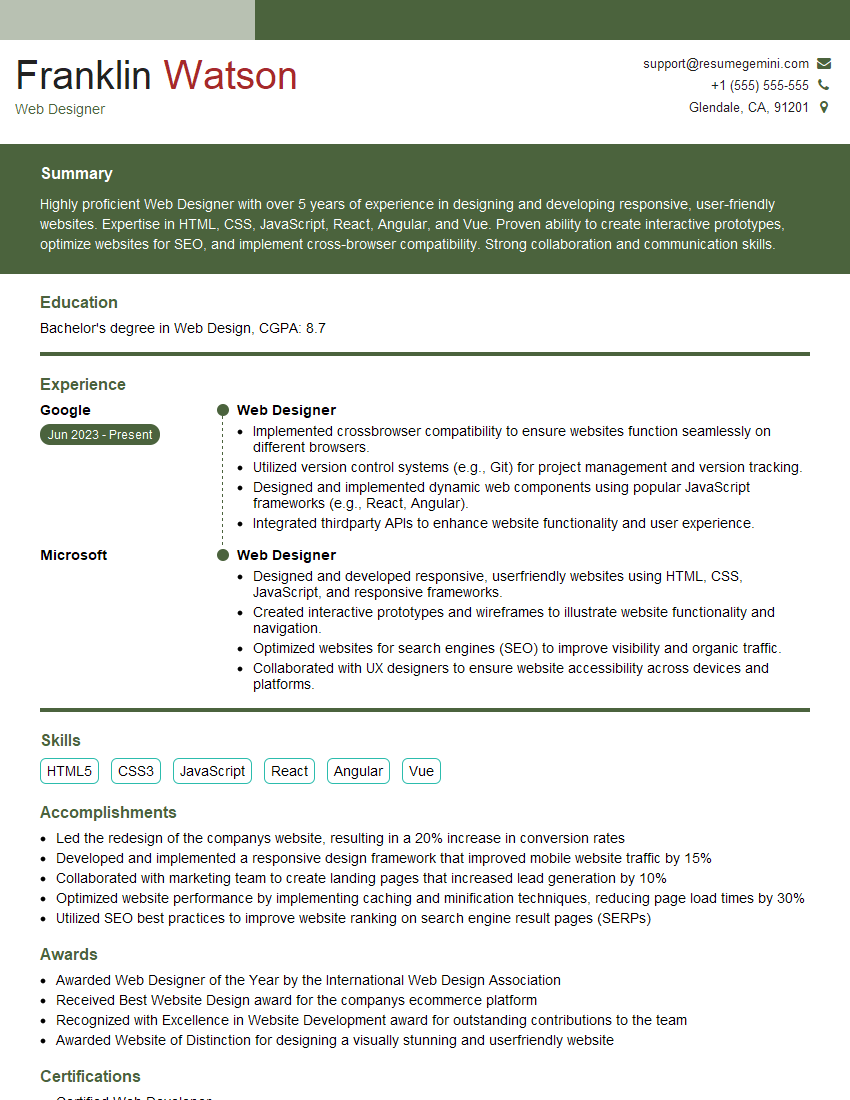
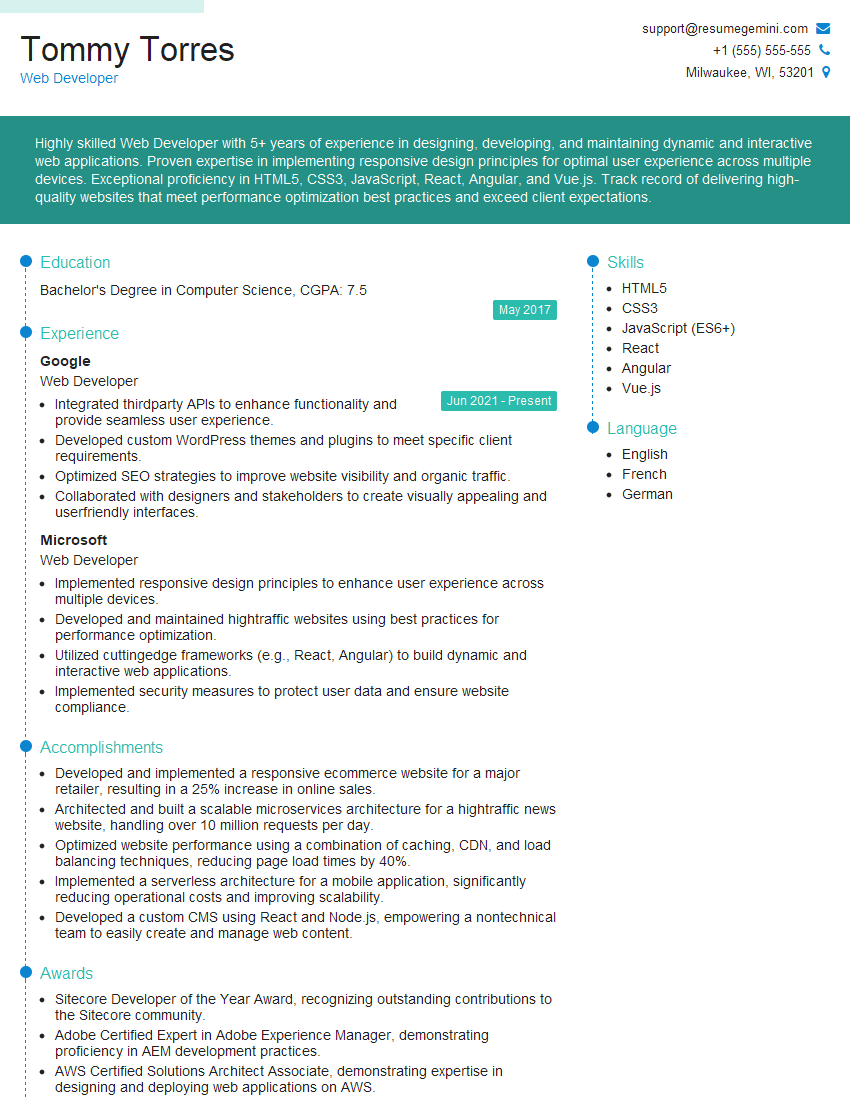
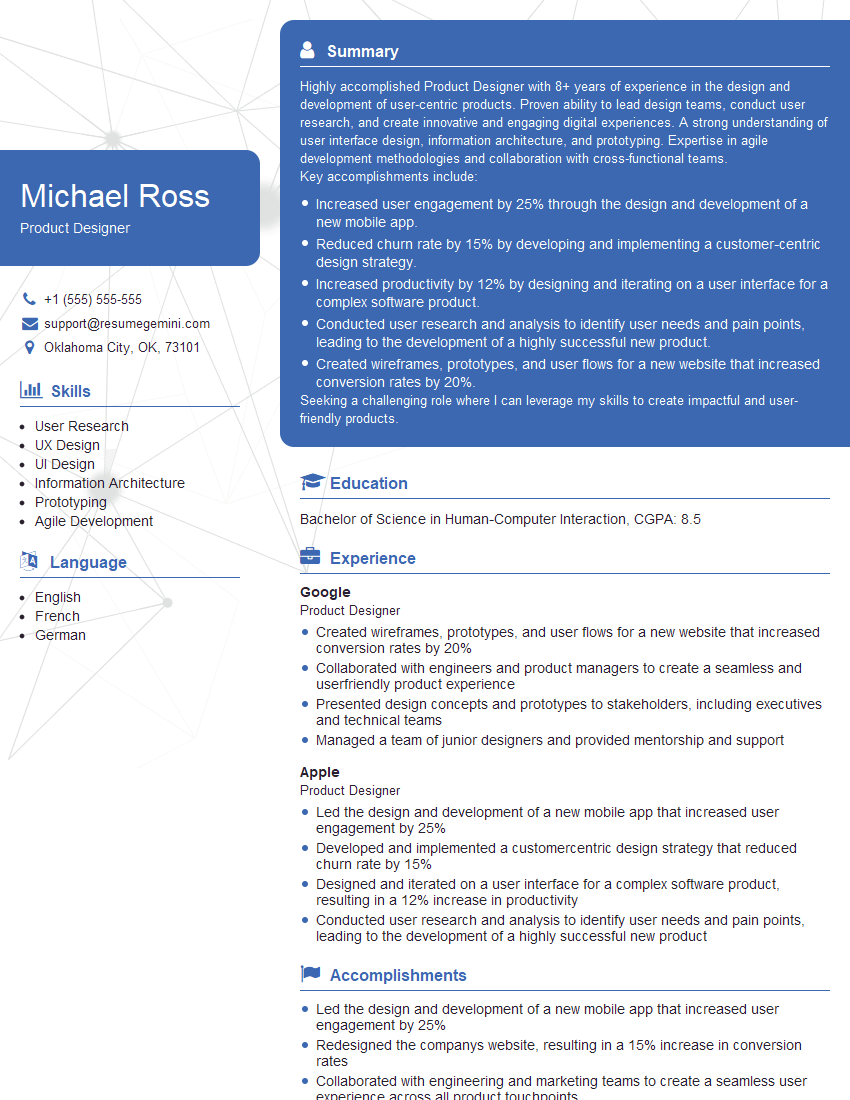
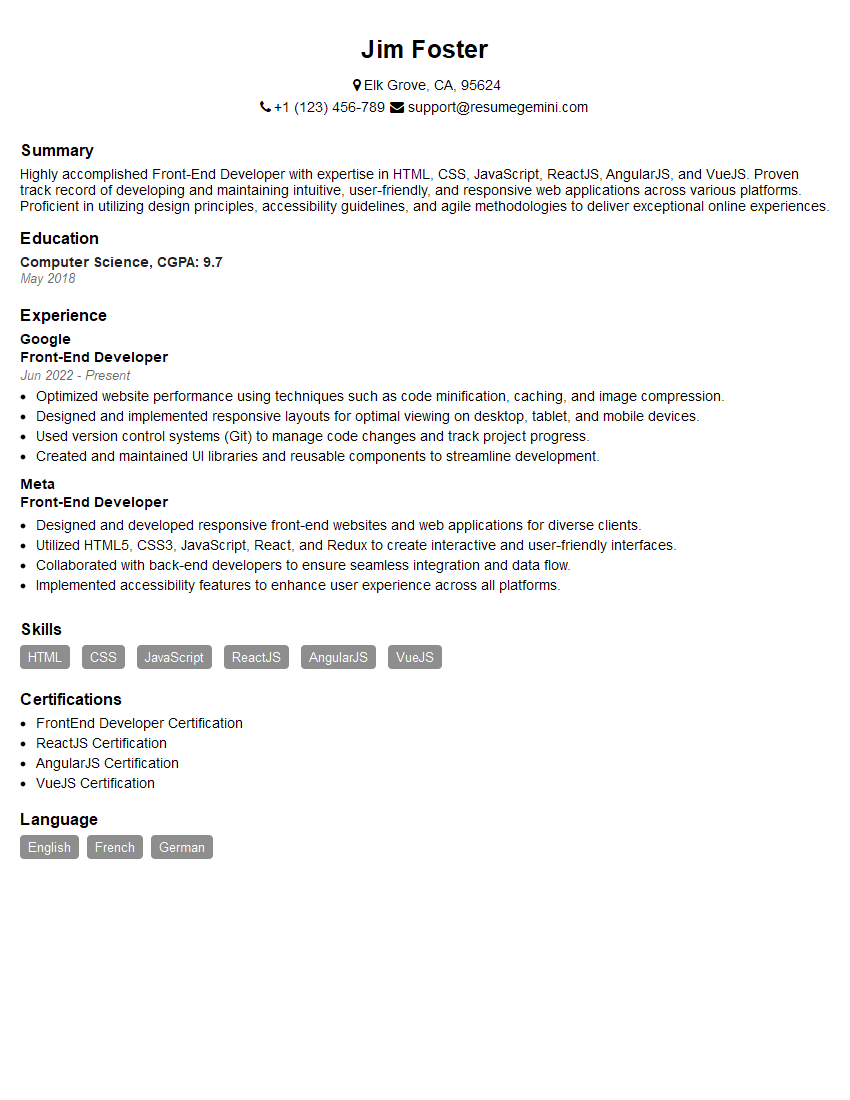
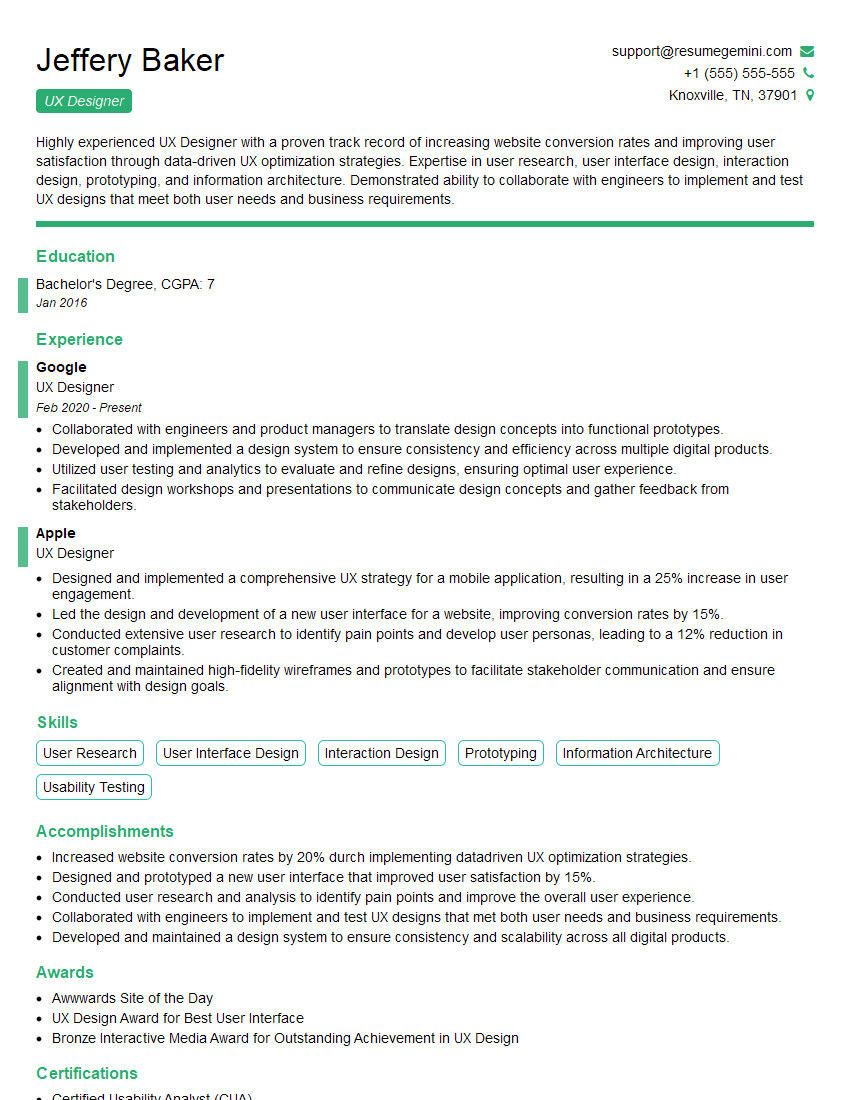
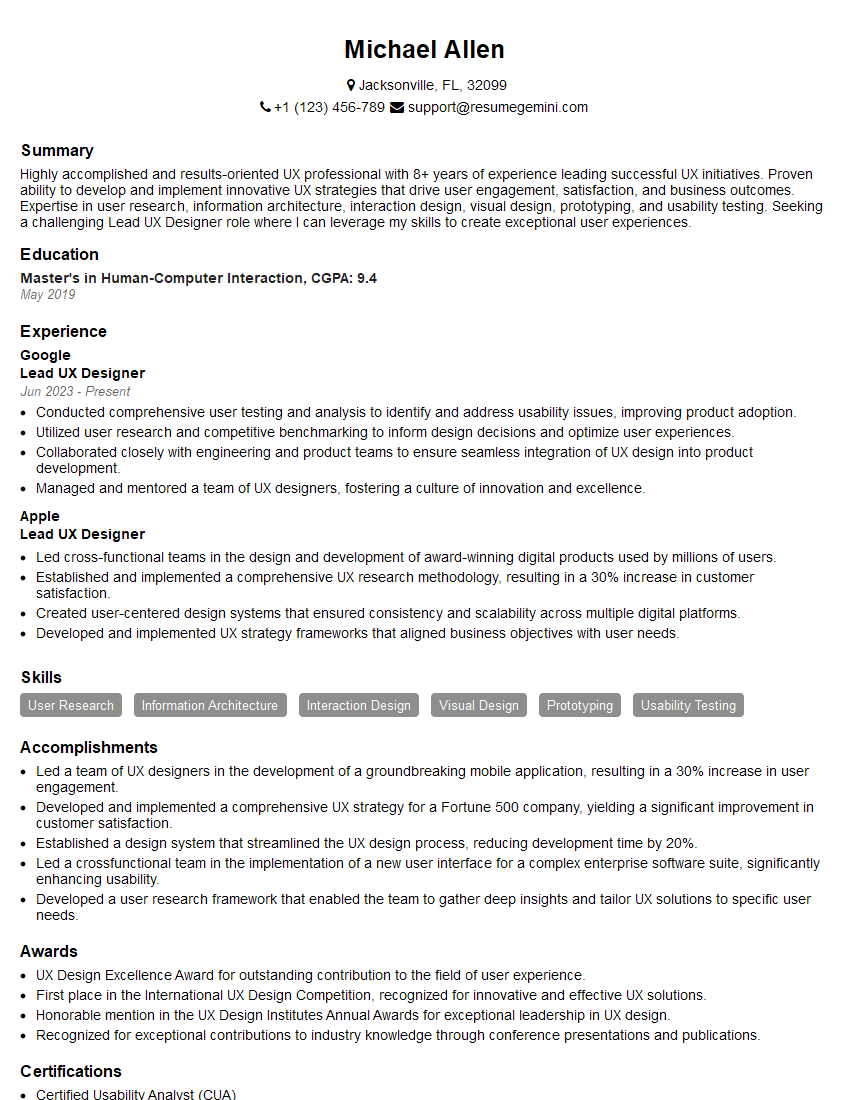
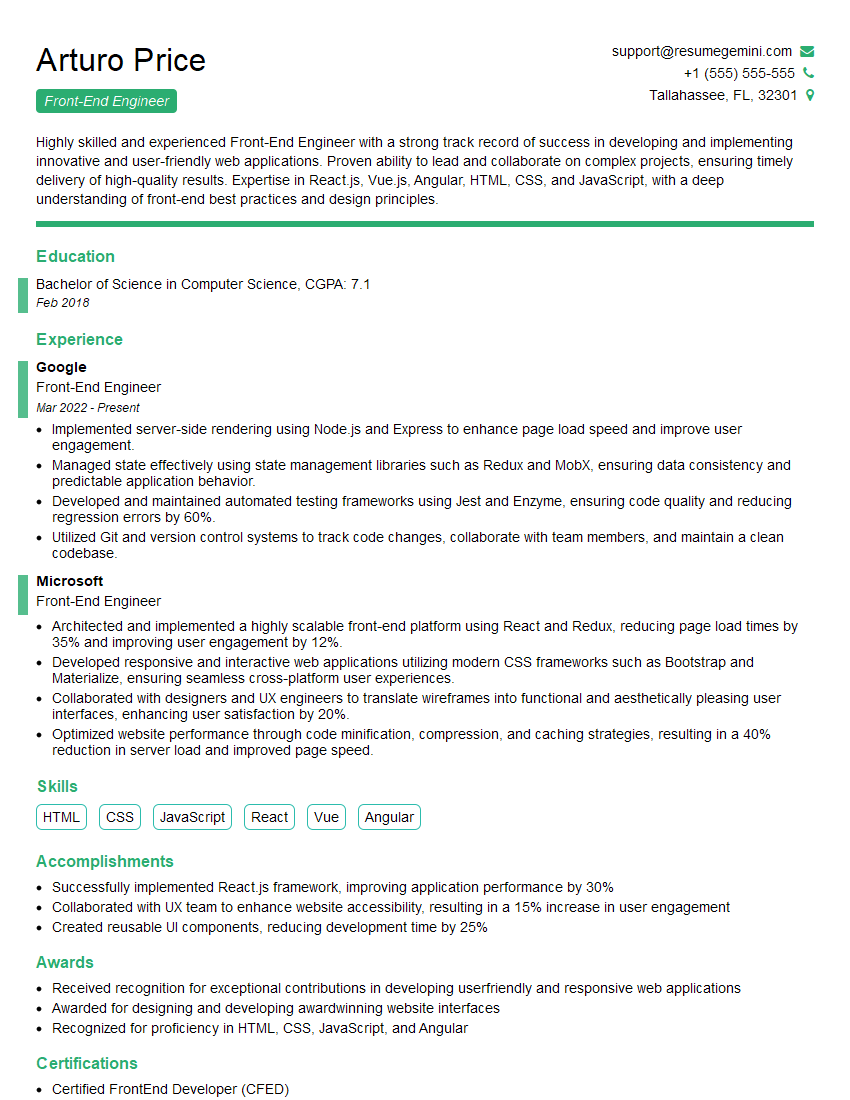
Mastering web design principles is crucial for career advancement in the ever-evolving digital landscape. A strong understanding of UX/UI, accessibility, and responsive design will significantly enhance your job prospects. To maximize your chances, create an ATS-friendly resume that highlights your skills and experience effectively. ResumeGemini is a trusted resource that can help you build a professional and impactful resume. They provide examples of resumes tailored to web design principles, ensuring your application stands out.

Explore more articles
Users Rating of Our Blogs
Share Your Experience
We value your feedback! Please rate our content and share your thoughts (optional).
What Readers Say About Our Blog
Hello,
we currently offer a complimentary backlink and URL indexing test for search engine optimization professionals.
You can get complimentary indexing credits to test how link discovery works in practice.
No credit card is required and there is no recurring fee.
You can find details here:
https://wikipedia-backlinks.com/indexing/
Regards
NICE RESPONSE TO Q & A
hi
The aim of this message is regarding an unclaimed deposit of a deceased nationale that bears the same name as you. You are not relate to him as there are millions of people answering the names across around the world. But i will use my position to influence the release of the deposit to you for our mutual benefit.
Respond for full details and how to claim the deposit. This is 100% risk free. Send hello to my email id: [email protected]
Luka Chachibaialuka
Hey interviewgemini.com, just wanted to follow up on my last email.
We just launched Call the Monster, an parenting app that lets you summon friendly ‘monsters’ kids actually listen to.
We’re also running a giveaway for everyone who downloads the app. Since it’s brand new, there aren’t many users yet, which means you’ve got a much better chance of winning some great prizes.
You can check it out here: https://bit.ly/callamonsterapp
Or follow us on Instagram: https://www.instagram.com/callamonsterapp
Thanks,
Ryan
CEO – Call the Monster App
Hey interviewgemini.com, I saw your website and love your approach.
I just want this to look like spam email, but want to share something important to you. We just launched Call the Monster, a parenting app that lets you summon friendly ‘monsters’ kids actually listen to.
Parents are loving it for calming chaos before bedtime. Thought you might want to try it: https://bit.ly/callamonsterapp or just follow our fun monster lore on Instagram: https://www.instagram.com/callamonsterapp
Thanks,
Ryan
CEO – Call A Monster APP
To the interviewgemini.com Owner.
Dear interviewgemini.com Webmaster!
Hi interviewgemini.com Webmaster!
Dear interviewgemini.com Webmaster!
excellent
Hello,
We found issues with your domain’s email setup that may be sending your messages to spam or blocking them completely. InboxShield Mini shows you how to fix it in minutes — no tech skills required.
Scan your domain now for details: https://inboxshield-mini.com/
— Adam @ InboxShield Mini
Reply STOP to unsubscribe
Hi, are you owner of interviewgemini.com? What if I told you I could help you find extra time in your schedule, reconnect with leads you didn’t even realize you missed, and bring in more “I want to work with you” conversations, without increasing your ad spend or hiring a full-time employee?
All with a flexible, budget-friendly service that could easily pay for itself. Sounds good?
Would it be nice to jump on a quick 10-minute call so I can show you exactly how we make this work?
Best,
Hapei
Marketing Director
Hey, I know you’re the owner of interviewgemini.com. I’ll be quick.
Fundraising for your business is tough and time-consuming. We make it easier by guaranteeing two private investor meetings each month, for six months. No demos, no pitch events – just direct introductions to active investors matched to your startup.
If youR17;re raising, this could help you build real momentum. Want me to send more info?
Hi, I represent an SEO company that specialises in getting you AI citations and higher rankings on Google. I’d like to offer you a 100% free SEO audit for your website. Would you be interested?
Hi, I represent an SEO company that specialises in getting you AI citations and higher rankings on Google. I’d like to offer you a 100% free SEO audit for your website. Would you be interested?
good