Every successful interview starts with knowing what to expect. In this blog, we’ll take you through the top Underwater Structural Inspection interview questions, breaking them down with expert tips to help you deliver impactful answers. Step into your next interview fully prepared and ready to succeed.
Questions Asked in Underwater Structural Inspection Interview
Q 1. Explain the different types of underwater structural inspections.
Underwater structural inspections encompass a range of methods tailored to the specific structure and its condition. They can be broadly categorized as visual inspections, non-destructive testing (NDT) inspections, and remotely operated vehicle (ROV) inspections.
- Visual Inspections: These are often the initial step, involving divers or remotely operated vehicles (ROVs) equipped with cameras to assess the overall condition of the structure. This allows for a preliminary identification of potential problems like cracks, corrosion, or marine growth. Think of it like a visual ‘once-over’ before more in-depth investigations.
- Non-Destructive Testing (NDT) Inspections: These employ various techniques to evaluate the structural integrity without causing damage. Common NDT methods include ultrasonic testing (UT), magnetic particle inspection (MPI), and electromagnetic testing (ET). These provide detailed information about material properties, the presence of defects, and the extent of damage.
- Remotely Operated Vehicle (ROV) Inspections: ROVs are unmanned submersibles equipped with cameras, sensors, and manipulators to conduct inspections in harsh or inaccessible environments. They allow for detailed visual inspection, data acquisition, and even the deployment of NDT equipment underwater.
The choice of inspection method depends on factors like the type of structure (e.g., offshore platform, pipeline, bridge pier), the depth of water, the level of access, and the desired level of detail.
Q 2. Describe your experience with various Non-Destructive Testing (NDT) methods used in underwater inspections.
My experience encompasses a wide range of NDT methods used in underwater inspections. I’ve extensively used:
- Ultrasonic Testing (UT): UT uses high-frequency sound waves to detect internal flaws like cracks and corrosion. I’ve utilized this technique on offshore platforms to assess the thickness of structural members and identify potential areas of fatigue. It’s like using sonar, but instead of mapping the ocean floor, we’re mapping the internal structure of a component.
- Magnetic Particle Inspection (MPI): MPI is effective for detecting surface and near-surface cracks in ferromagnetic materials. I’ve employed MPI during inspections of pipelines to identify stress corrosion cracking, which is a common cause of failure. Imagine sprinkling iron filings on a magnetized object; cracks will disrupt the magnetic field, causing the filings to cluster around them.
- Electromagnetic Testing (ET): ET utilizes eddy currents to detect surface and subsurface flaws in conductive materials. This method is particularly useful for inspecting pipelines and other tubular structures for corrosion and pitting. The principles are similar to using a metal detector, but instead of finding lost coins, we’re locating areas of material degradation.
I’m proficient in interpreting the data obtained from these NDT methods and using this data to create comprehensive inspection reports and recommend appropriate repair strategies.
Q 3. What are the common causes of underwater structural degradation?
Underwater structures face unique challenges that lead to degradation. Common causes include:
- Corrosion: This is arguably the most significant factor, driven by the electrochemical reactions between the structure’s metal and the seawater. Different types of corrosion exist, including uniform corrosion, pitting, crevice corrosion, and stress corrosion cracking.
- Marine Growth: Organisms like barnacles, mussels, and algae attach to structures, increasing drag and potentially causing damage to coatings and even the underlying metal through scouring and abrasion. Think of it as a constantly growing, abrasive ‘crust’ that can weaken the structure.
- Erosion: The constant flow of water, particularly in high-velocity currents, can erode the structure’s surface, removing protective coatings and weakening the material. This is particularly evident around sharp edges and protrusions.
- Scouring: This occurs when currents remove sediment around the base of a structure, leaving the structure unsupported and vulnerable to damage. It’s like undermining a building’s foundation.
- Impact Damage: Collisions with ships, debris, or ice can inflict significant damage to underwater structures.
The combination of these factors often accelerates the degradation process, leading to structural weakening and potentially catastrophic failure.
Q 4. How do you identify and assess corrosion in underwater structures?
Identifying and assessing corrosion involves a multi-faceted approach:
- Visual Inspection: Divers or ROVs can identify obvious signs of corrosion such as pitting, rust, and scaling. The extent of visible corrosion gives an initial indication of the problem’s severity.
- NDT Methods: UT, ET, and MPI are crucial for detecting corrosion that is not readily visible. UT, in particular, can accurately measure the remaining thickness of a corroded member, allowing for an accurate assessment of its remaining strength.
- Corrosion Rate Measurement: This involves monitoring the corrosion rate over time using techniques like electrochemical measurements or weight-loss measurements from test coupons. It gives us an understanding of how fast the corrosion is progressing.
- Material Sampling: In some cases, samples of the corroded material may be taken and analyzed in a laboratory to determine the type and extent of corrosion.
By combining these methods, we can build a comprehensive understanding of the corrosion’s extent, type, and rate, which allows for informed decisions about repair or replacement.
Q 5. Explain your experience with ROV operations and data acquisition.
I have extensive experience in ROV operations and data acquisition. My experience includes:
- ROV Piloting: I’m proficient in operating various types of ROVs, from small, lightweight units for shallow water inspections to larger, more sophisticated systems capable of operating at significant depths.
- Sensor Integration: I’m experienced in integrating various sensors onto ROVs, including high-definition cameras, sonar systems, and NDT equipment such as UT probes. This allows us to gather comprehensive data, going beyond simple visuals.
- Data Acquisition and Management: I’m skilled in acquiring, processing, and managing data from ROV inspections, using specialized software to create high-resolution images, videos, and 3D models of the inspected structures. This creates a robust record for analysis and reporting.
- Data Post-Processing: This involves cleaning, enhancing, and analyzing the acquired data, often using specialized software to create detailed reports and 3D models that can be shared and reviewed with clients.
For example, during a recent inspection of an offshore wind turbine foundation, we utilized an ROV equipped with a high-resolution camera and sonar to create a detailed 3D model of the structure, which revealed significant areas of corrosion requiring immediate attention. This allowed for timely intervention, preventing a potentially costly failure.
Q 6. Describe your experience interpreting underwater inspection data.
Interpreting underwater inspection data requires a keen eye and a thorough understanding of material science, structural mechanics, and corrosion mechanisms. My approach involves:
- Visual Analysis: Carefully reviewing images and videos to identify corrosion, cracks, marine growth, and other anomalies. This includes assessing the extent and severity of any damage observed.
- NDT Data Analysis: Analyzing UT, ET, and MPI data to quantify the extent of material degradation, identify the location and size of defects, and assess the remaining structural integrity. This usually involves specialized software for data processing and interpretation.
- Correlation of Data: Integrating visual inspection data with NDT data to create a holistic picture of the structure’s condition. This includes identifying potential areas of concern which may require further investigation.
- Report Generation: Producing comprehensive reports that clearly document the findings, including detailed descriptions, measurements, and photographic evidence. Recommendations for repair, maintenance, or further inspection are also included.
Experience plays a crucial role in interpreting subtle variations in data that can indicate developing issues. For instance, a small change in the ultrasonic waveform could signify the onset of fatigue cracking, which, if left undetected, could have significant implications for structural integrity.
Q 7. How do environmental factors impact underwater structural integrity?
Environmental factors significantly influence underwater structural integrity. These factors include:
- Water Temperature: Fluctuations in water temperature can accelerate corrosion rates and affect the strength of certain materials.
- Salinity: Higher salinity levels generally increase the rate of corrosion.
- Water Currents: Strong currents can cause erosion and scour, removing sediment and leaving structures unsupported.
- Wave Action: Wave action can cause significant impact damage and increase fatigue in structural members.
- Marine Growth: As mentioned previously, marine growth can increase drag and cause abrasion.
- Ice: In colder climates, ice scouring can cause significant damage to structures.
- Biological Factors: Certain marine organisms can actively contribute to corrosion by secreting corrosive substances.
Understanding these environmental factors is crucial for predicting the rate of degradation and designing structures that can withstand the harsh underwater environment. This includes selecting appropriate materials, designing for increased strength, and implementing corrosion protection measures.
Q 8. What safety protocols do you follow during underwater inspections?
Safety is paramount in underwater inspection. We adhere to a rigorous multi-layered protocol, starting with pre-dive planning that includes thorough risk assessments, detailed dive plans outlining contingencies, and comprehensive equipment checks. This involves verifying the functionality of all diving gear, communication systems (e.g., underwater communication units), and remotely operated vehicles (ROVs) or other inspection equipment.
During the dive, we maintain constant communication with the surface support team, employing buddy systems for divers and adhering to strict decompression procedures. Environmental factors like currents, visibility, and water temperature are closely monitored and accounted for in our planning and execution. Emergency procedures, including emergency ascent protocols and access to readily available emergency equipment, are clearly defined and regularly practiced. Post-dive procedures include thorough equipment cleaning and maintenance, comprehensive debriefings, and review of all recorded data. Think of it like a carefully orchestrated symphony, every element playing its part to ensure a safe and productive dive.
Q 9. What are the limitations of different underwater inspection techniques?
Different underwater inspection techniques each have inherent limitations. For instance, visual inspection, while simple and cost-effective, is highly dependent on water clarity. Poor visibility severely restricts the effectiveness of visual inspections, especially in turbid waters or at significant depths.
Remotely Operated Vehicles (ROVs) offer greater reach and maneuverability than divers, but their capabilities are limited by their tether length and the resolution of their cameras and sensors. Sophisticated techniques like sonar and acoustic imaging can detect flaws in structures, but interpreting the data requires specialized training and can be challenging due to the complexity of the signals.
Non-destructive testing (NDT) methods such as underwater magnetic particle inspection (MPI) or ultrasonic testing (UT) can be highly accurate in detecting defects, but they are often expensive and require specialized equipment and trained personnel. The choice of technique always depends on a careful assessment of the specific needs of the inspection, the environmental conditions, and budget constraints.
Q 10. How do you document and report findings from underwater inspections?
Documentation and reporting are critical in underwater inspections. We meticulously document all findings, using a combination of high-resolution photos and videos captured by divers and ROVs, along with detailed written reports. These reports include location specifics, descriptions of any damage or anomalies identified, and measurements where applicable. We utilize specialized software to overlay inspection data onto 3D models of the structure, creating a comprehensive visual representation of the findings.
The final report follows a standardized format, usually including a summary of the inspection objectives, methodology, findings, conclusions, and recommendations. We use industry-standard terminology and provide clear, concise descriptions to ensure that the findings are easily understood by clients and other stakeholders. For example, we might use a standardized scale to quantify the severity of corrosion or cracking, providing quantifiable data to facilitate decision-making.
Q 11. Explain your understanding of underwater welding inspection standards.
Underwater welding inspection standards are crucial for ensuring the structural integrity of underwater structures. These standards, often dictated by classification societies like ABS, DNV, or Lloyd’s Register, specify acceptable welding procedures, quality control measures, and inspection techniques. The standards cover aspects such as welder qualifications, material specifications, and non-destructive testing methods for verifying weld quality.
For example, the standards might stipulate the use of specific NDT techniques, like radiographic testing (RT) or ultrasonic testing (UT), to detect flaws within the weld. Acceptance criteria for weld imperfections are also specified, defining the permissible size and type of flaws. A failure to meet these standards can lead to significant safety and financial consequences.
Q 12. Describe your experience with different types of underwater structures (e.g., bridges, pipelines, platforms).
My experience encompasses a wide variety of underwater structures. I’ve been involved in inspections of offshore platforms, ranging from large oil and gas platforms to smaller wind turbine foundations. These inspections often involve the use of ROVs for detailed examinations of critical components such as support legs, pipelines, and subsea equipment. I’ve also conducted inspections of underwater pipelines, using a combination of diving and remotely operated vehicles to assess corrosion, scour, and other damage mechanisms.
Furthermore, I have experience with bridge inspections, particularly in areas exposed to harsh marine environments. These inspections often involve identifying damage caused by marine growth, erosion, or impacts from vessels. Each type of structure presents its own unique challenges and requires a tailored approach to inspection.
Q 13. How do you handle unforeseen circumstances or equipment malfunctions during an inspection?
Unforeseen circumstances and equipment malfunctions are always possibilities in underwater inspections. We have robust contingency plans to address such scenarios. For example, if an ROV malfunctions, we have backup systems and trained personnel who can troubleshoot and repair the equipment or switch to an alternative inspection technique, such as diver inspection, if feasible.
If a diver encounters an unexpected problem, such as a strong current or reduced visibility, the buddy system and established communication protocol allow for immediate response from the surface support team. Emergency procedures, including staged decompression stops and emergency ascent plans, are regularly practiced to ensure the safety of the divers. In all cases, safety is prioritized, and the inspection might be temporarily halted or adjusted as necessary to address the problem safely.
Q 14. What software and tools are you proficient in using for underwater inspection analysis?
I am proficient in using a variety of software and tools for underwater inspection analysis. This includes specialized software for processing and analyzing data from sonar, acoustic imaging, and ROV cameras. For example, I have extensive experience with software packages capable of creating 3D models of underwater structures from ROV video and sonar data, allowing for detailed inspection and measurement of defects.
I’m also familiar with various data management and reporting tools that allow for effective organization and presentation of inspection findings. My proficiency also extends to the operation and maintenance of various underwater inspection equipment, including ROVs, underwater cameras, and non-destructive testing (NDT) tools. The right tools and software are essential to effectively translate the data from underwater inspections into valuable information for client decision-making.
Q 15. How do you ensure the accuracy and reliability of your underwater inspection results?
Ensuring accuracy and reliability in underwater inspection hinges on a multi-pronged approach. It starts with meticulous planning and selection of appropriate inspection methods. For example, we carefully consider the structure’s material, the environmental conditions (visibility, currents, depth), and the required level of detail. We might use Remotely Operated Vehicles (ROVs) equipped with high-definition cameras, sonar systems, and advanced sensors for detailed visual inspections, thickness measurements, and material analysis. For complex geometries or critical components, we may employ specialized tools like underwater manipulators or acoustic sensors for precise data acquisition.
Beyond the equipment, rigorous quality control measures are crucial. This involves calibrating equipment before deployment, using multiple inspection techniques for redundancy, and implementing a robust data management system to track and analyze results. We always compare our findings against previous inspection reports, identifying trends and potential issues. Post-inspection, data is carefully reviewed by experienced engineers and technicians, and the findings are cross-checked to reduce bias and human error. We also use image processing software to enhance the quality of underwater imagery, allowing us to spot even subtle defects more efficiently. Think of it like a medical diagnosis: multiple tests and careful analysis provide the most reliable results.
Finally, rigorous documentation is paramount. This includes detailed reports outlining the inspection methodology, equipment used, findings, and recommendations. This meticulous approach allows us to maintain a high level of accuracy and reliability throughout the entire inspection process.
Career Expert Tips:
- Ace those interviews! Prepare effectively by reviewing the Top 50 Most Common Interview Questions on ResumeGemini.
- Navigate your job search with confidence! Explore a wide range of Career Tips on ResumeGemini. Learn about common challenges and recommendations to overcome them.
- Craft the perfect resume! Master the Art of Resume Writing with ResumeGemini’s guide. Showcase your unique qualifications and achievements effectively.
- Don’t miss out on holiday savings! Build your dream resume with ResumeGemini’s ATS optimized templates.
Q 16. Describe your experience with different types of underwater environments and their challenges.
My experience spans diverse underwater environments, each presenting unique challenges. I’ve worked in clear tropical waters, where visibility allows for detailed visual inspections using divers or ROVs. However, in such environments, strong currents can complicate operations and require specialized equipment and safety procedures. Conversely, I’ve worked in murky or silt-laden waters, such as those near river mouths or in certain ports. Here, visibility is significantly reduced, necessitating the use of sonar systems or advanced sensors for defect detection. The silt can also coat equipment, requiring frequent cleaning and maintenance.
Deep-sea environments add further complexities. Pressure increases dramatically with depth, impacting equipment reliability. The cold, dark conditions can limit operational time and require specialized lighting and power systems for ROVs or remotely operated submersibles (ROVs). Furthermore, strong currents or marine life can damage equipment and pose safety risks. In all these diverse environments, adaptive planning, robust equipment, and experienced personnel are essential for successful underwater inspection projects.
Q 17. Explain your understanding of relevant codes and standards (e.g., ASME, API).
My understanding of relevant codes and standards, such as those published by ASME (American Society of Mechanical Engineers) and API (American Petroleum Institute), is thorough. These codes define the acceptable limits for structural integrity and provide guidelines for inspection, repair, and maintenance of underwater structures. For instance, ASME Section VIII, Division 1 and 2, addresses pressure vessel design and construction, including those used in offshore platforms and subsea pipelines. API standards often focus on the specific requirements for the oil and gas industry, covering aspects like inspection procedures for pipelines, storage tanks, and offshore platforms.
My experience extends to interpreting and applying these codes to specific projects. I am proficient in identifying which standards are relevant to a given structure and project and using these standards to assess the condition of a structure, determining if it meets the required safety standards and identifying areas needing attention. In essence, these codes are crucial for guaranteeing the safety and integrity of underwater structures, and adhering to these standards is crucial for the safety and success of my projects.
Q 18. How do you determine the severity of structural damage detected during an inspection?
Determining the severity of structural damage detected underwater requires a combination of visual assessment, quantitative measurements, and engineering judgment. First, we document the location, size, and type of damage. For example, a crack might be described as a 2-cm long, 1-mm wide crack located near a weld. Then, we measure the depth of corrosion or the extent of pitting using appropriate tools. Quantitative data provides objective measurements. We may also use ultrasonic thickness gauging to measure material loss. The next stage involves assessing the significance of this damage. This step is where engineering judgment and expertise are essential.
We consider the structural significance of the damaged area, the material properties, the load-bearing capacity of the structure, and the environmental conditions. The severity of a crack, for instance, is greater if it is located in a highly stressed region of the structure, or if it’s propagating. A small crack in a low-stress area might be less critical than a larger crack in a highly stressed zone. Our assessment frequently involves comparing measured data with allowable limits defined in relevant codes and standards (e.g., ASME, API). The final determination of severity often involves a thorough analysis, potentially including finite element analysis (FEA), to accurately predict the remaining life and structural integrity of the affected component. This careful assessment ensures effective prioritization of repairs and maintenance, ensuring safety and preventing catastrophic failures.
Q 19. How do you communicate technical information effectively to non-technical audiences?
Communicating complex technical information to non-technical audiences requires clear, concise language, avoiding jargon wherever possible. I employ analogies and visual aids to explain complex concepts. For example, instead of saying ‘the corrosion rate exceeded the allowable limit,’ I might explain, ‘The metal is deteriorating faster than we can safely allow.’ I use simple diagrams, charts, and photographs to illustrate key findings, especially when presenting to clients or stakeholders with limited technical backgrounds.
I structure my presentations to start with a brief overview, progressively adding detail as the audience’s understanding grows. I also focus on the implications of the findings, rather than getting bogged down in technical details. For example, instead of explaining the intricacies of a specific weld defect, I’d focus on the potential consequences of ignoring it, such as a potential structural failure. I prioritize active listening and feedback to ensure clarity and to tailor communication to each audience’s needs. I’ve found that this multi-faceted approach ensures that everyone understands the significance of the inspection results and their implications.
Q 20. Describe your experience with underwater project management.
My experience in underwater project management encompasses all aspects of the project lifecycle, from initial planning and budgeting to execution, monitoring, and reporting. I’m proficient in planning and executing complex operations, coordinating diverse teams of divers, ROV pilots, engineers, and support personnel. This includes scheduling equipment rentals, obtaining necessary permits and approvals, managing logistics, and ensuring compliance with health, safety, and environmental (HSE) regulations.
A significant part of my work involves risk management. We develop contingency plans for potential problems, such as equipment failure or adverse weather conditions. Thorough pre-inspection planning is key to success; detailed site surveys, meticulous equipment checks, and the development of detailed operational procedures are critical for mitigating risks. Efficient communication among team members is vital to overcome unforeseen challenges and optimize productivity. My experience includes successfully managing projects across various scales and locations, always prioritizing safety and meeting project deadlines, while staying within budget.
Q 21. How do you manage risk associated with underwater inspection activities?
Managing risk in underwater inspection is paramount. We employ a proactive, multi-layered approach based on Hazard Identification and Risk Assessment (HIRA). We systematically identify potential hazards, such as equipment failure, adverse weather, entanglement with marine life, or diver decompression sickness. For each hazard, we assess the likelihood and severity of the consequences. This informs the development of mitigation strategies.
These strategies might include redundant systems (e.g., having backup equipment), implementing strict safety protocols (e.g., diver buddy systems), using specialized equipment (e.g., ROVs for deep-water inspections), or employing risk-reduction techniques (e.g., limiting operations during unfavorable weather). Regular safety briefings, training, and drills are critical. Detailed emergency response plans are also developed and practiced. We maintain close communication with all involved parties, continually monitoring conditions and adjusting plans as necessary. Throughout the entire project, we adhere to stringent safety protocols and actively manage risks to minimize the potential for accidents and ensure the safety of personnel and the environment.
Q 22. What is your experience with underwater photography or videography for inspection purposes?
Underwater photography and videography are essential for documenting the condition of submerged structures. My experience spans over 10 years, encompassing a wide range of projects, from inspecting offshore platforms to assessing damage to bridge pilings. I’m proficient in operating various underwater housings for DSLR and GoPro cameras, employing specialized lighting techniques to ensure clear and detailed imagery even in low-visibility conditions. For instance, on a recent project involving a damaged offshore wind turbine foundation, high-resolution imagery allowed us to pinpoint the precise location and extent of the corrosion, enabling targeted repair strategies. I also utilize photogrammetry techniques to create 3D models from the captured images, providing a comprehensive visual representation of the structure’s condition. This approach greatly assists in damage assessment and report generation.
Furthermore, I have experience using remotely operated vehicles (ROVs) equipped with high-definition cameras for inspections in challenging environments, where divers cannot operate safely or effectively. The ROV’s maneuverability allows for capturing detailed footage from difficult-to-reach areas, providing crucial data for accurate assessment.
Q 23. Explain your understanding of different types of underwater adhesives and coatings.
Underwater adhesives and coatings play a critical role in protecting submerged structures from corrosion and biofouling. My understanding encompasses a range of materials, including epoxy-based adhesives, polyurethane coatings, and specialized anti-corrosive paints. The choice of material depends on various factors, such as the type of substrate, the environmental conditions (water salinity, temperature, current), and the required service life. For example, epoxy adhesives are often used for bonding components due to their excellent strength and adhesion properties. Polyurethane coatings provide excellent protection against abrasion and biofouling, while specialized anti-corrosive paints act as a barrier against corrosive elements in seawater.
It’s crucial to consider the long-term implications of selecting a material. Some materials may degrade over time, requiring periodic maintenance and recoating. Therefore, proper material selection based on thorough environmental assessment is paramount to ensure the longevity and effectiveness of the chosen solution. For example, in a particularly aggressive marine environment, a multi-layer coating system might be necessary, combining a primer, a corrosion-inhibiting layer, and a final protective topcoat.
Q 24. How do you ensure the proper calibration and maintenance of underwater inspection equipment?
Regular calibration and maintenance are crucial for ensuring the accuracy and reliability of underwater inspection equipment. For all equipment, we follow a strict preventative maintenance schedule and adhere to manufacturer’s recommendations. This involves regular cleaning, visual inspections, and functional testing. For example, underwater cameras and lights are checked for proper functionality and image clarity, while ROVs undergo thorough system checks, including thruster performance and battery life tests. Calibration procedures vary by equipment but often involve using traceable standards and calibration tools to validate measurements. For instance, sonar systems are calibrated using known targets to ensure accurate distance and depth readings. Maintaining detailed records of all calibration and maintenance activities is essential for traceability and regulatory compliance. This ensures that all inspection data is reliable and defensible.
Failure to properly calibrate and maintain equipment can lead to inaccurate data, potentially resulting in costly errors in damage assessment and repair strategies. Imagine misjudging the extent of corrosion due to a faulty sonar reading; this could lead to inadequate repairs and further damage down the line. Thorough maintenance ensures the safety of personnel and the accuracy of the inspection process.
Q 25. Describe your experience with underwater acoustic inspection techniques.
Underwater acoustic inspection techniques, such as sonar and acoustic imaging, are invaluable for assessing the integrity of submerged structures. My experience includes utilizing side-scan sonar to map large areas of the seabed and identify potential anomalies. This technology is especially useful for locating objects or features buried beneath sediment or obscured by poor visibility. For example, we used side-scan sonar to successfully locate a missing pipeline section buried beneath the seafloor.
I am also experienced in using other acoustic techniques such as acoustic thickness gauging to measure the thickness of structures like pipelines or storage tanks from a distance. These non-destructive methods allow for the assessment of corrosion without requiring direct contact with the structure, reducing both risk and time constraints. The interpretation of acoustic data requires a thorough understanding of signal processing and acoustic principles to distinguish between natural variations and significant structural defects. Therefore, robust data analysis is crucial for producing accurate assessment reports.
Q 26. How do you prepare for and execute an underwater inspection plan?
Preparing for and executing an underwater inspection plan requires a systematic approach. It begins with a thorough review of available information, such as design drawings, previous inspection reports, and environmental data. This allows us to identify potential risks and hazards and tailor the inspection plan accordingly. A detailed risk assessment is carried out, identifying potential hazards such as strong currents, low visibility, or the presence of marine life, to ensure diver safety. Next, we define clear inspection objectives, scope, and methodologies. This may involve choosing the appropriate inspection equipment, selecting dive teams and technicians, and developing a detailed work schedule.
During execution, we meticulously follow the predetermined plan, documenting all activities, observations, and measurements. Regular communication between the dive team and support personnel is maintained to ensure effective coordination and efficient problem-solving. Post-inspection, a thorough review and analysis of all collected data are performed to compile a comprehensive inspection report. This report contains detailed findings, including photographic and video evidence and a comprehensive assessment of the structure’s condition.
Q 27. What are the key differences between visual inspection and NDT methods?
Visual inspection and Non-Destructive Testing (NDT) methods are both crucial for underwater structural assessments, but they differ significantly in their capabilities. Visual inspection, using divers or ROVs, provides a qualitative assessment of the structure’s condition, identifying readily apparent damage like cracks, corrosion, or biofouling. However, it’s limited to what’s visually observable and doesn’t detect internal defects. This approach is often the first step, creating a baseline for further investigation.
NDT methods, such as acoustic thickness gauging, magnetic particle inspection, and ultrasonic testing, provide quantitative data about the structure’s integrity. These methods can detect internal defects and measure parameters such as material thickness and flaw size, giving a deeper understanding of the structure’s condition than visual inspection alone. For instance, ultrasonic testing can reveal internal corrosion or cracking not visible on the surface. The combination of visual and NDT methods offers a comprehensive approach to underwater structural assessment, providing both qualitative and quantitative data for a complete understanding of the structure’s condition and longevity.
Q 28. Explain your experience with reporting and remediation recommendations for underwater structural damage.
Reporting and remediation recommendations are critical aspects of underwater structural inspections. Following the inspection, I compile a comprehensive report that documents all findings, including detailed descriptions of any damage, supporting photographs and videos, and quantitative data from NDT methods. The report includes an assessment of the severity of the damage and its potential impact on the structure’s integrity and lifespan. This assessment takes into account factors such as the extent of the damage, its location, and the environmental conditions.
Based on the assessment, I develop specific remediation recommendations, outlining suitable repair techniques, materials, and a projected timeline. These recommendations may include minor repairs, such as patching or cleaning, or more extensive interventions, such as structural strengthening or component replacement. The report also includes cost estimations for the recommended repairs and an evaluation of the long-term implications of the damage if left unaddressed. Clarity and precision in reporting and recommendations are essential for effective communication with stakeholders and facilitating informed decision-making regarding repairs and maintenance.
Key Topics to Learn for Underwater Structural Inspection Interview
- Non-Destructive Testing (NDT) Methods: Understanding various NDT techniques like ultrasonic testing (UT), magnetic particle inspection (MPI), and visual inspection (VIS) applied underwater. This includes knowing their limitations and suitability for different structures.
- Underwater Vehicle Operation and Maintenance: Familiarity with Remotely Operated Vehicles (ROVs) and Autonomous Underwater Vehicles (AUVs), including their operational procedures, safety protocols, and common maintenance issues. Practical experience will be highly valuable here.
- Structural Mechanics and Materials Science: A solid grasp of the principles of structural mechanics, particularly as they relate to underwater structures. Knowing common materials used in underwater construction and their susceptibility to corrosion and degradation is crucial.
- Dive Planning and Safety Procedures: Understanding the importance of proper dive planning, including risk assessment, contingency planning, and emergency procedures. This demonstrates a commitment to safety, a key aspect of this field.
- Data Acquisition and Analysis: Knowing how to collect, interpret, and present data obtained during inspections. Experience with relevant software and reporting procedures will be advantageous.
- Corrosion and Degradation Mechanisms: Deep understanding of the processes causing degradation of underwater structures (e.g., marine growth, corrosion, fatigue). Problem-solving skills related to identifying the root causes are essential.
- Regulatory Compliance and Standards: Awareness of relevant industry standards and regulations governing underwater inspections and reporting. Demonstrating knowledge of these standards shows professionalism and attention to detail.
Next Steps
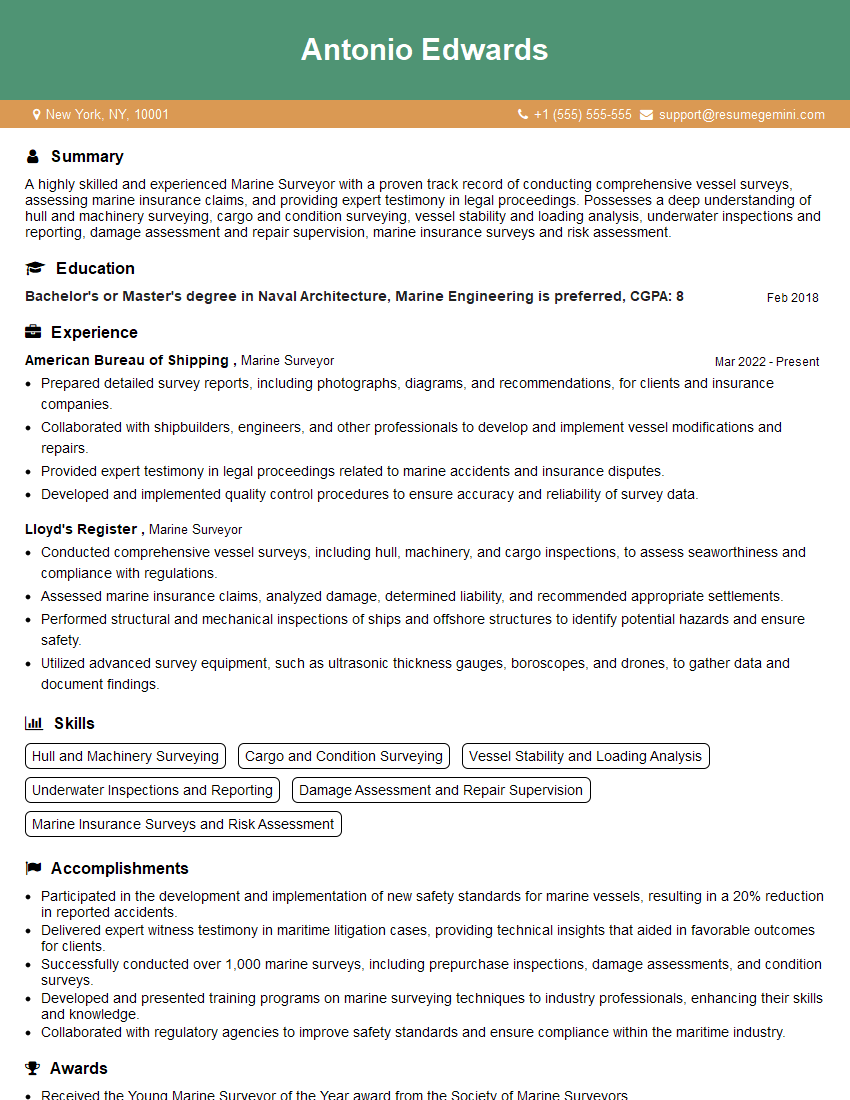
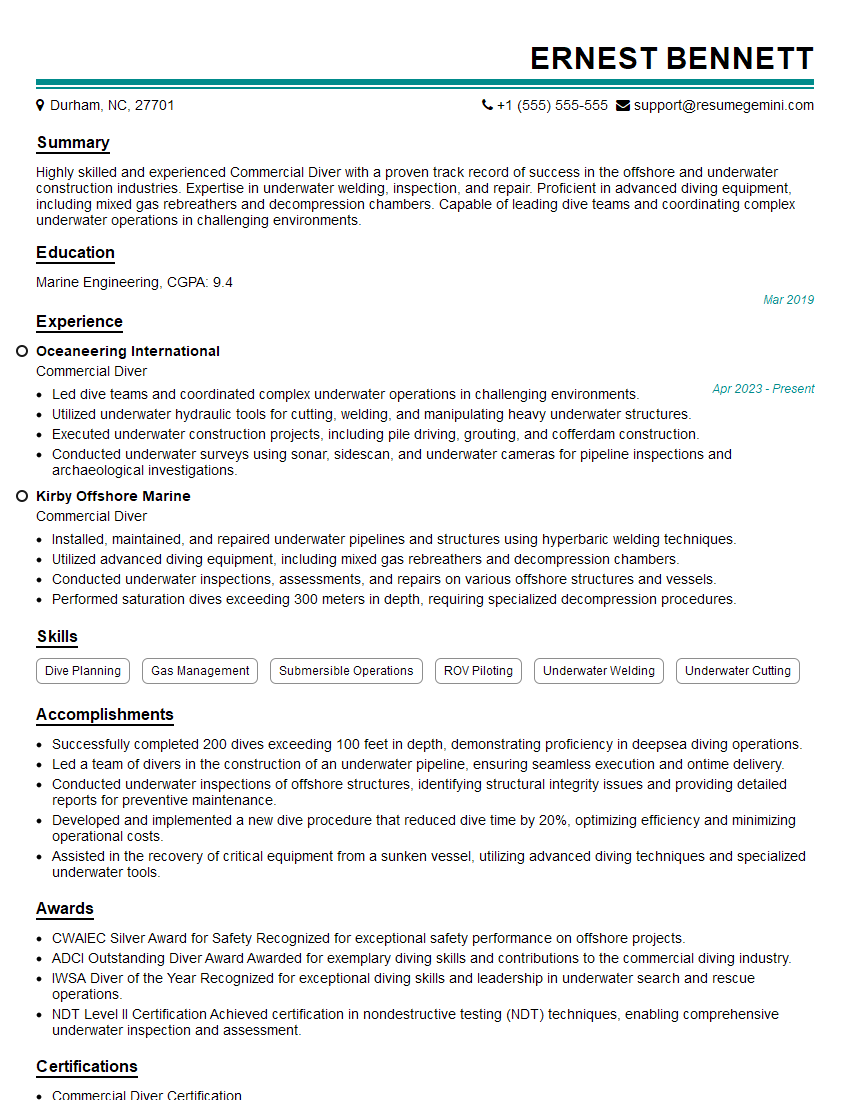
Mastering Underwater Structural Inspection opens doors to exciting and rewarding careers in a specialized and in-demand field. Advancement opportunities are plentiful for skilled professionals who demonstrate expertise in both theoretical knowledge and practical application. To significantly boost your job prospects, it’s crucial to create an ATS-friendly resume that effectively highlights your skills and experience. ResumeGemini is a trusted resource that can help you build a professional and impactful resume. We offer examples of resumes specifically tailored to Underwater Structural Inspection to guide you in crafting a compelling application that will impress potential employers. Invest in your future; invest in a well-crafted resume.
Explore more articles
Users Rating of Our Blogs
Share Your Experience
We value your feedback! Please rate our content and share your thoughts (optional).
What Readers Say About Our Blog
Very informative content, great job.
good