Preparation is the key to success in any interview. In this post, we’ll explore crucial Validation Report Writing interview questions and equip you with strategies to craft impactful answers. Whether you’re a beginner or a pro, these tips will elevate your preparation.
Questions Asked in Validation Report Writing Interview
Q 1. Describe your experience writing validation reports.
Throughout my career, I’ve authored numerous validation reports for a wide range of equipment and processes within the pharmaceutical and medical device industries. This experience encompasses everything from simple equipment validations like balances and autoclaves to complex process validations for manufacturing sterile products. I’ve been involved in all phases, from the initial planning and protocol development to the final report writing and approval. For example, I recently led the validation of a new high-speed tablet press, which involved meticulous data analysis, deviation investigation, and a final report meticulously documenting the entire process and its successful outcome. Another example involves writing validation reports for software used in our manufacturing execution system (MES).
My reports consistently adhere to regulatory guidelines (e.g., FDA, EMA, and ICH guidelines) and internal SOPs, ensuring compliance and clarity. I find that using a structured approach and employing clear visuals makes the information easily digestible for both technical and non-technical audiences.
Q 2. What are the key elements of a well-structured validation report?
A well-structured validation report should follow a logical flow, guiding the reader through the entire validation process. Key elements include:
- Introduction: Clearly defines the purpose, scope, and methodology of the validation.
- Materials and Methods: Details the equipment, materials, and procedures used. This section needs to be precise enough to allow for reproducibility.
- Results: Presents the collected data in a clear and organized manner, often using tables and graphs. Raw data should be available in appendices.
- Discussion: Interprets the results and discusses any deviations or out-of-specification results. This section is crucial for demonstrating a thorough understanding of the data.
- Conclusion: Summarizes the findings and states whether the validation was successful or not. It should clearly state whether the equipment or process meets predetermined acceptance criteria.
- Appendices: Contains supporting documents like raw data, calculations, and calibration certificates.
- Approval Signatures: Indicates the review and approval of the report by relevant personnel.
Think of it like a compelling story – you need to set the scene (introduction), describe the actions (methods), reveal the outcome (results), discuss the significance (discussion), and provide a satisfying resolution (conclusion). Appendices are like the footnotes, providing detailed evidence to support the narrative.
Q 3. How do you ensure the accuracy and completeness of your validation reports?
Ensuring accuracy and completeness is paramount. My approach involves several key steps:
- Rigorous Data Collection: Implementing robust data collection procedures and using calibrated equipment are critical. I always employ checklists and double-checking mechanisms to minimize errors.
- Data Integrity: Maintaining complete and traceable data is paramount. I follow ALCOA+ principles (Attributable, Legible, Contemporaneous, Original, Accurate + Complete, Enduring, Available) throughout the process.
- Deviation Investigations: Any deviation from the protocol is thoroughly investigated and documented. The root cause analysis is performed and corrective actions are clearly defined.
- Peer Review: Before finalization, the report undergoes a thorough peer review by another qualified individual. This provides an independent check for errors and omissions.
- SOP Adherence: I meticulously follow standard operating procedures (SOPs) throughout the entire validation process to guarantee consistency and compliance.
Imagine building a house – you wouldn’t skip steps or use substandard materials. The same meticulous care applies to validation reporting; precision and accuracy are not optional but essential.
Q 4. Explain the difference between qualification and validation.
While both qualification and validation demonstrate that a system or process performs as intended, they differ in scope and focus:
- Qualification: Focuses on ensuring that the design of a system, equipment, or process is suitable for its intended purpose. It’s typically a one-time activity performed before validation. Think of it as proving the blueprint is sound before construction begins.
- Validation: Focuses on confirming that the performance of a qualified system or process consistently meets pre-defined specifications. This involves performing tests and documenting results to demonstrate consistent performance over time. It’s like testing the finished house to ensure everything works as planned.
For instance, qualification of a cleanroom might involve reviewing design specifications, HEPA filter testing, and room pressurization testing. Validation would then involve ongoing monitoring and testing to ensure the cleanroom maintains its cleanliness level over time.
Q 5. What are the different types of validation you are familiar with?
I’m familiar with a variety of validation types, including:
- Equipment Qualification (EQ): Installation Qualification (IQ), Operational Qualification (OQ), and Performance Qualification (PQ) demonstrate the suitability of equipment.
- Process Validation: Verifies that a manufacturing process consistently produces a product meeting predetermined quality attributes.
- Cleaning Validation: Confirms the effectiveness of cleaning procedures in removing residues from equipment and preventing cross-contamination.
- Computer System Validation (CSV): Ensures that computer systems used in regulated environments are reliable, accurate, and secure.
- Method Validation: Demonstrates that analytical methods produce accurate and reliable results.
The specific validation type needed depends on the context. For example, a new analytical method would require method validation, while a new piece of manufacturing equipment would require equipment qualification followed by process validation to demonstrate the equipment works reliably within the overall manufacturing process.
Q 6. How do you handle deviations and out-of-specification results during validation?
Deviations and out-of-specification (OOS) results require a thorough and documented investigation. My approach involves:
- Immediate Action: The deviation or OOS result is immediately reported and documented. Any ongoing work is stopped until the issue is resolved.
- Root Cause Analysis: A detailed investigation is conducted to identify the root cause of the deviation or OOS. This often involves reviewing data, interviewing personnel, and analyzing procedures.
- Corrective and Preventive Actions (CAPA): Based on the root cause analysis, appropriate CAPA are implemented to prevent recurrence. These may include changes to procedures, equipment modifications, or additional training.
- Impact Assessment: A risk assessment is performed to determine the impact of the deviation or OOS on product quality and patient safety.
- Documentation: All aspects of the investigation, including findings, conclusions, and CAPA, are meticulously documented in a deviation report or OOS investigation report.
This process ensures that deviations are not dismissed but are treated as opportunities to improve systems and processes, ultimately improving product quality and regulatory compliance. It’s like troubleshooting a car engine – you don’t just ignore the problem; you find the cause and fix it to prevent future breakdowns.
Q 7. Describe your experience with Computer System Validation (CSV).
I have extensive experience in Computer System Validation (CSV), encompassing various phases of the software development lifecycle. This involves ensuring that computer systems used in regulated environments are reliable, accurate, and secure. My experience includes writing and reviewing validation plans, executing test scripts, analyzing results, and documenting the entire process in a comprehensive validation report.
My CSV experience includes working with systems such as LIMS (Laboratory Information Management Systems), MES (Manufacturing Execution Systems), and Electronic Batch Records (EBR) systems. I am familiar with various validation methodologies, including risk-based approaches, and I can adapt my strategies to meet the specific requirements of different systems and regulatory guidelines. A recent project involved validating a new LIMS system, which required meticulous attention to data integrity, audit trails, and user access control. This involved detailed testing of functionalities, security features, and ensuring compliance with 21 CFR Part 11.
Q 8. What are the regulatory requirements for validation reports in your industry?
Regulatory requirements for validation reports vary significantly depending on the industry and the specific product or process being validated. For instance, in the pharmaceutical industry, regulations like those from the FDA (21 CFR Part 11) and EMA (Good Manufacturing Practice guidelines) are paramount. These regulations dictate stringent requirements for data integrity, electronic records, and audit trails. They mandate comprehensive documentation, including detailed protocols, raw data, calculations, and conclusions, all meticulously recorded and archived. In the medical device industry, similar stringent requirements exist, often guided by ISO 13485 and other relevant standards, focusing on safety and efficacy. For software validation, standards like GAMP 5 (Good Automated Manufacturing Practice) offer guidance. Essentially, regardless of the specific industry, validation reports must demonstrate that a system, process, or product consistently performs as intended and meets predefined specifications, with all evidence securely documented and readily auditable.
For example, in a pharmaceutical setting, a validation report for a cleaning process would need to demonstrate that the cleaning procedure effectively removes residual drug product from equipment to prevent cross-contamination, ensuring patient safety. This requires detailed documentation of the cleaning method, the analytical testing used to measure residual levels, and the acceptance criteria used to determine if the cleaning is successful. Failure to meet these regulatory requirements can lead to significant consequences, including regulatory actions, product recalls, and reputational damage.
Q 9. How do you manage and track validation activities?
Managing and tracking validation activities requires a robust system. We typically use a combination of a validated electronic document management system (EDMS) and a project management software. The EDMS stores all validation documentation, ensuring version control and preventing unauthorized modifications. Project management software allows for task assignment, deadline tracking, and progress monitoring. We also utilize validation lifecycle management software where applicable. Each validation activity, from initial planning to final report approval, is assigned a unique identifier and tracked throughout its lifecycle. This includes defining milestones, assigning responsibilities, and regularly reviewing progress against the established timeline.
A crucial aspect of this process is regular status meetings and reporting. These meetings bring together all relevant stakeholders to review progress, address challenges, and ensure the project stays on track. We leverage metrics such as the number of completed tasks, outstanding issues, and any deviations from the plan to inform these reports. This proactive approach ensures timely completion of validation activities and minimizes potential delays. For instance, using Gantt charts and dashboards within the project management software provide visual representations of progress, allowing for proactive problem-solving and resource allocation.
Q 10. How do you ensure the traceability of your validation reports?
Traceability in validation reports is critical for demonstrating compliance and ensuring data integrity. We achieve this by implementing a comprehensive system of cross-referencing and documentation. Every piece of data, from raw data to conclusions, must be linked back to its source. We use unique identifiers for all documents, equipment, and personnel involved. This includes detailed descriptions of methods, equipment settings, and personnel training records. Each report includes a comprehensive list of references, cross-referencing data sources, and supporting documents. This allows for complete transparency and facilitates easy verification of the results. Think of it like a detective case: each piece of evidence must be linked back to the crime scene to build a compelling case.
An example would be a cross-reference from the raw data file to the analytical method used to generate the data, to the validation protocol, and ultimately to the final report conclusion. We strictly adhere to procedures for managing change control, ensuring that any modifications to documents or procedures are properly documented and tracked. This rigorous approach helps prevent errors and ensures that all data are accurately linked throughout the validation lifecycle. This approach makes auditing far simpler and more efficient and strengthens the overall integrity of the validation process.
Q 11. Explain your understanding of risk assessment in validation.
Risk assessment in validation is a critical step that identifies potential hazards or failures and determines their likelihood and impact. It’s a proactive approach to ensure that validation activities focus on the most critical aspects of the system or process. We typically employ a structured risk assessment methodology, such as Failure Mode and Effects Analysis (FMEA), to systematically evaluate potential failure modes, their severity, likelihood of occurrence, and the ability to detect them. This allows us to prioritize validation activities, allocate resources effectively, and mitigate potential risks. For example, a high-severity, high-likelihood failure mode would require more stringent validation efforts compared to a low-severity, low-likelihood failure mode.
In practice, this means developing a risk assessment matrix, evaluating each potential failure mode, and assigning risk priority numbers (RPNs). These RPNs are used to prioritize mitigation activities. For instance, if a critical instrument malfunctions, posing a safety risk, the risk assessment would highlight the need for redundant systems or rigorous preventive maintenance protocols within the validation plan. By implementing a robust risk assessment early in the process, we can avoid costly rework and ensure the safety and efficacy of the validated system or process.
Q 12. What are your strategies for efficient report writing and review?
Efficient report writing and review require a structured approach and the use of templates. We utilize standardized templates for validation reports that ensure consistency and completeness. These templates are designed to guide the authors through all required sections, including the purpose, methodology, results, and conclusions. We employ a review process that involves multiple reviewers to catch potential errors and omissions. This includes a technical review by subject matter experts and a quality review to ensure compliance with regulatory guidelines. This multi-level review process is critical for ensuring the accuracy and completeness of the reports.
To improve efficiency, we leverage tools such as collaboration platforms, enabling reviewers to provide comments and track changes efficiently. Clear communication channels and established timelines for reviews are critical for maintaining a streamlined workflow. Utilizing a structured writing style with clear headings, subheadings, and concise language also significantly improves the overall readability and comprehension of the reports, making the review process more efficient and effective. Regular training on report writing and review procedures keeps our team up-to-date with best practices and ensures consistency across all projects.
Q 13. How do you handle conflicting data or interpretations during validation?
Handling conflicting data or interpretations requires a methodical approach. The first step is to thoroughly investigate the source of the discrepancy. This involves re-examining the raw data, verifying the methods used, and reviewing the analyses. We often involve multiple subject matter experts to independently assess the data and interpretations. A well-documented investigation is critical, with all findings clearly reported. If the conflict cannot be resolved, the report should clearly state the disagreement, along with the supporting evidence for each interpretation. Any assumptions or limitations should be explicitly stated. The report might also include recommendations for further investigation or testing to resolve the uncertainty. It’s crucial to maintain transparency and document the entire process meticulously.
For example, if different analytical techniques yield conflicting results, we might perform additional analyses to verify the accuracy of each method. If the conflict remains, we would document all observations, interpretations, and the subsequent decisions made in addressing the conflicting data. The goal is to provide a comprehensive and objective assessment, leaving no ambiguity for the reader. Ignoring or suppressing conflicting data is unacceptable, as it compromises the integrity of the validation process.
Q 14. Describe your experience with validation lifecycle management.
Validation lifecycle management encompasses all activities related to planning, executing, and maintaining validated systems and processes. It’s a continuous cycle starting with initial risk assessment, which determines the scope and requirements of the validation activities. This is followed by the development of a validation plan that outlines the strategy, methodology, and timeline for the validation project. The execution phase includes all the necessary testing and documentation. After successful completion, the system or process is qualified and released for use. However, the validation lifecycle doesn’t end there; it involves ongoing monitoring and maintenance to ensure continued compliance. Periodic reviews and re-validation activities are essential to maintain the integrity of the validated system. We utilize change control procedures to manage modifications or upgrades that may affect the validation status.
For instance, a new software update might require a re-validation of the affected functionality. Effective validation lifecycle management ensures that systems and processes remain compliant, safe, and effective over time. It also reduces the risk of unexpected failures and ensures that the validation process remains efficient and cost-effective. Employing a clear, documented lifecycle provides traceability and facilitates audits and regulatory inspections, minimizing any potential delays or difficulties.
Q 15. What tools and software do you use for validation report writing?
My toolset for validation report writing is multifaceted and tailored to the specific needs of the project. It always includes a word processor like Microsoft Word or similar software with robust formatting capabilities, essential for creating professional-looking documents with consistent styles. I also rely heavily on spreadsheets like Microsoft Excel or Google Sheets for organizing and analyzing data, often creating tables and charts to visually represent validation results. For complex data analysis and statistical calculations, I utilize specialized software like R or Python, especially when dealing with large datasets or advanced statistical methods. Finally, a version control system like Git is invaluable for tracking changes and collaborating with others on report preparation.
For example, I might use Excel to analyze the results of a system suitability test, then create charts summarizing the findings, which I would then integrate into the Word document. If the validation involved a large amount of data requiring more complex statistical analysis, I might use R to perform regression analysis or other statistical tests before presenting the results in a user-friendly format in the report.
Career Expert Tips:
- Ace those interviews! Prepare effectively by reviewing the Top 50 Most Common Interview Questions on ResumeGemini.
- Navigate your job search with confidence! Explore a wide range of Career Tips on ResumeGemini. Learn about common challenges and recommendations to overcome them.
- Craft the perfect resume! Master the Art of Resume Writing with ResumeGemini’s guide. Showcase your unique qualifications and achievements effectively.
- Don’t miss out on holiday savings! Build your dream resume with ResumeGemini’s ATS optimized templates.
Q 16. How do you ensure the readability and understandability of your reports?
Readability and understandability are paramount in validation reports. Think of the report as a story; it needs a clear narrative that guides the reader through the validation process. I achieve this by employing several strategies:
- Clear Structure: I use a logical flow, starting with the objective, outlining the methodology, detailing the results, and finally drawing conclusions. Headings, subheadings, and bullet points are used extensively to break down complex information.
- Plain Language: Technical jargon is minimized and clearly defined when necessary. I avoid overly complex sentences and use active voice whenever possible.
- Visual Aids: Tables, charts, and graphs are used strategically to present data concisely and effectively. A well-designed visual can convey complex information much more quickly than a lengthy paragraph.
- Peer Review: Before finalization, I always have the report reviewed by a colleague who isn’t directly involved in the validation to ensure clarity and understandability from an independent perspective.
For example, instead of saying “The system demonstrated 99.7% accuracy within the 95% confidence interval,” I might say, “The system was highly accurate, with only three out of a thousand tests showing incorrect results.” This makes the information much easier for a non-technical audience to understand.
Q 17. Explain the importance of change control in validation processes.
Change control is crucial in validation because it ensures that any modifications to validated systems or processes are properly documented, assessed for their impact, and re-validated as needed. Without a robust change control process, the integrity of the validation and the regulatory compliance of the system could be compromised. Think of it like maintaining the integrity of a building – any changes, however small, need proper oversight and approval to ensure the overall structure remains safe and sound.
A well-defined change control process typically includes steps such as proposing the change, assessing its impact on validation, approving the change, implementing the change, and then revalidating the affected aspects of the system. This rigorous process prevents accidental degradation of system performance and allows for timely identification and resolution of any issues caused by the change. Failure to follow change control procedures can lead to significant problems, including regulatory non-compliance and even product recalls.
Q 18. How do you handle updates and revisions to existing validation reports?
Handling updates and revisions to validation reports requires a systematic approach to maintain accuracy and traceability. I always use a version control system (like Git) to track changes. Each revision is clearly documented with a version number and a change log detailing the modifications made. The rationale behind the changes is also included. For significant changes, a full revalidation might be required; for minor updates, an addendum or appendix might suffice.
For instance, if a new test method is adopted, I would create a revised report version, document the change in the change log, explain why the new method was implemented, and include the revalidation results. This ensures complete transparency and auditability, allowing anyone to easily trace the evolution of the report and understand its current state.
Q 19. What are your preferred methods for documenting validation activities?
My preferred method for documenting validation activities combines electronic and paper-based systems. A comprehensive electronic system is key, allowing for easy searchability, version control, and collaboration. This typically involves a combination of electronic lab notebooks (ELNs), document management systems (DMS), and a version control system such as Git. This approach ensures traceability and accessibility of all validation documents. However, original data records – such as handwritten notes, equipment printouts, and raw data – are usually kept as paper-based records in accordance with regulatory requirements. They are then carefully scanned and stored electronically, maintaining the integrity of the original documents.
For example, raw data from equipment might be kept in a physical logbook, alongside any handwritten observations. A scan of this logbook is then stored in the DMS, linked to the associated electronic documents in the ELN.
Q 20. How do you address reviewer comments and feedback during report preparation?
Addressing reviewer comments and feedback is a crucial part of the validation report writing process. I approach this systematically. First, I carefully review all comments and feedback, paying close attention to the rationale behind each one. Then, I respond to each comment individually, either making the requested changes or providing a well-reasoned justification if I disagree with the suggestion. This response should be clear, concise, and respectful. I meticulously track all changes and responses, ensuring complete transparency and traceability. Finally, I consolidate all changes and responses, ensuring that the revised report accurately reflects the feedback received and any necessary modifications.
For instance, if a reviewer questions a particular data point, I might re-check the raw data and provide a detailed explanation of the methodology used to arrive at that value. If a reviewer suggests improved clarity in a section, I revise the writing accordingly and highlight the change in the report’s revision history.
Q 21. How do you ensure compliance with regulatory requirements in your validation reports?
Ensuring compliance with regulatory requirements is paramount in validation report writing. This requires a thorough understanding of the relevant guidelines and regulations, which vary depending on the industry and the specific system being validated. For example, in the pharmaceutical industry, this might involve adherence to guidelines from agencies like the FDA (Food and Drug Administration) or EMA (European Medicines Agency). I make sure that the reports consistently address all required aspects of validation, including a clear statement of the objective, a detailed description of the methodology used, a comprehensive presentation of the results, and a conclusion that clearly states whether the system meets the predefined acceptance criteria.
To ensure compliance, I adhere to the ALCOA+ principles (Attributable, Legible, Contemporaneous, Original, Accurate, and complete, plus Enduring and Available) throughout the documentation process. I maintain meticulous records, ensuring the reports are auditable and traceable. I often utilize templates and checklists that are designed to align with specific regulatory requirements to help ensure consistency and completeness. Regular training on current regulations and best practices ensures my ongoing compliance.
Q 22. Describe your approach to writing effective conclusions and recommendations.
Effective conclusions and recommendations in validation reports are crucial for clear communication and actionable insights. My approach begins with a thorough review of all the collected data and observations from the validation activities. I then synthesize this information to concisely state whether the system, process, or equipment meets predetermined acceptance criteria. This isn’t simply a yes or no; it needs to quantify the extent of compliance.
For example, instead of stating ‘The system passed validation,’ I might write, ‘The system demonstrated compliance with all predefined acceptance criteria, with a 99.9% success rate across all test cases.’ This level of detail is crucial.
Recommendations flow directly from the conclusions. If deviations or failures occurred, I meticulously analyze the root cause and propose specific, practical solutions. This may involve process improvements, equipment modifications, or additional training. For example, if a deviation occurred due to inadequate operator training, my recommendation might be to implement a revised training program with updated documentation and competency assessments. The recommendations must be clear, feasible, and directly address the findings. Finally, I ensure the report’s language is non-technical and easily understood by all stakeholders.
Q 23. Explain your familiarity with different validation methodologies.
My familiarity with validation methodologies encompasses a wide range, tailored to the context of the system or process being validated. I’m proficient in various techniques, including:
- Installation Qualification (IQ): Verifying that the equipment or system is installed correctly and meets specifications.
- Operational Qualification (OQ): Confirming that the equipment or system operates according to its design and intended use.
- Performance Qualification (PQ): Demonstrating that the equipment or system consistently produces the expected results within pre-defined parameters.
- Computer System Validation (CSV): Specifically addressing the validation of software and associated hardware within regulated environments, often involving risk-based approaches.
- Process Validation: Demonstrating that a manufacturing process consistently produces a product that meets predetermined quality attributes.
The selection of the appropriate methodology depends heavily on the context. For instance, validating a simple analytical instrument may only need IQ/OQ/PQ, while validating a complex manufacturing process would require a more comprehensive approach involving process validation and potentially statistical process control (SPC) techniques. I always ensure that the chosen methodology is compliant with relevant regulatory guidelines, like GMP or GAMP.
Q 24. What are some common challenges you’ve faced in validation report writing?
Challenges in validation report writing are inevitable. One common hurdle is dealing with incomplete or ambiguous data. This often necessitates further investigation or clarification, potentially delaying the project. For instance, if there’s a gap in the data logs, this requires careful review and potentially re-testing. This is where strong analytical skills are critical to interpret what’s available and determine the most appropriate action.
Another challenge is balancing technical detail with clear communication. Validation reports are often reviewed by individuals with varying technical backgrounds, so it’s crucial to present complex information in a simple, easy-to-understand way. I often find using visual aids, like flowcharts and graphs, can greatly enhance understanding. Finally, coordinating the writing and review process with different stakeholders can also be challenging. I always use a structured approach, including clear timelines and communication plans to mitigate this. Establishing a clear review process with defined roles and responsibilities from the start reduces this risk.
Q 25. How do you prioritize different validation activities?
Prioritization of validation activities is crucial for efficient resource allocation and timely project completion. My approach typically involves a risk-based strategy. I identify the critical systems and processes, those with the highest potential impact on product quality or patient safety. These are prioritized first.
For example, in a pharmaceutical setting, the validation of critical process equipment such as autoclaves or sterilizers would take precedence over the validation of non-critical equipment like a printer used for labeling. I utilize risk assessment tools, such as Failure Mode and Effects Analysis (FMEA), to quantitatively assess the potential risks associated with each validation activity and make informed decisions on prioritization. This allows for a balanced approach, ensuring that the most critical areas receive the necessary attention without delaying the entire project.
Q 26. Describe your experience working with cross-functional teams on validation projects.
Collaboration is key to successful validation projects. I’ve consistently worked with cross-functional teams, including engineers, quality control personnel, manufacturing staff, and IT specialists. Open communication is vital – using regular meetings, shared documents, and clear communication channels. I actively participate in team meetings, actively listen to other team members’ perspectives, and seek consensus on validation strategies and approaches.
For instance, during a recent project involving the validation of a new manufacturing process, I worked closely with manufacturing engineers to ensure the validation protocols were feasible and practical. Collaborating with quality control specialists allowed for aligning the validation plan with the company’s quality systems. This level of communication and collaboration ensures that the validation report is accurate, comprehensive, and effectively addresses the needs of all stakeholders.
Q 27. How do you stay updated with current industry best practices and regulations?
Staying current with industry best practices and regulations is paramount. I actively engage in several methods to ensure my knowledge remains up-to-date:
- Professional Organizations: Membership in organizations like the International Society for Pharmaceutical Engineering (ISPE) provides access to valuable resources, training, and networking opportunities.
- Conferences and Workshops: Attending industry conferences and workshops allows me to learn about the latest advancements and regulatory changes.
- Regulatory Updates: I regularly review updates from regulatory bodies like the FDA, EMA, and other relevant agencies to understand evolving regulations and guidance documents.
- Professional Publications: I subscribe to and read relevant journals and publications to stay abreast of current research and best practices.
Continuous learning ensures my validation reports comply with the latest standards and industry expectations.
Q 28. Explain your understanding of data integrity and its implications for validation reports.
Data integrity is fundamental to the credibility and reliability of validation reports. It refers to the completeness, consistency, and accuracy of data throughout its lifecycle. Compromised data integrity can render validation reports invalid, leading to inaccurate conclusions and potentially impacting product quality or patient safety.
In validation reports, data integrity is ensured through several measures. This includes establishing robust data management systems, implementing appropriate controls to prevent data manipulation or deletion, and maintaining detailed audit trails. For example, ensuring proper calibration of instruments, using electronic data capture systems with built-in safeguards against unauthorized modifications, and performing regular data backups are essential to maintain data integrity. Any deviation from these practices is meticulously documented and explained in the validation report. Without robust data integrity, the validity and credibility of the entire validation exercise are seriously compromised.
Key Topics to Learn for Validation Report Writing Interview
- Understanding Validation Requirements: Learn to thoroughly analyze and interpret validation requirements from regulatory guidelines (e.g., GMP, GAMP) and internal standards. This includes identifying critical parameters and acceptance criteria.
- Defining Validation Scope and Objectives: Practice defining the scope and objectives of a validation project, ensuring clear articulation of the intended purpose and deliverables.
- Validation Methodologies: Master various validation methodologies, including IQ (Installation Qualification), OQ (Operational Qualification), and PQ (Performance Qualification). Understand their applications and limitations.
- Data Analysis and Interpretation: Develop skills in analyzing validation data, identifying trends, and interpreting results in the context of the defined acceptance criteria. Practice recognizing potential outliers and deviations.
- Report Structure and Content: Learn the essential components of a well-structured validation report, adhering to industry best practices and regulatory expectations. This includes clear executive summaries, detailed methodology sections, and comprehensive conclusions.
- Deviation Handling and Risk Assessment: Understand how to document and address deviations from the validation plan. Learn to perform risk assessments and justify decisions made during the validation process.
- Regulatory Compliance: Gain a firm understanding of relevant regulations and guidelines impacting validation reports, and how to ensure compliance throughout the entire process.
- Problem-solving and Troubleshooting: Develop your ability to identify and troubleshoot potential issues during validation studies, documenting your approach and solutions effectively.
- Effective Communication: Practice communicating complex technical information clearly and concisely, both verbally and in written reports, to a diverse audience.
Next Steps
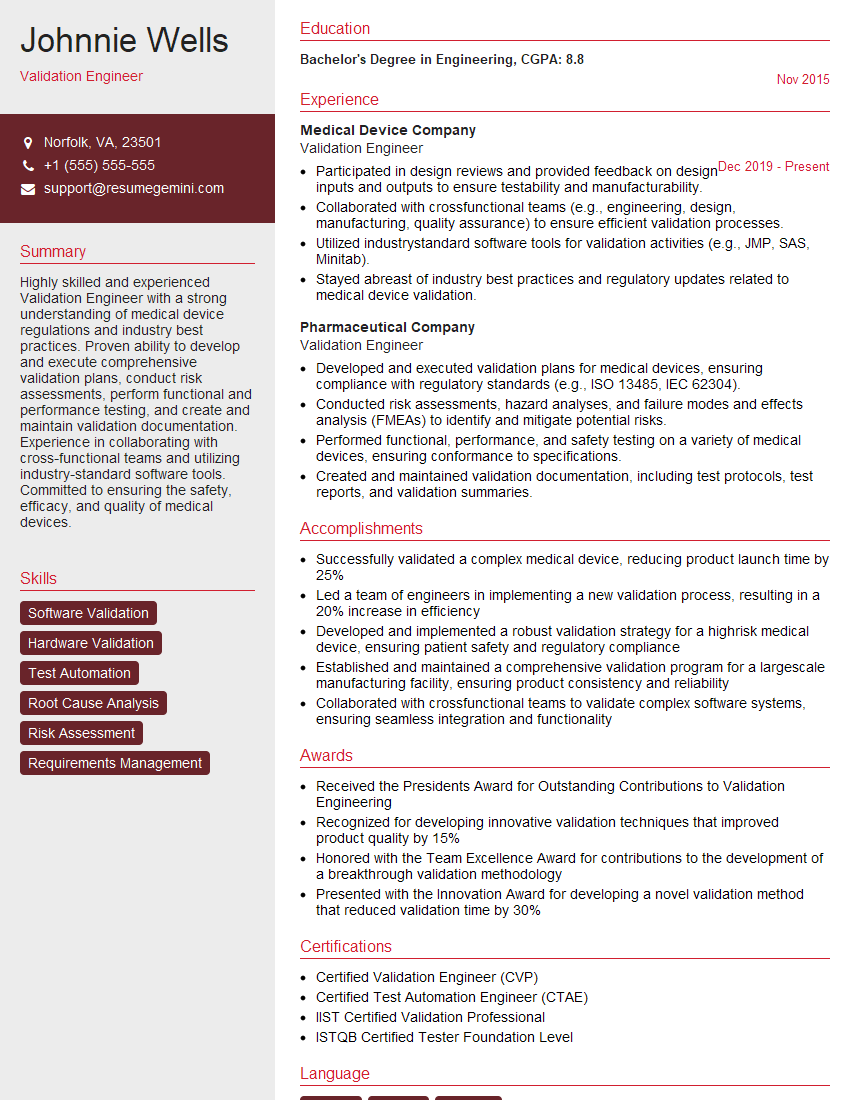
Mastering Validation Report Writing is crucial for career advancement in regulated industries. A strong understanding of validation principles and the ability to produce clear, concise, and compliant reports are highly sought-after skills. To maximize your job prospects, create an ATS-friendly resume that effectively highlights your expertise. ResumeGemini is a trusted resource that can help you build a professional and impactful resume. Examples of resumes tailored to Validation Report Writing are available to guide you in crafting your own compelling application materials. Take the next step towards your dream career today!

Explore more articles
Users Rating of Our Blogs
Share Your Experience
We value your feedback! Please rate our content and share your thoughts (optional).
What Readers Say About Our Blog
Very informative content, great job.
good