The right preparation can turn an interview into an opportunity to showcase your expertise. This guide to Value Engineering and Cost Analysis interview questions is your ultimate resource, providing key insights and tips to help you ace your responses and stand out as a top candidate.
Questions Asked in Value Engineering and Cost Analysis Interview
Q 1. Explain the difference between Value Engineering and Value Analysis.
While the terms are often used interchangeably, there’s a subtle but important distinction between Value Engineering (VE) and Value Analysis (VA). VA is a microscopic approach, focusing on analyzing individual components or features of a product or system to identify cost-reduction opportunities without sacrificing functionality. Think of it as detailed examination of existing designs. VE, on the other hand, is a macroscopic approach, encompassing a broader perspective. It involves questioning the overall function and purpose of a project from its inception to find creative alternatives and improve overall value – considering things like lifecycle costs, environmental impact and user experience alongside initial cost. VA is often a part of the broader VE process.
Analogy: Imagine building a house. VA might focus on finding a cheaper but equally effective type of insulation. VE would step back and ask: Do we even need this much insulation given the climate? Could we change the design to reduce energy needs altogether?
Q 2. Describe your experience with different cost estimation methods (e.g., parametric, bottom-up, analogous).
My experience spans a range of cost estimation methods. I frequently employ parametric estimating, especially in early project phases, using historical data and statistical relationships to predict costs based on project parameters like size, complexity, and location. For example, estimating the cost of a software project based on lines of code or the cost of a building based on square footage. I also use bottom-up estimating, which involves breaking down the project into individual work packages and estimating their costs individually. This provides a more detailed and accurate cost estimate but requires significantly more time and effort. Lastly, analogous estimating is utilized when similar projects exist, leveraging their historical data as a basis for cost estimation, providing a quick overview but potentially lacking precision if the analogy isn’t perfect.
In practice, I often combine these methods. For instance, I may use parametric estimating to obtain a preliminary cost estimate, then refine it through bottom-up analysis for critical components, and then validate it against analogous projects for consistency.
Q 3. How do you identify and quantify cost savings opportunities in a project?
Identifying and quantifying cost savings opportunities requires a structured approach. It begins with a thorough understanding of the project’s requirements, functional specifications, and current design. I employ techniques like:
- Functional analysis: This involves defining the functions of each component or system. By understanding the ‘what’ before the ‘how’, we can explore alternative ways to achieve the same functionality at lower costs.
- Value analysis workshops: Brainstorming sessions with cross-functional teams encourage creative ideas and challenge assumptions. This often leads to innovative solutions that are cost-effective.
- Life cycle cost analysis: This considers all costs associated with the project throughout its entire life, including maintenance, repair, and disposal. This helps identify potential savings opportunities that might be missed with a focus on initial investment alone.
Quantification involves estimating the cost savings associated with each opportunity. This might involve detailed cost comparisons between current and proposed solutions. For example, comparing the cost of using a different material, a streamlined construction process, or adopting more efficient technology. Documentation and impact assessments are crucial for justifying the savings.
Q 4. What are some common value engineering techniques you’ve used?
Over my career, I’ve employed several value engineering techniques, including:
- Substitution: Replacing expensive materials or components with less costly alternatives without compromising performance. For example, using a different type of steel with similar strength but lower cost.
- Simplification: Streamlining the design or process to eliminate unnecessary complexity. This might involve removing redundant features or steps.
- Standardization: Utilizing standard components or processes to reduce manufacturing and procurement costs.
- Integration: Combining multiple functions into a single component to reduce the number of parts and simplify assembly.
- Fast tracking: Overlapping project phases to reduce overall project duration and associated costs.
The selection of the technique depends on the specific project and the nature of the cost drivers. I often use a combination of these techniques to maximize savings.
Q 5. Explain your process for developing a cost baseline.
Developing a robust cost baseline is crucial for effective project management. My process involves the following steps:
- Work Breakdown Structure (WBS): Decomposing the project into smaller, manageable tasks. This ensures all aspects are considered.
- Cost Estimation: Estimating the cost of each work package using appropriate cost estimation methods (parametric, bottom-up, analogous, as discussed earlier).
- Contingency Planning: Incorporating a contingency reserve to account for unforeseen risks and uncertainties. This percentage should be based on project complexity and risk assessment.
- Management Reserve: Including a management reserve to cover changes in project scope or major unexpected issues. This is usually a smaller percentage than contingency.
- Documentation and Review: Thoroughly documenting the cost baseline, assumptions made, and the reasoning behind the estimations. This involves review and sign-off from key stakeholders.
The result is a comprehensive cost baseline that serves as a benchmark against which actual project costs are measured. This baseline is regularly reviewed and updated as the project progresses.
Q 6. How do you handle unexpected cost overruns during a project?
Unexpected cost overruns require a swift and decisive response. My approach involves:
- Identify the cause: Conduct a thorough investigation to pinpoint the source of the overrun. This might involve analyzing project schedules, reviewing change orders, and assessing performance against the baseline.
- Quantify the impact: Accurately assess the extent of the overrun and its impact on the project schedule and objectives.
- Develop mitigation strategies: Brainstorm and evaluate potential solutions to address the overrun. This may involve value engineering, scope changes, negotiating with vendors, or adjusting the project schedule.
- Communicate transparently: Keep stakeholders informed of the situation, the proposed solutions, and the potential implications. Transparency is key to maintaining trust and support.
- Implement and Monitor: Implement the chosen mitigation strategies and closely monitor their effectiveness. Regularly track the progress and adjust the plan as needed.
The key here is proactive management. Regular monitoring, early detection of potential problems, and a culture of open communication are crucial to preventing or minimizing cost overruns.
Q 7. How do you prioritize value engineering opportunities based on potential impact and feasibility?
Prioritizing value engineering opportunities requires a balanced approach, considering both potential impact and feasibility. I often use a scoring system or a matrix to evaluate each opportunity. This might include factors such as:
- Potential cost savings: The estimated amount of savings associated with each opportunity.
- Implementation feasibility: The ease and practicality of implementing each opportunity, considering technical, schedule, and resource constraints.
- Risk assessment: The potential risks and uncertainties associated with implementing each opportunity.
- Alignment with project goals: How well each opportunity aligns with the overall project objectives.
I might assign weights to each factor based on their importance in the context of the project. Then, each opportunity is scored based on these factors, resulting in a prioritized list of actions. This data-driven approach ensures resources are focused on the most impactful and feasible opportunities.
Q 8. Describe your experience with Earned Value Management (EVM).
Earned Value Management (EVM) is a project management technique for measuring project performance and progress. It integrates scope, schedule, and cost data to provide a comprehensive view of project health. My experience with EVM spans several large-scale infrastructure projects. I’ve used it to track project progress against the baseline plan, identify variances, and predict future performance. This involved calculating the Earned Value (EV), Planned Value (PV), and Actual Cost (AC) for various work packages. For instance, on a recent highway construction project, we utilized EVM to monitor the paving schedule. By comparing the planned progress (PV) against the actual completed work (EV), we identified a delay in the paving activities. This allowed us to proactively address the issue, preventing further cost overruns and schedule slippage. Further, the cost performance index (CPI = EV/AC) and schedule performance index (SPI = EV/PV) provided valuable insights into the efficiency and effectiveness of the project. A CPI less than 1 indicated cost overruns, while an SPI less than 1 indicated schedule delays. We used this information to re-allocate resources and adjust schedules to mitigate risks and meet project objectives.
Q 9. How do you communicate cost and value information to stakeholders with varying levels of technical expertise?
Communicating cost and value information effectively to diverse stakeholders requires tailoring the message to their understanding. For highly technical audiences, I use detailed reports, including cost breakdowns, sensitivity analyses, and risk assessments. I might delve into specific metrics like Net Present Value (NPV) and Internal Rate of Return (IRR). For less technical stakeholders, I focus on high-level summaries, using visual aids like charts and graphs to highlight key findings. For example, instead of explaining discounted cash flow models, I would show a simple graph illustrating the projected return on investment over time. I always prioritize clarity, avoiding jargon and focusing on the implications of the data. For executive summaries, I present a clear and concise overview of the key financial aspects of the project, highlighting potential risks and opportunities, emphasizing the value proposition of the proposed solution.
Q 10. How do you incorporate risk management into your cost analysis?
Risk management is integral to accurate cost analysis. I incorporate risk by identifying potential cost drivers, estimating their probabilities, and quantifying their potential impacts. This often involves a combination of qualitative and quantitative risk assessment techniques. For example, a qualitative approach involves brainstorming potential risks and ranking their likelihood and impact, while a quantitative approach uses techniques like Monte Carlo simulations to model the uncertainty and variability of cost estimates. The results are then incorporated into the cost baseline to create a range of probable costs, helping stakeholders make informed decisions. A contingency reserve is then established to cover unexpected costs that may arise due to risks.
Q 11. Explain your experience with different software tools used for cost analysis and value engineering.
My experience encompasses several software tools for cost analysis and value engineering. I’m proficient in spreadsheet software like Microsoft Excel for basic cost estimations and sensitivity analysis. For more complex projects, I utilize specialized software such as Primavera P6 for scheduling and cost control, and dedicated cost estimating software like CostX. These tools allow for detailed cost modeling, risk analysis, and what-if scenarios. I’m also familiar with BIM (Building Information Modeling) software, which enables cost estimation and value engineering during the design phase. Choosing the right tool depends on the project’s complexity and the specific needs of the analysis. For example, a simple renovation project might only need Excel, while a large infrastructure project might require the use of Primavera P6 and CostX. Software familiarity is only one part – the true expertise is in the application of the underlying principles of value engineering and cost analysis.
Q 12. Describe a project where you successfully implemented value engineering and achieved significant cost savings.
On a recent hospital renovation project, we successfully implemented value engineering, resulting in significant cost savings. The initial design included expensive custom-made cabinetry. Through brainstorming sessions with the design team, contractors, and hospital staff, we identified a readily available, off-the-shelf alternative that met all functional requirements at a significantly lower cost. This substitution, coupled with minor adjustments in the design, resulted in a 15% reduction in overall construction costs without compromising quality or functionality. The savings were clearly documented and presented to the client, highlighting the value-added nature of the alternative design choices. This success demonstrated the tangible benefits of value engineering and its importance in optimizing project budgets without sacrificing project deliverables.
Q 13. How do you perform a life-cycle cost analysis?
A life-cycle cost analysis (LCCA) considers all costs associated with an asset or project over its entire lifespan, from design and construction to operation, maintenance, and eventual disposal. The process involves identifying all cost elements, estimating their values, and discounting them to their present value using an appropriate discount rate. It requires careful consideration of factors like inflation, interest rates, and technological advancements. For example, in analyzing the LCCA of a solar power system, we would include the initial investment costs, installation costs, operating and maintenance expenses, energy production savings, and eventual decommissioning costs. The LCCA helps in making informed decisions about the economic viability of various design alternatives by providing a comprehensive view of the total cost of ownership over the asset’s life. By comparing the LCCA of different options, we can identify the most cost-effective approach.
Q 14. What are some common pitfalls to avoid in value engineering?
Several pitfalls can hinder the effectiveness of value engineering. One common mistake is focusing solely on initial costs and neglecting long-term operational costs. This can lead to seemingly cheaper solutions that prove more expensive over time due to high maintenance or energy consumption. Another is failing to involve all key stakeholders early in the process. This can create resistance to changes proposed later. Overlooking the potential impact on functionality or quality is another critical error. Sometimes, the pursuit of cost savings can compromise the core functionality or performance of the project, negating the benefits. Finally, inadequate documentation and communication can prevent the successful implementation of value engineering initiatives. By carefully avoiding these pitfalls and following a structured approach, we can ensure the successful application of value engineering principles and achieve optimal project outcomes.
Q 15. How do you balance cost reduction with maintaining project quality and functionality?
Balancing cost reduction with maintaining project quality and functionality is a crucial aspect of Value Engineering. It’s not about simply cutting costs; it’s about optimizing the value proposition. We achieve this through a systematic approach that involves identifying areas where costs can be reduced without compromising essential project requirements.
- Functionality Analysis: We meticulously review the project’s specifications to identify ‘nice-to-haves’ versus ‘must-haves’. ‘Nice-to-haves’ often become candidates for cost reduction or elimination without impacting core functionality.
- Value-Based Ranking: We assign a value score to each project element, considering its contribution to the overall project goals. This allows us to prioritize cost-reduction efforts on elements with lower value scores.
- Creative Problem Solving: This often involves brainstorming alternative solutions. For instance, instead of using expensive, custom-designed components, we might explore using readily available, off-the-shelf alternatives with equivalent functionality.
- Life-Cycle Cost Analysis: We look beyond initial costs to consider long-term maintenance, operation, and disposal costs. Sometimes, a slightly higher initial investment results in significant savings over the project’s lifecycle.
Example: In a building project, we might replace a high-end imported marble with a locally sourced, equally durable stone, significantly reducing material and transportation costs without compromising the structural integrity or aesthetic appeal.
Career Expert Tips:
- Ace those interviews! Prepare effectively by reviewing the Top 50 Most Common Interview Questions on ResumeGemini.
- Navigate your job search with confidence! Explore a wide range of Career Tips on ResumeGemini. Learn about common challenges and recommendations to overcome them.
- Craft the perfect resume! Master the Art of Resume Writing with ResumeGemini’s guide. Showcase your unique qualifications and achievements effectively.
- Don’t miss out on holiday savings! Build your dream resume with ResumeGemini’s ATS optimized templates.
Q 16. Explain your understanding of cost-benefit analysis.
Cost-benefit analysis (CBA) is a systematic approach to evaluating the financial merits of a project or decision. It involves comparing the total costs associated with a project against its total benefits, expressed in monetary terms. The goal is to determine whether the benefits outweigh the costs and, if so, by how much.
A simple CBA involves:
- Identifying all costs: This includes direct costs (materials, labor), indirect costs (overhead), and intangible costs (opportunity costs).
- Identifying all benefits: These can be tangible (increased revenue, reduced operating expenses) or intangible (improved safety, enhanced brand image). Intangible benefits often need to be quantified using appropriate valuation methods.
- Estimating the time horizon: The period over which the costs and benefits are measured. This is crucial because the time value of money impacts the evaluation.
- Discounting future cash flows: Future benefits and costs are discounted to reflect their present value, accounting for the time value of money.
- Calculating the net present value (NPV): The difference between the present value of benefits and the present value of costs. A positive NPV suggests the project is financially worthwhile.
Example: A company is considering investing in new software. CBA would compare the software’s cost (purchase, training, implementation) with the anticipated benefits (increased productivity, reduced errors, improved customer service). If the NPV is positive, the investment is justified.
Q 17. How do you deal with conflicting priorities between cost reduction and project schedule?
Conflicting priorities between cost reduction and project schedule require careful negotiation and prioritization. Often, trade-offs are necessary, and the optimal balance depends on the specific project context and risk tolerance.
- Prioritization Matrix: A matrix that plots cost against schedule impact, allowing for visualization and prioritization of tasks. Tasks with high cost impact and low schedule impact are ideal candidates for cost reduction.
- Fast-Tracking and Crashing: Techniques to accelerate the schedule, but they often involve increasing costs. We carefully analyze the cost implications of these techniques to ensure they are justified.
- Value Engineering: Identify alternative methods to achieve the same outcome with a potentially faster and cheaper approach. This might involve finding more efficient technologies or processes.
- Risk Assessment: Identify potential risks related to both cost and schedule. Prioritize tasks and mitigation strategies based on the assessed risks.
Example: In a construction project, we might decide to slightly delay a non-critical element to negotiate a lower price from a subcontractor. This balances the cost saving with a minor delay that doesn’t affect the overall project delivery date.
Q 18. Describe your experience with different types of contracts and their impact on cost analysis.
Different contract types significantly impact cost analysis. Understanding the contract’s terms is paramount for accurate cost estimation and risk management.
- Lump Sum Contracts: The contractor provides a fixed price for the entire project. Cost analysis focuses on accurate initial estimation to avoid losses. Changes are managed through change orders.
- Cost-Plus Contracts: The contractor’s costs are reimbursed, plus a fee (fixed or percentage). Cost analysis focuses on monitoring and controlling costs throughout the project. Risk of cost overruns is higher.
- Unit Price Contracts: Prices are set per unit of work (e.g., cubic yard of excavation). Cost analysis requires accurate quantity estimations. Changes in quantities directly affect the final price.
- Time and Materials Contracts: The contractor is paid for labor and materials used. Cost analysis is ongoing and requires strict tracking of labor hours and material usage. Risk of uncontrolled costs is high unless diligently managed.
Example: In a lump-sum contract, a thorough initial cost analysis is crucial. Underestimating costs can lead to significant losses for the contractor. In a cost-plus contract, strong cost control measures are essential to prevent escalating costs.
Q 19. How do you identify and mitigate potential cost risks?
Identifying and mitigating potential cost risks involves a proactive approach using several techniques:
- Risk Identification: Brainstorming sessions, checklists, and historical data analysis are used to identify potential cost risks (e.g., material price fluctuations, labor shortages, unforeseen site conditions).
- Risk Assessment: Each risk is analyzed considering its likelihood and potential impact. This helps prioritize risk mitigation efforts.
- Risk Response Planning: Strategies are developed to address each identified risk. These might include risk avoidance (eliminating the risk), risk mitigation (reducing the likelihood or impact), risk transfer (insurance or contractual agreements), or risk acceptance (accepting the risk and its consequences).
- Contingency Planning: A contingency reserve is established to absorb unforeseen costs. The size of the reserve depends on the overall risk profile.
- Regular Monitoring and Reporting: Costs are monitored throughout the project, and any deviations from the budget are analyzed and addressed promptly.
Example: In a construction project, a risk assessment might identify the potential for material price increases. A risk response could involve securing material supplies in advance at fixed prices, thus mitigating the risk of cost overruns.
Q 20. What are some key performance indicators (KPIs) you use to track cost and value performance?
Key Performance Indicators (KPIs) are vital for tracking cost and value performance. They provide insights into project health and facilitate timely corrective actions.
- Cost Performance Index (CPI): Measures the efficiency of cost spending (Earned Value/Actual Cost). A CPI < 1 indicates cost overruns.
- Schedule Performance Index (SPI): Measures schedule efficiency (Earned Value/Planned Value). An SPI < 1 indicates schedule slippage.
- Estimate at Completion (EAC): Predicts the total cost at project completion based on current performance.
- Variance Analysis: Compares actual costs and schedules against planned values to identify deviations and their causes.
- Value Added per Dollar Spent: Measures the value created per dollar invested in the project.
Example: Tracking the CPI and SPI throughout the project allows for early identification of cost overruns or schedule delays. This enables proactive measures to address the issues and prevent further escalation.
Q 21. Explain your experience with variance analysis and how you address cost variances.
Variance analysis is a crucial tool for understanding cost deviations. It involves comparing actual costs with budgeted costs, identifying the reasons for variances, and taking corrective actions.
The process involves:
- Calculating the variance: The difference between the actual cost and the budgeted cost (Actual Cost – Budgeted Cost).
- Analyzing the variance: Investigating the reasons for the variance. This may involve reviewing project documentation, interviewing project personnel, and identifying factors like material price increases, labor inefficiencies, or changes in scope.
- Addressing the variance: Developing and implementing corrective actions to prevent further variances. This might involve revising the project plan, negotiating with suppliers, improving project management, or taking other corrective actions.
Example: If the variance analysis shows a significant cost overrun in a specific task due to material price increases, a corrective action could involve exploring alternative materials or renegotiating with the supplier.
Effective variance analysis requires a robust project tracking system and a proactive approach to addressing deviations. It’s not simply about identifying problems but also about learning from them to improve future project performance.
Q 22. How do you incorporate sustainability considerations into your cost analysis?
Integrating sustainability into cost analysis isn’t just about adding a ‘green’ layer; it’s about fundamentally changing how we define value. We need to move beyond solely focusing on initial capital costs and incorporate the long-term operational and environmental costs. This involves a lifecycle cost analysis (LCCA), considering factors like energy consumption, material sourcing, waste generation, and the eventual disposal or recycling of components. For instance, while solar panels have a higher upfront cost than traditional electricity, their long-term operational cost savings (reduced electricity bills) and environmental benefits (reduced carbon emissions) significantly impact the overall value proposition.
Practically, I use tools and methodologies like embodied carbon calculators to quantify the environmental impact of materials. We’ll also factor in potential government incentives or penalties associated with sustainable practices. A sensitivity analysis helps assess the impact of uncertainties around future energy prices or environmental regulations on the total cost. This holistic approach ensures that ‘sustainable’ isn’t an optional add-on, but a core element in decision-making.
Q 23. How do you quantify the intangible benefits of value engineering?
Quantifying intangible benefits in value engineering is crucial, but it requires a structured approach. We can’t simply rely on subjective opinions. Instead, we use techniques that translate qualitative aspects into quantifiable metrics. For example, improved employee morale resulting from a redesigned workspace might lead to increased productivity, which can then be estimated in terms of cost savings. Similarly, enhanced brand reputation due to sustainable practices could be linked to increased market share and revenue.
One method is to use surveys or focus groups to gather data on employee satisfaction or customer perceptions. This qualitative data can then be translated into quantitative data using established valuation models. For instance, we can calculate the increase in sales revenue predicted due to improved brand image, using market research and statistical analysis. Another approach is to use a scoring system to rank different options based on their intangible benefits. Each benefit is assigned a score based on its importance and its impact on the overall project. This allows for a more objective comparison of different options, even when dealing with intangible benefits.
Q 24. Describe your experience with working in a collaborative environment for value engineering initiatives.
Collaboration is the cornerstone of successful value engineering. I thrive in multidisciplinary teams, bringing together engineers, architects, contractors, and stakeholders. My experience includes facilitating workshops where diverse perspectives are encouraged and where constructive feedback is actively solicited. I’m skilled at mediating discussions and fostering an environment of mutual respect, even when disagreements arise. For example, on a recent project involving a hospital renovation, I facilitated a series of workshops bringing together doctors, nurses, hospital administrators, and construction professionals. By leveraging everyone’s expertise, we were able to identify a significantly more cost-effective solution that improved both patient flow and staff workflow, exceeding initial expectations.
My approach involves structured brainstorming sessions, using tools like Pugh matrices to compare different design options based on multiple criteria. Active listening and clear communication are essential in ensuring that everyone feels heard and valued. The resulting solutions are always stronger and more comprehensive because of the collective input.
Q 25. What are your strengths and weaknesses in the area of cost analysis and value engineering?
My strengths lie in my analytical skills, particularly in developing comprehensive cost models that accurately predict project expenses. I am proficient in various cost estimation techniques, including parametric costing, bottom-up estimating, and analogous estimating. I am also adept at using data analysis tools to identify cost-saving opportunities. My experience with complex projects equips me to handle multifaceted challenges and prioritize effectively.
However, my weakness is sometimes focusing too much on detail and potentially getting bogged down in minutiae. I’m actively working on improving my ability to quickly assess the bigger picture and delegate tasks to others efficiently. I achieve this through time management techniques and by focusing on the strategic goals of a project, ensuring that the detailed analysis ultimately supports the higher-level objectives. This ensures that my analytical capabilities are not hindering overall project efficiency.
Q 26. How do you stay up to date with the latest industry trends and best practices in value engineering?
Staying current is paramount in this dynamic field. I actively participate in professional organizations like the Society of American Value Engineers (SAVE), attending conferences and webinars to learn about the latest techniques and case studies. I regularly read industry publications and journals, focusing on emerging trends in areas like sustainable design, building information modeling (BIM), and digital twins. I also maintain a professional network of contacts through online platforms and industry events to stay updated on innovative practices. This multi-faceted approach keeps me abreast of technological advances and ensures that my knowledge base remains robust and relevant.
Q 27. How do you use data analytics to support your value engineering efforts?
Data analytics plays a crucial role in my value engineering process. I use various tools and techniques to analyze cost data, identify trends, and support decision-making. For example, I utilize statistical software such as R or Python to analyze historical cost data and create predictive models for future projects. This allows me to anticipate potential cost overruns and proactively implement mitigation strategies. I also employ data visualization techniques to present complex cost information in an accessible and understandable format for stakeholders. This improves transparency and ensures that everyone is on the same page when discussing cost-saving measures.
Furthermore, I integrate data from different sources, including BIM models and project management software, to get a comprehensive picture of the project’s cost structure. This holistic approach to data analysis empowers us to find opportunities that a purely qualitative analysis might miss. For example, analyzing energy consumption data from a BIM model might highlight inefficiencies in the building design, which can then be addressed through value engineering, resulting in significant long-term cost savings.
Q 28. What is your approach to problem-solving when faced with complex cost-related challenges?
My problem-solving approach for complex cost challenges is structured and methodical. I typically follow these steps: First, I clearly define the problem, ensuring everyone understands the specific cost issue. Next, I gather and analyze all relevant data, identifying potential root causes. Then, I develop several potential solutions, using brainstorming techniques and leveraging my team’s expertise. Each solution is evaluated based on its cost-effectiveness, feasibility, and potential impact. This often includes a detailed risk assessment. After selecting the best solution, I implement it carefully, closely monitoring progress and making adjustments as needed. Finally, I document the entire process, including lessons learned and best practices, for future reference.
For instance, when faced with unexpected cost overruns on a construction project, I first investigated the root cause, which turned out to be unforeseen soil conditions. Then, I worked with the engineering team to explore several alternatives, such as modifying the foundation design or using alternative materials. We evaluated each option based on cost, time, and risk and ultimately selected a solution that minimized the impact on the project timeline and budget while maintaining the structural integrity.
Key Topics to Learn for Value Engineering and Cost Analysis Interview
- Value Engineering Fundamentals: Understanding the core principles, methodologies, and objectives of Value Engineering. This includes learning about different Value Engineering techniques and their applications.
- Cost Estimation Techniques: Mastering various cost estimation methods, such as parametric estimating, bottom-up estimating, and analogous estimating. Practice applying these techniques to real-world scenarios.
- Life Cycle Cost Analysis (LCCA): Gain a thorough understanding of LCCA and its application in evaluating long-term project costs and benefits. Focus on identifying and analyzing all relevant costs over a project’s lifespan.
- Value Analysis and Functional Analysis: Develop proficiency in conducting value analysis and functional analysis to identify cost-saving opportunities without compromising functionality or quality. Practice breaking down complex systems into their core functions.
- Risk Management in Cost Analysis: Understand how to identify, assess, and mitigate risks that can impact project costs and schedules. Practice incorporating risk analysis into your cost estimations.
- Data Analysis and Interpretation: Develop strong skills in analyzing cost data, identifying trends, and drawing meaningful conclusions. Familiarize yourself with various data visualization techniques.
- Communication and Presentation Skills: Practice clearly and concisely communicating your Value Engineering and Cost Analysis findings to both technical and non-technical audiences. Develop strong presentation skills to effectively showcase your work.
- Software Proficiency: Demonstrate familiarity with relevant software tools used in cost estimation and analysis (mention specific software if applicable to the target roles). This could include spreadsheet software, specialized cost estimating software, or project management software.
Next Steps
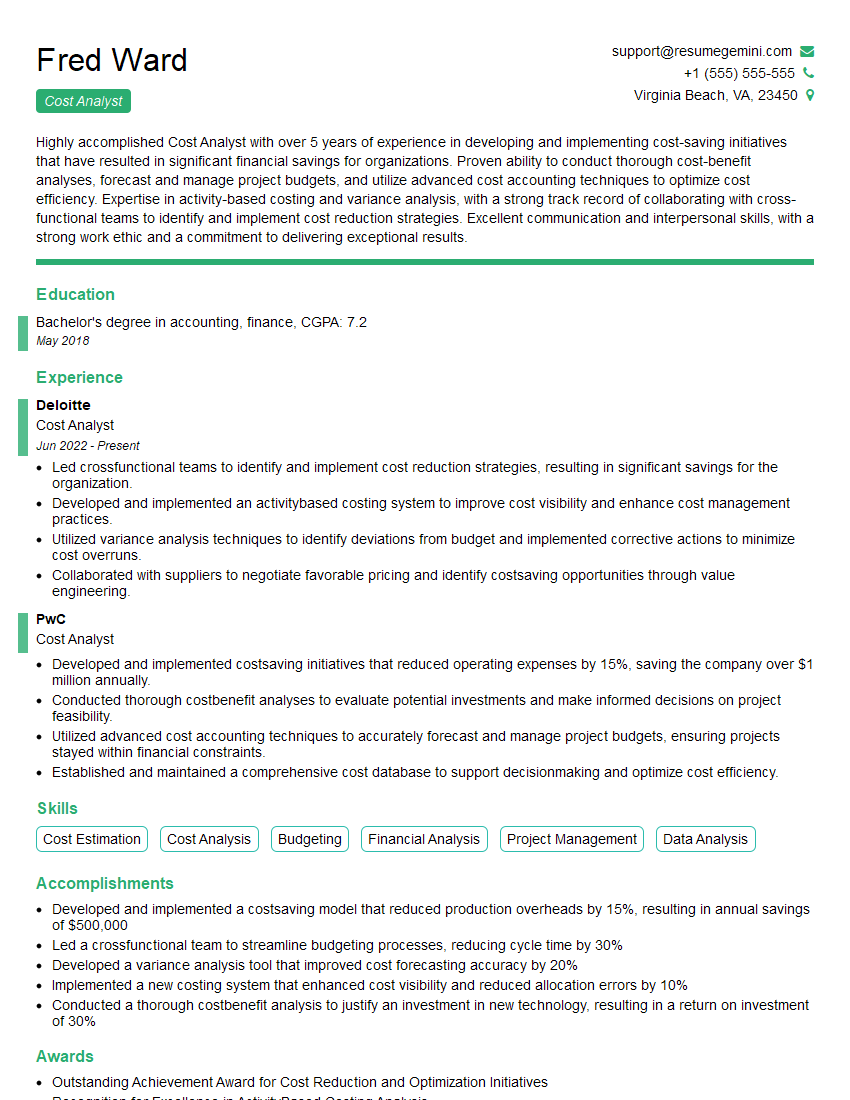
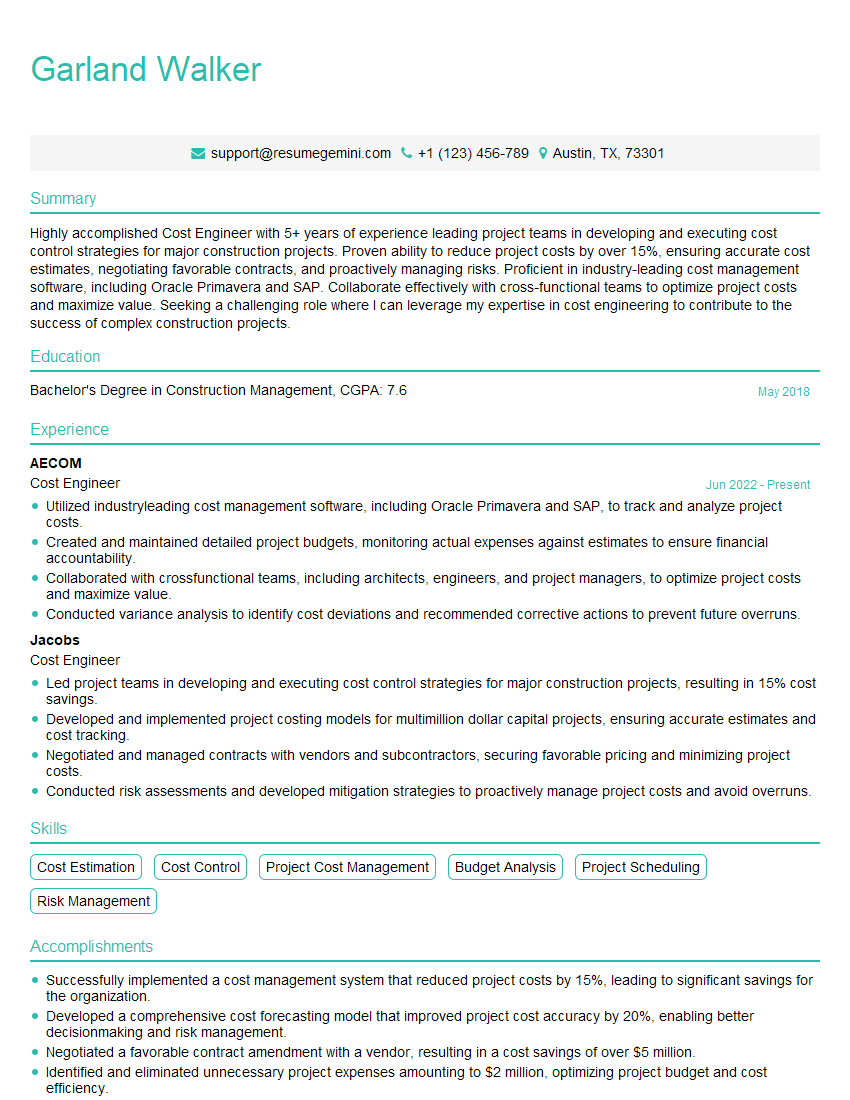
Mastering Value Engineering and Cost Analysis is crucial for career advancement in many fields, opening doors to leadership roles and higher earning potential. A strong understanding of these principles demonstrates valuable problem-solving skills and a commitment to efficiency and cost optimization. To significantly enhance your job prospects, crafting an ATS-friendly resume is essential. This ensures your application gets noticed by recruiters and hiring managers. We highly recommend using ResumeGemini to build a professional and impactful resume. ResumeGemini offers a streamlined process and provides examples of resumes tailored to Value Engineering and Cost Analysis, giving you a head start in crafting a winning application.
Explore more articles
Users Rating of Our Blogs
Share Your Experience
We value your feedback! Please rate our content and share your thoughts (optional).
What Readers Say About Our Blog
Very informative content, great job.
good