Interviews are more than just a Q&A session—they’re a chance to prove your worth. This blog dives into essential Vocal Accompaniment interview questions and expert tips to help you align your answers with what hiring managers are looking for. Start preparing to shine!
Questions Asked in Vocal Accompaniment Interview
Q 1. What styles of vocal accompaniment are you proficient in?
My proficiency in vocal accompaniment spans a wide range of styles. I’m highly experienced in classical styles, from Baroque to Romantic periods, including accompanying art songs, opera arias, and choral works. I’m also adept at accompanying contemporary vocal styles, such as jazz, musical theatre, and pop, adapting my approach to suit the genre’s specific rhythmic and harmonic characteristics. For instance, accompanying a classical Lied requires a delicate touch and a deep understanding of the composer’s intentions, whereas accompanying a jazz vocalist demands improvisation and responsiveness to their phrasing. I also have experience with world music styles, adapting my accompaniment to the unique melodic and rhythmic conventions of various cultures.
- Classical: Art Song, Opera, Choral
- Contemporary: Jazz, Musical Theatre, Pop
- World Music: (Specific examples depend on experience, e.g., Flamenco, Brazilian)
Q 2. Describe your experience with sight-reading vocal music.
Sight-reading is fundamental to my work as a vocal accompanist. I possess a high level of proficiency in sight-reading complex vocal scores, handling varied musical styles, rhythmic complexities, and key changes with confidence. My training involved extensive sight-reading practice, including working with challenging scores from various composers and genres. I can usually sight-read a piece accurately at a tempo suitable for rehearsal, and then refine my interpretation through subsequent readings. The key is not just reading the notes but understanding the overall musical context – the phrasing, dynamics, and expressive intent of the composer.
For example, during a recent audition, I was presented with a previously unseen art song in a minor key with numerous tempo changes. Through careful and focused sight-reading, I was able to provide a solid and supportive accompaniment for the singer, enabling them to present a strong performance.
Q 3. How do you adapt your accompaniment style to different vocalists?
Adapting my accompaniment style to different vocalists is crucial. I approach this by carefully listening to their vocal characteristics, including their vocal range, timbre, phrasing, and stylistic preferences. Some singers may prefer a more supportive, unobtrusive accompaniment, while others may appreciate a more active and interpretive role from the pianist. I also consider their vocal strengths and weaknesses, adjusting the accompaniment to highlight their strengths and minimize challenges. For example, if a singer has difficulty with high notes, I might adjust the harmony or dynamics in those sections to provide better support.
I always engage in a preliminary discussion with the vocalist to understand their musical goals and preferences. This collaborative approach ensures that the accompaniment enhances their performance and supports their artistic vision. Essentially, it’s a conversation – a musical dialogue where the accompanist must be a sensitive listener and a supportive partner.
Q 4. Explain your approach to working with a conductor or director.
My approach to working with a conductor or director involves clear communication and mutual respect. I believe in active listening and a willingness to adapt to their vision for the piece. Before rehearsals, I carefully study the score and any directorial notes to understand their interpretation. During rehearsals, I remain attentive to their cues, making adjustments to the accompaniment as needed to ensure that the musical performance flows smoothly. This often involves adapting tempos, dynamics, and articulation according to their instructions.
Open communication is key. I will readily offer suggestions or ask clarifying questions if I have any uncertainties, but ultimately, I aim to support the conductor’s vision and contribute to a cohesive and powerful performance. A collaborative spirit is vital – the goal is a unified artistic expression, not individual expression.
Q 5. How do you handle unexpected tempo or key changes during a performance?
Handling unexpected tempo or key changes during a performance requires quick thinking and adaptability. My training emphasizes ear training and improvisation, which are essential skills in such situations. If a singer unexpectedly changes the tempo or key, I use my musical instincts and knowledge to seamlessly follow along, maintaining the overall musical integrity of the performance. This may involve adjusting harmonies or rhythms on the fly to support the singer. Years of experience have honed my ability to react calmly and effectively to such improvisational demands.
A good understanding of harmonic theory and rhythmic structures is crucial for this. Being able to quickly assess and respond to the changes in tempo and key will help make the transition sound natural and professional to the audience.
Q 6. What software or technology are you familiar with for creating or editing vocal accompaniments?
I am proficient in various software and technology for creating and editing vocal accompaniments. I am highly skilled with digital audio workstations (DAWs) such as Logic Pro X and Sibelius, using them for tasks ranging from creating accompaniments from scratch to editing existing ones. I’m comfortable using notation software to create scores, transcribing music, and generating MIDI accompaniments. I can also work with various audio formats (WAV, MP3, AIFF) and use audio editing tools to adjust levels, add effects, and ensure high-quality audio for recordings and performances.
My familiarity with MIDI technology allows for flexibility in adapting accompaniments, such as adjusting instrumentation or generating different harmonic versions. For example, I might use a DAW to create a simplified accompaniment for a rehearsal and a more elaborate one for a performance.
Q 7. Describe your experience with different types of microphones and audio equipment.
My experience encompasses a range of microphones and audio equipment, from condenser mics ideal for capturing nuanced details of vocal performances to dynamic mics suitable for live settings with higher sound pressure levels. I understand the characteristics of various microphones and can select the most appropriate one for a given situation. I’m familiar with audio interfaces, mixers, and signal processing equipment, understanding the importance of proper gain staging and signal flow to ensure a clean and high-fidelity recording or live performance.
For example, choosing the right microphone significantly impacts the audio quality. A condenser microphone might be preferred for recording a singer in a studio setting due to its sensitivity, whereas a dynamic microphone would be suitable for a live performance because of its robustness and ability to handle higher sound levels. My knowledge extends to setting up and troubleshooting audio equipment, ensuring a smooth and reliable technical aspect to the performance.
Q 8. How do you ensure accurate rhythmic and harmonic support for a vocalist?
Accurate rhythmic and harmonic support is the cornerstone of effective vocal accompaniment. It’s about being a seamless extension of the vocalist’s performance, not a competing element. I achieve this through a multifaceted approach:
Deep Score Analysis: Before even playing a note, I meticulously analyze the score. I identify the harmonic progression, rhythmic complexities, and any implied harmonies or rhythmic nuances that aren’t explicitly notated. This gives me a complete understanding of the musical landscape.
Active Listening: During rehearsals and performances, I listen intently to the vocalist’s phrasing, dynamics, and rhythmic flexibility. I adjust my playing subtly to complement their interpretation, ensuring a cohesive and supportive musical experience. Imagine it like a conversation – I respond to the vocalist’s ‘lines’ in real time.
Strong Rhythmic Foundation: A solid rhythmic foundation is paramount. I practice regularly with a metronome, ensuring my timing is precise and unwavering. This provides a stable framework for the vocalist to build upon.
Harmonic Awareness: I focus on understanding the underlying harmonic structure and how each chord functions within the piece. This allows me to provide harmonic support that is both accurate and expressive.
For example, if the vocalist is employing a rubato (flexible tempo), I would subtly adjust my rhythmic pulse to follow their expressive phrasing, maintaining the overall harmonic structure.
Q 9. What is your process for learning a new piece of vocal music?
Learning a new vocal piece involves a systematic process designed to ensure both musical accuracy and interpretive depth:
Initial Familiarization: I begin by listening to several recordings of the piece, paying close attention to different interpretations. This provides a broad understanding of the style and potential expressive choices.
Score Study: I thoroughly analyze the score, identifying key changes, melodic lines, rhythmic patterns, and the overall harmonic structure. I mark the score with dynamic and phrasing indications to guide my interpretation.
Collaborative Rehearsal: Working closely with the vocalist is crucial. We discuss the intended interpretation, phrasing, and emotional arc of the piece. This collaborative dialogue helps shape a unified musical vision.
Individual Practice: I practice the accompaniment thoroughly, focusing on rhythmic accuracy, harmonic clarity, and dynamic shading. I also practice adapting my playing to accommodate the vocalist’s nuances.
Run-throughs: We conduct multiple run-throughs, refining the performance details and adjusting the balance between accompaniment and vocal line.
This iterative process ensures a polished performance that reflects both the composer’s intention and our shared artistic vision.
Q 10. How do you maintain a professional demeanor during challenging performance situations?
Maintaining a professional demeanor during challenging performance situations requires mental preparation and a proactive approach to problem-solving. I focus on:
Thorough Preparation: The best way to handle unexpected challenges is through meticulous preparation. Rehearsing extensively, anticipating potential difficulties, and having contingency plans in place reduce stress and improve my ability to react calmly.
Positive Self-Talk: Before a performance, I engage in positive self-talk to build confidence and reduce anxiety. I remind myself of my skills and preparation.
Adaptability: Unexpected issues will occur. I remain flexible and adapt to changes smoothly. This might involve adjusting the tempo, dynamics, or even improvising a section if needed. The key is to remain calm and maintain musicality.
Professional Etiquette: Maintaining a respectful and supportive attitude towards the vocalist and the audience is vital. I remain focused on providing the best possible musical support even if things don’t go as planned.
For instance, if a vocalist forgets a lyric, I can seamlessly use a subtle rhythmic shift or harmonic emphasis to help them recover gracefully without drawing undue attention to the error.
Q 11. Describe your experience working with vocalists of varying skill levels.
My experience spans a wide range of vocalist skill levels. I adapt my approach to meet the needs of each individual:
Beginner Vocalists: With beginners, I provide clear, patient guidance, focusing on building a strong foundation in rhythm and pitch. I might simplify the accompaniment to make the vocal line more accessible. Patience and positive reinforcement are key.
Intermediate Vocalists: With intermediate vocalists, we explore more nuanced aspects of phrasing, dynamics, and interpretation. I encourage experimentation and support their individual artistic expression.
Advanced Vocalists: With advanced vocalists, the collaboration becomes a true partnership. We push creative boundaries, exploring complex rhythmic and harmonic ideas together. The role becomes more about mutual inspiration and collaboration.
Regardless of skill level, my focus remains consistent: to provide unwavering support and create a collaborative musical experience that highlights the vocalist’s strengths.
Q 12. How familiar are you with different vocal techniques and styles?
I’m very familiar with diverse vocal techniques and styles, including classical, jazz, pop, musical theatre, and folk. My understanding extends to:
Classical Vocal Techniques: I’m well-versed in bel canto, operatic, and art song styles, understanding the importance of breath support, resonance, and phrasing.
Jazz Vocal Techniques: I’m familiar with scat singing, improvisation, and swing rhythms, understanding the improvisational nature of jazz vocal performance.
Pop and Musical Theatre Styles: I understand the demands of contemporary styles, including microphone techniques, amplification, and the need for dynamic and rhythmically engaging accompaniment.
Folk Styles: I’m familiar with various folk singing techniques and traditions, understanding the importance of storytelling and authentic instrumentation.
This broad knowledge base enables me to provide tailored support to vocalists across a spectrum of musical genres.
Q 13. Explain your approach to practicing and preparing for performances.
My approach to practice and preparation is meticulous and iterative. It’s a process of refining both technical proficiency and interpretive depth:
Technical Practice: I dedicate time to technical exercises, focusing on scales, arpeggios, and chord progressions relevant to the piece. This builds finger dexterity and strengthens musical foundations.
Musicality Practice: I practice incorporating phrasing, dynamics, and articulation into my playing. This ensures the accompaniment is not just technically accurate but also musically expressive.
Rehearsal with Vocalist: Collaborative rehearsal is central. We refine details of tempo, dynamics, phrasing, and balance between vocal line and accompaniment.
Performance Simulation: Before a performance, I conduct practice runs in a setting that simulates the performance environment. This allows me to manage any performance anxiety and fine-tune my approach.
My goal is to build a performance that is both polished and spontaneous, allowing for artistic interaction and expression.
Q 14. How do you maintain a balance between providing support and remaining unobtrusive?
The balance between providing support and remaining unobtrusive is a delicate art. It’s about being a supportive partner, not a dominating presence. My approach involves:
Dynamic Control: I carefully adjust my volume and dynamics to complement the vocalist without overpowering their voice. Think of it as a painter who strategically uses light and shadow to highlight their subject.
Textural Sensitivity: I choose accompaniment textures that are appropriate for the style and context of the music. Sometimes a sparse accompaniment is ideal, allowing the vocal line to shine. Other times, a richer texture can provide support and depth.
Harmonic Subtlety: I use subtle harmonic nuances to enhance the emotional impact of the music without distracting from the vocal line. My goal is to weave a harmonic tapestry that complements the vocalist’s artistry.
Rhythmic Sensitivity: My rhythmic approach is equally careful. I follow the vocalist’s lead, adapting my playing to accommodate their phrasing and rhythmic freedom, providing a solid but unobtrusive rhythmic foundation.
Ultimately, the ideal accompaniment is one that enhances the vocal performance without being noticed as a separate entity; a seamless blend of musical artistry.
Q 15. Describe your experience with improvisation and accompanying spontaneously.
Improvisation and spontaneous accompaniment are crucial skills for any vocalist accompanist. It’s about reacting intuitively to the vocalist’s phrasing, dynamics, and emotional delivery, creating a supportive and dynamic musical landscape in real-time. My experience spans years of performing in various settings, from intimate jazz clubs to large concert halls. I’ve accompanied singers of diverse genres, including classical, jazz, pop, and musical theatre, developing a strong sense of harmonic awareness, rhythmic flexibility, and melodic invention on the fly. For example, during a jazz gig, a singer might unexpectedly extend a phrase or alter the melody slightly; my ability to instantly respond with complementary chords or countermelodies is paramount to maintaining the musical flow and creating a cohesive and exciting performance. This often involves listening intently for subtle cues in the vocalist’s performance and reacting in a way that adds to the music, rather than detracting from it. It’s a conversation, a musical dialogue.
Career Expert Tips:
- Ace those interviews! Prepare effectively by reviewing the Top 50 Most Common Interview Questions on ResumeGemini.
- Navigate your job search with confidence! Explore a wide range of Career Tips on ResumeGemini. Learn about common challenges and recommendations to overcome them.
- Craft the perfect resume! Master the Art of Resume Writing with ResumeGemini’s guide. Showcase your unique qualifications and achievements effectively.
- Don’t miss out on holiday savings! Build your dream resume with ResumeGemini’s ATS optimized templates.
Q 16. How do you effectively communicate with vocalists regarding musical interpretations?
Effective communication with vocalists is paramount. It’s not just about technical details but about understanding their artistic vision. I begin by establishing a clear understanding of the song’s intended mood, tempo, and stylistic approach. I actively listen to the vocalist’s interpretation during rehearsals, and we discuss nuances in phrasing, dynamics, and articulation. I’m open to their suggestions and contribute my own insights, always ensuring that the final interpretation respects the singer’s vision. For example, if a vocalist wants to emphasize a particular lyrical phrase, I might subtly adjust the harmonic rhythm or add a subtle textural element to support their expression. Nonverbal communication is equally important; I watch their body language and facial expressions for any indications of where they might need support or encouragement. A collaborative approach where we work together as a team is crucial. We might even use terms like ‘stronger here’, ‘softer dynamics’, or ‘slightly slower tempo’ for clarity during rehearsals.
Q 17. What is your experience with transposing music for different vocal ranges?
Transposing music is a common task for vocal accompanists. I’m proficient in transposing scores for various vocal ranges, ensuring the piece remains musically satisfying and vocally comfortable for the singer. This often involves understanding the specific challenges and capabilities of different vocal types (soprano, mezzo-soprano, alto, tenor, baritone, bass). My process usually starts with determining the key that best suits the vocalist’s range and comfort. Then, I use a combination of traditional methods (e.g., circle of fifths) and software tools (e.g., Sibelius, MuseScore) to make the transposition accurately. I always double-check the transposed version, paying close attention to accidentals and maintaining the overall musical integrity of the piece. A crucial aspect is considering how the transposition might impact the harmonic structure or vocal tessitura. For example, a simple transposition might work fine, but others may require more thoughtful adjustments to retain the feeling of the original composition.
Q 18. How do you handle technical difficulties during a performance?
Handling technical difficulties requires quick thinking and adaptability. My approach is proactive; before any performance, I ensure that all equipment is working correctly, and I have backup plans in place. During a performance, if a technical issue arises, such as a microphone malfunction or a sudden power outage, I maintain composure and try to minimize disruption. This might involve seamlessly switching to an alternative instrument or improvising a brief instrumental passage until the problem is resolved. I’ve had instances where a page turned prematurely, and I had to quickly find my place, all the while keeping the tempo and emotional context of the song. Maintaining a professional demeanor and minimizing any visible panic is key. My focus always remains on supporting the vocalist and ensuring that the audience has a smooth and enjoyable experience.
Q 19. What is your preferred method for marking scores and creating performance notes?
My preferred method for marking scores involves using a combination of traditional pencil markings and digital annotations. I use different colored pencils to indicate dynamics, articulation, phrasing, and any special instructions for the vocalist. For instance, I might use a red pencil for crescendo/diminuendo markings and a blue pencil for phrasing. For digital annotations, I use software like Sibelius or Finale, allowing for more flexibility and precise placement of markings. I also include performance notes in the score, summarizing the overall interpretation, tempo suggestions, and any stylistic considerations. These notes are especially helpful when working with new vocalists or when revisiting pieces after a period of time. This organized approach ensures clarity and efficiency, reducing confusion during rehearsals and performances.
Q 20. How do you build rapport and collaborate effectively with vocalists?
Building rapport with vocalists is about mutual respect and understanding. I approach each collaboration by establishing clear communication channels and actively listening to their needs and preferences. I prioritize creating a comfortable and collaborative environment where they feel safe to express their ideas and concerns. Open dialogue is key; I value their feedback and incorporate it into our collaborative efforts. A shared understanding of the piece’s musical and emotional goals is paramount. Building trust takes time, but consistent positive interactions, respectful communication, and a willingness to compromise create a strong foundation for effective collaboration. I also take the time to learn about their vocal strengths, preferences, and any potential challenges they might face, enabling me to better support them during rehearsals and performances. Treating them as collaborators, not just clients, fosters a deeper bond and leads to richer musical outcomes.
Q 21. Describe your experience with recording vocal accompaniment tracks in a studio.
My experience in recording vocal accompaniment tracks in a studio setting is extensive. It involves a meticulous approach, starting with careful preparation of the musical score and ensuring that all technical aspects are in place. I pay close attention to sound quality, microphone placement, and the overall sonic balance of the recording. I am comfortable working with various digital audio workstations (DAWs) like Pro Tools, Logic Pro, and Ableton Live. During the recording session, precise timing and dynamic control are crucial. I often employ techniques such as punch-in/punch-out recording and layering to achieve optimal results. I have a keen ear for detail and ensure the final product is polished and ready for mixing and mastering. Post-production work might involve editing out minor imperfections and adjusting levels to create a cohesive and professional-sounding accompaniment track. Careful planning, attention to detail, and proficiency in using studio technology are key factors in producing high-quality recordings.
Q 22. What are some common challenges in vocal accompaniment, and how do you address them?
Vocal accompaniment, while seemingly straightforward, presents several challenges. One major hurdle is maintaining a balance between supporting the vocalist and creating a cohesive musical whole. Another is adapting to different vocal styles and interpreting musical nuances effectively. Technical difficulties, such as microphone feedback or instrument tuning issues, can also disrupt a performance. Finally, the pressure of live performance and the need to react spontaneously to a vocalist’s improvisations require considerable skill and adaptability.
Addressing these challenges involves meticulous preparation. This includes thorough rehearsal, developing a strong understanding of the music’s harmonic structure and rhythmic complexities, and careful consideration of the vocalist’s strengths and weaknesses. During the performance, active listening, clear communication with the vocalist, and quick problem-solving are crucial. For instance, if I experience microphone feedback, I might adjust my volume or position, or consult with the sound engineer. If a vocalist deviates from the planned melody, I need to be flexible enough to adjust my accompaniment seamlessly.
- Rehearsal: Multiple rehearsals allow for the identification and resolution of potential problems.
- Communication: Clear communication with the vocalist is key to understanding their style and preferences.
- Technical Proficiency: Strong instrumental technique and problem-solving abilities are essential to navigate technical issues.
Q 23. How do you differentiate between providing harmonic support and overshadowing the vocalist?
The difference between providing harmonic support and overshadowing the vocalist is a delicate balance akin to walking a tightrope. Harmonic support means complementing the vocalist’s melody with chords and rhythmic patterns that enhance the emotional impact and musicality of the song, without drawing attention away from the primary vocal line. Overshadowing, on the other hand, occurs when the accompaniment becomes too prominent, complex, or flashy, thereby distracting the listener from the vocalist’s performance.
I achieve this balance by carefully selecting voicings (the specific combination of notes in a chord) that are texturally appropriate and dynamically sensitive to the vocalist’s phrasing. For instance, I might choose sparse, subtle accompaniments during quiet passages, building to fuller, richer textures during powerful moments, always ensuring that the melody remains the focal point. I also pay close attention to my volume, dynamics, and rhythmic articulation, avoiding unnecessary ornamentation or showy techniques that might detract from the vocalist’s expression. Think of it like a painter who skillfully uses colors and brushstrokes to enhance a portrait without obscuring the subject’s features.
Q 24. What are your rates for different types of vocal accompaniment gigs?
My rates vary depending on several factors, including the type of gig, its duration, the complexity of the music, the location, and any special requirements. For a small, intimate performance (e.g., a solo singer-songwriter gig at a coffee house), my rate might start around $100-$200. Larger events, such as a concert at a larger venue, a corporate event, or a recording session, will naturally command higher rates, potentially ranging from $500 to $1500 or more per performance. I offer customized packages that can accommodate different needs and budgets, and I’m always happy to discuss pricing options during a consultation.
Q 25. How familiar are you with copyright and licensing regulations in music?
I’m very familiar with copyright and licensing regulations in music. I understand the importance of obtaining the necessary permissions for using copyrighted material, whether it’s performing a song live, using it in a recording, or distributing a recording. I am aware of the different licensing organizations like ASCAP, BMI, and SESAC, and I always make sure to acquire the appropriate licenses before using any protected work. Ignoring copyright laws can lead to legal issues and financial penalties, so I treat this aspect of my profession with the utmost seriousness and attention to detail.
In practice, this means that before undertaking any gig involving copyrighted material, I always verify with the client that all necessary licenses are in place. If I am responsible for selecting the music, I meticulously check for copyright information and ensure all required licenses are acquired.
Q 26. What are your career goals related to vocal accompaniment?
My career goals revolve around establishing myself as a highly sought-after and versatile vocal accompanist. I aim to expand my repertoire, refine my skills in various musical styles, and collaborate with a diverse range of vocalists and musical ensembles. Beyond live performance, I also aspire to contribute to music production and recording projects, furthering my understanding of the technical aspects of music creation. Ultimately, I envision a career that combines artistic expression, technical expertise, and a deep appreciation for the collaborative nature of music-making.
Q 27. Describe a situation where you had to overcome a challenging musical obstacle during an accompaniment.
During a performance of a complex contemporary classical piece, the vocalist unexpectedly altered a key section of the music, deviating significantly from the agreed-upon arrangement. The change introduced a new harmonic progression that was initially quite jarring and challenging to follow. However, I quickly analyzed the new harmonic structure, identified the key shifts, and adapted my accompaniment on the fly. My strong improvisational skills and in-depth understanding of music theory allowed me to seamlessly integrate the improvised section into the overall performance, maintaining a cohesive and musical interpretation of the piece, even in the face of the unexpected change. The experience highlighted the importance of being adaptable, quick-thinking, and musically fluent.
Q 28. How do you adapt your accompaniment to different acoustic environments?
Adapting to different acoustic environments is critical for a successful accompaniment. Different spaces have vastly different acoustic properties: some are reverberant (echo-y), while others are dry. My approach involves careful listening and adjustments to my playing style and equipment. In a reverberant space, I might play with a lighter touch to avoid muddy textures and excessive resonance. In a dry space, I might add more dynamic contrast and fuller textures to compensate for the lack of natural reverberation.
Furthermore, I might need to adjust my volume and microphone placement to optimize the sound. I work closely with the sound engineer, when one is present, to ensure the balance between the vocalist and the accompaniment is ideal for the specific acoustic environment. My goal is to ensure that the accompaniment always sounds balanced, well-integrated, and complements the vocalist’s performance regardless of the location.
Key Topics to Learn for Vocal Accompaniment Interview
- Harmonic Accompaniment: Understanding chord progressions, voicing techniques, and creating appropriate harmonic textures for various vocal styles (e.g., classical, jazz, pop).
- Rhythmic Accompaniment: Mastering rhythmic precision, syncopation, and stylistic variations in accompaniment patterns to support the vocalist’s phrasing and dynamics.
- Stylistic Awareness: Demonstrating proficiency in diverse musical genres and adapting accompaniment styles to suit the vocalist’s needs and the overall musical context.
- Improvisation and Creativity: Developing the ability to improvise accompaniments, adding embellishments, and responding dynamically to the vocalist’s performance.
- Practical Application: Preparing examples of your accompaniment work – recordings or live performances showcasing your skills in different styles and contexts.
- Technical Proficiency: Demonstrating competence in your chosen instrument(s) and showcasing excellent technique, including clean articulation and accurate intonation.
- Collaboration and Communication: Highlighting your ability to work effectively with vocalists, understand their needs, and communicate musically through your playing.
- Music Theory Fundamentals: Reviewing key concepts like scales, modes, chord structures, and analysis, as these form the foundation of effective accompaniment.
- Problem-Solving Approaches: Being prepared to discuss how you handle technical challenges during a performance, such as unexpected changes in tempo or key.
- Listening Skills: Emphasize your ability to actively listen to the vocalist, respond sensitively to their nuances, and create a supportive musical environment.
Next Steps
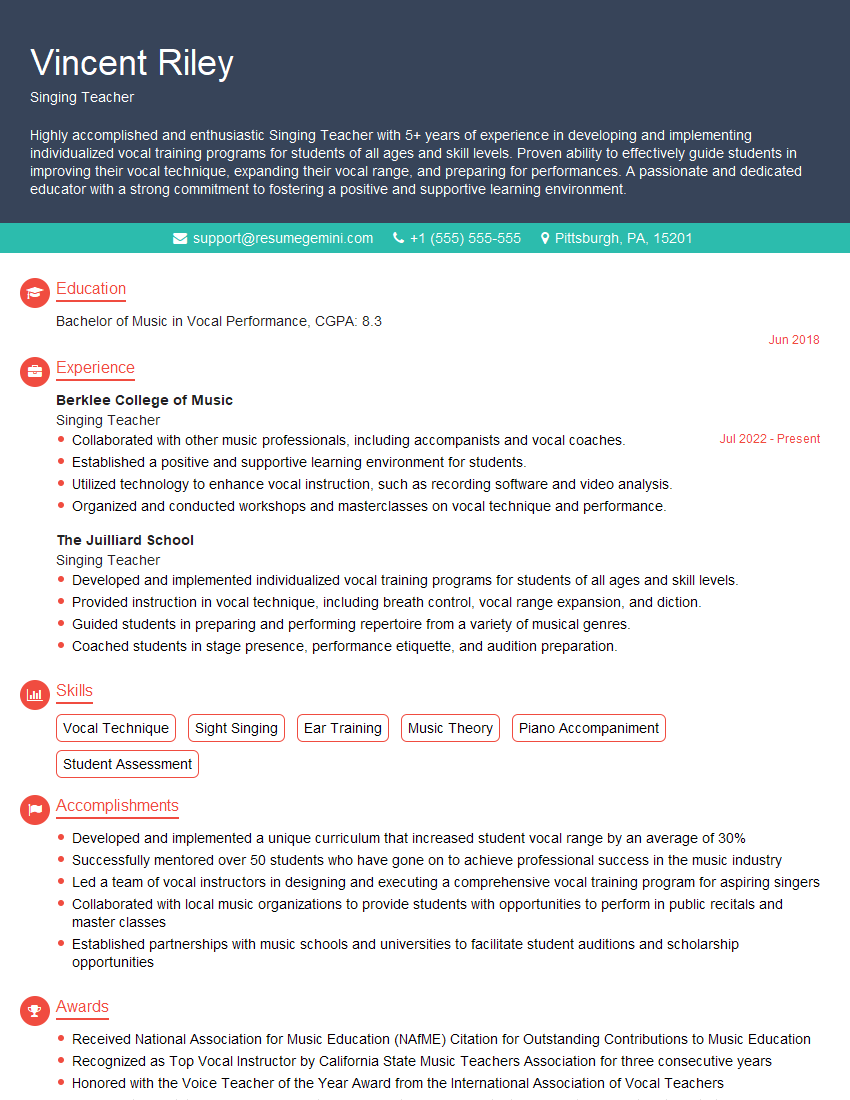
Mastering vocal accompaniment opens doors to exciting career opportunities in various musical settings, from studio sessions and live performances to teaching and composing. To maximize your job prospects, it’s crucial to present your skills effectively. Creating an ATS-friendly resume is key to getting your application noticed. ResumeGemini is a trusted resource for building professional resumes that stand out. They offer examples of resumes tailored to Vocal Accompaniment to help you create a compelling application that showcases your unique talents and experience.
Explore more articles
Users Rating of Our Blogs
Share Your Experience
We value your feedback! Please rate our content and share your thoughts (optional).
What Readers Say About Our Blog
Very informative content, great job.
good