Interviews are more than just a Q&A session—they’re a chance to prove your worth. This blog dives into essential Vocal Projection and Diction interview questions and expert tips to help you align your answers with what hiring managers are looking for. Start preparing to shine!
Questions Asked in Vocal Projection and Diction Interview
Q 1. Explain the physiological mechanisms behind vocal projection.
Vocal projection, simply put, is the ability to make your voice heard clearly over a distance or in a noisy environment. It’s not about shouting; it’s about efficient use of your breath and vocal mechanisms. Physiologically, it involves a complex interplay of several systems:
Respiration: Strong, controlled exhalation from your diaphragm is the foundation. Think of it like a bellows – the stronger and more controlled the airflow, the louder and clearer your voice.
Phonation: This involves the vibration of your vocal cords in the larynx. Efficient phonation produces a clear, resonant sound. Proper vocal cord closure and tension are vital for projection.
Resonance: This is the amplification of sound waves within your vocal tract (chest, throat, and head cavities). Resonance adds richness and power to your voice, allowing for greater projection without strain. Think of a musical instrument; the resonating chamber amplifies the sound.
Articulation: Clear articulation ensures your words are understandable even when projecting your voice. Precise movements of your tongue, lips, and jaw are crucial for intelligible speech.
In essence, effective vocal projection requires coordinated effort from your respiratory system, larynx, resonating chambers, and articulators. Imagine a singer needing to fill a large concert hall; they achieve this through a masterful control of all these elements.
Q 2. Describe the difference between articulation and pronunciation.
While both articulation and pronunciation contribute to clear speech, they address different aspects. Think of it like building a house: pronunciation is the foundation, while articulation is the fine detailing.
Pronunciation refers to the way you produce the sounds of a word, adhering to its accepted phonetic form. It includes stress patterns and intonation. For example, correctly pronouncing the ‘th’ sound in ‘thin’ versus ‘this’ is a matter of pronunciation.
Articulation refers to the clarity and precision of the individual sounds you produce. It focuses on the movement of the articulators (tongue, lips, jaw) to shape the sounds distinctly. A mumbled ‘s’ sound, even if the pronunciation is otherwise correct, indicates poor articulation.
Poor pronunciation results in miscommunication, while poor articulation renders speech unclear or difficult to understand, even if the pronunciation itself is accurate. For example, someone might pronounce ‘butter’ correctly but mumble the ‘t’ sounds, making it sound like ‘budder’. This highlights the distinct roles of pronunciation and articulation in effective communication.
Q 3. How do you improve breath control for enhanced vocal projection?
Improving breath control is fundamental to enhanced vocal projection. It’s about learning to support your voice from your diaphragm, not your throat. Here’s a stepwise approach:
Diaphragmatic Breathing Exercises: Practice deep, abdominal breathing. Place one hand on your chest and the other on your stomach. Inhale deeply, feeling your stomach expand, and exhale slowly, feeling your stomach contract. Avoid chest breathing, which is less efficient.
Sustained Phonation: Practice sustaining vowel sounds (like ‘ah’ or ‘ooh’) on a single breath for increasing durations. This builds lung capacity and control.
Controlled Exhalation: Practice slowly exhaling while resisting the airflow slightly. This simulates the pressure needed for sustained vocal projection. Think of blowing up a balloon slowly and steadily.
Straw Breathing: Exhale through a straw for several minutes each day. This strengthens the muscles responsible for precise breath control.
Consistent practice of these exercises strengthens your respiratory muscles, allowing for longer, more controlled exhalations, crucial for vocal projection without strain.
Q 4. What techniques do you use to maintain vocal health during prolonged speaking?
Maintaining vocal health during prolonged speaking requires a holistic approach:
Hydration: Drink plenty of water throughout the day. Think of your vocal cords as delicate tissues; they need lubrication.
Vocal Rest: Allow your voice to rest periodically, especially after extensive use. Avoid whispering, which can be more strenuous than speaking normally.
Posture: Maintain good posture while speaking; it improves airflow and reduces strain.
Humming and Stretching: Gentle humming and vocal exercises can warm up and relax your vocal cords.
Avoid Irritants: Limit alcohol, caffeine, and smoking; these can dry out your vocal cords.
Vocal Warm-ups: Before any extended speaking engagement, do some vocal warm-ups to prepare your voice.
Imagine a marathon runner – they wouldn’t run a marathon without training and proper care. Similarly, treating your voice with care is essential for long-term health and effective projection.
Q 5. How would you assess an individual’s diction?
Assessing an individual’s diction involves evaluating both pronunciation and articulation. I would use a multi-faceted approach:
Informal Conversation: Engage in casual conversation to observe natural speech patterns and identify any potential issues.
Reading Passage: Ask the individual to read a short passage aloud. This allows for a controlled assessment of pronunciation and articulation.
Specific Sound Assessment: Focus on assessing specific sounds or combinations of sounds known to be problematic (e.g., ‘th’ sounds, blends).
Recording and Playback: Recording the individual’s speech and playing it back allows for a more objective analysis of their diction.
The assessment should note both errors in pronunciation (e.g., incorrect vowel sounds or stress placement) and articulation (e.g., slurred words, imprecise consonant production). The goal is to identify areas needing improvement and tailor a training plan accordingly.
Q 6. Describe common diction errors and their corrections.
Common diction errors include:
Substitution: Replacing one sound with another (e.g., saying ‘dis’ instead of ‘this’).
Omission: Leaving out sounds (e.g., saying ‘gonna’ instead of ‘going to’).
Addition: Adding extra sounds (e.g., saying ‘idear’ instead of ‘idea’).
Distortion: Producing sounds imprecisely (e.g., a lisp).
Slurring: Running words together, making them difficult to distinguish.
Corrections involve targeted exercises focused on the specific error. For example, for substitution errors, repeated practice of the correct sound in isolation and in words is necessary. For slurring, focusing on pausing between words and emphasizing articulation can be helpful. Often, visual aids showing the correct mouth and tongue positions are beneficial.
Q 7. Explain how to adapt vocal projection to different acoustic environments.
Adapting vocal projection to different acoustic environments requires awareness and adjustment. Here’s how:
Assess the Space: Before speaking, observe the size, shape, and acoustics of the room. Larger rooms require more projection, while smaller, reverberant spaces require less power but more careful articulation to avoid muddiness.
Adjust Volume: Adjust your volume appropriately; avoid shouting in smaller spaces, as this can sound harsh. In larger spaces, use your breath control and resonance to project without strain.
Use Resonance Effectively: In reverberant spaces, focus on clear articulation to ensure your words are distinct and not swallowed by the echoes. In dead spaces (those that absorb sound), you might need to project slightly more.
Utilize Microphones: In large venues, utilize microphones to amplify your voice effectively. Learn proper microphone technique to avoid feedback and ensure optimal sound.
Think of a public speaker adapting their presentation for a small boardroom versus a large auditorium. The approach to vocal projection would drastically differ depending on the acoustic setting.
Q 8. How do you use vocal variety to maintain audience engagement?
Maintaining audience engagement hinges on vocal variety. A monotone voice is a surefire way to lose your listeners. Think of your voice as a musical instrument; you wouldn’t play a song using only one note! Vocal variety involves manipulating several key elements: pitch (high and low notes), pace (speed of speech), volume (loud and soft), and tone (emotional inflection).
- Pitch variation keeps the listener alert and prevents boredom. Imagine a teacher explaining a complex concept – shifting to a higher pitch for emphasis on key terms helps to highlight important information.
- Changes in pace can create dramatic effect, building suspense or urgency in certain moments. A slower pace for crucial points allows for better comprehension.
- Dynamic volume control adds depth and interest. A quiet, intimate tone for a personal anecdote contrasted with a stronger, louder voice for a powerful conclusion is highly effective.
- Tone is about conveying emotion effectively. A change in tone can instantly shift the audience’s perception of a message. For example, using a slightly sarcastic tone for a humorous point will generate laughter, whereas a serious, somber tone is suitable for conveying sensitive information.
By skillfully combining these elements, you can create a captivating listening experience and command your audience’s attention.
Q 9. What strategies do you employ to improve vocal resonance?
Improving vocal resonance involves understanding how sound is produced and amplified within your body. Resonance is essentially the amplification of sound through the resonating chambers – your chest, throat, and head cavities.
- Posture: Good posture is fundamental. Stand tall, relax your shoulders, and keep your head level. This opens up your chest cavity, allowing for optimal airflow and resonance.
- Breathing: Diaphragmatic breathing (breathing from your diaphragm rather than your chest) is crucial. This provides a steady stream of air, which is essential for strong, resonant sound production.
- Mouth and Throat Opening: Keep your mouth and throat relaxed and open. Tense muscles restrict airflow and dampen resonance. Practice yawning to feel the expansion and openness required.
- Vocal Exercises: Humming, lip trills, and tongue trills are excellent for relaxing the vocal cords and increasing resonance. Try gently massaging your throat and neck muscles to release tension.
- Environmental Factors: The acoustics of the room can influence resonance. A room with good acoustics will naturally amplify sound; in contrast, a room with poor acoustics might require more conscious effort to project your voice effectively.
Regular practice of these techniques will significantly enhance the richness and clarity of your voice.
Q 10. How do you overcome vocal fatigue during presentations?
Vocal fatigue is a common problem, particularly for those who frequently speak publicly. It stems from overuse or misuse of vocal cords. Prevention is key!
- Hydration: Drink plenty of water throughout the day. Dehydration significantly impacts vocal health. Avoid excessive caffeine or alcohol, which can dehydrate you.
- Vocal Rest: Allow your voice sufficient rest. Avoid whispering, which can be even more straining than speaking normally.
- Proper Breathing Techniques: Remember to breathe deeply and consistently to support your voice. Avoid shallow breathing, which can lead to strain.
- Vocal Warm-ups: Before any extended speaking engagement, perform vocal warm-ups to prepare your vocal cords. These could include humming, lip trills, and simple vocal exercises.
- Reduce Strain: Avoid shouting or speaking over loud noises; instead, try to position yourself strategically to minimize the need for excessive projection.
- Professional Guidance: If you experience persistent vocal fatigue, consider consulting a vocal coach or speech therapist.
Addressing vocal fatigue proactively safeguards your vocal health and ensures long-term vocal performance.
Q 11. Describe the importance of pacing and pausing in effective communication.
Pacing and pausing are not mere stylistic choices; they are fundamental tools for effective communication. They dictate the rhythm of your speech, influencing comprehension and engagement.
- Pacing: Varying your speed keeps the audience engaged. A faster pace can build excitement, while a slower pace allows listeners to absorb crucial information. Think of a storyteller – they naturally adjust their pace to reflect the narrative.
- Pausing: Strategic pauses provide emphasis, allowing ideas to sink in and promoting better comprehension. A well-timed pause before a key point creates anticipation and highlights the importance of the statement. Pauses also give you a chance to take a breath and gather your thoughts. They’re crucial for avoiding a rushed, incoherent delivery.
Mastering pacing and pausing transforms a simple speech into a dynamic, memorable experience. It’s a skill honed through practice and awareness of your audience’s receptiveness.
Q 12. How do you project your voice in a noisy environment?
Projecting your voice in a noisy environment requires a multi-pronged approach. It’s not just about yelling louder – that leads to strain and vocal fatigue.
- Articulation: Enunciate clearly and precisely. This enhances intelligibility, making your message easier to understand even amidst background noise.
- Resonance: Focus on using your resonating chambers (chest, throat, head) to amplify your voice naturally. Good posture and diaphragmatic breathing play a vital role here.
- Microphone Use: If a microphone is available, use it effectively. Learn proper microphone technique to ensure clear audio pickup.
- Strategic Positioning: Position yourself strategically closer to your audience or use visual aids to draw their attention to you.
- Environmental Control (if possible): If possible, try to minimize or mitigate the source of background noise, or consider speaking in a quieter setting if feasible.
By combining these strategies, you can ensure your message cuts through the noise and reaches your audience effectively.
Q 13. Explain your method for teaching proper breathing techniques.
Teaching proper breathing techniques for vocal projection starts with understanding the difference between shallow chest breathing and diaphragmatic breathing.
- Demonstration and Explanation: I begin by demonstrating diaphragmatic breathing myself, explaining how the diaphragm, a muscle beneath the lungs, expands downward upon inhalation, drawing air deep into the lungs. I use visual aids, like placing a hand on the stomach to show the expansion.
- Physical Practice: Students practice lying down and feeling the movement of their stomach as they breathe. This helps them feel the proper engagement of the diaphragm.
- Controlled Exhalation: We practice sustained exhalations, controlling the flow of air for a consistent stream of sound. This is vital for avoiding breathiness in speaking.
- Integration with Speech: We gradually integrate diaphragmatic breathing with speech, starting with simple sentences and progressing to longer passages. Feedback and adjustments are given throughout this process.
- Sustained Practice: Regular practice is emphasized. I provide homework exercises and encourage daily practice to solidify the learned techniques.
My method emphasizes a hands-on, experiential approach, ensuring students develop a deep understanding and control of their breath for effective vocal delivery.
Q 14. How do you help individuals overcome stage fright or anxiety related to public speaking?
Overcoming stage fright or public speaking anxiety involves a combination of cognitive and behavioral strategies. It’s a common fear, and understanding its root causes is the first step.
- Preparation and Practice: Thorough preparation significantly reduces anxiety. Knowing your material intimately builds confidence. Rehearsing multiple times, ideally in front of a supportive audience (even friends or family), helps desensitize you to the performance setting.
- Visualization: Visualization techniques involve mentally rehearsing a successful presentation. Imagine yourself speaking confidently, engaging with the audience, and delivering your message effectively.
- Positive Self-Talk: Challenge negative thoughts. Replace self-critical statements with positive affirmations. Remind yourself of your strengths and previous successes.
- Relaxation Techniques: Deep breathing exercises, meditation, and progressive muscle relaxation can help manage physical symptoms of anxiety (e.g., rapid heartbeat, trembling hands).
- Exposure Therapy: Gradually increase your exposure to public speaking situations. Start with smaller, less intimidating audiences, and gradually work your way up to larger settings.
- Professional Help: If anxiety is overwhelming, seeking guidance from a therapist or counselor can provide additional support and coping mechanisms.
Addressing stage fright is a journey, not a destination. Through consistent practice and the adoption of appropriate strategies, individuals can build confidence and master the art of public speaking.
Q 15. What strategies do you use to improve clarity of speech?
Improving speech clarity hinges on precise articulation and resonance. Think of it like sculpting sound – each word needs to be clearly defined and projected.
- Articulation Exercises: I often start with tongue twisters (e.g., “Peter Piper picked a peck of pickled peppers”) to improve the precision of mouth movements. We then focus on individual sounds, practicing consonant-vowel combinations.
- Diaphragmatic Breathing: Proper breathing supports clear, resonant speech. Clients learn to engage their diaphragm, allowing for controlled airflow and preventing strained voice. Imagine blowing up a balloon – that’s the kind of controlled breath we aim for.
- Enunciation Practice: We work on emphasizing consonants and vowels, slowing down speech to ensure every syllable is clearly produced. This helps avoid mumbled speech.
- Recording and Playback: Hearing oneself objectively is crucial. Recording sessions allow clients to identify areas needing improvement, fostering self-awareness.
For instance, a client presenting frequently may struggle with rapid speech. By incorporating these techniques, they can enhance their delivery, ensuring their message is clearly understood.
Career Expert Tips:
- Ace those interviews! Prepare effectively by reviewing the Top 50 Most Common Interview Questions on ResumeGemini.
- Navigate your job search with confidence! Explore a wide range of Career Tips on ResumeGemini. Learn about common challenges and recommendations to overcome them.
- Craft the perfect resume! Master the Art of Resume Writing with ResumeGemini’s guide. Showcase your unique qualifications and achievements effectively.
- Don’t miss out on holiday savings! Build your dream resume with ResumeGemini’s ATS optimized templates.
Q 16. How do you work with clients to improve their vocal tone and quality?
Improving vocal tone and quality is a holistic process. It’s about optimizing the instrument – the voice – to achieve optimal resonance and expressiveness.
- Vocal Warm-ups: Similar to athletes warming up their muscles, we start with gentle humming and scales to prepare the vocal cords. This prevents strain and ensures optimal performance.
- Posture and Alignment: Good posture is fundamental. A slumped posture restricts breath and impacts resonance. We focus on proper alignment, ensuring the body supports vocal production effectively.
- Resonance Exploration: Clients explore different resonance spaces – like the chest, mask (the area around the face), and head – to find their optimal vocal tone. This is about finding the sweet spot that projects sound naturally.
- Vocal Range Exercises: We expand vocal range through exercises that gradually push boundaries in a controlled way, similar to stretching muscles.
- Relaxation Techniques: Stress and tension negatively impact vocal quality. We integrate relaxation techniques, such as deep breathing and mindfulness, to help clients release tension and speak freely.
For example, a singer might have a breathy tone. By focusing on proper breathing and resonance, we can develop a fuller, richer sound.
Q 17. How do you assess and address vocal pitch issues?
Assessing vocal pitch involves analyzing the fundamental frequency of the voice and identifying any deviations from the optimal range. This is often a crucial element for actors, singers, and public speakers.
- Pitch Range Assessment: We assess the client’s vocal range using standardized scales and exercises. This helps to determine their comfortable speaking and singing pitch range.
- Identifying Pitch Issues: We analyze recordings and live sessions to pinpoint whether the issues are due to tension, improper breathing, or underlying medical conditions. For example, monotone speech might indicate a lack of vocal flexibility.
- Targeted Exercises: Specific exercises address the identified issues. For example, if the pitch is too high, we use exercises to lower it gradually and safely. If the pitch is inconsistent, we focus on controlled breathing and pitch matching exercises.
- Professional Referrals: In cases of severe or persistent pitch issues, I might refer the client to a vocal pathologist or ENT specialist to rule out any medical causes.
Consider a client who speaks in a consistently high-pitched voice, straining their vocal cords. We will carefully evaluate their vocal habits, conduct exercises to lower their pitch, and teach sustainable techniques to maintain a healthy speaking voice.
Q 18. Describe your experience in providing feedback on vocal performance.
Providing feedback on vocal performance is about offering constructive criticism in a supportive and encouraging manner. It’s a delicate balance of identifying areas for improvement and building confidence.
- Specific and Actionable Feedback: I avoid vague statements. Feedback is always specific, pointing to particular instances and suggesting concrete steps for improvement. For instance, instead of saying “your projection was weak,” I’d say, “At 1:15 in the recording, your projection was soft; let’s work on engaging your diaphragm more effectively.”
- Positive Reinforcement: I highlight strengths before addressing weaknesses. Building confidence is critical; focusing on positive aspects sets a supportive tone.
- Using Demonstrations: Whenever possible, I use practical demonstrations to illustrate concepts. This makes complex ideas easier to grasp and provides a tangible model for the client to emulate.
- Collaborative Approach: Feedback is a two-way conversation. I encourage clients to share their thoughts and perspectives, fostering a collaborative environment.
I have worked with numerous individuals – from public speakers refining their presentations to actors enhancing their character voices. The feedback process is tailored to each client’s needs and goals, always emphasizing improvement and growth.
Q 19. How do you adapt your communication style based on the audience?
Adapting communication style to the audience is paramount. The same vocal projection techniques won’t work in a boardroom meeting as they would at a rock concert. Understanding context is key.
- Formal vs. Informal Settings: Formal settings (e.g., presentations, lectures) require a more formal tone, clear articulation, and a controlled pace. Informal settings (e.g., casual conversations, team meetings) permit a more relaxed and natural delivery.
- Audience Knowledge: I tailor the level of detail and technical language to match the audience’s understanding. A scientific presentation requires precise technical terminology, while a general audience needs clear, simple language.
- Audience Size and Acoustics: Large audiences and poor acoustics require stronger projection and clearer enunciation. Smaller settings allow for a more intimate tone.
- Cultural Considerations: Understanding cultural nuances is crucial. Nonverbal communication, including vocal tone and pace, can vary across cultures.
For example, when working with a CEO preparing for a shareholder meeting, I’d focus on projecting authority and confidence, emphasizing precision and clarity. In contrast, when coaching a teacher interacting with students, I’d encourage a more approachable and engaging tone.
Q 20. Explain how body language can complement or detract from vocal projection.
Body language significantly complements or detracts from vocal projection. Think of it as the visual counterpart to the auditory. The two work in harmony.
- Posture and Stance: Good posture, with a relaxed but upright stance, opens the chest and lungs, improving breathing and resonance. A slumped posture restricts airflow and dampens projection.
- Facial Expressions: Engaging facial expressions enhance vocal delivery. Natural expressions reinforce the message and make the presentation more engaging.
- Gestures: Purposeful hand gestures emphasize key points and aid clarity. Overly exaggerated or distracting gestures can be detrimental, taking attention away from the message.
- Eye Contact: Maintaining eye contact connects with the audience, enhancing engagement and trust. Avoiding eye contact suggests lack of confidence or disinterest.
A powerful presentation incorporates confident posture, natural gestures, and engaged facial expressions. These non-verbal cues amplify the vocal delivery, making the message resonate more effectively.
Q 21. How would you address a client struggling with a lisp or other speech impediment?
Addressing a lisp or other speech impediment requires a multi-faceted approach, often involving collaboration with other specialists.
- Assessment and Diagnosis: I would first refer the client to a speech-language pathologist (SLP) for a proper diagnosis and to determine the underlying cause of the impediment.
- Targeted Exercises: The SLP will design targeted exercises to address the specific issue. For example, exercises focusing on tongue placement and articulation might help with a lisp.
- Building Confidence: A crucial aspect is building the client’s confidence and reducing anxiety around speaking. Positive reinforcement and gradual exposure to speaking situations are vital.
- Technological Aids: In some cases, technological aids such as speech therapy apps or software can be useful for practice and tracking progress.
- Ongoing Support: Addressing speech impediments often requires consistent effort and practice. The SLP will provide ongoing support and adjust the therapy plan as needed.
Working with a client who has a speech impediment requires patience, understanding, and a collaborative approach with healthcare professionals to ensure effective and sensitive treatment.
Q 22. Describe your experience using technology to improve vocal projection or diction (e.g., microphones, recording software).
Technology plays a crucial role in enhancing vocal projection and diction training. I extensively use recording software like Audacity and Adobe Audition to capture and analyze vocal performances. This allows clients and myself to objectively assess aspects like pitch, volume, pace, and clarity. For example, we can visually see the variations in amplitude on a waveform, immediately identifying sections where projection is weak or inconsistent. Microphones, particularly those with cardioid polar patterns, help isolate the speaker’s voice, minimizing background noise and enabling a more focused analysis. Furthermore, software allows for slow-motion playback, allowing for detailed analysis of articulation and pronunciation. This feedback loop is invaluable, helping clients visualize and understand the mechanics of their vocal delivery.
Beyond recording and playback, I also utilize voice analysis software that provides quantitative data on pitch, resonance, and vocal range. This data provides an objective measure of improvement over time and helps fine-tune training plans. Imagine a client struggling with a particular consonant sound; the software can pinpoint the exact frequency where the sound is weak, enabling targeted exercises to improve resonance and clarity.
Q 23. What are some common misconceptions about vocal projection?
A prevalent misconception is that vocal projection solely involves shouting. In reality, effective projection stems from proper breath support, resonance, and articulation, not sheer volume. Many believe that ‘being loud’ equates to being heard, but this often results in strained, inefficient vocal production. Another common misconception is that only certain individuals are ‘naturally’ gifted with good projection; while some may have a naturally resonant voice, techniques can improve projection regardless of voice type. Finally, some believe that projection is a standalone skill and neglect the interplay of diction and body language—clear enunciation complements vocal power, and confident posture projects a strong voice.
Q 24. How do you tailor your approach to different learning styles when teaching vocal projection and diction?
I adapt my teaching to cater to visual, auditory, and kinesthetic learners. For visual learners, I utilize diagrams explaining breath mechanics, articulation charts, and visual aids to illustrate proper posture. Auditory learners benefit from listening exercises, recorded feedback sessions, and explanations focusing on the sounds and nuances of speech. Kinesthetic learners actively participate in exercises involving physical movement, including breath work, posture adjustments, and physical articulation exercises. For instance, a kinesthetic learner might learn resonance through feeling the vibrations in their chest cavity while vocalizing. This diverse approach ensures everyone engages effectively with the material.
Q 25. Explain the relationship between vocal projection and confidence.
Vocal projection and confidence are intrinsically linked. Confident posture, clear articulation, and a strong vocal delivery enhance self-assurance. Conversely, a timid voice or unclear speech can hinder confidence. For instance, someone delivering a presentation with weak projection might feel unsure and hesitant, while strong projection empowers them and boosts their belief in themselves. I work with clients to break the cycle: improved vocal skills build confidence, which in turn improves their vocal delivery in a positive feedback loop.
Q 26. How do you measure the effectiveness of your vocal projection and diction training?
I measure training effectiveness using a multi-faceted approach. Firstly, I utilize pre- and post-training voice recordings to objectively compare vocal range, clarity, and projection. Secondly, I assess the client’s self-perceived confidence through questionnaires and feedback sessions. Thirdly, I incorporate real-world scenarios: practicing speeches in various settings, conducting mock presentations, or participating in role-playing exercises. The client’s performance in these settings offers a practical evaluation of improvement. Finally, I track their progress via consistent assessment of their breathing techniques, articulation, resonance, and vocal stamina.
Q 27. How would you handle a situation where a client has difficulty understanding feedback?
If a client struggles to understand feedback, I employ several strategies. I start by simplifying my language, using analogies and real-world examples to make concepts more relatable. For instance, instead of saying ‘improve your diaphragmatic support,’ I might say ‘imagine breathing like you’re smelling a flower deeply.’ I adjust my communication style to match their learning style, focusing on visual aids, demonstrations, or hands-on exercises if needed. I also encourage them to actively ask questions, clarifying any uncertainties immediately. If the difficulty persists, I may involve another professional, such as a speech-language pathologist, for a second opinion and collaborative approach.
Q 28. What are your continuing professional development plans related to vocal projection and diction?
My continuing professional development involves staying abreast of current research and techniques in voice science, speech therapy, and performance arts. I regularly attend workshops, conferences, and webinars on vocal health, vocal pedagogy, and communication skills. I also actively seek mentorship from experienced professionals in related fields. This ensures that I am constantly updating my skills, implementing innovative methods, and providing the highest quality training to my clients.
Key Topics to Learn for Vocal Projection and Diction Interview
- Understanding Breath Control: Learn diaphragmatic breathing techniques for consistent vocal projection and stamina. Practical application: Practice exercises to improve breath support and control while speaking.
- Articulation and Enunciation: Master clear pronunciation and precise articulation of sounds. Practical application: Tongue twisters and vocal exercises to improve clarity and precision.
- Resonance and Tone: Explore how to utilize your vocal resonators to achieve a rich, full tone and improve projection naturally. Practical application: Experiment with different vocal placements to find your optimal resonance.
- Vocal Projection Techniques: Develop strategies for projecting your voice effectively without strain, considering different environments and audience sizes. Practical application: Practice projecting your voice in various settings, from small rooms to larger spaces.
- Diction and Vocabulary: Expand your vocabulary and refine your diction for professional communication. Practical application: Analyze scripts or speeches, paying close attention to word choice and pronunciation.
- Pace and Rhythm: Understand the importance of varying pace and rhythm for engaging communication. Practical application: Practice delivering a speech or presentation with varied pacing and rhythmic emphasis.
- Vocal Warm-ups and Exercises: Develop a routine of vocal warm-ups to prepare your voice for performance or presentations. Practical application: Incorporate regular vocal warm-ups into your daily routine.
- Dealing with Nervousness: Develop techniques to manage nervousness and maintain clear vocal delivery under pressure. Practical application: Practice your presentation in front of a mirror or trusted friend to build confidence.
Next Steps
Mastering vocal projection and diction is crucial for success in many careers, opening doors to leadership roles, public speaking opportunities, and enhanced communication skills. A strong resume is your first impression. To significantly increase your job prospects, create an ATS-friendly resume that highlights your skills and experience effectively. ResumeGemini is a trusted resource to help you build a professional and impactful resume that showcases your abilities. Examples of resumes tailored to Vocal Projection and Diction professionals are available to guide you through the process.

Marketing Communications Manager Resume Sample
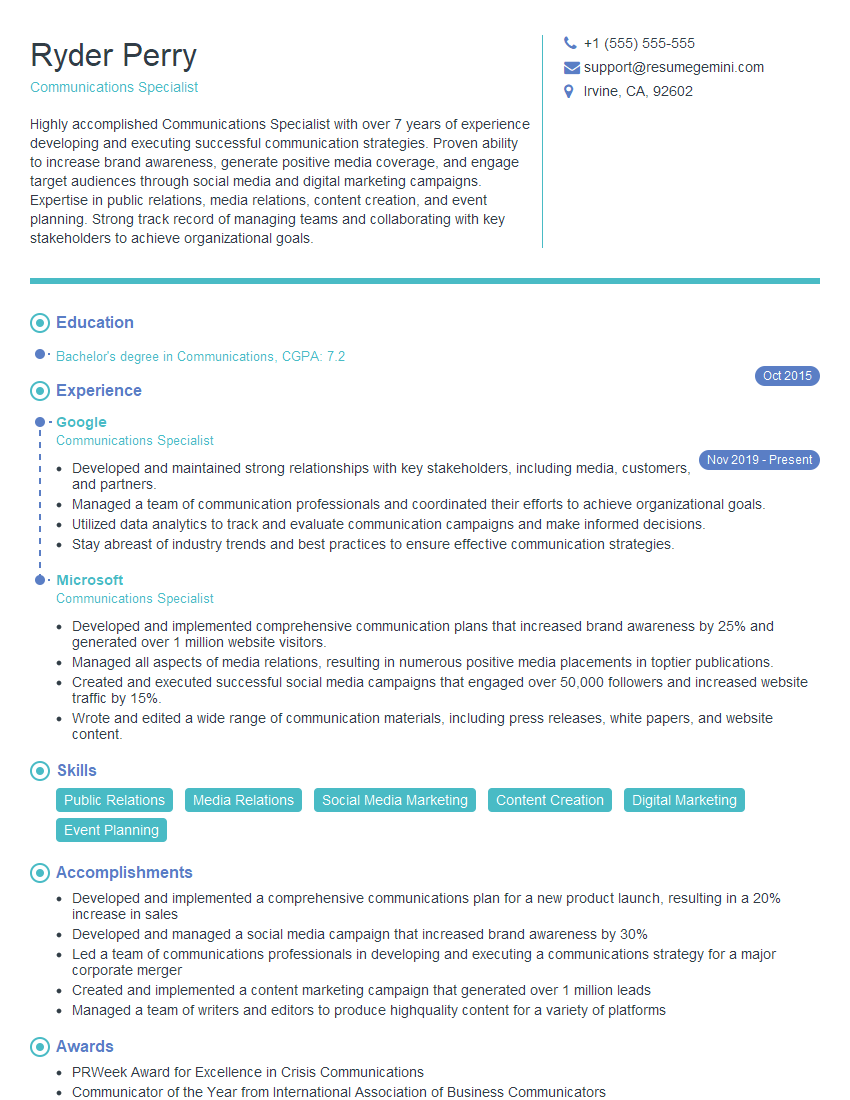
Communications Specialist Resume Sample
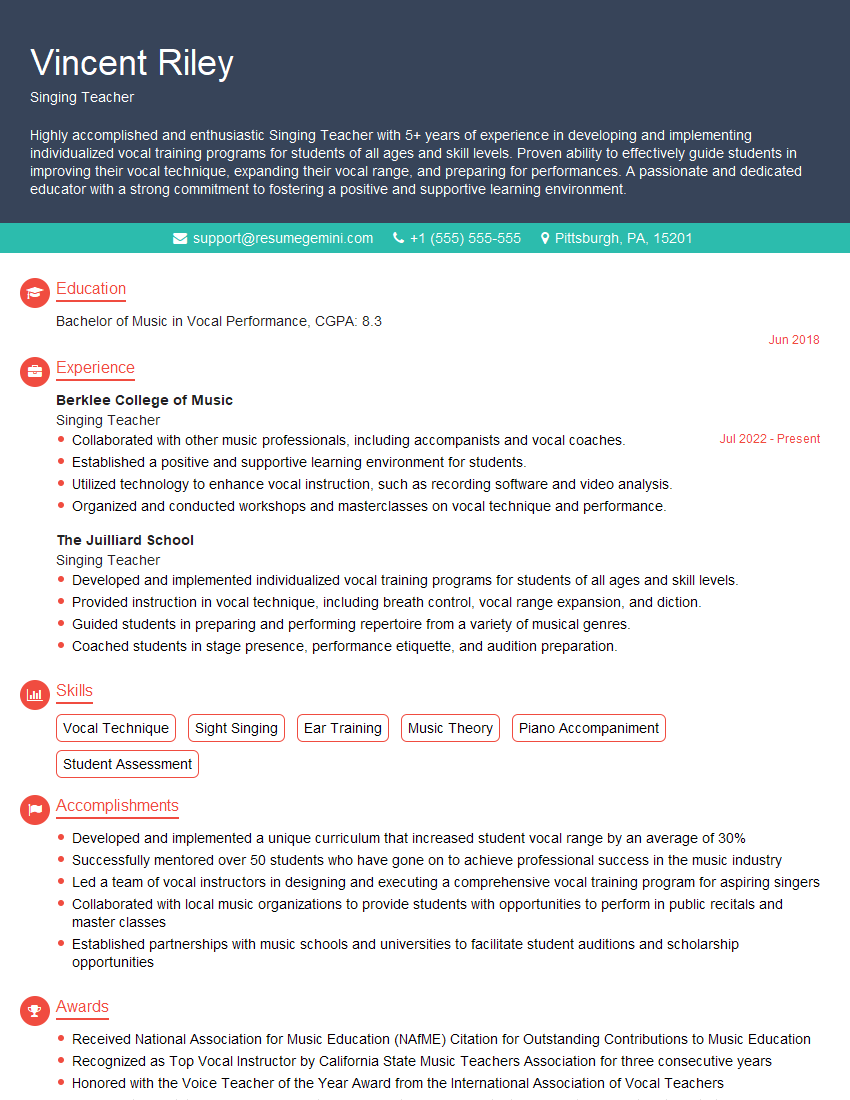
Singing Teacher Resume Sample
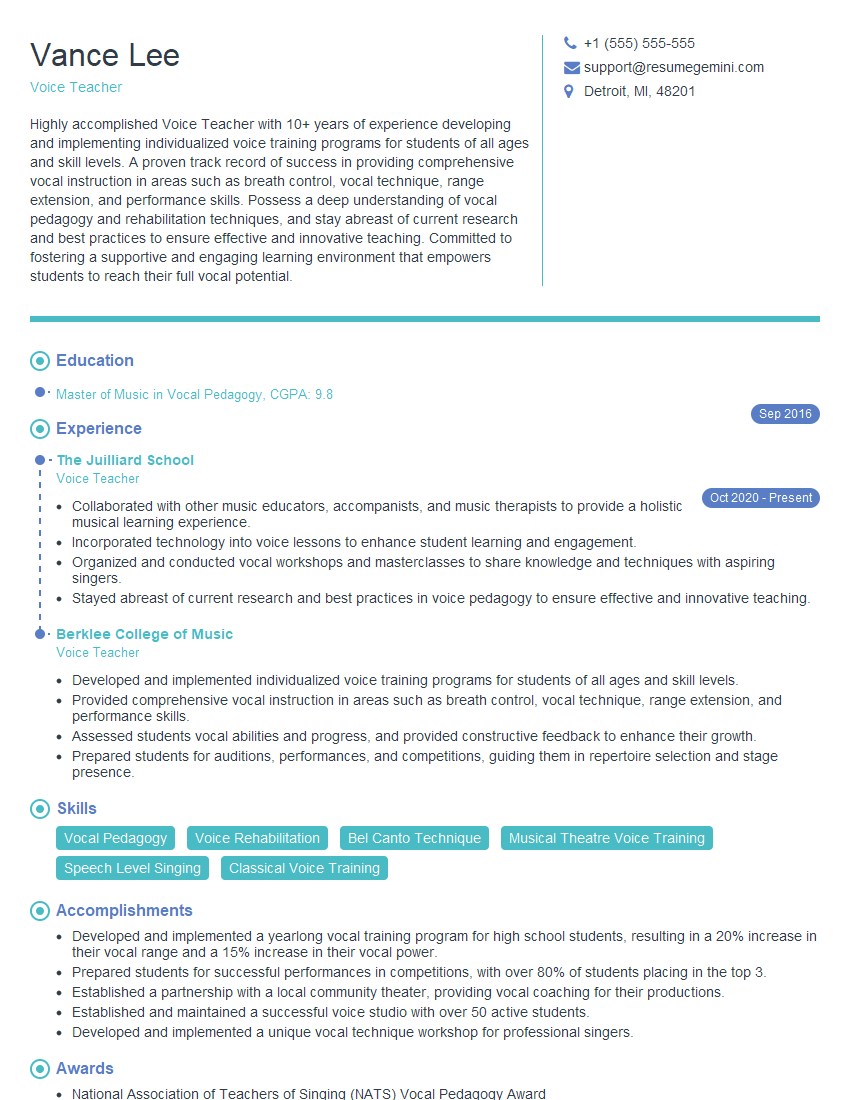
Voice Teacher Resume Sample
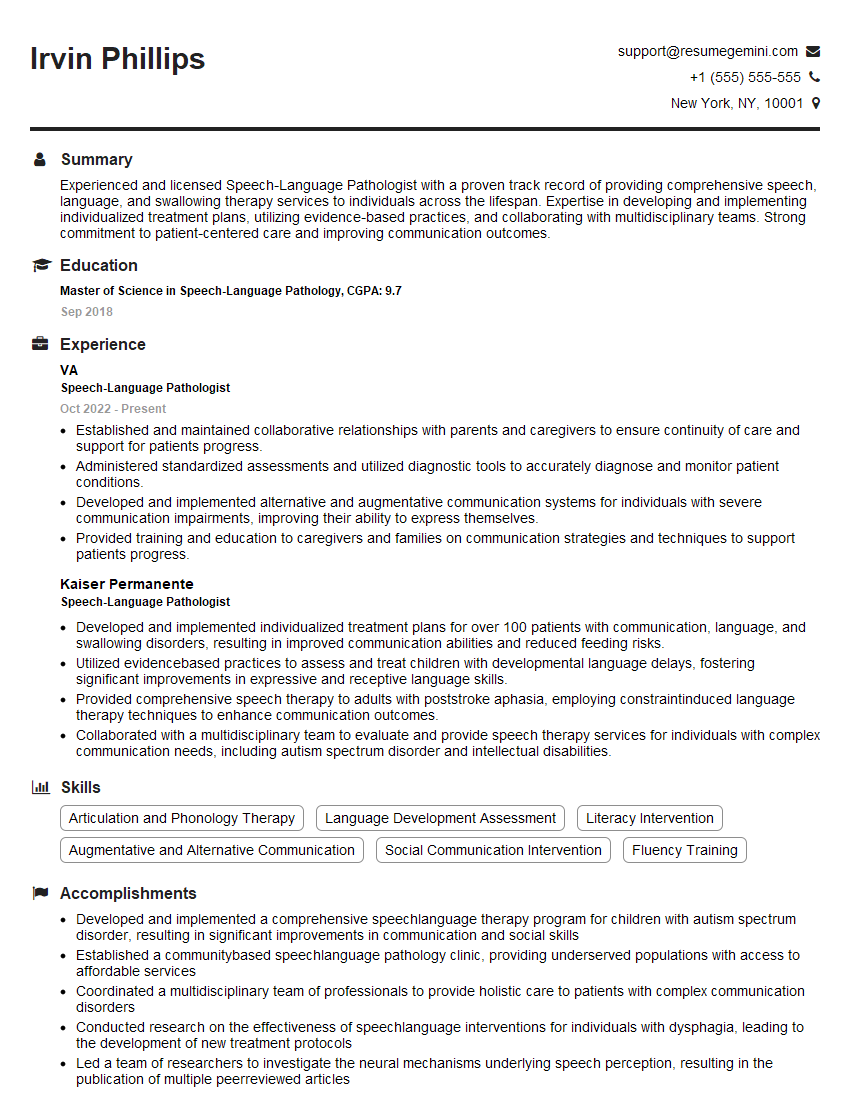
Speech-Language Pathologist Resume Sample
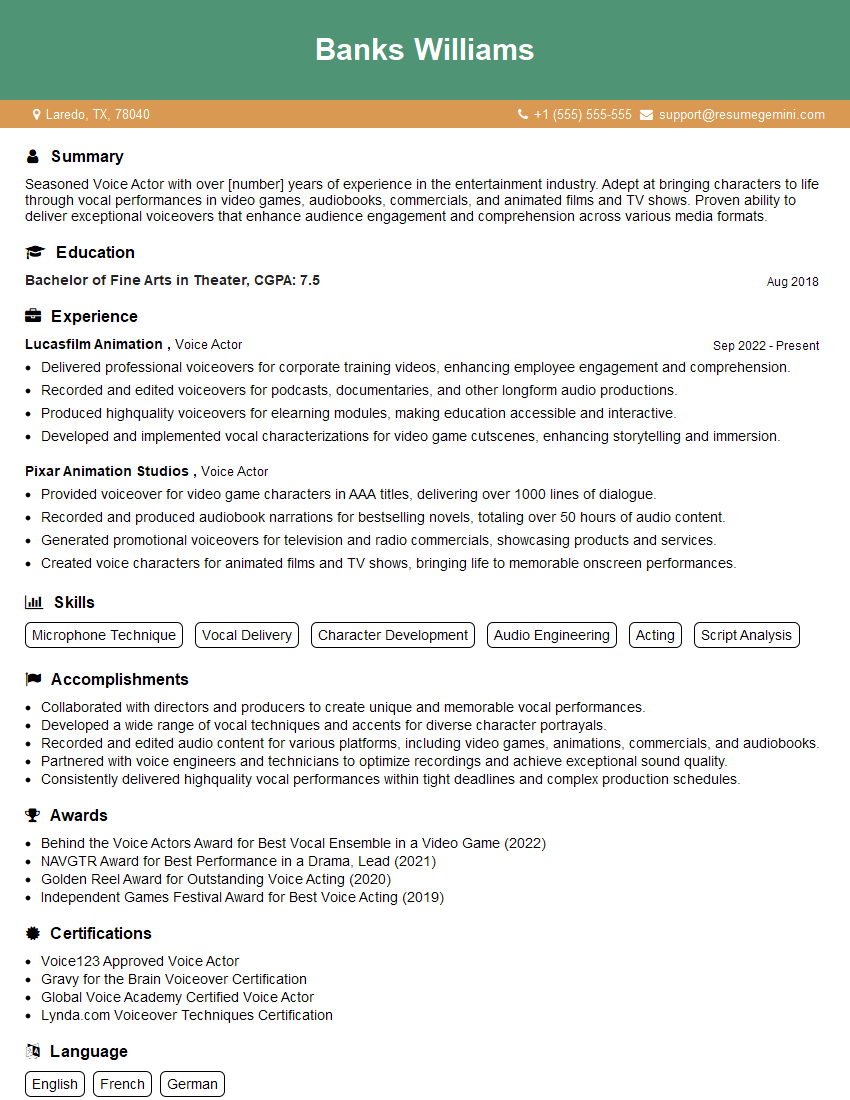
Voice Actor Resume Sample
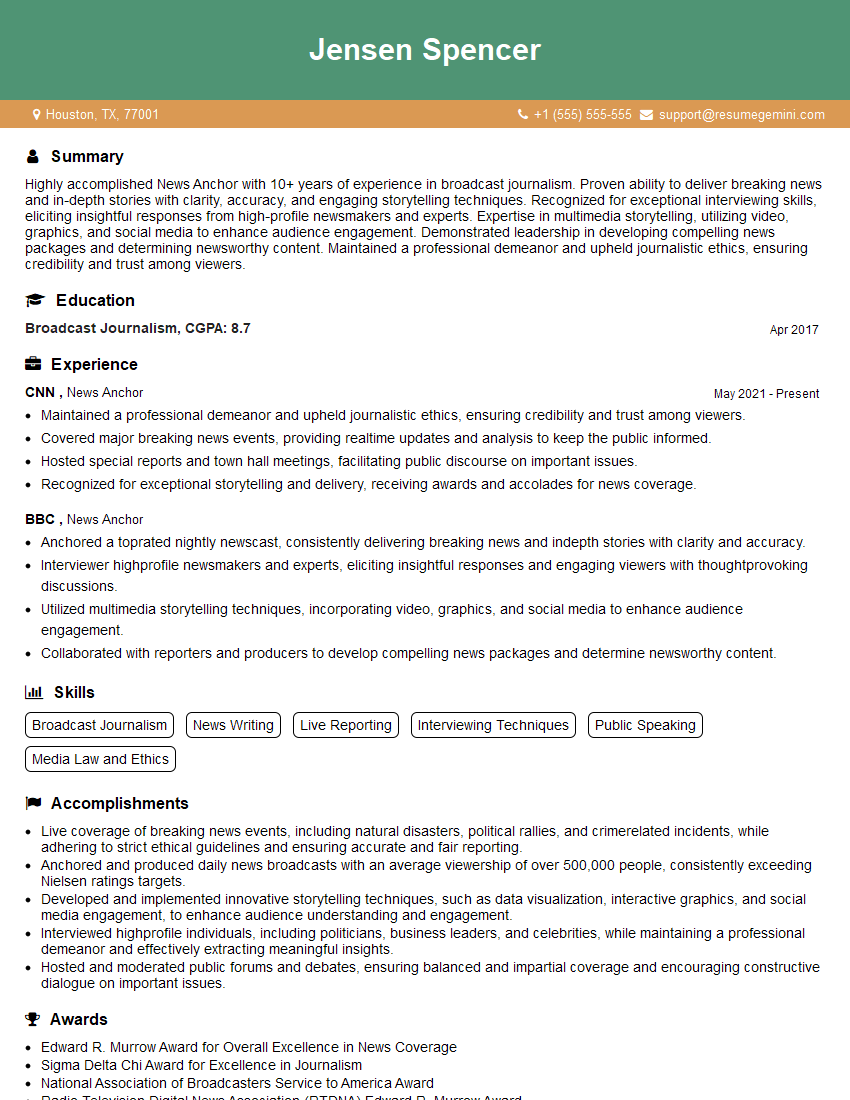
News Anchor Resume Sample
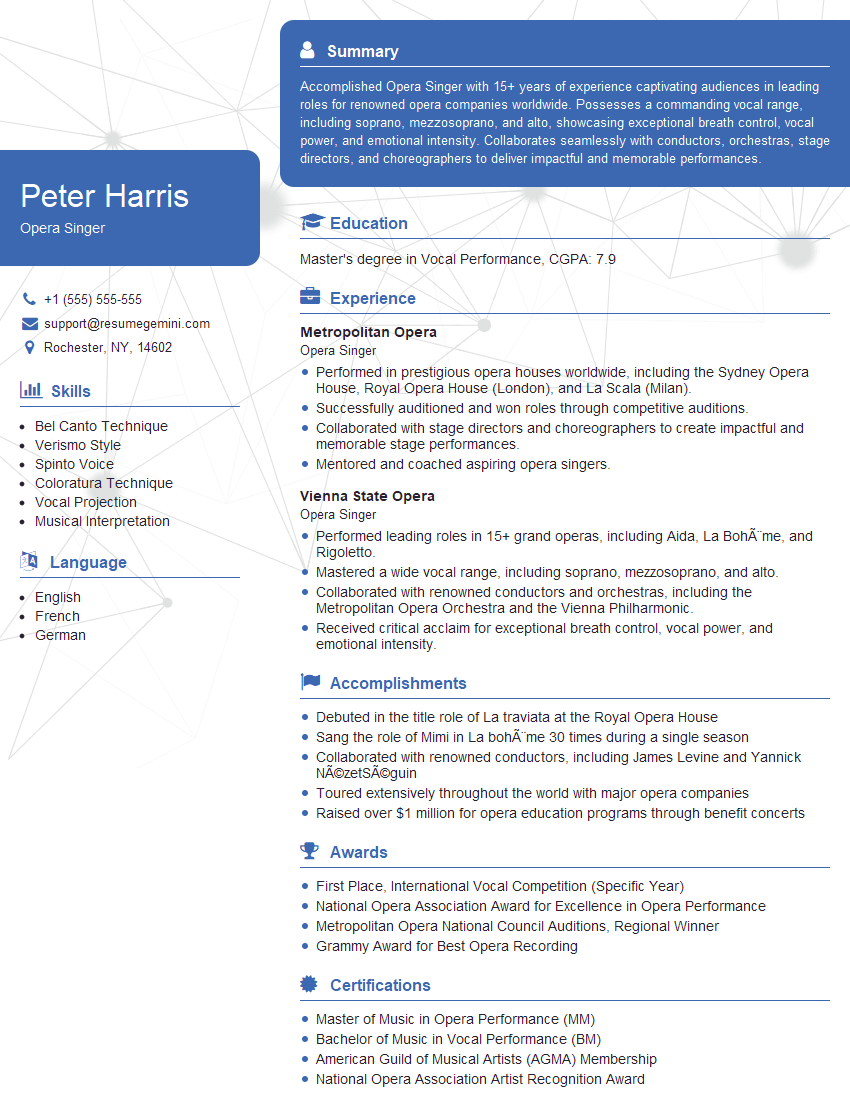
Opera Singer Resume Sample
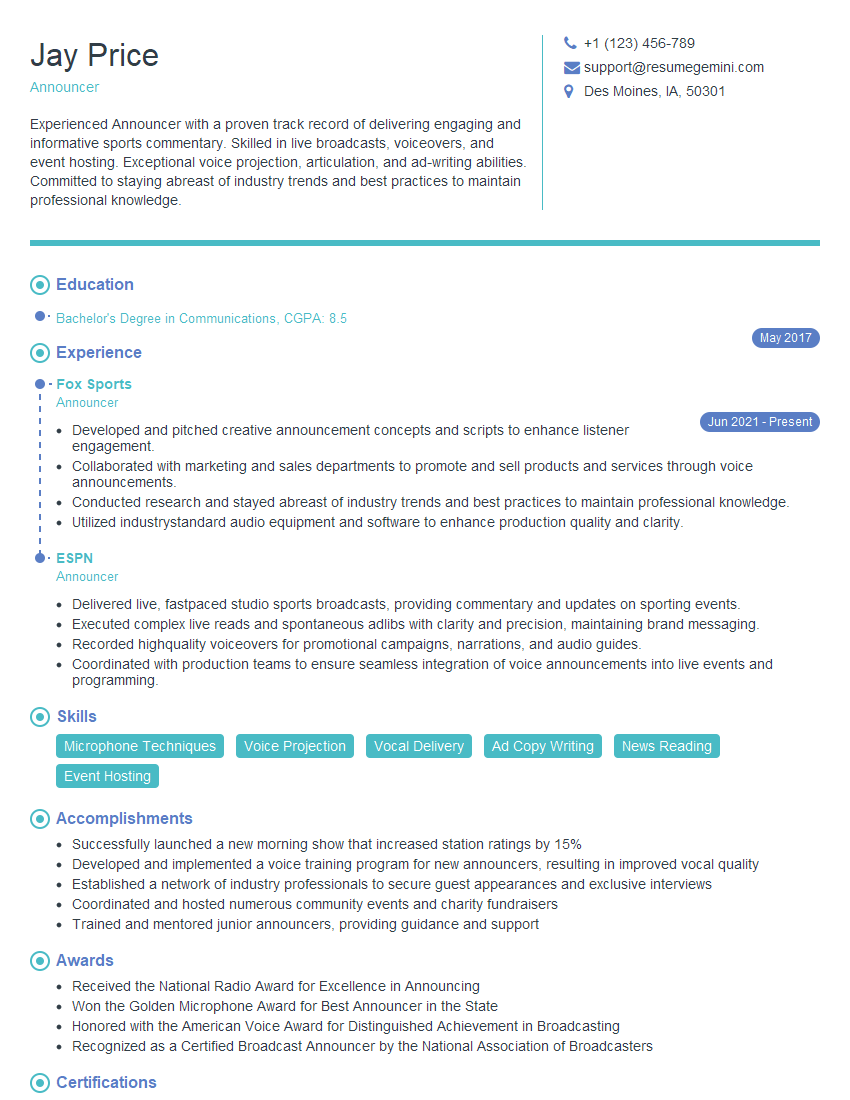
Announcer Resume Sample

Radio Host Resume Sample
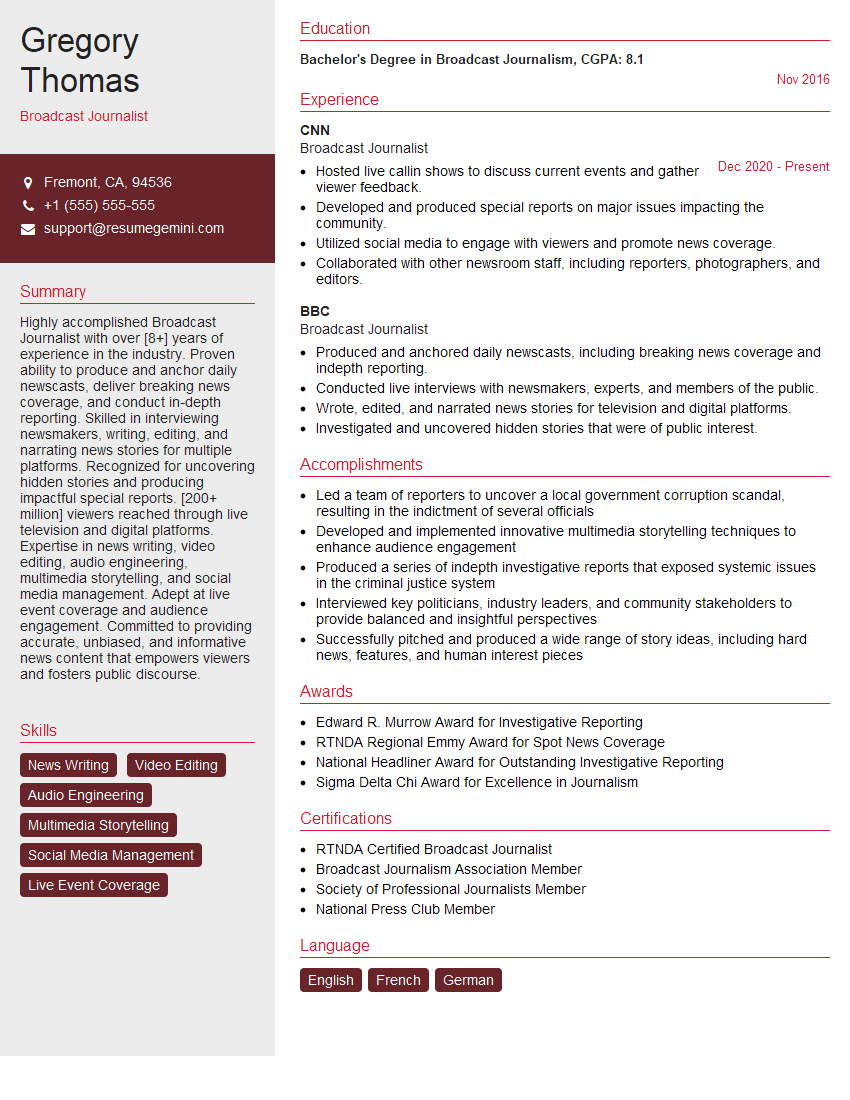
Broadcast Journalist Resume Sample
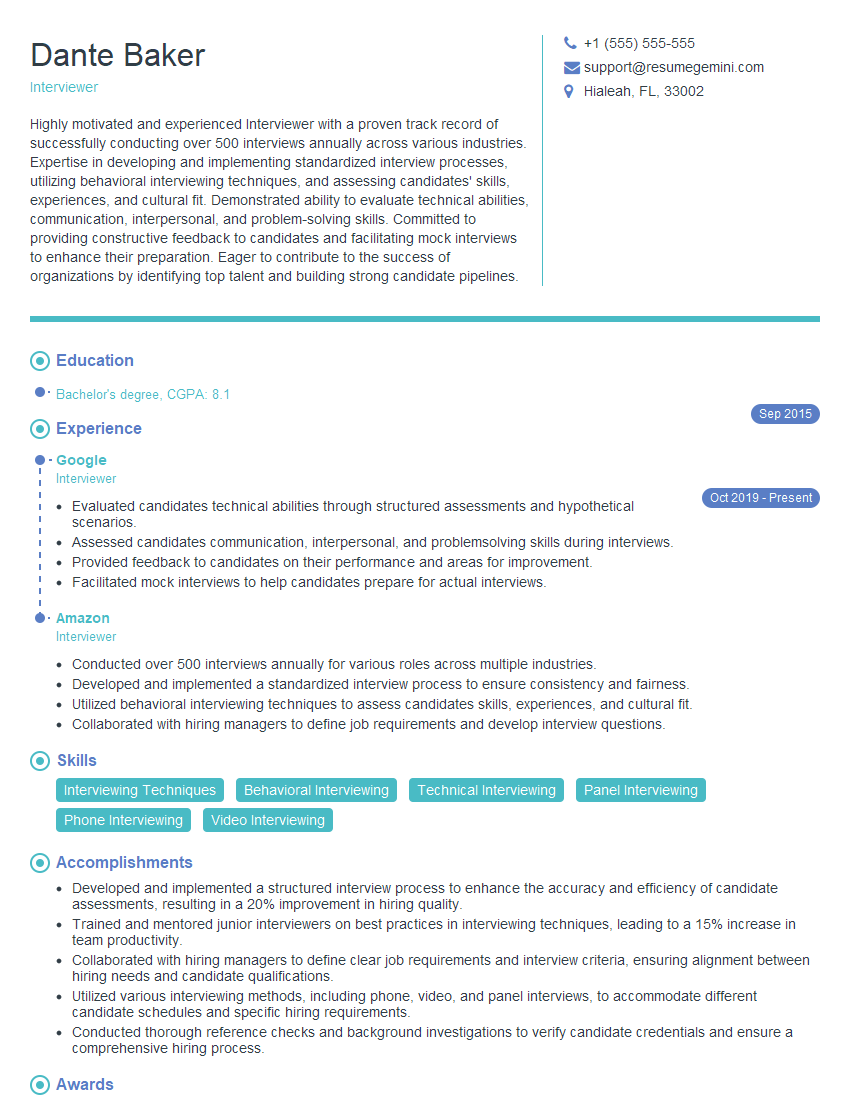
Interviewer Resume Sample
Explore more articles
Users Rating of Our Blogs
Share Your Experience
We value your feedback! Please rate our content and share your thoughts (optional).
What Readers Say About Our Blog
Very informative content, great job.
good