Cracking a skill-specific interview, like one for Vocalist, requires understanding the nuances of the role. In this blog, we present the questions you’re most likely to encounter, along with insights into how to answer them effectively. Let’s ensure you’re ready to make a strong impression.
Questions Asked in Vocalist Interview
Q 1. Describe your vocal range and tessitura.
My vocal range extends from a comfortable low A2 (A below middle C) to a high C6 (two octaves above middle C). However, my tessitura, or the most comfortable and efficient part of my range, lies between D3 (D above middle C) and A5 (A above the staff). This means while I can reach notes outside this range, singing within my tessitura requires less strain and allows for greater control, resonance, and endurance. Think of it like a baseball pitcher’s optimal throwing range—they can throw harder, but their most effective pitches are within their comfortable zone.
For example, I might comfortably sustain a long phrase in my tessitura, but attempting a high note outside it could sound strained or less resonant, affecting the overall musicality. Understanding my tessitura helps me choose repertoire that best suits my voice and ensures vocal health.
Q 2. What vocal techniques do you employ for breath control?
Breath control is fundamental to singing, and I utilize several techniques. Diaphragmatic breathing is key—I focus on expanding my diaphragm, the muscle below my lungs, to inhale deeply and steadily. Imagine filling a balloon from the bottom, not just the top. This provides a constant air supply for sustained notes and phrases.
I also practice controlled exhalation by gradually releasing air, preventing breathiness or gasping. Appoggiatura, a vocal technique where a short note is added before the main note, helps me manage breath better while adding expressiveness. Finally, I regularly do breathing exercises, such as hissing out air slowly or sustaining a humming sound, to build strength and control. This daily practice is like an athlete training their body—it’s essential to maintain vocal fitness.
Q 3. Explain your approach to interpreting musical phrasing and dynamics.
Interpreting musical phrasing and dynamics involves understanding the composer’s intent and conveying it through vocal expression. I analyze the score meticulously, considering the melody, harmony, and rhythm. Phrasing is like creating sentences with my voice— each phrase has a beginning, a middle, and an end, requiring subtle shifts in tempo, dynamics, and articulation to bring out the meaning.
Dynamics are the variations in volume; I carefully consider the composer’s markings (piano, forte, crescendo, diminuendo) and use them as a guide while also adding my own artistic interpretation to create emotional impact. For example, a gradual crescendo on a phrase expressing love might differ significantly in character from a sudden forte during a moment of anger. I strive for a natural and expressive delivery that avoids mechanical execution, always striving for emotional honesty.
Q 4. How do you handle stage fright or performance anxiety?
Stage fright is a common experience, even for seasoned performers. My strategy involves a multifaceted approach. Thorough preparation is crucial—rehearsing until the performance feels almost second nature significantly reduces anxiety. Visualization, where I mentally rehearse the performance in a positive and successful manner, also helps. I also engage in relaxation techniques like deep breathing and meditation before a performance.
Beyond these, I focus on connecting with the audience. Remembering that I’m sharing something I love with people who want to enjoy it can transform performance anxiety into excitement. Finally, learning from past experiences – even unsuccessful ones – helps build confidence and resilience. Every performance, regardless of the outcome, is a learning opportunity.
Q 5. Describe your experience with microphone techniques.
Microphone technique is about maximizing sound quality and minimizing unwanted noises. I understand the importance of maintaining consistent distance from the microphone, avoiding plosives (hard consonant sounds like ‘p’ and ‘b’) by adjusting my mouth position, and using proper vocal projection rather than relying solely on amplification. I’ve worked with various types of microphones, from dynamic mics for stage performances to condenser mics for studio recordings, understanding their unique characteristics and how to optimize my vocal delivery for each.
For example, using a dynamic microphone onstage often requires a slightly more aggressive approach to vocal projection, while condenser mics in the studio are more sensitive and require a subtler touch. Practical experience and feedback from engineers have been instrumental in refining my technique.
Q 6. What software or hardware are you proficient in for vocal recording and editing?
My proficiency in vocal recording and editing software includes Pro Tools, Logic Pro X, and Audacity. I’m also comfortable using various audio interfaces, such as the Universal Audio Apollo and Focusrite Scarlett interfaces, to ensure high-quality recording. Pro Tools and Logic Pro X are industry-standard Digital Audio Workstations (DAWs) allowing for precise editing, mixing, and mastering of audio. Audacity is a free and versatile tool, useful for basic editing and experimentation.
Understanding these tools allows me to create polished recordings and tailor my sound to specific needs. For instance, I might use noise reduction in Audacity to clean up a recording, or employ more advanced mixing and mastering techniques in Pro Tools to achieve a professional studio sound. This technical expertise complements my vocal skills, ensuring the highest possible quality in my recordings.
Q 7. How do you adapt your vocal style to different genres of music?
Adapting my vocal style to different genres requires versatility and an understanding of the unique characteristics of each style. For example, singing jazz might involve a more improvisational approach, focusing on phrasing and articulation, while singing pop music often requires greater emphasis on clarity and powerful projection. Classical singing emphasizes breath support, tone quality, and precision, quite different from the rawness and emotionality frequently present in blues or rock.
I immerse myself in each genre by studying its prominent artists, listening extensively, and practicing the specific techniques associated with it. This holistic approach allows me not only to change my vocal approach to match the musical style but also the overall artistic interpretation. It’s about finding the appropriate ‘voice’ for each genre, maintaining vocal health while also showcasing my artistic versatility.
Q 8. Explain your understanding of vocal health and hygiene.
Vocal health and hygiene are paramount for any vocalist. It’s not just about avoiding illness; it’s about proactively maintaining the optimal condition of your vocal instrument to ensure consistent performance and longevity. Think of your voice as a finely tuned instrument – it requires careful care and attention.
- Hydration: Drinking plenty of water throughout the day is crucial. Dehydration thickens vocal fold secretions, making it harder to produce clear and resonant sound. I aim for at least 2 litres of water daily, more when I’m singing extensively.
- Vocal Rest: Giving your voice adequate rest is essential, especially after strenuous singing sessions. Avoid excessive talking or yelling, and schedule regular breaks. Think of it like weightlifting – you need rest for muscle recovery.
- Proper Breathing Techniques: Learning and practicing diaphragmatic breathing is key. This allows for efficient airflow and reduces strain on the vocal cords. Poor breathing can lead to vocal fatigue and even injury.
- Vocal Warm-ups and Cool-downs: Just like athletes warm up before exercise, vocal warm-ups prepare the vocal cords for singing. Cool-downs help them relax gradually after a performance. I always incorporate these into my routine.
- Healthy Lifestyle: A balanced diet, regular exercise, and sufficient sleep all contribute to overall health, which directly impacts vocal health. Avoid smoking, excessive alcohol consumption, and anything that irritates the throat.
- Avoiding Irritants: Things like excessive caffeine, dairy products (for some individuals), and environmental pollutants (like smoke and dust) can negatively affect vocal health. I’m mindful of my environment and try to minimize exposure to such irritants.
Q 9. Describe your experience working with other musicians in a collaborative setting.
Collaboration is an integral part of my work. I’ve had the pleasure of working with various musicians, from instrumentalists to other vocalists, in diverse musical settings. Successful collaboration requires strong communication, mutual respect, and a shared artistic vision.
For example, during a recent project with a jazz quartet, we spent considerable time discussing the arrangement and phrasing of the songs. We experimented with different harmonies and rhythms, openly sharing ideas and offering constructive feedback. This collaborative process enriched the final product far beyond what any of us could have achieved individually. The ability to listen actively to other musicians’ ideas and integrate them seamlessly into my own performance is a skill I constantly hone.
Q 10. How do you handle constructive criticism regarding your vocal performance?
I view constructive criticism as an invaluable tool for growth. It’s not personal; it’s about improving my craft. My approach involves actively listening to the feedback, seeking to understand the critic’s perspective, and analyzing whether their points are valid and applicable.
For instance, if a director suggests I need to project more power in a certain section, I’ll analyze my technique, perhaps experimenting with different breathing techniques or vocal placement to address the issue. I’ll then practice incorporating these adjustments into my performance. I believe the most valuable criticism is specific and actionable, helping me pinpoint areas for improvement and refine my skills.
Q 11. What is your process for learning and memorizing new musical material?
Learning and memorizing new material is a multi-stage process for me. It begins with a thorough understanding of the music.
- Initial Understanding: I start by listening repeatedly to the piece, focusing on melody, harmony, rhythm, and lyrics. I’ll often analyze the musical structure, identifying key sections and phrasing.
- Vocalization and Phrasing: I then begin vocalizing the melody, paying attention to accurate pitch and intonation. I work on phrasing, ensuring the musical line is smooth and expressive.
- Memorization Techniques: I use a combination of techniques, including repetition, chunking (breaking the song into smaller, manageable sections), and associating musical phrases with lyrics or imagery.
- Performance Practice: Finally, I practice performing the piece, paying attention to dynamics, articulation, and overall interpretation. I incorporate the piece into my practice sessions until it is firmly ingrained in my memory.
This process allows me to internalize the music not only as a series of notes but also as an expressive and meaningful communication.
Q 12. How would you describe your vocal tone and timbre?
My vocal tone is often described as rich and warm with a hint of vibrato. The timbre is quite versatile, allowing me to adapt my vocal quality depending on the style of music. For example, I can easily adjust my timbre for a more intimate, ballad-style performance or a powerful, belt-style performance. I’ve been told my voice has a certain emotional depth that resonates with audiences.
Q 13. What are your strengths and weaknesses as a vocalist?
My strengths lie in my versatility and emotional expressiveness. I can comfortably navigate various musical genres, and I believe I connect with audiences on an emotional level. I’m also dedicated to continuous improvement and actively seek out opportunities for professional development.
One area I’m constantly working on is expanding my vocal range, particularly at the higher registers. While I can achieve a certain level of power in the upper register, I aim for greater control and consistency. This is an ongoing process that involves targeted vocal exercises and consistent practice.
Q 14. How do you maintain your vocal health on tour or during extensive rehearsal periods?
Maintaining vocal health during tours and extensive rehearsals requires a proactive and disciplined approach. The strategies I employ are similar to those for everyday vocal health, but with increased vigilance and attention to detail.
- Consistent Hydration: I carry a water bottle with me at all times and make a conscious effort to hydrate frequently throughout the day.
- Vocal Rest and Recovery: I schedule breaks between rehearsals or performances to give my voice a rest. I avoid unnecessary talking, especially in loud environments.
- Strategic Warm-ups and Cool-downs: I always warm up thoroughly before performances and cool down afterward, regardless of the schedule.
- Vocal Hygiene: I’m even more attentive to avoiding irritants, like excessive caffeine or exposure to dust and pollutants.
- Supportive Team: Having a supportive team that understands the importance of vocal health is crucial. They can help manage my schedule and ensure I have the time and resources to prioritize my vocal well-being.
Q 15. Describe your experience with sight-reading music.
Sight-reading is the ability to perform music at first sight, without prior preparation. It’s a crucial skill for any professional vocalist, demanding a strong understanding of musical notation and rhythm. My experience encompasses years of practice, ranging from simple melodies to complex orchestral scores. I approach sight-reading systematically: first, I quickly scan the piece to grasp its overall structure, key, and time signature. Then, I analyze the melodic contour and rhythmic patterns before attempting a vocalization, paying close attention to phrasing and articulation. I regularly practice sight-reading exercises, focusing on different styles and complexities to maintain and improve proficiency. For instance, I recently sight-read a challenging aria from an unfamiliar opera, successfully navigating complex rhythmic patterns and dynamic shifts, demonstrating my capacity to quickly interpret and perform new musical material.
Career Expert Tips:
- Ace those interviews! Prepare effectively by reviewing the Top 50 Most Common Interview Questions on ResumeGemini.
- Navigate your job search with confidence! Explore a wide range of Career Tips on ResumeGemini. Learn about common challenges and recommendations to overcome them.
- Craft the perfect resume! Master the Art of Resume Writing with ResumeGemini’s guide. Showcase your unique qualifications and achievements effectively.
- Don’t miss out on holiday savings! Build your dream resume with ResumeGemini’s ATS optimized templates.
Q 16. Explain your understanding of music theory and its application to vocal performance.
Music theory is the backbone of vocal performance. A solid understanding of key signatures, scales, chords, intervals, and rhythm allows me to interpret musical scores effectively, make informed artistic choices, and communicate the composer’s intention. For example, recognizing a dominant chord progression indicates a potential point of harmonic resolution, influencing my phrasing and dynamics. Knowing the key helps me choose the appropriate vocal register and optimize my tone. I use theory to analyze vocal lines, identifying potential challenges such as wide leaps or difficult intervals, and devise strategies for smooth execution. My performance is enhanced by being able to transpose pieces to better suit my vocal range or to collaborate effectively with instrumentalists by understanding their parts and harmonies. This theoretical foundation also enables me to improvise thoughtfully, creating melodic and harmonic structures that complement the musical context.
Q 17. How do you handle improvisation or ad-libbing in a performance?
Improvisation, or ad-libbing, is a powerful tool that adds spontaneity and expressiveness to a performance, provided it’s done tastefully and within the musical context. My approach to improvisation is rooted in musical theory; I build upon existing harmonic progressions, incorporating melodic ideas that resonate with the overall mood and style of the piece. I avoid random notes and focus on creating meaningful musical phrases. Before attempting improvisation, I analyze the harmonic structure of the song. I identify potential points where improvisation would enhance the performance without disrupting the flow. For example, during a slow ballad, I might extend a phrase with embellishments and runs, maintaining the emotional arc. In a more upbeat context, I might incorporate rhythmic variations or call-and-response elements. Ultimately, my improvisation aims to engage the audience, deepen the emotional impact, and showcase my musical creativity while remaining respectful to the original work.
Q 18. Describe your experience with different vocal microphone types and their applications.
My experience with vocal microphones is extensive. Different microphone types offer varying polar patterns and frequency responses, each best suited for specific vocal characteristics and recording environments. For example, cardioid microphones, which pick up sound primarily from the front, are excellent for isolating a vocalist’s voice on stage. They minimize unwanted background noise. Large-diaphragm condenser microphones are known for their warmth and detail, making them ideal for studio recording, capturing subtle nuances in the voice. Dynamic microphones are durable and handle high sound pressure levels well, suitable for live performances where loud instrumental sounds are present. I’m adept at choosing and using the appropriate microphone type based on the specific setting and desired sound. This includes adjusting microphone placement for optimal sound quality and minimizing proximity effect, a phenomenon causing bass boost at close distances.
Q 19. How familiar are you with vocal warm-up exercises and routines?
Vocal warm-ups are essential for vocal health and performance readiness. My routine includes a series of exercises designed to prepare my vocal cords for optimal function and prevent injury. This typically starts with gentle humming and lip trills to loosen the vocal muscles. Then, I progress to scales and arpeggios, gradually expanding my range and focusing on breath control and resonance. I incorporate tongue twisters and articulation exercises to improve clarity and diction. My warm-up routine is tailored to the specific demands of the performance. If it’s a high-energy performance, I include exercises to strengthen my vocal projection, while for a more intimate setting, my warm-up might focus on breath control and tone refinement. This routine allows me to achieve peak vocal performance while minimizing the risk of vocal strain or fatigue.
Q 20. What is your experience with audio feedback and how do you mitigate it?
Audio feedback, that high-pitched squeal caused by sound looping from the microphone to the speakers, is a common issue in live performances. My experience includes understanding and mitigating this by identifying its source and implementing various strategies. It commonly happens when a microphone picks up sound from the speakers. To avoid feedback, I carefully adjust my microphone placement, keeping it as far as possible from the speakers. I work closely with sound engineers to adjust the gain settings and use EQ to minimize problematic frequencies. I’m also attentive to the overall sound system; understanding issues like improper speaker placement or inadequate acoustic treatment in the venue. My proactive approach in understanding these elements ensures minimal feedback issues, providing a smooth and professional performance.
Q 21. How do you approach recording vocals in a studio environment?
Recording vocals in a studio involves a collaborative approach. It starts with proper preparation, including sufficient warm-up and a clear understanding of the song’s arrangement and desired vocal style. I work closely with the producer and engineer to ensure the desired sound quality, making adjustments to microphone positioning, equalization, and compression. I focus on consistent vocal delivery, taking multiple takes to refine the performance. I pay close attention to dynamic control and phrasing, ensuring the nuances of my delivery are captured. Post-recording, I may collaborate in the editing process, listening for any imperfections and providing input on vocal adjustments. My studio experience ensures efficient and high-quality vocal recordings. Through careful planning and collaboration, I can deliver consistent and professional results.
Q 22. How do you ensure your vocal performance aligns with the overall artistic vision of a project?
Aligning my vocal performance with a project’s artistic vision is paramount. It’s not just about hitting the right notes, but embodying the emotion and intent behind the music. I begin by thoroughly understanding the director’s or composer’s vision. This involves careful listening to reference tracks, reviewing the score (if applicable), and engaging in detailed discussions to clarify the desired mood, style, and overall message. For example, in a project with a melancholic theme, I’d focus on conveying vulnerability and introspection through my phrasing, dynamics, and tone. Conversely, an upbeat, energetic piece would require a brighter tone, bolder phrasing, and perhaps even more powerful projection. I constantly seek feedback throughout the process, making adjustments as needed to ensure the performance resonates with the overall artistic direction.
I see myself as a collaborative partner. I actively participate in shaping the interpretation, suggesting vocal techniques that might enhance the emotional impact, and even providing ideas for stylistic choices if appropriate. Open communication is key to a successful collaboration.
Q 23. Describe your experience with music notation software (e.g., Sibelius, Finale).
I’m proficient in Sibelius and have a working knowledge of Finale. My experience with music notation software extends beyond simply reading scores; I utilize it to meticulously prepare for performances. I’ll often use Sibelius to annotate scores with specific vocal markings, such as dynamic variations (crescendo, diminuendo), articulation (legato, staccato), and phrasing. This allows me to internalize the nuances of the piece and ensure a consistently high-quality performance. For instance, I might add detailed breath markings to a particularly long phrase, optimizing my breath control for optimal delivery. I’ve also used Sibelius to create customized practice scores, focusing on specific sections that require more attention. It’s a valuable tool for meticulous planning and preparation.
Q 24. How do you handle technical difficulties during a live performance?
Handling technical difficulties during a live performance requires quick thinking and adaptability. My approach is rooted in preparedness and problem-solving. Before any performance, I meticulously check my equipment – microphone, monitors, and any in-ear systems. During the performance, I remain acutely aware of my surroundings and maintain open communication with the sound engineer. Should a technical issue arise (such as a microphone malfunction), I’ve learned to remain calm and react swiftly. For instance, I might adjust my positioning to find a better signal or, if the problem is severe, briefly engage with the audience while the issue is being resolved, turning a potential hiccup into an opportunity for connection.
I’ve trained myself to be flexible. If a section of music unexpectedly cuts out, I’m prepared to improvise or subtly adjust the performance to maintain flow and engagement. Ultimately, my goal is to minimize any disruption to the audience’s experience.
Q 25. Describe your experience working within a specific musical style (e.g., Jazz, Classical, Pop).
My extensive experience lies within the realm of Jazz vocal performance. I’ve spent years developing my improvisational skills, exploring different phrasing techniques, and mastering the intricate rhythmic and harmonic complexities of this genre. I am comfortable with scat singing and incorporating various vocal effects to create a unique and engaging performance. I value the collaborative nature of jazz, where spontaneous interactions with other musicians are central to the performance. For example, in a recent performance, I collaborated with a trio to improvise a soulful rendition of a standard, weaving melodies and harmonies that spontaneously emerged from our shared musical conversation. This requires a deep understanding of harmony, rhythm, and the ability to listen attentively and respond creatively to my fellow musicians.
Beyond Jazz, I possess a foundational understanding of Classical and Pop styles, allowing me to adapt my vocal technique and interpretation accordingly.
Q 26. What are your salary expectations for this role?
My salary expectations are commensurate with my experience and the specific demands of this role. I’m open to discussing a competitive salary range based on the details of the position and industry standards.
Q 27. What are your long-term career goals as a vocalist?
My long-term career goals involve building a diverse and impactful career as a vocalist. This encompasses a wide range of activities, including live performances, studio recordings, collaborations with various artists and ensembles, and possibly even exploring opportunities in musical theatre or songwriting. I envision myself expanding my skills and musical horizons, constantly seeking new challenges and creative avenues. Ultimately, I strive to create meaningful musical experiences that resonate with audiences and leave a lasting impression.
Q 28. Do you have any questions for me?
Yes, I have a few questions. First, could you elaborate on the specific responsibilities and expectations of this role? Second, what opportunities are there for professional development and growth within the organization? Finally, what is the typical workflow and collaborative process for projects within the team?
Key Topics to Learn for Vocalist Interview
- Vocal Technique Fundamentals: Understanding breath control, resonance, vocal placement, and projection techniques. Consider how these impact different vocal styles and genres.
- Musical Theory and Application: Demonstrate knowledge of scales, chords, rhythm, and melody as they relate to vocal performance and interpretation. Practice applying this theoretical knowledge to practical vocal exercises.
- Performance Practice and Stagecraft: Explore microphone technique, stage presence, audience engagement, and overcoming performance anxiety. Think about how to translate your skills into a compelling and professional performance.
- Vocal Health and Care: Discuss the importance of vocal hygiene, recognizing and addressing vocal fatigue or strain, and the role of proper warm-up and cool-down routines. Be prepared to explain your approach to maintaining vocal health.
- Music Styles and Genres: Demonstrate familiarity with various musical styles and how vocal techniques adapt accordingly. Be ready to discuss your expertise and experience in specific genres.
- Sight-reading and Music Transcription: Practice sight-reading musical notation and transcribing melodies by ear. Highlight your proficiency in quickly adapting to new musical material.
- Aural Skills and Ear Training: Discuss your ability to identify intervals, chords, and rhythms by ear. This showcases your musical sensitivity and understanding of harmony.
- Improvisation and Creativity: Be prepared to discuss your improvisational skills and how you approach creative expression within a musical context. Show your ability to think on your feet musically.
Next Steps
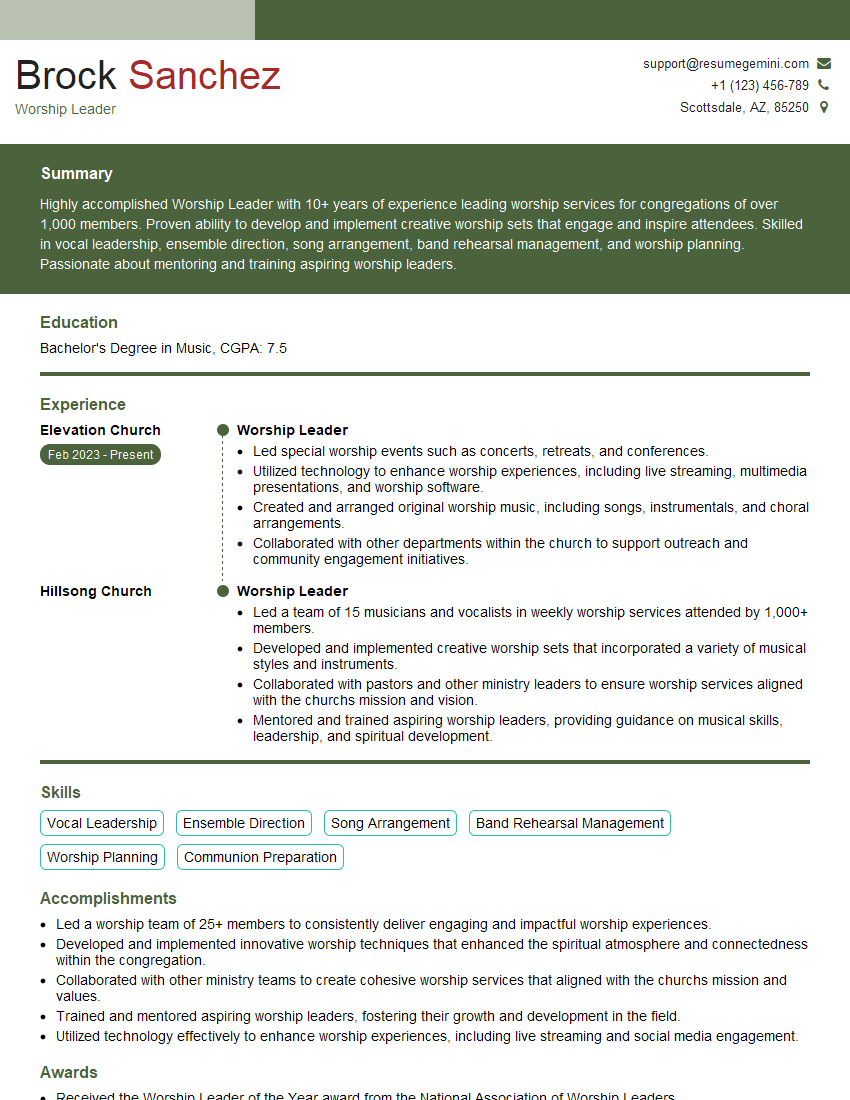
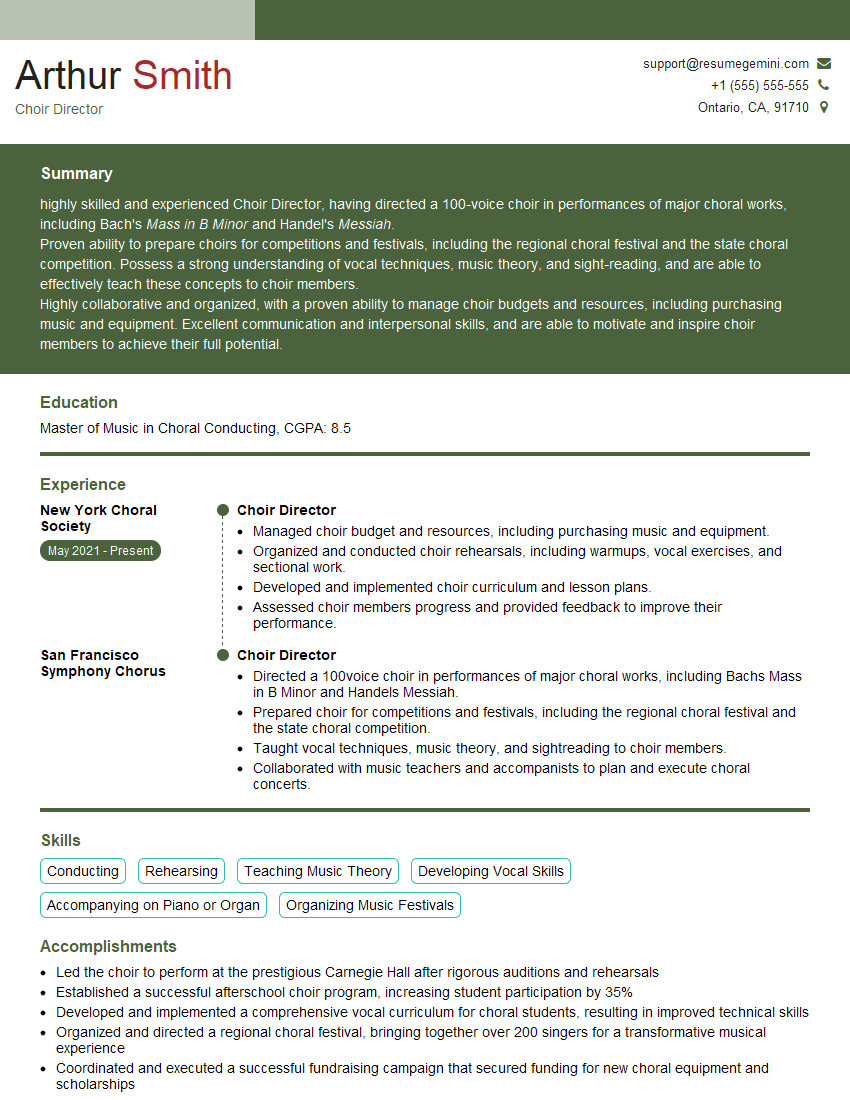
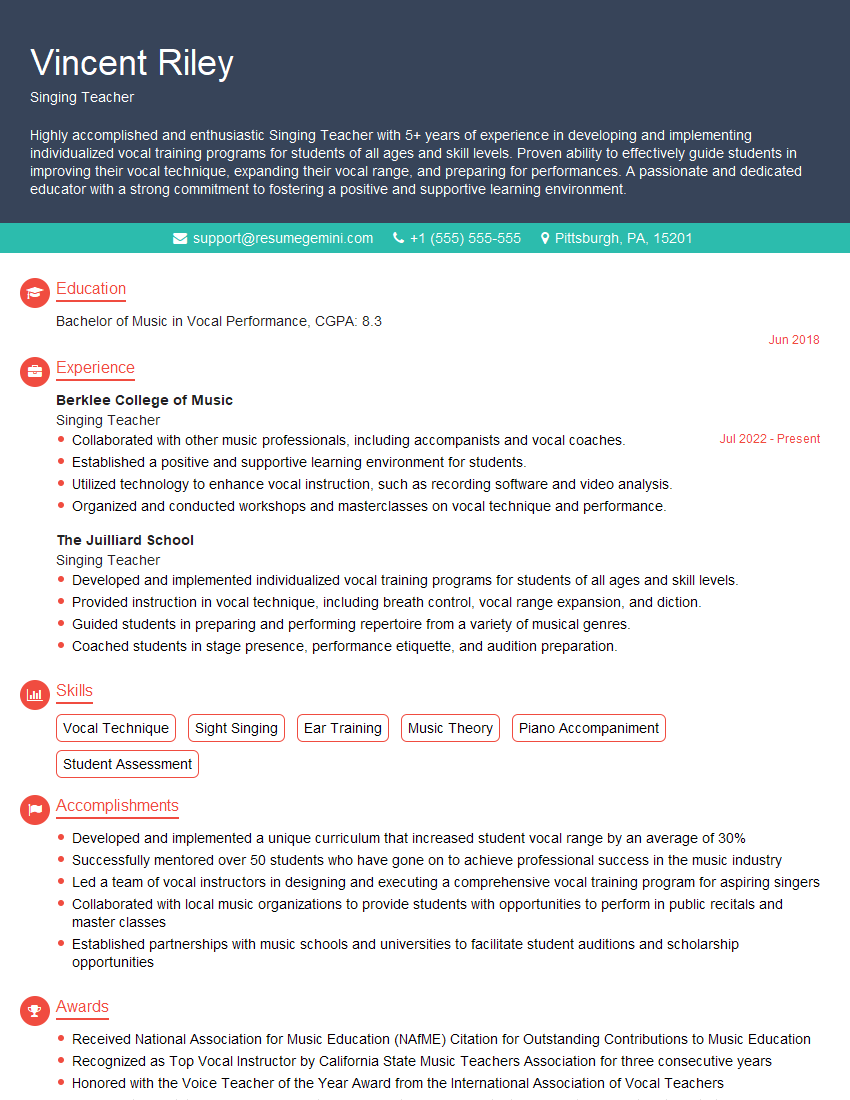
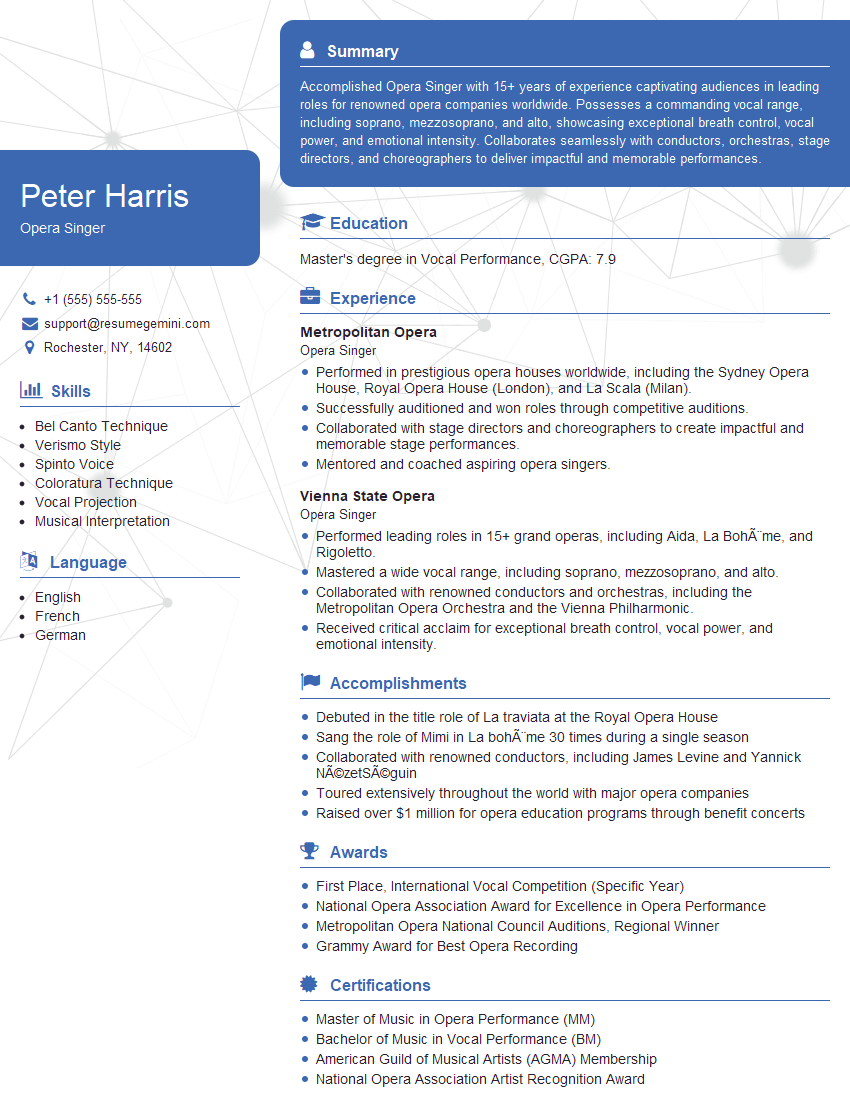
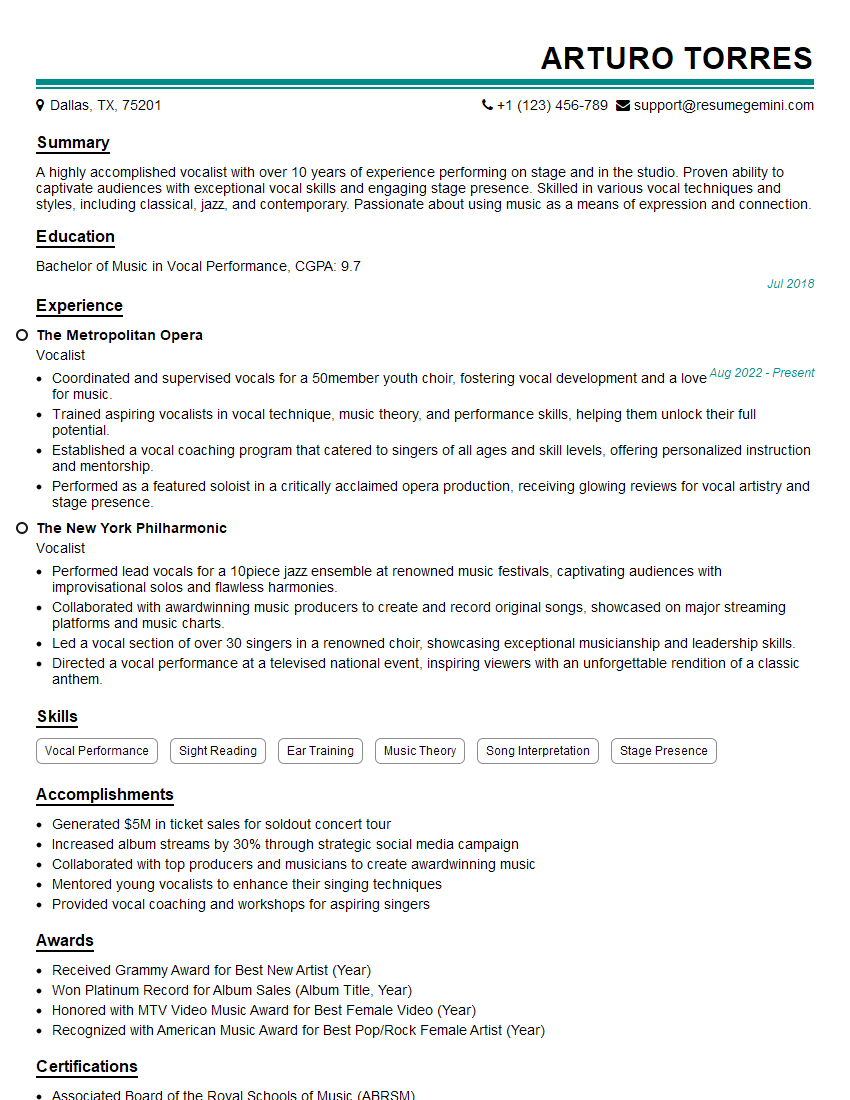
Mastering the skills and knowledge related to Vocalist is crucial for career advancement in the music industry, opening doors to diverse opportunities. A strong resume is your first impression; ensure yours is ATS-friendly to maximize your chances of landing an interview. To create a professional and impactful resume that highlights your unique vocal talents, we highly recommend using ResumeGemini. ResumeGemini provides a streamlined and efficient process for building a compelling resume, and we provide examples of resumes tailored to Vocalist roles to help you get started.
Explore more articles
Users Rating of Our Blogs
Share Your Experience
We value your feedback! Please rate our content and share your thoughts (optional).
What Readers Say About Our Blog
Very informative content, great job.
good