Cracking a skill-specific interview, like one for Voiceover and On-Camera Performance, requires understanding the nuances of the role. In this blog, we present the questions you’re most likely to encounter, along with insights into how to answer them effectively. Let’s ensure you’re ready to make a strong impression.
Questions Asked in Voiceover and On-Camera Performance Interview
Q 1. Describe your experience with different microphone types and their applications.
My experience with microphones spans a wide range, from dynamic mics ideal for capturing powerful, close-miked vocals to sensitive condenser mics perfect for nuanced voiceover work. The choice depends heavily on the project’s needs and environment.
- Dynamic Microphones (e.g., Shure SM7B): These are robust, handle high sound pressure levels well, and are less sensitive to handling noise. They are excellent for voiceover in less-than-perfect acoustic spaces or when a more present, ‘booming’ sound is desired. I often use a Shure SM7B for narration or audiobooks where clarity and presence are paramount.
- Condenser Microphones (e.g., Neumann U 87 Ai): Condenser mics are more sensitive and capture a wider frequency range, ideal for picking up subtle nuances and creating a more polished, refined sound. They require a quieter recording environment and are perfect for voice acting projects demanding emotional depth and subtlety. I’ll opt for a Neumann U 87 Ai for animation or character work that needs intricate vocal texture.
- USB Microphones (e.g., Blue Yeti): These are convenient for quick recordings or home studio setups, offering a balance between portability and decent audio quality. While not my go-to for professional work, they are a viable option for smaller projects or initial auditions.
Ultimately, selecting the right microphone is crucial for achieving the desired sonic landscape. It’s all about matching the microphone’s characteristics to the vocal performance and project goals.
Q 2. Explain your process for interpreting a script for voiceover work.
Interpreting a script for voiceover is a multi-step process that goes beyond simply reading the words. It’s about understanding the text’s subtext, the target audience, and the overall tone and style of the project.
- Understanding the Context: I begin by thoroughly reading the entire script to grasp the narrative arc, character relationships, and overall tone. What’s the message? Who’s the intended audience? What’s the emotional landscape?
- Character Analysis: For character-driven pieces, I analyze each character’s personality, motivations, and relationships. I consider their age, background, and emotional state to inform vocal choices.
- Identifying Key Emotional Moments: I pinpoint moments of high emotion or pivotal shifts in the narrative, ensuring those are delivered with the appropriate vocal inflection and pacing.
- Pacing and Rhythm: I consider the pace and rhythm needed to create a captivating listening experience, ensuring natural breaks and pauses for emphasis.
- Vocal Tone and Style: I determine the appropriate vocal tone—conversational, authoritative, playful, etc.—to align with the script’s message and target audience. This might involve selecting a specific accent or dialect.
For example, if I’m voicing a children’s story, my approach will be significantly different from narrating a corporate video. I tailor my interpretation to ensure the delivery matches the overall feel and purpose of the project.
Q 3. How do you manage vocal fatigue during long recording sessions?
Vocal fatigue during long sessions is a serious concern, and I use several strategies to mitigate it. Think of your voice like a muscle—it needs rest and proper care.
- Hydration: I drink plenty of water throughout the session. Staying hydrated is crucial for maintaining vocal lubrication.
- Vocal Warm-ups and Cool-downs: I always start with vocal exercises to prepare my vocal cords and end with cool-down exercises to relax them. This is like stretching before and after a workout.
- Regular Breaks: I take frequent short breaks every 30-45 minutes to rest my voice and avoid strain. These breaks allow my vocal cords to recover.
- Proper Breathing Techniques: Using diaphragmatic breathing ensures efficient breath support, minimizing strain and allowing for consistent vocal output.
- Humidifier: A humidifier in the recording booth can help maintain optimal humidity levels, which is beneficial for vocal health.
- Voice Rest Outside Recording: I avoid excessive talking or shouting outside of recording sessions to allow my voice to recover fully.
Ignoring vocal fatigue can lead to serious issues like vocal nodules or polyps. Prioritizing vocal health is essential for a long and successful career.
Q 4. What techniques do you use to modulate your voice for different characters or styles?
Modulating my voice for different characters or styles involves a combination of techniques focused on vocal variety and expressiveness.
- Pitch Variation: I adjust the pitch of my voice to reflect the character’s age, personality, and emotional state. A high-pitched voice might indicate youth or excitement, while a lower pitch could suggest maturity or seriousness.
- Pace and Rhythm: The speed and rhythm of my speech can significantly alter the character’s personality. A fast pace might suggest nervousness or excitement, while a slower pace could create a sense of calm or deliberation.
- Vocal Timbre and Tone: I manipulate the quality of my voice—its resonance, texture, and overall sound—to create distinct characters. A raspy voice might convey age or illness, whereas a bright, clear tone could suggest youthfulness or energy.
- Accents and Dialects: I utilize accents and dialects to further enhance character differentiation and realism, but only when I am confident in accurate and respectful portrayal.
- Inflection and Emphasis: Careful use of inflection and emphasis on specific words helps to convey emotion and nuance, creating a more engaging performance.
For example, if I’m playing a gruff, elderly character, I’ll lower my pitch, use a slower pace, and possibly add a slight rasp to my voice. Conversely, a young, energetic character might require a higher pitch, faster pace, and brighter tone.
Q 5. Describe your experience with audio editing software (e.g., Audacity, Pro Tools).
My experience with audio editing software includes proficiency in both Audacity and Pro Tools. Audacity is a great free and open-source option ideal for basic editing tasks, while Pro Tools is a professional industry-standard Digital Audio Workstation (DAW) offering advanced features for complex projects.
- Audacity: I use Audacity for simple edits like removing clicks, pops, and background noise, adjusting levels, and performing basic cuts and fades. It’s a great tool for learning the basics of audio editing and is perfect for smaller, less complex projects.
- Pro Tools: Pro Tools is my preferred DAW for professional voiceover projects. Its advanced features allow for precise editing, mixing, and mastering. I use it for more intricate tasks such as multi-track recording, EQ and compression, noise reduction, and creating polished audio for final deliverables.
Understanding the strengths and limitations of each software allows me to select the most appropriate tool for the job, ensuring a high-quality final product regardless of project size or complexity. Knowing both gives me a broader skillset and allows me to adjust to various client needs.
Q 6. How do you handle technical difficulties during a recording session?
Handling technical difficulties during a recording session requires a calm and proactive approach. My strategy focuses on problem identification, troubleshooting, and maintaining a professional demeanor.
- Identify the Problem: First, I pinpoint the exact nature of the issue. Is it a microphone problem? A software glitch? A computer malfunction?
- Troubleshooting Steps: I systematically troubleshoot the problem, checking cables, connections, software settings, and hardware components. I’ll often consult with the engineer or technician if needed.
- Communicate Clearly: I maintain clear and open communication with the client or director, keeping them informed of the situation and any potential delays. Transparency is key.
- Alternative Solutions: If the problem persists, I explore alternative solutions, such as using a backup microphone or system. Adaptability is vital in these situations.
- Maintain Professionalism: Regardless of the difficulty, I strive to maintain a professional and positive attitude, focusing on finding a solution rather than dwelling on the problem.
A memorable instance involved a sudden power outage during a crucial recording. I remained calm, we immediately switched to a backup generator, and were able to complete the session with minimal disruption. Maintaining composure ensures a smoother workflow and prevents panic from affecting the final product.
Q 7. What is your approach to incorporating director feedback into your performance?
Incorporating director feedback is crucial for delivering a successful performance. My approach involves active listening, thoughtful consideration, and iterative refinement.
- Active Listening: I listen attentively to the director’s feedback, ensuring I fully understand their notes and suggestions. I ask clarifying questions if anything is unclear.
- Understanding the Intent: I consider the director’s intentions behind the feedback. What are they trying to achieve with the adjustments? What aspect of the performance needs improvement?
- Implementation: I carefully implement the suggested changes, focusing on the nuances of delivery, tone, pace, and emotional expression.
- Iterative Refinement: I may perform several takes incorporating the feedback, continually refining my performance until the director is satisfied. This is a collaborative process, and I value their expertise.
- Open Communication: I maintain open communication with the director throughout the process, seeking further guidance and clarification as needed. A collaborative approach always leads to the best results.
Often, directors may ask for more emotion in a particular line or suggest a change in pacing to improve the flow. By actively engaging with their feedback, I consistently deliver performances that meet or exceed client expectations.
Q 8. Describe your experience working with a teleprompter.
Working with a teleprompter is a crucial skill for on-camera and voiceover work. It allows for a smooth delivery of scripts while maintaining eye contact and natural performance. My approach involves several key steps. First, I familiarize myself thoroughly with the script before even sitting in front of the teleprompter. This allows me to understand the nuances of the text and deliver it with authenticity. Then, I adjust the speed of the scrolling text to match my natural speaking rhythm, avoiding a robotic or rushed delivery. I focus on reading ahead of the text on screen as much as possible, creating a conversational feel instead of simply reading words off a screen. This requires practice, but it yields a more engaging and believable performance. For example, during a recent corporate video, I used this technique to seamlessly present complex financial information in an easily digestible format. The result was a client who was extremely pleased with the natural flow and clarity of the presentation. Finally, I always make sure the teleprompter is positioned correctly to avoid neck strain and maintain eye contact.
Q 9. How do you maintain professionalism and composure while on camera, even under pressure?
Maintaining professionalism and composure on camera, especially under pressure, is paramount. My strategy rests on three pillars: preparation, mindfulness, and a positive attitude. Thorough preparation, including script memorization (where possible), understanding the project’s goals, and knowing my role within the larger production, significantly reduces anxiety. Mindfulness techniques, such as deep breathing exercises before a take, help center me and manage any nervousness. Finally, maintaining a positive and collaborative attitude on set fosters a supportive environment. For instance, I recall a shoot where the lighting malfunctioned just before a crucial scene. By staying calm, suggesting solutions, and working with the crew, we managed to resolve the issue quickly. The positive vibe kept the energy up and ultimately led to a successful shot. This adaptability and calm demeanor is often what differentiates a good performance from a great one.
Q 10. What is your approach to improvising on-camera?
Improvisation on camera requires a blend of spontaneity and control. My approach involves understanding the scene’s context and characters thoroughly. This gives me a foundation upon which to build improvised dialogue and actions. I always listen attentively to my scene partner, reacting organically to their performance. I leverage my understanding of comedic timing and dramatic pacing to shape improvised moments, ensuring they serve the overall narrative. The key is not to stray too far from the established character and story arc. For example, in a recent commercial, I was tasked with responding to an unexpected line from my co-star. By staying true to my character’s personality and using my understanding of the product, I managed to craft a spontaneous, humorous, and brand-appropriate response that exceeded expectations.
Q 11. How do you adapt your performance to different camera angles and lighting?
Adapting to different camera angles and lighting is essential for effective on-camera performance. I actively anticipate camera movements and adjust my body language and performance accordingly. A close-up requires a more subtle and nuanced performance, whereas a wide shot necessitates broader gestures and movement. Similarly, I take lighting into account; adjusting my position and facial expressions to optimize visibility and avoid casting shadows or appearing washed out. Understanding the relationship between the camera, lighting, and my body helps create a more cohesive and visually appealing performance. I think of it like painting a picture; the camera angles and lighting are the tools, and the performance is the brushstrokes – together, they create the final image.
Q 12. Describe your experience with various acting techniques (e.g., Method, Meisner).
My training incorporates elements from various acting techniques, including Meisner and aspects of the Method. Meisner’s emphasis on truthful behavior and reacting authentically to the environment and scene partners shapes my on-camera performance, emphasizing spontaneity and emotional truth. I find Method acting helpful in deeper character exploration, focusing on building believable backstories and motivations. The blend helps me to approach each role with an understanding of what makes a character tick and how to portray their emotions truthfully without resorting to clichés. For instance, in a recent drama, I used Meisner’s techniques for improvisation to enhance the scene’s realism, while incorporating Method’s emotional depth allowed me to portray the character’s vulnerabilities effectively. It’s about finding the right tool for the job.
Q 13. Explain your understanding of screen presence and how you project it on camera.
Screen presence is the ability to command attention and engage the audience through the camera lens. It’s a combination of charisma, confidence, and technical skill. I believe strong screen presence is cultivated through several factors. First, a deep understanding of my character allows me to inhabit them authentically, communicating their emotions and thoughts convincingly. Second, maintaining good posture and engaging eye contact (even when using a teleprompter) helps connect with the audience. Finally, I utilize vocal variety and intentional physicality to create dynamic performances that capture the viewer’s attention. It’s not about being loud or flamboyant but about being present, engaging, and communicating clearly and authentically. I’ve found that consistent practice in front of the camera, coupled with constructive feedback, dramatically improves my screen presence.
Q 14. How do you prepare for a role that requires a specific accent or dialect?
Preparing for a role requiring a specific accent or dialect is a meticulous process that starts with thorough research. I begin by listening extensively to recordings of native speakers, paying close attention to pronunciation, intonation, and rhythm. I then work with dialect coaches, who provide personalized guidance and feedback. This often includes exercises focusing on specific sounds and phrases, as well as incorporating the dialect into everyday conversations to achieve naturalness. Immersive techniques, such as watching films and television shows featuring the dialect, further solidify my understanding. For a recent project requiring a Scottish accent, I spent weeks immersed in Scottish literature and worked closely with a coach to ensure accuracy and authenticity. This dedication to detail resulted in a performance that was praised for its believability and nuance.
Q 15. Describe your experience with self-taping auditions.
Self-taping auditions have become an essential part of the modern actor’s toolkit. My experience encompasses everything from mastering the technical aspects – ensuring proper lighting, sound, and camera angles – to delivering compelling performances within the constraints of a solo recording. I’ve successfully self-taped for a wide range of projects, from commercials requiring high-energy delivery to dramatic pieces needing nuanced emotional portrayal. I meticulously plan my setup, conducting several test recordings to check audio and video quality. This includes carefully choosing a location with minimal background noise and ensuring my script is well-rehearsed. I treat a self-tape audition with the same seriousness as a live audition, knowing a well-executed self-tape is my best chance to showcase my skills.
For instance, for a recent commercial audition, I invested time in finding a location that mirrored the tone of the commercial itself. The result was a tape that not only demonstrated my acting abilities, but also showed my proactive approach to matching the project’s aesthetic. In contrast, for a dramatic piece, I prioritized a quiet and uncluttered space to avoid distracting the casting directors from my performance. The key is adaptability and thorough preparation.
Career Expert Tips:
- Ace those interviews! Prepare effectively by reviewing the Top 50 Most Common Interview Questions on ResumeGemini.
- Navigate your job search with confidence! Explore a wide range of Career Tips on ResumeGemini. Learn about common challenges and recommendations to overcome them.
- Craft the perfect resume! Master the Art of Resume Writing with ResumeGemini’s guide. Showcase your unique qualifications and achievements effectively.
- Don’t miss out on holiday savings! Build your dream resume with ResumeGemini’s ATS optimized templates.
Q 16. How do you manage stage fright or nervousness before a performance?
Stage fright is a common experience, even for seasoned performers. My strategy involves a multi-pronged approach focused on preparation, mindfulness, and positive self-talk. Thorough rehearsal is paramount; the more comfortable I am with the material, the less anxious I feel. I also practice mindfulness techniques, such as deep breathing exercises and meditation, to calm my nerves. This helps to center me and reduce physical symptoms of anxiety. Finally, I replace negative self-talk with positive affirmations, reminding myself of my skills and past successes. This shift in mindset helps me approach the performance with confidence rather than fear. Visualisation is another key technique. I imagine myself delivering a successful performance, focusing on the positive aspects of the experience.
For example, before a live voiceover session for a major animation studio, I spent several hours rehearsing the script, experimenting with different vocal tones and delivery styles. I then engaged in a 15-minute guided meditation focusing on my breathing and calming any pre-performance jitters. By focusing on my breath and reminding myself of my preparation, I was able to manage my anxiety effectively. The result was a smoother performance, free from the distracting effects of stage fright.
Q 17. How do you handle constructive criticism from directors or clients?
Constructive criticism is invaluable for growth, and I embrace it as an opportunity to learn and improve. I approach feedback with an open mind, seeking to understand the director’s or client’s perspective rather than becoming defensive. I actively listen to their points, ask clarifying questions if needed, and take detailed notes. I consider the feedback carefully, identifying specific areas where I can refine my performance. I then actively work on implementing those suggestions, integrating them into my next performance.
For instance, if a director notes that my delivery lacks energy in a particular scene, I’ll analyze my performance, possibly reviewing recordings to identify areas for improvement. I might work with a vocal coach to develop techniques for projecting more energy, or explore different physical movements to enhance the delivery. The key is to view the feedback as a guide towards excellence, not a judgment of my capabilities.
Q 18. What is your experience with different camera formats (e.g., HD, 4K)?
My experience spans various camera formats, from standard definition to high-definition (HD) and ultra-high-definition (4K). Each format presents unique challenges and opportunities. HD offers a good balance of quality and file size, suitable for most projects. 4K provides exceptional detail and clarity, allowing for greater flexibility in post-production, particularly in terms of cropping and zooming. I understand the technical requirements of each format and adjust my performance accordingly. For example, with 4K, subtle facial expressions and nuances in movement are more readily apparent, requiring a higher level of precision in my performance. I’m comfortable working with various camera setups and understand the impact of resolution on the final product.
Working on a 4K project requires a heightened awareness of one’s physicality. In HD, a slight twitch might be less noticeable, but in 4K, these details are amplified. Therefore, I pay meticulous attention to my posture, expressions, and even the smallest movements during a 4K shoot. This attention to detail ensures a polished performance that benefits from the added resolution.
Q 19. What is your understanding of lighting and its effect on on-camera performance?
Lighting plays a crucial role in on-camera performance, shaping mood, enhancing facial features, and impacting the overall visual appeal. My understanding of lighting encompasses different types of lighting, such as three-point lighting (key, fill, and back), as well as their effects on mood and atmosphere. Harsh lighting can create shadows that distract from the performance, whereas soft lighting can create a more natural and flattering look. I collaborate closely with the director of photography (DP) to ensure optimal lighting, communicating my preferences and suggestions to achieve the desired effect. Good lighting is essential to avoid harsh shadows or overexposure, which can detract from a polished performance. I also understand how lighting can significantly affect a character’s emotional portrayal and the overall storytelling.
For example, in a dramatic scene requiring a melancholic mood, low-key lighting with subtle shadows can effectively convey the character’s emotional state. Conversely, bright and even lighting might be ideal for a comedic scene that necessitates a cheerful and vibrant atmosphere. Understanding lighting principles is key for delivering a performance that complements the visual elements of the production.
Q 20. How do you manage your time effectively during a busy filming schedule?
Effective time management is critical on a busy filming schedule. My approach involves careful planning, prioritization, and efficient communication. I always review the shooting schedule thoroughly in advance, noting key scenes and identifying any potential time constraints. I arrive on set well-prepared, having rehearsed my lines and understood my character’s arc. During downtime, I use the time wisely for reviewing notes or preparing for upcoming scenes, rather than getting distracted. Open communication with the director and crew is also vital; if I encounter any unexpected delays or challenges, I promptly communicate them to ensure the schedule remains on track. I understand that a busy schedule requires flexibility and adaptability. This includes adjusting to unexpected changes, and maintaining professionalism and positive energy.
For a recent project, the filming schedule was extremely tight. I proactively reviewed the call sheet and identified potential areas for optimization. I coordinated with the costume and makeup departments to streamline the process, ensuring I was prepared in advance to optimize my time. This allowed me to move between different scenes swiftly, helping the production team stay on schedule. Collaboration and preparedness are essential to managing time effectively.
Q 21. Explain your experience collaborating with other members of a production team.
Collaboration is the cornerstone of successful filmmaking. My experience working with various production teams has honed my ability to communicate effectively, contribute creatively, and adapt to different working styles. I believe in active listening and clear communication, ensuring my understanding of the director’s vision and the contributions of other team members. I respect the expertise of each member of the team, recognizing that my role is one piece of a larger puzzle. I’m comfortable offering suggestions and feedback when appropriate, contributing to the creative process in a constructive and collaborative way. This approach fosters a positive team environment and results in a more successful final product.
For instance, on a recent independent film, I worked closely with the cinematographer to determine camera angles and positioning to best convey my character’s emotions. My suggestions were welcomed, enhancing the scene’s overall impact. Building rapport and respecting everyone’s skills builds trust and productivity – ultimately making for a higher-quality production.
Q 22. How do you handle last-minute script changes or unexpected challenges?
Adaptability is key in this industry. When faced with last-minute script changes, I prioritize understanding the reason behind the change – is it a minor tweak or a significant alteration? For minor changes, I quickly adjust my pacing and inflection to maintain a consistent tone. For major changes, I take a moment to fully grasp the new direction, perhaps asking clarifying questions about the intent. I then recalibrate my approach, focusing on delivering the revised message with the same professionalism and skill as the original. Imagine a commercial shoot where the client decides at the last minute to switch the product’s highlighted feature. I wouldn’t panic; instead, I’d quickly adjust my delivery to emphasize the new focus while maintaining the overall tone and enthusiasm.
Unexpected technical challenges are handled similarly. If my microphone malfunctions, I’ll immediately communicate with the team to troubleshoot. My goal is to find a solution quickly and efficiently, minimizing downtime and ensuring the project stays on track. A calm and proactive approach is essential in these moments.
Q 23. What software are you proficient in for video editing (e.g., Adobe Premiere, Final Cut Pro)?
While my primary focus is performance, I possess a working knowledge of several video editing software packages. I’m proficient in Adobe Premiere Pro, which is my go-to for most projects. I’m also familiar with Final Cut Pro and have used it on a few occasions. My proficiency lies in understanding the workflow—importing audio files, aligning them with visuals, basic sound design edits, and exporting finished files. I’m comfortable collaborating with editors and providing feedback on the audio integration process to ensure a seamless final product.
Q 24. Describe your understanding of different voiceover styles (e.g., narration, commercial, explainer video).
Different voiceover styles require distinct approaches. Narration demands a clear, authoritative, and engaging delivery that guides the listener through the content. Think of audiobooks or documentaries; the voice needs to be informative and trustworthy. Commercial voiceovers require energy, enthusiasm, and persuasive qualities to sell a product or service. Consider a fast-paced, upbeat tone for an energy drink ad versus a smooth, sophisticated tone for a luxury car. Explainer videos require a conversational and approachable tone; the goal is to make complex information easily digestible for the viewer. I adjust my tone, pace, and inflection to match the specific needs of each project, always keeping the target audience in mind.
Q 25. How do you ensure your voiceover performance aligns with the visual elements of the project?
Alignment between voiceover and visuals is crucial. I always request a visual preview before recording. This allows me to understand the mood, pacing, and overall aesthetic. For instance, if the visuals are fast-paced and dynamic, I’ll match that energy with my delivery. Conversely, if the visuals are slow and contemplative, my voiceover will reflect that mood. I consider the visual storytelling as a partner to the auditory storytelling, ensuring both elements complement each other to create a cohesive and impactful message. Before each take, I might even narrate along with a play-through to ensure the best synergy between the two.
Q 26. What is your process for selecting and using appropriate vocal tones and inflections?
Selecting the right vocal tone and inflections is a crucial part of conveying the intended emotion and meaning. My process begins with carefully reading the script and identifying the key emotions and themes. I then consider the target audience and the overall message. For example, a children’s story will require a playful and enthusiastic tone, while a serious documentary will necessitate a more measured and authoritative delivery. I experiment with different vocal techniques during practice sessions, paying close attention to the impact of each approach. I might even record several variations to see which best captures the essence of the script and aligns with the project’s goals.
Q 27. Explain your understanding of the importance of vocal projection and clarity.
Vocal projection and clarity are paramount. Projection ensures the audience can hear and understand the message, even in noisy environments. Clarity, on the other hand, refers to speaking distinctly and articulating words effectively. Poor projection can lead to muffled audio, while unclear diction can make the message confusing. I practice articulation exercises to strengthen my vocal muscles and ensure crisp delivery. I also pay close attention to microphone technique and recording environment to minimize background noise and optimize sound quality. Think of it like a singer needing to project their voice across a large venue—the audience needs to clearly hear and understand every word.
Q 28. How do you maintain consistent vocal energy and enthusiasm throughout a long project?
Maintaining consistent vocal energy and enthusiasm throughout a long project requires strategic planning and self-care. I break down lengthy projects into manageable sections, taking regular breaks to rest my voice and avoid vocal fatigue. I stay hydrated, avoid excessive caffeine or alcohol, and engage in vocal warm-ups throughout the process. Listening to music or taking short walks can also help boost my energy levels. Crucially, I remember the overall goal and stay connected to the project’s purpose, which keeps me motivated and enthusiastic, even during the most challenging parts. It’s like running a marathon; pacing yourself, hydrating, and staying focused on the finish line are crucial for successful completion.
Key Topics to Learn for Voiceover and On-Camera Performance Interview
- Understanding Your Brand: Developing a clear understanding of your unique vocal and on-screen presence, and how to tailor it to different roles and audiences.
- Vocal Technique & Delivery (Voiceover): Mastering vocal projection, pace, inflection, and articulation for compelling voiceover performances; practicing different microphone techniques and styles.
- On-Camera Presence & Technique: Developing strong eye contact, body language, and emotional expressiveness for engaging on-camera performances; understanding lighting, camera angles, and blocking.
- Audition Preparation & Strategies: Developing effective audition strategies including script analysis, character development, and improvisation techniques for both voiceover and on-camera work.
- Technical Aspects (Voiceover): Familiarity with recording equipment, software, and file formats. Understanding the process of voiceover production, including editing and post-production.
- Acting Techniques & Character Development: Applying acting principles, such as method acting, to portray characters convincingly in both voiceover and on-camera roles; working with emotion and subtext.
- Script Analysis & Interpretation: Developing skills in breaking down scripts to understand subtext, character motivations, and overall narrative arc for both mediums.
- Networking and Industry Knowledge: Understanding the voiceover and on-camera industry landscape, key players, and networking strategies to build professional relationships.
- Problem-Solving and Adaptability: Demonstrating the ability to adapt to unexpected situations, troubleshoot technical issues (for voiceover), and maintain composure under pressure during auditions and performances.
Next Steps
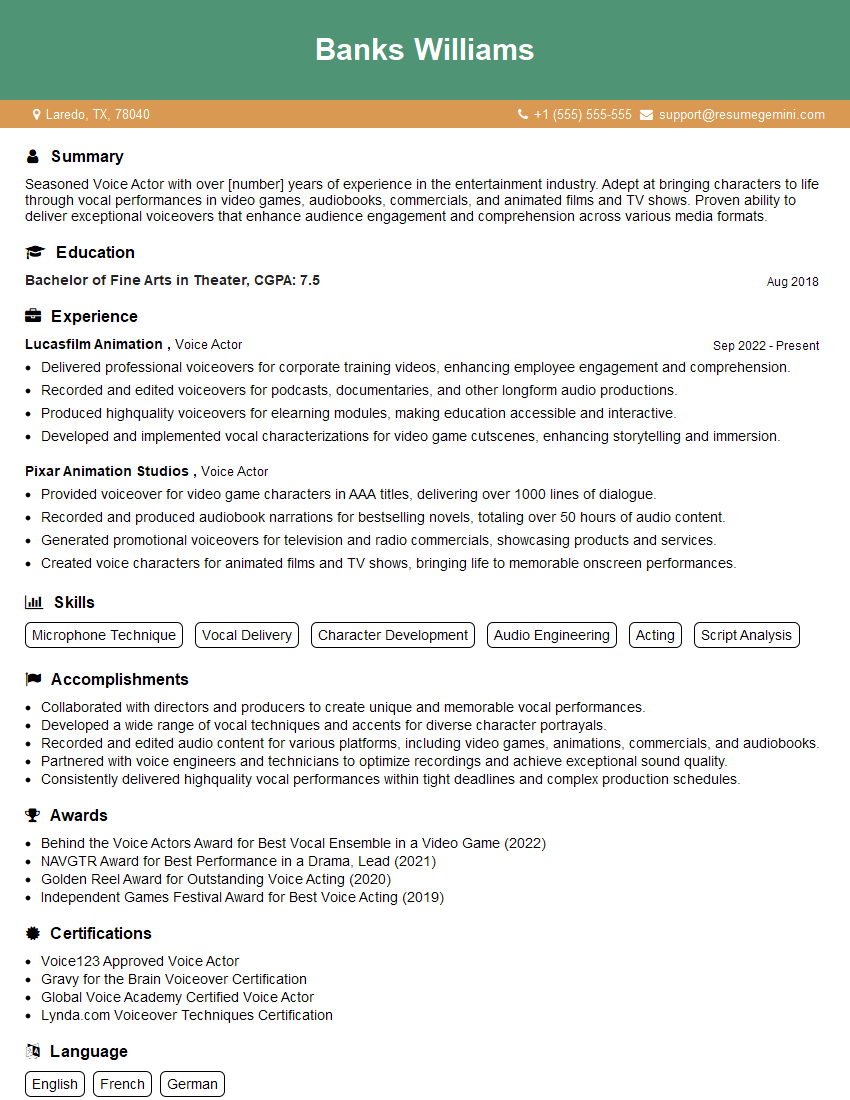
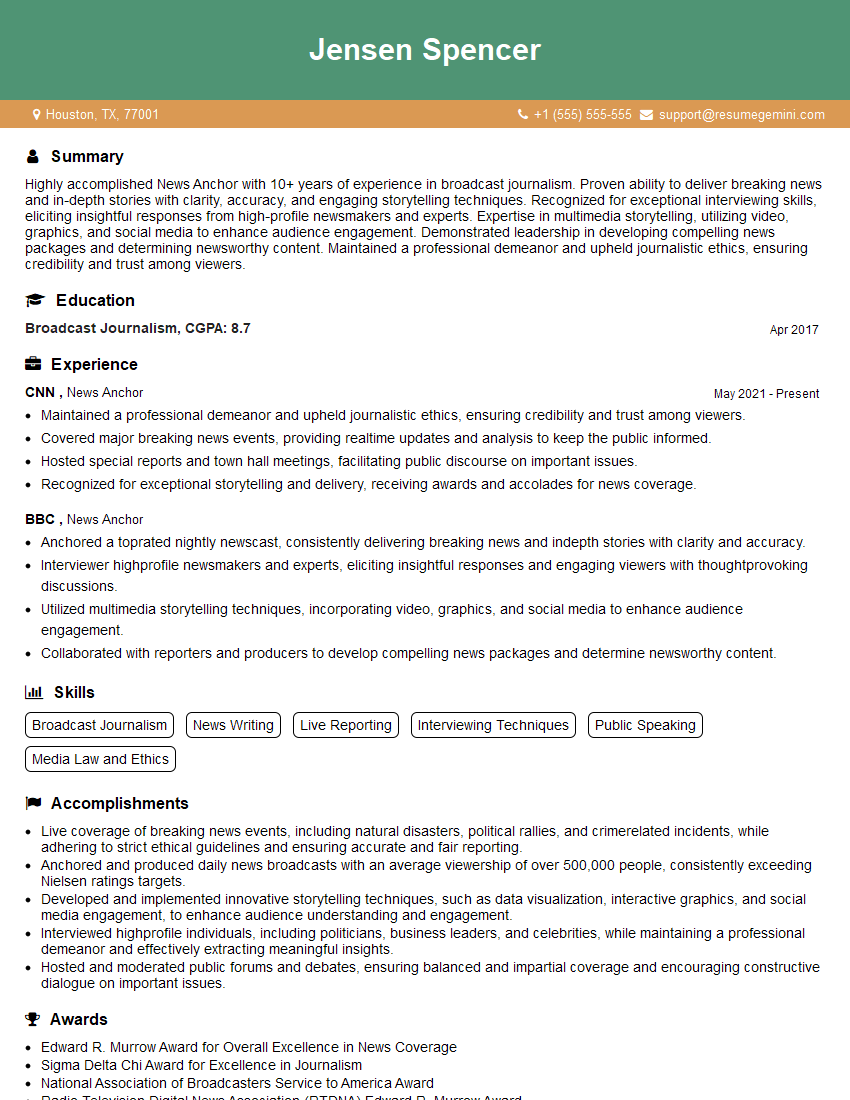
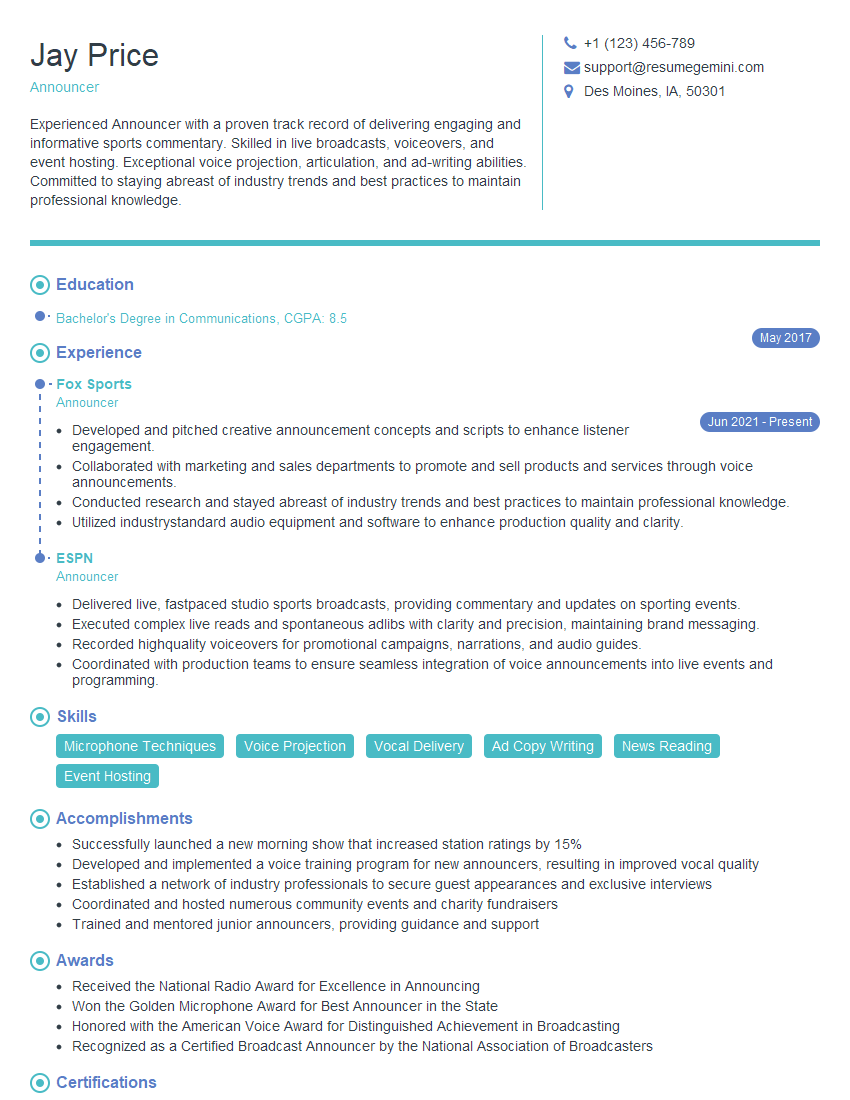
Mastering Voiceover and On-Camera Performance opens doors to diverse and exciting career opportunities, from animation and commercials to corporate videos and documentaries. A strong, ATS-friendly resume is crucial for showcasing your skills and experience to potential employers. To significantly boost your job prospects, we encourage you to leverage the power of ResumeGemini, a trusted resource for creating professional and impactful resumes. ResumeGemini offers resume examples specifically tailored to Voiceover and On-Camera Performance, providing you with valuable templates and guidance. Take advantage of these resources to craft a resume that truly highlights your unique talents and capabilities.

Explore more articles
Users Rating of Our Blogs
Share Your Experience
We value your feedback! Please rate our content and share your thoughts (optional).
What Readers Say About Our Blog
Very informative content, great job.
good