The thought of an interview can be nerve-wracking, but the right preparation can make all the difference. Explore this comprehensive guide to Steel Detailing and Fabrication interview questions and gain the confidence you need to showcase your abilities and secure the role.
Questions Asked in Steel Detailing and Fabrication Interview
Q 1. Explain the process of creating a steel detailing drawing from architectural plans.
Creating steel detailing drawings from architectural plans is a multi-step process that transforms the architect’s vision into fabrication-ready instructions. It begins with a thorough review of the architectural drawings, structural engineering calculations, and specifications. This provides the foundation for understanding the overall building design and the specific requirements for the steel structure.
- Extraction of Relevant Data: We extract critical information such as column locations, beam sizes, connections, and bracing details. This involves careful measurement and interpretation of architectural drawings, ensuring we accurately represent the building’s geometry.
- Modeling in Detailing Software: This extracted data is then input into specialized steel detailing software (like Tekla Structures or AutoCAD). Here, a 3D model of the steel structure is created. This model incorporates precise dimensions, member sizes, and connection types.
- Connection Design & Detailing: This is a crucial step. We detail each connection, specifying bolt sizes, weld types, and other fastening elements according to the engineering specifications and applicable codes. This requires a solid understanding of structural mechanics and connection design best practices.
- Drawing Generation: Once the 3D model is complete and verified, the software generates detailed shop drawings. These drawings include general arrangement drawings, fabrication drawings, and erection drawings. These drawings clearly indicate all dimensions, cuts, welds, bolt holes, and other fabrication requirements. We then review for accuracy and completeness.
- Coordination & Collaboration: Throughout the process, we often collaborate with structural engineers and other disciplines to resolve conflicts and ensure a cohesive design. This often involves reviewing design models and providing feedback for improvements.
Imagine building a Lego castle from an instruction manual. The architectural plans are like a blurry photo of the final castle. Our job is to translate that blurry photo into precise, detailed instructions with each Lego brick precisely placed and every connection securely fastened. We’re not just drawing lines; we’re building a virtual structure, ensuring it’s constructible and efficient.
Q 2. What software are you proficient in for steel detailing (Tekla, AutoCAD, Revit, etc.)?
My proficiency in steel detailing software is extensive. I’m highly experienced with Tekla Structures, considered the industry-leading software for steel detailing. I’m also proficient in AutoCAD, particularly in using its advanced capabilities for 2D drafting and annotation. While I haven’t used Revit extensively for steel detailing, I’m familiar with its capabilities and understand its integration with other BIM (Building Information Modeling) software. My experience allows me to leverage the strengths of each software depending on the project requirements and client preferences. For complex projects, Tekla’s 3D modeling and clash detection capabilities are indispensable, but AutoCAD’s precision for 2D detailing remains crucial.
Q 3. Describe your experience with different steel connection types (e.g., welds, bolts).
I have extensive experience with various steel connection types, including both bolted and welded connections. The choice between them depends on factors like the structural requirements, fabrication capabilities, and cost considerations.
- Bolted Connections: These are versatile and allow for easier adjustments during assembly. Different bolt types (high-strength bolts, shear bolts) and configurations (single shear, double shear) are chosen based on load requirements and design specifications. I’m familiar with different detailing requirements for different bolt types – pre-tensioned vs. slip-critical.
- Welded Connections: These offer higher strength and stiffness in many cases and generally result in simpler detailing. Various weld types (butt welds, fillet welds, groove welds) are specified based on the connection geometry and load transfer mechanism. I have a deep understanding of weld symbols and their accurate representation in drawings, ensuring the fabrication process will produce the correct welds.
For instance, a moment connection in a steel frame might utilize a combination of bolted and welded elements, with high-strength bolts transferring shear and welds transferring moment. Selecting the right connection type involves a detailed analysis and careful consideration of the design and fabrication constraints. I’ve worked on projects with intricate connection designs, always ensuring both the structural integrity and ease of fabrication are optimized.
Q 4. How do you ensure accuracy in your steel detailing work?
Accuracy is paramount in steel detailing. A single error can lead to costly rework, delays, and even structural failure. I employ a multi-layered approach to ensure accuracy.
- Model Checking and Validation: I utilize the software’s built-in checking tools to detect geometric errors, clash detection, and interference issues within the 3D model.
- Dimensional Verification: I meticulously verify all dimensions against the structural design and architectural plans, using independent calculations where necessary. I’ve developed robust spreadsheets and checklists for this purpose.
- Detailing Standards and Codes: I rigidly adhere to relevant standards and codes (AISC, AISC 360, local codes) throughout the detailing process to ensure compliance and structural integrity.
- Peer Review and Quality Control: Our team employs a peer review process to catch errors before drawings are finalized. This cross-checking provides an additional layer of quality assurance.
- Material Takeoff and BOM Verification: Accurate material takeoffs are crucial for cost estimation and procurement. I meticulously check these against the 3D model to ensure everything is accounted for.
Think of it like assembling a complex clock. Each component must be perfectly sized and placed to ensure functionality. My methods are designed to minimize the risk of even small inaccuracies that could disrupt the final, functional steel structure.
Q 5. What are common steel detailing standards and codes (AISC, AISC 360, etc.)?
I’m well-versed in various steel detailing standards and codes. The most prominent include:
- AISC (American Institute of Steel Construction): This is the leading authority on steel construction in North America, and their publications provide the fundamental guidelines for steel design and detailing.
- AISC 360: This specific standard, “Specification for Structural Steel Buildings,” dictates the design criteria for steel structures, informing my detailing practices.
- ASTM (American Society for Testing and Materials): ASTM standards define material properties and testing procedures for steel products, which are critical for choosing suitable materials for the project.
- Local Building Codes: These vary by jurisdiction and must be considered to ensure compliance with local regulations.
Adhering to these standards ensures that the steel structure is safe, durable, and meets the required performance criteria. It’s not just about following rules; it’s about ensuring the safety and stability of the structure. Ignoring these standards could lead to significant consequences.
Q 6. How do you handle revisions and changes during the steel detailing process?
Handling revisions and changes efficiently is a crucial part of the process. It involves a systematic approach to minimize disruptions.
- Revision Tracking: I utilize the software’s version control capabilities to track all changes and revisions. This allows us to easily revert to previous versions if necessary.
- Clear Communication: Open communication with the engineers and the client is key. Changes are communicated promptly and clearly, and their implications are discussed before implementation.
- Impact Assessment: Before implementing changes, I carefully assess their impact on other parts of the design. This often involves model updates and re-checking to ensure the overall design integrity is maintained.
- Updated Drawings: Revised drawings are clearly marked with revision numbers and dates to track modifications. This ensures everyone is working from the latest, accurate version.
- Change Order Management: Formal change order procedures are followed, with appropriate documentation to avoid disputes and maintain a clear record of alterations.
Think of it as updating a software program. You have to carefully manage changes so they don’t break the entire application. Similarly, in steel detailing, we need a structured approach to ensure that changes are implemented accurately and don’t compromise the overall structural integrity of the design.
Q 7. Explain your understanding of shop drawings and their importance.
Shop drawings are detailed fabrication drawings that provide the fabricator with all the necessary information to manufacture the steel components. They are crucial for several reasons.
- Clear Fabrication Instructions: They provide precise dimensions, cut lines, weld details, bolt hole locations, and other essential information, leaving no room for ambiguity.
- Quality Control: They serve as a vital tool for quality control both for the fabricator and the project’s structural engineers.
- Clash Detection: Shop drawings allow for final clash detection to be made prior to fabrication, avoiding costly issues during the construction phase.
- Communication and Coordination: They facilitate communication between the detailer, the fabricator, the erector, and the engineer.
- Legal Protection: They act as a legal record of the agreed-upon design and fabrication details, reducing the risk of disputes or liability claims.
Imagine building a complex puzzle. Shop drawings are like the high-resolution image of the completed puzzle that the builder utilizes as a reference. They transform the general plan into actionable instructions, making fabrication efficient and error-free.
Q 8. Describe your experience with different steel fabrication methods.
My experience encompasses a wide range of steel fabrication methods, from the most traditional to the latest advancements. I’m proficient in various techniques, including:
- Welding: I’m familiar with different welding processes like SMAW (Shielded Metal Arc Welding), GMAW (Gas Metal Arc Welding), and FCAW (Flux-Cored Arc Welding), understanding their applications and limitations for different steel grades and thicknesses. For example, I’ve specified GMAW for thin-gauge stainless steel because of its clean welds and ability to manage heat input effectively.
- Bolting: I’m experienced in designing and detailing bolted connections, understanding the importance of proper bolt sizing, spacing, and edge distances to ensure structural integrity. I’ve worked on projects requiring high-strength bolting for seismic design, ensuring accurate specifications in the drawings.
- Cutting and Shaping: I’ve worked with various cutting methods including plasma cutting, oxy-fuel cutting, and laser cutting, choosing the optimal method depending on material type, required precision, and production volume. Laser cutting, for instance, offers superior accuracy for intricate details in thin sheets.
- Rolling and Bending: I have a thorough understanding of the limitations and tolerances involved in rolling and bending processes, ensuring designs are feasible and account for springback. In one project, precise bending was crucial, so we employed a press brake with advanced CNC control for repeatability and accuracy.
This broad experience enables me to optimize designs for fabrication efficiency, cost-effectiveness, and structural performance.
Q 9. How do you manage large and complex steel detailing projects?
Managing large and complex steel detailing projects requires a systematic and collaborative approach. I utilize a combination of strategies, including:
- Work Breakdown Structure (WBS): I break down the project into smaller, manageable tasks, assigning responsibilities and deadlines to team members. This allows for better tracking of progress and identification of potential bottlenecks.
- BIM (Building Information Modeling) software: Using BIM software, like Tekla Structures or Revit, enables coordinated modeling and clash detection, reducing errors and improving collaboration among various disciplines.
- Effective Communication: Regular meetings, progress reports, and clear communication channels ensure everyone stays informed and aligned with the project goals. This includes proactive communication of any potential issues or delays.
- Quality Control Procedures: Implementing rigorous quality checks at each stage of the process, from modeling to shop drawing production, ensures accuracy and adherence to design specifications. This could include automated checks within the software and manual reviews by experienced detailers.
- Version Control: Using a centralized repository for all project files allows for easy access, tracking of changes, and collaboration among the team. This helps prevent conflicts and ensures everyone is working on the most up-to-date drawings.
For example, in a recent high-rise project, we successfully utilized this approach to manage over 10,000 tons of steel, coordinating with structural engineers, fabricators, and erectors to deliver the project on time and within budget.
Q 10. What is your experience with BIM (Building Information Modeling) in steel detailing?
My experience with BIM in steel detailing is extensive. I’m proficient in using software like Tekla Structures and Revit to create accurate 3D models, generate detailed shop drawings, and manage project information. This allows for better coordination with other disciplines, early clash detection, and improved fabrication efficiency.
For instance, BIM allows us to identify clashes between steel members and MEP (Mechanical, Electrical, and Plumbing) systems early in the design process, saving time and preventing costly rework on-site. The ability to generate accurate quantities directly from the model is also a significant advantage for material take-offs and cost estimations. Moreover, I’ve used BIM to create detailed fabrication models that directly feed into CNC machines, minimizing human error and accelerating the fabrication process.
My experience also includes using BIM for collaborative work-sharing and the creation of 4D (time-based) models for construction sequencing, which enhances project scheduling and management.
Q 11. How do you handle conflicts or discrepancies in design drawings?
Handling conflicts or discrepancies in design drawings requires a systematic and meticulous approach. My process involves:
- Identification: Carefully review all drawings for inconsistencies, discrepancies, or missing information. This often involves cross-referencing different drawings and specifications.
- Documentation: Thoroughly document all identified conflicts and discrepancies. Include detailed descriptions, referencing drawing numbers and specific locations.
- Communication: Immediately communicate the identified conflicts and discrepancies to the design team, requesting clarification and resolution. This usually involves a formal RFI (Request for Information) process.
- Resolution: Once clarification is received, implement the necessary corrections in the detailing model and drawings. Maintain a detailed record of all changes and revisions.
- Verification: After implementing corrections, thoroughly verify the accuracy and consistency of the revised drawings. This includes peer review and internal quality checks.
I prioritize open communication and collaboration to ensure that all issues are resolved efficiently and accurately, avoiding any potential delays or errors during fabrication and construction.
Q 12. Explain your understanding of material take-offs for steel detailing.
Material take-offs are a crucial part of steel detailing, providing accurate quantities of steel members, connections, and other materials required for fabrication. My experience involves utilizing both manual and automated methods:
- Manual Take-Offs: Involves meticulously measuring dimensions from drawings and calculating quantities of each component. While this is more time-consuming, it’s essential for verifying the accuracy of automated take-offs.
- Automated Take-Offs: BIM software significantly automates this process, extracting quantities directly from the 3D model. This reduces errors and significantly speeds up the process. However, careful review is still crucial to ensure accuracy.
- Material Specifications: The take-off must accurately specify the material grade, type, and dimensions of each component, ensuring consistency with project specifications.
- Waste Factor: A waste factor is always included to account for cutting losses, material imperfections, and other potential waste during fabrication.
Accurate material take-offs are essential for cost estimation, material procurement, and efficient fabrication planning. In my experience, discrepancies in take-offs can lead to significant cost overruns and project delays. Therefore, rigorous quality checks are essential at every stage.
Q 13. How do you ensure the accuracy of dimensions and tolerances in your drawings?
Ensuring the accuracy of dimensions and tolerances in drawings is paramount. My approach involves several key steps:
- Precise Modeling: Creating accurate 3D models using BIM software forms the foundation of accurate detailing. This involves employing precise modeling techniques and adhering to the specified tolerances from the beginning.
- Regular Checks and Audits: Regularly check the model and drawings for errors and inconsistencies. This includes utilizing built-in software tools for clash detection and dimensional verification.
- Tolerance Specification: Clearly define tolerances for all dimensions in the drawings, adhering to relevant industry standards and project specifications. This ensures that fabricated components will fit together correctly.
- Dimensional Coordination: Carefully coordinate all dimensions to ensure that there are no clashes or interferences between different components. This is crucial in complex structures.
- Peer Review: Employing a system of peer review allows for independent verification of dimensional accuracy and adherence to tolerances.
For example, in projects with high precision requirements, like those involving prefabricated modular units, we implement stringent quality control measures and perform multiple checks to ensure dimensional accuracy within very tight tolerances, sometimes employing advanced measurement tools.
Q 14. Describe your experience with steel detailing software quality checks.
Steel detailing software offers powerful quality check features that I utilize extensively. These include:
- Clash Detection: Software identifies conflicts between different elements in the model, such as intersections of steel members or conflicts with other building systems.
- Dimensional Checks: Software automatically verifies dimensions and identifies potential discrepancies, such as misaligned elements or incorrect distances.
- Fabrication Rules and Constraints: Many software packages allow the definition of fabrication rules and constraints, preventing the creation of impossible or inefficient designs.
- Material and Connection Checks: Software can check material properties and connection designs against specified requirements and industry standards.
- Automated Reporting: Software generates reports summarizing potential errors and inconsistencies, enabling efficient identification and resolution of problems.
Beyond software checks, I also implement manual quality control procedures, including peer review and independent verification of critical dimensions and details. This multi-layered approach ensures high accuracy and reduces the risk of errors that could lead to fabrication issues or on-site problems.
Q 15. What is your understanding of fabrication tolerances and their impact on the project?
Fabrication tolerances are the permissible variations from the design dimensions of steel components during the manufacturing process. Think of it like baking a cake – you have a recipe (design), but the final product might not be exactly the same size or weight each time. These variations are acceptable within a certain range, defined by standards and specifications like AISC (American Institute of Steel Construction). Exceeding these tolerances can lead to serious problems, including:
- Interference Issues: Components might not fit together properly, causing delays and rework.
- Structural Weakness: Deviations from designed dimensions can compromise the structural integrity of the entire building, potentially leading to safety hazards.
- Cost Overruns: Rework and adjustments due to tolerance issues significantly increase the project cost and timeline.
For example, a slightly oversized beam could prevent it from fitting into a pre-fabricated column. Conversely, an undersized beam could weaken the entire structure. Therefore, strict adherence to fabrication tolerances is crucial for a successful project.
Career Expert Tips:
- Ace those interviews! Prepare effectively by reviewing the Top 50 Most Common Interview Questions on ResumeGemini.
- Navigate your job search with confidence! Explore a wide range of Career Tips on ResumeGemini. Learn about common challenges and recommendations to overcome them.
- Craft the perfect resume! Master the Art of Resume Writing with ResumeGemini’s guide. Showcase your unique qualifications and achievements effectively.
- Don’t miss out on holiday savings! Build your dream resume with ResumeGemini’s ATS optimized templates.
Q 16. How do you prioritize tasks and manage deadlines in a fast-paced environment?
In a fast-paced environment, effective task prioritization is essential. I use a combination of techniques. Firstly, I analyze each task based on its urgency and importance using a prioritization matrix (like Eisenhower Matrix). This helps categorise tasks into ‘Do’, ‘Decide’, ‘Delegate’, and ‘Delete’ categories.
Secondly, I employ project management software to track deadlines, progress, and dependencies between different tasks. This gives me a clear overview of what needs to be done and when. For instance, creating a detailed Gantt chart allows me to visualize the project timeline and identify potential conflicts. Regular review meetings with the team, and open communication with the project manager, ensure that any potential issues or delays are addressed promptly and efficiently. I am proficient in tools like MS Project and Primavera P6. Finally, proactive communication with stakeholders helps manage expectations and prevents last-minute surprises.
Q 17. Explain your experience with different types of steel sections (e.g., I-beams, channels).
My experience encompasses a wide range of steel sections. I’m very familiar with I-beams (wide-flange beams), channels, angles, tees, and hollow structural sections (HSS). I-beams are commonly used for major structural elements due to their high strength-to-weight ratio. Channels are often used in secondary members or bracing systems. Angles find applications in connections and bracing. Tees are versatile elements, sometimes used in smaller beams or support structures. HSS offer superior strength and aesthetics in certain applications.
In my experience, selecting the appropriate section depends on the load-bearing requirements, available space, fabrication constraints, and cost considerations. For example, in a high-rise building, I-beams would be preferred for their ability to support substantial loads, whereas channels might be used in a smaller industrial structure. Understanding the material properties and limitations of each section is critical for successful design and detailing.
Q 18. How do you ensure that your detailing work meets all relevant safety standards?
Ensuring my detailing work meets safety standards is paramount. I meticulously follow relevant codes and standards such as AISC, Eurocode 3, and local building regulations. This includes verifying connection designs, confirming weld sizes and types, and ensuring proper bolt specifications. I regularly consult these codes and standards to stay updated on the latest safety requirements. Furthermore, I utilise detailing software that incorporates these standards, such as Tekla Structures or AutoCAD, which provides built-in checks and warnings for potential safety violations.
A critical step is also conducting thorough checks on my own work and requesting peer reviews to catch any potential oversights. Documentation is another vital aspect; detailed drawings, calculations, and specifications must be clear and easily understood by the fabricators and construction crews. Ultimately, the safety of the structure is my top priority.
Q 19. Describe your experience with working with different types of welds.
I have extensive experience with various weld types, including fillet welds, groove welds (butt welds, V-welds, U-welds), and specialized welds like plug welds and spot welds. Fillet welds are commonly used for connecting plates and members at angles, offering a relatively straightforward and efficient solution. Groove welds are ideal for connecting elements with a full-penetration joint, necessary for high-strength applications. My understanding extends to different welding processes such as Shielded Metal Arc Welding (SMAW), Gas Metal Arc Welding (GMAW), and Gas Tungsten Arc Welding (GTAW), each suited for different material types and thicknesses. I specify the appropriate weld type and process based on the design requirements, material properties, and fabrication capabilities. For example, while fillet welds are suitable for many scenarios, high-strength connections necessitate groove welds with stringent quality control processes.
Q 20. How do you handle a situation where a design error is discovered in the detailing?
Discovering a design error in the detailing is a serious matter. My first step would be to verify the error independently, using various methods to confirm its existence and impact. This includes reviewing original design drawings, calculations, and specifications. Once confirmed, I would immediately notify the design engineer and project manager, providing detailed information about the error and its potential consequences. We’d collaboratively determine the best course of action to correct the error, whether it involves minor revisions or a complete redesign of the affected component. In the event of major revisions, a thorough impact assessment would be necessary to determine the schedule and cost implications. Transparency and clear communication are crucial throughout this process to ensure a timely resolution that prioritizes the safety and structural integrity of the project.
Q 21. Describe your experience with coordinating with other disciplines (e.g., architects, engineers).
Coordination with other disciplines is a fundamental aspect of steel detailing. I have a proven track record of successful collaboration with architects, structural engineers, MEP (Mechanical, Electrical, and Plumbing) engineers, and contractors. Effective communication is key; I utilize BIM (Building Information Modeling) software to share and integrate models with other disciplines, enabling efficient clash detection and coordination. This allows us to identify and resolve conflicts early in the design phase, avoiding costly rework later on. Regular meetings and clear communication protocols ensure everyone is on the same page, adhering to project deadlines and maintaining consistency across all design components. For instance, coordinating with MEP engineers ensures that steel members don’t interfere with ductwork or piping runs. Similarly, coordination with architects ensures that the structural steel design integrates seamlessly with the overall architectural vision of the building.
Q 22. What is your understanding of the different types of bolts used in steel structures?
Understanding bolt types is crucial in steel detailing because the selection impacts structural integrity and construction efficiency. Different bolts serve various purposes, each with specific strength and installation requirements. We primarily use high-strength bolts in steel construction, categorized broadly as:
- ASTM A325 Bolts: These are high-strength, heavy hex structural bolts, often used in ordinary weathering conditions. They offer good tensile strength and are relatively easy to install.
- ASTM A490 Bolts: These offer even higher strength than A325 bolts and are suitable for more demanding applications or harsher environments.
- Bearing-Type Bolts: These bolts rely on the bearing strength between the bolt and the connected members. They are generally less expensive but require precise hole tolerances.
- Tension-Type Bolts (Pretensioned Bolts): These bolts are tightened to a specific tension using calibrated torque wrenches. This creates a clamped connection, resisting both shear and tension. They’re critical for ensuring the structural integrity of connections.
The choice depends on the design load, environmental factors, and cost considerations. For instance, A490 bolts might be selected for a bridge structure subjected to significant wind loads while A325 bolts would suffice for a simpler building frame. Understanding bolt material properties and their specified torque values is paramount.
Q 23. How do you interpret structural engineering calculations and apply them in detailing?
Interpreting structural engineering calculations is the foundation of steel detailing. It involves meticulously reviewing structural drawings, calculations, and specifications to accurately represent the engineer’s design intent. I start by familiarizing myself with the overall design concept and load scenarios. This involves understanding the:
- Member sizes and sections: Identifying the correct I-beams, channels, angles, or plates required.
- Connection types: Understanding the types of welds, bolts, and other fasteners needed based on the engineer’s design.
- Loads and reactions: Analyzing the forces acting on the steel members to ensure the connections are adequately designed to withstand these loads.
- Material specifications: Ensuring that the steel grades and other materials specified are appropriate for the application.
Then, I translate these calculations into detailed shop drawings which precisely detail the dimensions, connections, and fabrication processes for each component. I often use software like Tekla Structures or AutoCAD to create these detailed drawings. A crucial part is performing checks and validating calculations against the initial engineer’s design to prevent any discrepancies.
Q 24. Explain your understanding of the fabrication process for steel structures.
Steel fabrication is a multifaceted process involving several stages. Imagine it as building with giant LEGOs, but each piece needs precise cutting, forming, and joining. The process typically starts with:
- Cutting and Shaping: Steel plates, beams, and other sections are cut to precise dimensions using CNC plasma cutting, laser cutting, or sawing. They’re then formed or bent using press brakes, rollers, or other machinery as per the shop drawings.
- Welding: This is a critical step where the individual components are joined together. Different welding methods like SMAW, GMAW, or FCAW are used depending on the material thickness and design requirements. Inspectors verify weld quality to ensure strength and integrity.
- Drilling and Punching: Holes are created for bolts and other fasteners. This is often done using CNC machines for accuracy and efficiency.
- Surface Treatment: Depending on the project requirements, the fabricated steel may undergo surface treatment like painting, galvanizing (hot-dip or electro-galvanizing) or other coatings for corrosion protection.
- Assembly: Once all components are ready, they are assembled according to the shop drawings. This may involve on-site assembly or pre-assembly in a controlled factory environment.
Quality control at each step is essential to ensure the final structure meets design specifications and safety standards. A thorough understanding of welding codes, quality control procedures, and tolerance allowances is essential for a successful fabrication process.
Q 25. How do you utilize CNC machining data in your detailing workflow?
CNC machining data is invaluable for precise fabrication and efficient detailing. I typically receive this data in DXF, DWG, or other compatible formats. I utilize it in several ways:
- Verification: I import the CNC data into my detailing software (like Tekla Structures) to verify that the dimensions and geometry match the detailed shop drawings. This helps to prevent discrepancies between the design and the actual fabrication.
- Fabrication Process Integration: The CNC data directly guides the cutting and punching operations, ensuring that the components are precisely manufactured according to the design specifications. This minimizes errors and rework.
- Clash Detection: By incorporating the CNC data into a BIM environment, I can check for potential clashes with other building systems, such as HVAC or plumbing, much earlier in the process.
- Reporting and Documentation: The CNC data is part of the fabrication documentation and provides traceability for material usage and fabrication processes.
By effectively incorporating CNC data into my workflow, I can reduce fabrication errors, improve efficiency, and ensure the timely delivery of accurate and high-quality steel components.
Q 26. Describe your experience in resolving clashes between different disciplines in a BIM environment.
Resolving clashes in a BIM environment requires proactive communication and collaboration. I’ve had several instances where my steel detailing clashed with other disciplines, such as MEP (Mechanical, Electrical, and Plumbing) systems or architectural elements. My approach usually involves:
- Regular Coordination Meetings: Attending regular coordination meetings with all disciplines allows early detection and discussion of clashes.
- BIM Software Utilization: Using BIM software with clash detection features helps to identify and visualize conflicts quickly. Software like Navisworks or Revit are invaluable here.
- Collaborative Problem Solving: Once a clash is identified, I work collaboratively with the relevant disciplines to find solutions. This often involves compromises and adjustments to designs to minimize interference.
- Documentation: Thorough documentation of all clash resolutions, including drawings and meeting minutes, is essential to maintain a clear record and avoid future conflicts.
For instance, I once had a clash between a steel column and an HVAC duct. By working with the MEP engineer, we adjusted the duct routing, resulting in a solution that avoided compromising the structural integrity of the steel column and ensured adequate clearance for maintenance.
Q 27. How familiar are you with different types of steel finishes and their applications?
Steel finishes are essential for aesthetics, corrosion protection, and overall structural longevity. The appropriate finish greatly depends on the environment and intended lifespan of the structure. Some common types include:
- Painting: A versatile finish offering a range of colors and levels of protection. The type of paint and number of coats depend on environmental exposure.
- Hot-Dip Galvanizing: This involves dipping the steel into molten zinc, creating a durable protective coating. It’s exceptionally effective against corrosion and is commonly used for outdoor structures or in harsh environments.
- Electro-galvanizing: A more cost-effective alternative to hot-dip galvanizing, providing a thinner zinc coating. Suitable for less aggressive environments.
- Powder Coating: A durable and attractive finish, resistant to chipping and abrasion. It provides good corrosion resistance.
- Zinc-Rich Primers: Applied before other finishes, these primers offer enhanced corrosion protection, particularly in high-humidity areas.
The selection of a particular finish is driven by factors such as budget, environmental considerations, maintenance requirements, and aesthetic preferences. For example, hot-dip galvanizing might be preferred for a bridge in a coastal region while powder coating might be chosen for a building in a less corrosive urban environment.
Q 28. Explain your approach to managing and organizing large datasets in steel detailing projects.
Managing large datasets in steel detailing projects requires a systematic approach. The sheer volume of information involved, including geometric data, material specifications, and fabrication instructions, can easily become overwhelming. My strategies include:
- Database Management: Utilizing well-structured databases within my detailing software (like Tekla Structures) to organize and store data efficiently. This facilitates easy retrieval and analysis of information.
- Cloud Storage: Leveraging cloud storage solutions for large files and project backups to ensure data security and accessibility.
- Version Control: Implementing version control measures to track changes and revisions effectively. This is crucial for collaboration and error correction.
- Data Cleaning: Regularly cleaning and validating data to prevent inconsistencies and errors that can arise from large datasets. This often involves automated checks and verification processes.
- Data Visualization: Using data visualization tools to analyze and interpret trends and potential issues early on in the project. This can help to prevent costly errors down the line.
By adopting these strategies, I can maintain a well-organized, reliable, and efficient workflow for even the most complex steel detailing projects. Regular data backups and a clear file naming convention are additional elements of this crucial process.
Key Topics to Learn for Your Steel Detailing and Fabrication Interview
- Structural Steel Design Principles: Understanding loads, stresses, and the behavior of steel members under various conditions. This includes familiarity with relevant codes and standards (e.g., AISC).
- Detailing Software Proficiency: Demonstrating expertise in commonly used software such as Tekla Structures, AutoCAD, or Revit. Be prepared to discuss your experience with modeling, detailing, and producing fabrication drawings.
- Fabrication Processes: A thorough understanding of cutting, welding, bending, and other fabrication techniques. Be ready to discuss quality control measures and common challenges encountered during fabrication.
- Shop Drawings and Documentation: Understanding the importance of accurate and comprehensive shop drawings, including dimensions, tolerances, and fabrication notes. Highlight your experience in creating clear and concise documentation.
- Material Selection and Properties: Knowledge of different steel grades, their properties, and suitability for specific applications. Be able to discuss factors influencing material choice and their impact on the overall project.
- Connection Design and Analysis: Understanding various connection types (e.g., bolted, welded) and their design considerations. Be prepared to discuss the practical application of these connections in real-world projects.
- Problem-Solving and Troubleshooting: Describe your experience identifying and resolving issues during the detailing or fabrication process. Showcase your ability to think critically and find effective solutions to technical challenges.
- Building Codes and Regulations: Familiarity with relevant building codes and regulations is crucial. Be prepared to discuss how these regulations impact detailing and fabrication practices.
- Teamwork and Communication: Highlight your ability to work effectively in a team environment, collaborate with engineers and fabricators, and communicate technical information clearly and concisely.
- Safety Procedures and Regulations: Demonstrate understanding and adherence to safety protocols in the steel fabrication environment.
Next Steps
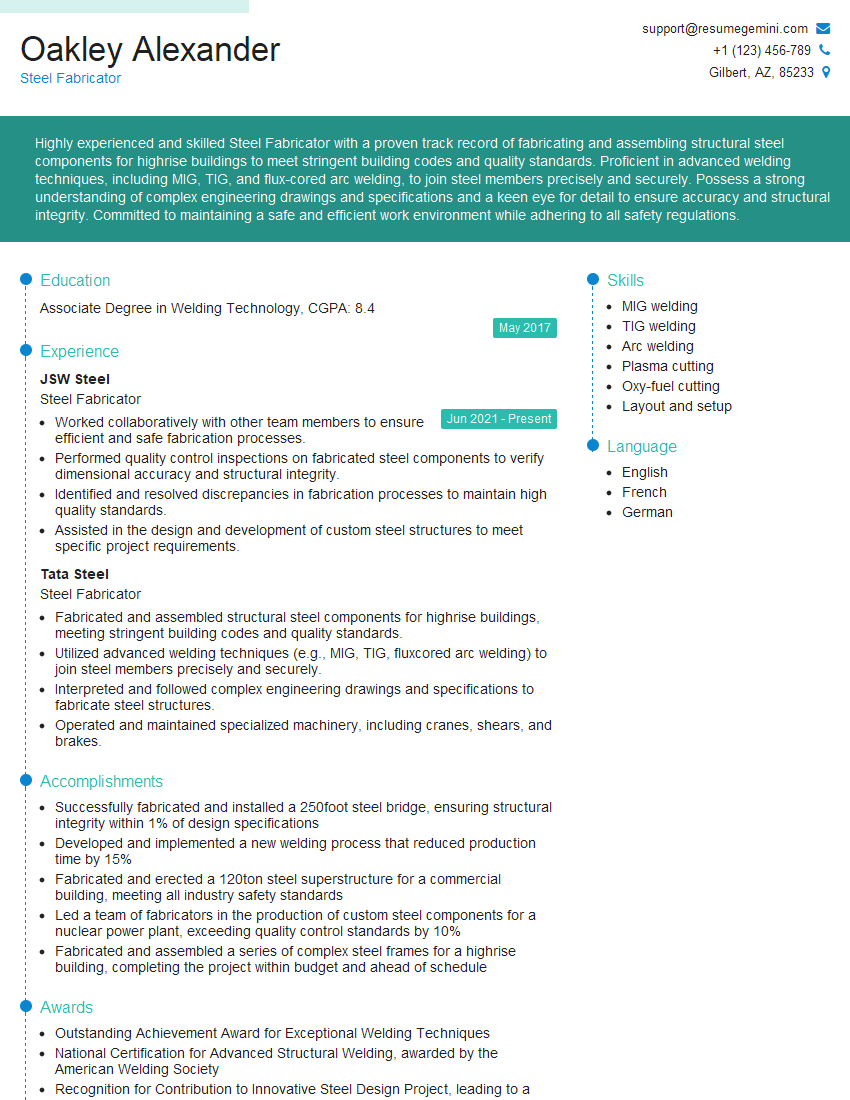
Mastering Steel Detailing and Fabrication opens doors to exciting career advancements, offering opportunities for specialization and leadership within the construction and manufacturing industries. To maximize your job prospects, it’s crucial to present your skills effectively. Creating an ATS-friendly resume is key to ensuring your application gets noticed. ResumeGemini can help you build a powerful, professional resume that showcases your expertise. We provide examples of resumes tailored to Steel Detailing and Fabrication to guide you through the process. Take the next step toward your dream career today!


Explore more articles
Users Rating of Our Blogs
Share Your Experience
We value your feedback! Please rate our content and share your thoughts (optional).
What Readers Say About Our Blog
Very informative content, great job.
good