The thought of an interview can be nerve-wracking, but the right preparation can make all the difference. Explore this comprehensive guide to Flower Identification interview questions and gain the confidence you need to showcase your abilities and secure the role.
Questions Asked in Flower Identification Interview
Q 1. Describe the process of using a dichotomous key for plant identification.
A dichotomous key is a tool used for identifying organisms, including plants. It’s a series of paired statements, or couplets, that lead you through a decision-making process. Each couplet presents two contrasting characteristics; you choose the statement that best describes your specimen and follow the associated number to the next couplet. This continues until you reach a final identification.
Think of it like a choose-your-own-adventure book for plants! For example, a couplet might read: 1a. Leaves opposite; go to 3. 1b. Leaves alternate; go to 7. You’d select the description that matches your plant’s leaf arrangement and proceed accordingly. This process eliminates possibilities until you arrive at the species’ name.
Dichotomous keys require careful observation of the plant’s characteristics. Accuracy in describing these features is crucial for successful identification. They are especially useful for identifying plants in the field where you may lack access to other resources.
Q 2. Explain the significance of floral morphology in plant classification.
Floral morphology, the study of flower structure, is fundamental to plant classification because floral features are often highly conserved within a species and can differ significantly between species. The number, arrangement, and shape of floral parts (sepals, petals, stamens, carpels) are crucial taxonomic characters. For instance, the presence or absence of petals, the number of petals, their fusion or separation, stamen arrangement, and the type of ovary all provide valuable clues for plant identification and classification.
Imagine you’re building a car; the engine, wheels, and steering wheel are essential components that define its function and type. Similarly, the components of a flower are key features that allow botanists to classify plants into different groups. These morphological characteristics aid in understanding evolutionary relationships between plants.
Q 3. Differentiate between monocots and dicots based on floral characteristics.
Monocots and dicots are two major classes of flowering plants distinguished by several characteristics, including their floral structures. While exceptions exist, there are some general differences:
- Number of flower parts: Monocots typically have flower parts in multiples of three (e.g., three petals, six stamens), while dicots usually have flower parts in multiples of four or five (e.g., four petals, eight stamens).
- Fusion of flower parts: In monocots, floral parts are often fused (united), while in dicots they are more likely to be free.
For example, a lily (monocot) often has six petals arranged in two whorls of three, whereas a buttercup (dicot) usually displays five separate petals. These differences, though not always absolute, are valuable distinguishing features.
Q 4. Name five families of flowering plants and list key identifying features for each.
Here are five important flowering plant families with key identifying features:
- Rosaceae (Rose family): Often have five petals, numerous stamens, and a superior ovary (ovary positioned above the other flower parts). Examples include roses, apples, and strawberries.
- Asteraceae (Aster or daisy family): Characterized by composite flower heads, where many small flowers (florets) are clustered together to form a larger, seemingly single flower. Examples include sunflowers, daisies, and dandelions.
- Fabaceae (Legume or pea family): Have irregular flowers with a characteristic banner, wings, and keel petal arrangement; fruits are legumes (pods). Examples include peas, beans, and clover.
- Poaceae (Grass family): Flower parts are reduced and inconspicuous, often wind-pollinated; leaves are long and narrow with parallel venation. Examples include wheat, corn, and bamboo.
- Solanaceae (Nightshade family): Often have radial symmetry, five fused petals forming a bell or trumpet shape, and usually five stamens. Examples include tomatoes, potatoes, and peppers.
Q 5. How do you identify poisonous plants? Explain safety procedures.
Identifying poisonous plants requires extreme caution. Never taste or touch a plant unless you are absolutely certain of its identity. Reliable field guides with detailed descriptions and illustrations are essential. Note that even images can be unreliable without the full context of the surrounding environment and overall plant structure. Focusing on several distinctive characteristics, such as leaf arrangement, flower structure, fruit type, and overall plant habit can help. Consulting multiple sources of information before making an identification is recommended.
Safety Procedures:
- Never ingest any wild plant without expert verification.
- Wear gloves and long sleeves when handling unfamiliar plants to avoid skin contact with potential irritants or toxins.
- Wash your hands thoroughly after handling any wild plants.
- If you suspect poisoning, seek immediate medical attention. Take a sample of the plant (if possible, safely and without further risk) to help with diagnosis.
- Learn to recognize common poisonous plants in your region using reliable resources.
It’s important to be aware that plant toxicity can vary depending on factors like the plant’s age, part of the plant, and the individual’s sensitivity.
Q 6. Describe the different types of inflorescences.
Inflorescences are the arrangements of flowers on a stem that are characteristic to the plant species. They range in complexity from a single flower to elaborate branched structures. Some common types include:
- Raceme: Flowers are arranged along an unbranched, elongated axis, each flower having its own stalk (pedicel).
- Spike: Similar to a raceme, but the flowers lack individual stalks (sessile).
- Panicle: A branched raceme, with multiple smaller racemes arranged along a central axis.
- Umbel: Flowers arise from a common point, like the spokes of an umbrella.
- Head (capitulum): Many small flowers are densely clustered together on a common receptacle, as seen in the Asteraceae family.
- Cyme: The central flower opens first, followed by the lateral flowers.
Understanding inflorescence types is crucial for plant identification as it is a consistent characteristic of a species or genus. For instance, observing a characteristic umbel inflorescence is strongly indicative of the Apiaceae family (carrot family).
Q 7. Explain the importance of understanding plant families for identification.
Understanding plant families is paramount for efficient and accurate plant identification. Plant families group together species sharing common evolutionary ancestry and similar characteristics. Once you can place a plant in a particular family, you significantly narrow down the possibilities for its genus and species identification. Families often share distinctive floral and vegetative characteristics, making it much easier to use a dichotomous key or other identification resources. Knowing the family allows you to predict certain traits, such as flower structure, fruit type, and leaf arrangement, making the identification process much more efficient.
For instance, if you identify a plant as belonging to the Fabaceae (Legume) family, you know to look for characteristic legume fruits (pods), usually irregular flowers, and often alternate compound leaves. This significantly simplifies the identification process and reduces reliance solely on a detailed key that covers a vast number of unrelated plant species.
Q 8. What are the key characteristics used to identify flowering plants?
Flower identification relies on a combination of characteristics, allowing botanists and enthusiasts to pinpoint a plant’s species. These characteristics can be broadly categorized into:
- Floral Morphology: This encompasses the flower’s overall shape, size, and color. Think of the distinct trumpet shape of a daffodil versus the delicate, five-petaled structure of a wild rose. The arrangement of petals (e.g., radial or bilateral symmetry) is crucial.
- Reproductive Structures: Examining the number and arrangement of stamens (male reproductive organs) and pistils (female reproductive organs) is paramount. Are the stamens fused together? Is the pistil superior or inferior (position relative to the other floral parts)? These details often distinguish closely related species.
- Leaf Structure: While not directly part of the flower, leaf shape, arrangement, and texture (e.g., serrated, smooth, hairy) provide valuable clues, often used in conjunction with floral features to confirm identification. Leaf venation patterns also play a significant role.
- Fruit and Seed Characteristics: The type of fruit produced (berry, capsule, achene, etc.) and the characteristics of the seeds are valuable post-flowering identifiers.
- Overall Plant Habit: The plant’s growth form (herb, shrub, tree, vine), height, branching pattern, and presence of hairs or thorns add important context. A sprawling groundcover will obviously be a different species than a tall tree, even if their flowers share some similarities.
By carefully observing these characteristics and cross-referencing them with botanical keys or field guides, accurate identification is achievable. For instance, a flower with four petals, a cruciform arrangement, and silique fruit points towards the Brassicaceae family (mustards, cabbages).
Q 9. How do you use a hand lens effectively for flower identification?
A hand lens, or magnifying glass, is an invaluable tool for close examination of minute floral structures. To use it effectively:
- Proper Lighting: Ensure adequate natural or artificial light. Poor lighting obscures details. Diffuse light is best to avoid harsh shadows.
- Stable Platform: Place the flower on a stable surface, like a flat rock or a field notebook, to minimize movement during observation.
- Gentle Handling: Avoid damaging delicate petals or reproductive structures. Use tweezers if necessary to manipulate parts gently.
- Systematic Examination: Start with a low magnification to get an overview, then increase magnification for detailed study of specific parts such as pollen grains, anther structure, or petal venation. Note the color, texture, and shape of these features meticulously.
- Note Taking: Sketch or photograph details as you go. Memory can be unreliable, so detailed records are crucial.
For example, using a hand lens, you can clearly see the subtle differences in pollen grain shape and surface texture between two similar-looking species, thus enabling accurate identification. A hand lens helps to appreciate the intricate details that are otherwise invisible to the naked eye, making it an essential tool for accurate and effective plant identification.
Q 10. How do environmental factors influence flower morphology?
Environmental factors significantly influence flower morphology, essentially shaping the flower’s form and function. These influences can be:
- Sunlight: Flowers in full sun often have thicker, more pigmented petals to protect against UV radiation. Shade-loving plants may have larger, more delicate flowers adapted for attracting pollinators in lower light conditions.
- Water Availability: Plants in arid environments may have smaller, thicker flowers to conserve moisture. Conversely, those in consistently wet environments might have larger, more delicate flowers.
- Temperature: Extreme temperatures can affect flower size, shape, and flowering time. Flowers in high-altitude or cold environments may be smaller or have adaptations like thicker petals to protect reproductive structures from frost.
- Nutrient Availability: Nutrient-rich soils can lead to larger and more vibrant flowers, while nutrient-poor soils may lead to smaller and less colorful flowers.
- Pollinator Type: The type of pollinator significantly shapes floral morphology. For instance, bird-pollinated flowers tend to be brightly colored and tubular, while bee-pollinated flowers often have landing platforms and nectar guides.
For example, alpine plants, adapted to harsh environments, often develop smaller, denser flowers with thicker petals for protection against strong winds and cold temperatures, unlike their lowland relatives.
Q 11. Explain the differences between complete and incomplete flowers.
The terms “complete” and “incomplete” refer to the presence or absence of specific floral parts. A complete flower contains all four main whorls: sepals (calyx), petals (corolla), stamens (androecium), and pistils (gynoecium). Examples include lilies and roses. An incomplete flower lacks one or more of these whorls. For example:
- Staminate flowers only have stamens (male flowers).
- Pistillate flowers only have pistils (female flowers).
- Flowers lacking petals are described as apetalous.
- Flowers lacking sepals are asepalous.
Many plants have separate male and female flowers on the same plant (monoecious) or on different plants (dioecious), thus exhibiting incomplete flowers. Knowing whether a flower is complete or incomplete is crucial for understanding its reproductive biology and assisting with precise identification.
Q 12. Describe the structure of a typical flower, including its reproductive parts.
A typical flower exhibits a beautiful radial or bilateral symmetry, and its key structural components, working together as a reproductive unit, are:
- Receptacle: The base of the flower, where all other parts attach.
- Sepals (Calyx): Usually green, leaf-like structures forming the outermost whorl, protecting the developing bud. Collectively they are called the calyx.
- Petals (Corolla): Often brightly colored and showy, attracting pollinators. The collective of petals is called the corolla. Petal shape and arrangement are significant identification characteristics.
- Stamens (Androecium): Male reproductive organs, composed of:
- Filament: A slender stalk.
- Anther: A sac-like structure producing pollen.
- Pistils (Gynoecium): Female reproductive organs, composed of:
- Stigma: The receptive surface for pollen.
- Style: The stalk connecting the stigma to the ovary.
- Ovary: The enlarged basal part containing ovules (which develop into seeds after fertilization).
The arrangement of these parts, particularly the position of the ovary relative to other floral parts (superior or inferior), is diagnostic for many plant families. Understanding this structure is fundamental to plant identification and to comprehending pollination biology.
Q 13. What are some common techniques for preserving plant specimens for identification?
Preserving plant specimens for accurate identification requires careful techniques to maintain their integrity and key features. Common methods include:
- Pressing and Drying: This classic method involves placing the specimen between sheets of absorbent paper under pressure for several weeks or months. This flattens the specimen, preserving its shape and color reasonably well. Proper pressing is crucial to avoid distortion.
- Fluid Preservation: Submerging specimens in a preservative solution, such as ethanol or formalin, prevents decomposition. This method preserves the three-dimensional structure of the plant, but the color is often altered. It is ideal for preserving fleshy parts that don’t press well.
- Freeze-drying: This method removes water from the specimen through sublimation, which preserves the structure and color exceptionally well. It’s more expensive and technically demanding than other methods.
- Silicon Gel Drying: This desiccant absorbs moisture rapidly, preserving the plant’s natural color and shape quickly, ideal for delicate flowers.
Proper labeling is essential for all methods. Include details such as date, location, habitat, and collector’s name. High-quality photographs should also be taken before preservation, capturing the specimen’s natural appearance in its environment.
Q 14. How can you distinguish between annuals, biennials, and perennials based on floral characteristics?
The life cycle of a plant determines how its floral characteristics might manifest, offering clues for identification. However, floral characteristics alone may not always be definitive.
- Annuals: Complete their life cycle in one year. They germinate, flower, produce seeds, and die within a single growing season. Their flowers might appear quite profusely once conditions are suitable.
- Biennials: Complete their life cycle in two years. The first year is devoted to vegetative growth, and flowering occurs in the second year, often resulting in a much more abundant display than in their first year. After flowering and seed production, they die.
- Perennials: Live for more than two years, flowering repeatedly over their lifespan. Their flowering behavior can vary considerably, depending on factors like climate and species. Some may flower profusely every year, while others might have less frequent or more sporadic flowering patterns.
While the timing and duration of flowering provide hints, other factors such as plant size, branching pattern, and leaf morphology are equally important. A robust perennial might, in its early years, resemble a biennial in terms of its growth pattern. However, in contrast to a biennial, it will not die after flowering.
Q 15. Describe the challenges of identifying plants in the field.
Identifying plants in the field presents numerous challenges, often stemming from the variability of natural environments and the inherent complexities of plant morphology. Imagine trying to identify a flower based on a blurry photo; it’s difficult!
- Variability in plant morphology: Plants of the same species can exhibit significant variation in size, shape, and color depending on factors like sunlight, soil conditions, and altitude. This can make it challenging to match a field specimen to a reference image or description. For example, a mountain daisy might be smaller and have fewer petals at higher altitudes.
- Incomplete specimens: You might only find parts of a plant, making complete identification impossible. Finding a single leaf without the flower or fruit severely limits your identification possibilities.
- Environmental factors: Weather conditions, such as strong winds or heavy rain, can hinder observation and damage plant structures. A storm might leave a plant partially broken, obscuring important characteristics.
- Hybridisation and variation: Natural hybridization between plant species can create intermediate forms that are difficult to classify using standard field guides. This is a common problem in areas where different plant species co-exist.
- Lack of clear distinguishing features: Some species are remarkably similar to others, making even close examination insufficient for accurate identification. Think of the difficulty distinguishing between different types of mint!
Career Expert Tips:
- Ace those interviews! Prepare effectively by reviewing the Top 50 Most Common Interview Questions on ResumeGemini.
- Navigate your job search with confidence! Explore a wide range of Career Tips on ResumeGemini. Learn about common challenges and recommendations to overcome them.
- Craft the perfect resume! Master the Art of Resume Writing with ResumeGemini’s guide. Showcase your unique qualifications and achievements effectively.
- Don’t miss out on holiday savings! Build your dream resume with ResumeGemini’s ATS optimized templates.
Q 16. How can you use digital resources for plant identification?
Digital resources have revolutionized plant identification. They’ve made identifying plants faster and more accessible, even for novices. Imagine having access to a vast library of plant information at your fingertips!
- Plant identification apps: Apps such as PlantNet and PictureThis use image recognition technology to compare photos of plants with their extensive databases, providing potential identifications and information. You simply take a picture, and the app suggests possibilities.
- Online databases: Websites like the USDA PLANTS Database and the Global Biodiversity Information Facility (GBIF) provide comprehensive information on plant species, including descriptions, distribution maps, and images. These are invaluable research tools for deeper investigations.
- Interactive keys: Online interactive keys allow you to navigate through a series of questions about the plant’s characteristics to narrow down the possibilities and identify the plant. These are particularly useful if you have difficulty finding an image match.
- Digital field guides: Many field guides are now available in digital formats, offering searchable databases and improved image quality compared to printed versions. These are often more portable and easier to update.
Q 17. Explain the process of identifying an unknown plant using online databases.
Identifying an unknown plant using online databases is a systematic process. It’s like solving a botanical puzzle, piecing together information to arrive at the correct answer.
- Gather information: Take detailed notes and photos of the plant, including its leaves (shape, margin, arrangement), stem (texture, branching pattern), flowers (color, shape, number of petals, arrangement), fruits (if present), and overall habitat.
- Select an appropriate database: Choose a database relevant to your geographic location. This will help narrow down the possibilities considerably.
- Use search tools: Use the database’s search functions, filtering by characteristics observed in step 1 (e.g., flower color, leaf shape, habitat). The more features you can describe, the better.
- Compare images and descriptions: Compare the images and descriptions in the database results with your own observations. Look for consistent features across multiple sources to increase confidence.
- Consult multiple sources: Don’t rely on a single identification. Cross-referencing multiple sources verifies the identification, reducing the chance of error.
- Consider geographical location: The plant’s geographical location is crucial; plants are naturally distributed and some are confined to specific regions.
Q 18. How would you approach identifying a plant with atypical morphology?
Identifying a plant with atypical morphology requires a more nuanced approach, calling for careful observation and consideration of potential causes for the unusual features. Imagine finding a plant stressed by drought; it might not look like the textbook version!
- Assess the extent of the atypicality: Determine whether the unusual features are minor variations or significant deviations from the norm for that species.
- Consider environmental factors: Unusual growth can be caused by stressors like drought, nutrient deficiency, disease, or pest infestation. These factors affect morphology.
- Examine similar species: Compare the atypical plant to closely related species to see if it exhibits intermediate characteristics, suggesting hybridization.
- Consult expert sources: If you cannot identify the plant through standard methods, seek help from experienced botanists or plant identification societies. They can provide valuable insights.
- Document your findings: Thoroughly document the unusual features and their context, including photos, location, and any environmental observations. This information can be invaluable to other researchers.
Q 19. What are some common mistakes to avoid when identifying plants?
Several common mistakes can lead to inaccurate plant identification. Avoiding them improves accuracy and builds confidence.
- Relying solely on visual similarities: Many plants appear similar at first glance, but key differences exist in their flowers, fruits, or other characteristics. A superficial visual comparison can lead to errors.
- Ignoring geographical location: A plant’s geographical range significantly narrows down the possibilities; ignoring it broadens the possibilities too much.
- Overlooking details: Failing to pay close attention to minute details, such as leaf venation, flower structure, or fruit type, can lead to misidentification.
- Rushing the process: Plant identification requires patience and careful observation. Rushing will lead to errors.
- Failing to verify identifications: Relying on a single source or quick online search without cross-referencing or seeking expert opinions can be risky. Always verify!
Q 20. How can you distinguish between similar species of flowering plants?
Distinguishing between similar species often requires attention to subtle differences and using multiple identification tools. It is often like finding the differences between identical twins!
- Focus on key characteristics: Compare detailed morphological characteristics, such as flower structure (number of petals, stamen arrangement, pistil shape), leaf shape and arrangement, and fruit type. These minute details often distinguish species.
- Use multiple identification keys: Use several identification keys (printed or online) and compare the results. Each key may focus on different characteristics and approach the problem slightly differently.
- Examine microscopic features: If necessary, use a magnifying glass or microscope to examine subtle details like leaf hairs, pollen grain structure, or other microscopic characteristics.
- Consider geographical distribution: The overlapping geographical ranges of similar species can make identification challenging; it can help to know the specific location.
- Consult expert opinion: If uncertainty remains after exhausting other methods, consult experts in plant taxonomy or local botanical societies for further guidance.
Q 21. Explain the importance of accurate plant identification in conservation efforts.
Accurate plant identification is fundamental to successful conservation efforts. Imagine trying to protect a species without knowing what it looks like!
- Species monitoring: Accurate identification allows for effective monitoring of plant populations, helping assess their health and track changes over time.
- Habitat management: Knowing the specific needs of plant species facilitates appropriate habitat management strategies to protect vulnerable populations.
- Invasive species control: Correct identification is crucial for identifying and controlling invasive plant species that threaten native ecosystems.
- Biodiversity assessment: Accurate plant identification is critical for biodiversity assessments to understand and conserve plant diversity in a region.
- Conservation planning and policy: Data on plant distributions and abundance, derived from accurate identification, informs conservation planning and policy decisions.
Q 22. Describe the role of flower identification in agriculture.
Flower identification plays a crucial role in agriculture, forming the cornerstone of various practices. Accurate identification allows farmers to:
- Select appropriate crops: Identifying compatible plant species for specific soil types and climates ensures optimal growth and yield.
- Implement effective pest and disease management: Recognizing weeds and identifying early signs of plant diseases enables timely intervention, preventing widespread damage and minimizing crop loss. For example, identifying a specific weed helps determine the most effective herbicide.
- Improve pollination strategies: Understanding the flowering patterns and pollinator preferences of different crops is vital for maximizing pollination success. Knowing which flowers attract which pollinators allows for better management of pollinator habitats.
- Enhance breeding programs: Identifying desirable traits in wild relatives of cultivated plants allows breeders to incorporate beneficial characteristics into new crop varieties. For example, identifying a wild relative with drought resistance helps develop more resilient crops.
Essentially, precise flower identification ensures efficient resource utilization and sustainable agricultural practices.
Q 23. How does flower identification contribute to pharmaceutical research?
Flower identification is paramount in pharmaceutical research, as many medicinal compounds originate from plants. Accurate identification ensures:
- Correct species selection: Different species within a genus might have vastly different chemical compositions and medicinal properties. Identifying the precise species is crucial for consistent results in research and drug development.
- Standardized extraction: Once a plant is identified, researchers can establish standardized procedures for extracting active compounds, ensuring consistency and reliability across various batches of raw material. For instance, the extraction process for compounds from Papaver somniferum (opium poppy) requires precise identification to ensure safety and regulatory compliance.
- Drug efficacy and safety assessment: Identifying the plant source is essential for testing its efficacy and potential toxicity. Knowing the plant species and its characteristics enables accurate testing and risk assessment.
- Conservation of plant resources: Proper identification supports the sustainable harvesting of medicinal plants, preventing overexploitation and species extinction.
In short, accurate flower identification is not just vital for research accuracy but also for the ethical and sustainable sourcing of medicinal compounds.
Q 24. Discuss the ethical considerations related to collecting plant specimens for identification.
Ethical considerations in plant specimen collection are crucial for biodiversity conservation. Key aspects include:
- Obtaining necessary permits: Collecting specimens from protected areas or involving endangered species often requires specific permits and approvals from relevant authorities. Failure to do so is illegal.
- Minimizing environmental impact: Collection methods should be non-destructive or minimally invasive, ensuring minimal disruption to the plant population and its ecosystem. This might involve collecting only small samples, avoiding removal of entire plants.
- Respecting private land: Before collecting specimens on private property, obtaining the landowner’s permission is mandatory. This is a matter of basic courtesy and respect.
- Responsible data management: Collected specimens and their associated data should be properly documented, stored, and managed according to established protocols, including sharing information with herbaria and scientific databases for future research. This ensures the data can benefit the wider scientific community.
Ignoring these considerations can have severe consequences, ranging from legal repercussions to irreversible harm to plant populations and ecosystems. Responsible collection is crucial for ethical research.
Q 25. How do you verify the accuracy of your plant identification?
Verifying plant identification accuracy involves a multi-step approach utilizing several techniques:
- Multiple identification keys: I always cross-reference identifications using several botanical keys and field guides to ensure consistency. Different keys employ different characteristics, reducing the chance of error.
- Microscopic examination: In challenging cases, microscopic analysis of pollen, trichomes (plant hairs), and other microscopic features provides crucial details for precise identification. This is particularly useful for cryptic species.
- Comparison with herbarium specimens: Referencing verified specimens in herbaria allows for direct comparison of morphological features, aiding identification accuracy. Herbaria are a treasure trove of information.
- Expert consultation: Consulting with other experienced botanists or taxonomists, especially for complex or ambiguous cases, provides valuable insights and avoids errors. A second pair of eyes can often spot things overlooked.
- DNA barcoding: In cases of high uncertainty, DNA barcoding techniques offer highly accurate species identification using genetic markers. This is a modern, increasingly-used technique.
This rigorous approach ensures high confidence in the accuracy of my plant identifications.
Q 26. Describe your experience using different botanical resources (e.g., field guides, online databases).
My experience with botanical resources is extensive. I regularly use:
- Field guides: I’m proficient with numerous regional and specialized field guides, adapting my choice to the geographical location and plant groups I am studying. For example, when working in the southeastern United States, I rely heavily on specific guides that cover that flora.
- Online databases: I’m familiar with several online botanical databases, including (mention relevant databases without URLs), using them for taxonomic information, image comparisons, and geographic distribution data. These databases are invaluable resources.
- Herbarium collections: I regularly visit herbaria, examining preserved specimens to verify identifications and access historical data. These collections represent centuries of botanical knowledge.
- Specialized literature: I am well-versed in using botanical journals and monographs for in-depth information on specific plant groups or taxonomic revisions. Staying updated on the current literature is critical for accuracy.
Combining these resources significantly enhances my identification capabilities and enables me to approach identification systematically and effectively.
Q 27. Explain a time you encountered a difficult plant identification challenge and how you overcame it.
I once encountered a particularly challenging identification while surveying a remote area. I found a small, unassuming plant with unusual leaf morphology and indistinct flowers. Initial attempts using standard field guides proved inconclusive.
To solve this, I employed a multi-pronged strategy:
- Detailed documentation: I meticulously documented all morphological characteristics, taking numerous photographs from various angles and making detailed sketches of the plant.
- Microscopic analysis: I examined pollen and leaf trichomes under a microscope, revealing unique features not readily visible to the naked eye. This led to preliminary differentiation.
- Herbarium search: I visited the nearest herbarium, comparing my specimens and images to historical collections in their database, narrowing down the possibilities considerably.
- Expert consultation: I contacted a specialist in the relevant plant family, sharing my findings. His expertise and access to more specialized literature helped us positively identify the plant as a rare and previously under-documented species.
This experience emphasized the importance of employing a systematic approach and seeking expert assistance when encountering ambiguous cases. The identification of this rare species highlighted the value of comprehensive documentation and collaboration within the scientific community.
Key Topics to Learn for Flower Identification Interview
- Flower Morphology: Understanding the structure of flowers, including petals, sepals, stamens, pistils, and their variations across different species. This foundational knowledge is crucial for accurate identification.
- Floral Diagrams and Formulas: Learning to interpret floral diagrams and formulas to quickly summarize key characteristics of a flower’s structure. This is essential for efficient identification and comparison.
- Plant Families and Genera: Familiarizing yourself with key plant families (e.g., Rosaceae, Asteraceae, Fabaceae) and their defining floral characteristics. Understanding genera within these families will significantly improve your identification skills.
- Dichotomous Keys: Mastering the use of dichotomous keys for efficient and systematic flower identification. Practice using various keys to build your proficiency.
- Flowering Seasons and Habitats: Understanding the seasonal flowering patterns and typical habitats of different plant species will help narrow down possibilities during identification.
- Practical Application: Developing skills in using field guides, hand lenses, and other tools for accurate identification in diverse environments. Practice your observation and documentation skills.
- Problem-Solving Techniques: Learn how to approach ambiguous or challenging identification situations. Practice analyzing characteristics, comparing similarities and differences between species, and applying your knowledge to resolve uncertainties.
- Geographic Distribution: Understanding the geographic distribution of plant species helps narrow down possibilities when identifying an unknown specimen.
Next Steps
Mastering flower identification is vital for career advancement in fields like botany, horticulture, ecology, and conservation. A strong understanding of plant taxonomy and identification techniques is highly sought after by employers. To significantly increase your chances of landing your dream job, it’s crucial to present your skills effectively. Creating an ATS-friendly resume is key to getting your application noticed. ResumeGemini is a trusted resource to help you build a professional and impactful resume that highlights your expertise. Examples of resumes tailored to Flower Identification are available to guide you through the process. Invest time in crafting a compelling resume – it’s your first impression on potential employers.

Greenhouse Manager Resume Sample

Nursery Manager Resume Sample

Landscape Architect Resume Sample

Environmental Consultant Resume Sample

Arborist Resume Sample
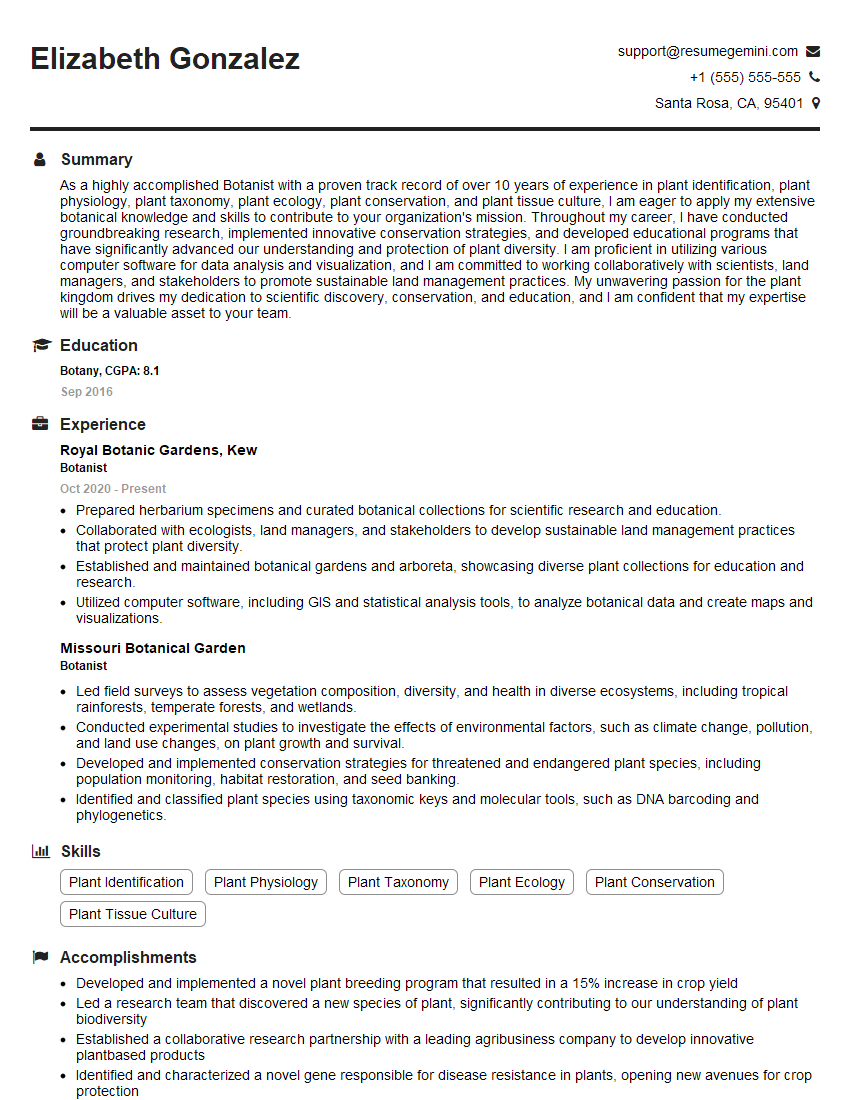
Botanist Resume Sample

Plant Breeder Resume Sample

Plant Pathologist Resume Sample

Ecologist Resume Sample

Plant Taxonomist Resume Sample

Park Ranger Resume Sample

Seed Specialist Resume Sample

Herbarium Curator Resume Sample

Florist Resume Sample
Explore more articles
Users Rating of Our Blogs
Share Your Experience
We value your feedback! Please rate our content and share your thoughts (optional).
What Readers Say About Our Blog
Very informative content, great job.
good