Interviews are more than just a Q&A session—they’re a chance to prove your worth. This blog dives into essential Textile interview questions and expert tips to help you align your answers with what hiring managers are looking for. Start preparing to shine!
Questions Asked in Textile Interview
Q 1. Explain the difference between warp and weft yarns.
Warp and weft yarns are the two fundamental components of woven fabrics. Think of it like building a wall: warp yarns are the vertical threads, providing the foundation, while weft yarns are the horizontal threads that interlace with the warp to create the fabric’s structure. The warp yarns are usually stronger and more evenly spaced than the weft yarns because they endure more tension during the weaving process. Imagine a tightly woven tapestry – the lengthwise yarns (warp) are under considerable tension, holding the entire piece together. The weft yarns, then, are interwoven across, filling in the structure.
- Warp yarns: Run lengthwise in the fabric, providing the foundation. They are often under higher tension during weaving.
- Weft yarns: Run crosswise, interlacing with the warp yarns to create the fabric’s structure. They’re typically less tightly spaced and under less tension.
Understanding the difference is crucial for designing fabrics with specific properties. For example, using stronger warp yarns will result in a fabric with greater strength in the lengthwise direction.
Q 2. Describe the various types of textile fibers (natural and synthetic).
Textile fibers can be broadly classified as natural or synthetic. Natural fibers originate from plants or animals, while synthetic fibers are created artificially.
- Natural Fibers:
- Cellulosic: Derived from plants, including cotton (the most widely used), linen (strong and lustrous), and hemp (durable and environmentally friendly). Each has unique characteristics – cotton is soft and absorbent, linen is crisp and strong, and hemp is known for its resilience.
- Protein: Originate from animals, such as wool (warm and soft, with varying properties depending on the sheep breed), silk (luxurious, smooth, and strong), and cashmere (extremely soft and luxurious).
- Synthetic Fibers: Manufactured from chemicals, including polyester (durable, wrinkle-resistant, and inexpensive), nylon (strong and elastic), acrylic (soft and warm, often used as a wool substitute), and rayon (a semi-synthetic fiber that drapes well). These fibers are created to offer specific properties, such as durability, elasticity, or water resistance.
The choice of fiber depends heavily on the desired properties of the final fabric, the cost considerations, and environmental concerns. For instance, a durable outdoor jacket might utilize polyester for its water resistance, while a soft sweater might use wool for warmth.
Q 3. What are the key properties of different fabric weaves (plain, twill, satin)?
Fabric weaves significantly impact a fabric’s appearance, drape, and durability. The three basic weaves – plain, twill, and satin – differ in how warp and weft yarns interlace.
- Plain Weave: The simplest weave, with warp and weft yarns interlacing alternately over and under one another. It creates a balanced, relatively stable fabric, often exhibiting a crisp, even texture. Think of a simple checkerboard pattern. Examples include cotton sheets and calico.
- Twill Weave: Created by floating the weft yarn over two or more warp yarns before going under one. This creates diagonal lines (wales) on the fabric’s surface. Twill weaves are generally stronger and more durable than plain weaves, with a distinct diagonal texture. Denim is a classic example.
- Satin Weave: Characterized by long floats of warp or weft yarns, resulting in a smooth, lustrous surface with a characteristic sheen. This weave is less durable than twill or plain weave due to the long floats, but it offers a luxurious feel and appearance. Satin sheets are a prime example.
Understanding weave structures is critical for selecting fabrics appropriate for specific applications. For example, a twill weave is suitable for workwear due to its durability, while a satin weave is preferred for evening wear because of its luxurious appearance.
Q 4. Explain the dyeing process and different dyeing methods.
Dyeing is the process of adding color to textile fibers or fabrics. It involves immersing the material in a dye bath containing colorants that penetrate the fibers. The process involves several steps, including pre-treatment (cleaning), dyeing, and post-treatment (rinsing and drying).
- Dyeing Methods:
- Fiber Dyeing: Dyeing the individual fibers before spinning into yarn. This results in the most even color distribution, especially useful for blends.
- Yarn Dyeing: Dyeing the yarn before weaving or knitting. Offers flexibility and allows for variegated color effects.
- Piece Dyeing: Dyeing the entire fabric after weaving or knitting. This is a common method for large-scale production, although achieving even color distribution can be more challenging.
- Garment Dyeing: Dyeing the completed garment. This provides a unique, often vintage-looking finish, but the process is less precise.
The choice of dyeing method depends on factors like fabric type, desired color effect, and cost considerations. For example, piece dyeing is cost-effective for mass production, while garment dyeing is suitable for creating unique, one-of-a-kind items.
Q 5. Describe the finishing processes used to improve fabric properties.
Finishing processes are applied to fabrics to improve their aesthetics, performance, and durability. These processes enhance properties such as softness, wrinkle resistance, water repellency, and dimensional stability.
- Mechanical Finishing: Processes like calendering (pressing to create a smooth surface), shearing (removing fuzzy fibers), and brushing (raising fibers to create softness) affect the fabric’s texture and hand feel.
- Chemical Finishing: Treatments such as mercerization (treating cotton to increase luster and strength), water-repellent finishes (e.g., Teflon), and flame-retardant finishes improve specific functional properties.
- Other Finishes: These include processes such as bleaching (removing natural color), softening (adding agents to improve the fabric’s feel), and anti-static treatments.
A garment’s overall quality and performance are significantly influenced by the finishing processes employed. For example, wrinkle-resistant finishes are crucial for garments requiring minimal ironing, while water-repellent finishes are essential for outdoor clothing.
Q 6. What are the common textile testing methods used for quality control?
Textile testing is crucial for quality control, ensuring products meet specified standards. Various tests are conducted at different stages of production.
- Fiber Testing: Tests determine fiber properties like length, strength, fineness, and maturity.
- Yarn Testing: Evaluates yarn properties like strength, evenness, and count.
- Fabric Testing: Assesses fabric properties such as strength, abrasion resistance, colorfastness, shrinkage, and drape.
- Garment Testing: Measures aspects like dimensional stability, seam strength, and overall garment construction.
Common testing methods include tensile strength tests (measuring fabric’s resistance to pulling), abrasion tests (evaluating fabric’s resistance to wear), and colorfastness tests (assessing color’s resistance to fading).
Q 7. How do you identify fabric defects and their causes?
Identifying fabric defects is a critical aspect of quality control. Defects can arise at any stage of production, from fiber processing to garment construction.
- Visual Inspection: The most common method, where inspectors carefully examine the fabric for imperfections.
- Microscopic Examination: Used to identify minute defects not visible to the naked eye.
- Instrumental Analysis: Employing instruments to measure fabric properties and detect irregularities.
Common fabric defects include holes, broken yarns, slubs (thickened areas in yarn), mispicks (errors in the weaving pattern), and stains. The cause of a defect can vary; it might be due to faulty equipment, improper handling, or poor-quality raw materials. Systematic investigation, often involving tracing the defect back through the production process, is necessary to identify the root cause and prevent recurrence.
Q 8. Explain the concept of fabric drape and its importance.
Fabric drape refers to the way a fabric hangs or falls. It’s essentially the fabric’s inherent ability to mold itself to a three-dimensional form. Think of how a silk scarf gracefully drapes compared to a stiff denim jacket – that’s the difference in drape. It’s a crucial characteristic determined by factors like fiber type, yarn structure, fabric construction (knit or woven), and finishing processes.
The importance of drape is paramount in garment design and manufacturing. The drape directly influences the final look and feel of a garment. A poorly draping fabric can ruin even the best design. For example, a fabric with poor drape might create undesirable wrinkles or cling to the body in an unflattering way. Conversely, a fabric with excellent drape can enhance the silhouette and create a luxurious, flowing effect. Understanding drape allows designers to choose the right fabric for the intended garment style and use, contributing significantly to the overall aesthetic appeal and wearer comfort.
Consider the difference between a flowing evening gown, requiring a fabric with excellent drape like silk charmeuse, and a structured blazer, which needs a fabric with less drape, such as a twill or gabardine. The selection of fabric is entirely dictated by the desired drape and the resulting garment style.
Q 9. Discuss the different types of knitting techniques.
Knitting involves interlocking loops of yarn to create a fabric. Several techniques exist, each producing different fabric characteristics.
- Weft Knitting: This is the most common type, creating a fabric with a distinct ‘right’ and ‘wrong’ side. The yarn loops run horizontally across the width of the fabric. Examples include jersey (used for t-shirts), rib knit (often seen in cuffs and collars), and purl knit (creates a textured surface).
- Warp Knitting: Unlike weft knitting, the yarn loops run vertically, parallel to the length of the fabric. This method often results in more open and sheer fabrics. Examples include tricot (used for lingerie) and raschel (used for lace and decorative fabrics).
- Double Knitting: Creates a double-layered fabric, offering warmth and stability. Each loop is connected to another loop on the other side of the fabric.
- Intarsia and Jacquard Knitting: These advanced techniques are used for creating complex patterns and designs by using multiple yarn colors in a single fabric. They differ primarily in how the color changes are managed; Intarsia switches colours abruptly creating visible colour breaks, while Jacquard is more seamless and uses a programmed system for color changes.
The choice of knitting technique depends on the desired fabric properties like stretch, drape, weight, and texture. Understanding these differences is crucial for selecting the appropriate technique for a specific application.
Q 10. Describe the process of weaving fabric on a loom.
Weaving is a textile manufacturing process where two sets of yarns are interlaced at right angles to produce a fabric. One set is called the warp (lengthwise yarns) and the other the weft (crosswise yarns).
The process begins with the preparation of the warp yarns, which are wound onto a warp beam. These yarns are then threaded through the heddles (devices that raise and lower the yarns) and reed (a comb-like device that spaces the warp yarns). The weft yarn is carried across the warp yarns by a shuttle (in traditional looms) or other mechanisms (in modern looms).
The loom operates by alternately raising and lowering groups of warp yarns, creating a shed (opening) through which the weft yarn is passed. This process is repeated, creating the interlacing pattern that forms the fabric. After the weft yarn is inserted, it is beaten into place by the reed, compressing the fabric.
Different weaving techniques exist, leading to various fabric structures like plain weave (simple over-under pattern), twill weave (diagonal lines), satin weave (smooth, lustrous surface), and many more. The final fabric’s properties such as strength, texture, and drape depend on the weaving technique and the types of yarn used. Modern looms are highly automated, using sophisticated computer controls to manage the entire process.
Q 11. What are the different types of textile printing methods?
Textile printing involves applying designs and colors to fabrics. Many methods exist, each with its strengths and weaknesses.
- Screen Printing: Uses stencils to apply ink to the fabric. It’s versatile, cost-effective for large runs, and allows for bold designs.
- Rotary Screen Printing: A more efficient, high-speed version of screen printing, ideal for large-scale production.
- Digital Printing: Uses inkjet technology to print directly onto the fabric. It offers high precision, detailed designs, and low minimum order quantities, making it suitable for custom designs and smaller runs.
- Block Printing: A traditional method where hand-carved wooden blocks are used to apply ink to the fabric. Labor-intensive but produces unique, handcrafted designs.
- Roller Printing: Uses engraved rollers to apply ink to the fabric. This is also suitable for large scale printing and repetitive patterns.
The choice of printing method depends on factors like design complexity, production volume, budget, and desired fabric properties.
Q 12. Explain the importance of colorfastness in textiles.
Colorfastness refers to a fabric’s ability to retain its color when exposed to various conditions like washing, sunlight, rubbing, and perspiration. It’s a critical aspect of textile quality and consumer satisfaction. A fabric with poor colorfastness will fade, bleed (lose color in water), or crock (transfer color to other surfaces), rendering the garment unattractive and reducing its lifespan.
The importance of colorfastness is multifaceted. For manufacturers, it affects product quality and brand reputation. For consumers, it impacts the garment’s longevity and aesthetic appeal. Poor colorfastness can lead to customer complaints, returns, and brand damage. Therefore, rigorous testing procedures are in place to assess colorfastness, ensuring that textiles meet industry standards and customer expectations.
For example, a brightly colored t-shirt that fades significantly after the first wash is a clear indication of poor colorfastness and reflects badly on the brand. Colorfastness testing involves standard procedures using various chemicals and exposure to light, ensuring the dye adheres to the fabric properly.
Q 13. How do you manage textile waste and promote sustainability?
Managing textile waste and promoting sustainability is crucial for environmental responsibility and economic viability. The textile industry is a major contributor to pollution and landfill waste.
Strategies for managing textile waste and promoting sustainability include:
- Recycling: Repurposing textile scraps into new products or using them as insulation materials.
- Upcycling: Transforming old garments into new, higher-value items.
- Reducing consumption: Encouraging the production of durable, long-lasting garments and promoting conscious consumerism.
- Improving production processes: Adopting water-saving technologies, using eco-friendly dyes, and minimizing energy consumption in manufacturing.
- Implementing closed-loop systems: Designing products with end-of-life recycling in mind, allowing materials to be recovered and reused.
- Promoting awareness and education: Educating consumers on the importance of sustainable textile practices.
By implementing these strategies, the textile industry can significantly reduce its environmental impact and contribute to a more sustainable future. My personal experience involves advocating for and working towards using recycled materials and promoting the upcycling of textile waste at various levels, from production planning to the consumer level.
Q 14. Describe your experience with textile CAD software.
I have extensive experience using various textile CAD (Computer-Aided Design) software packages, including but not limited to Optitex, Lectra Modaris, and Gerber Accumark. My proficiency extends beyond basic functionalities to encompass advanced features such as 3D garment simulation, pattern grading, marker making, and production planning.
In previous roles, I’ve used CAD software to:
- Design and develop garment patterns: Creating and modifying patterns using digital tools, streamlining the design process and improving accuracy.
- Simulate fabric drape and fit: Predicting how a garment will drape on a 3D avatar before physical production, minimizing costly errors.
- Create efficient marker plans: Optimizing fabric usage to reduce waste and improve production efficiency.
- Collaborate with teams: Sharing design files and facilitating seamless communication across the design and manufacturing process.
My experience with CAD software has significantly improved efficiency, accuracy, and collaboration within design and production teams. For instance, in one project, the use of 3D simulation software helped identify a fit issue in a design, saving significant time and cost compared to discovering the issue only during the sampling stage.
Q 15. Explain your understanding of textile supply chains.
Textile supply chains are complex networks involving numerous stages, from raw material sourcing to finished product delivery. Think of it like a relay race: each participant needs to perform their task flawlessly for the final product to succeed.
- Raw Material Sourcing: This begins with cultivating or extracting raw materials like cotton, wool, silk, or synthetic fibers.
- Spinning: Raw fibers are spun into yarns, a process that determines the yarn’s strength, texture, and overall quality. This can involve ring spinning, open-end spinning, or other advanced techniques.
- Weaving or Knitting: Yarns are then transformed into fabrics through weaving (interlacing yarns at right angles) or knitting (interlooping yarns).
- Fabric Finishing: Fabrics undergo various treatments like bleaching, dyeing, printing, and coating to enhance their appearance, feel, and performance.
- Garment Manufacturing: Fabrics are cut and sewn into garments, which may involve numerous steps depending on the garment’s complexity.
- Distribution and Retail: Finished garments are then distributed through various channels, reaching wholesalers, retailers, and ultimately, consumers.
Understanding each stage and its potential bottlenecks is crucial for efficient management of the entire supply chain. For example, a delay in dyeing could impact the entire production schedule.
Career Expert Tips:
- Ace those interviews! Prepare effectively by reviewing the Top 50 Most Common Interview Questions on ResumeGemini.
- Navigate your job search with confidence! Explore a wide range of Career Tips on ResumeGemini. Learn about common challenges and recommendations to overcome them.
- Craft the perfect resume! Master the Art of Resume Writing with ResumeGemini’s guide. Showcase your unique qualifications and achievements effectively.
- Don’t miss out on holiday savings! Build your dream resume with ResumeGemini’s ATS optimized templates.
Q 16. How do you handle production delays or quality issues?
Production delays and quality issues are inevitable in textile manufacturing. My approach focuses on proactive prevention and reactive problem-solving.
- Proactive Measures: This involves careful planning, utilizing robust quality control measures at each stage of production, maintaining strong relationships with suppliers, and having contingency plans in place. For example, having multiple sourcing options for raw materials minimizes the risk of delays due to supplier issues.
- Reactive Measures: When issues arise, I employ a structured approach:
- Identify the root cause: Thorough investigation is critical to pinpointing the problem, whether it’s a machinery malfunction, raw material defect, or human error.
- Implement corrective actions: This might involve repairing machinery, replacing faulty materials, retraining personnel, or adjusting processes.
- Implement preventative measures: Once the problem is solved, I work to prevent its recurrence by implementing changes to processes or training.
- Communicate effectively: Keeping stakeholders informed throughout the process is essential, particularly with clients who might need revised delivery dates.
In one instance, a delay in dye delivery threatened a major order. By quickly identifying an alternative supplier and negotiating expedited shipping, we minimized the delay’s impact, successfully meeting the deadline and maintaining client satisfaction.
Q 17. What are your experiences with different types of textile machinery?
My experience encompasses a wide range of textile machinery, from traditional to advanced technologies.
- Spinning Machinery: I’m proficient with ring spinning machines, open-end spinning machines, and air-jet spinning machines, understanding their capabilities and limitations in producing different yarn types.
- Weaving Machinery: I have hands-on experience with various weaving machines, including rapier looms, air-jet looms, and projectile looms. This experience helps me choose the optimal machine for specific fabric structures and production requirements.
- Knitting Machinery: I’m familiar with both circular and flat knitting machines, understanding their applications in producing various knitted fabrics.
- Finishing Machinery: My expertise includes dyeing machines, printing machines, and various finishing equipment such as calenders and stenters. I understand the intricacies of various finishing processes and their effects on the fabric’s properties.
This diverse experience allows me to optimize production processes, choose appropriate machinery, and effectively troubleshoot equipment-related problems.
Q 18. How do you stay updated with the latest trends in the textile industry?
Staying updated in the dynamic textile industry is crucial. I employ several strategies:
- Industry Publications and Journals: I regularly read trade publications and journals like Textile World, Textile Today, and other specialized publications to stay informed about new technologies, trends, and market analysis.
- Industry Conferences and Trade Shows: Attending industry events allows me to network with peers, learn about the latest innovations, and gain insights from leading experts.
- Online Resources: I actively follow industry blogs, websites, and social media platforms to stay abreast of the latest news and developments.
- Professional Networks: Being part of professional organizations like the American Society for Testing and Materials (ASTM) and other relevant groups provides access to valuable resources and networking opportunities.
Furthermore, I actively seek out continuing education opportunities to enhance my knowledge base and keep my skills sharp.
Q 19. Describe your experience working with different types of fabric finishes.
My experience encompasses a broad spectrum of fabric finishes, each impacting the fabric’s properties differently.
- Dyeing: I have experience with various dyeing techniques, including reactive dyeing, vat dyeing, and disperse dyeing, understanding how different dyes interact with various fiber types.
- Printing: I’m proficient in various printing techniques, such as rotary printing, screen printing, and digital printing, each offering unique advantages in terms of design complexity and production scale.
- Finishing Treatments: I have hands-on experience with various treatments such as mercerization (for improved luster and strength in cotton), resin finishing (for wrinkle resistance), and water-repellent finishes (for improved water resistance).
- Coating: I’m familiar with different coating techniques to enhance properties like water resistance or flame retardancy.
Understanding the interplay between different finishes and their impact on the final product is crucial for producing high-quality, durable textiles. For example, choosing the wrong dye for a specific fiber type can lead to poor color fastness and affect the garment’s longevity.
Q 20. Explain the importance of understanding fabric composition in garment construction.
Understanding fabric composition is paramount in garment construction for several reasons:
- Drapability and Shaping: Different fiber types and blends exhibit varying degrees of drape and stiffness. Knowing the composition allows for appropriate pattern adjustments and construction techniques to achieve the desired garment shape.
- Sewability: Certain fabrics are more challenging to sew than others. Understanding fiber properties (e.g., strength, elasticity, thickness) helps in selecting appropriate needles, stitch types, and sewing speeds to avoid issues such as needle breakage or fabric damage.
- Shrinkage and Elasticity: Fabric composition significantly impacts shrinkage and elasticity. Pre-shrinking fabrics and using appropriate seam allowances are crucial to prevent distortion and maintain the garment’s shape after washing.
- Durability and Care: Fabric composition dictates the garment’s durability, wash instructions, and overall care. Understanding these factors is essential for providing accurate care instructions to the consumer.
For instance, working with a silk garment requires different techniques and precautions compared to working with a cotton garment because of the inherent differences in their fiber properties and sensitivities.
Q 21. How would you troubleshoot a problem with fabric shrinkage?
Troubleshooting fabric shrinkage involves a systematic approach:
- Identify the type of shrinkage: Is it lengthwise, widthwise, or both? This helps determine the root cause.
- Determine the fiber content: Different fibers have different shrinkage tendencies. Wool and cotton are prone to shrinkage, while synthetics generally exhibit less shrinkage.
- Investigate the finishing processes: Improper finishing processes can lead to excessive shrinkage. Review the process parameters, such as temperature and time, to identify any deviations from optimal settings.
- Analyze the washing conditions: High temperatures and harsh detergents can cause excessive shrinkage. Evaluate the washing parameters used.
- Check for pre-treatment: Were appropriate pre-treatment procedures performed before finishing or construction?
- Test for residual chemicals: Residual sizing or finishing chemicals can sometimes cause unexpected shrinkage.
If the problem is related to finishing, adjustments in the process, such as modifying the temperature or time, might be necessary. If it’s due to fabric construction, using pre-shrunk fabric or implementing additional preventative measures in the construction process might be the solution. In cases of unknown origin, laboratory testing might be required to fully diagnose and address the cause.
Q 22. Describe your experience with different fabric weight measurements and their applications.
Fabric weight is crucial in textile production, determining drape, durability, and end-use. It’s typically measured in grams per square meter (gsm) or ounces per square yard (osy). Lighter fabrics (e.g., 100-150 gsm) are suitable for garments like blouses and summer dresses, offering breathability and drape. Medium-weight fabrics (e.g., 150-250 gsm) are versatile, used in shirts, trousers, and lightweight jackets. Heavier fabrics (e.g., above 250 gsm) are used for coats, upholstery, and durable items needing warmth and strength. I’ve worked extensively with these measurements, ensuring the right weight is selected for each project. For example, a client needed a lightweight lining for a coat; we chose a 120 gsm charmeuse silk which provided the desired drape and reduced the overall garment weight.
In my previous role, I oversaw the selection of a 300 gsm canvas for a high-end handbag line, prioritizing durability and a luxurious feel. Precise weight control is vital; even small variations can impact the final product’s quality and customer satisfaction. My experience includes using various testing equipment to ensure consistent weight throughout the production process, preventing costly rework and delays.
Q 23. What are the different types of fabric structures and how do they affect the fabric properties?
Fabric structures significantly influence textile properties. The most common include:
- Plain weave: Simple over-under interlacing of warp and weft yarns, resulting in a basic, durable fabric (e.g., cotton shirting).
- Twill weave: Diagonal lines created by floating warp or weft yarns, offering strength and texture (e.g., denim).
- Satin weave: Long floats of warp or weft yarns creating a smooth, lustrous surface (e.g., satin bedding).
- Knit structures: Interlooping of yarns creating flexible, stretchy fabrics (e.g., jersey t-shirts). This includes various types like single jersey, double jersey, interlock, etc., each with unique properties.
- Non-woven structures: Fibers bonded together mechanically or chemically, creating fabrics with varied properties (e.g., felt, geotextiles). These often have unique applications like disposable medical gowns or filtration materials.
For instance, a twill weave’s diagonal pattern makes it stronger than a plain weave, leading to its use in durable materials like denim. The smooth, lustrous face of a satin weave provides a luxurious feel, ideal for garments and bedding. The elasticity of a knit structure makes it suitable for clothing requiring flexibility and comfort.
Q 24. Discuss the impact of different fiber blends on textile performance.
Fiber blends combine the advantages of different fibers to achieve desired textile performance. For example, blending cotton with polyester improves durability and wrinkle resistance, while a blend of wool and silk offers warmth and luxurious softness. The ratio of fibers influences the final properties. A higher percentage of cotton in a cotton-polyester blend will result in a softer, more breathable fabric, but it might wrinkle more easily. Conversely, a higher polyester percentage enhances durability and wrinkle resistance but reduces breathability.
In my experience, I’ve seen how different blends address specific needs. For example, a performance sportswear line might use a blend of polyester and elastane for its excellent moisture-wicking, stretch, and durability properties, while a luxurious scarf might be made from a silk and cashmere blend to provide exceptional softness and warmth. Understanding the individual fiber properties and their interaction in a blend is crucial for successful fabric development.
Q 25. How do you ensure consistency in textile production?
Consistency in textile production is paramount. We achieve this through a multi-pronged approach:
- Strict quality control at every stage: From raw material inspection to finished goods, rigorous testing ensures quality standards are met. This includes checking fiber length, yarn count, fabric weight, and color consistency.
- Standardized processes and machinery: Precisely calibrated equipment and documented procedures minimize variations in production. Regular maintenance of machines is crucial.
- Skilled workforce: Well-trained operators understand quality standards and follow procedures diligently. This includes ongoing training and feedback mechanisms.
- Statistical Process Control (SPC): Data analysis helps identify trends and variations, allowing for timely adjustments to maintain consistency. This often involves using control charts to track key quality parameters.
- Regular audits and inspections: Internal and external audits ensure compliance with standards and identify areas for improvement.
This comprehensive system minimizes defects and ensures that the final product meets the desired specifications. In my previous role, implementing a new SPC system resulted in a 15% reduction in production defects.
Q 26. Describe your experience with textile costing and budgeting.
Textile costing and budgeting requires a detailed understanding of all production costs, including raw materials, labor, overhead, and marketing. I’ve extensive experience developing accurate cost estimates based on various factors, including fabric type, quantity, design complexity, and production methods. I utilize costing methodologies like activity-based costing (ABC) to accurately allocate costs to different products and processes.
Budgeting involves forecasting sales, production volume, and expenses. This is often done using historical data and market analysis. I’ve worked on multiple projects where I developed detailed budgets, tracked expenses, and managed variances to ensure projects remained within allocated funds. For example, I managed a project budget of $500,000 for a high-end fashion collection, achieving cost savings through efficient sourcing and lean manufacturing techniques.
Q 27. How do you manage relationships with suppliers and clients in the textile industry?
Managing relationships with suppliers and clients is critical in the textile industry. I build strong relationships based on trust, transparency, and mutual respect. For suppliers, this involves open communication, fair negotiation, and consistent quality control. I ensure timely payments and work collaboratively to resolve issues. For clients, I provide excellent service, clear communication, and meet project deadlines. Regular feedback sessions and thorough documentation help ensure everyone is on the same page.
Strong supplier relationships ensure a reliable supply of high-quality raw materials at competitive prices. For example, by cultivating a long-term relationship with a key supplier, I was able to secure preferential pricing and priority access to materials, ensuring timely delivery even during high demand periods. With clients, building trust is achieved through demonstrating competence and professionalism. Active listening, responsiveness, and proactive communication build confidence in my expertise and reliability.
Q 28. What are your salary expectations for this role?
My salary expectations for this role are in the range of [Insert Salary Range] annually. This is based on my experience, skills, and the responsibilities associated with this position. I am open to discussing this further and am confident that my contributions will provide significant value to your organization. I am flexible and willing to negotiate based on the overall compensation package.
Key Topics to Learn for Textile Interview
- Fiber Science: Understanding natural and synthetic fibers, their properties (strength, elasticity, durability), and processing methods. Practical application: Analyzing the suitability of different fibers for specific textile products.
- Yarn Manufacturing: Familiarize yourself with spinning techniques (ring spinning, open-end spinning, air-jet spinning), yarn structures, and their impact on fabric properties. Practical application: Evaluating yarn quality and selecting appropriate yarns for desired fabric characteristics.
- Fabric Construction: Master the different weaving and knitting techniques, understanding their advantages and disadvantages. Practical application: Identifying fabric defects and recommending solutions based on construction methods.
- Textile Finishing: Learn about dyeing, printing, and other finishing processes that enhance fabric aesthetics and performance. Practical application: Understanding colorfastness, wrinkle resistance, and other functional finishes.
- Textile Testing and Quality Control: Grasp the importance of quality control throughout the textile production process and common testing methods. Practical application: Analyzing test results to identify areas for improvement and ensure product quality.
- Textile Design and Trends: Stay updated on current trends and design principles in the textile industry. Practical application: Proposing innovative designs and materials for new product development.
- Sustainability and Eco-Friendly Practices: Understand the environmental impact of textile production and explore sustainable alternatives. Practical application: Identifying and implementing eco-friendly processes in textile manufacturing.
- Supply Chain Management: Familiarize yourself with the global textile supply chain, from raw material sourcing to finished product distribution. Practical application: Optimizing supply chain efficiency and minimizing costs.
Next Steps
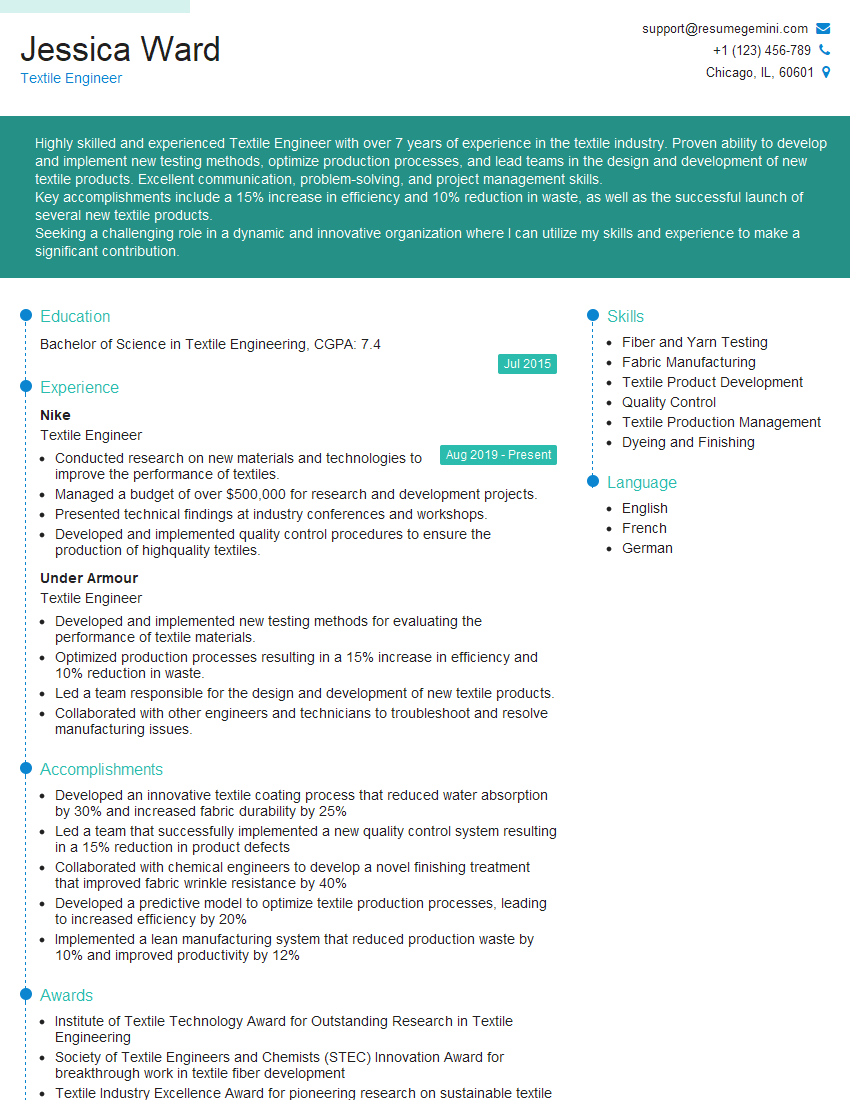
Mastering the intricacies of the textile industry opens doors to exciting career opportunities and significant professional growth. A strong understanding of these key areas will significantly enhance your interview performance and position you for success. To further boost your job prospects, creating an ATS-friendly resume is crucial. ResumeGemini is a trusted resource to help you build a professional and effective resume that will catch the eye of recruiters. Examples of resumes tailored to the Textile industry are available to help you craft the perfect application.






Explore more articles
Users Rating of Our Blogs
Share Your Experience
We value your feedback! Please rate our content and share your thoughts (optional).
What Readers Say About Our Blog
Very informative content, great job.
good