Unlock your full potential by mastering the most common Material Tension Analysis interview questions. This blog offers a deep dive into the critical topics, ensuring you’re not only prepared to answer but to excel. With these insights, you’ll approach your interview with clarity and confidence.
Questions Asked in Material Tension Analysis Interview
Q 1. Explain the difference between tensile stress and tensile strain.
Tensile stress and tensile strain are fundamental concepts in material science that describe a material’s response to being pulled apart. Think of stretching a rubber band: Tensile stress is the force applied to the rubber band per unit area, essentially how much force is being exerted on each tiny piece of the rubber. It’s calculated as force (F) divided by the cross-sectional area (A): σ = F/A. The units are typically Pascals (Pa) or pounds per square inch (psi).
Tensile strain, on the other hand, is the measure of how much the rubber band stretches relative to its original length. It’s the change in length (ΔL) divided by the original length (L0): ε = ΔL/L0. Strain is dimensionless, often expressed as a percentage.
In essence, stress is the cause (the force applied), and strain is the effect (the resulting deformation).
Q 2. Describe Hooke’s Law and its limitations in material tension analysis.
Hooke’s Law is a fundamental principle stating that the stress applied to a material is directly proportional to the resulting strain, within the elastic region. This means that if you double the force, you double the stretch (within limits). Mathematically, it’s represented as: σ = Eε, where ‘E’ is the Young’s modulus or elastic modulus (a material property).
Imagine a spring: stretching it slightly will cause it to return to its original shape once released. This is elastic behavior. However, Hooke’s Law has limitations:
- It only applies within the elastic region: Beyond a certain point (the yield strength), the material starts to deform permanently. Think of stretching the rubber band too far – it won’t snap back to its original length.
- It doesn’t account for all materials: Some materials exhibit non-linear elastic behavior, meaning the stress-strain relationship isn’t perfectly linear.
- It neglects time-dependent effects: Some materials show creep (slow deformation under constant stress) or stress relaxation (decrease in stress under constant strain), which are not captured by Hooke’s Law.
In practical applications, understanding these limitations is crucial. Designing structures based solely on Hooke’s Law without considering the yield strength or potential for creep could lead to catastrophic failures.
Q 3. What is the yield strength of a material, and how is it determined?
Yield strength is the stress at which a material begins to deform plastically; that is, it starts to deform permanently and won’t return to its original shape once the load is removed. It marks the transition from elastic to plastic behavior.
It’s determined experimentally through a tensile test. A specimen is subjected to a controlled tensile load, and the stress and strain are recorded. The yield strength is often defined as the stress corresponding to a specific offset strain (e.g., 0.2% offset yield strength), which helps account for the slight curvature at the onset of yielding.
Imagine bending a paperclip: initially, you can bend it and it springs back. But once you pass the yield strength, the paperclip bends permanently and stays bent. The yield strength is a critical design parameter because it dictates the maximum stress a material can withstand before permanent deformation occurs. This is important when you need to ensure a part maintains its shape and function.
Q 4. Explain the concept of elastic modulus and its significance.
The elastic modulus, also known as Young’s modulus (E), is a material property that quantifies the stiffness of a material. It represents the ratio of stress to strain in the elastic region, as defined by Hooke’s Law (E = σ/ε). A higher elastic modulus indicates a stiffer material, meaning it requires more stress to produce the same amount of strain.
Think of comparing steel to rubber: steel has a much higher elastic modulus than rubber, meaning it’s much stiffer and resists deformation more than rubber. The elastic modulus is crucial in engineering design because it allows engineers to predict how a material will deform under a given load. It is essential for calculating deflections and stresses in structural components.
Q 5. What are the different types of material failure modes under tension?
Materials under tension can fail in several ways:
- Fracture: This is a complete separation of the material into two or more pieces. It can be brittle (sudden, without significant plastic deformation) or ductile (with significant plastic deformation before fracture). Imagine snapping a dry twig (brittle) versus slowly stretching a piece of taffy until it breaks (ductile).
- Yielding: As discussed earlier, this involves permanent deformation without complete fracture. The material undergoes plastic deformation, and even if the load is removed, the material remains deformed.
- Necking: This is a localized reduction in the cross-sectional area of a specimen during tensile testing, often preceding fracture in ductile materials. The material thins down before breaking, similar to pulling taffy until it becomes thinner at one point before breaking.
- Fatigue: This occurs under cyclic loading (repeated stress applications). Even stresses below the yield strength can cause cracks to form and propagate eventually leading to failure. Think of repeatedly bending a wire until it breaks.
Understanding these failure modes is crucial for designing safe and reliable structures. The choice of material and design must account for the potential failure modes to prevent catastrophic failures.
Q 6. How do you interpret a stress-strain curve?
A stress-strain curve is a graphical representation of a material’s response to tensile loading. The horizontal axis represents strain, and the vertical axis represents stress. The curve reveals important material properties:
- Elastic Region: The initial linear portion of the curve, where Hooke’s Law applies.
- Yield Strength: The stress at which plastic deformation begins.
- Ultimate Tensile Strength: The maximum stress the material can withstand before failure.
- Fracture Point: The point where the material breaks.
- Ductility: The ability of a material to deform plastically before fracture (measured by elongation or reduction in area).
- Toughness: The amount of energy a material can absorb before fracture (represented by the area under the curve).
By analyzing the stress-strain curve, engineers can determine a material’s suitability for a particular application. For example, a material with high yield strength and toughness might be ideal for structural components that require high load-bearing capacity and resistance to impact.
Q 7. Describe the process of performing a tensile test.
A tensile test is a standardized procedure for determining a material’s mechanical properties under tensile loading. Here’s a step-by-step process:
- Specimen Preparation: A sample of the material with precise dimensions is prepared according to specific standards.
- Specimen Mounting: The specimen is carefully mounted in the grips of a universal testing machine.
- Loading: The machine applies a controlled tensile load to the specimen.
- Data Acquisition: The machine continuously measures and records the applied load and the resulting elongation (or strain).
- Data Analysis: The stress and strain data are then used to generate a stress-strain curve, from which material properties such as yield strength, ultimate tensile strength, and elastic modulus can be determined.
Tensile testing is fundamental in material characterization and is widely used in quality control and research and development settings to ensure materials meet the required specifications. Different standards govern the exact procedures and reporting of the test depending on the application and the material under consideration.
Q 8. Explain the concept of Poisson’s ratio.
Poisson’s ratio describes the ratio of transverse strain to axial strain in a material subjected to uniaxial stress. Imagine stretching a rubber band. As you pull it lengthwise (axial strain), it gets thinner sideways (transverse strain). Poisson’s ratio quantifies this relationship. A higher Poisson’s ratio indicates a material that deforms more significantly laterally when stretched.
Mathematically, it’s defined as:
ν = - (lateral strain / axial strain)The negative sign is included because axial strain and lateral strain are typically opposite in sign (one increases while the other decreases).
For example, a rubber band has a relatively high Poisson’s ratio, meaning it becomes significantly thinner when stretched. In contrast, a material like cork has a Poisson’s ratio close to zero, exhibiting minimal lateral deformation when stretched.
Q 9. What are the different methods for determining material properties?
Determining material properties crucial for tension analysis involves several methods, each with its strengths and weaknesses:
- Tensile Testing: This is the most common method. A specimen is subjected to a controlled tensile load, and its elongation and force are measured. This directly yields stress-strain curves, providing data on Young’s modulus, yield strength, ultimate tensile strength, and more.
- Ultrasonic Testing: This non-destructive method uses sound waves to measure material properties indirectly. The speed of sound through the material is related to its elastic modulus.
- Nanoindentation: This technique probes the material at a very small scale, providing local mechanical properties. It’s useful for analyzing very small samples or heterogeneous materials.
- Analytical Modeling: Based on the material’s microstructure and known properties, mathematical models can predict its mechanical behavior under tension. This is often used for materials with complex compositions.
The choice of method depends on factors like the material, the required accuracy, the availability of equipment, and the nature of the application. For instance, tensile testing might be preferred for quality control of a manufactured component, while ultrasonic testing is ideal for inspecting large structures for internal defects without damaging them.
Q 10. What are the common units used to measure stress and strain?
Stress and strain are fundamental quantities in material tension analysis. Their units are:
- Stress: The force applied per unit area. Common units are Pascals (Pa), megapascals (MPa), and pounds per square inch (psi).
1 MPa = 1 N/mm² = 10⁶ Pa - Strain: The ratio of change in length to original length. Strain is dimensionless, but it’s often expressed as a percentage or as a decimal fraction (e.g., 0.01 or 1%).
Understanding these units is vital for interpreting experimental data and performing calculations in material tension analysis. For example, if a material experiences a stress of 50 MPa, it means a force of 50 Newtons is applied over every square millimeter of its cross-sectional area.
Q 11. Explain the significance of the ultimate tensile strength.
Ultimate tensile strength (UTS) represents the maximum stress a material can withstand before it starts to neck and eventually fracture. It’s a critical parameter for design engineers as it determines the maximum load a component can carry safely. A higher UTS indicates a stronger material.
Think of it as the material’s breaking point. Exceeding the UTS will lead to failure, whether that’s a complete fracture or a significant loss of structural integrity. In structural engineering, designs use a safety factor to ensure the stresses remain well below the UTS to prevent failures.
For instance, designing a bridge requires knowing the UTS of the steel used to ensure the bridge can withstand the anticipated loads without collapsing.
Q 12. Describe the concept of fatigue in material tension.
Material fatigue refers to the weakening of a material due to repeated cyclic loading. Even if the stress in each cycle remains below the yield strength, the material might fail after a certain number of cycles. This is because microscopic cracks initiate and propagate with each loading cycle, eventually leading to catastrophic failure.
Imagine bending a paper clip back and forth repeatedly. Eventually, it will break, even though the force applied in each bend is less than the force required to break it in a single bend. This is a demonstration of fatigue. Factors like stress amplitude, mean stress, and the presence of defects influence fatigue life.
Fatigue is a major concern in many engineering applications, particularly in aerospace, automotive, and power generation, where components undergo millions of cycles during operation. Engineers employ techniques like fatigue testing to determine fatigue life and implement design modifications to prevent fatigue failures.
Q 13. How does temperature affect material tension properties?
Temperature significantly influences material tension properties. Generally, as temperature increases, the material’s strength decreases, while its ductility (ability to deform before fracture) increases.
Consider the example of steel. At low temperatures, steel becomes brittle and prone to fracture under relatively low stresses. However, at high temperatures, it loses strength but gains ductility. This is because elevated temperatures increase atomic mobility, making the material more susceptible to deformation but less resistant to fracture.
Conversely, some polymers exhibit a reverse trend, becoming stronger and less ductile at higher temperatures within certain ranges. Understanding this temperature dependence is crucial for designing components that operate under varying temperature conditions. This knowledge informs material selection and ensures the safe and reliable functioning of parts in various environments.
Q 14. Explain the concept of creep in material tension.
Creep is the time-dependent deformation of a material under a constant load or stress at elevated temperatures. Unlike elastic deformation, which is instantaneous and recoverable, creep deformation is permanent and continues to increase with time.
Imagine a metal wire hanging under a heavy weight at a high temperature. Over time, the wire will gradually elongate, even though the weight remains constant. This elongation is creep. This behavior is crucial in applications involving high temperatures and sustained loads, such as turbine blades in jet engines or pressure vessels in power plants.
Three stages are generally observed in creep: primary (decreasing creep rate), secondary (constant creep rate), and tertiary (accelerated creep rate leading to failure). Understanding creep behavior is critical in designing structures and components that must withstand high temperatures and sustained loads over extended periods.
Q 15. Describe the role of Finite Element Analysis (FEA) in material tension analysis.
Finite Element Analysis (FEA) is a powerful computational method used extensively in material tension analysis. It works by dividing a complex structure into smaller, simpler elements (like a jigsaw puzzle). Each element’s behavior under stress is calculated, and the results are then assembled to predict the overall response of the entire structure to tensile loading. This allows engineers to analyze stress and strain distributions, predict failure points, and optimize designs before physical prototyping, saving time and resources.
For example, imagine designing a bridge cable. FEA allows us to model the cable’s geometry, material properties (like Young’s modulus and yield strength), and the applied load (the weight of the bridge). The software then solves for stress and strain at each element, highlighting areas prone to failure, allowing us to adjust the cable’s diameter or material to ensure its structural integrity.
Career Expert Tips:
- Ace those interviews! Prepare effectively by reviewing the Top 50 Most Common Interview Questions on ResumeGemini.
- Navigate your job search with confidence! Explore a wide range of Career Tips on ResumeGemini. Learn about common challenges and recommendations to overcome them.
- Craft the perfect resume! Master the Art of Resume Writing with ResumeGemini’s guide. Showcase your unique qualifications and achievements effectively.
- Don’t miss out on holiday savings! Build your dream resume with ResumeGemini’s ATS optimized templates.
Q 16. What are the advantages and limitations of FEA in material tension analysis?
Advantages of FEA in material tension analysis:
- Accuracy: Provides detailed stress and strain distributions, often impossible to obtain through experimental methods alone.
- Cost-effectiveness: Reduces the need for extensive and expensive physical testing.
- Design Optimization: Allows engineers to virtually test multiple design iterations before committing to manufacturing.
- Predictive Capability: Helps predict failure modes and ultimate tensile strength.
Limitations of FEA in material tension analysis:
- Model Dependency: Accuracy relies heavily on the accuracy of the material model and meshing (how the structure is divided into elements). Inaccurate assumptions can lead to inaccurate results.
- Computational Cost: Analyzing complex structures can require significant computing power and time.
- Material Behavior: Accurately modeling complex material behaviors (like plasticity, creep, or fracture) can be challenging and requires advanced material models.
- Boundary Conditions: Properly defining boundary conditions (how the structure is supported) is crucial for accurate results, and mistakes here are common.
Q 17. How do you validate FEA results?
Validating FEA results is crucial to ensure their reliability. This involves comparing the FEA predictions with experimental data obtained from physical testing. A common approach is to perform tensile tests on physical specimens representative of the modeled structure. The experimental stress-strain curve is then compared to the FEA-predicted curve. Good agreement validates the FEA model, while discrepancies may indicate issues with the material model, meshing, or boundary conditions. Further investigations are then required to identify and correct these issues. In some cases, simple analytical solutions or established empirical equations can also be used for comparison, especially for simpler geometries.
For instance, if we’re analyzing a simple cylindrical rod under tension, the analytical solution for stress is easily calculable. We can compare this analytical stress to the FEA-predicted stress at various points along the rod to assess the accuracy of our model. Significant deviation necessitates a review of our FEA setup.
Q 18. Explain the difference between static and dynamic loading in tension.
The key difference between static and dynamic loading in tension lies in the rate at which the load is applied.
Static loading involves applying a load slowly and steadily, allowing the material to reach equilibrium at each load increment. The load is held constant, and the material’s response is measured under these constant conditions. Think of hanging a weight from a wire – the weight is applied slowly, and the wire stretches until it reaches a new equilibrium state.
Dynamic loading, on the other hand, involves applying a load rapidly, often involving impact or high-speed loading. The inertia of the material plays a significant role in its response. Consider a sudden impact force on a car’s bumper in a collision. The force is applied rapidly, and the material’s response is affected by its mass and elasticity.
In FEA, these differences are handled using different solvers. Static analysis is typically less computationally intensive, while dynamic analysis often requires more sophisticated techniques and computational resources.
Q 19. Describe different types of material testing equipment used for tension tests.
Various material testing equipment is used for tension tests, each offering different capabilities and levels of accuracy. Common types include:
- Universal Testing Machines (UTMs): These are versatile machines capable of performing a wide range of mechanical tests, including tension, compression, bending, and shear tests. They typically employ a load cell to measure the applied force and an extensometer to measure the elongation of the specimen. UTMs can be used to test a wide variety of materials, from metals and polymers to composites.
- Instron Machines: A specific brand of UTM, known for their precision and advanced capabilities.
- Hydraulic Testing Machines: These machines use hydraulic systems to apply the load, often capable of handling very high forces.
- Servo-Hydraulic Testing Machines: These offer precise control over load application rate and are often used for dynamic testing.
The choice of equipment depends on factors like the material being tested, the required accuracy, the range of forces, and the type of loading (static or dynamic).
Q 20. How do you handle data outliers in material testing?
Data outliers in material testing can significantly skew the results and lead to inaccurate conclusions. Handling them requires careful consideration. First, identify the outliers visually by plotting the data. Next, investigate the cause of the outlier. It could be due to experimental error (e.g., incorrect specimen preparation, faulty equipment, or human error during testing), or it could represent a genuine anomaly in the material itself. If the outlier is due to experimental error, it should be removed from the dataset. However, if the cause is uncertain, or if the outlier is a valid data point (e.g., representing a flaw in the material), then robust statistical methods should be employed that are less sensitive to outliers, such as median instead of mean for central tendency.
For example, using a robust statistical analysis to estimate the material strength might be necessary, and a thorough review of the entire experimental procedure is warranted if there are multiple outliers.
Q 21. How do you determine the appropriate sample size for material testing?
Determining the appropriate sample size for material testing is critical to ensure the results are statistically representative of the material’s properties. The required sample size depends on several factors, including:
- Desired level of confidence: Higher confidence requires a larger sample size.
- Acceptable margin of error: Smaller margins of error require larger sample sizes.
- Material variability: Higher material variability requires larger sample sizes.
- Testing cost: Larger sample sizes increase testing costs.
Statistical power analysis can help determine the minimum sample size needed to achieve a desired level of confidence and margin of error. Software packages or online calculators can assist in this process. A common starting point might be 5-10 specimens for initial testing, followed by a larger sample size if the initial data show high variability or inconclusive results. Often, statistical analysis will provide specific numbers based on established statistical power tests.
Q 22. Explain the concept of stress concentration.
Stress concentration refers to the localized increase in stress around geometric discontinuities or irregularities in a component under tensile load. Imagine a smooth, perfectly uniform bar versus one with a sharp notch or hole. The stress isn’t evenly distributed across the cross-section of the notched bar; it’s significantly higher at the root of the notch. This higher stress is the stress concentration.
This phenomenon is crucial because even relatively small imperfections can dramatically reduce the component’s tensile strength. The stress concentration factor (Kt) quantifies this increase, comparing the maximum stress at the discontinuity to the nominal stress (applied load divided by the minimum cross-sectional area). For example, a Kt of 2.5 means the stress at the notch is 2.5 times higher than the average stress in the component.
Understanding and mitigating stress concentration is vital in design to prevent premature failure. Techniques like using fillets (smooth transitions between different radii), reducing sharp corners, and employing proper heat treatments can effectively minimize stress concentration.
Q 23. How does material microstructure affect tensile properties?
Material microstructure, the arrangement of grains and phases within a material, significantly influences its tensile properties. The size, shape, orientation, and distribution of grains directly affect the material’s strength, ductility, and toughness.
For example, a material with fine grains generally exhibits higher yield strength and hardness compared to one with coarse grains. This is because fine grains present more grain boundaries, which act as barriers to dislocation movement (the mechanism of plastic deformation). More barriers mean more resistance to deformation, hence higher strength. However, finer grains can reduce ductility, the ability of the material to deform plastically before fracture.
Furthermore, the presence of secondary phases, precipitates, or inclusions can significantly affect tensile properties. These can act as stress concentrators, leading to early failure. Inclusions may weaken the material by acting as crack initiation sites. The type and distribution of these phases, therefore, are critical aspects of material characterization.
Q 24. Describe the different types of failure criteria used in material tension.
Several failure criteria are used in material tension analysis to predict the onset of failure. These criteria typically relate the stress state to the material’s properties.
- Maximum Stress Theory (Rankine): This simple criterion states that failure occurs when the maximum principal stress exceeds the material’s tensile strength. It’s easy to apply but often conservative.
- Maximum Shear Stress Theory (Tresca): Failure occurs when the maximum shear stress exceeds the material’s shear strength (approximately half its tensile strength). It’s more accurate than the maximum stress theory for ductile materials.
- Maximum Distortion Energy Theory (von Mises): This criterion considers the distortion energy in the material. Failure occurs when the von Mises stress (a scalar measure of the combined shear stresses) exceeds the material’s yield strength. It’s generally the most accurate theory for ductile materials under complex stress states.
- Maximum Principal Strain Theory: This theory focuses on the maximum principal strain and predicts failure when it surpasses a critical value.
The choice of failure criterion depends on the material’s behavior (ductile or brittle) and the complexity of the stress state. For ductile materials under uniaxial tension, both maximum stress and von Mises criteria often provide satisfactory results. For brittle materials or complex stress states, the von Mises criterion is preferred.
Q 25. How do you determine the safety factor for a given application?
The safety factor (SF) is a critical parameter that accounts for uncertainties in material properties, loads, and manufacturing processes. It’s the ratio of the material’s ultimate strength to the maximum expected stress in the component.
SF = Ultimate Tensile Strength / Maximum Allowable Stress
Determining the safety factor involves several steps:
- Identify the maximum expected stress: This requires careful analysis of the applied loads and stress concentrations.
- Determine the material’s ultimate tensile strength: This data is typically found in material datasheets.
- Select an appropriate safety factor: The value depends on various factors, including the consequences of failure (e.g., higher SF for critical components), material variability, and load uncertainties. Typical SF values range from 1.5 to 5 or more. Codes and standards may provide guidance for specific applications.
- Calculate the maximum allowable stress: Divide the ultimate tensile strength by the selected safety factor.
Example: If a component experiences a maximum stress of 50 MPa, and the material has an ultimate tensile strength of 250 MPa, and we choose a safety factor of 2.5, the maximum allowable stress is 100 MPa (250 MPa / 2.5), which is sufficiently higher than the expected stress, indicating an acceptable level of safety.
Q 26. Explain how material tension analysis is used in design optimization.
Material tension analysis plays a vital role in design optimization by enabling engineers to create lighter, stronger, and more cost-effective components. By simulating the stress and strain distributions under various loading conditions, engineers can identify areas of high stress and refine the design to minimize these stresses without compromising functionality.
Techniques such as finite element analysis (FEA) are commonly used for this purpose. FEA allows for detailed stress analysis of complex geometries and load conditions. Engineers can use the results of FEA to optimize the shape, dimensions, and material selection, aiming to reduce weight while maintaining adequate strength and safety margins.
For example, in designing a lightweight aircraft component, FEA can help identify areas where material thickness can be reduced without compromising structural integrity. Similarly, by analyzing stress distributions, designers can optimize the placement of reinforcement features like ribs or stiffeners to increase component strength and rigidity.
Q 27. Describe a situation where you had to troubleshoot a material tension related problem.
In a previous project involving the design of a high-strength steel cable for a suspension bridge, we encountered unexpected cable failures during testing. Initial analysis pointed towards exceeding the material’s yield strength. However, further investigation revealed localized corrosion at specific points along the cable. This corrosion had created stress concentration points, significantly reducing the cable’s effective cross-sectional area and accelerating failure even at relatively low loads.
To troubleshoot, we conducted a thorough metallurgical analysis of the failed cable sections, revealing the extent of the corrosion and its impact on the microstructure. We then implemented stricter quality control procedures during manufacturing to prevent corrosion, and introduced a more robust surface treatment to enhance corrosion resistance. We also redesigned the cable termination to minimize stress concentration at those critical areas. Through these steps, we improved the cable design and eliminated the failures.
Q 28. How do you stay up-to-date with the latest advancements in material tension analysis?
Staying current in the field of material tension analysis necessitates continuous learning and engagement with the latest advancements. I actively pursue this through several avenues:
- Reading peer-reviewed journals and publications: Journals like ‘Materials Science and Engineering’, ‘International Journal of Solids and Structures’, and ‘Experimental Mechanics’ provide up-to-date research on material behavior and analytical techniques.
- Attending conferences and workshops: Participating in industry conferences and workshops allows me to learn from experts, network with colleagues, and stay abreast of new developments.
- Utilizing online resources and professional societies: Online platforms and professional societies like ASM International and the American Society of Mechanical Engineers (ASME) provide access to technical papers, webinars, and online courses.
- Engaging with software updates: Regularly updating FEA software ensures access to advanced analysis capabilities and improved algorithms.
Staying informed ensures that I can utilize the best available methods and knowledge in my work, leading to improved designs, optimized processes, and safer products.
Key Topics to Learn for Material Tension Analysis Interview
- Stress-Strain Relationships: Understanding different material behaviors (elastic, plastic, viscoelastic) under tension and the implications for design.
- Constitutive Models: Familiarize yourself with common material models (e.g., linear elastic, elastoplastic) and their application in tension analysis. Understand their limitations and when each is appropriate.
- Failure Criteria: Mastering various failure theories (e.g., maximum stress, maximum shear stress, von Mises) and their application in predicting component failure under tensile loading.
- Finite Element Analysis (FEA) in Tension: Understand the basic principles of FEA and how it’s used to analyze tensile stress and strain distributions in complex geometries.
- Experimental Techniques: Be familiar with common experimental methods for determining material tensile properties (e.g., tensile testing, extensometry).
- Practical Applications: Be prepared to discuss real-world applications of material tension analysis, such as structural design, component testing, and material selection.
- Problem-Solving Approaches: Practice solving typical tension-related problems, focusing on clear methodology and interpretation of results. Consider different scenarios and boundary conditions.
- Fatigue and Creep: Understand the effects of cyclic loading and high temperatures on material behavior under tension.
Next Steps
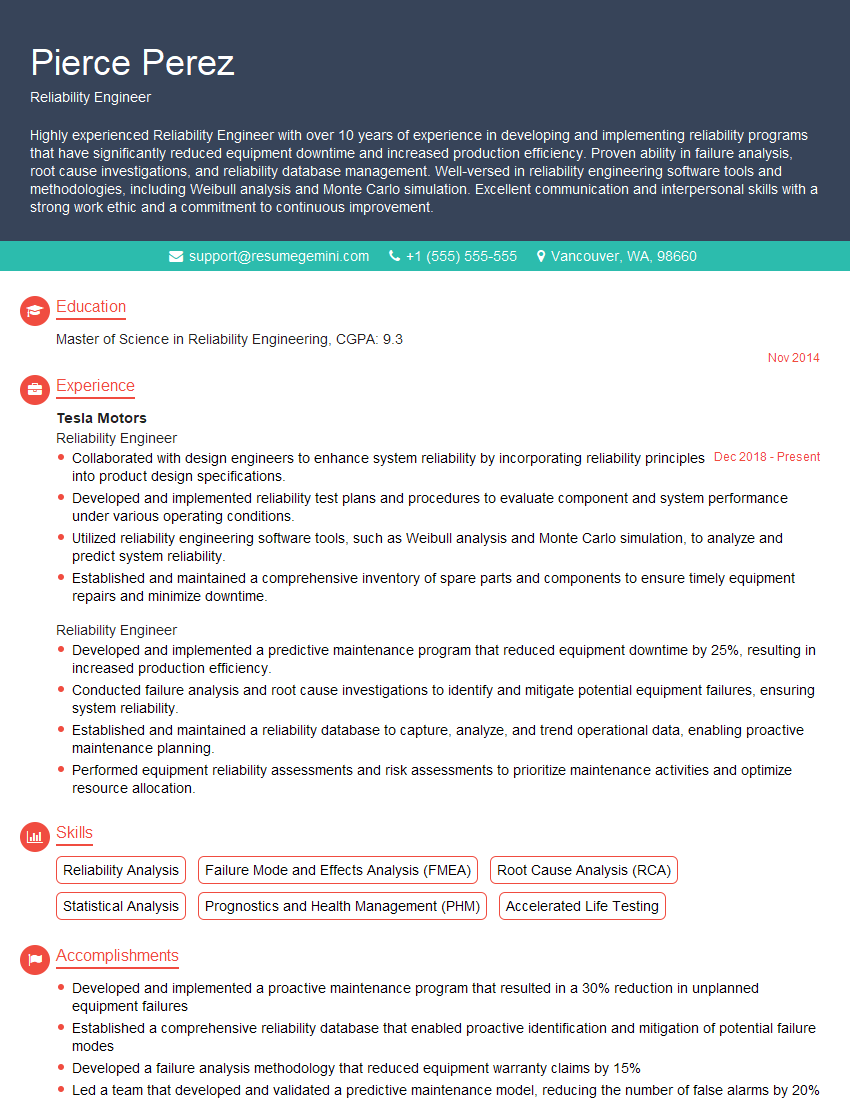
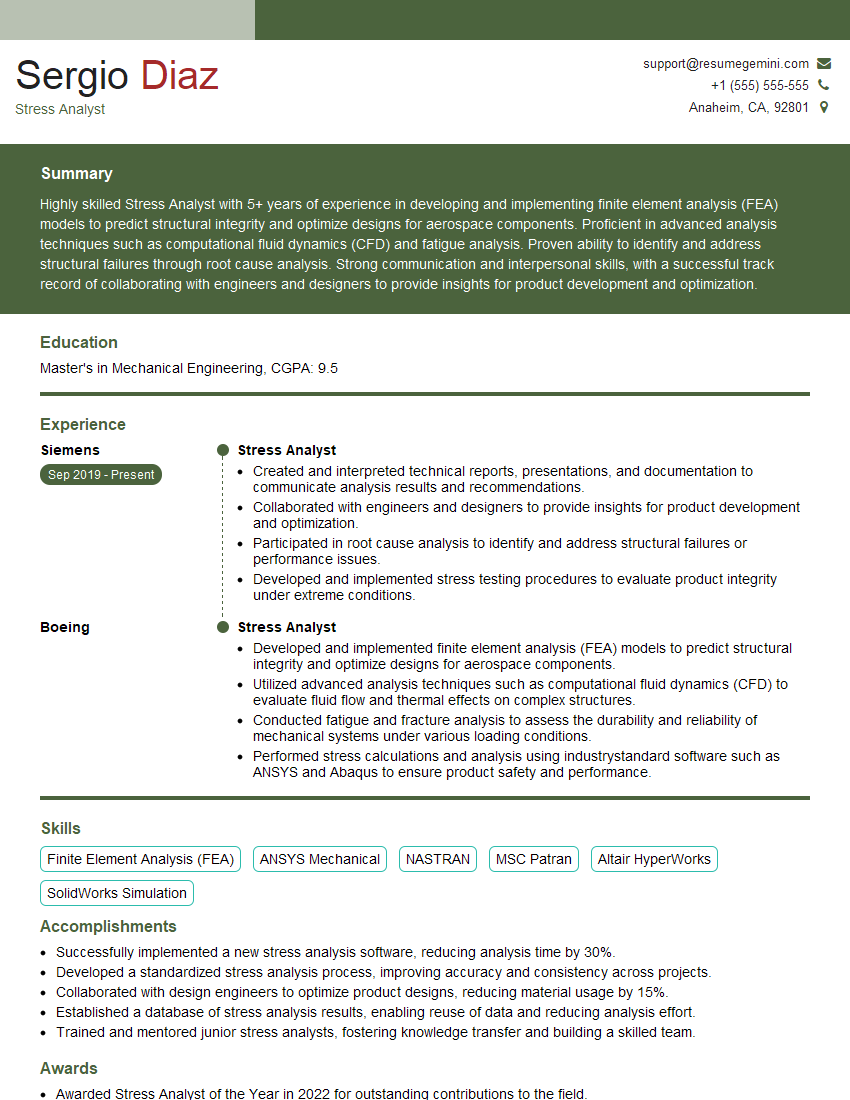
Mastering Material Tension Analysis opens doors to exciting career opportunities in engineering and related fields. A strong understanding of these concepts is highly valued by employers. To maximize your job prospects, create an ATS-friendly resume that effectively highlights your skills and experience. ResumeGemini is a trusted resource to help you build a professional and impactful resume. We provide examples of resumes tailored specifically to Material Tension Analysis to help you showcase your expertise effectively. Take the next step towards your dream career – build your best resume with ResumeGemini.

Explore more articles
Users Rating of Our Blogs
Share Your Experience
We value your feedback! Please rate our content and share your thoughts (optional).
What Readers Say About Our Blog
Very informative content, great job.
good