The right preparation can turn an interview into an opportunity to showcase your expertise. This guide to Stress Concentration interview questions is your ultimate resource, providing key insights and tips to help you ace your responses and stand out as a top candidate.
Questions Asked in Stress Concentration Interview
Q 1. Explain the concept of stress concentration and its significance in engineering design.
Stress concentration refers to the localized increase in stress around geometric discontinuities or changes in a component’s cross-section. Imagine a smooth, perfectly uniform bar under tension. The stress is evenly distributed. Now, imagine introducing a small hole. The stress will significantly increase around the edges of that hole, even though the overall applied load hasn’t changed. This localized stress elevation is crucial in engineering because it can lead to premature failure, even if the overall stress level remains below the material’s yield strength. It’s like focusing sunlight with a magnifying glass – a small, concentrated area experiences a much greater intensity than the surrounding region. In engineering design, understanding and mitigating stress concentration is vital for ensuring structural integrity and preventing catastrophic failures.
Q 2. What are the common causes of stress concentration in mechanical components?
Several factors contribute to stress concentration in mechanical components. These include:
- Holes: Holes, whether circular, elliptical, or irregularly shaped, are common culprits. The smaller the hole’s radius relative to the component’s thickness, the higher the stress concentration.
- Sharp Corners and Notches: Abrupt changes in geometry, like sharp corners or notches, dramatically increase stress. Think of a paper clip – it’s easy to break it at the sharp bend because stress concentrates there.
- Grooves and Keyways: Grooves, keyways, and other features designed to hold components together introduce stress concentration. These are often unavoidable but need careful consideration during design.
- Threads and Screw Holes: The complex geometry of threads and screw holes inherently leads to stress concentration.
- Fillet Radii: Small fillet radii (the radius at the intersection of two surfaces) cause a higher stress concentration than larger radii. Increasing the fillet radius is a common design strategy for stress reduction.
- Surface Defects: Manufacturing imperfections like cracks, scratches, or inclusions can create significant localized stress concentrations, potentially leading to fatigue failure.
Q 3. Describe different methods for analyzing stress concentration.
Several methods exist for analyzing stress concentration, ranging from simple estimations to sophisticated computational techniques:
- Theoretical Stress Concentration Factors (Kt): These factors are derived using analytical methods for simple geometries and loading conditions. They provide a dimensionless ratio of the maximum stress to the nominal stress (stress calculated without considering the stress concentration).
- Finite Element Analysis (FEA): FEA is a powerful computational method that can accurately model complex geometries and loading conditions to predict stress distributions. It provides a detailed stress map, highlighting regions of high stress concentration.
- Experimental Methods: Techniques like photoelasticity, strain gauge measurements, and brittle coating can be used to experimentally determine stress concentrations. These methods are useful for verifying analytical and numerical predictions, especially for intricate geometries.
- Empirical Equations and Charts: Many handbooks and design guides offer empirical equations and charts that provide Kt values for common geometries. These can provide quick estimates, especially in preliminary design stages.
Q 4. How does geometry affect stress concentration?
Geometry plays a dominant role in stress concentration. Sharp corners and abrupt changes in cross-section lead to much higher stress concentrations compared to smooth, gradual transitions. The smaller the radius of curvature at a geometric discontinuity (like a hole or fillet), the higher the stress concentration. Imagine trying to bend a metal rod with a sharp bend versus a gradual curve – the sharp bend will fail much sooner because of the localized stress concentration. This is why designers often incorporate generous fillet radii and avoid sharp corners wherever possible. The shape and size of holes also significantly impact stress concentration. An elliptical hole, for example, will exhibit higher stress concentration at the ends of its major axis than a circular hole of the same area.
Q 5. Explain the use of stress concentration factors (Kt).
The stress concentration factor (Kt) is a dimensionless quantity that represents the ratio of the maximum stress (σmax) at a stress concentration point to the nominal stress (σnom) in the absence of the stress concentration. Mathematically, it’s expressed as:
Kt = σmax / σnomFor example, if Kt = 3, it indicates that the maximum stress at the stress concentration location is three times the nominal stress. Kt is used in design to estimate the maximum stress at critical locations. This allows engineers to determine whether the design is safe under the expected loading conditions by comparing the maximum stress to the material’s yield or ultimate strength.
Q 6. How do material properties influence stress concentration?
While stress concentration is primarily a geometric phenomenon, material properties do influence the overall response. Ductile materials, which can undergo significant plastic deformation before failure, can often tolerate higher stress concentrations than brittle materials, which fracture abruptly with minimal plastic deformation. A ductile material might yield locally at the stress concentration point, redistributing stress and preventing catastrophic failure. A brittle material, however, is more likely to fracture at the point of highest stress concentration.
Q 7. Describe the limitations of using stress concentration factors.
It’s essential to acknowledge the limitations of using stress concentration factors:
- Simplified Geometry: Kt values are often derived for idealized geometries. Real-world components rarely exhibit perfect geometry, leading to deviations from calculated values.
- Linear Elastic Behavior: Most Kt values assume linear elastic material behavior. This may not be accurate for materials that undergo significant plastic deformation or exhibit complex material behavior (e.g., creep, fatigue).
- Static Loading: Kt values are usually determined for static loading conditions. Dynamic loading, such as cyclic stresses in fatigue applications, can significantly alter the stress distribution and failure mechanisms.
- Three-Dimensional Effects: Many stress concentration factor charts and equations are based on two-dimensional analyses. This can lead to inaccuracies for complex three-dimensional geometries.
- Interaction Effects: Kt values may not accurately account for interactions between multiple stress concentration points in a component.
Therefore, it’s crucial to consider these limitations and use Kt values judiciously, employing more sophisticated analysis methods when necessary, such as FEA, to obtain more accurate and reliable results.
Q 8. What is the role of Finite Element Analysis (FEA) in stress concentration analysis?
Finite Element Analysis (FEA) is an indispensable tool in stress concentration analysis. It allows us to numerically model complex geometries and loading conditions, providing a detailed visualization of stress distribution within a component. Unlike analytical methods which are often limited to simplified shapes, FEA can handle intricate designs with holes, fillets, and other geometric features that are notorious for causing stress concentration. The process involves discretizing the component into numerous small elements, solving governing equations for each element, and then assembling the results to obtain the overall stress field. This provides a much more accurate prediction of stress concentrations than traditional methods, enabling engineers to identify potential failure points and optimize designs.
For example, imagine designing a crankshaft. Analytical methods might provide a rough estimate of stress, but FEA allows us to model the complex geometry, material properties, and loading conditions with high fidelity, revealing precisely where and how much stress concentrates, particularly around the fillets and journal bearings. This precision is crucial for ensuring the crankshaft can withstand operational stresses without failure.
Q 9. Explain the difference between static and fatigue stress concentration.
Static stress concentration refers to the stress increase at a geometric discontinuity under a constant load. Imagine a simple bar with a hole; applying a tensile load causes a significantly higher stress around the hole’s edges compared to the average stress in the bar. This is a static situation – the load is applied once and remains constant. Fatigue stress concentration, on the other hand, deals with the effects of cyclic loading. The same hole in the bar, subjected to repeated loading and unloading, will lead to stress concentration that drives crack initiation and propagation, eventually causing fatigue failure. The peak stress during each cycle is critical in fatigue, and the concentration effect is amplified by the repeated application of stress.
A key difference lies in the failure criteria. For static loading, we’re typically concerned with yielding or ultimate tensile strength. In fatigue, we consider fatigue life and endurance limits, using methods like S-N curves or fracture mechanics to predict failure. The stress concentration factor is still important in both, but its implications and how it’s used in design are different.
Q 10. How does surface finish affect stress concentration?
Surface finish significantly impacts stress concentration. A smoother surface reduces stress concentration, while a rough surface exacerbates it. Think of it like this: a smooth surface distributes the load more evenly, minimizing stress peaks. A rough surface, with its irregularities and microscopic imperfections, acts as a multitude of tiny stress raisers, leading to higher local stresses. These microscopic imperfections can initiate cracks, especially under fatigue loading. This is why polishing components in critical applications can improve fatigue life considerably.
In the context of FEA, surface roughness can be modeled using various techniques, like incorporating surface texture parameters or employing more refined meshing in regions of high surface irregularity. This adds computational complexity, but accurately capturing the effect of surface roughness is crucial for accurate and reliable stress analysis, particularly in high-cycle fatigue applications such as turbine blades or automotive components.
Q 11. Discuss the use of notches and fillets in mitigating stress concentration.
Notches and fillets play a crucial role in mitigating stress concentration. Notches are abrupt changes in geometry (e.g., sharp corners), while fillets are smooth transitions between different sections of a component (e.g., a rounded corner). Notches act as stress raisers, significantly increasing stress concentrations at their base. Fillets, on the other hand, effectively reduce stress concentrations by smoothly distributing the load, leading to lower peak stresses. The radius of a fillet is a critical design parameter; a larger radius generally leads to a lower stress concentration.
For example, consider a rectangular bar with a hole. A sharp corner at the hole’s edge creates a high stress concentration. Replacing this sharp corner with a fillet dramatically reduces the peak stress. In FEA, the design of fillets and notches can be optimized to minimize stress concentrations to acceptable levels, thus enhancing the component’s strength and reliability. It’s often a balancing act between functionality and stress reduction. Too large a fillet may compromise the component’s stiffness or other functional requirements.
Q 12. Explain the concept of stress intensity factor (KI).
The stress intensity factor (KI) is a crucial parameter in fracture mechanics, quantifying the stress field at the tip of a crack. It essentially represents the intensity of the stress singularity at the crack tip. A higher KI indicates a more severe stress concentration at the crack tip, making it more prone to crack propagation. KI is dependent on the applied load, geometry, and crack size. It’s usually expressed as:
KI = σ√(πa)where σ is the applied stress, and ‘a’ is the crack length. This is a simplified expression for a specific scenario; more complex formulas exist for different crack geometries and loading conditions. KI is essential for predicting crack propagation using fracture toughness (KIC), a material property representing the critical stress intensity factor at which crack propagation starts.
In design, we use KI to assess the fracture risk of components with cracks or other flaws. By comparing KI with KIC, we can determine whether a crack is likely to propagate. This is particularly important in safety-critical applications.
Q 13. How do you determine the appropriate mesh density for accurate stress concentration analysis using FEA?
Determining the appropriate mesh density for accurate stress concentration analysis in FEA is crucial for obtaining reliable results. In regions of high stress concentration, such as at sharp corners or near holes, a finer mesh is essential to capture the stress gradient accurately. A coarse mesh in these areas will lead to inaccurate stress predictions, potentially underestimating the severity of the stress concentration. Conversely, a very fine mesh everywhere is computationally expensive and unnecessary.
A common strategy is to use mesh refinement techniques. This involves progressively refining the mesh size near regions of interest (high stress gradients) while maintaining a coarser mesh in areas with relatively uniform stress. Mesh independence studies are also crucial. This involves running the FEA with progressively finer meshes until the results converge, indicating that the mesh is fine enough to accurately capture the stress concentration. The mesh density should be carefully chosen to balance accuracy and computational cost.
Q 14. Describe different methods for reducing stress concentration in a design.
Several methods can reduce stress concentration in a design:
- Using fillets and larger radii: Replacing sharp corners with smooth transitions minimizes stress peaks.
- Avoiding sharp notches and holes: Sharp changes in geometry act as stress raisers. If holes are unavoidable, using larger holes or elliptical holes can reduce stress concentrations.
- Stress relieving features: Adding features like grooves or cutouts can redistribute stress and reduce the concentration in critical areas.
- Material selection: Using materials with higher yield strength or better fracture toughness can improve the component’s resistance to stress concentration and crack propagation.
- Optimizing loading conditions: If possible, altering the way a load is applied can minimize stress concentration in vulnerable areas.
- Surface treatment: Polishing or other surface treatments can reduce stress concentration by smoothing out surface imperfections.
The choice of method depends on the specific application, design constraints, and manufacturing capabilities. It is often an iterative process involving FEA and experimental verification to achieve an optimal solution that ensures adequate component strength and durability.
Q 15. What are the common failure modes associated with stress concentration?
Stress concentration leads to several failure modes, primarily brittle fracture and fatigue failure. Brittle fracture occurs when the highly stressed region at the concentration point reaches its ultimate tensile strength, causing a sudden and catastrophic crack propagation. This is common in materials with limited ductility. Fatigue failure, on the other hand, is a progressive process where repeated cyclic loading at stress levels below the yield strength eventually leads to crack initiation and propagation at the stress concentration point. This is significantly more prevalent in many engineering applications.
- Brittle Fracture: Imagine a glass bottle with a small scratch. The scratch acts as a stress concentrator. A relatively small applied force can cause the bottle to fracture suddenly along the scratch.
- Fatigue Failure: Think of a paperclip repeatedly bent back and forth. The point where the paperclip is bent experiences high stress concentration, and eventually, it will fatigue and break, even if the force applied in each cycle is well below what would be required to break it in a single application.
- Yielding/Plastic Deformation: In ductile materials, localized yielding might occur near stress concentration points before fracture. This doesn’t necessarily lead to immediate failure but can initiate crack formation or reduce the component’s load-carrying capacity.
Career Expert Tips:
- Ace those interviews! Prepare effectively by reviewing the Top 50 Most Common Interview Questions on ResumeGemini.
- Navigate your job search with confidence! Explore a wide range of Career Tips on ResumeGemini. Learn about common challenges and recommendations to overcome them.
- Craft the perfect resume! Master the Art of Resume Writing with ResumeGemini’s guide. Showcase your unique qualifications and achievements effectively.
- Don’t miss out on holiday savings! Build your dream resume with ResumeGemini’s ATS optimized templates.
Q 16. Explain the concept of fatigue life and its relation to stress concentration.
Fatigue life refers to the number of stress cycles a component can withstand before failure occurs due to fatigue. Stress concentration significantly reduces fatigue life. The higher the stress concentration factor, the fewer cycles are needed to cause failure. This is because the highly localized stress at the concentration point accelerates crack initiation and propagation. The relationship can be expressed using concepts like the S-N curve (Stress vs Number of cycles to failure) where stress concentration shifts the curve to the left, indicating earlier failure at lower stress levels.
Consider a shaft with a keyway. The keyway introduces a stress concentration. A smooth shaft might withstand millions of cycles, but the shaft with the keyway might fail after only thousands of cycles under the same loading. This drastic reduction in fatigue life highlights the importance of addressing stress concentration in design, especially for components subjected to cyclic loading.
Q 17. How does temperature affect stress concentration?
Temperature significantly impacts stress concentration. Elevated temperatures generally reduce material strength and ductility, making it more susceptible to failure under stress concentration. At higher temperatures, creep deformation also becomes a factor, leading to progressive deformation and eventual failure. Conversely, very low temperatures can increase material brittleness, making it more prone to brittle fracture at stress concentration points. For example, a component operating at cryogenic temperatures might show increased sensitivity to stress concentration.
The material’s properties, such as yield strength and fracture toughness, are temperature-dependent. A thorough understanding of these temperature-dependent material properties is critical when evaluating stress concentration in components exposed to varying thermal conditions.
Q 18. Explain the difference between nominal stress and local stress.
Nominal stress is the average stress calculated based on the applied load and the gross cross-sectional area of a component, ignoring any geometric discontinuities. Local stress, on the other hand, is the actual stress at a specific point on a component, considering the effect of geometric features like holes, notches, or fillets. At stress concentration points, local stress is significantly higher than the nominal stress. The ratio between the local stress and the nominal stress is known as the stress concentration factor (Kt).
Imagine a flat plate with a circular hole under tension. The nominal stress would be the applied force divided by the plate’s cross-sectional area. However, the stress at the edges of the hole is far greater than the nominal stress. This higher stress at the hole edge is the local stress.
Q 19. How would you validate the results of a stress concentration analysis?
Validating stress concentration analysis results involves a multi-faceted approach combining theoretical calculations, numerical simulations (like Finite Element Analysis – FEA), and experimental testing. First, analytical methods can provide an initial estimate using stress concentration factors (Kt) found in handbooks or derived using analytical equations. However, these methods may have limitations for complex geometries.
Next, FEA offers a detailed analysis, providing accurate stress distribution. The results from FEA can be validated by comparing them with experimental data obtained through strain gauge measurements or photoelasticity techniques. These experiments measure the actual stress or strain in the region of interest. Agreement between FEA and experimental results helps confirm the accuracy of both the analysis and the material properties used in the simulation. Discrepancies might necessitate adjustments to the model or further investigation of material behavior.
Q 20. Discuss the importance of considering stress concentration in safety critical applications.
In safety-critical applications, like aerospace, automotive, and medical devices, considering stress concentration is paramount. Neglecting stress concentration can lead to premature and catastrophic failure, with potentially severe consequences. Accurate assessment and mitigation of stress concentration are essential to ensure the component’s reliability and safety.
For example, a flaw in a pressure vessel could lead to a catastrophic explosion if not properly designed to account for stress concentration. Similarly, a fatigue crack in an aircraft component could cause a structural failure if not accounted for in the design process. Design guidelines and rigorous testing are often incorporated to address these concerns.
Q 21. What are some common software packages used for stress concentration analysis?
Several software packages are commonly used for stress concentration analysis. Finite Element Analysis (FEA) software dominates this field, with prominent packages including:
- ANSYS: A widely used, comprehensive FEA software package capable of handling complex geometries and material models.
- ABAQUS: Another powerful FEA software known for its advanced capabilities in nonlinear analysis and material modeling.
- Nastran: A robust FEA solver often used in aerospace and automotive industries.
- SolidWorks Simulation: An integrated FEA tool within the SolidWorks CAD software, providing a convenient workflow.
The choice of software depends on the complexity of the problem, available resources, and specific requirements of the analysis.
Q 22. Describe your experience using FEA software for stress analysis.
My experience with FEA software for stress analysis spans over ten years, encompassing a wide range of tools like ANSYS, Abaqus, and Nastran. I’ve used these extensively for various projects, from analyzing the stress concentration in turbine blades to evaluating the structural integrity of pressure vessels. I’m proficient in mesh generation, applying appropriate material properties, defining boundary conditions, and interpreting the resulting stress fields. For instance, in one project involving a complex automotive component, I utilized ANSYS to identify areas of high stress concentration around a sharp corner, enabling the design team to implement effective modifications. This involved not only running the simulations but also critically evaluating mesh density and element type selection to ensure accurate results. I also possess experience validating FEA results through comparison with experimental data and analytical solutions.
Q 23. How would you approach analyzing stress concentration in a complex geometry?
Analyzing stress concentration in complex geometries requires a multi-faceted approach. First, I would begin with a thorough geometric review, identifying potential areas of stress concentration – typically sharp corners, holes, or abrupt changes in cross-section. Next, I would employ FEA software to create a highly refined mesh in these critical regions. This ensures that the software accurately captures the stress gradients. The mesh density needs to be much higher near these regions compared to the smoother parts of the geometry. I would then carefully define appropriate boundary conditions, reflecting the realistic loading scenarios. For example, a fixed support might represent a weld, while a pressure load might simulate internal fluid pressure. Once the simulation is run, I’d focus on post-processing, using visualization tools to identify locations with peak stresses. To validate the results, I might use a simpler, analytically solvable model (e.g., a circular hole in an infinite plate) for comparison. Finally, I would thoroughly document the assumptions, methods, and results. Consider a complex casting with multiple internal channels: a coarser mesh could be used for the body of the casting while a much finer mesh would be applied near the channels and their intersections to precisely model the stress concentration at these points.
Q 24. What are the different types of boundary conditions used in stress concentration analysis?
Various boundary conditions are crucial in accurately simulating stress concentration. Common types include:
- Fixed Support: Simulates a completely constrained region, often used to model welds or clamped sections. This condition prevents any displacement in all directions (x, y, and z).
- Simply Supported: Allows rotation but prevents displacement in specific directions. This is frequently employed to represent supports with limited constraint.
- Pressure Load: Applies a uniform or non-uniform pressure to a surface, mirroring internal pressure in vessels or fluid forces on components.
- Force Load: Applies a concentrated or distributed force, representing external loads like tension, compression, or bending. Point loads are often used for simplified loading conditions.
- Symmetry Boundary Conditions: Used to reduce computational time by exploiting symmetry in the geometry and loading. These conditions are particularly helpful for axisymmetric or plane strain problems.
The choice of boundary conditions significantly impacts the results; therefore, careful consideration of the actual physical constraints and loading conditions is paramount for accurate stress analysis.
Q 25. Describe your experience with experimental stress analysis techniques.
My experience with experimental stress analysis techniques includes strain gauge applications and photoelasticity. I’ve used strain gauges to measure strain directly on components under various loading conditions, providing valuable experimental data to correlate and validate FEA results. For complex components or when high spatial resolution is required, digital image correlation (DIC) techniques have become essential. Photoelasticity, while less frequently employed now, is excellent for visualizing stress distributions in transparent materials. In a past project involving a complex crankshaft, we utilized strain gauges at several critical locations to obtain experimental stress data that helped refine our FEA model, leading to more accurate stress predictions and a safer design.
Q 26. Explain how you would interpret the results from a stress concentration analysis.
Interpreting stress concentration analysis results involves a multi-step process. First, I examine the stress contours and identify the locations of peak stresses. Then, I compare these peak stresses to material properties, specifically the yield strength or ultimate tensile strength, to calculate the stress concentration factor (Kt). This factor quantifies the degree of stress magnification due to the geometric discontinuity. A Kt greater than 1 indicates a stress amplification. I also consider the safety factor, which ensures the design can withstand unexpected loads or material variations. Finally, I document all findings in a comprehensive report, including all assumptions made and potential sources of error.
For example, finding a high stress concentration near a hole doesn’t automatically imply failure. It depends on the value of the stress concentration factor, material properties, and the applied load relative to the material’s strength. This detailed evaluation aids in making informed decisions regarding design modifications or material selection.
Q 27. How would you determine the critical location for stress concentration in a given component?
Determining the critical location for stress concentration often begins with visual inspection of the component geometry, pinpointing regions with sharp corners, holes, or abrupt changes in cross-section. Following this, FEA analysis provides a precise determination of stress distribution. By employing contour plots and examining the stress values at various locations, the peak stress values and their corresponding locations are readily identified. Furthermore, I would consider factors such as the applied loading and material properties. For instance, a relatively small notch might be inconsequential under low loads, but could become critical when subjected to high stress levels. A combination of geometric assessment and FEA is vital for accurate identification of stress concentration hotspots.
Q 28. How do you handle uncertainties and approximations in stress concentration analysis?
Uncertainties and approximations are inherent in stress concentration analysis. To address these, I employ several strategies. First, I acknowledge and document all assumptions made regarding material properties, boundary conditions, and loading. Second, I perform sensitivity studies, varying parameters within realistic ranges to evaluate the impact on the results. This helps quantify the uncertainty associated with the analysis. Third, I employ multiple analysis techniques, comparing FEA results to analytical solutions (when possible) or experimental data. Finally, I apply conservative safety factors to account for uncertainties and ensure the design’s reliability. By following these steps, I aim to mitigate the influence of approximations and enhance the confidence level of the results. For example, uncertainties in material properties might be handled by using the lower bounds of material strength in the calculations, resulting in a more conservative estimate of the stress.
Key Topics to Learn for Stress Concentration Interview
- Fundamentals of Stress and Strain: Understanding stress tensors, strain tensors, and their relationships (Hooke’s Law) is foundational. Consider various stress states (uniaxial, biaxial, triaxial).
- Stress Concentration Factors (Kt): Mastering the calculation and interpretation of Kt for various geometries (holes, notches, fillets) is crucial. Explore different methods of determining Kt, including analytical solutions and FEA.
- Geometric Stress Concentration: Analyze how different geometric features impact stress distribution. Practice identifying regions of high stress concentration in components and structures.
- Fatigue and Fracture Mechanics: Understand how stress concentration significantly influences fatigue life and crack initiation. Explore concepts like fatigue strength reduction factors.
- Finite Element Analysis (FEA): Learn to use FEA software to model and analyze stress concentrations in complex geometries. Familiarize yourself with mesh refinement techniques in regions of high stress.
- Practical Applications: Be prepared to discuss real-world examples where understanding stress concentration is critical, such as in pressure vessel design, machine component design, and structural analysis.
- Experimental Techniques: Gain familiarity with experimental methods used to measure stress concentrations, including strain gauges and photoelasticity.
- Stress Concentration Mitigation Techniques: Discuss methods used to reduce stress concentrations, such as fillet radii, hole reinforcement, and material selection.
Next Steps
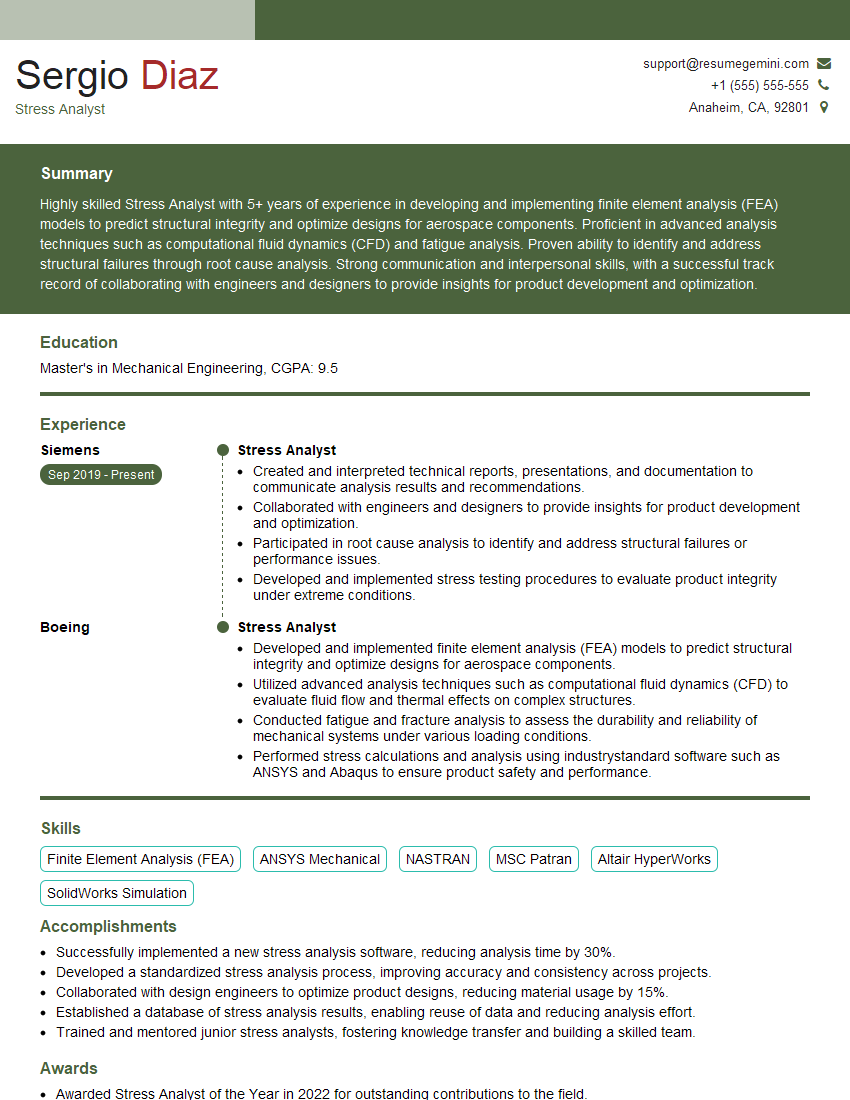
Mastering stress concentration is vital for a successful career in engineering and related fields. A strong understanding of these concepts opens doors to advanced roles and projects, demonstrating your analytical and problem-solving skills to potential employers. To enhance your job prospects, create a compelling and ATS-friendly resume that highlights your expertise. ResumeGemini is a trusted resource that can help you build a professional resume showcasing your skills and experience effectively. Examples of resumes tailored to Stress Concentration are available to guide you.



Explore more articles
Users Rating of Our Blogs
Share Your Experience
We value your feedback! Please rate our content and share your thoughts (optional).
What Readers Say About Our Blog
Very informative content, great job.
good