Preparation is the key to success in any interview. In this post, we’ll explore crucial Gaffing and Landing Fish interview questions and equip you with strategies to craft impactful answers. Whether you’re a beginner or a pro, these tips will elevate your preparation.
Questions Asked in Gaffing and Landing Fish Interview
Q 1. Describe your experience with different types of gaffs.
My experience encompasses a wide range of gaffs, each suited for different fish sizes and situations. I’m proficient with standard aluminum gaffs, ranging in length from 4 to 6 feet, depending on the boat and target species. For larger game fish, I prefer heavier-duty gaffs with longer shafts and a more robust hook. I also utilize specialized gaffs like the ‘tail gaff’ for situations where accessing the fish’s head is difficult and a ‘multi-hook’ gaff for increased security when dealing with particularly powerful species. The choice of gaff material is also crucial – I prefer strong, lightweight aluminum for maneuverability and durability.
- Aluminum Gaffs: Lightweight, durable, and versatile for a wide range of applications.
- Stainless Steel Gaffs: More resistant to corrosion, making them ideal for saltwater fishing.
- Carbon Fiber Gaffs: Exceptional strength-to-weight ratio but generally more expensive.
The choice of gaff always depends on the target fish and the environment. I’ve found that versatility is key – having several options ready ensures I can handle any situation effectively.
Q 2. Explain the proper technique for gaffing various species of fish.
Gaffing technique varies depending on the species and its size and strength. The goal is always to secure the fish quickly and safely, minimizing stress and injury. For smaller fish, a quick, precise jab into the gill plate is effective. With larger, more powerful fish, however, I aim for a more secure hold. I would target the fish’s lower jaw area, working with the fish’s movements and avoiding unnecessary force. This area provides the best leverage and stability. Here’s a breakdown:
- Smaller Fish: Quick jab into the gill plate.
- Larger Fish: Secure placement into the lower jaw or behind the pectoral fin. Avoid placing the hook too far back as the gaff may damage the meat.
- Highly Active Fish: A team approach, with one person gaffing and others handling the line and keeping it taut.
For example, gaffing a marlin requires a different approach than gaffing a trout. Marlin demand a decisive, powerful stroke aiming for the lower jaw, while a trout would typically be gaffed in the gills.
Q 3. How do you handle a large, struggling fish during landing?
Handling a large, struggling fish during landing requires teamwork, precision, and a calm demeanor. First, I ensure the line is taut but not overly tight to avoid breakage. My team would use a combination of techniques to bring the fish under control: keeping the rod angled away from the boat, using a ‘pumping’ action to tire the fish, and using an appropriately sized gaff and net to secure it. Once gaffed, the fish should be carefully lifted and brought onboard, avoiding any sudden movements that could cause injury to the fish or the crew. For the very largest species, a specialized lifting sling or even a boat crane might be necessary.
I’ve personally experienced handling a massive tuna that required four of us to lift it safely onto the boat, ensuring all movement was coordinated. A rush or lack of coordination could result in injuries to both the crew and the fish.
Q 4. What safety precautions do you take when gaffing and landing fish?
Safety is paramount. Before any gaffing or landing, I always ensure that everyone on the boat is aware of the procedure and their roles. This includes having appropriate safety gear readily accessible such as appropriate eye protection, gloves, and non-slip footwear. I emphasize the importance of clear communication, especially with larger, powerful fish. We maintain a safe distance between the gaffer and the fish, using the rod and line to maintain control and allowing the gaff only when it is properly positioned. Sharpened gaffs must be handled with extreme care to avoid accidental injuries. We always follow the guidelines for handling and releasing fish according to regulations.
Prevention is key. A clear understanding of our roles and limitations is crucial to reduce risk of injury during these operations.
Q 5. How do you assess the best gaffing point on a fish?
Assessing the best gaffing point depends largely on the species, size, and its behavior. Ideally, the goal is to hook the fish securely while minimizing damage and stress. For many species, the lower jaw offers a strong, secure hold. However, the positioning may need to adapt for specific fish, if the lower jaw is not immediately accessible. I always try to avoid piercing vital organs like the heart or gills unnecessarily. This minimizes injury and improves chances of survival if a release is required.
For example, a leaping tuna might require a quick jab to a less accessible area of the body depending on its position in the air, while a calm, docile snapper will allow more time for an accurate hook placement on the jaw. Quick judgment is essential for success while still ensuring the fish’s well-being.
Q 6. Describe your experience with different types of landing nets.
My experience includes various landing nets, each tailored for different situations. For smaller fish, I use lightweight nets with smaller mesh to prevent damage or escape. Larger species demand stronger nets with larger mesh and reinforced rims. Material is important too – I prefer nets with durable nylon mesh and strong, flexible frames. A good net is a critical piece of equipment, offering a gentler alternative to a gaff when possible.
- Small Mesh Nets: For delicate species or smaller fish.
- Large Mesh Nets: For bigger and more robust species.
- Rubber Nets: Gentle on the fish’s skin.
- Aluminum Framed Nets: Durable, lightweight.
The right net makes all the difference in protecting the fish and avoiding unnecessary stress during capture.
Q 7. How do you adapt your gaffing and landing techniques to different water conditions?
Water conditions significantly impact gaffing and landing techniques. In calm waters, a precise gaff and careful netting are effective. Strong currents, however, require a more aggressive and controlled approach. The gaff needs to secure the fish swiftly to avoid being swept away. Rough seas present the biggest challenge, necessitating a strong and stable approach from the crew and potentially requiring additional crew members for support. Visibility also plays a role; poor visibility necessitates a more cautious approach to prevent accidental gaffing of other items or boat damage. I always adapt my techniques to the conditions, prioritizing safety and the integrity of the catch.
For example, gaffing a fish in a strong current requires a quick and decisive movement to secure the fish before it’s swept away, whereas calmer waters would allow for more time and precision.
Q 8. Explain how you would handle a fish entangled in fishing gear.
Handling a fish entangled in fishing gear requires a calm and methodical approach. The priority is to safely free the fish while minimizing further stress and injury.
- Assess the situation: Determine the type of gear, how the fish is entangled, and the fish’s species and size. This helps determine the best course of action.
- Use appropriate tools: This might include long-nose pliers, line cutters, or even a specialized disentangling tool. Avoid using sharp objects that could further injure the fish.
- Work slowly and carefully: Sudden movements can panic the fish and cause more harm. Gently work the gear free, taking care not to snag the fish’s fins or gills.
- Support the fish: While freeing the fish, try to support its weight to reduce stress on its body.
- Post-release care: Once freed, allow the fish time to recover before releasing it back into the water. Ensure it swims away strongly.
For instance, if a large Tarpon is tangled in a monofilament line, I would carefully approach the fish in the boat, using long-nosed pliers to cut the line as close to the fish as possible, being mindful of not letting the line wrap around my hands. I would support the fish’s weight while untangling it. After releasing, I’d observe to make sure it swims away strongly and doesn’t exhibit any signs of distress.
Q 9. What are the signs of a stressed or injured fish during landing?
Recognizing signs of stress and injury in a fish is crucial for responsible handling. Stressed or injured fish exhibit several tell-tale symptoms:
- Rapid gill movements: Excessive gill flaring indicates the fish is struggling to breathe.
- Pale gills: Loss of gill color suggests poor oxygen uptake and potential shock.
- Lethargy or lack of response: An unresponsive or sluggish fish may be injured or severely stressed.
- Damage to fins or body: Obvious wounds, fin tears, or broken scales are clear indicators of injury.
- Abnormal swimming behavior: Erratic or unnatural swimming patterns can point towards distress.
- Exhaustion: A fish that’s extremely tired may struggle to swim away normally.
For example, a fish with clamped fins, struggling to stay upright in the water is showing very clear signs of stress. Another example is a fish showing deep cuts from a hook. These need immediate attention.
Q 10. How do you minimize fish stress and injury during the landing process?
Minimizing stress and injury during landing involves using appropriate techniques and tools:
- Quick and efficient handling: Keep the fish out of the water for the shortest time possible.
- Wet hands: Always use wet hands when handling a fish to avoid damaging its protective slime coat.
- Proper support: Support the fish’s weight to prevent damage to its internal organs.
- Avoid squeezing or pinching: Handle fish gently, avoiding any pressure that could cause injury.
- Appropriate gaffing techniques: Aim for a quick and clean gaff placement to minimize injury. Avoid unnecessarily deep gaffs
- Using a net: A properly sized net can reduce trauma and is a preferred method for many species.
- Proper release techniques: If releasing, support the fish vertically in the water until it recovers and swims away on its own.
Think of it like this: the less time a fish spends out of its natural environment, the less likely it is to experience stress. A properly placed net minimizes the struggle and trauma.
Q 11. Describe your experience with various fish handling techniques.
My experience encompasses a wide range of fish handling techniques, tailored to the species and situation. This includes:
- Using various nets: From small landing nets for trout to larger nets for pelagic species.
- Gaffing techniques: I am proficient in gaffing various fish types, ensuring proper placement to minimize injury and maximize safety.
- Handlining: For smaller fish, I often rely on carefully handlining them in.
- Using specialized tools: I’m familiar with and use different tools depending on the species – like a lip gripper for largemouth bass and dehookers for removing hooks without hurting the fish.
- No-kill practices: I am experienced in handling fish for immediate release, taking care to minimize stress during the process.
For example, I’ve handled delicate species like bonefish using a specialized net and quick release techniques, whereas larger, stronger species require different gaffing and handling methods to ensure both safety and minimal damage.
Q 12. How do you ensure the safety of yourself and others during gaffing and landing operations?
Safety is paramount during gaffing and landing operations. My safety protocols include:
- Sharp object awareness: Always handle gaffs and other sharp tools carefully and with awareness of others nearby.
- Proper footing: Ensure secure footing on the boat or shore to prevent falls.
- Use of appropriate safety gear: Depending on the situation, this might include gloves, eye protection, and even a life vest.
- Communication: Communicate clearly with other individuals involved in the operation to coordinate movements and avoid accidents.
- Proper gaffing technique: Aim for a quick and clean gaff placement and avoid unnecessary force.
- Considering the environment: Always be mindful of potential hazards in the surrounding environment, such as slippery decks, sharp objects, or strong currents.
I’ve learned through experience that a calm, deliberate approach is key to preventing accidents. A rushed gaff or a misplaced foot can lead to serious consequences.
Q 13. What are the legal regulations regarding fish handling in your area?
Legal regulations regarding fish handling vary significantly depending on location and species. It’s crucial to be fully aware of these regulations in your specific area, which often include:
- Size and bag limits: Regulations specifying the minimum and maximum size of fish that can be kept, and the number of fish of each species that can be caught.
- Protected species: Rules outlining which species are protected and cannot be harvested.
- Gear restrictions: Limitations on the types of fishing gear that can be used.
- Closed seasons: Periods during which fishing for specific species is prohibited.
- Methods of handling and release: Specific guidelines for minimizing stress and injury to fish during handling and release.
For example, in my area, we have strict regulations on the handling of salmon, emphasizing proper release techniques to ensure high survival rates. It’s my responsibility to ensure that every action I take aligns with local and regional fishing laws.
Q 14. Describe your experience with different types of fish holds or storage.
My experience includes various fish holds and storage methods, each with its own advantages and limitations:
- Livewells: These recirculating water systems are ideal for keeping live bait and catch alive for a short period. Crucial aspects are ensuring sufficient oxygenation and maintaining appropriate water temperature and cleanliness.
- Ice chests or coolers: Suitable for short-term storage of fish intended for consumption, ensuring they remain cold to prevent spoilage. Proper icing is crucial.
- Fish bags: These breathable bags can be used for temporary storage, especially for species intended for immediate release. They also need proper ventilation and can aid with revival post-release.
- Dedicated fish storage on boats: Larger boats often have dedicated refrigerated fish holds, allowing for longer-term storage of catches intended for consumption.
The choice of storage depends entirely on the intended use of the fish, the length of time it will be stored and the species. For example, a delicate fish intended for immediate release would be handled with a fish bag and released as soon as possible. A larger fish intended for consumption would be properly iced in a cooler for transport.
Q 15. How do you maintain the quality of fish during and after landing?
Maintaining fish quality starts the moment it’s hooked. Minimizing stress is key. This means a quick, efficient fight, avoiding excessive pulling or prolonged struggles. For larger fish, using a proper gaff and net minimizes injury. Once landed, immediately support the fish’s weight to prevent damage to its internal organs. If it’s going to be released, handle it gently and quickly return it to the water ensuring its orientation is correct to facilitate recovery. If it’s destined for consumption, immediately chilling the fish on ice is paramount. Properly icing a fish slows down enzymatic and bacterial decomposition, preserving its freshness and quality for a much longer time. Imagine treating the fish like a delicate package – careful handling at every stage prevents damage and spoilage.
- Quick fight: Minimize the struggle to reduce stress and lactic acid buildup.
- Gaffing and netting techniques: Employ appropriate techniques to minimize injury.
- Immediate chilling: Place fish on ice as quickly as possible, ideally in a slurry of ice and water.
- Proper handling: Support the fish’s weight to prevent organ damage.
Career Expert Tips:
- Ace those interviews! Prepare effectively by reviewing the Top 50 Most Common Interview Questions on ResumeGemini.
- Navigate your job search with confidence! Explore a wide range of Career Tips on ResumeGemini. Learn about common challenges and recommendations to overcome them.
- Craft the perfect resume! Master the Art of Resume Writing with ResumeGemini’s guide. Showcase your unique qualifications and achievements effectively.
- Don’t miss out on holiday savings! Build your dream resume with ResumeGemini’s ATS optimized templates.
Q 16. Explain the process of weighing and measuring fish.
Weighing and measuring fish is crucial for accurate data collection in fisheries management and research. A certified scale, accurate to at least 0.1 kg (or 0.1 lb) should be used. The fish should be weighed while supported to avoid stressing it unnecessarily. Measurements should be taken from the fish’s snout to the end of its tail (total length). For certain species and research purposes, you may need to measure fork length (distance from snout to the fork of the tail). Note that some species, like sharks, may need special handling and measurement procedures.
Step-by-step process:
- Use a certified scale that’s properly calibrated.
- Support the fish securely to prevent damage during weighing.
- Record the weight to the nearest 0.1 kg (or 0.1 lb).
- Measure the total length (or fork length as appropriate) using a measuring board or ruler, ensuring accurate placement.
- Record all measurements accurately and clearly.
Q 17. How do you identify different species of fish?
Identifying fish species requires careful observation of several features. This often involves looking at physical characteristics such as body shape, fin structure, coloration, and scale patterns. Reference materials, such as field guides, photographs, and online databases, are essential. Sometimes, more specific identification may require examining internal structures or using DNA analysis. The location of the catch can also be a helpful clue. For example, you’re much more likely to catch a halibut in the Pacific than in the Atlantic.
- Body shape: Elongated, compressed, or deep-bodied.
- Fin structure: Number and shape of dorsal, anal, caudal, pectoral, and pelvic fins.
- Coloration: Overall coloration and any distinctive markings.
- Scale patterns: Size and arrangement of scales.
- Habitat: Location where the fish was caught.
Remember to always consult reliable sources for accurate species identification.
Q 18. How do you choose the appropriate gaff for different sizes and species of fish?
Choosing the right gaff is critical for both fish welfare and safety. The size of the gaff should be proportionate to the size of the fish. A small gaff for a large fish risks injury and loss of the fish. Conversely, a large gaff for a small fish is unnecessary and could cause damage. The gaff’s material and design should be strong enough to handle the specific fish species. Some gaffs are better suited for certain situations; for example, a longer shaft may be necessary for larger, deeper-dwelling fish. Consider a gaff with a slightly barbed hook for better fish retention, but always prioritize responsible fishing practices.
- Size: Match the gaff size to the fish size.
- Material: Choose durable materials like stainless steel or titanium.
- Hook design: Consider the barb design based on the species and handling requirements.
- Shaft length: Select a length appropriate for the fishing environment.
Q 19. Explain how to properly clean and maintain your gaffs and landing nets.
Cleaning and maintaining your gaffs and landing nets is vital to their longevity and to prevent the spread of diseases. After each use, thoroughly rinse the equipment with fresh water, removing any fish slime or debris. Use a stiff brush to remove encrusted material. For saltwater use, pay particular attention to thorough rinsing to prevent corrosion. Regularly inspect the gaff for any signs of damage, such as bent or broken hooks, or a weakened shaft. For storage, ensure the equipment is completely dry to prevent rust. Applying a light coat of oil can add an extra layer of protection, especially in humid environments. A well-maintained gaff and net are essential tools for any angler.
Q 20. What are the common challenges encountered during gaffing and landing fish?
Gaffing and landing fish present several challenges. Strong currents, rough seas, or difficult terrain can make handling large or struggling fish extremely challenging and potentially dangerous. The fish itself may be unexpectedly large or strong, putting stress on both the angler and the equipment. Inaccurate gaffing can also result in injury to the fish or the angler. Additionally, poor visibility, especially at night or in murky water, significantly increases the difficulty.
- Environmental factors: Strong currents, rough seas, or difficult terrain.
- Fish behavior: Unexpectedly large or strong fish.
- Gaffing technique: Improper placement leading to injury.
- Visibility issues: Difficult to see the fish in low-light or murky water.
Q 21. How do you handle equipment malfunctions during gaffing and landing operations?
Equipment malfunctions during gaffing and landing are frustrating but can be addressed with proper planning and resourcefulness. Having backup equipment is crucial. A spare gaff, a reliable net, and extra line are vital. If a gaff breaks, quickly assess the situation. If possible, use your net to land the fish or secure it while retrieving the spare. If the net fails, using a hand line or another alternative might be necessary. In addition to backups, having the appropriate repair tools and knowledge may mitigate potential issues. The key is to remain calm, adapt to the situation, and prioritize both your own safety and the welfare of the fish.
Problem-solving steps:
- Assess the situation: Determine the nature of the malfunction.
- Employ backup equipment: Utilize spare gaffs or nets.
- Improvise solutions: Use available tools, such as hand lines, to secure the fish.
- Prioritize safety: Ensure both personal and fish safety.
Q 22. How do you work as part of a team to effectively gaff and land fish?
Effective teamwork during gaffing and landing is crucial for safety and efficiency. It’s not just about one person hooking the fish; it’s a coordinated effort. Think of it like a well-oiled machine.
- Clear Communication: Before the fish is even hooked, we establish hand signals or verbal cues. This is especially important in noisy environments or when visibility is limited. For example, a hand signal might indicate the direction of the fish’s pull, signaling whether the gaffer needs to move left or right to maintain a safe distance.
- Designated Roles: We assign specific roles – angler(s), gaffer, netter (if necessary), and someone to handle the fish once it’s aboard. This prevents confusion and ensures everyone knows their responsibilities. The angler manages the rod and reel, guiding the fish towards the boat while communicating its movements. The gaffer’s job is precise and requires strong anticipation.
- Synchronization: The timing needs to be perfect. The gaffer must wait for the right moment, taking into consideration the fish’s movements and the boat’s position to make a clean, controlled gaff shot. The netter provides backup, ready to assist if the gaff misses or the fish is too large for the gaff alone.
- Post-Landing Procedures: Once the fish is aboard, the team works together to handle it safely and quickly, minimizing stress on the fish and avoiding injury to the crew. This involves immediately securing the fish to prevent it from thrashing.
For example, during a recent tournament, our team landed a large marlin. Clear communication about the fish’s sudden change in direction prevented any accidental hooks or falls. The gaffer reacted swiftly, placing the gaff precisely, allowing the netter to secure the fish safely once aboard.
Q 23. Describe a situation where you had to improvise during a gaffing and landing procedure.
During a charter trip, we encountered a large tuna that took our bait well offshore. Our regular gaff broke unexpectedly when the fish made a powerful run. We were miles from shore, and a replacement wasn’t an option.
Improvisation was key. We used a spare, heavy-duty boat hook that was longer than our gaff. It lacked the sharpness and precise point of a gaff, but the team worked together. One angler held the boat steady near the fish while the other, instead of using the hook’s point, secured the fish by hooking it firmly along the body, just behind the gills. The long hook and the coordinated effort allowed us to control the fish and eventually bring it safely onboard. This demonstrates that a quick thinking and adapting to unforeseen circumstances are necessary in gaffing.
Q 24. How do you prioritize safety and efficiency when gaffing and landing fish?
Prioritizing safety and efficiency in gaffing and landing requires a balanced approach. Safety is paramount, and efficiency follows if done correctly.
- Personal Protective Equipment (PPE): This includes sturdy gloves, safety glasses, and potentially even cut-resistant clothing, especially when dealing with larger, more aggressive species. A slip or a sudden movement by the fish can be dangerous.
- Controlled Movements: Avoid jerky movements when gaffing or handling the fish. Smooth, deliberate actions minimize the risk of injury to both the crew and the fish. This allows the angler to effectively manage the fish and reduce the strain on their equipment.
- Proper Gaffing Technique: Aim for a precise placement of the gaff, typically aiming for the fish’s gill area or, less ideally, the body behind the head to minimize damage. A well-placed gaff leads to quicker landings.
- Emergency Procedures: Having a plan in place for emergencies, such as a fish thrashing uncontrollably or a gaff malfunctioning, is essential. This should include having backup equipment and pre-agreed procedures for assistance.
For instance, when handling sharks, we utilize specialized heavy-duty gear and follow strict procedures to minimize risk. Our priority is the safety of the crew and the ethical handling of the shark, ensuring its quick return to the water if not retained.
Q 25. What are the environmental considerations during fish handling?
Environmental considerations are crucial in responsible fishing practices. We must minimize the stress and harm to fish and their habitat.
- Minimize Handling Time: The quicker we can land and release (if necessary) a fish, the less stress it experiences. This involves efficient techniques and well-coordinated teamwork.
- Wetting Hands: Always wet your hands before handling fish to avoid removing their protective slime coat, which helps against parasites and disease.
- Proper Release Techniques: If we are releasing a fish, we follow best practices to ensure its survival. This may involve supporting the fish’s weight to prevent damage to the fish’s body.
- Waste Management: We properly dispose of any trash or unwanted materials, preventing pollution of the water.
For example, when targeting billfish, we are extremely conscious of minimizing their time out of the water and always support their weight during the release process. We also handle them carefully, making sure not to cause any unnecessary stress or damage.
Q 26. Describe your knowledge of different fishing techniques that influence fish landing.
Different fishing techniques directly impact how easily and safely a fish can be landed.
- Trolling: Trolling often involves battling larger and stronger fish, demanding a well-coordinated team and strong equipment for a safe landing process.
- Jigging: Jigging requires quicker reflexes, particularly in retrieving the fish; this calls for a keen awareness and sharp actions.
- Bottom Fishing: Bottom fishing typically involves heavier tackle and can lead to slower but powerful fights, demanding careful maneuvering to avoid tangles or excessive strain on the equipment or the fish.
- Fly Fishing: Fly fishing demands lighter tackle and often involves smaller fish, making gaffing less necessary; however, safe handling is still crucial to prevent damage during landing.
Understanding these techniques informs our approach to gaffing and landing. For example, in trolling, we anticipate strong runs and have the necessary backup gear and team coordination ready to handle a large fish effectively and safely.
Q 27. How do you deal with difficult or unpredictable fish behavior during landing?
Unpredictable fish behavior requires adaptability and experience.
- Maintaining Control: Keeping a firm grip on the rod and maintaining consistent pressure helps prevent sudden, powerful runs. This involves careful balancing of the drag and the physical pull on the rod.
- Adapting Technique: We might need to change our gaffing approach depending on the fish’s behavior. This might involve working faster or taking a more cautious approach depending on the fish’s erratic movements or physical resistance.
- Patience: Sometimes, the best approach is to allow the fish to tire itself out, especially with larger specimens. This minimizes stress and improves the chances of a safe landing.
- Teamwork: The entire team must remain alert and responsive to any change in the fish’s behavior to coordinate reactions efficiently.
For instance, if a fish is jumping repeatedly, we might need to adjust our boat’s position and the pressure on the line to guide it away from obstructions or to prevent it from injuring itself. This calls for a calm and coordinated response.
Q 28. Explain your experience with using specialized equipment for landing exceptionally large fish.
Landing exceptionally large fish requires specialized equipment and techniques.
- Larger Gaffs: We use heavier-duty gaffs with longer shafts and stronger hooks for larger fish. These are designed to withstand the powerful struggles of large fish.
- Harness Systems: When dealing with extremely large fish, harness systems can distribute the strain across the body, preventing injury to the angler. The angler can use their legs and body to effectively manage the tension of the fight.
- Multiple Gaffers: For exceptionally large fish, having multiple experienced gaffers can provide additional support and safety. One might gaff the fish while another secures it. This ensures secure capture with the least amount of stress on the fish.
- Hydraulic Winches: In some cases, particularly with extremely large fish, we’ll utilize hydraulic winches to assist in bringing the fish aboard safely and efficiently. This reduces physical strain on the crew, allowing for a smoother and more controlled landing.
For example, when landing a giant tuna weighing over 1000 pounds, we used a specialized large gaff, and a harness to distribute the strain. The entire team worked together, using a hydraulic winch to assist in bringing the massive fish aboard while always prioritizing safety.
Key Topics to Learn for Gaffing and Landing Fish Interview
- Fish Biology and Behavior: Understanding fish species, their fighting styles, and typical reactions to being hooked is crucial for successful gaffing and landing.
- Gaffing Techniques: Master various gaffing techniques depending on fish size, species, and location. Practice proper grip, angle, and force application to minimize injury to both fish and handler.
- Landing Techniques: Learn different methods for landing fish safely and efficiently, considering factors like boat size, water conditions, and the presence of others.
- Equipment Knowledge: Demonstrate familiarity with different types of gaffs, nets, and other landing tools. Understand their strengths, weaknesses, and appropriate uses.
- Safety Procedures: Highlight your understanding of safety protocols, including preventing injury to yourself and others, and responsible handling of potentially dangerous species.
- Ethical Considerations: Discuss the ethical implications of gaffing and landing, emphasizing responsible catch-and-release techniques and minimizing harm to the fish.
- Problem-Solving Scenarios: Be prepared to discuss how you would handle unexpected challenges, such as a difficult hook removal, a struggling fish, or equipment malfunction.
- Teamwork and Communication: Explain your ability to work effectively as part of a team, coordinating efforts with other crew members for safe and efficient fish landing.
Next Steps
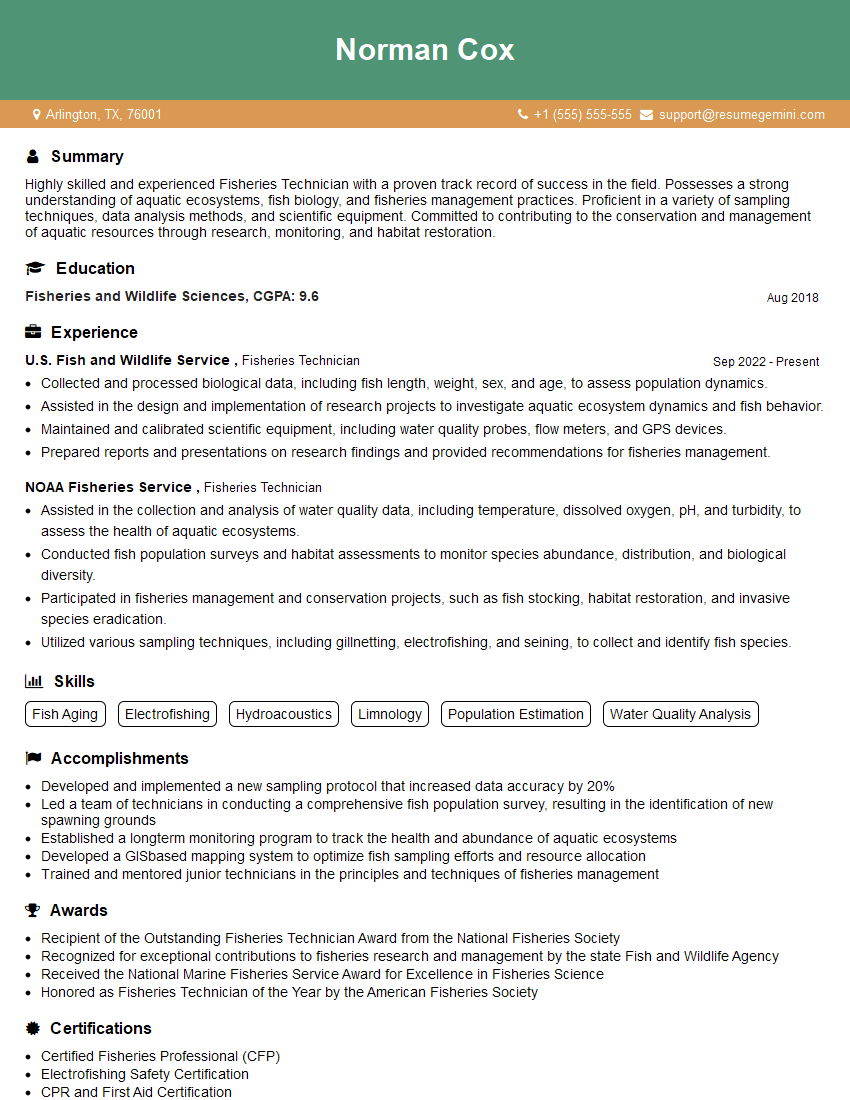
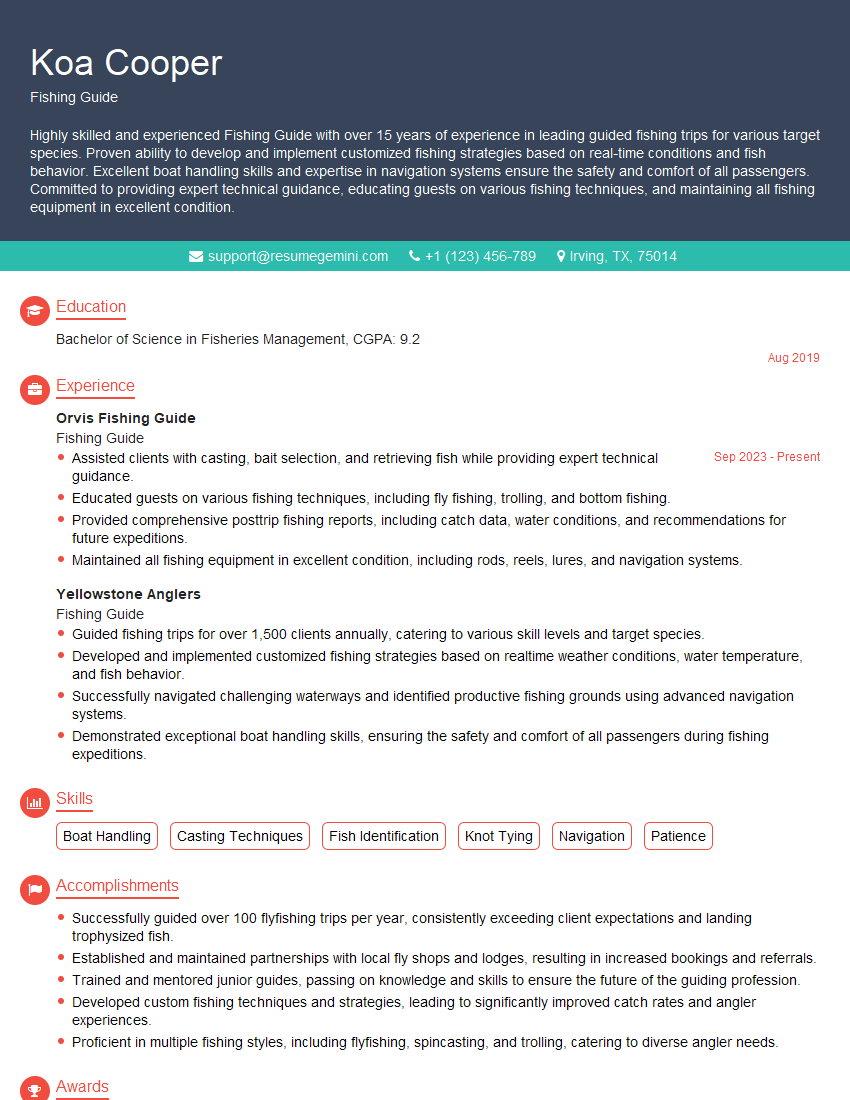
Mastering gaffing and landing techniques is essential for career advancement in the fishing industry, demonstrating both skill and responsibility. A strong resume is critical to showcasing your expertise. To maximize your job prospects, create an ATS-friendly resume that highlights your abilities and experience. We recommend using ResumeGemini to build a professional and impactful resume that catches the eye of potential employers. ResumeGemini offers examples of resumes tailored to the Gaffing and Landing Fish profession, providing a valuable resource for your job search.
Explore more articles
Users Rating of Our Blogs
Share Your Experience
We value your feedback! Please rate our content and share your thoughts (optional).
What Readers Say About Our Blog
Very informative content, great job.
good