Every successful interview starts with knowing what to expect. In this blog, we’ll take you through the top Garment Assembly and Finishing interview questions, breaking them down with expert tips to help you deliver impactful answers. Step into your next interview fully prepared and ready to succeed.
Questions Asked in Garment Assembly and Finishing Interview
Q 1. What are the different types of sewing machines used in garment assembly?
The garment industry utilizes a wide variety of sewing machines, each specialized for different tasks. The choice depends on fabric type, stitch requirements, and production volume. Some common types include:
- Lockstitch machines: These are the workhorses of garment production, creating a strong, durable stitch ideal for most seams. Think of the classic sewing machine you might have at home, but much more robust and versatile.
- Overlock (serger) machines: These machines stitch and simultaneously cut and finish raw edges, preventing fraying and creating a professional finish, often used for seams that will be visible.
- Coverstitch machines: Used for creating a professional, decorative stitch often found on hems and necklines, giving a flat, even look.
- Chainstitch machines: These create a chain-like stitch, often used for temporary basting or for creating decorative effects. They’re typically faster but less durable than lockstitch.
- Blind stitch machines: These create nearly invisible stitches, commonly used for hemming, particularly on delicate fabrics.
- Bartacking machines: These reinforce stress points like buttonholes and corners, preventing tearing.
The specific type and features of the machine will significantly impact the efficiency and quality of the garment construction.
Q 2. Explain the process of basic garment construction.
Basic garment construction follows a systematic process. Let’s take a simple t-shirt as an example:
- Pattern Making/Cutting: The process starts with a pattern – a template of the garment pieces. This pattern is then used to cut the fabric pieces. Accuracy at this stage is paramount.
- Marking and Notching: Matching marks and notches are made on the fabric pieces to ensure accurate alignment during assembly.
- Sewing the Shoulder Seams: The shoulder seams are sewn using a lockstitch machine, ensuring the seam allowance is consistent.
- Sewing the Side Seams: Similar to shoulder seams, side seams are sewn using a lockstitch machine.
- Attaching the Sleeves: Sleeves are carefully attached to the armholes, matching the notches and ensuring smooth, even seams.
- Sewing the Neckband: A neckband is attached to the neckline, creating a clean and finished edge.
- Hemming the Sleeves and Bottom: The sleeves and bottom hem are finished, typically with a double-needle or coverstitch for a professional look and durability.
This process, while simplified, highlights the key steps. More complex garments involve additional steps such as pocket attachments, zipper installation, and more elaborate finishing techniques.
Q 3. Describe your experience with different stitching techniques.
Throughout my career, I’ve mastered various stitching techniques. My experience spans from basic straight stitches to more intricate techniques. This includes:
- Straight Stitch: The foundation of most garment construction, used for seams, darts, and more. Different stitch lengths and tensions are used depending on fabric weight and style.
- Zigzag Stitch: Used for finishing raw edges to prevent fraying, attaching elastic, or creating decorative effects. The width and length are adjustable.
- Overlock Stitch: A four-thread stitch that simultaneously sews, trims, and finishes raw edges, creating a professional and durable seam, especially for knits. Different overlock stitch types cater to various fabric types and weights.
- Coverstitch: A decorative stitch often used for hems and necklines, creating a flat and professional finish. Different coverstitch types create variations in look and durability.
- Blind Hem Stitch: Creates an almost invisible hem, perfect for dress pants or skirts. The stitch is hidden within the folded fabric edge.
My proficiency in these techniques allows me to adapt to the specific needs of different projects and fabrics. I can adjust stitch parameters for optimal results depending on the project requirements.
Q 4. How do you ensure quality control during garment assembly?
Quality control is crucial in garment assembly. It begins from the initial stages of fabric inspection and continues through each step of the process. My approach incorporates:
- Pre-Production Checks: Thorough examination of fabric for defects (e.g., flaws, inconsistencies). Checking the pattern pieces for accuracy and proper marking.
- In-Process Checks: Regular monitoring of stitching quality, ensuring correct seam allowances, and checking for inconsistencies in stitching throughout the production process. This often involves visual inspection and random sampling.
- Final Inspection: A meticulous examination of the finished garment for defects, including stitching flaws, fabric imperfections, and proper size and fit. This often involves checklists and standardized grading systems.
- Using Quality Control Tools: Employing tools such as seam gauges, rulers, and fabric tension testers to ensure consistency and adherence to specifications.
- Documentation and Feedback Loops: Maintaining meticulous records of defects found, allowing for immediate corrective action and improvement in the production process.
A proactive quality control system ensures high-quality garments and reduces waste.
Q 5. What are the common defects found in garment finishing?
Common defects in garment finishing include:
- Uneven hems: Inconsistent hem widths or crooked hems.
- Loose stitches: Stitches that are loose or easily pulled apart.
- Missed stitches: Gaps or skipped stitches in the seam.
- Fabric defects: Stains, holes, or discoloration in the fabric.
- Incorrect sizing: Garment is not the correct size according to the pattern.
- Poorly finished seams: Raw, unfinished edges or uneven seam allowances.
These defects can drastically affect the quality and appeal of the garment. Preventing them requires meticulous attention to detail during each stage of the production process.
Q 6. How do you troubleshoot a malfunctioning sewing machine?
Troubleshooting a malfunctioning sewing machine requires a systematic approach. I typically follow these steps:
- Identify the Problem: What exactly is wrong? Is the machine not stitching, is it making unusual noises, or is the stitch quality poor?
- Check the Obvious: Is the power cord connected? Is the machine properly threaded? Is the needle correctly installed and sharp? Are there any obstructions in the machine such as broken threads or lint buildup?
- Check Tension: Adjust the upper and lower tension dials. Improper tension is a common cause of poor stitch quality.
- Examine the Needle and Bobbin: A bent needle or a damaged bobbin can easily cause problems. Replace these if necessary.
- Check the Timing: Some issues are related to the machine’s internal timing. This usually requires experience and a basic understanding of the machine’s mechanics. If you are unfamiliar with this, contact a professional.
- Consult the Manual: The machine’s manual provides troubleshooting guides and diagrams.
- Seek Professional Help: If the problem persists, contact a qualified sewing machine technician for repairs.
Preventing machine malfunctions involves regular maintenance, such as oiling and cleaning, and avoiding using the machine with damaged components.
Q 7. Explain the importance of maintaining a clean and organized workspace.
Maintaining a clean and organized workspace is paramount for efficiency and safety in garment assembly. A cluttered workspace leads to:
- Increased Errors: Finding materials and tools takes more time, leading to wasted time and potential mistakes.
- Reduced Productivity: Navigating a messy space slows down the entire workflow.
- Safety Hazards: Trip hazards, tangled cords, and scattered sharp objects increase the risk of accidents.
- Poor Quality Control: A disorganized area may cause damage to garments or contribute to inconsistencies.
A well-organized workspace, on the other hand, promotes focus and efficiency. This involves proper storage of tools, materials, and finished garments, a clear work surface, and regular cleaning. Think of it like this: a clear workspace leads to a clear mind, resulting in better work and fewer errors.
Q 8. How do you handle pressing different fabrics?
Pressing different fabrics requires understanding their unique properties. Think of it like cooking – you wouldn’t cook a delicate fish the same way you’d cook a tough steak. Different fabrics react differently to heat and pressure. For instance, delicate silks and rayons require low heat and a press cloth to prevent scorching. A cotton shirt, on the other hand, can tolerate higher heat and direct pressing. Wool needs a slightly damp press cloth and careful handling to avoid unwanted shine or damage. Synthetics like polyester might require lower temperatures to avoid melting. I always check the fabric content label for guidance and perform a test press on a hidden seam before proceeding on the main garment.
- Delicate Fabrics (Silk, Rayon): Low heat, press cloth, light pressure.
- Cotton: Medium to high heat, can tolerate direct pressing (but always check).
- Wool: Medium heat, damp press cloth, careful even pressure.
- Synthetics (Polyester, Nylon): Low to medium heat, avoid prolonged contact with iron.
Q 9. What are the different types of garment finishes?
Garment finishes encompass all the processes that enhance the appearance, feel, and durability of a garment after it’s been sewn. These finishes can be broadly categorized:
- Surface Finishes: These alter the look and feel of the fabric. Examples include washing (to soften denim), dyeing (to add color), printing (to add patterns), and bleaching (to lighten the color).
- Structural Finishes: These improve the garment’s shape, drape, and durability. Examples include pressing (to remove wrinkles and set seams), pleating (to create folds), and stiffening (to add structure to collars or cuffs).
- Functional Finishes: These enhance the garment’s performance. Examples include water-repellent coatings, wrinkle-resistant treatments, and stain-resistant finishes.
- Embellishments: This category includes adding details like embroidery, beading, sequins, or other decorative elements.
The choice of finish depends on the type of garment, the fabric used, and the desired aesthetic and functionality.
Q 10. Describe your experience with different pressing techniques.
My pressing experience includes a variety of techniques, ranging from basic steam ironing to specialized methods for delicate fabrics and complex garment structures. I’m proficient in using different types of pressing equipment, including steam irons, industrial pressing machines, and sleeve boards. For example, I use a pressing cloth for delicate fabrics to prevent shine or scorching, and I’ve mastered techniques like pleat setting, dart pressing, and seam pressing to create clean, crisp lines. I also have experience in using pressing ham to create curves and shaping details like shoulders. I’ve learned to tailor my pressing techniques based on the fabric type and garment construction to achieve the best possible results, always prioritizing minimizing fabric damage while maximizing sharpness and definition.
Q 11. How do you identify and correct stitching errors?
Identifying and correcting stitching errors requires a keen eye and a methodical approach. I start by carefully inspecting the garment for inconsistencies in stitch length, skipped stitches, broken threads, or puckering. If I find a problem, I’ll first try to correct it by carefully re-sewing the affected area using a matching thread and needle. If the error is severe, then I might need to unpick the stitching and redo it. For example, if there is puckering, I will check the tension of the stitch and adjust it accordingly. If the stitches are uneven, I’ll review my stitch settings and potentially adjust my speed.
My process generally involves:
- Careful visual inspection of the stitching.
- Identification of the specific type of error.
- Selection of the appropriate correction technique (resewing, unpicking, etc.).
- Precise and careful execution of the correction.
- Final inspection to ensure quality.
Q 12. What are your skills in using different types of needles and threads?
My skills with needles and threads are extensive. I’m familiar with a wide variety of needle types, including sharps, ballpoints, microtex, stretch, and jeans needles. Each type is suited for specific fabrics, from delicate silks to heavy-duty denim. I choose the needle based on the fabric type and stitch requirements. Thread selection is equally important – I know how to choose the right thread weight, fiber content (e.g., polyester, cotton, silk), and color to achieve the desired aesthetic and durability. For example, a fine silk requires a fine, sharp needle and a delicate silk thread, while heavy canvas might necessitate a heavy-duty jeans needle and a strong polyester thread.
Q 13. Explain your experience with different types of fabrics and their properties.
My experience with fabrics encompasses a wide range of materials, including natural fibers like cotton, linen, silk, wool, and blends of synthetic fibers like polyester, nylon, and spandex. I understand the properties of each fabric, such as drape, weight, texture, and its response to various finishing techniques. For example, I know that linen wrinkles easily but has a beautiful drape, while silk is delicate and prone to snags, and cotton is durable and easy to care for. This knowledge allows me to select appropriate sewing techniques and finishing processes for each material to achieve optimal results and avoid damaging the fabric.
Q 14. How do you ensure the accuracy of pattern cutting?
Ensuring accuracy in pattern cutting is crucial for a well-fitting garment. I meticulously check the pattern pieces against the original design and the fabric grain to ensure that the pattern pieces are aligned correctly, not only for placement but also for the flow of the grain of the fabric. I use precise measuring tools and pay close attention to detail to avoid any errors during cutting, taking special care with notches and markings that indicate critical alignment points. I also do test runs of pattern pieces before large scale cutting to account for any fabric shrinkage.
My process includes:
- Careful checking of the pattern pieces for accuracy before cutting.
- Accurate measurement and marking of the fabric.
- Precise cutting along the pattern lines, paying close attention to details like notches and grainlines.
- Careful handling of the cut fabric to avoid distortion or damage.
- Regularly checking my work against the pattern.
Q 15. What safety precautions do you follow while operating sewing machines?
Safety is paramount when operating sewing machines. My approach is multifaceted, starting with a thorough machine inspection before each use. I check for loose parts, proper needle alignment, and the secure fitting of the presser foot. I always ensure the machine is properly grounded to prevent electrical shocks. Further, I use the appropriate safety guards provided by the manufacturer and always keep my hands and fingers away from the needle and moving parts. Think of it like driving a car – you wouldn’t drive without checking your mirrors and seatbelt; similarly, I never operate a sewing machine without these crucial checks. I also wear safety glasses to protect my eyes from flying debris. Finally, I maintain a clean and organized workspace to minimize tripping hazards and avoid accidents.
- Regular machine maintenance: Preventative maintenance reduces the risk of malfunctions.
- Proper posture: Maintaining good posture minimizes strain and fatigue.
- Clear workspace: A tidy space reduces the chance of accidents.
Career Expert Tips:
- Ace those interviews! Prepare effectively by reviewing the Top 50 Most Common Interview Questions on ResumeGemini.
- Navigate your job search with confidence! Explore a wide range of Career Tips on ResumeGemini. Learn about common challenges and recommendations to overcome them.
- Craft the perfect resume! Master the Art of Resume Writing with ResumeGemini’s guide. Showcase your unique qualifications and achievements effectively.
- Don’t miss out on holiday savings! Build your dream resume with ResumeGemini’s ATS optimized templates.
Q 16. Describe your experience working with high-speed sewing machines.
I have extensive experience operating high-speed sewing machines, specifically in the production of women’s blouses. The key to success with these machines is precision and speed, achieved through practice and understanding the machine’s capabilities. I’ve worked with Juki and Singer high-speed models, mastering the techniques needed to maintain consistent stitch quality even at rapid speeds. Initially, it was challenging to adjust to the increased pace; however, by focusing on efficient movements and using ergonomic techniques to minimize fatigue, I was able to significantly improve my productivity without compromising quality. I also developed a systematic approach to threading and bobbin changes to minimize downtime. Think of it like learning to play a musical instrument – it takes time and dedication to master the speed and precision required for a flawless performance.
Q 17. How do you manage your time effectively in a fast-paced production environment?
In a fast-paced environment, effective time management is critical. My strategy revolves around prioritization and efficient workflow. I start my day by reviewing the production schedule and identifying high-priority tasks. I then break down larger tasks into smaller, manageable steps, using a ‘first in, first out’ (FIFO) approach to streamline my workflow. I avoid multitasking, instead focusing on completing one task before moving to the next. This method prevents errors and ensures a consistent output. I also leverage lean manufacturing principles, constantly looking for ways to eliminate waste and improve efficiency. It’s like running a marathon; you need a pacing strategy to avoid burnout and ensure you reach the finish line.
Q 18. How do you maintain consistent quality throughout the assembly process?
Maintaining consistent quality throughout assembly requires a multi-pronged approach. Firstly, I meticulously follow the specifications outlined in the technical package, paying close attention to stitch length, seam allowances, and fabric manipulation techniques. Secondly, I regularly inspect my work, comparing it to the quality standards set by the company. I also perform regular self-checks using mirrors to ensure even stitching and neat finishes. Thirdly, I don’t hesitate to seek clarification from supervisors or more experienced colleagues if I encounter any doubts or challenges. Think of it as baking a cake; you wouldn’t just throw ingredients together; you’d carefully measure each one and follow the recipe precisely to achieve the desired result.
Q 19. What are the common challenges in garment assembly and finishing, and how do you address them?
Common challenges in garment assembly and finishing include fabric defects, inconsistent material supply, machine malfunctions, and meeting tight deadlines under pressure. I address fabric defects by carefully inspecting the material before starting the assembly process, rejecting any pieces with noticeable flaws. Inconsistent material supply is tackled through proactive communication with the supply chain team. When machine malfunctions occur, I follow established procedures for reporting the issue and working with the maintenance team to get the machine back in operation quickly. Meeting deadlines requires effective time management strategies and, occasionally, prioritizing urgent tasks over others. It’s all about problem-solving and proactive management, similar to a captain navigating a ship through a storm; you anticipate challenges and take appropriate actions to maintain course.
Q 20. How do you handle working under pressure and meeting tight deadlines?
Working under pressure and meeting tight deadlines is an intrinsic part of the garment industry. My approach involves remaining calm, prioritizing tasks effectively, and seeking support from my colleagues when needed. I break down large tasks into smaller, more manageable steps, focusing on one step at a time. This prevents feeling overwhelmed and allows me to maintain focus and efficiency. I also communicate openly with supervisors about any potential delays or challenges, ensuring transparency and proactive problem-solving. It’s a balancing act, similar to tightrope walking; maintaining focus, balance, and consistent progress are crucial to success.
Q 21. Explain your experience working with different types of garment construction methods (e.g., flat-felled seams, French seams).
I have extensive experience working with various garment construction methods, including flat-felled seams, French seams, and Hong Kong seams. Flat-felled seams, for example, are incredibly durable and commonly used in men’s wear. I know precisely how to construct them correctly to create a neat, strong seam. French seams, often found in high-end garments, require more precision and attention to detail, as they involve encasing raw edges for a clean finish. Similarly, I understand the intricacies of Hong Kong seams, known for their high-end, clean finish. My experience extends to understanding which seam type is most appropriate for a particular fabric and garment type, demonstrating my comprehensive understanding of garment construction techniques. It’s not just about knowing how to sew; it’s about knowing which technique is best for each specific situation – it’s like a chef choosing the right knife for different ingredients.
Q 22. What is your knowledge of different types of garment embellishments and their application?
Garment embellishments significantly enhance the aesthetic appeal and market value of clothing. My knowledge encompasses a wide range, from basic to highly specialized techniques. These include:
- Embroidery: This involves using needles and threads to create intricate designs. I’m experienced with various embroidery types, including machine embroidery (using computerized sewing machines for high-speed production) and hand embroidery (for intricate detailing and customized designs).
- Printing: Screen printing, digital printing, and heat transfer printing allow for large-scale, cost-effective application of designs and logos. I understand the nuances of each method, including ink selection, fabric suitability, and pre- and post-treatment processes.
- Beading and Sequins: These add texture and sparkle. My experience includes hand-beading for high-end pieces and machine application for mass production, understanding the importance of secure attachment to prevent loss during wear and washing.
- Appliqués: These involve attaching fabric patches or other materials to the garment. I’m familiar with different attachment methods, including hand-sewing, machine stitching, and adhesive bonding, ensuring a durable and visually appealing finish.
- Other techniques: This includes techniques like rhinestones, studs, patches, and laser cutting, each requiring specific knowledge of application methods and material compatibility.
My experience ensures I can select the most appropriate embellishment method based on factors like design complexity, production volume, budget, and fabric type, optimizing both aesthetics and efficiency.
Q 23. Describe your experience with quality control checks at different stages of production.
Quality control is paramount in garment production. My experience involves implementing and overseeing checks at various stages:
- Fabric Inspection: Checking for flaws like holes, discoloration, and inconsistencies in the fabric before cutting. This often includes using specialized equipment to assess fabric strength and quality.
- Cutting Inspection: Verifying that the cut pieces are accurate according to the pattern, and checking for any defects resulting from the cutting process. This step is crucial for minimizing waste and ensuring consistent sizing.
- Sewing Inspection: Checking stitching quality, seam strength, and adherence to specifications. This might involve visual inspection and pulling on seams to test strength. I’m experienced in detecting common sewing errors like skipped stitches or loose threads.
- Finishing Inspection: Examining the finished garment for defects like loose threads, inconsistent hemming, missing buttons, and overall presentation. This often involves multiple levels of checks, including in-line inspections and final quality assurance checks before shipping.
I’ve implemented various statistical process control (SPC) techniques and created detailed checklists to ensure comprehensive and consistent quality checks throughout production, improving efficiency and reducing defects.
Q 24. What experience do you have with industrial sewing equipment maintenance?
My experience with industrial sewing equipment maintenance extends to both preventative and corrective maintenance. I’m proficient in:
- Preventative Maintenance: Regular lubrication, cleaning, and adjustments of sewing machines, including needle changes, tension adjustments, and bobbin replacement. Following manufacturer’s guidelines, creating maintenance schedules, and proactive troubleshooting minimizes downtime and enhances machine longevity.
- Corrective Maintenance: Troubleshooting and repairing common issues such as broken needles, jammed bobbins, and timing problems. I possess the skills to identify and replace malfunctioning parts, and understand the importance of using genuine replacement parts to maintain machine performance.
- Overseeing Machine Operators: Guiding operators on the proper use and care of machines and regularly checking machines for proper function. This includes training operators on basic troubleshooting and maintenance tasks.
My approach to maintenance ensures smooth operations and minimizes production delays. I understand the importance of well-maintained equipment for maximizing efficiency, minimizing waste, and delivering high-quality garments. In one instance, I identified a recurring needle breakage issue by adjusting the machine’s tension and needle selection, reducing downtime by 20%.
Q 25. How do you adapt to changes in production requirements and new technologies?
Adaptability is crucial in the fast-paced garment industry. I approach change through a structured process:
- Understanding the Change: Thoroughly reviewing the new requirements or technologies, seeking clarification if needed, and understanding the implications for production.
- Training and Skill Development: Actively participating in training programs and workshops to acquire new skills related to new technologies or processes. This includes both hands-on training and theoretical understanding.
- Process Adaptation: Modifying existing processes to accommodate the new requirements, optimizing workflows, and ensuring a smooth transition. This often involves collaborating with other team members and management.
- Continuous Improvement: Constantly evaluating the new processes and technologies, identifying areas for optimization, and incorporating feedback to enhance efficiency and quality. This involves data analysis and performance monitoring.
For example, when our factory transitioned to a new computerized cutting system, I actively participated in the training and helped my team adapt to the new software and procedures, ensuring a seamless transition with minimal disruption to production.
Q 26. What is your understanding of lean manufacturing principles in garment production?
Lean manufacturing principles aim to maximize value and minimize waste in production. In garment production, this translates to:
- Value Stream Mapping: Identifying and eliminating all non-value-added steps in the production process, streamlining workflows, and optimizing efficiency.
- Just-in-Time (JIT) Inventory: Maintaining minimal inventory levels to reduce storage costs and waste, ensuring materials arrive only when needed.
- Kaizen (Continuous Improvement): Implementing small, incremental improvements to processes to enhance efficiency, reduce defects, and increase productivity.
- 5S Methodology: Organizing the workspace to improve efficiency and safety through the principles of Sort, Set in Order, Shine, Standardize, and Sustain.
- Pull System: Producing garments only when there is demand, minimizing overproduction and ensuring efficient resource allocation.
I’ve been involved in implementing lean principles in several projects, resulting in reduced lead times, lower inventory costs, and improved overall efficiency. For example, by implementing a pull system, we reduced our inventory holding costs by 15% and shortened lead times by 10%.
Q 27. Describe your experience collaborating with team members in a production setting.
Collaboration is vital in a garment production setting. My experience involves effective teamwork through:
- Clear Communication: Using clear and concise communication to convey instructions, updates, and feedback to team members. This includes active listening and seeking clarification.
- Problem-Solving: Collaboratively identifying and resolving production issues through brainstorming, root cause analysis, and implementing corrective actions.
- Training and Support: Providing training and support to less experienced team members, sharing expertise and promoting knowledge transfer.
- Respectful Interactions: Maintaining a respectful and supportive environment, encouraging teamwork and open communication.
In one instance, we faced a significant delay due to a machine malfunction. By working collaboratively with the maintenance team and the production team, we were able to quickly identify the problem, find a temporary solution, and minimize the overall impact on production schedule.
Q 28. How familiar are you with different types of industrial sewing machine maintenance?
My familiarity with industrial sewing machine maintenance encompasses various aspects:
- Mechanical Maintenance: Understanding the mechanical components of sewing machines, including the needle bar, feed dog, and stitch formation mechanism, and performing repairs and adjustments as needed.
- Electrical Maintenance: Troubleshooting and repairing electrical issues, including motor problems, wiring faults, and control panel malfunctions.
- Lubrication and Cleaning: Proper lubrication of moving parts and regular cleaning to prevent wear and tear and ensure efficient operation. This includes understanding the types of lubricants suitable for different machine parts.
- Troubleshooting: Diagnosing and resolving common sewing machine problems, such as skipped stitches, inconsistent stitch length, and needle breakage.
I understand the importance of maintaining detailed maintenance logs to track machine performance and identify recurring problems. This proactive approach minimizes downtime, extends machine lifespan, and ultimately contributes to a smoother production process.
Key Topics to Learn for Garment Assembly and Finishing Interview
- Sewing Machine Operation & Maintenance: Understanding different sewing machine types, their functionalities, troubleshooting common malfunctions, and performing basic maintenance.
- Garment Construction Techniques: Practical knowledge of various stitching methods (e.g., straight stitch, zigzag stitch, overlock stitch), seam finishes, and their applications in different garment types.
- Fabric Properties & Handling: Identifying different fabric types (e.g., cotton, silk, synthetics), understanding their properties, and selecting appropriate sewing techniques for optimal results.
- Pattern Interpretation & Cutting: Ability to interpret sewing patterns, accurately cut fabric pieces, and understand pattern adjustments for fit and sizing.
- Quality Control & Inspection: Identifying defects in garments, understanding quality standards, and implementing quality control measures throughout the assembly and finishing process.
- Finishing Techniques: Mastering techniques like pressing, hemming, button attachment, zipper insertion, and other finishing processes to ensure a high-quality final product.
- Production Efficiency & Time Management: Understanding the importance of efficiency in garment production, optimizing workflow, and meeting deadlines.
- Safety Procedures & Workplace Practices: Adhering to safety regulations, using machinery safely, and maintaining a clean and organized workspace.
- Problem-solving and Adaptability: Troubleshooting issues during garment assembly, adapting to changing work demands, and finding solutions to production challenges.
Next Steps
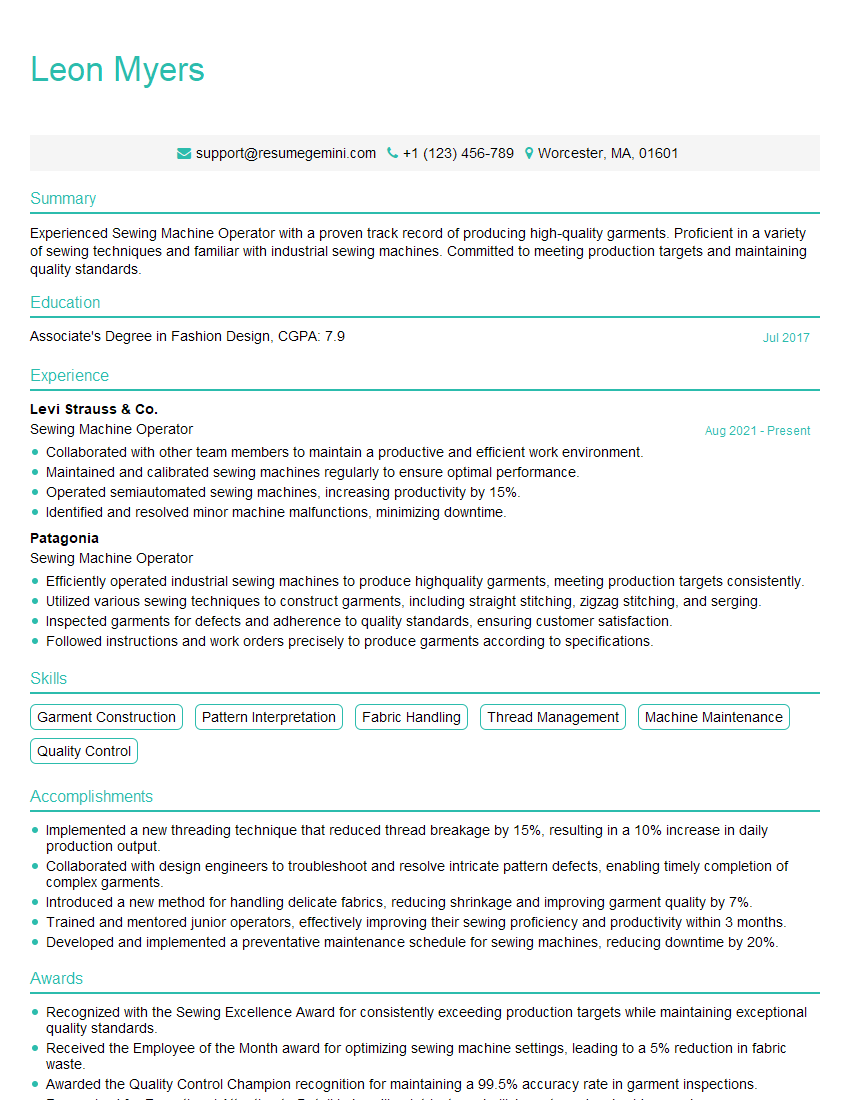
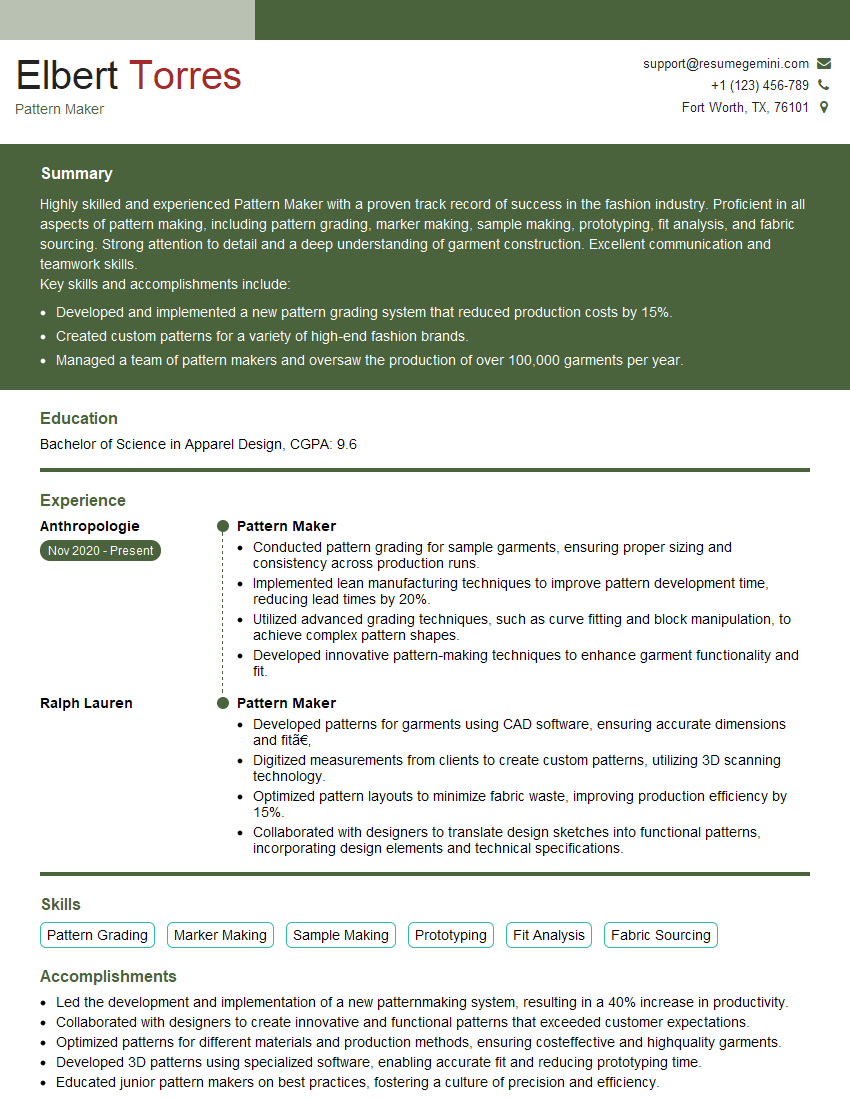
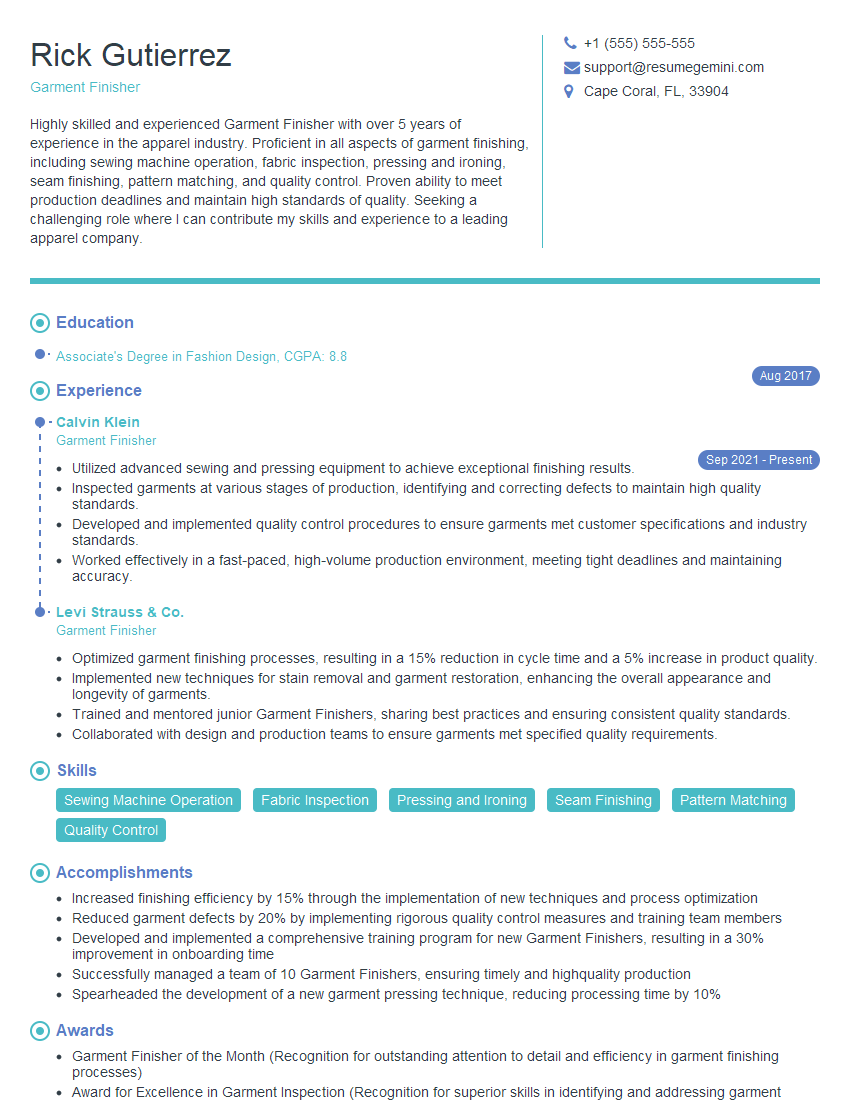
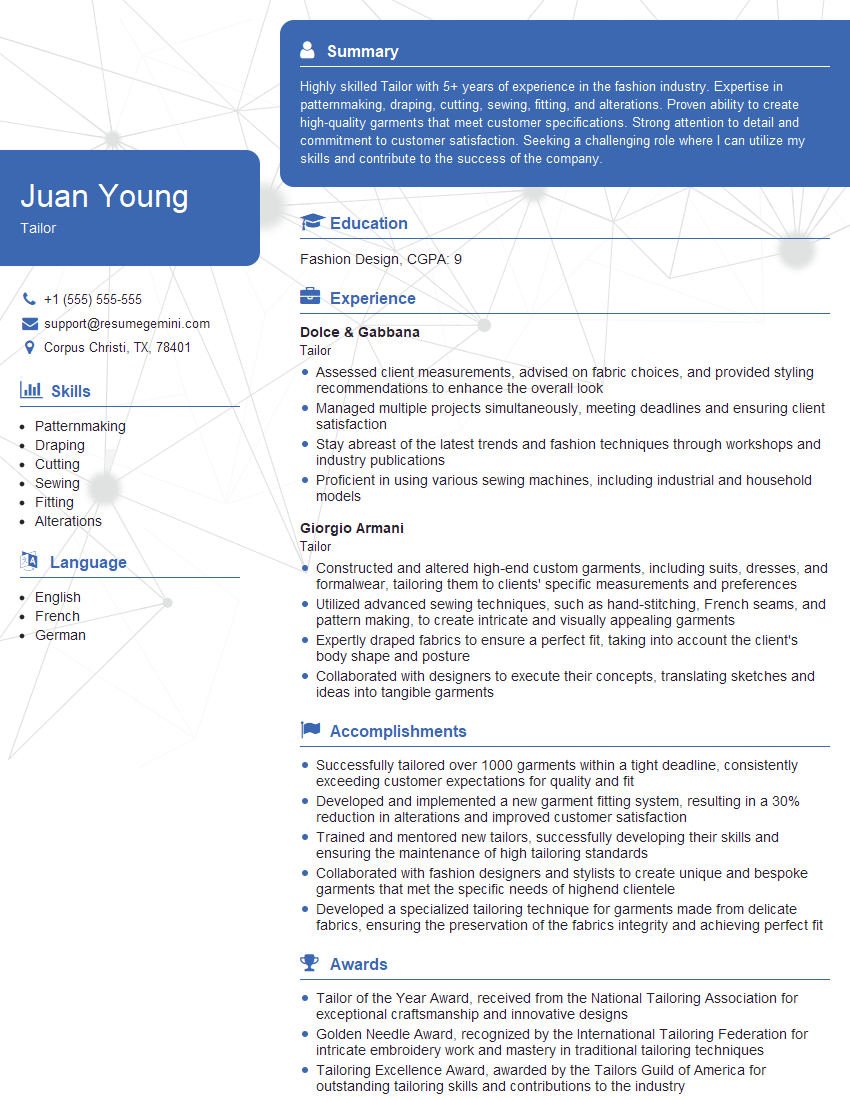
Mastering Garment Assembly and Finishing opens doors to diverse and rewarding career paths within the fashion and apparel industry. From entry-level positions to supervisory roles, your expertise in these areas is highly sought after. To significantly improve your job prospects, creating a strong, ATS-friendly resume is crucial. ResumeGemini is a trusted resource that can help you build a professional and effective resume, highlighting your skills and experience to attract potential employers. Examples of resumes tailored specifically to Garment Assembly and Finishing are available to guide you through the process.




Explore more articles
Users Rating of Our Blogs
Share Your Experience
We value your feedback! Please rate our content and share your thoughts (optional).
What Readers Say About Our Blog
Very informative content, great job.
good