Every successful interview starts with knowing what to expect. In this blog, we’ll take you through the top Training Plan Creation interview questions, breaking them down with expert tips to help you deliver impactful answers. Step into your next interview fully prepared and ready to succeed.
Questions Asked in Training Plan Creation Interview
Q 1. Describe your experience in needs analysis for training plan development.
Needs analysis is the cornerstone of effective training plan development. It’s the process of identifying the gap between the current state of performance and the desired future state. This involves a systematic investigation to understand the organization’s performance needs, learning needs of the target audience, and the resources available. Think of it like diagnosing a patient before prescribing medicine. You can’t treat the symptoms without understanding the root cause.
My approach involves a multi-faceted analysis including:
- Performance Analysis: Examining current performance data (KPIs, sales figures, error rates) to pinpoint areas needing improvement. For example, if sales are down, we’d analyze if it’s due to lack of product knowledge or ineffective sales techniques.
- Organizational Analysis: Assessing the organizational culture, structure, and resources to determine if they support training initiatives. This includes understanding the budget, time constraints, and management support.
- Task Analysis: Breaking down specific job roles into their constituent tasks to determine the skills and knowledge required for successful performance. This could involve observing employees, reviewing job descriptions, and interviewing subject matter experts.
- Individual Analysis: Evaluating the existing knowledge, skills, and abilities (KSAs) of the target audience through surveys, interviews, or assessments to identify individual learning needs. For example, a pre-training assessment could reveal that some employees need more basic instruction than others.
By combining these analyses, I build a comprehensive profile of training needs, leading to a targeted and effective training plan.
Q 2. Explain your approach to identifying learning objectives for a training program.
Defining clear learning objectives is crucial for successful training. They serve as the guideposts for the entire training process, ensuring that learners acquire the necessary knowledge, skills, and attitudes. They should be specific, measurable, achievable, relevant, and time-bound (SMART).
My approach to identifying learning objectives involves:
- Aligning with Business Needs: Starting with the overall business goals and working backward to determine how training can contribute. For example, if the goal is increased customer satisfaction, a learning objective might be ‘Participants will be able to handle customer complaints effectively in 80% of simulated scenarios.’
- Analyzing Task Requirements: Examining the tasks employees must perform and defining the KSAs required. If a task is ‘processing customer orders,’ objectives could include ‘Participants will be able to accurately input order details into the system within 5 minutes’ and ‘Participants will be able to identify and resolve common order entry errors.’
- Considering Learner Characteristics: Taking into account the prior experience, learning styles, and demographics of the learners. This ensures the objectives are tailored to their needs and abilities.
- Using Action Verbs: Framing objectives using action verbs that clearly define the expected learner behavior. Instead of saying ‘Understand marketing principles,’ I’d use ‘Apply marketing principles to develop a targeted social media campaign.’
Once defined, these objectives form the basis for designing the curriculum, assessing learning, and measuring the training’s effectiveness.
Q 3. How do you determine the most appropriate training delivery methods (e.g., online, in-person, blended)?
Choosing the right training delivery method is critical for maximizing impact and engagement. The ideal method depends on factors like the learning objectives, target audience, budget, and available resources. There’s no one-size-fits-all solution. I consider the pros and cons of various methods and often opt for a blended approach.
- Online Learning (eLearning): Cost-effective for large groups, accessible anytime, anywhere. Best for delivering information, knowledge acquisition, and self-paced learning. However, it can lack the interaction and immediate feedback of in-person training.
- In-Person Training: Facilitates interaction, collaboration, and immediate feedback. Ideal for hands-on activities, skill development, and building relationships. But it’s more expensive, requires scheduling coordination, and has limited reach.
- Blended Learning: Combines online and in-person methods to leverage the strengths of both. For example, pre-work could be done online, followed by in-person workshops for skill practice and collaboration. This offers flexibility and a more holistic learning experience.
For instance, training sales staff on a new product might involve online modules to learn product features, followed by in-person role-playing sessions to practice sales techniques. This ensures that learners receive both the theoretical knowledge and the practical application.
Q 4. How do you measure the effectiveness of a training program?
Measuring training effectiveness is essential to demonstrate its return on investment (ROI) and identify areas for improvement. My approach employs a multi-level evaluation strategy, using both formative and summative assessment methods.
- Reactions: Assessing participant satisfaction through surveys and feedback forms. This helps understand the training’s appeal and identify aspects needing improvement.
- Learning: Measuring knowledge gained through pre- and post-training assessments, quizzes, and tests. This determines if learning objectives were met.
- Behavior: Observing on-the-job performance changes to see if learners are applying their new knowledge and skills. This might involve performance reviews, observations, or 360-degree feedback.
- Results: Evaluating the impact of training on business outcomes, such as increased productivity, reduced errors, or improved customer satisfaction. This demonstrates the training’s contribution to organizational goals. Using KPIs is key here.
A balanced approach to evaluating these four levels allows for a comprehensive understanding of the training’s overall success. If there’s a disconnect between learning and results, it points to a need for adjustments in the training program.
Q 5. Describe your process for developing a training budget.
Developing a realistic training budget is critical. It’s not just about the costs; it’s about justifying the investment. My approach is to break down costs into several categories:
- Instructor Fees: Cost of hiring internal or external trainers, including travel and accommodation if applicable.
- Materials and Resources: Costs of training materials (handouts, workbooks), software licenses, online learning platforms, and equipment.
- Venue Costs: Rental fees for training rooms, conference facilities, or virtual meeting platforms.
- Technology Costs: Investment in LMS software, video conferencing tools, and other relevant technologies.
- Administrative Costs: Time spent on planning, coordination, communication, and participant management.
- Evaluation Costs: Expenses associated with pre- and post-training assessments, surveys, and other evaluation methods.
I then analyze these costs against the potential benefits (increased productivity, reduced errors, improved customer satisfaction) to demonstrate the ROI. This budget is presented with clear justification, showing how each expense contributes to overall training effectiveness.
Q 6. How do you ensure training content is engaging and relevant?
Engaging and relevant training content keeps learners motivated and promotes knowledge retention. It’s about making the learning experience enjoyable and applicable to their everyday work. My strategies include:
- Storytelling: Using narratives and real-world examples to connect with learners and make the content more memorable.
- Interactive Activities: Incorporating quizzes, games, simulations, and group discussions to actively involve learners and enhance engagement.
- Visual Aids: Utilizing images, videos, infographics, and other visual elements to improve understanding and retention.
- Relevance to Job Roles: Directly linking training content to learners’ tasks and responsibilities. Focusing on practical skills and knowledge they’ll use immediately.
- Regular Feedback: Providing constructive feedback throughout the training process to reinforce learning and address any misconceptions.
For example, instead of simply lecturing on customer service, I might use role-playing exercises, case studies, and videos of successful customer interactions to make the learning more engaging and practical.
Q 7. What experience do you have with Learning Management Systems (LMS)?
I have extensive experience with various Learning Management Systems (LMS), including Moodle, Canvas, and Cornerstone OnDemand. My experience encompasses more than just uploading content; it extends to course design within the LMS, leveraging its features for effective learning delivery and tracking.
My expertise includes:
- Course Development: Designing and developing engaging online courses using LMS features like modules, quizzes, and discussion forums.
- Content Management: Organizing and managing training materials effectively within the LMS, ensuring easy access and navigation for learners.
- Learner Tracking and Reporting: Utilizing LMS analytics to monitor learner progress, identify areas needing improvement, and measure training effectiveness.
- Integration with other systems: Connecting the LMS with other organizational systems (HR, performance management) to streamline administrative processes and ensure data consistency.
I’m proficient in utilizing the LMS to create personalized learning paths, manage user access, track completions, and generate reports on training effectiveness. This ensures a streamlined and effective learning management process.
Q 8. How do you handle resistance to training within an organization?
Resistance to training is a common hurdle. It stems from various sources – lack of time, perceived irrelevance, fear of change, or even negative past training experiences. My approach is multifaceted and begins with understanding the root cause of the resistance.
- Active Listening and Engagement: I start by actively listening to concerns and addressing them directly. This often involves one-on-one conversations to understand individual perspectives.
- Demonstrating Value: I highlight the direct benefits of the training, linking it to individual roles, responsibilities, and career growth. For example, if the training is on a new software, I’ll showcase how it can streamline their workflow and potentially reduce their workload.
- Pilot Programs and Feedback Loops: I might implement a pilot program with a smaller group, allowing for iterative improvements and addressing concerns before full rollout. Feedback from this group informs the final training design.
- Incentivization and Recognition: Offering incentives, such as certificates of completion or recognition in team meetings, can significantly boost participation and engagement.
- Leadership Buy-in: Secure buy-in from leadership is critical. Their support and active participation can positively influence employee attitudes toward the training.
For example, in a previous role, we faced significant resistance to a new CRM system training. By conducting individual interviews, we discovered the main concern was the perceived complexity of the software and lack of time. We responded by offering shorter, more focused training sessions, providing individual coaching, and highlighting the time savings in the long run. This resulted in a significant increase in engagement and successful adoption.
Q 9. Explain your experience in creating assessments to evaluate learning outcomes.
Assessment design is crucial for evaluating learning effectiveness. I design assessments that are aligned with the learning objectives, using a variety of methods to ensure comprehensive evaluation.
- Pre-tests and Post-tests: These measure knowledge gain and identify areas needing further attention.
- Knowledge Checks: Embedded throughout the training, these ensure continuous learning and identify knowledge gaps in real-time.
- Performance-Based Assessments: These simulate real-world scenarios allowing trainees to demonstrate practical application of learned skills, such as role-playing or case studies.
- Surveys and Feedback Forms: These gather learner feedback on training effectiveness and identify areas for improvement.
- Observations: In some cases, direct observation of trainees in their workplace after the training helps evaluate practical application.
For instance, when developing training on customer service, I designed a post-test that included scenario-based questions testing their ability to handle difficult customers, mirroring real-world situations. This provided a more realistic evaluation of their acquired skills than a simple multiple-choice test.
Q 10. How do you adapt training materials to meet the needs of diverse learners?
Adapting training materials for diverse learners is essential for ensuring inclusivity and maximizing impact. I incorporate several strategies to achieve this:
- Multi-Modal Learning: I leverage various learning styles by incorporating videos, audio, interactive exercises, and text-based content. This caters to visual, auditory, and kinesthetic learners.
- Accessibility Considerations: I ensure all materials are accessible to learners with disabilities by following accessibility guidelines (e.g., WCAG). This includes providing alternative text for images, using clear font styles, and offering transcripts for audio/video content.
- Language Support: If the training is intended for a multilingual audience, I offer translated versions or use tools for real-time translation.
- Cultural Sensitivity: I ensure that the content and examples used are culturally appropriate and sensitive to the backgrounds of all learners.
- Differentiated Instruction: I provide various levels of support, catering to learners with different prior knowledge and skill levels. This could include optional advanced materials or additional resources for those needing extra help.
For example, when creating a safety training program, I incorporated videos with closed captions, interactive simulations, and handouts with clear visual aids. This made the training accessible and engaging for learners with diverse learning styles and needs.
Q 11. Describe your experience in designing and developing eLearning modules.
I have extensive experience designing and developing eLearning modules using various tools and technologies. My process typically involves:
- Needs Assessment: Defining clear learning objectives and identifying the target audience’s knowledge gaps.
- Storyboarding: Creating a visual representation of the module’s content and flow, ensuring a logical and engaging learning experience.
- Content Creation: Developing engaging and informative content, using a variety of media such as videos, animations, interactive exercises, and quizzes.
- Interactive Design: Incorporating interactive elements to enhance engagement and knowledge retention, such as branching scenarios, simulations, and gamification elements.
- Testing and Refinement: Thoroughly testing the module for functionality and usability, and iteratively refining it based on feedback.
I’m proficient in using authoring tools such as Articulate Storyline, Adobe Captivate, and Lectora. For example, in a recent project, I developed an eLearning module on compliance procedures using Articulate Storyline. I incorporated interactive scenarios, branching narratives, and knowledge checks to make the training engaging and effective.
Q 12. How do you ensure training programs are aligned with business goals?
Aligning training programs with business goals is paramount for maximizing ROI. I accomplish this by:
- Strategic Planning: Collaborating with business leaders to identify key business objectives and translate them into specific training needs.
- Performance Gap Analysis: Identifying skill gaps within the workforce that are hindering the achievement of business goals.
- Performance Metrics: Defining measurable metrics to track the effectiveness of the training in achieving business goals, such as increased sales, improved productivity, or reduced error rates.
- Return on Investment (ROI) Analysis: Quantifying the return on investment of the training program by measuring improvements in business outcomes.
- Continuous Improvement: Regularly reviewing and updating the training program based on performance data and feedback to ensure it remains aligned with evolving business needs.
For example, when a company wanted to increase sales, we developed training focused on sales techniques and customer relationship management. Post-training, we tracked sales figures and found a significant increase, demonstrating the direct link between training and business success.
Q 13. What are some common challenges you’ve faced in training plan creation and how did you overcome them?
Several challenges arise in training plan creation. One common challenge is securing sufficient budget and resources. Another is managing conflicting priorities and deadlines.
- Budget Constraints: To overcome budget limitations, I prioritize training needs, focusing on high-impact areas with the greatest return on investment. I also explore cost-effective solutions, such as leveraging free online resources or developing in-house materials.
- Conflicting Priorities: When faced with competing priorities, I utilize project management techniques like prioritization matrices and Gantt charts to ensure efficient resource allocation and timely completion.
- Stakeholder Management: I proactively engage stakeholders throughout the process, actively seeking their input and addressing their concerns to foster collaboration and buy-in.
- Measuring Effectiveness: To accurately assess the impact of training, I establish clear metrics and evaluation methods at the outset. This helps in gathering data to demonstrate the value of the training program.
In one instance, a project had a tight deadline and limited resources. To address this, I streamlined the training content, focused on the most crucial aspects, and utilized readily available resources, ensuring we still met the objectives within the constraints.
Q 14. What software or tools are you proficient in using for training development?
I’m proficient in a range of software and tools for training development. These include:
- Authoring Tools: Articulate Storyline, Adobe Captivate, Lectora, and Elucidat.
- Video Editing Software: Adobe Premiere Pro, Final Cut Pro.
- Graphic Design Software: Adobe Photoshop, Illustrator.
- Learning Management Systems (LMS): Moodle, Blackboard, Canvas, and TalentLMS.
- Collaboration Tools: Google Workspace (Docs, Sheets, Slides), Microsoft Office 365.
My familiarity with these tools allows me to create and deliver high-quality training materials effectively and efficiently, adapting to various project needs and technologies.
Q 15. How do you manage and track the progress of training participants?
Managing and tracking participant progress is crucial for effective training. I employ a multi-faceted approach combining technology and personalized interaction. This typically involves a Learning Management System (LMS) to track course completion, quiz scores, and assignment submissions. The LMS provides data visualization, allowing me to identify areas where participants are struggling and tailor interventions. For example, if I see a significant drop-off in engagement after module three, I know to revisit that material and perhaps offer additional support, like supplemental videos or small group coaching sessions.
Beyond the LMS, I regularly incorporate informal check-ins. This could be through quick polls during training sessions, brief surveys after modules, or individual conversations to gauge understanding and address any roadblocks. This combination of automated tracking and personalized feedback ensures a holistic view of progress and allows for proactive intervention.
For instance, in a recent leadership training program, our LMS indicated a lower-than-average score on a conflict resolution module. Following this, we scheduled additional sessions focusing on practical application and role-playing exercises, significantly improving performance in subsequent assessments.
Career Expert Tips:
- Ace those interviews! Prepare effectively by reviewing the Top 50 Most Common Interview Questions on ResumeGemini.
- Navigate your job search with confidence! Explore a wide range of Career Tips on ResumeGemini. Learn about common challenges and recommendations to overcome them.
- Craft the perfect resume! Master the Art of Resume Writing with ResumeGemini’s guide. Showcase your unique qualifications and achievements effectively.
- Don’t miss out on holiday savings! Build your dream resume with ResumeGemini’s ATS optimized templates.
Q 16. How do you incorporate feedback into the iterative process of training development?
Feedback is the lifeblood of iterative training development. I integrate feedback loops at multiple stages, from initial needs analysis to post-training evaluation. I use various methods to gather feedback, including participant surveys, focus groups, and observation of training sessions. For example, I might ask participants to complete a short survey at the end of each module, providing both quantitative data (e.g., ratings) and qualitative feedback (e.g., open-ended comments).
This feedback helps inform revisions to the training materials and delivery methods. If a particular concept is consistently confusing, I’ll revise the content, perhaps adding clarifying examples or simplifying the language. If participants find the pace too slow, I might incorporate more interactive elements to maintain engagement. This iterative process ensures that the training continually improves and aligns with the needs of the learners.
For instance, in a technical skills training, post-training feedback revealed confusion regarding a specific software feature. This led to the creation of supplemental video tutorials and the inclusion of more hands-on practice sessions in subsequent iterations.
Q 17. Explain your experience in creating and delivering training to large groups.
I have extensive experience designing and delivering training to large audiences. My approach emphasizes clear communication, engaging content, and effective use of technology. For example, I’ve delivered training webinars to hundreds of participants simultaneously, using interactive polls, Q&A sessions, and breakout rooms to foster participation and ensure everyone feels heard. To maintain engagement during lengthy sessions, I incorporate varied methods like presentations, interactive games, group activities, and case studies.
When delivering in-person training to large groups, I employ techniques like active learning strategies, small group discussions, and frequent check-ins to maintain engagement and address individual needs. Effective use of visual aids, like slides and videos, are also crucial in maintaining clarity and focus for larger groups. Clear structure, repetition of key concepts, and summary points at the end of each section are also crucial to ensuring understanding with large groups. I prioritize clear communication, both verbally and through visual materials, to ensure all participants understand the training material, regardless of their learning style.
Q 18. How do you ensure training materials are accessible to individuals with disabilities?
Ensuring accessibility for individuals with disabilities is paramount. I adhere to WCAG (Web Content Accessibility Guidelines) when developing training materials. This includes providing alternative text for images, using clear and concise language, ensuring sufficient color contrast, and offering transcripts for videos. For individuals with visual impairments, I ensure the availability of screen reader-compatible formats like text-based PDFs and audio recordings.
For learners with auditory impairments, I provide closed captions or transcripts for videos and audio materials. When designing interactive components, I consider accessibility implications, for example, ensuring that keyboard navigation is possible and that color is not the only method of conveying information. I also offer various learning formats to accommodate different needs – for example, providing printouts or large-font versions of materials along with digital options.
Q 19. What is your experience with adult learning principles?
My training designs are grounded in adult learning principles, such as Knowles’ Andragogy model. This emphasizes self-concept, prior experience, readiness to learn, orientation to learning, and motivation. I believe that adult learners are self-directed and bring valuable life experiences to the learning environment. Therefore, I incorporate experiential learning methods like case studies, simulations, and problem-solving activities to actively engage learners and foster their autonomy.
I also focus on relevance, tailoring training content to address the specific needs and goals of the learners. For example, instead of lecturing on abstract concepts, I’ll present real-world scenarios and case studies to show how the skills apply to their work. Furthermore, I foster a collaborative and supportive learning environment, encouraging peer interaction and knowledge sharing. I use methods like group discussions, peer feedback, and collaborative projects to enhance the learning experience.
Q 20. How do you stay current with trends and best practices in training and development?
Staying current in the field of training and development is essential. I actively engage in continuous professional development through several avenues. I regularly attend conferences, webinars, and workshops to learn about the latest trends and best practices. I also subscribe to industry publications, follow influential thought leaders on social media, and participate in professional networks.
I constantly review and evaluate my training methodologies and materials to ensure they are aligned with current best practices. I regularly explore new technologies and learning tools that can enhance the effectiveness and engagement of my training programs. For example, I recently incorporated microlearning techniques and gamification elements into my training designs to meet the demands of shorter attention spans and evolving preferences among learners.
Q 21. Describe your experience with project management methodologies in the context of training development.
I have extensive experience utilizing project management methodologies, primarily Agile, in training development. This allows for flexibility and adaptation throughout the process. I use Agile’s iterative approach, breaking down the training project into smaller, manageable sprints, allowing for continuous evaluation and refinement. Each sprint focuses on a specific deliverable, like creating a module, conducting a pilot session, or developing assessment materials.
I utilize project management tools to track progress, manage resources, and ensure timely completion. This typically includes using tools to manage tasks, deadlines, and communication with stakeholders. Effective communication is key, and I regularly provide progress updates to stakeholders throughout the project lifecycle. This collaborative and iterative approach ensures that the final training program effectively meets the needs of learners and aligns with the overall objectives, incorporating feedback and adjustments along the way.
Q 22. How do you prioritize training initiatives based on business needs?
Prioritizing training initiatives based on business needs is crucial for maximizing ROI. I use a strategic approach that combines data analysis with stakeholder collaboration. First, I analyze business objectives, identifying key performance indicators (KPIs) and areas needing improvement. This could involve reviewing sales figures, customer satisfaction surveys, or employee performance reviews. For example, if sales are down due to a lack of product knowledge among the sales team, product training becomes a top priority.
Next, I conduct a needs analysis, gathering information from various sources like surveys, interviews, and focus groups to understand the specific knowledge and skill gaps. This helps determine the precise training needs and tailor the content accordingly. Finally, I use a prioritization matrix, weighing factors like urgency, impact on business goals, and available resources. This allows me to create a prioritized list of training initiatives, ensuring that the most impactful training is delivered first.
For instance, if the company is launching a new product (high impact, high urgency) and employee skills are lacking, this training would take precedence over a less critical initiative like compliance training (lower impact, lower urgency), even if the latter is also important.
Q 23. What is your approach to building a training evaluation strategy?
My approach to building a training evaluation strategy is multifaceted and aligns with Kirkpatrick’s four levels of evaluation. This ensures we measure the effectiveness of the training program at multiple levels, not just immediate reaction. The strategy includes:
- Level 1: Reaction: Assessing learner satisfaction through surveys and feedback forms immediately after the training. This helps identify areas needing improvement in delivery or content.
- Level 2: Learning: Measuring knowledge gained through quizzes, tests, and practical exercises. This quantifies how much knowledge was acquired during the training.
- Level 3: Behavior: Observing changes in on-the-job performance. This could involve monitoring performance metrics, peer evaluations, or 360-degree feedback to see if trainees are applying their new knowledge and skills.
- Level 4: Results: Measuring the overall impact on business outcomes. This may involve tracking sales increases, reduced error rates, or improved customer satisfaction. It links training directly to business goals.
By using a mix of quantitative (tests, data analysis) and qualitative (feedback, observations) methods, we gain a comprehensive understanding of the training’s effectiveness and its impact on the organization.
Q 24. How do you handle unexpected issues or challenges that may arise during training delivery?
Unexpected issues during training delivery are inevitable. My approach focuses on proactive planning and adaptable solutions. I always have contingency plans in place, including backup instructors, alternative delivery methods (online backup if in-person is disrupted), and readily available technical support. If the technology fails, I have a plan B ready, such as switching to a non-tech-dependent method.
For example, during an in-person session, if the projector malfunctions, I’d immediately switch to handouts or alternative presentation materials. If a key speaker is unavailable, I have prepared alternative content or delegate parts to other knowledgeable staff. Furthermore, open communication is crucial. I keep stakeholders updated on any issues and work collaboratively to find the best solution. This transparency helps mitigate negative impacts and builds trust.
Q 25. Describe your experience with gamification in training.
I have extensive experience using gamification to enhance training engagement and knowledge retention. Gamification introduces game-design elements into the training, such as points, badges, leaderboards, and challenges. This helps to motivate learners and make the learning process more enjoyable. I’ve successfully integrated gamified elements into various training programs, from compliance training to sales skills development.
For example, in a sales training program, I used a points system where trainees earned points for completing modules, achieving high scores on quizzes, and demonstrating effective sales techniques in role-playing exercises. These points could be redeemed for rewards like gift cards or extra time off, further incentivizing participation. The leaderboard added an element of friendly competition, motivating trainees to perform better.
However, it’s crucial to design gamification strategically; it shouldn’t feel forced or superficial. The game mechanics should align with the learning objectives and be relevant to the trainees’ needs and interests. Forcing gamification can be detrimental, making the training feel less serious than it needs to be.
Q 26. What is your understanding of different training methodologies, such as Kirkpatrick’s four levels of evaluation?
Kirkpatrick’s four levels of evaluation provide a robust framework for assessing training effectiveness. They are:
- Level 1: Reaction: Measures learner satisfaction and engagement.
- Level 2: Learning: Assesses knowledge and skill acquisition.
- Level 3: Behavior: Measures the application of learned knowledge and skills in the workplace.
- Level 4: Results: Evaluates the impact of training on organizational outcomes.
Beyond Kirkpatrick’s model, I’m familiar with various other training methodologies, including:
- Andragogy: Adult learning principles emphasizing self-direction, experience, and relevance.
- Experiential Learning: Learning through direct experience and reflection.
- Instructional Design Models (ADDIE, SAM): Frameworks for systematic development and implementation of training programs.
- Blended Learning: Combining online and offline training methods for a more comprehensive approach.
My understanding of these methodologies enables me to select and apply the most appropriate approach based on the specific learning objectives, target audience, and available resources.
Q 27. How do you create a training plan that considers various learning styles?
Creating a training plan that caters to various learning styles is essential for maximizing learner engagement and knowledge retention. I use a multi-modal approach that combines various learning methods, catering to visual, auditory, and kinesthetic learners. This can be achieved through incorporating:
- Visual aids: Charts, graphs, presentations, videos.
- Auditory learning: Lectures, discussions, podcasts.
- Kinesthetic learning: Hands-on activities, role-playing, simulations.
For example, in a technical training session, I might use diagrams and illustrations (visual) to explain complex concepts, supplement it with verbal explanations and discussions (auditory), and then provide hands-on practice with the actual equipment (kinesthetic). This ensures that learners of all styles can grasp the material effectively. Furthermore, providing diverse learning materials (e.g., video tutorials, interactive modules, written guides) caters to individual preferences and learning paces. I also incorporate methods for learners to self-assess and identify their dominant learning styles.
Q 28. Describe a time you had to revise a training plan due to unforeseen circumstances.
During the development of a leadership training program for a retail chain, we experienced unforeseen circumstances. The planned keynote speaker, a high-profile CEO, had to cancel due to a last-minute family emergency. This was only a week before the training was scheduled to begin. Immediately, we activated our contingency plan. We contacted several backup speakers and finally secured an equally qualified and well-respected industry expert who could deliver a similar message.
However, this necessitated a quick revision of the training agenda to accommodate the new speaker’s presentation style and content expertise. We revised the schedule, modified some materials, and ensured the new speaker had access to the necessary background information. We also proactively communicated the changes to the participants, ensuring transparency and minimizing disruption. The training ultimately proceeded smoothly, and participant feedback remained highly positive. This incident underscored the importance of having comprehensive contingency plans and maintaining open communication during unexpected disruptions. This showed our ability to adapt and maintain training quality even in challenging circumstances.
Key Topics to Learn for Training Plan Creation Interview
- Needs Analysis: Understanding learner needs, goals, and existing knowledge through various assessment methods (surveys, interviews, observations).
- Learning Objectives: Defining clear, measurable, achievable, relevant, and time-bound (SMART) learning objectives aligned with organizational goals.
- Curriculum Design: Structuring the training content logically, sequencing learning activities effectively, and incorporating diverse learning methods (e.g., lectures, workshops, simulations).
- Instructional Strategies: Selecting appropriate teaching methods to cater to different learning styles and preferences (e.g., visual, auditory, kinesthetic).
- Assessment & Evaluation: Designing formative and summative assessments to measure learning outcomes and the effectiveness of the training program.
- Technology Integration: Leveraging technology (e.g., LMS, e-learning platforms, virtual reality) to enhance the learning experience and accessibility.
- Budgeting & Resource Allocation: Developing a realistic budget and allocating resources effectively to ensure successful program implementation.
- Program Delivery & Facilitation: Effectively delivering the training program, managing participants, and adapting to different learning environments.
- Post-Training Evaluation & Improvement: Gathering feedback, analyzing data, and making improvements to the training program based on evaluation results.
- Training Materials Development: Creating engaging and effective training materials (handouts, presentations, online resources) that support learning objectives.
Next Steps
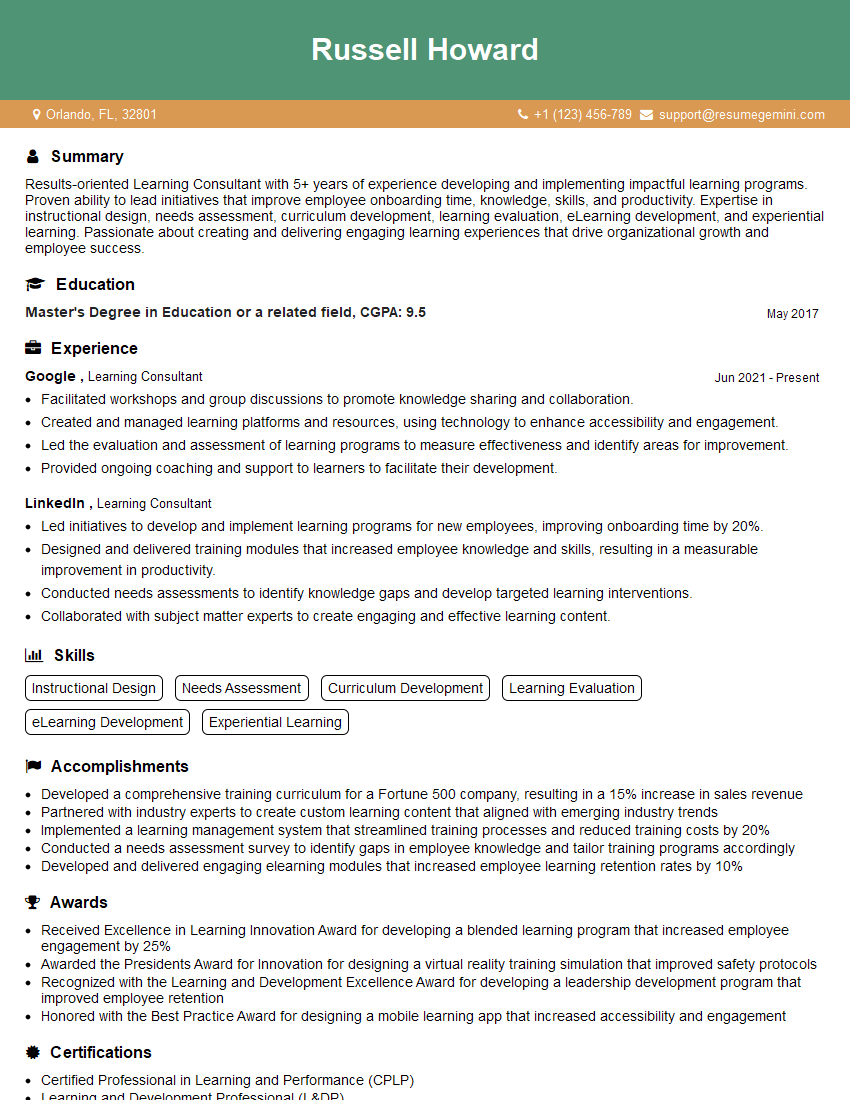
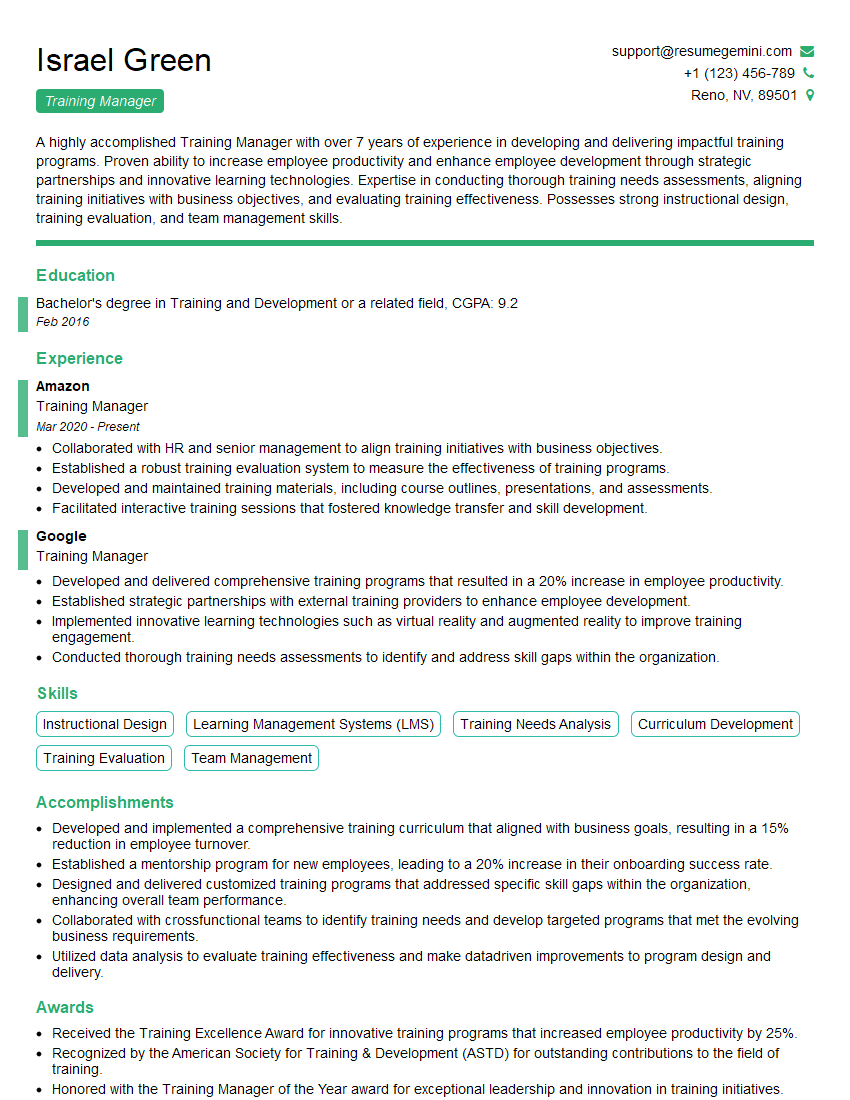
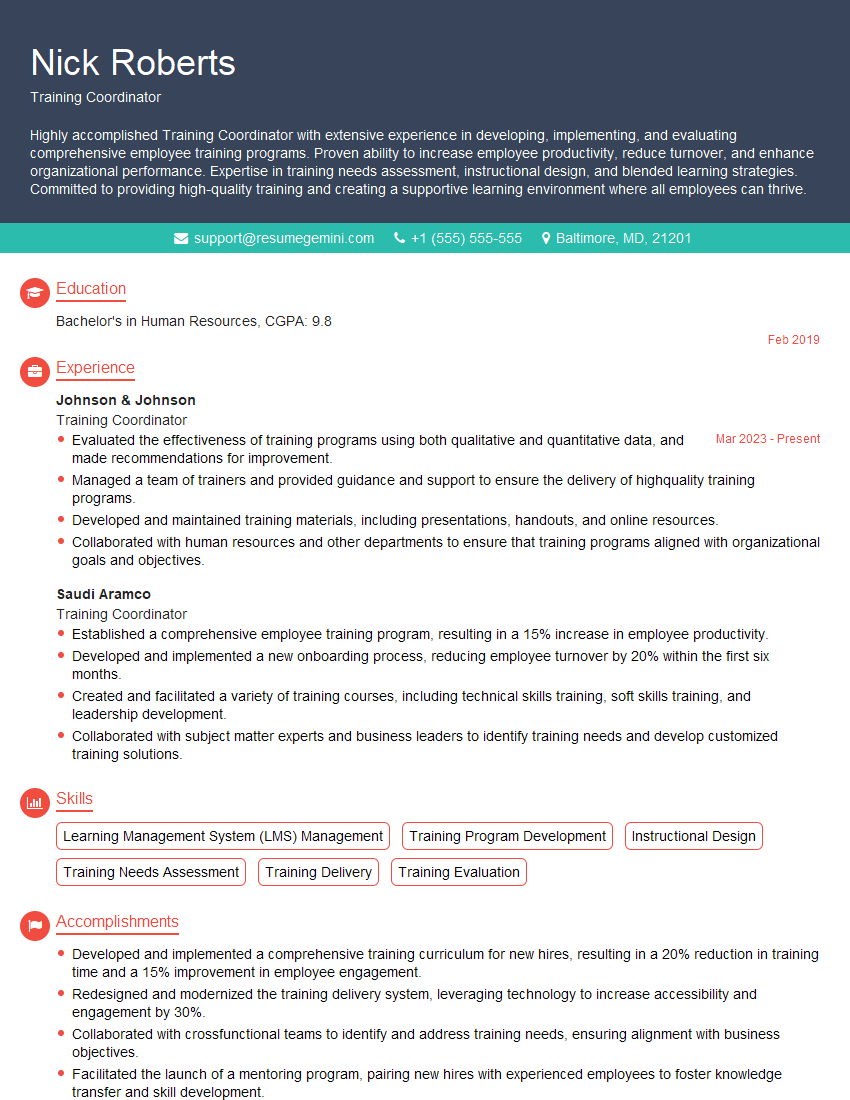
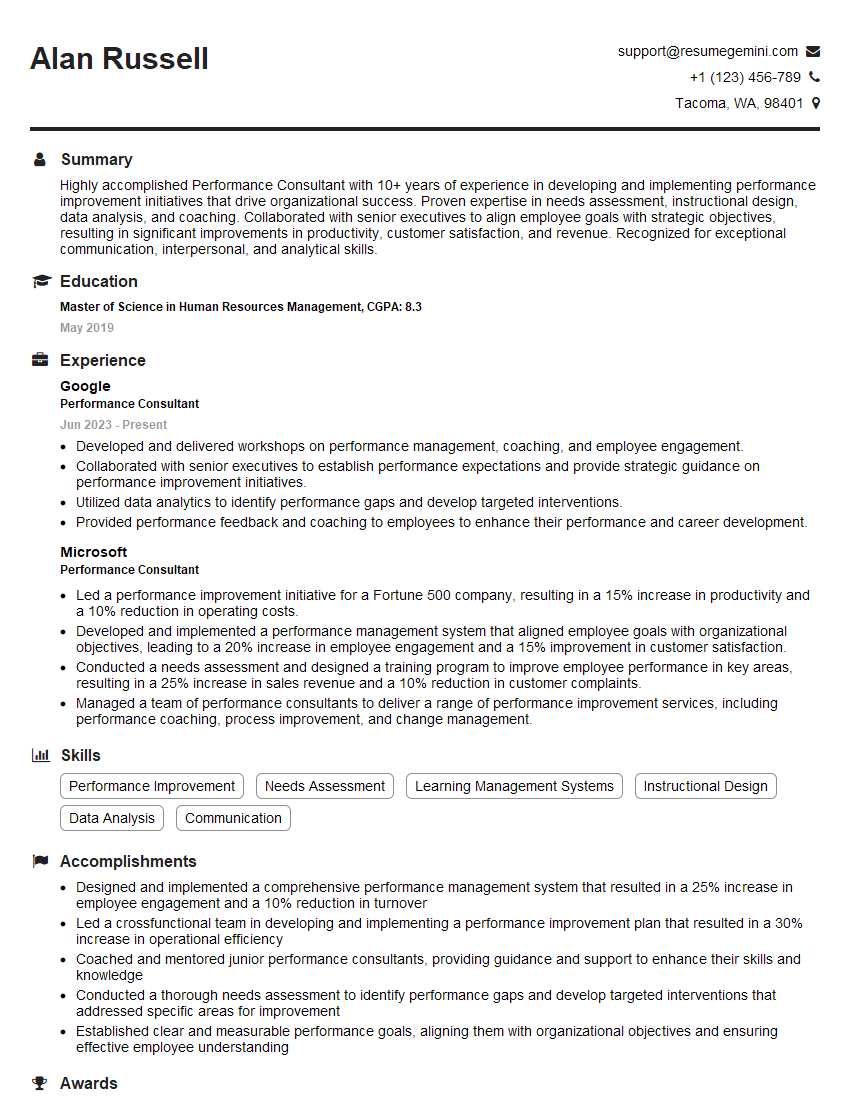
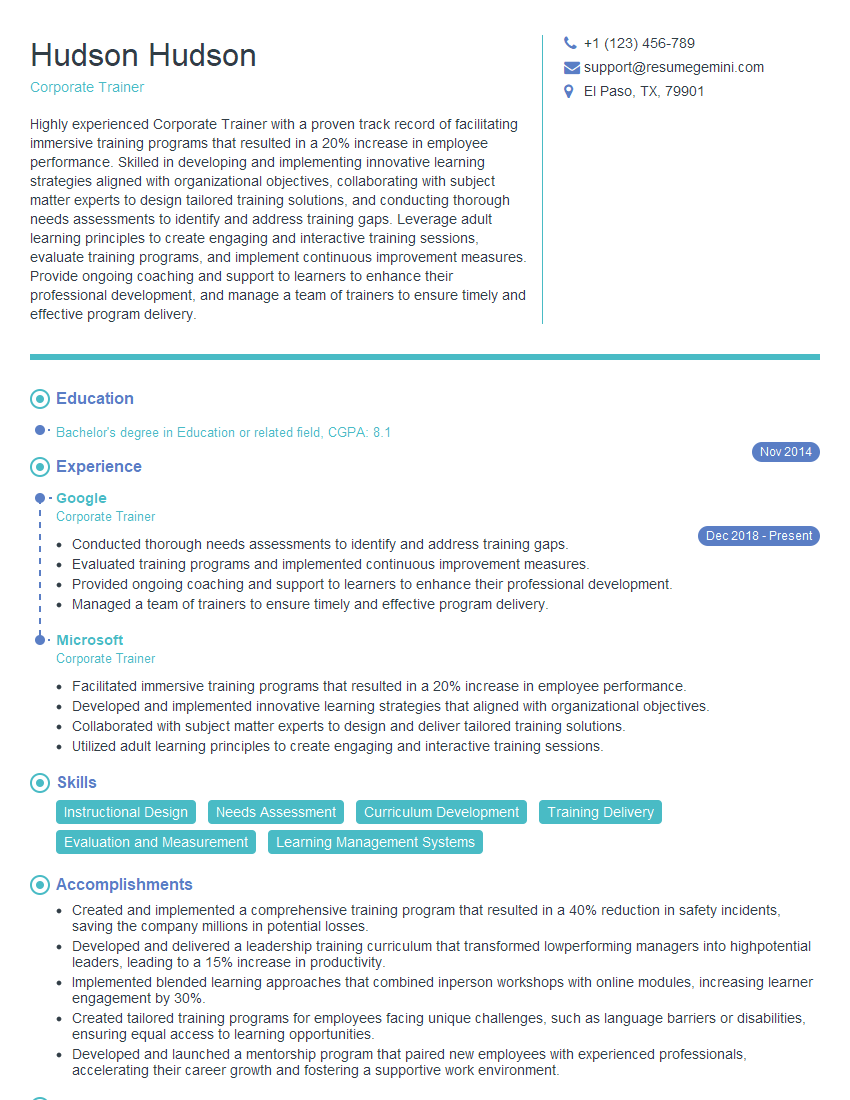
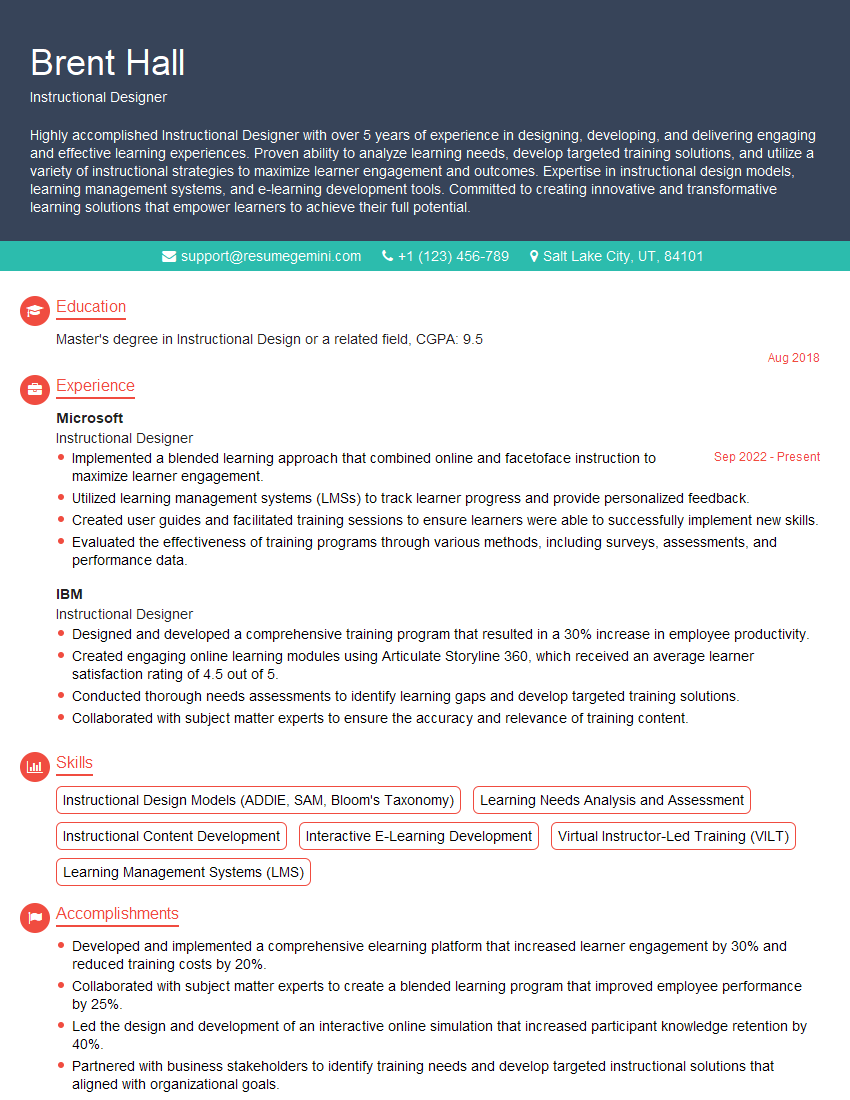
Mastering Training Plan Creation is crucial for career advancement in learning and development, human resources, and instructional design. A strong understanding of these principles demonstrates your ability to contribute significantly to an organization’s success by improving employee skills and performance. To maximize your job prospects, create an ATS-friendly resume that showcases your expertise. We highly recommend using ResumeGemini to build a professional and impactful resume. ResumeGemini offers a streamlined process and provides examples of resumes tailored to Training Plan Creation to help you present your skills effectively.


Explore more articles
Users Rating of Our Blogs
Share Your Experience
We value your feedback! Please rate our content and share your thoughts (optional).
What Readers Say About Our Blog
Very informative content, great job.
good