Cracking a skill-specific interview, like one for Lighting and Space Planning, requires understanding the nuances of the role. In this blog, we present the questions you’re most likely to encounter, along with insights into how to answer them effectively. Let’s ensure you’re ready to make a strong impression.
Questions Asked in Lighting and Space Planning Interview
Q 1. Explain the principles of illuminance and luminance.
Illuminance and luminance are two crucial photometric quantities in lighting design, often confused but distinct. Illuminance measures the amount of light falling on a surface, essentially how much light the surface receives. It’s measured in lux (lx). Think of it like rainfall – the amount of rain hitting a square meter of ground. Luminance, on the other hand, measures the amount of light emitted or reflected from a surface in a particular direction. It’s measured in candelas per square meter (cd/m²), also known as nits. This is like the brightness of the wet ground reflecting light – how much light is bouncing back towards your eyes.
For example, a brightly lit desk (high illuminance) might have a lower luminance if the surface is dark and absorbs much of the light. Conversely, a dimly lit, highly reflective white surface might have a high luminance despite low illuminance.
Q 2. Describe different types of lighting fixtures and their applications.
Lighting fixtures are categorized in various ways, including by light source, distribution, and application. Common types include:
- Recessed downlights: Ideal for general illumination in ceilings, offering a clean, unobtrusive look. Often used in offices, retail spaces, and homes.
- Track lighting: Highly versatile, allowing adjustable positioning of light heads to highlight specific areas. Commonly found in art galleries, retail displays, and kitchens.
- Pendant lights: Suspended from the ceiling, offering both ambient and accent lighting. Suitable for dining areas, living rooms, and foyers.
- Surface-mounted fixtures: Attached directly to the ceiling or wall, simple to install and suitable for various spaces. Used in corridors, hallways, and areas where recessed lighting isn’t feasible.
- Linear fixtures: Long, continuous light sources, often used for task lighting in offices or under kitchen cabinets.
- Ambient lighting: Often indirect or diffused light for general illumination. Think of recessed lights or chandeliers providing background light.
- Accent lighting: Highlights specific features or art pieces, usually directed lighting. Track lighting with spotlights is a classic example.
- Task lighting: Focused light for specific tasks such as reading or cooking. Desk lamps or under-cabinet lighting are examples.
The choice depends on factors such as the space’s function, aesthetic preferences, and available budget. A well-designed lighting scheme employs a combination of these types to create a balanced and functional lighting environment.
Q 3. How do you calculate the required lighting levels for a specific space?
Calculating required lighting levels involves considering the space’s function, the type of task performed, and the desired visual comfort. We use the illuminance level (in lux) as the key parameter. There are various standards and guidelines (like IES) providing recommended illuminance values for different spaces.
The process generally follows these steps:
- Determine the required illuminance: Consult lighting standards or guidelines to find the recommended illuminance for the space’s function (e.g., 300 lx for office work, 500 lx for detailed tasks). Consider the age and visual acuity of the occupants.
- Measure the area: Calculate the total area of the space to be lit.
- Account for light loss factors: Various factors reduce the effective illuminance, including:
- Room surface reflectance: Darker surfaces absorb more light.
- Lamp depreciation: Light output diminishes over time.
- Luminaire dirt depreciation: Dust and dirt reduce light output.
- Light fixture efficiency:
- Calculate the required luminous flux (lumens): This is the total light output needed. It’s calculated by multiplying the required illuminance (lx), the area (m²), and the light loss factor (a multiplier typically between 1.2 and 1.5).
- Select luminaires: Choose light fixtures that provide the required luminous flux and have a suitable light distribution for the space.
For example, an office area of 50m² requiring 300 lx and with a light loss factor of 1.3 would need: 300 lx * 50 m² * 1.3 = 19500 lumens. The chosen lighting fixtures must have a total lumen output that meets or exceeds this value.
Q 4. What are the key considerations for daylighting design?
Daylighting design aims to maximize the use of natural light to reduce reliance on artificial lighting, resulting in energy savings and improved occupant well-being. Key considerations include:
- Orientation: Maximize south-facing glazing in the northern hemisphere (or north-facing in the southern hemisphere) to capture maximum sunlight. Consider the sun’s path throughout the day and year.
- Window size and placement: Strategic placement of windows to provide uniform illumination and minimize glare. Consider the aspect ratio and window-to-wall ratio.
- Window types and materials: Use glazing with high visible light transmittance and low solar heat gain coefficient (SHGC) to minimize heat gain in hot climates. Consider using light shelves to reflect daylight deeper into the space.
- Light shelves and other daylighting devices: These architectural elements reflect and redirect daylight, improving depth of penetration and reducing glare.
- Shading devices: Employ external shading (e.g., overhangs, louvers) to control direct sunlight and prevent glare, particularly during peak sun hours.
- Interior finishes: Use light-colored interior finishes to reflect daylight and enhance brightness. Careful consideration of the reflective properties of walls, ceilings and floors is essential.
- Integration with artificial lighting: Daylighting control systems often integrate with artificial lighting to provide seamless transitions between natural and artificial light sources.
A well-designed daylighting system can significantly reduce energy costs and create a more pleasant and productive workspace.
Q 5. Explain the concept of visual comfort and how to achieve it.
Visual comfort refers to the absence of visual discomfort, allowing for clear and effortless vision. Achieving it requires a balanced approach to lighting design, considering several factors:
- Uniformity: Avoid harsh contrasts and ensure even illumination across the space to minimize eye strain.
- Glare control: Minimize direct and reflected glare from light sources, windows, and reflective surfaces. This often involves appropriate shielding of luminaires and use of low-glare finishes.
- Color rendering: Select light sources with high color rendering index (CRI) to accurately represent the colors of objects. A CRI of 80 or higher is generally recommended for most applications.
- Illuminance levels: Adequate but not excessive illuminance levels are necessary. This is dependent on the task being performed and often needs a consideration of ambient, accent, and task lighting.
- Color temperature: Consider the color temperature of the light source. Warmer color temperatures (2700-3000K) are generally more relaxing, while cooler temperatures (5000-6500K) can feel more energizing.
Think of it like listening to music: too loud is uncomfortable, too quiet is difficult to hear and you have to strain. Appropriate lighting is similar. A well-designed lighting system ensures sufficient brightness, manages glare, and allows for comfortable visual perception. This ultimately increases productivity and improves well-being.
Q 6. What are the common lighting control systems and their benefits?
Common lighting control systems offer greater flexibility and efficiency. These include:
- Manual switches: The simplest form, allowing for on/off control of individual lighting circuits.
- Dimmers: Allow for adjusting the light intensity, enabling control over ambiance and energy consumption.
- Occupancy sensors: Automatically turn lights on when a space is occupied and off when it’s empty, significantly saving energy.
- Daylight harvesting systems: Reduce artificial lighting levels based on the amount of available daylight, optimizing energy usage and improving visual comfort.
- Timers: Schedule lighting operation, ideal for automated control of lighting in unoccupied periods.
- Smart lighting systems: Integrate with building management systems or mobile apps to provide extensive control, monitoring, and scheduling capabilities.
Benefits include significant energy savings, improved visual comfort, extended fixture life, increased occupant control, and enhanced building management capabilities.
Q 7. How do you integrate lighting design with the overall space planning?
Lighting design is intrinsically linked to space planning. It’s not simply about adding lights; it’s about shaping the experience of the space. The two should be integrated from the very beginning of the design process.
Here’s how they work together:
- Defining zones: Lighting helps define different functional zones within a space. For example, task lighting in a kitchen work area differentiates it from the dining zone illuminated by pendant lights.
- Creating ambiance: Lighting dramatically affects the mood and atmosphere of a room. Warm, dim lighting promotes relaxation, while bright, cool lighting encourages activity.
- Highlighting architectural features: Strategic lighting can accentuate architectural details and create visual interest.
- Improving wayfinding: Well-placed lighting guides occupants through a space and enhances safety.
- Influencing spatial perception: Lighting can modify the perceived size and shape of a room. For example, uplighting can make a ceiling appear taller.
- Collaboration in the design process: Architects, interior designers, and lighting designers must collaborate closely to achieve a harmonious and effective design.
Imagine designing a restaurant: The space planning determines the layout of tables and bar, while the lighting design accentuates the bar area, creates intimate zones for dining, and ensures sufficient illumination for navigating the space safely. The lighting choices will help reinforce and improve the overall space planning.
Q 8. Describe your experience with lighting software (e.g., DIALux, Relux).
My experience with lighting software is extensive, encompassing both DIALux and Relux, among others. I’ve utilized DIALux extensively for projects requiring detailed illuminance calculations and energy simulations, particularly in larger commercial spaces. Its intuitive interface and powerful rendering capabilities allow for precise lighting layouts and energy performance assessments. For instance, on a recent museum project, DIALux helped optimize the lighting to minimize glare on delicate artifacts while maintaining sufficient illumination for visitor comfort. Relux, on the other hand, excels in its ability to handle complex scenarios with multiple light sources and reflective surfaces. I’ve employed it in projects with intricate architectural details where accurate light propagation is critical, such as a contemporary art gallery with highly reflective walls and ceilings. Proficiency in these tools allows me to create realistic simulations, predict energy consumption, and optimize designs for both aesthetic and functional needs.
Q 9. How do you incorporate energy efficiency principles into lighting design?
Incorporating energy efficiency into lighting design is paramount. It starts with selecting energy-efficient light sources, such as LEDs, which offer significant energy savings compared to traditional incandescent or fluorescent bulbs. Beyond the fixture itself, I consider strategies such as daylight harvesting – maximizing natural light to reduce reliance on artificial lighting. This involves careful placement of windows and the use of light shelves or other architectural elements to distribute daylight effectively. For example, in a school design, we strategically positioned windows and incorporated light shelves to minimize the need for artificial lighting during daytime hours. We also employ advanced control systems, like occupancy sensors and dimmers, to automatically adjust lighting levels based on occupancy and ambient light levels. This minimizes energy waste when a space is unoccupied or brightly lit by natural light. Finally, careful space planning itself contributes to efficiency: well-designed layouts minimize the need for extensive lighting in underutilized areas.
Q 10. What are the latest trends in lighting technology?
The lighting industry is constantly evolving. Currently, we’re seeing a surge in popularity of human-centric lighting (HCL), which tailors light color and intensity to improve occupant wellbeing and productivity. This involves using dynamic lighting systems that adjust throughout the day to mimic natural daylight patterns. Another major trend is the integration of smart lighting systems, allowing for remote control, personalized settings, and energy monitoring. Furthermore, advancements in LED technology continue to improve efficacy, color rendering, and lifespan, offering increasingly versatile and sustainable options. We are also witnessing the rise of biophilic design, which integrates natural elements into the built environment, including natural light as a key component. The use of bioluminescent materials, although still in early stages, represents a fascinating frontier in sustainable and aesthetically unique lighting solutions.
Q 11. Explain the importance of color rendering index (CRI).
The Color Rendering Index (CRI) is a crucial metric indicating how accurately a light source renders the colors of objects compared to a reference light source (usually daylight). A higher CRI (ranging from 0 to 100) signifies better color rendering. A CRI of 80 or higher is generally considered good for most applications, ensuring that colors appear natural and true-to-life. In a retail setting, for example, accurate color rendering is critical for showcasing merchandise; a low CRI might make clothing appear dull or differently colored than it actually is, potentially impacting sales. Conversely, in an industrial setting where color accuracy isn’t as critical, a lower CRI light source might suffice, prioritizing energy efficiency over perfect color reproduction. Choosing the appropriate CRI is a balance between aesthetic needs and energy efficiency considerations, tailored to the specific requirements of each project.
Q 12. How do you address lighting challenges in different architectural styles?
Lighting challenges vary greatly across architectural styles. In a traditional Victorian home, for instance, I might prioritize warm-toned lighting and carefully placed fixtures to highlight intricate architectural details and create a cozy ambiance. This could involve using dimmer switches and carefully selecting fixtures that complement the existing style. Conversely, in a modern minimalist space, I might favor clean lines, recessed lighting, and accent lighting to create a sleek and uncluttered aesthetic. In a historic building requiring preservation, I carefully consider the existing structure and its historical significance, using lighting techniques that both illuminate the space and protect the architectural integrity. The approach to lighting is always contextual, seeking a harmonious blend between form and function that enhances the overall design concept. Each architectural style presents its own set of challenges and opportunities, demanding a thoughtful and customized lighting solution.
Q 13. Describe your process for developing a lighting design plan.
My process for developing a lighting design plan begins with a thorough understanding of the project’s goals, budget, and client’s preferences. I then conduct a site analysis, considering the architectural features, existing infrastructure, and ambient light conditions. This includes measuring the space, analyzing daylight availability, and documenting any existing lighting systems. Next, I develop a lighting concept, outlining the overall lighting scheme, including the types of light sources, fixture selection, and control systems. This is often presented visually using sketches, diagrams, and 3D renderings. I then move to the detailed design phase, creating accurate lighting layouts using software like DIALux or Relux to ensure compliance with lighting standards and energy efficiency goals. The process involves numerous iterations and refinements based on feedback and revisions, leading to a final lighting design plan that is both functional and aesthetically pleasing.
Q 14. How do you collaborate with other design professionals (architects, interior designers)?
Collaboration is central to my design process. I maintain open and consistent communication with architects and interior designers throughout the project. Early involvement in the design phase allows me to integrate lighting considerations into the overall architectural and interior design plans. I actively participate in design meetings, offering input on space planning and material selections that impact lighting performance. I often utilize digital platforms for sharing design files and feedback, ensuring seamless collaboration. For example, I’ve used BIM (Building Information Modeling) software to integrate lighting models directly into the architect’s overall building model. This integrated approach ensures that the lighting design is not an afterthought, but rather a fully integrated component of the overall design, leading to a more cohesive and successful outcome.
Q 15. How do you manage lighting projects within budget and timeline constraints?
Managing lighting projects within budget and timeline requires a proactive and meticulous approach. It starts with a thorough understanding of the client’s needs and budget from the initial consultation. We then develop a detailed design proposal that includes a comprehensive lighting scheme, specifying fixture types, quantities, and costs. This proposal also incorporates a realistic timeline, outlining key milestones and deliverables.
To stay within budget, we explore cost-effective solutions without compromising quality. This might involve using energy-efficient LED fixtures, negotiating with suppliers for better pricing, or optimizing the number of fixtures needed through careful design and placement. We use project management software to track progress, monitor expenses, and ensure we stay on schedule. For example, in a recent project for a restaurant, we initially faced budget constraints. By substituting some higher-end fixtures with equally effective, but more budget-friendly alternatives, and negotiating bulk discounts, we successfully delivered a stunning lighting design within the allocated budget.
Regular communication with the client and project team is vital for identifying potential issues early and implementing timely solutions. Any necessary changes are documented and approved, ensuring transparency and avoiding cost overruns. This proactive approach keeps the project on track, minimizing risks and ensuring client satisfaction.
Career Expert Tips:
- Ace those interviews! Prepare effectively by reviewing the Top 50 Most Common Interview Questions on ResumeGemini.
- Navigate your job search with confidence! Explore a wide range of Career Tips on ResumeGemini. Learn about common challenges and recommendations to overcome them.
- Craft the perfect resume! Master the Art of Resume Writing with ResumeGemini’s guide. Showcase your unique qualifications and achievements effectively.
- Don’t miss out on holiday savings! Build your dream resume with ResumeGemini’s ATS optimized templates.
Q 16. What are the building codes and regulations related to lighting design?
Building codes and regulations related to lighting design vary by location but generally focus on safety, energy efficiency, and accessibility. These regulations often cover aspects such as:
- Illumination levels: Minimum light levels required for different spaces (e.g., hallways, stairwells, work areas) to ensure safety and visibility. These are usually expressed in foot-candles or lux.
- Emergency lighting: Requirements for backup lighting systems in case of power failure, ensuring safe evacuation.
- Energy efficiency standards: Regulations promoting the use of energy-efficient lighting technologies and fixtures, often specifying minimum energy efficiency ratings.
- Glare control: Regulations to limit excessive glare that can cause discomfort or impair vision.
- Accessibility requirements: Guidelines for lighting design to accommodate individuals with visual impairments, ensuring appropriate illumination levels and contrast.
It is crucial for lighting designers to be familiar with the specific codes and regulations applicable to their project location. Failure to comply can lead to project delays, fines, or even legal issues. We always consult the relevant building codes and standards early in the design process and incorporate them into our lighting plans. We also work closely with building inspectors and other relevant authorities to ensure compliance throughout the project.
Q 17. Explain your experience with different types of lamps (LED, fluorescent, incandescent).
My experience encompasses a wide range of lamp types, each with its own advantages and disadvantages:
- Incandescent lamps: These produce warm, inviting light but are highly inefficient and generate significant heat. They have largely been replaced by more energy-efficient options due to their short lifespan and high energy consumption. I primarily use them now in very specific situations where their warm color temperature is paramount and energy efficiency is a secondary concern.
- Fluorescent lamps: Offer better energy efficiency than incandescent lamps but can produce a cooler, less inviting light. They also contain mercury, requiring careful disposal. While still used in some commercial applications, their popularity has declined due to the rise of LEDs.
- LED lamps (Light Emitting Diodes): These are currently the most energy-efficient and versatile option. LEDs offer a long lifespan, a wide range of color temperatures, and excellent dimming capabilities. They are also becoming increasingly affordable, making them a cost-effective choice in the long run. In most projects, LEDs are my preferred choice due to their efficiency, longevity, and design flexibility.
The choice of lamp type depends on factors such as budget, energy efficiency requirements, desired color temperature, and the specific application. For example, in a residential setting, I might use warm-white LEDs for a cozy atmosphere, while in an office setting, cooler-white LEDs might be more appropriate for improved task illumination.
Q 18. How do you ensure accessibility and inclusivity in your lighting design?
Accessibility and inclusivity are paramount in my lighting design approach. This involves considering the needs of people with visual impairments or other disabilities. Key considerations include:
- Sufficient illumination levels: Ensuring adequate light levels to meet the needs of individuals with low vision.
- Appropriate contrast: Creating sufficient contrast between surfaces and objects to improve visibility.
- Reduced glare: Minimizing glare to reduce discomfort and improve visual clarity.
- Color temperature selection: Choosing color temperatures that are comfortable and easy on the eyes for a wider range of individuals.
- Emergency lighting: Ensuring adequate emergency lighting to facilitate safe evacuation for everyone.
For example, in a museum setting, we carefully considered the needs of visually impaired visitors by providing tactile signage, audio descriptions, and strategically placed lighting to highlight key exhibits without creating glare or harsh shadows. We collaborate with accessibility specialists to ensure that our designs meet or exceed all relevant accessibility standards.
Q 19. Describe your experience with sustainable lighting practices.
Sustainable lighting practices are integral to my work. My approach focuses on minimizing the environmental impact of lighting systems through the use of energy-efficient technologies, sustainable materials, and responsible disposal methods. This includes:
- Specifying energy-efficient fixtures and lamps: Prioritizing LEDs with high efficacy ratings.
- Implementing daylight harvesting strategies: Designing spaces that maximize the use of natural light, reducing reliance on artificial lighting.
- Using occupancy sensors and dimmers: Automating lighting systems to reduce energy consumption in unoccupied spaces or when lower light levels are sufficient.
- Choosing fixtures made from recycled or sustainable materials: Considering the environmental impact of the materials used in the lighting fixtures.
- Proper disposal of lighting components: Ensuring proper disposal of lamps containing mercury or other hazardous materials.
In a recent project for a corporate office building, we incorporated daylight harvesting through the use of large windows and light shelves. We also installed occupancy sensors in conference rooms and hallways to automatically switch off the lights when not in use. These strategies led to significant energy savings and reduced the carbon footprint of the building.
Q 20. How do you handle client feedback and revisions during the design process?
Client feedback and revisions are essential components of the design process. We encourage open communication and actively seek feedback at various stages of the project. We typically hold regular meetings with the client to review progress, discuss design options, and address any concerns. We use collaborative tools like online design platforms to share our work and facilitate feedback exchange.
When revisions are needed, we carefully analyze the client’s comments and incorporate them into the design, ensuring that the changes are feasible and align with the project goals and budget. We document all changes and obtain the client’s approval before proceeding. For example, in a residential project, the client initially wanted a very minimalist lighting scheme. After reviewing the initial design, they expressed a desire for more ambient lighting in the living room. We incorporated their feedback by adding recessed lighting and dimmer switches, enhancing the atmosphere of the space while maintaining the minimalist aesthetic.
Our aim is to create a lighting design that not only meets the technical requirements but also reflects the client’s vision and preferences. A collaborative and iterative approach ensures that the final product exceeds expectations.
Q 21. Explain the importance of light layering in a space.
Light layering is a fundamental principle in lighting design that involves using multiple layers of lighting to create a dynamic and functional space. It’s akin to adding layers of paint to a canvas – each layer contributes to the overall effect. The three primary layers are:
- Ambient lighting: This provides general illumination and sets the overall mood of the space. Think of it as the base layer of your painting. Examples include recessed lighting, chandeliers, or wall sconces.
- Task lighting: This focuses light on specific areas where tasks are performed, such as a desk, kitchen counter, or reading chair. This layer is like highlighting specific elements in your artwork.
- Accent lighting: This highlights architectural features, artwork, or other decorative elements. This provides visual interest and depth, adding emphasis to certain points in your painting.
Effective light layering creates visual interest, enhances functionality, and improves the overall ambiance of a space. For instance, in a living room, ambient lighting might be provided by recessed downlights, task lighting by a floor lamp next to a reading chair, and accent lighting by spotlights highlighting artwork on the walls. This layering creates a comfortable and visually appealing environment, accommodating diverse activities and highlighting key features of the space.
Q 22. How do you assess the impact of lighting on human behavior and mood?
Lighting profoundly impacts human behavior and mood. Think of it like this: light is the body’s primary cue for regulating its circadian rhythm, influencing sleep-wake cycles, hormone production, and overall well-being. Different light spectrums and intensities evoke various emotional responses.
- Warm light (2700K-3000K): Evokes feelings of relaxation, comfort, and intimacy. Think of a cozy living room with warm-toned incandescent bulbs. This is ideal for relaxation areas.
- Cool light (5000K-6500K): Promotes alertness, focus, and productivity. This is commonly used in offices and classrooms. Too much cool light can feel sterile and harsh.
- Bright light: Can increase energy levels and improve mood, but excessive brightness can be stressful and overwhelming.
- Dim light: Can induce calmness and sleepiness, but insufficient light can lead to fatigue and negatively impact productivity.
In my work, I assess this impact through understanding the user’s needs and the function of the space. For instance, a hospital waiting room needs calming warm light, whereas a surgery suite needs bright, cool, and shadow-free illumination. I consider not only the intensity but also the color temperature and color rendering index (CRI) of the light sources.
Q 23. What are the key factors to consider when designing lighting for a retail space?
Designing lighting for retail spaces requires a strategic blend of art and science. The goal is to enhance the customer experience, highlight merchandise, and create a welcoming atmosphere. Key factors include:
- Merchandise presentation: Accent lighting strategically placed to highlight key products and create visual focal points. Think of jewelry stores using pinpoint spotlights to showcase diamonds.
- Ambient lighting: Overall illumination to create a comfortable and inviting atmosphere. This should be carefully balanced to avoid harsh shadows or overly bright spaces.
- Task lighting: Lighting specifically designed for tasks like browsing, fitting rooms, and cashier counters. This needs to be bright enough for functionality but not distracting.
- Energy efficiency: Implementing energy-saving lighting technologies like LEDs while maintaining high-quality illumination. This saves costs and contributes to sustainability.
- Branding and atmosphere: Lighting should reflect the brand identity and desired ambiance. A luxury boutique will have different lighting than a fast-fashion store.
For example, I once worked on a project where we used a combination of warm white LEDs for general illumination, cool white LEDs for task lighting in fitting rooms, and track lighting with adjustable spotlights to highlight specific displays. The result was a well-lit, visually appealing space that effectively showcased the merchandise and enhanced the overall shopping experience.
Q 24. How do you approach lighting design in a historical building?
Lighting design in historical buildings demands a sensitive approach, respecting the architectural integrity and historical context. The process begins with thorough research to understand the building’s history and original lighting methods. This could involve studying old photographs, architectural drawings, and consulting historical records.
My approach involves:
- Preservation of existing features: Identifying and preserving any original lighting fixtures or features whenever possible. Sometimes, this might mean restoring and adapting rather than replacing.
- Authentic replication: If original fixtures are beyond repair, creating authentic replications using materials and techniques consistent with the building’s era. This maintains the historical aesthetic.
- Concealed lighting: Employing recessed or cove lighting techniques to minimize visual impact on the architectural details and avoid disrupting the historical character.
- Energy-efficient solutions: Using modern energy-efficient technology, like LEDs, while maintaining color accuracy and minimizing the intrusion of contemporary fixtures.
- Collaboration with preservationists: Working closely with preservationists and historical consultants to ensure that the lighting design respects and complements the building’s historical significance.
For example, a recent project involved illuminating a historic library. We carefully restored the original chandeliers and used concealed LED lighting to highlight architectural details such as vaulted ceilings and ornate cornices without obscuring them or changing the historical character of the space.
Q 25. Explain your understanding of different light sources and their spectral power distributions.
Different light sources have unique spectral power distributions (SPD), affecting how they appear to the eye and interact with objects. SPD is essentially a graph showing the intensity of light at different wavelengths. This determines the color temperature (cool vs. warm) and color rendering index (CRI) of the light.
- Incandescent: Produce warm, yellowish light with a relatively low CRI. They are energy inefficient, but offer excellent color rendering.
- Fluorescent: Offer good energy efficiency but often have a cooler, slightly greenish tint and lower CRI compared to LEDs.
- LEDs (Light Emitting Diodes): Highly energy-efficient, available in a wide range of color temperatures and CRIs. They are becoming the dominant light source due to their versatility and sustainability. Different LEDs can mimic the SPD of other light sources, making them very adaptable.
- High-Pressure Sodium (HPS): Produce a yellowish-orange light, high intensity, and are energy-efficient. They are commonly used in street lighting but have poor color rendering.
- Metal Halide: Offer good color rendering and high light output but require more energy compared to LEDs. Their SPD has a more balanced color range than HPS.
Understanding SPD allows me to choose the right light source for a specific application. For instance, a museum needing high color accuracy would benefit from LEDs with a high CRI (90+), whereas street lighting can use HPS or LED equivalents with a focus on energy efficiency and intensity.
Q 26. Describe your experience with lighting simulations and renderings.
Lighting simulations and renderings are crucial tools in my design process. I regularly use software like DIALux evo, AGI32, and Revit to create realistic visualizations of lighting schemes. These tools allow me to:
- Experiment with different lighting fixtures and placements: I can easily try different configurations and see their effect on the space’s overall illumination before committing to a physical installation.
- Assess luminance levels and illuminance: The software calculates these values, ensuring compliance with lighting standards and client requirements. This ensures the light levels are functional and comfortable.
- Visualize the impact on the space’s aesthetics: Renderings show how the lighting will affect the overall atmosphere and how different materials will appear under various light sources.
- Communicate design ideas effectively: Visualizations help me explain my proposals to clients and stakeholders. It’s much easier to understand a concept when seeing it rendered.
For instance, on a recent project, simulations revealed that our initial layout of track lighting in a retail space created undesirable shadows in certain areas. Using the simulation software, we adjusted the fixture placement and angles, significantly improving the lighting quality. This saved both time and cost by identifying the issue before any physical installation.
Q 27. How do you balance aesthetics with functionality in lighting design?
Balancing aesthetics and functionality is paramount in lighting design. It’s not simply about providing adequate illumination; it’s about creating an environment that is both beautiful and functional.
My approach involves:
- Integrating lighting fixtures seamlessly into the architecture: Careful selection of fixtures that complement the space’s style and don’t visually dominate the environment. Concealed or minimalist fixtures are often prioritized.
- Using light to highlight architectural features: Employing lighting to accentuate interesting architectural details, creating visual interest and enhancing the aesthetic appeal.
- Creating layers of light: Combining ambient, task, and accent lighting to create a dynamic and visually engaging space, adding depth and interest.
- Considering the color temperature and CRI: Choosing light sources that not only provide sufficient illumination but also contribute to the desired mood and enhance the appearance of colors in the space.
- Collaborating with architects and interior designers: Working collaboratively ensures that the lighting design complements the overall design aesthetic and functionality of the space.
For example, in a restaurant design, I might use warm, dimmable LED downlights for ambient lighting, task lighting under bar counters, and accent lighting to highlight artwork. The lighting would be chosen to highlight the design details while creating a cozy and inviting dining atmosphere.
Q 28. What are your strategies for resolving lighting design conflicts?
Lighting design conflicts often arise from competing priorities – budget constraints, aesthetic preferences, technical limitations, or even conflicting opinions among stakeholders. Resolving these conflicts requires careful communication, compromise, and creative problem-solving.
My strategies include:
- Open communication: Facilitating open discussions among all stakeholders to clearly understand each party’s needs and concerns. This helps identify the root cause of the conflict.
- Prioritization: Working with stakeholders to prioritize requirements, recognizing that not all goals can be fully realized within the given constraints.
- Value engineering: Exploring alternative solutions that meet the essential requirements while staying within budget or addressing technical limitations.
- Data-driven decision making: Using lighting simulations and calculations to justify design choices and demonstrate the impact of different options. This helps build consensus based on evidence.
- Compromise and negotiation: Finding solutions that balance the needs of all stakeholders. This might involve adjusting lighting levels, selecting different fixtures, or modifying the lighting scheme to find a compromise.
For example, a recent project involved a conflict between the client’s desire for dramatic accent lighting and the architect’s concern about the impact on the building’s façade. We resolved this by using carefully placed, low-intensity spotlights that highlighted the architectural details without compromising the building’s appearance. Open communication and visualization were key to finding a satisfactory solution.
Key Topics to Learn for Lighting and Space Planning Interview
- Illumination Design Principles: Understanding different lighting types (ambient, accent, task), color temperature, and light levels (lux, foot-candles). Practical application: Designing lighting schemes for various spaces (residential, commercial, retail) considering energy efficiency and user experience.
- Space Planning Fundamentals: Analyzing spatial requirements, workflow optimization, and furniture arrangement. Practical application: Creating functional and aesthetically pleasing layouts for offices, restaurants, or museums, considering accessibility and code compliance.
- Lighting Technologies: Familiarity with LED, fluorescent, incandescent, and other lighting technologies, their pros and cons, and their applications in different settings. Practical application: Specifying appropriate lighting fixtures based on project needs and budget constraints.
- Daylighting Strategies: Maximizing natural light through window placement, fenestration design, and light shelves. Practical application: Integrating daylighting into building designs to reduce energy consumption and improve occupant well-being.
- Sustainability and Energy Efficiency: Understanding LEED principles and energy codes related to lighting design. Practical application: Designing lighting systems that minimize environmental impact and comply with relevant regulations.
- Lighting Control Systems: Knowledge of dimming systems, occupancy sensors, and other smart lighting technologies. Practical application: Implementing energy-efficient lighting control strategies to optimize performance and reduce costs.
- Software Proficiency: Familiarity with relevant design software (e.g., AutoCAD, Revit, Dialux). Practical application: Utilizing software to create detailed lighting plans and renderings.
- Client Communication and Collaboration: Effectively communicating design ideas, addressing client concerns, and collaborating with other professionals (architects, engineers). Practical application: Presenting design proposals and managing client expectations throughout the project lifecycle.
Next Steps
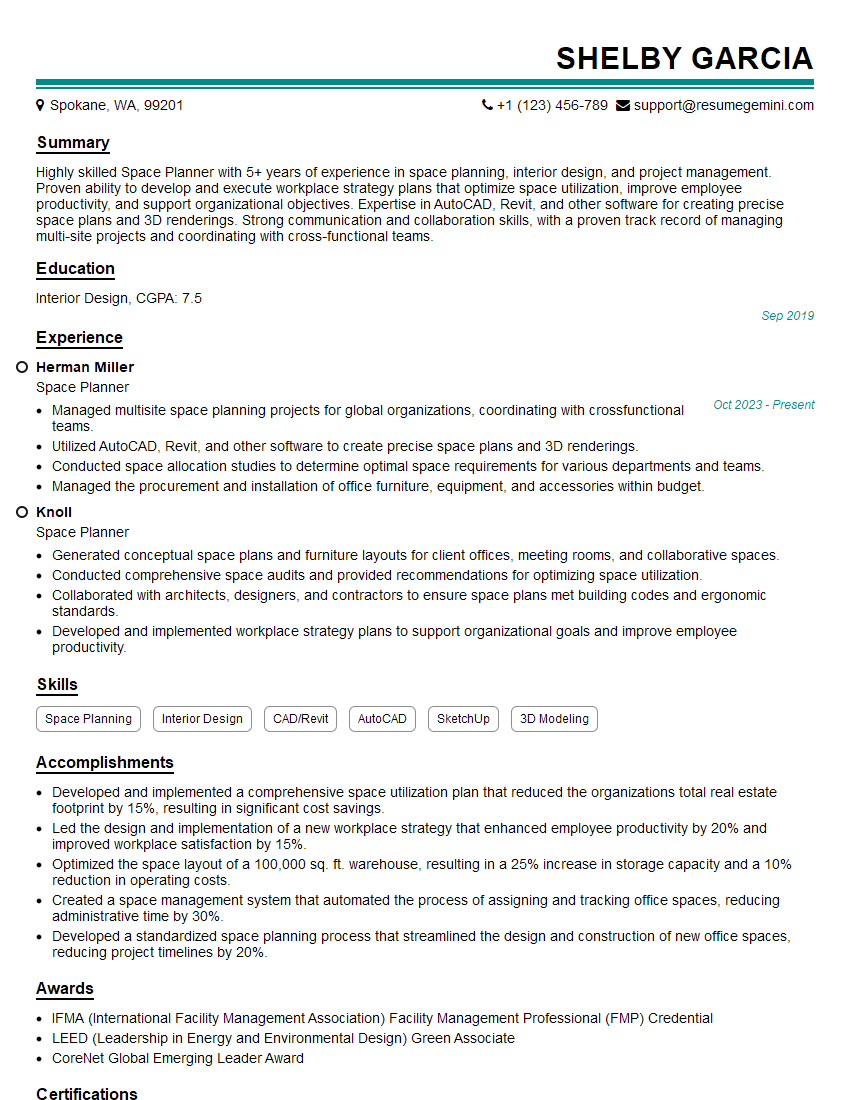
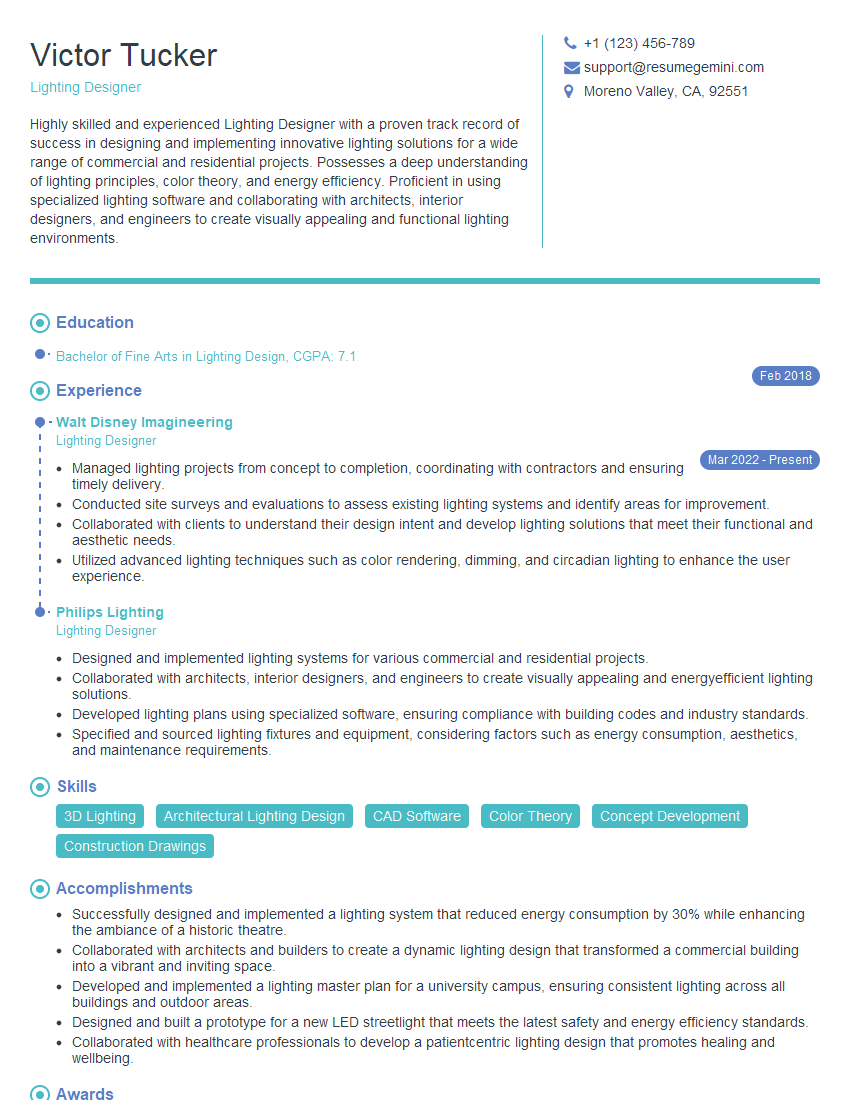
Mastering Lighting and Space Planning opens doors to exciting career opportunities in architecture, interior design, and engineering. A strong understanding of these principles is highly valued by employers. To enhance your job prospects, create an ATS-friendly resume that showcases your skills and experience effectively. ResumeGemini is a trusted resource to help you build a professional resume that stands out. We provide examples of resumes tailored to Lighting and Space Planning to help guide you.
Explore more articles
Users Rating of Our Blogs
Share Your Experience
We value your feedback! Please rate our content and share your thoughts (optional).
What Readers Say About Our Blog
Very informative content, great job.
good