Cracking a skill-specific interview, like one for Laser System Design, requires understanding the nuances of the role. In this blog, we present the questions you’re most likely to encounter, along with insights into how to answer them effectively. Let’s ensure you’re ready to make a strong impression.
Questions Asked in Laser System Design Interview
Q 1. Explain the principle of laser operation.
Laser operation relies on a principle called stimulated emission. Imagine atoms as tiny energy storage units. Normally, these atoms exist in a lower energy state (ground state). We pump energy into the system (e.g., using electricity or another laser), exciting some atoms to a higher energy state (excited state). These excited atoms are unstable and tend to return to their ground state, releasing the stored energy as light. In a typical light source, this happens randomly. But in a laser, we create a population inversion—more atoms are in the excited state than in the ground state. When one excited atom spontaneously emits a photon (light particle), it triggers a chain reaction. This photon stimulates other excited atoms to release identical photons, leading to an avalanche effect. These photons are then reflected back and forth between two mirrors within the laser cavity, creating a highly amplified, coherent, and monochromatic (single-wavelength) beam of light.
Think of it like a perfectly synchronized choir. Each singer (atom) produces the same note (photon) at the same time, resulting in a powerful and focused sound (laser beam). This process requires a gain medium (to provide the excited atoms), an energy source (pump), and an optical resonator (mirrors) to amplify and collimate the light.
Q 2. Describe different types of lasers and their applications.
Lasers come in a wide variety of types, classified by their gain medium, wavelength, and operating mode. Some common types include:
- Helium-Neon (HeNe) Lasers: These gas lasers produce a visible red light, commonly used in barcode scanners and laser pointers. They are relatively low power and simple to operate.
- Diode Lasers (Semiconductor Lasers): These solid-state lasers are compact, efficient, and widely used in CD/DVD players, laser printers, and fiber optic communication. They are highly tunable and offer a range of wavelengths.
- Nd:YAG Lasers: These solid-state lasers, using a Neodymium-doped Yttrium Aluminum Garnet crystal, produce infrared light and are used for industrial material processing (cutting, welding), medical applications (surgery), and laser ranging.
- CO2 Lasers: Gas lasers operating in the infrared, they are high-power lasers widely used for material processing, laser cutting, and medical applications.
- Excimer Lasers: These gas lasers use a mixture of inert and halogen gases to produce ultraviolet light, commonly employed in microlithography (semiconductor manufacturing) and eye surgery (LASIK).
The application of a specific laser depends heavily on its characteristics, such as wavelength, power, and beam quality. For example, a high-power CO2 laser is ideal for cutting metal because of its high energy output, while a low-power diode laser is suitable for optical communication due to its efficiency and narrow beam divergence.
Q 3. What are the key components of a laser system?
A typical laser system comprises several key components:
- Gain Medium: The material that amplifies light through stimulated emission (e.g., ruby crystal, semiconductor, gas mixture).
- Pump Source: Provides energy to excite the atoms in the gain medium (e.g., flash lamp, electric current, another laser).
- Optical Resonator (Cavity): Usually formed by two mirrors that reflect light back and forth through the gain medium, building up the intensity of the laser beam. One mirror is partially reflective, allowing the laser beam to escape.
- Power Supply: Provides the necessary electrical power to the pump source and other components.
- Cooling System: Removes heat generated during laser operation, particularly crucial for high-power lasers.
- Beam Delivery System: Guides and manipulates the laser beam, including mirrors, lenses, and optical fibers.
- Control System: Monitors and regulates laser parameters such as power, wavelength, and beam shape.
The design of these components and their interaction are crucial in determining the performance and characteristics of the overall laser system.
Q 4. How do you ensure laser safety in a design?
Laser safety is paramount in laser system design. It involves mitigating potential hazards from the intense and potentially damaging light produced. Key safety measures include:
- Enclosure: Enclosing the laser system prevents accidental exposure to the laser beam.
- Interlocks: Safety switches that automatically shut down the laser if the enclosure is opened or safety procedures are violated.
- Warning Labels and Signage: Clear and visible warnings about the presence of laser radiation and potential hazards.
- Beam Attenuators: Devices that reduce the power of the laser beam to safe levels during alignment and maintenance procedures.
- Protective Eyewear: Specialized eyewear that filters out specific wavelengths of laser light, protecting the eyes from damage.
- Beam Shutters: Mechanically operated devices that block the laser beam when not in use.
- Emergency Stop Buttons: Easily accessible buttons that instantly shut down the laser system in emergencies.
- Risk Assessment and Safety Training: Thorough risk assessment of the system and comprehensive training for all personnel operating or maintaining the laser.
Compliance with relevant safety standards and regulations (e.g., ANSI Z136) is essential. The safety measures selected depend on the laser’s class (determined by its power and wavelength), its applications, and the environment in which it operates.
Q 5. Explain the concept of laser beam propagation and divergence.
Laser beam propagation refers to how the laser beam travels through space. Ideally, a laser beam would travel in a perfectly straight line. However, in reality, due to diffraction, the beam spreads out as it propagates. This spreading is quantified by the beam divergence. A low divergence beam maintains its diameter over long distances, while a high-divergence beam spreads rapidly.
Beam divergence is affected by the laser’s design, primarily the diameter of the beam at the output aperture and the wavelength of the light. A smaller beam diameter leads to greater divergence. The divergence angle is typically expressed in milliradians (mrad).
Think of it like a water stream from a hose. A narrow stream (small beam diameter) spreads more rapidly than a wide stream (large beam diameter). Understanding beam propagation and divergence is vital for accurate focusing, beam delivery, and target engagement in applications such as laser cutting, laser surgery, and laser ranging. It dictates the working distance and spot size achievable.
Q 6. Describe different laser beam shaping techniques.
Laser beam shaping involves modifying the spatial distribution of the laser beam’s intensity. Different applications require different beam profiles. Common techniques include:
- Aspheric Lenses: These lenses have non-spherical surfaces that can reshape the beam profile, creating different spots sizes and intensity distributions.
- Diffractive Optical Elements (DOEs): These are patterned optical elements that diffract the light to create custom beam profiles, such as flat-top beams, Gaussian beams, or Bessel beams. They can achieve more complex shaping compared to lenses.
- Axicons: These conical lenses produce a long, narrow beam with a constant diameter, ideal for applications requiring a long focal depth such as some types of laser material processing.
- Spatial Light Modulators (SLMs): These devices dynamically control the phase or amplitude of the light, offering real-time control of the beam’s shape and other characteristics.
The choice of technique depends on the desired beam profile, the wavelength of the laser, the required accuracy, and the cost constraints. For example, flat-top beams are often preferred for laser material processing to ensure uniform energy distribution across the work area. Precise shaping is critical in applications such as optical trapping and laser micromachining.
Q 7. How do you design for thermal management in high-power laser systems?
Thermal management in high-power laser systems is critical because significant heat is generated during laser operation, which can damage components and reduce performance. Efficient heat removal is crucial for maintaining stability and extending the lifespan of the laser.
Strategies for thermal management include:
- Heat Sinks: High-conductivity materials (like copper or aluminum) that passively draw heat away from the laser diode or gain medium.
- Liquid Cooling: Circulating a coolant (water, oil, or specialized fluids) to directly absorb heat from the components.
- Thermoelectric Coolers (TECs): Solid-state devices that use the Peltier effect to transfer heat from one side to another, providing more precise temperature control.
- Air Cooling: Using fans and heat sinks to dissipate heat to the surrounding environment. Suitable for lower power lasers.
- Optimized Packaging and Design: Careful design of the laser housing and components to enhance heat dissipation pathways.
The choice of cooling method depends on the power level of the laser, the ambient temperature, and the required operating temperature stability. High-power laser systems often employ a combination of these methods to ensure effective thermal management. Improper thermal management can lead to component failure, reduced efficiency, and instability in the laser’s output.
Q 8. What are the common laser system control methods?
Laser system control methods encompass a range of techniques to precisely manage laser parameters like power, beam shape, and pointing. These methods are crucial for achieving desired performance and stability in diverse applications. Common approaches include:
- Analog control: Utilizes analog signals (voltage or current) to adjust laser parameters. This is often simpler and less expensive but can be less precise than digital methods. Think of a simple potentiometer controlling laser power.
- Digital control: Offers high precision and flexibility, using digital signals and microcontrollers or computers to manage the laser. This allows for sophisticated control algorithms and automated processes. Examples include computer-controlled power supplies and beam steering mirrors.
- Closed-loop feedback control: Integrates sensors to monitor the laser output and adjust parameters accordingly to maintain stability and consistency. For example, a sensor measuring beam power can automatically adjust the laser’s drive current to maintain a constant output.
- Software-based control: Advanced laser systems use sophisticated software interfaces to control all aspects of operation, enabling complex sequences, data acquisition, and real-time monitoring. This is typical in industrial laser systems or scientific instruments.
The choice of control method depends on the specific application, the required precision, and cost constraints. A simple laser pointer might use analog control, whereas a high-precision laser used in micromachining will require a sophisticated digital closed-loop system.
Q 9. Explain the process of laser beam alignment and adjustment.
Laser beam alignment and adjustment are critical for optimal system performance. Improper alignment leads to reduced efficiency, unwanted reflections, and potential damage to optical components. The process generally involves:
- Initial Alignment: This typically uses a low-power visible laser beam for ease of visualization. Mirrors and lenses are adjusted to ensure the beam follows the desired path through the entire system. We often use alignment tools like crosshairs and beam profilers.
- Precision Adjustment: After initial alignment, fine-tuning is done to optimize beam quality and minimize losses. This may involve adjusting the position and orientation of optical components with micrometer screws. Optical alignment is crucial and often uses techniques like autocollimation.
- Beam Profiling: Measuring the beam’s shape and intensity profile (e.g., using a CCD camera or a beam profiler) at various points is essential to verify the alignment and detect any aberrations.
- Optimization: Iterative adjustments are made to maximize the beam’s power density at the target or optimize the focus spot size. This might involve shifting lenses, adjusting mirrors, or fine-tuning the laser itself.
Imagine aiming a bow and arrow: The initial alignment is like getting the arrow roughly pointed at the target. Precision adjustments are like making fine tweaks to get the arrow perfectly on target. Beam profiling is like examining the arrow’s trajectory and making further corrections to enhance its accuracy.
Q 10. How do you characterize the performance of a laser system?
Characterizing laser system performance requires a comprehensive assessment of several key parameters. These parameters help evaluate its suitability for a specific application and identify areas for improvement. Key metrics include:
- Output Power: Measured in Watts (W) or milliwatts (mW), this indicates the total power of the laser beam.
- Beam Quality (M2): This parameter, also known as the beam propagation factor, quantifies how closely the laser beam resembles an ideal Gaussian beam. A lower M2 indicates better beam quality, leading to tighter focusing and higher precision.
- Beam Diameter and Divergence: Measuring the beam’s diameter at various distances from the output aperture helps determine its divergence angle. A lower divergence indicates better collimation and longer working distance.
- Wavelength: This determines the color of the laser and its interaction with different materials. Precision is vital as the application dictates the wavelength range (e.g., UV, visible, IR).
- Temporal Characteristics: For pulsed lasers, parameters like pulse width, repetition rate, and pulse energy are critical. Continuous wave (CW) lasers are characterized by their stability and output power consistency.
- Beam pointing stability: This measures how stable the laser’s pointing direction is over time. Drift can significantly affect precision applications.
These parameters are often measured using various diagnostic tools and techniques and are essential for ensuring the system meets the required specifications for a given application, such as material processing, medical procedures, or scientific experiments.
Q 11. What are the common laser diagnostics techniques?
Laser diagnostics are crucial for ensuring optimal performance and identifying potential problems. Common techniques include:
- Beam Profiling: Using cameras or beam profilers to analyze the spatial intensity distribution of the laser beam. This helps assess beam quality, spot size, and alignment.
- Power Measurement: Utilizing power meters to measure the laser’s output power, ensuring it meets specifications and remains stable.
- Wavelength Measurement: Using spectrometers or wavemeters to precisely determine the laser’s wavelength and its spectral characteristics.
- Temporal Measurement: For pulsed lasers, oscilloscopes and autocorrelators are used to measure pulse width, shape, repetition rate, and jitter.
- Beam pointing stability measurement: Using specialized sensors to monitor the stability of the laser beam’s direction.
- Mode analysis: Techniques like interferometry help determine the transverse mode structure of the laser beam.
These diagnostics are essential for troubleshooting, maintaining optimal performance, and ensuring the reliability of the laser system. Think of them as a comprehensive health check for your laser.
Q 12. Discuss your experience with laser system simulation software.
My experience with laser system simulation software is extensive. I’ve used programs like Zemax, Lumerical, and COMSOL extensively for various projects. These tools are invaluable for:
- Optical Design: Simulating the propagation of laser beams through complex optical systems, optimizing component placement, and predicting performance.
- Thermal Analysis: Modeling the thermal effects within laser components, predicting temperature distributions, and preventing damage due to heat buildup.
- Beam Propagation: Simulating beam characteristics, including diffraction, scattering, and aberrations.
- System Optimization: Identifying potential design flaws and optimizing system parameters to achieve desired performance characteristics.
For instance, in one project involving a high-power fiber laser system, we used Zemax to optimize the design of the beam delivery system, minimizing beam distortion and maximizing throughput. The simulation helped us to avoid costly and time-consuming experimental iterations.
Q 13. Explain different laser scanning techniques.
Laser scanning techniques are employed to manipulate the laser beam’s position and trajectory across a surface or volume. Different techniques exist depending on the application and required speed and precision.
- Galvanometer scanning: Uses high-speed rotating mirrors to deflect the laser beam, achieving fast and precise scanning over a relatively small area. Common in laser marking and laser engraving.
- Resonant scanning: Employs a vibrating mirror driven at its resonant frequency, enabling very high-speed scanning but with limited scan range. Suitable for high-throughput applications like printing.
- Polygon scanning: Uses a rotating multifaceted mirror to scan a laser beam in a raster pattern. Often used in laser printers and scanners.
- Acousto-optic deflectors (AODs): These use sound waves to diffract the laser beam, providing fast and accurate beam steering. Widely employed in applications requiring high precision and speed.
- Piezoelectric actuators: Offer extremely precise control over the laser beam position, but usually with slower scanning speeds. Useful in applications like microscopy and micromachining.
The choice of scanning technique depends on factors such as the required speed, accuracy, scan area, and cost constraints. For example, galvanometer scanning is ideal for flexible, high-precision applications while resonant scanning excels in high-speed tasks.
Q 14. How do you select appropriate optical components for a laser system?
Selecting appropriate optical components for a laser system is critical for optimal performance and reliability. The process involves considering various factors:
- Laser Wavelength: The optical components must be compatible with the laser’s wavelength to minimize losses and prevent damage. This includes the refractive index and transmission characteristics of lenses and mirrors.
- Power Handling: Components must withstand the laser’s power without damage. Higher power lasers require components with increased damage thresholds.
- Beam Diameter: The size and shape of the laser beam dictate the size and focal length of lenses and mirrors.
- Application Requirements: Factors like required beam focusing, collimation, and spatial filtering influence component selection.
- Environmental Factors: Operating temperature, humidity, and vibration can affect component performance. Components must be chosen based on their environmental tolerance.
- Cost and Availability: While performance is paramount, cost and availability also influence the final choices.
For example, in designing a laser cutting system, you might choose high-quality, high-damage-threshold mirrors and lenses to handle the high power of the laser and ensure precise beam delivery. Choosing components with appropriate anti-reflection coatings is also critical to minimize losses.
Q 15. Describe your experience with laser system integration and testing.
Laser system integration and testing is a multifaceted process demanding meticulous attention to detail. My experience spans the entire lifecycle, from initial component selection and optical alignment to final system performance verification. This includes designing and implementing control systems, integrating various subsystems (such as pump lasers, cooling systems, and beam delivery optics), and developing comprehensive test procedures. For example, in one project involving a high-power fiber laser for industrial cutting, I was responsible for designing a robust water-cooling system, ensuring accurate beam pointing stability, and implementing a closed-loop control system to maintain consistent output power. Rigorous testing involved characterizing the beam quality (M²), measuring cutting speed and precision on various materials, and verifying the system’s safety features. Another project focused on a smaller, more precise laser system for ophthalmic surgery. Here, the integration and testing phase required extremely precise alignment of optical components, coupled with comprehensive safety protocols and stringent performance verification using specialized phantoms.
Career Expert Tips:
- Ace those interviews! Prepare effectively by reviewing the Top 50 Most Common Interview Questions on ResumeGemini.
- Navigate your job search with confidence! Explore a wide range of Career Tips on ResumeGemini. Learn about common challenges and recommendations to overcome them.
- Craft the perfect resume! Master the Art of Resume Writing with ResumeGemini’s guide. Showcase your unique qualifications and achievements effectively.
- Don’t miss out on holiday savings! Build your dream resume with ResumeGemini’s ATS optimized templates.
Q 16. How do you troubleshoot laser system malfunctions?
Troubleshooting laser system malfunctions requires a systematic approach. I typically start by reviewing system logs and error messages. This often provides clues about the source of the problem. Then, I conduct visual inspections of the optical path, checking for misalignments, loose connections, or damage to optical components. Next, I use diagnostic tools such as power meters, beam profilers, and oscilloscopes to measure key parameters and identify deviations from expected performance. For instance, if the output power is low, I might check the pump laser’s efficiency, the quality of the cooling system, or the presence of optical losses within the resonator. If the beam profile is distorted, I’ll investigate potential issues with the optical elements or thermal lensing effects. A methodical process of elimination, combined with a deep understanding of laser physics and optics, is crucial to pinpoint the root cause of the problem efficiently.
Q 17. What are the safety regulations and standards for laser systems?
Safety regulations and standards for laser systems are paramount, varying based on laser class and application. The most commonly referenced standard is IEC 60825, which categorizes lasers based on their potential hazard. This classification determines the necessary safety precautions, including appropriate laser safety eyewear, protective enclosures, and warning signage. For example, Class 4 lasers require the most stringent safety measures, including controlled access areas, interlocks, and beam shutters. Beyond the IEC standards, there are often additional regulations specific to the country or region and the application. In medical applications, compliance with regulations such as FDA guidelines is also critical. In my work, I always incorporate safety features into the system design, including interlocks to prevent accidental laser activation and emergency shutdown mechanisms. Regularly scheduled safety inspections and operator training are also essential aspects of ensuring compliance and operator safety.
Q 18. Discuss your experience with different types of laser applications (e.g., material processing, medical, sensing).
My experience encompasses diverse laser applications. In material processing, I’ve worked on systems for laser cutting, welding, and surface treatment of metals and polymers, optimizing laser parameters for different materials and processes. This involves understanding the interaction of laser light with the target material and selecting appropriate laser sources and optics to achieve the desired results. In medical applications, I’ve been involved in projects related to laser surgery and ophthalmology, where precision and safety are paramount. Here, the focus is on controlling pulse duration and energy to minimize collateral damage. Finally, I have experience in laser sensing applications, particularly in rangefinding and LIDAR systems. In this area, I’ve focused on optimizing pulse repetition rates, receiver sensitivity, and data processing techniques to achieve high-resolution measurements.
Q 19. Explain the concept of laser resonator design.
Laser resonator design is critical for determining the laser’s output characteristics, such as power, beam quality, and wavelength. The resonator essentially provides optical feedback to amplify the light generated by the gain medium (e.g., a crystal or semiconductor). A typical resonator consists of two mirrors that reflect the light back and forth through the gain medium. The distance between these mirrors determines the resonator’s length and the output wavelength. Different resonator designs exist, each offering specific advantages. For example, a Fabry-Perot resonator is simple and commonly used but is susceptible to mode hopping. On the other hand, more complex resonators like Unstable resonators are used to produce high-power beams with a specific divergence profile, often for material processing applications. Designing a resonator involves careful consideration of factors like mirror reflectivity, curvature, and alignment, alongside the gain medium’s properties. Advanced designs often incorporate intracavity elements to control beam shaping or wavelength selection.
Q 20. Describe your experience with laser beam quality measurements (M²).
Beam quality, often quantified by the M² factor (beam propagation factor), is a critical parameter for many laser applications. M² indicates how closely a laser beam’s divergence matches that of an ideal Gaussian beam. A lower M² value represents a higher beam quality. I have extensive experience measuring M² using beam profilers, which capture the spatial intensity distribution of the laser beam at different propagation distances. This data is then used to calculate the M² value, providing insight into the beam’s divergence and its suitability for a particular application. In the past, I have used both scanning-slit and camera-based beam profilers for M² measurements, selecting the appropriate technique based on the laser’s power and wavelength. In high-power applications, special precautions must be taken to protect the beam profiler from damage.
Q 21. How do you design for minimizing noise and vibration in laser systems?
Minimizing noise and vibration in laser systems is crucial for maintaining stability and precision, especially in applications requiring high accuracy, such as micromachining or laser scanning. Several strategies are employed. Active vibration isolation systems, using air mounts or piezoelectric actuators, can effectively reduce the transmission of external vibrations to the laser system. Passive methods, such as using vibration-damping materials in the system’s construction, are also effective. Careful attention to the thermal design is important, as temperature fluctuations can induce thermal lensing and beam wander. Robust mechanical design, including rigid optical mounts and precise alignment mechanisms, ensures long-term stability. In addition, the use of closed-loop control systems with feedback mechanisms can help compensate for residual vibrations or thermal drifts, ensuring consistent beam pointing and stability. For example, in a recent project involving a high-precision laser marking system, we implemented a combination of active and passive vibration isolation measures, resulting in a significant reduction in beam jitter and improved mark quality.
Q 22. What are the considerations for designing a fiber-optic laser delivery system?
Designing a fiber-optic laser delivery system involves careful consideration of several key factors to ensure efficient and safe laser beam transmission. Think of it like designing a high-speed data highway for light.
Fiber Type and Core Diameter: The choice of fiber (single-mode or multi-mode) and core diameter directly impacts the laser beam’s propagation characteristics. Single-mode fibers maintain a cleaner beam profile, crucial for applications requiring high spatial resolution, while multi-mode fibers can tolerate larger beam divergences. The choice depends on the laser’s wavelength and the application’s needs.
Fiber Length and Attenuation: Longer fiber lengths lead to increased signal attenuation (loss of power). This necessitates careful selection of low-loss fibers and potentially the use of optical amplifiers to boost the signal strength. This is analogous to signal loss in a long electrical cable – you need boosters to maintain signal quality.
Coupling Efficiency: Efficiently coupling the laser light into the fiber is paramount. Misalignment or poor coupling results in significant power loss. We use specialized optical components like collimators and lenses to maximize this coupling.
Connectors and Splices: Connections between fiber segments must minimize insertion losses (power loss at the joint). High-quality connectors and fusion splicing techniques are essential for reliable performance. Poor connections act like bottlenecks in our data highway, significantly reducing efficiency.
Safety Considerations: Safety is paramount. We need to consider the potential hazards associated with high-power lasers, including eye and skin damage. This involves implementing safety features like interlocks, beam shutters, and appropriate protective housings.
Q 23. Describe your experience with pulsed laser systems.
My experience with pulsed laser systems spans several years and encompasses various applications, from micromachining to laser-induced breakdown spectroscopy (LIBS). I’ve worked extensively with both solid-state (e.g., Nd:YAG) and ultrafast (e.g., Ti:sapphire) pulsed lasers.
In one project, we developed a high-repetition-rate Nd:YAG laser system for precision micro-drilling of aerospace components. This required careful control of pulse energy, pulse width, and repetition rate to achieve the desired material removal rate and surface quality. We had to optimize the Q-switching mechanism and carefully design the pulse shaping electronics to meet the tight tolerances needed for the application.
Another project involved the development of a LIBS system using a pulsed laser for elemental analysis of geological samples. Here, the focus was on optimizing the laser parameters (pulse energy, wavelength) to maximize signal-to-noise ratio and achieving precise spatial resolution. This involved careful selection of optics, detectors and signal processing algorithms.
Q 24. How do you design for environmental factors in laser systems?
Designing laser systems for various environmental factors is crucial for robust and reliable operation. Think about how a car needs protection from rain and extreme temperatures – the same logic applies to laser systems.
Temperature: Temperature fluctuations can affect the laser’s output power, beam quality, and even damage components. We use thermal management techniques like heat sinks, thermoelectric coolers, and temperature-controlled enclosures to mitigate these effects.
Humidity: High humidity can lead to condensation on optical surfaces, causing scattering and degrading performance. Hermetically sealed enclosures and desiccant packs are often employed to control humidity levels within the system.
Vibration: Vibration can misalign optical components, leading to power loss and beam instability. Vibration isolation mounts and rigid mechanical designs are necessary to minimize these effects.
Dust and Contamination: Dust particles can scatter the laser beam and damage optical components. Air filtration systems and cleanroom environments may be necessary to maintain optical surface cleanliness.
Electromagnetic Interference (EMI): EMI can disrupt the laser’s electronic controls and affect its stability. Shielding and proper grounding are vital for reliable operation in electrically noisy environments.
Q 25. What are the different types of laser modulation techniques?
Laser modulation techniques control the laser’s output power or intensity over time. Think of it like adjusting the volume of a musical instrument. Different techniques are suitable for different applications.
Amplitude Modulation (AM): This changes the laser’s power directly, often used for simple on/off switching or intensity control in communication systems. It’s like turning the volume knob up and down.
Frequency Modulation (FM): This changes the frequency of the laser’s output. This is used in fiber optic communication to increase data transmission capacity, like modulating the pitch of a musical note.
Phase Modulation (PM): This changes the phase of the laser’s output wave. It’s widely used in interferometry and optical coherence tomography, where precise control of the optical phase is essential.
Pulse Modulation: This involves generating pulses of laser light with varying pulse widths, shapes, and repetition rates. This is crucial for applications like laser machining, LIDAR, and various medical treatments.
Electro-optic Modulation: This utilizes electro-optic crystals to change the refractive index of the material in response to an applied electric field, thus modulating the laser beam. Pockels cells are a common example.
Acousto-optic Modulation: This employs the interaction of sound waves and light waves to modulate the laser beam, allowing for efficient and fast modulation speeds.
Q 26. Explain your understanding of laser-matter interaction.
Laser-matter interaction describes how light from a laser interacts with materials. The outcome depends heavily on the laser’s parameters (wavelength, intensity, pulse duration) and the material’s properties.
At low intensities, we might observe linear absorption or scattering, where the material absorbs or deflects the light. This is like shining a flashlight on a wall. At higher intensities, non-linear effects like multi-photon absorption and stimulated Raman scattering can occur, leading to more complex interactions.
For pulsed lasers, the interaction is further complicated by the short duration of the pulse. Very short pulses can lead to phenomena such as laser ablation (material removal) and plasma generation. This is akin to a concentrated burst of energy capable of vaporizing a small amount of material.
Understanding laser-matter interaction is critical for designing laser systems for a range of applications, from laser cutting and welding to medical therapies and scientific research. For example, choosing the appropriate laser wavelength is crucial for achieving optimal absorption in a target material for processes like laser marking or surgery.
Q 27. How do you design for cost-effectiveness in a laser system?
Cost-effectiveness is a major consideration in laser system design. It’s not just about the initial purchase price but also the overall cost of ownership, including maintenance, operation, and replacement costs. We employ several strategies:
Component Selection: We prioritize using reliable, readily available components at competitive prices, balancing cost and performance. This involves carefully evaluating various suppliers and specifications.
Modular Design: Modular designs allow for easier maintenance and repair, reducing downtime and replacement costs. It is like using Lego blocks: if one block fails, you replace that one instead of the whole structure.
Optimization of Laser Parameters: Efficient use of laser power minimizes energy consumption and reduces operational costs. We aim to achieve the desired outcome with the lowest possible power level.
Efficient Cooling Systems: Efficient cooling systems reduce energy consumption and prolong the lifespan of laser components, reducing replacement costs.
Simulation and Modeling: Using simulation software to optimize the design before building a prototype can help avoid costly mistakes and iterations during development.
Q 28. Describe your experience with laser system maintenance and repair.
Extensive experience in laser system maintenance and repair is crucial. It’s like being a mechanic for a very sophisticated and sensitive machine. My experience includes:
Preventative Maintenance: Regular cleaning of optical components, checking alignment, and monitoring system performance prevent more serious issues later. This is similar to regular servicing of a car to prevent breakdowns.
Troubleshooting: Identifying and resolving faults requires a systematic approach, often involving checking power supplies, optical components, and control electronics. I employ various diagnostic techniques, such as power measurements and beam profile analysis.
Component Replacement: Replacing faulty components such as lasers, optics, or electronics requires specialized knowledge and tools. This needs careful handling and attention to detail.
Calibration and Alignment: Laser systems often require periodic recalibration and realignment of optical components to ensure optimal performance. This involves using precision adjustment mechanisms and measurement tools.
Safety Procedures: All maintenance and repair tasks are carried out following strict safety protocols to prevent accidents involving high-power lasers.
Key Topics to Learn for Laser System Design Interview
- Laser Fundamentals: Understanding laser principles, types of lasers (e.g., gas, solid-state, fiber), and their operating characteristics. This includes gain media, pumping mechanisms, and cavity design.
- Optical Design: Mastering optical components (mirrors, lenses, beamsplitters), beam propagation, and optical resonators. Consider practical applications like beam shaping and focusing for specific applications.
- Laser System Components: Familiarity with essential components such as power supplies, cooling systems, and control electronics. Be prepared to discuss their function, integration, and potential failure modes.
- Safety and Regulations: Understanding laser safety standards and regulations, including class designations and necessary safety precautions. This is crucial for demonstrating responsible design practices.
- Specific Laser Applications: Deep dive into relevant applications depending on the job description (e.g., material processing, medical applications, optical communication, sensing). Be ready to discuss practical challenges and solutions in chosen areas.
- Modeling and Simulation: Experience with simulation software for laser beam propagation and system performance analysis. This demonstrates practical problem-solving skills.
- System Integration and Testing: Understanding the process of integrating various components into a complete laser system, including alignment procedures and performance testing methodologies.
Next Steps
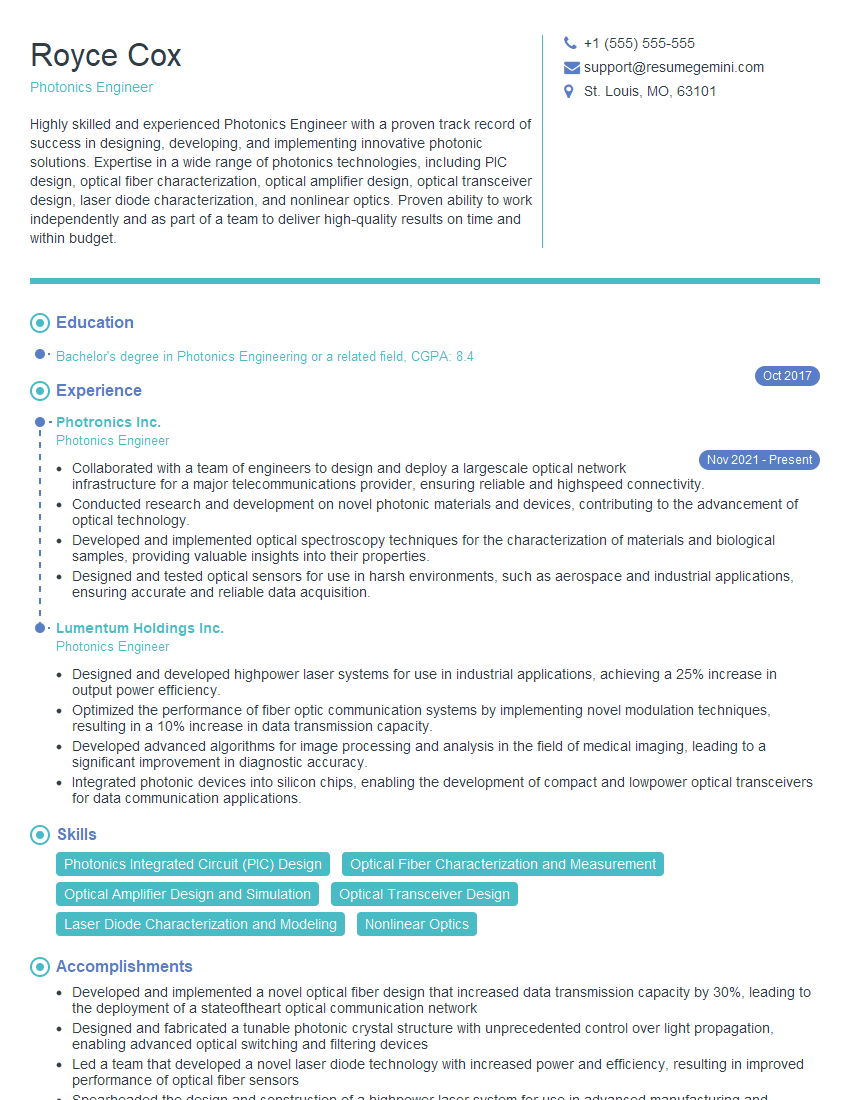
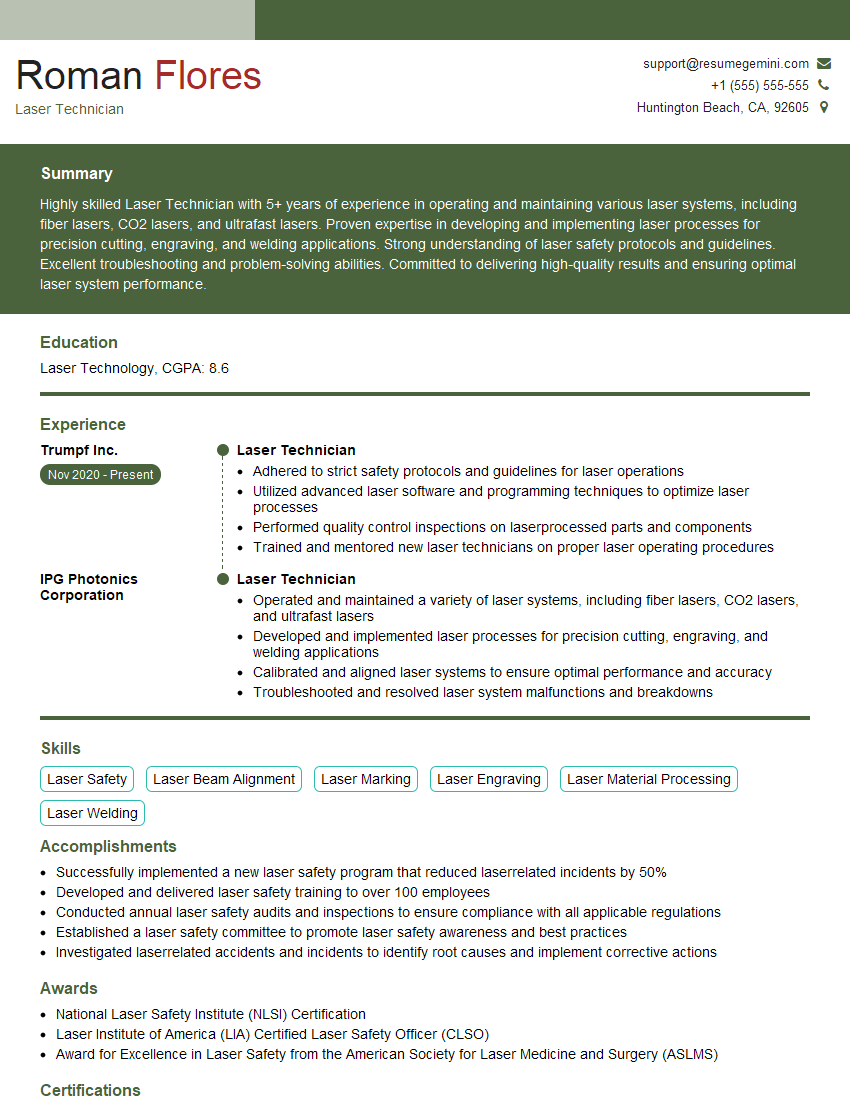
Mastering Laser System Design opens doors to exciting and innovative careers in various high-tech industries. A strong understanding of these principles is highly valued and significantly increases your earning potential. To maximize your job prospects, crafting an ATS-friendly resume is crucial. ResumeGemini can help you build a professional and impactful resume that highlights your skills and experience effectively. We provide examples of resumes tailored to Laser System Design to guide you in creating a winning application. Let ResumeGemini help you land your dream job!

Explore more articles
Users Rating of Our Blogs
Share Your Experience
We value your feedback! Please rate our content and share your thoughts (optional).
What Readers Say About Our Blog
Very informative content, great job.
good