Are you ready to stand out in your next interview? Understanding and preparing for Solar Array Design and Optimization interview questions is a game-changer. In this blog, we’ve compiled key questions and expert advice to help you showcase your skills with confidence and precision. Let’s get started on your journey to acing the interview.
Questions Asked in Solar Array Design and Optimization Interview
Q 1. Explain the different types of solar panel technologies and their applications.
Solar panel technology is constantly evolving, with several main types dominating the market. The choice depends heavily on factors like cost, efficiency, and application.
- Crystalline Silicon: This is the most common type, further divided into monocrystalline and polycrystalline. Monocrystalline panels are made from a single silicon crystal, resulting in higher efficiency (around 18-22%) and a darker, uniform appearance. Polycrystalline panels, made from multiple silicon crystals, are less efficient (around 15-17%) but are generally cheaper. They have a characteristic blueish speckled appearance.
- Thin-Film Solar Panels: These panels are made by depositing a thin layer of photovoltaic material onto a substrate. They are generally less efficient than crystalline silicon but can be more flexible and lightweight, making them suitable for integration into building materials or curved surfaces. Types include Amorphous Silicon (a-Si), Cadmium Telluride (CdTe), and Copper Indium Gallium Selenide (CIGS).
- Perovskite Solar Cells: This emerging technology offers high efficiency potential and is relatively inexpensive to produce. However, stability and scalability remain challenges. They’re promising for niche applications and future large-scale deployments.
Applications: Crystalline silicon panels are widely used in residential, commercial, and utility-scale solar power plants due to their balance of cost and efficiency. Thin-film panels find applications in building-integrated photovoltaics (BIPV), flexible solar applications, and portable power systems. Perovskite cells are still under development but show promise for improving efficiency and reducing costs further.
Q 2. Describe the process of sizing a solar array for a residential building.
Sizing a residential solar array involves determining the number of panels needed to meet the household’s energy needs. It’s a multi-step process:
- Assess Energy Consumption: Analyze your electricity bills to determine your average monthly and annual energy usage (kWh). This gives you a baseline for your solar system’s target energy production.
- Consider Solar Irradiance: Check the solar irradiance data for your location. This data represents the amount of solar energy available at your site. Higher irradiance means more energy production per panel.
- Panel Selection: Choose solar panels based on factors like efficiency, cost, and aesthetics. The panel’s wattage (W) is crucial for sizing calculations.
- Determine System Size: Estimate the necessary system size in kilowatts (kW) based on your energy consumption and local solar irradiance. A rule of thumb is to account for potential losses (shading, temperature, etc.) by adding a safety margin, typically 10-20%. For example, if your annual consumption is 10,000 kWh and the average solar irradiance dictates you need about 1 kWp to generate 1000 kWh per year, then you’d need a system between 10-12 kWp.
- Calculate Panel Quantity: Divide the total system size (in kWp) by the wattage of your chosen panel (in kWp) to determine the number of panels required.
- Inverter Selection: Choose an inverter with enough capacity to handle the total power output of your array. The inverter converts the DC electricity from the panels into AC electricity for household use.
Example: If your annual energy consumption is 8,000 kWh, with 1 kWp generating roughly 800 kWh annually in your location, you’d need approximately 10 kWp. Using 300W panels (0.3 kWp), you would need around 34 panels (10 kWp / 0.3 kWp ≈ 33.33).
Q 3. How do you determine the optimal tilt and azimuth angles for a solar array?
Optimizing tilt and azimuth angles is crucial for maximizing solar energy capture. The optimal angles depend on your latitude, the time of year, and the specific orientation of your roof or land.
- Tilt Angle: This is the angle between the solar panel and the horizontal plane. Ideally, it should match your latitude for optimal year-round performance. However, tilting slightly steeper (5-15 degrees) can increase winter production at the cost of slightly reducing summer production. This is often a good compromise in many climates.
- Azimuth Angle: This is the angle between the solar panel’s orientation (due south in the Northern Hemisphere) and due south. A perfectly south-facing array has an azimuth angle of 0 degrees. Variations can be necessary due to shading or roof constraints. Any deviation from south should be carefully evaluated for its impact on overall annual energy yield.
Determining Optimal Angles: You can use solar irradiance maps or specialized software (discussed later) to model the energy production for various tilt and azimuth angles at your location. These tools simulate hourly or even minute-by-minute solar irradiation and help pinpoint the most productive orientation for your solar array. In many cases, a near-optimum solution (such as following the latitude rule for tilt) is sufficient due to other factors such as shading.
Q 4. What are the key factors to consider when designing a solar array for a commercial building?
Designing a commercial solar array requires a more complex approach than residential systems. Key factors include:
- Energy Demand Profile: Commercial buildings have fluctuating energy demands throughout the day and year. Accurate load profiling is essential to accurately size the system and ensure sufficient power is generated when needed.
- Rooftop Space and Shading: Commercial buildings often have complex roof geometries and significant shading from surrounding structures or trees. Careful analysis is needed to mitigate shading losses and optimize panel placement.
- Building Codes and Permits: Stricter regulations and permitting processes apply to commercial projects. Compliance with local building codes and fire safety standards is paramount.
- Cost Considerations: Return on investment (ROI) is a critical factor in commercial projects. A detailed financial analysis, including upfront costs, maintenance, and energy savings, is required.
- Grid Connection and Interconnection Requirements: Connecting a large commercial solar array to the electrical grid involves specific procedures and regulations. Proper interconnection studies are essential.
- System Aesthetics: The visual impact of a solar array on the building’s appearance is crucial for maintaining brand image and property value.
Practical Application: A large office building might require a detailed shadow analysis using software to determine the best panel layout on a complex roof. The design would also incorporate provisions for future expansion or system upgrades.
Q 5. Explain the concept of shading and its impact on solar array performance.
Shading is a major concern in solar array design. Even a small amount of shade can significantly reduce the power output of an entire string of panels, a phenomenon known as the ‘string effect’.
Impact: When a single panel in a series string is shaded, its voltage drops, reducing the output of all other panels connected in that string. This is because the current in a series circuit is the same throughout. Even partial shading can cause dramatic losses. A small shadow on a single cell within a panel can also significantly impair its function. Therefore, careful attention to shading from trees, buildings, or even the panels themselves (self-shading) is crucial.
Example: A single tree branch casting a shadow on one panel in a string of 10 can severely reduce the power output of all 10 panels, instead of just that one panel. This demonstrates why shading analysis is critical in solar array design.
Q 6. How do you account for shading losses in your designs?
Several strategies are used to minimize the impact of shading on solar array performance:
- Shading Analysis: Employing software and tools (discussed below) to analyze potential shading throughout the year, at different times of day. This identifies areas prone to shading and helps in optimizing panel placement and orientation.
- Optimized Panel Placement: Strategic panel placement to minimize self-shading and shading from external sources. This may involve careful consideration of roof geometry and surrounding structures.
- Bypass Diodes: Incorporating bypass diodes in individual panels or strings allows current to bypass a shaded section, limiting the impact on the overall array performance. This reduces the string effect.
- Microinverters: Using microinverters, which process the power from individual panels, eliminates the string effect. If one panel is shaded, it doesn’t affect the others.
- Panel Cleaning: Regular panel cleaning can help prevent minor shading from dirt and debris.
Practical Application: In a complex roof layout with many obstructions, a detailed 3D shading analysis is performed using specialized software. This analysis may guide the decision to use microinverters or strategically position panels to minimize the worst-case scenarios of shading.
Q 7. What software or tools do you use for solar array design and simulation?
Several software and tools are used for solar array design and simulation:
- PVsyst: A powerful and widely used software for detailed design and simulation of photovoltaic systems. It includes advanced modelling capabilities for shading, temperature effects, and energy yield estimation.
- Helioscope: A cloud-based software that offers 3D modeling and shading analysis. It simplifies the design process and provides visual representations of the array’s performance.
- Aurora: Another widely used platform offering similar capabilities to Helioscope, combining 3D modeling with detailed performance analysis.
- Autodesk Revit (with plugins): While not exclusively for PV design, Revit allows for the integration of PV models into building design, facilitating coordination between architectural and solar design aspects.
These tools allow for detailed simulations, considering various factors like panel characteristics, weather data, and shading to optimize the design for maximum energy production.
Q 8. Describe your experience with different inverter technologies and their selection criteria.
Inverter technology selection is crucial for optimal solar array performance. I have extensive experience with central inverters, string inverters, and microinverters. Central inverters are the simplest, connecting the entire array to a single unit. They are cost-effective but offer less flexibility and are susceptible to complete system failure if one component fails. String inverters, on the other hand, combine multiple strings of panels into one unit, offering better fault tolerance. However, shading on one panel affects performance of the entire string. Microinverters, my preferred choice for many applications, optimize each panel individually, maximizing energy harvest even with partial shading or differing panel performance.
Selection criteria depend on several factors: system size (central inverters best for smaller systems), budget (central inverters are often cheapest upfront), desired level of monitoring and fault tolerance (microinverters provide granular monitoring and better fault tolerance), and the array’s physical characteristics (string inverters are better suited for uniform arrays). For example, a large commercial rooftop project might benefit from string inverters for cost-effectiveness, while a residential system with significant shading would be better served by microinverters for optimized energy production.
Q 9. Explain the importance of ground-mount vs. roof-mount solar array designs.
Ground-mount and roof-mount solar array designs have distinct advantages and disadvantages. Ground-mount systems offer greater flexibility in terms of array orientation and size, allowing for optimal sun exposure and potentially higher energy yield. They are also easier to maintain and upgrade. However, they require more land, may need expensive foundation work, and might face permitting challenges. Roof-mount systems are more convenient for homeowners with available roof space, usually less expensive to install, and can use existing rooftop structures. However, they are constrained by roof size, orientation, and structural integrity, leading to potentially lower energy output and more challenging maintenance access. For example, a large commercial solar farm will benefit from a ground-mount system, while a home with a south-facing roof ideally suited for panels is prime for a roof-mount design. The optimal choice involves a detailed site assessment considering available space, budget, and energy needs.
Q 10. Discuss the challenges and considerations for integrating solar arrays with existing electrical grids.
Integrating solar arrays with existing electrical grids presents several challenges. Firstly, ensuring grid compatibility is paramount. The system needs to meet the grid’s voltage and frequency requirements and must incorporate safety features like anti-islanding protection to prevent backfeeding during outages. Secondly, interconnection studies are required to assess the grid’s capacity to handle the added solar power. Overloading the grid can lead to instability, and insufficient capacity may necessitate upgrades to the grid infrastructure. Thirdly, permitting and regulatory compliance can be complex and vary by location. Permitting bodies often have specific requirements regarding system design, safety, and interconnection procedures. These are often time consuming and costly. For instance, a project might require upgrades to the local transformer or the installation of additional grid-tied infrastructure before the solar array can be safely connected.
Q 11. How do you design for microinverters versus string inverters?
Designing for microinverters versus string inverters involves different approaches. With microinverters, each panel is independently monitored and optimized. This leads to a modular design where panels can be added or replaced easily. The design focuses on ensuring sufficient wiring and cabling to accommodate each microinverter and distributing the power to the main combiner box. String inverter designs necessitate a more careful layout to minimize shading effects within each string. String length must be optimized to balance voltage drop and the number of panels within a string. Shade on a single panel affects the entire string; thus, strategic panel placement becomes very important. For example, in a system with significant partial shading, a microinverter design would maximize energy harvest compared to a string inverter design, even if the string inverter may be less costly up front.
Q 12. What are the key safety considerations during the design and installation of a solar array?
Safety is paramount in solar array design and installation. Key considerations include electrical shock hazards, fire hazards, and potential fall hazards during installation and maintenance. Design must incorporate appropriate grounding and bonding to minimize electrical shock risks. Components must be selected and installed according to manufacturers’ specifications and relevant codes. Overcurrent protection devices, such as fuses and circuit breakers, must be appropriately sized to prevent overheating and fires. In addition, robust mounting systems and fall protection measures are crucial, especially for ground-mount systems and rooftop installations. Proper training and adherence to safety protocols for personnel are vital. A good analogy is a well-designed home’s electrical system; many aspects overlap in terms of required safeguards.
Q 13. Explain your understanding of the National Electrical Code (NEC) as it pertains to solar installations.
The National Electrical Code (NEC) provides comprehensive standards for electrical installations, including solar photovoltaic (PV) systems. My understanding of the NEC encompasses articles 690 and associated articles that govern PV system design, installation, and inspection. This includes requirements for grounding, overcurrent protection, wiring methods, system grounding, disconnects, and arc flash mitigation. I regularly consult the NEC to ensure compliance, which involves understanding specific requirements for different system types and locations. For example, NEC Article 690.12 requires that all PV systems are adequately grounded, and the specific grounding requirements will depend on the system type and location. Ignoring NEC compliance can result in system failures, safety hazards, and insurance issues.
Q 14. How do you evaluate the financial viability of a solar project?
Evaluating the financial viability of a solar project involves a comprehensive analysis of costs and benefits. This includes calculating the initial investment costs (panels, inverters, installation, permits), ongoing operating and maintenance expenses, and potential incentives (tax credits, rebates). The analysis requires projecting future energy production based on system size, panel performance, and solar irradiance data for the specific location. Revenue streams include reduced electricity bills and potential feed-in tariffs or power purchase agreements (PPAs). Key metrics include the simple payback period (time to recoup initial investment), internal rate of return (IRR), and net present value (NPV). Sophisticated financial modeling tools and software are used to run scenarios with varying parameters to identify the optimal system design and financing options. For instance, a detailed financial model would assess different financing options like loans and leases and determine their effects on the project’s profitability over its lifetime.
Q 15. Describe your experience with solar array performance monitoring and analysis.
Solar array performance monitoring and analysis is crucial for ensuring optimal energy production and identifying potential issues. My experience involves utilizing various monitoring systems, from simple data loggers to sophisticated SCADA (Supervisory Control and Data Acquisition) systems. This data allows us to track key performance indicators (KPIs) such as power output, voltage, current, and temperature. I’m proficient in analyzing this data to identify trends, anomalies, and performance degradation. For instance, I once worked on a project where a seemingly minor voltage fluctuation, detected through continuous monitoring, pointed towards a failing inverter, preventing a major system failure. My analysis also includes using advanced techniques such as performance ratio calculations and comparing actual yield to predicted yield based on solar irradiance data. This provides a comprehensive understanding of system efficiency and helps pinpoint areas for improvement. I also use specialized software to create reports and visualizations to communicate findings effectively to clients.
Career Expert Tips:
- Ace those interviews! Prepare effectively by reviewing the Top 50 Most Common Interview Questions on ResumeGemini.
- Navigate your job search with confidence! Explore a wide range of Career Tips on ResumeGemini. Learn about common challenges and recommendations to overcome them.
- Craft the perfect resume! Master the Art of Resume Writing with ResumeGemini’s guide. Showcase your unique qualifications and achievements effectively.
- Don’t miss out on holiday savings! Build your dream resume with ResumeGemini’s ATS optimized templates.
Q 16. What are the common causes of solar array performance degradation?
Solar array performance degradation stems from a variety of factors. Think of it like a car – several components can impact its overall performance. Common causes include:
- Soiling: Dust, dirt, bird droppings, and pollen accumulating on panels reduce light absorption. This is particularly prevalent in arid or heavily polluted environments.
- Shading: Trees, buildings, or even other panels casting shadows on solar panels drastically reduce their output. Even partial shading can significantly impact the entire array’s performance.
- Module Degradation: Over time, solar panels naturally degrade, losing efficiency due to material aging and weathering. This is a slow process, but it’s important to account for it.
- Inverter Issues: Inverters convert DC power from panels to AC power for the grid. Malfunctions or aging inverters significantly reduce the system’s output.
- Wiring and Connection Problems: Loose connections, damaged wires, or faulty connectors can lead to significant power losses. A single bad connection can impact the entire string of panels.
- Hot Spots: These are areas on a panel where excessive heat builds up, often due to shading or cell damage. Hot spots can accelerate panel degradation.
Understanding these causes is critical for effective diagnosis and remediation.
Q 17. How do you address and mitigate performance issues in solar arrays?
Addressing performance issues requires a systematic approach. First, we thoroughly analyze performance data to pinpoint the problem’s source. Then, we implement targeted solutions:
- Cleaning: Regular panel cleaning, particularly in dusty or polluted areas, significantly boosts output.
- Shading Mitigation: Pruning trees, adjusting panel orientation, or installing bypass diodes can alleviate shading effects.
- Module Replacement: Replacing faulty or severely degraded panels restores optimal performance.
- Inverter Repair or Replacement: Fixing or replacing malfunctioning inverters is crucial for maximizing energy production.
- Wiring Inspection and Repair: Addressing loose connections and damaged wires is critical for maintaining optimal system performance.
- Thermal Imaging: Using thermal imaging cameras helps identify hot spots, indicating potential cell damage or shading issues.
A proactive approach that incorporates regular inspections and preventative maintenance minimizes the impact of performance issues and prolongs the life of the solar array. For example, in one instance, we implemented a preventative maintenance program involving quarterly inspections, leading to a consistent improvement in energy output and reduced repair costs over the array’s lifespan.
Q 18. Explain your understanding of Maximum Power Point Tracking (MPPT).
Maximum Power Point Tracking (MPPT) is a crucial technology in solar array design. Solar panels don’t produce their maximum power output at a single voltage and current. Instead, their power output varies with changing sunlight conditions (irradiance and temperature). MPPT algorithms constantly monitor the voltage and current produced by the solar panels and adjust the inverter’s input to extract the maximum possible power at any given moment. Think of it like a car’s automatic transmission – it constantly adjusts the gear ratio to optimize engine performance, and MPPT does the same for solar panels, maximizing power generation under varying conditions. Different MPPT algorithms exist, each with its own strengths and weaknesses. Common ones include Perturb and Observe, Incremental Conductance, and Hill Climbing. The choice depends on factors like cost, complexity, and efficiency requirements.
Q 19. Describe different methods for optimizing solar array energy production.
Optimizing solar array energy production involves a multi-faceted approach:
- Optimal Tilt and Azimuth Angles: Careful consideration of latitude, climate, and shading to maximize solar irradiance throughout the year.
- Panel Spacing and Arrangement: Ensuring adequate spacing between panels to prevent shading and allow for airflow.
- Bypass Diodes: Protecting against hot spots by allowing current to bypass shaded or damaged cells.
- Microinverters: Offering improved energy production and monitoring at the individual panel level.
- Advanced Monitoring Systems: Utilizing sophisticated systems to track and analyze performance data to identify and address potential issues proactively.
- Ground-Mounted vs. Roof-Mounted Systems: Selecting the most appropriate system type based on site constraints and energy production goals. For instance, larger ground-mounted systems often offer better performance than roof-mounted systems due to less shading and easier access for maintenance.
The optimization strategy must be tailored to the specific site conditions, energy needs, and budget constraints.
Q 20. How do you ensure compliance with relevant building codes and regulations?
Compliance with building codes and regulations is paramount. This involves a thorough understanding of local, state, and national codes related to solar installations. I carefully review these codes throughout the design process to ensure structural integrity, fire safety, and electrical safety standards are met. This includes aspects such as:
- Structural Load Calculations: Ensuring the roof or ground structure can withstand the added weight of the solar array.
- Electrical Code Compliance: Meeting requirements for wiring, grounding, overcurrent protection, and disconnect switches.
- Fire Safety: Adhering to standards to prevent fire hazards.
- Permitting and Inspections: Obtaining the necessary permits and coordinating inspections with local authorities.
My experience includes navigating various codes and regulations across different jurisdictions, ensuring each project is compliant and meets all necessary safety and performance standards.
Q 21. Discuss the impact of climate and weather conditions on solar array design.
Climate and weather conditions significantly impact solar array design. Factors such as:
- Solar Irradiance: The amount of sunlight received varies considerably based on location and time of year. Design needs to account for peak sun hours and seasonal variations.
- Temperature: High temperatures can reduce panel efficiency. Design must consider temperature coefficients and incorporate cooling strategies when necessary.
- Wind Load: High winds pose a structural risk. Design must ensure the system can withstand anticipated wind speeds.
- Snow Load: In snowy regions, the design must accommodate the weight of accumulated snow on the panels and the mounting structure.
- Humidity and Precipitation: High humidity and precipitation can accelerate corrosion and reduce panel performance. Appropriate materials and protective coatings are necessary.
I use specialized software to model these effects and optimize the array’s design for optimal performance in the specific climatic conditions of the installation site. For instance, I recently designed a system for a high-altitude location with significant snowfall, incorporating reinforced mounting structures and increased panel spacing to handle snow loads and wind conditions.
Q 22. What are your preferred methods for determining the optimal string configuration for a solar array?
Determining the optimal string configuration for a solar array is crucial for maximizing energy production and minimizing losses. It involves balancing several factors, primarily the number of modules per string, the string voltage, and the inverter’s input characteristics. My preferred approach is a multi-step process:
Understanding the system constraints: I start by analyzing the available modules’ specifications (power, voltage, current), the inverter’s maximum input voltage and current, and the shade conditions of the site. For example, a high-voltage inverter allows for longer strings, reducing the number of strings and associated wiring costs.
String length optimization: I use software tools and simulations to model different string configurations and evaluate their performance under various irradiance conditions. This helps to find the balance between maximizing power output and staying within the inverter’s operational limits. If using modules with a high open-circuit voltage, it’s common to use fewer modules per string to prevent exceeding the inverter’s maximum input voltage.
Mismatch losses consideration: I account for potential mismatch losses among modules within a string due to manufacturing tolerances or shading. Using a larger number of modules can mitigate the effects of individual module failures. We need to carefully evaluate the trade-offs between larger strings and mismatch losses.
Shading analysis: In sites with partial shading, optimizing string configuration becomes even more critical. Careful analysis of the shading patterns guides the placement of modules and design of strings to minimize the impact on overall power production. I employ advanced shading analysis tools to determine optimal string layouts.
Iterative design and refinement: Finally, I iterate through the process, adjusting the string configuration based on the results of the simulations and cost analyses until the optimal configuration is achieved, considering overall system cost, performance, and reliability.
Q 23. Explain your experience with different types of solar trackers.
My experience with solar trackers encompasses various types, each with its own advantages and disadvantages. I’ve worked extensively with:
Single-axis trackers: These rotate along a single axis (typically east-west) to follow the sun throughout the day. They offer a good balance between cost and performance, providing a significant increase in energy yield compared to fixed-tilt systems. I’ve used these extensively in projects with relatively flat terrain.
Dual-axis trackers: These track the sun along both the azimuth and elevation axes, maximizing solar energy capture throughout the day and year. While offering the highest energy yield, they are more complex and expensive than single-axis trackers, and require robust structural design to handle the increased loads. These are favored in areas with high solar irradiance and higher land costs where maximizing energy yield is paramount.
Fixed-tilt systems: While simpler and less expensive, fixed-tilt systems are less efficient, particularly in locations with significant seasonal changes in solar elevation. Their optimal tilt angle needs to be determined based on the latitude and climate.
The choice of tracker type is heavily dependent on factors like site-specific conditions (latitude, climate, terrain), project budget, and the desired return on investment. For example, in locations with high solar irradiance and expensive land, the additional cost of dual-axis trackers is often justified by the increased energy generation.
Q 24. How do you account for energy storage systems (batteries) in your solar array designs?
Incorporating energy storage systems (batteries) into solar array designs is becoming increasingly important for improving grid stability and providing backup power. My approach involves:
Determining energy storage needs: This involves calculating the desired backup time and the load profile. The capacity of the battery system needs to be sufficient to cover the load during periods of low or no solar power generation, whether it’s during nighttime or cloudy days. This often involves sophisticated load modeling and forecasting techniques.
Choosing the right battery technology: This depends on various factors including cost, lifespan, charge/discharge rates, and environmental impact. Lithium-ion batteries are becoming increasingly popular due to their high energy density and long cycle life. However, other technologies like lead-acid batteries are still relevant, particularly for lower-cost applications.
Sizing the inverter and charge controller: The inverter must be capable of handling both the solar input and the battery output. The charge controller regulates the charging and discharging of the batteries to prevent overcharging or deep discharging, extending battery lifespan.
Integrating the battery system into the overall design: This involves careful consideration of safety and electrical protection systems. Appropriate safety measures, such as over-current protection and thermal management, are crucial for safe and reliable operation.
For example, in a residential application, the battery system might be designed to provide backup power during grid outages, allowing essential appliances to function. In a larger-scale project, the battery system could help stabilize the grid by providing power during peak demand periods.
Q 25. Discuss the challenges of designing solar arrays for off-grid applications.
Designing solar arrays for off-grid applications presents unique challenges due to the absence of a reliable grid connection. Key considerations include:
Accurate load profiling: A precise understanding of the energy demand is paramount. This often requires detailed analysis of household appliances, lighting systems, and other energy-consuming devices to determine the total daily and seasonal energy needs.
Oversizing the system: Off-grid systems typically need to be oversized to account for periods of low solar irradiance (cloudy days, winter months). The system needs to have sufficient capacity to meet the energy demand even under unfavorable weather conditions. A larger array might be necessary to accommodate the energy requirements of the house and to provide sufficient reserve power.
Battery sizing: The battery bank needs to be sized to store enough energy to cover the energy needs during periods when solar power is unavailable. Careful consideration of battery capacity, discharge rate, and lifespan is crucial.
System reliability: Off-grid systems need to be highly reliable. Components must be chosen for durability and longevity to minimize the need for replacements or repairs, especially in remote areas where access to maintenance personnel might be limited.
Voltage regulation and protection: Robust voltage regulation and protection systems are essential to ensure the safe and efficient operation of the system.
Designing for off-grid applications often involves using simulation software and considering worst-case scenarios to ensure adequate system sizing and redundancy.
Q 26. How do you approach the design of a solar array for a large-scale solar farm?
Designing a solar array for a large-scale solar farm involves a more comprehensive approach that goes beyond individual array design. Key aspects include:
Site assessment and resource evaluation: Detailed site surveys and meteorological data analysis are vital to determine the optimal location, orientation, and tilt angle for the arrays. This includes considering factors like solar irradiance, terrain, shading, and environmental impact.
Land acquisition and permitting: Securing land rights and obtaining necessary permits is often a lengthy and complex process.
Array layout optimization: This involves optimizing the arrangement of solar arrays to maximize energy production while minimizing land use and ensuring efficient access for maintenance.
Grid connection and power evacuation: Large-scale solar farms require robust grid infrastructure for power evacuation, which often includes high-voltage transmission lines and substations.
System design and component selection: Choosing appropriate solar panels, inverters, and balance-of-system components is essential. Factors such as cost-effectiveness, reliability, and performance need careful consideration.
Construction management: Efficient construction management practices, including project scheduling, material procurement, and quality control, are critical for successful project completion.
Operation and maintenance plan: Developing a comprehensive O&M plan, including regular inspections, cleaning, and repair, is essential for long-term system performance.
The project requires thorough engineering design, detailed modeling and simulation, and professional project management to ensure success. Often, specialized software and Geographic Information Systems (GIS) are used to optimize the layout and assess potential challenges.
Q 27. What are the key metrics used to evaluate the performance of a solar array?
Key performance indicators (KPIs) for evaluating a solar array’s performance include:
Energy yield: The total amount of energy generated over a specific period (daily, monthly, or annually). This is typically measured in kilowatt-hours (kWh).
Capacity factor: The ratio of actual energy generated to the maximum possible energy output based on the installed capacity. It indicates how efficiently the system is utilizing its potential. A higher capacity factor suggests better performance and fewer downtime issues.
Performance ratio (PR): This considers various losses in the system, including shading, module mismatch, and soiling, to provide a holistic measure of efficiency. A higher PR signifies better overall performance.
Specific yield: Energy production per kilowatt (kW) of installed capacity. This helps compare the performance of different systems, standardizing the output based on system size.
System efficiency: This reflects the overall efficiency of converting solar radiation into usable electricity. It encompasses all losses, offering a comprehensive view of the system’s ability to generate power.
Return on investment (ROI): A crucial financial metric that considers the initial investment cost, energy generated, and operating expenses to evaluate the economic viability of the project.
Monitoring these metrics using data loggers and performance monitoring software is essential for assessing system health, identifying areas for improvement, and optimizing operational strategies.
Q 28. Describe your experience with solar array maintenance and troubleshooting.
My experience with solar array maintenance and troubleshooting covers a wide range of tasks, from routine inspections to complex repairs. I’ve worked on both small residential systems and large-scale utility-scale projects.
Preventive maintenance: This includes regular cleaning of solar panels to remove dirt, leaves, and bird droppings, which can significantly reduce energy output. Inspection of wiring, connectors, and grounding systems for any signs of damage or degradation is also crucial.
Troubleshooting: Identifying and resolving issues such as faulty modules, inverter malfunctions, wiring problems, or shading effects requires a systematic approach. I utilize specialized tools for fault detection, including thermal imaging cameras and electrical testing equipment.
Data analysis: Analyzing performance data from monitoring systems can help identify potential problems early on. Trends in energy output can pinpoint areas requiring attention, such as degraded panels or faulty components.
Corrective maintenance: This involves repairing or replacing faulty components, such as damaged solar modules, inverters, or other equipment. Safety procedures are always followed to ensure safe and efficient repair works.
Effective maintenance and troubleshooting are critical for maintaining optimal system performance, extending its lifespan, and ensuring a safe operating environment. Using remote monitoring systems helps in proactive identification and mitigation of issues.
Key Topics to Learn for Solar Array Design and Optimization Interview
- Site Assessment and Analysis: Understanding site conditions (shading, terrain, orientation), and their impact on array performance. Practical application includes using software to model solar irradiance and energy yield.
- Array Sizing and Configuration: Determining optimal array size based on energy demand, budget constraints, and available space. This involves calculations and simulations to optimize system output.
- Panel Selection and Technology: Evaluating different photovoltaic (PV) panel technologies (monocrystalline, polycrystalline, thin-film) and their performance characteristics. Practical application involves comparing datasheets and choosing panels based on specific project needs.
- Inverter Selection and Sizing: Choosing inverters that match the array’s power output and optimize energy conversion efficiency. This includes understanding MPPT (Maximum Power Point Tracking) algorithms.
- Wiring and Cabling Design: Designing safe and efficient wiring systems, considering voltage drop, current carrying capacity, and grounding requirements. Practical application involves using relevant electrical codes and standards.
- Balance of System (BOS) Components: Understanding the role and selection of other crucial components like mounting structures, combiner boxes, and disconnects.
- Software and Simulation Tools: Familiarity with software packages used for solar array design and optimization (e.g., PVsyst, Helioscope). Practical application includes using these tools to model and analyze different design scenarios.
- Economic Analysis and Financial Modeling: Evaluating the financial viability of solar array projects, including levelized cost of energy (LCOE) calculations and return on investment (ROI) analysis.
- Safety Regulations and Standards: Understanding and adhering to relevant safety regulations and standards for solar array design and installation.
- Troubleshooting and Problem Solving: Ability to diagnose and resolve common issues in solar array design and operation.
Next Steps
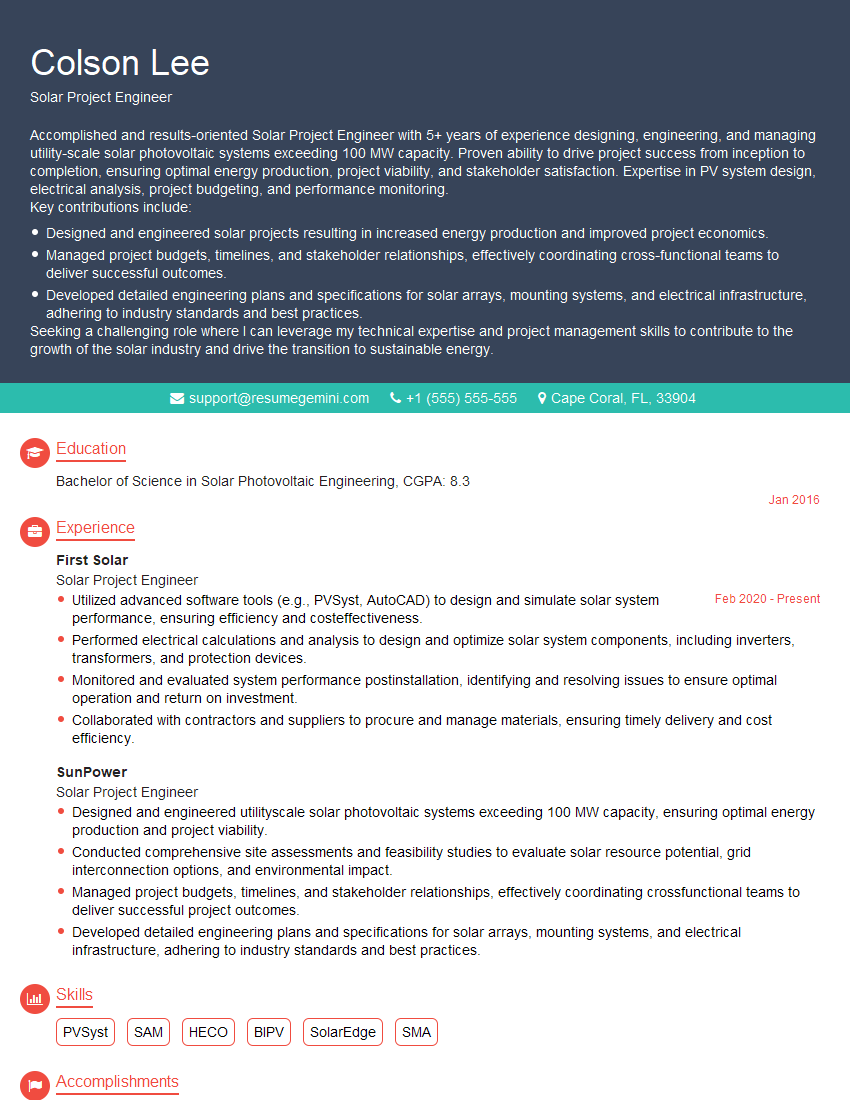
Mastering Solar Array Design and Optimization opens doors to exciting career opportunities in a rapidly growing renewable energy sector. To stand out, a strong and ATS-friendly resume is crucial. ResumeGemini is a trusted resource to help you build a professional and impactful resume that highlights your skills and experience. Examples of resumes tailored to Solar Array Design and Optimization are available to help you showcase your qualifications effectively and land your dream job.
Explore more articles
Users Rating of Our Blogs
Share Your Experience
We value your feedback! Please rate our content and share your thoughts (optional).
What Readers Say About Our Blog
Hello,
we currently offer a complimentary backlink and URL indexing test for search engine optimization professionals.
You can get complimentary indexing credits to test how link discovery works in practice.
No credit card is required and there is no recurring fee.
You can find details here:
https://wikipedia-backlinks.com/indexing/
Regards
NICE RESPONSE TO Q & A
hi
The aim of this message is regarding an unclaimed deposit of a deceased nationale that bears the same name as you. You are not relate to him as there are millions of people answering the names across around the world. But i will use my position to influence the release of the deposit to you for our mutual benefit.
Respond for full details and how to claim the deposit. This is 100% risk free. Send hello to my email id: [email protected]
Luka Chachibaialuka
Hey interviewgemini.com, just wanted to follow up on my last email.
We just launched Call the Monster, an parenting app that lets you summon friendly ‘monsters’ kids actually listen to.
We’re also running a giveaway for everyone who downloads the app. Since it’s brand new, there aren’t many users yet, which means you’ve got a much better chance of winning some great prizes.
You can check it out here: https://bit.ly/callamonsterapp
Or follow us on Instagram: https://www.instagram.com/callamonsterapp
Thanks,
Ryan
CEO – Call the Monster App
Hey interviewgemini.com, I saw your website and love your approach.
I just want this to look like spam email, but want to share something important to you. We just launched Call the Monster, a parenting app that lets you summon friendly ‘monsters’ kids actually listen to.
Parents are loving it for calming chaos before bedtime. Thought you might want to try it: https://bit.ly/callamonsterapp or just follow our fun monster lore on Instagram: https://www.instagram.com/callamonsterapp
Thanks,
Ryan
CEO – Call A Monster APP
To the interviewgemini.com Owner.
Dear interviewgemini.com Webmaster!
Hi interviewgemini.com Webmaster!
Dear interviewgemini.com Webmaster!
excellent
Hello,
We found issues with your domain’s email setup that may be sending your messages to spam or blocking them completely. InboxShield Mini shows you how to fix it in minutes — no tech skills required.
Scan your domain now for details: https://inboxshield-mini.com/
— Adam @ InboxShield Mini
Reply STOP to unsubscribe
Hi, are you owner of interviewgemini.com? What if I told you I could help you find extra time in your schedule, reconnect with leads you didn’t even realize you missed, and bring in more “I want to work with you” conversations, without increasing your ad spend or hiring a full-time employee?
All with a flexible, budget-friendly service that could easily pay for itself. Sounds good?
Would it be nice to jump on a quick 10-minute call so I can show you exactly how we make this work?
Best,
Hapei
Marketing Director
Hey, I know you’re the owner of interviewgemini.com. I’ll be quick.
Fundraising for your business is tough and time-consuming. We make it easier by guaranteeing two private investor meetings each month, for six months. No demos, no pitch events – just direct introductions to active investors matched to your startup.
If youR17;re raising, this could help you build real momentum. Want me to send more info?
Hi, I represent an SEO company that specialises in getting you AI citations and higher rankings on Google. I’d like to offer you a 100% free SEO audit for your website. Would you be interested?
Hi, I represent an SEO company that specialises in getting you AI citations and higher rankings on Google. I’d like to offer you a 100% free SEO audit for your website. Would you be interested?
good