Cracking a skill-specific interview, like one for Strategic Foresight, requires understanding the nuances of the role. In this blog, we present the questions you’re most likely to encounter, along with insights into how to answer them effectively. Let’s ensure you’re ready to make a strong impression.
Questions Asked in Strategic Foresight Interview
Q 1. Describe your experience developing and applying scenario planning methodologies.
Scenario planning is a powerful foresight methodology that helps organizations explore potential futures and develop robust strategies. My experience encompasses developing and facilitating scenario planning projects across diverse sectors, from technology to healthcare. I typically follow a structured approach, beginning with defining the scope and timeframe of the analysis, identifying key uncertainties that will shape the future (e.g., technological breakthroughs, regulatory changes, geopolitical shifts), and developing a set of plausible, yet contrasting, scenarios. These scenarios are not predictions but rather tools for exploring strategic implications. For example, in a recent project for a renewable energy company, we developed four scenarios based on variations in government policy, technological advancements, and consumer demand. Each scenario painted a different picture of the company’s potential market share and profitability, enabling the company to develop flexible and resilient strategies to navigate various future outcomes.
I also emphasize ensuring that the scenarios are internally consistent, plausible, and relevant to the organization’s strategic goals. Finally, we use these scenarios to explore potential strategic options and identify robust strategies that perform well under different future conditions, improving the organization’s decision-making capabilities under uncertainty.
Q 2. Explain how you identify and analyze key drivers of change impacting an organization.
Identifying and analyzing key drivers of change requires a systematic and multi-faceted approach. It involves scanning the environment for emerging trends and potential disruptions using various tools such as PESTLE analysis (Political, Economic, Social, Technological, Legal, Environmental) and STEEP analysis (Socio-cultural, Technological, Economic, Environmental, Political). I actively leverage both qualitative and quantitative data sources, including industry reports, academic research, news articles, social media trends, and internal data.
For instance, when working with a financial institution, I utilized trend analysis to identify shifts in consumer behavior toward digital banking and the rise of fintech companies. This allowed us to anticipate potential challenges and opportunities, ultimately shaping the organization’s strategic response. After identifying key drivers, I use a prioritization matrix to focus on the most impactful elements, considering both the likelihood and the potential impact of each driver on the organization.
Q 3. How do you assess the credibility and reliability of foresight data sources?
Assessing the credibility and reliability of foresight data sources is critical to ensure the validity of the analysis. I use a multi-pronged approach that includes evaluating the source’s reputation, methodology, and potential biases. For example, peer-reviewed academic articles hold higher credibility than unverified blog posts. Government reports often provide reliable data, but they might reflect a certain political stance. I also look for data triangulation—corroborating information from multiple independent sources to validate findings.
Furthermore, I always critically assess the data’s relevance to the specific context of the project. For instance, a global trend might not be directly applicable to a niche market. By carefully evaluating sources and employing data triangulation, we can build a strong foundation for accurate and robust foresight analysis.
Q 4. Detail your approach to integrating qualitative and quantitative data in foresight analysis.
Integrating qualitative and quantitative data is crucial for a comprehensive foresight analysis. Quantitative data, such as market size, sales figures, and demographic trends, provides objective measurements, while qualitative data, like customer feedback, expert opinions, and societal narratives, offer deeper insights into the ‘why’ behind the numbers. I often employ mixed-methods research designs, combining both types of data to get a holistic understanding.
For example, in a project for a retail company, we used quantitative sales data to identify declining product categories, then followed up with qualitative customer surveys and focus groups to understand the reasons behind the decline, allowing us to develop more effective strategies. This integrated approach ensures a more robust and nuanced analysis, leading to more informed and effective strategic recommendations.
Q 5. Describe your experience in facilitating foresight workshops and engaging stakeholders.
Facilitating foresight workshops and engaging stakeholders is essential for effective foresight. My approach focuses on creating a collaborative and inclusive environment where participants from various backgrounds and levels of expertise can share their insights. Before the workshop, I carefully design the agenda and materials to ensure alignment with the project’s objectives. During the session, I utilize a variety of interactive techniques like brainstorming, mind-mapping, and scenario-building exercises to encourage active participation and knowledge sharing. I also ensure the balance between structured discussion and open exploration, enabling the capture of diverse perspectives.
Post-workshop, I synthesize the insights gathered and communicate them clearly to all participants, ensuring that everyone understands the implications and next steps. Effective stakeholder engagement is crucial for ensuring buy-in and successful implementation of the foresight findings.
Q 6. How do you translate complex foresight findings into actionable recommendations for decision-makers?
Translating complex foresight findings into actionable recommendations requires careful consideration of the audience and their decision-making context. I avoid technical jargon and present the information in a clear, concise, and visually compelling manner, often using charts, graphs, and narratives. I frame the recommendations in terms of strategic options and potential implications, emphasizing the potential risks and rewards associated with each option. For example, instead of stating ‘Market penetration in segment X is projected to decline by 15% by 2025,’ I might say, ‘Given the projected decline in segment X, we recommend exploring diversification into segment Y, which shows significant growth potential, to mitigate revenue losses and maintain profitability.’
Finally, I always present a prioritized list of recommendations, highlighting the most critical actions that need to be taken. This ensures decision-makers have a clear roadmap for strategic action.
Q 7. Explain your understanding of different foresight methods (e.g., trend analysis, Delphi method, backcasting).
My understanding of foresight methods is extensive. Trend analysis involves identifying and extrapolating patterns in historical data to predict future trends. The Delphi method utilizes expert panels to achieve consensus on future possibilities through a structured iterative process, minimizing biases. Backcasting works backward from a desired future state to identify the necessary steps to achieve that future.
I also utilize other methods like qualitative scenario planning (as described earlier), quantitative modeling (using statistical methods to forecast future outcomes), and technology scanning (monitoring technological advancements and their potential societal impacts). Selecting the appropriate method depends on the specific project goals, available data, and timeframe. The choice often involves a combination of methods to leverage their respective strengths.
Q 8. How do you manage uncertainty and ambiguity in foresight projects?
Uncertainty and ambiguity are inherent in foresight work; predicting the future is, after all, impossible. My approach focuses on managing, not eliminating, these challenges. This involves a multi-pronged strategy:
- Scenario Planning: Instead of predicting a single future, we develop multiple plausible scenarios, each representing a different set of potential outcomes. This acknowledges the inherent uncertainty and prepares us for a range of possibilities. For example, in a project forecasting the impact of climate change on agriculture, we might develop scenarios ranging from moderate warming with effective adaptation to severe warming with significant societal disruption.
- Robustness Analysis: We analyze the sensitivity of our forecasts to changes in key assumptions. This helps identify the factors that have the biggest impact on the outcome and allows us to focus our efforts on understanding and managing those factors. For instance, in analyzing the future of electric vehicles, we would assess the robustness of adoption rates under varying conditions such as battery technology advancements and government regulations.
- Qualitative and Quantitative Methods: We combine both qualitative (e.g., expert interviews, stakeholder consultations) and quantitative (e.g., statistical modeling, data analysis) methods. Qualitative methods provide rich insights into underlying trends and potential disruptions, while quantitative methods offer more structured analyses and predictions. This approach helps us capture both the “what” and the “why” behind potential futures.
- Continuous Monitoring and Adaptation: Foresight is not a one-off exercise. We regularly monitor the environment, update our assumptions, and refine our scenarios as new information becomes available. This iterative approach allows us to adapt to evolving circumstances and maintain the relevance of our forecasts.
Q 9. Describe a time you had to adapt your foresight approach due to unexpected circumstances.
During a project forecasting the future of urban transportation, we initially focused heavily on autonomous vehicles. However, halfway through the project, the COVID-19 pandemic dramatically altered commuting patterns and public attitudes toward shared mobility. Our initial assumptions about ridership and infrastructure investment became obsolete. We adapted by:
- Integrating Pandemic-Related Data: We incorporated data on changes in commuting behavior, public health measures, and government spending on infrastructure related to the pandemic.
- Re-evaluating Scenarios: We revised our scenarios to include possibilities of increased remote work, reduced public transportation usage, and accelerated investment in cycling and micro-mobility solutions.
- Engaging New Stakeholders: We expanded our stakeholder consultations to include public health officials, urban planners who had firsthand experience with the pandemic’s effects, and experts in epidemiology.
- Shifting Focus: We adjusted the project’s emphasis from solely autonomous vehicles to a broader range of transportation solutions that considered the pandemic’s impact on urban mobility.
This experience underscored the importance of agility and adaptability in foresight work. The ability to quickly adjust to unforeseen events is crucial for maintaining the relevance and value of our analyses.
Q 10. How do you communicate complex foresight information effectively to diverse audiences?
Communicating complex foresight information effectively requires tailoring the message to the audience. My approach involves:
- Storytelling: Instead of presenting dry data, I use compelling narratives to illustrate potential futures. This helps engage the audience and make the information more memorable. For instance, instead of just saying “climate change will impact agriculture,” I might present a story of a specific farm facing challenges due to changing weather patterns.
- Visualizations: I use charts, graphs, maps, and other visuals to present data in an accessible and engaging format. Infographics, for example, can effectively communicate complex information succinctly.
- Interactive Tools: Where appropriate, I use interactive tools such as scenario planning games or simulations to allow audiences to actively participate in exploring possible futures. This fosters a deeper understanding and engagement with the material.
- Targeted Messaging: I tailor my language and level of detail to the audience’s background and knowledge. For executives, I might focus on high-level strategic implications, while for technical teams, I might dive deeper into methodological details.
- Feedback Loops: I actively solicit feedback from the audience to ensure that the information is being understood and received well. This iterative approach helps refine communication and maximize its impact.
Q 11. Explain your experience using foresight tools and technologies (e.g., software, databases).
I have extensive experience using various foresight tools and technologies. This includes:
- Software: I am proficient in using software packages such as
MATLABfor statistical modeling and analysis,Pythonwith libraries likePandasandScikit-learnfor data manipulation and machine learning, and specialized foresight software for scenario planning and impact assessment. - Databases: I am skilled in querying and analyzing large datasets from various sources, including government statistics, industry reports, academic publications, and social media. This allows me to identify trends and patterns that might otherwise be missed.
- Data Visualization Tools: I am proficient in using tools like
TableauandPower BIto create compelling visualizations of data and communicate findings effectively to diverse audiences. - Online Research Tools: I leverage online resources like Google Scholar, Scopus, and Web of Science to conduct comprehensive literature reviews and identify relevant research findings for foresight projects.
My experience with these technologies ensures that my analysis is rigorous, data-driven, and effectively communicated.
Q 12. How do you measure the impact and effectiveness of foresight initiatives?
Measuring the impact and effectiveness of foresight initiatives is crucial but challenging. We utilize a multi-faceted approach:
- Qualitative Feedback: We gather feedback from stakeholders through interviews, surveys, and workshops to assess their perception of the value and usefulness of the foresight work. This helps us understand how the insights have influenced decision-making and strategic planning.
- Quantitative Metrics: Where possible, we use quantitative metrics to measure the impact of foresight-informed decisions. For example, if a foresight project led to a change in investment strategy, we might track the financial performance of the investments made. Or, if it led to a change in policy, we might track changes in relevant policy outcomes.
- Benchmarking: We compare the outcomes of our foresight initiatives with those of similar initiatives in other organizations. This helps to assess the relative effectiveness of our approach.
- Long-Term Monitoring: We monitor the evolution of the issues addressed by the foresight project over time. This provides valuable insights into the accuracy of our predictions and the effectiveness of our recommendations.
- Attribution Challenges: It’s crucial to acknowledge that isolating the precise impact of foresight work is difficult. Often, it’s part of a complex mix of factors. We focus on documenting the use and influence of our work, aiming for a robust assessment, even if perfect attribution is impossible.
Q 13. Describe your experience in developing foresight frameworks and models.
I have extensive experience developing foresight frameworks and models tailored to specific organizational needs and strategic challenges. My approach includes:
- Contextualization: Before designing a framework, I thoroughly analyze the organizational context, considering its strategic goals, challenges, and resources. This ensures that the framework is relevant and applicable.
- Methodological Selection: I select appropriate methods depending on the timeframe, scope, and resources available. This might involve techniques like scenario planning, trend analysis, technology forecasting, or stakeholder engagement. For instance, in analyzing the long-term future of a specific industry, a detailed scenario planning approach is essential.
- Data Integration: I integrate diverse data sources including quantitative data (market research, economic indicators) and qualitative data (expert interviews, industry reports) to provide a comprehensive understanding of the future.
- Model Development: I develop models (quantitative or qualitative) to simulate different potential future scenarios and assess their potential implications. These models are regularly revisited and updated.
- Visualization and Communication: I develop ways to effectively communicate the insights derived from the model, using visualizations and stories to help stakeholders grasp the complexities of the future.
An example of a framework I developed involved a layered approach that integrated trend analysis, technological forecasting, and scenario planning to provide a comprehensive overview of the future of cybersecurity for a financial institution.
Q 14. Explain your understanding of the limitations and biases inherent in foresight exercises.
Foresight exercises are inherently subject to limitations and biases. Recognizing and mitigating these is crucial for responsible foresight practice. Key limitations include:
- Limitations of Data: Foresight relies on data that may be incomplete, inaccurate, or biased, potentially leading to flawed conclusions. For example, relying solely on historical data to predict future trends can be misleading, particularly during periods of rapid technological change or disruption.
- Cognitive Biases: Individuals involved in foresight exercises are susceptible to various cognitive biases (confirmation bias, anchoring bias, availability heuristic), which can influence their judgment and interpretations. Employing diverse teams and structured methodologies helps to mitigate these.
- Uncertainty and Complexity: The future is inherently unpredictable, and unforeseen events can drastically alter the trajectory of trends. Therefore, foresight work focuses on exploring possibilities rather than making definitive predictions.
- Ethical Considerations: Foresight can have ethical implications. For example, predicting potential social or environmental problems requires careful consideration of potential consequences. Ethical review and stakeholder consultation are critical.
- Methodological Limitations: The choice of methodology itself can introduce biases. For instance, a reliance on purely quantitative methods may neglect crucial qualitative insights.
To address these limitations, I emphasize rigorous methodology, transparency, continuous monitoring, and diverse stakeholder involvement. Critical self-reflection is crucial in acknowledging inherent biases and uncertainty.
Q 15. How do you prioritize foresight opportunities based on organizational strategic goals?
Prioritizing foresight opportunities aligns directly with an organization’s strategic goals. It’s not about exploring every possibility, but focusing on those most likely to impact the organization’s success or survival. This involves a systematic approach. First, we clearly define the organization’s strategic goals – what are its ambitions for the next 5, 10, or 20 years? Then, we use foresight methods like scenario planning, trend analysis, and technology scanning to identify potential opportunities and challenges. These are then evaluated against a matrix considering factors like probability of occurrence, potential impact on strategic goals (positive or negative), and the organization’s capacity to act. Opportunities with high probability, high impact on key strategic goals, and feasible action plans receive top priority. For example, if a company’s strategic goal is to become a market leader in sustainable energy, opportunities related to breakthroughs in battery technology or government policies supporting renewables would be prioritized over, say, developments in niche markets with minimal impact on the overall goal.
- Step 1: Define Strategic Goals: Clearly articulate the organization’s mission, vision, and specific, measurable, achievable, relevant, and time-bound (SMART) goals.
- Step 2: Foresight Analysis: Utilize various foresight methodologies to identify potential opportunities and challenges.
- Step 3: Prioritization Matrix: Develop a matrix to score opportunities based on probability, impact, and feasibility.
- Step 4: Resource Allocation: Allocate resources to the highest-priority opportunities.
Career Expert Tips:
- Ace those interviews! Prepare effectively by reviewing the Top 50 Most Common Interview Questions on ResumeGemini.
- Navigate your job search with confidence! Explore a wide range of Career Tips on ResumeGemini. Learn about common challenges and recommendations to overcome them.
- Craft the perfect resume! Master the Art of Resume Writing with ResumeGemini’s guide. Showcase your unique qualifications and achievements effectively.
- Don’t miss out on holiday savings! Build your dream resume with ResumeGemini’s ATS optimized templates.
Q 16. Describe your process for identifying and mitigating potential risks identified through foresight.
Identifying and mitigating risks stemming from foresight analysis is a crucial aspect of strategic decision-making. My process involves several key steps: First, risk identification utilizes various foresight techniques like scenario planning (to explore potential futures) and SWOT analysis (to understand strengths, weaknesses, opportunities, and threats). Once potential risks are identified, they’re analyzed using frameworks like risk registers, which catalogue each risk’s likelihood and potential impact. This informs a prioritization process—which risks pose the most significant threat to our strategic goals? Next, mitigation strategies are developed for high-priority risks. These could involve developing contingency plans, investing in risk reduction measures (e.g., insurance, diversification), or adjusting strategic goals in light of identified risks. Finally, continuous monitoring is crucial; the risk landscape is dynamic, and regular reviews ensure our mitigation strategies remain effective. For example, if foresight analysis suggests a high likelihood of a disruption caused by a new technology, mitigation might include investing in research and development to anticipate and adapt, or forming strategic partnerships to leverage the technology.
- Risk Identification: Employ scenario planning, SWOT analysis, and other foresight techniques.
- Risk Analysis: Use risk registers to assess the likelihood and impact of each identified risk.
- Risk Prioritization: Prioritize risks based on their potential impact on strategic goals.
- Mitigation Strategy Development: Create and implement strategies to reduce the likelihood or impact of high-priority risks.
- Monitoring and Review: Continuously monitor and review risks and mitigation strategies.
Q 17. How do you build and maintain strong relationships with stakeholders involved in foresight processes?
Building and maintaining strong stakeholder relationships is paramount in foresight work. Foresight isn’t done in isolation; it requires collaboration and buy-in from diverse individuals and groups. I start by actively engaging stakeholders early in the process, ensuring transparency and open communication throughout. This involves regular meetings, presentations, and workshops to keep everyone informed and involved. I encourage feedback and actively solicit input at every stage. To foster trust and credibility, I ensure the foresight process is rigorous, data-driven, and objective. I use clear and accessible language to avoid jargon and ensure everyone understands the findings and implications. I also personalize communication, tailoring my message to the specific needs and interests of each stakeholder group. Building relationships involves active listening and addressing concerns promptly. By demonstrating respect and valuing different perspectives, I cultivate a collaborative environment where stakeholders feel comfortable sharing their insights and contributing to the process. For instance, I’ve effectively used regular updates with visual dashboards to show progress to C-suite executives, while conducting more interactive workshops with front-line employees.
Q 18. Explain your understanding of emerging technologies and their potential impact on the future.
Emerging technologies are fundamentally reshaping our world, and understanding their potential impact is crucial for effective foresight. My understanding encompasses a wide range of technologies, including artificial intelligence (AI), quantum computing, biotechnology, nanotechnology, and the Internet of Things (IoT). AI, for instance, has the potential to automate tasks, improve decision-making, and create entirely new products and services, but also poses challenges related to job displacement and ethical concerns. Quantum computing could revolutionize fields like medicine and materials science, but its development is still in its early stages. Biotechnology holds immense potential in areas like healthcare and agriculture, but raises questions about genetic engineering and its ethical implications. Nanotechnology offers opportunities for innovation in materials and manufacturing, but also presents potential environmental and health risks. The IoT connects billions of devices, creating opportunities for improved efficiency and data collection, but also raises concerns about data security and privacy. Analyzing these technologies requires understanding not only their technical capabilities but also their societal, economic, and environmental impacts. We need to explore both the positive potentials and the potential risks and disruptions they may cause. A robust foresight process must incorporate these factors to inform strategic decision-making.
Q 19. How do you incorporate ethical considerations into your foresight work?
Ethical considerations are integral to my foresight work. Technological advancements often raise complex ethical dilemmas that must be proactively addressed. For instance, using AI for decision-making requires considering bias in algorithms and ensuring fairness and transparency. The development and deployment of new technologies should be guided by principles of human rights, privacy, and sustainability. I incorporate ethical considerations by: 1) Identifying Potential Ethical Issues: Proactively identifying potential ethical implications of future scenarios and technological advancements. 2) Stakeholder Engagement: Engaging diverse stakeholders to understand different ethical perspectives and values. 3) Ethical Frameworks: Applying established ethical frameworks and guidelines to assess the ethical implications of potential actions. 4) Transparency and Accountability: Ensuring transparency in the foresight process and taking responsibility for the ethical implications of decisions based on the analysis. A foresight exercise that ignores ethical dimensions is fundamentally flawed and could lead to unintended negative consequences. For example, when exploring the potential of AI in healthcare, we need to examine issues of data privacy, algorithmic bias, and access to care to ensure equitable and responsible use.
Q 20. Describe a time you had to make a difficult decision based on foresight analysis.
In a previous role, our foresight analysis predicted a significant shift in consumer preferences towards sustainable products. This presented a difficult decision. Our company was heavily invested in a product line that, while profitable, was not environmentally friendly. The foresight analysis suggested that continuing with this product line would severely damage our long-term reputation and market share. The difficult decision was to invest in the development of a new, sustainable product line, despite the short-term costs and uncertainty. This involved significant resource reallocation and a potential period of reduced profitability. However, based on the foresight analysis, we believed that this was the best long-term strategy to ensure the company’s survival and success in a changing market. The decision proved correct; our new product line gained significant market share, positioning us as a leader in sustainability and significantly boosting our brand image. The initial financial sacrifice was outweighed by the long-term gains.
Q 21. How do you ensure the foresight process remains relevant and adaptable over time?
Maintaining the relevance and adaptability of the foresight process is crucial in today’s rapidly changing world. I achieve this through a combination of strategies: First, continuous monitoring of the environment is essential. This involves regularly reviewing trends, technologies, and geopolitical events, updating our understanding of the future landscape. Secondly, iterative reviews and refinements of the foresight process itself are necessary. Regular feedback sessions with stakeholders help us identify areas for improvement and ensure the process remains aligned with organizational needs and priorities. Thirdly, incorporating new methodologies and tools is critical. The field of foresight is constantly evolving, so staying abreast of the latest techniques helps us refine our analysis and improve our predictions. For example, we might incorporate new data sources, experiment with emerging analytical techniques, or integrate insights from different foresight approaches. Finally, fostering a culture of learning and adaptation within the organization ensures the foresight process is not a one-off exercise but an ongoing, evolving capability. Regular training and knowledge sharing sessions ensure the team stays up-to-date and can effectively apply foresight insights to strategic decision-making. By embracing these strategies, we ensure the process remains dynamic, robust, and effective in navigating uncertainty.
Q 22. Describe your experience in using foresight to support innovation and strategic decision-making.
Strategic foresight is the ability to anticipate future trends and their potential impact on an organization. My experience leverages various foresight methodologies – from scenario planning and trend analysis to weak signals detection and horizon scanning – to support innovation and strategic decision-making. For instance, in my previous role at a tech company, we used scenario planning to explore potential impacts of emerging AI technologies on our product portfolio. By constructing multiple plausible futures (e.g., widespread AI adoption, limited AI adoption, AI regulation), we identified opportunities and threats, ultimately informing our R&D investments and product roadmap. This resulted in a more agile and resilient strategy, allowing us to adapt quickly to changing market conditions.
Another example involves using trend analysis to identify emerging customer needs. By analyzing social media, news articles, and market research reports, we pinpointed a growing demand for sustainable and ethically sourced products. This insight enabled the development of a new product line, significantly boosting market share and brand reputation.
Q 23. Explain how you would contribute to the development of a long-term strategic plan using foresight insights.
Foresight insights are crucial for developing robust long-term strategic plans. My approach involves integrating foresight into the strategic planning process from the outset. First, I would facilitate workshops to identify key uncertainties and potential disruptive forces. Then, we’d employ techniques like scenario planning to explore potential futures, assessing their implications for the organization’s mission, vision, and goals. This allows for the creation of flexible, adaptive strategies that can withstand unexpected events.
The resulting scenarios would be used to inform the development of multiple strategic options. These options would be evaluated against their resilience to different future scenarios, their alignment with organizational values, and their feasibility. Finally, the chosen strategy would incorporate key foresight indicators and triggers that would signal the need for adjustments as the future unfolds. This would allow for ongoing monitoring and adaptation of the plan, creating a dynamic and responsive strategic process rather than a static one.
Q 24. How do you ensure that foresight insights are integrated into operational plans and activities?
Integrating foresight into operational plans requires a multi-faceted approach. It’s not just about generating reports; it’s about embedding foresight thinking into the organizational culture. This involves several key steps:
- Translate insights into actionable intelligence: Foresight reports should move beyond broad statements and provide clear, specific recommendations for operational teams. For example, instead of simply stating ‘increased competition is expected,’ the report should specify which competitors, what market segments, and what actions the organization should take.
- Develop key performance indicators (KPIs): Create KPIs directly related to the identified future trends and scenarios. This ensures that operational teams are actively monitoring progress toward anticipated outcomes or mitigating potential risks.
- Integrate foresight into decision-making processes: Ensure that operational managers are actively involved in the foresight process and that foresight insights are considered alongside other data points in decision-making. This can be achieved through regular briefings, workshops, and training programs.
- Build a culture of anticipation: Encourage employees at all levels to be proactive in identifying emerging trends and potential disruptions. This fosters a culture of agility and innovation.
By incorporating these steps, the organization ensures foresight isn’t a standalone exercise, but an integral part of the ongoing operational management process.
Q 25. Describe your experience in developing foresight reports and presentations.
I have extensive experience developing foresight reports and presentations tailored to different audiences. My reports are structured to be clear, concise, and actionable. I prioritize visual storytelling to engage readers and ensure key messages resonate. This often involves using infographics, charts, and other visual aids to present complex data in an easily digestible format.
For executive audiences, I focus on high-level strategic implications and key decision points. For operational teams, the focus shifts to specific actions, timelines, and resource requirements. I always ensure my presentations are interactive, facilitating discussion and collaboration. For example, I’ve used interactive scenario planning exercises to engage stakeholders and explore different futures collectively. The feedback loops during the presentation process allows for a more collaborative and effective delivery of foresight insights.
Q 26. How do you stay up-to-date with the latest trends and developments in the field of strategic foresight?
Staying current in strategic foresight requires continuous learning and engagement. I actively participate in professional networks and attend conferences to learn from leading experts and share best practices. I subscribe to relevant journals and publications, such as the Journal of Futures Studies and Futures, and regularly scan industry-specific reports and publications.
I also leverage online resources, such as databases of emerging technologies and trend reports. Furthermore, I actively seek out diverse perspectives by engaging with experts from various fields and industries. This helps me identify blind spots and gain a more holistic understanding of emerging trends and their potential impact.
Q 27. How do you handle conflicting viewpoints or opinions within a foresight team?
Handling conflicting viewpoints within a foresight team is crucial for generating robust and well-rounded insights. I encourage open discussion and debate, viewing differences of opinion as an opportunity to explore diverse perspectives and refine our understanding. I facilitate structured discussions using techniques like the ‘devil’s advocate’ approach, ensuring all viewpoints are considered and challenged constructively.
When necessary, I use quantitative data and evidence-based reasoning to help resolve disagreements. However, I also recognize that some uncertainties cannot be resolved definitively. In such cases, I focus on documenting the range of possible outcomes and their associated probabilities, highlighting the implications of each for strategic decision-making.
Q 28. Describe a time you used foresight to successfully anticipate and address a significant challenge.
In a previous engagement with a financial institution, we used foresight to anticipate a significant regulatory shift. Through horizon scanning and regulatory analysis, we identified a potential change in lending regulations related to environmental, social, and governance (ESG) factors. While this change wasn’t widely discussed at the time, our analysis indicated a high probability of its occurrence within the next two to three years.
Using this foresight, the institution proactively adjusted its lending criteria, integrating ESG considerations. This allowed them to not only comply with the new regulations smoothly but also gain a competitive advantage by attracting environmentally conscious clients. The proactive approach mitigated significant potential financial and reputational risks, showcasing the value of strategic foresight in anticipating and effectively addressing critical challenges.
Key Topics to Learn for Your Strategic Foresight Interview
- Foresight Methodologies: Understand and compare various foresight methods such as scenario planning, trend analysis, Delphi technique, and horizon scanning. Be prepared to discuss their strengths, weaknesses, and appropriate applications.
- Environmental Scanning & Analysis: Demonstrate your ability to identify and analyze key drivers of change, including technological, economic, social, environmental, and political factors (PESTEL analysis). Discuss how to synthesize diverse information sources into actionable insights.
- Scenario Planning & Development: Explain the process of constructing plausible future scenarios, considering uncertainties and alternative pathways. Be ready to articulate how scenarios inform strategic decision-making and risk mitigation.
- Trend Analysis & Forecasting: Discuss your experience in identifying emerging trends, analyzing their potential impact, and developing forecasts based on quantitative and qualitative data. Highlight your ability to distinguish between signals and noise.
- Strategic Implications & Recommendations: Showcase your skills in translating foresight insights into practical strategic recommendations. Be prepared to discuss how to communicate complex information clearly and persuasively to diverse stakeholders.
- Risk Assessment & Management: Explain your understanding of how foresight informs risk identification, assessment, and mitigation strategies. Demonstrate your ability to evaluate potential risks and opportunities within the context of different scenarios.
- Communication & Collaboration: Highlight your experience in working collaboratively with cross-functional teams to gather information, develop insights, and communicate findings effectively. Emphasize your ability to present complex information in a clear and concise manner.
Next Steps: Unlock Your Strategic Foresight Career
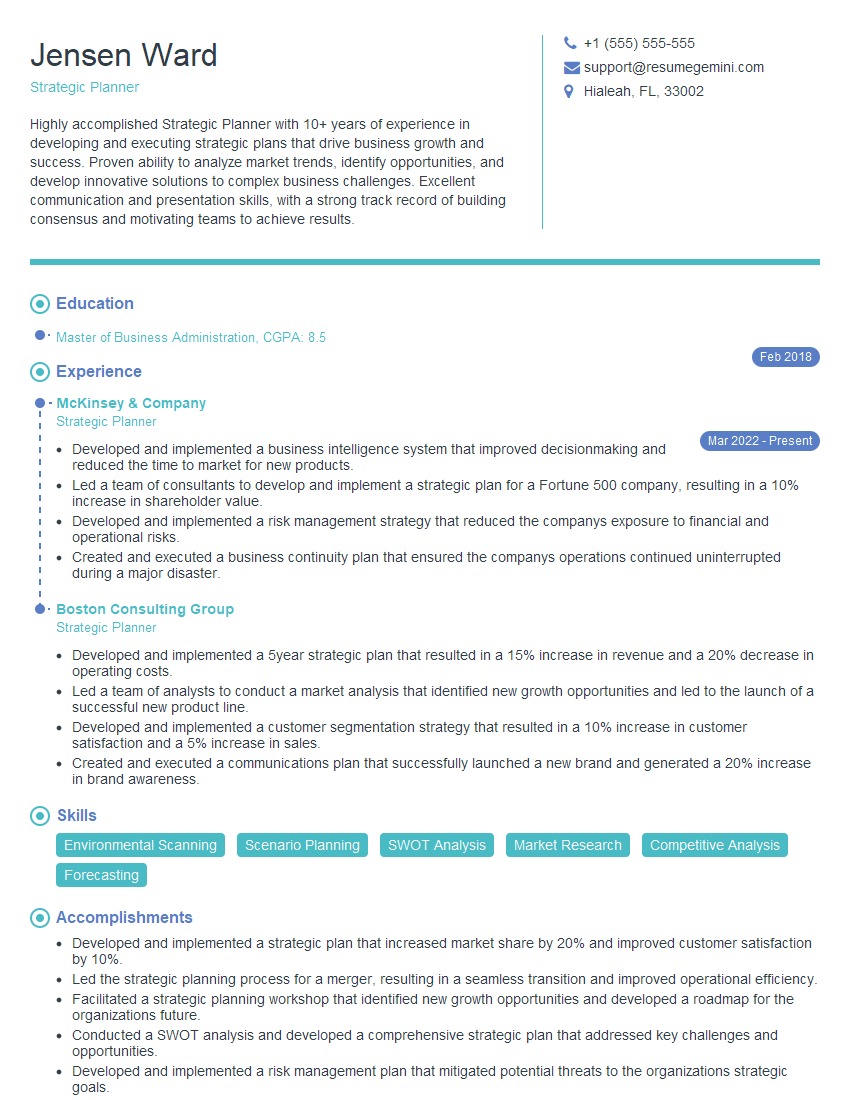
Mastering Strategic Foresight positions you at the forefront of organizational innovation and future preparedness – highly valued skills in today’s dynamic landscape. A strong resume is your key to unlocking these opportunities. Creating an ATS-friendly resume significantly increases your chances of getting noticed by recruiters. To make your resume truly stand out, leverage the power of ResumeGemini. ResumeGemini offers a streamlined process to craft a compelling narrative that showcases your skills and experience. We provide examples of resumes tailored to Strategic Foresight roles to help you get started.
Explore more articles
Users Rating of Our Blogs
Share Your Experience
We value your feedback! Please rate our content and share your thoughts (optional).
What Readers Say About Our Blog
Very informative content, great job.
good