The thought of an interview can be nerve-wracking, but the right preparation can make all the difference. Explore this comprehensive guide to ACI 318 interview questions and gain the confidence you need to showcase your abilities and secure the role.
Questions Asked in ACI 318 Interview
Q 1. Explain the difference between a ductile and brittle failure in concrete.
The difference between ductile and brittle failure in concrete hinges on how the material behaves before ultimate collapse. Ductile failure is characterized by significant yielding and large deformations before failure. Think of it like pulling taffy – it stretches and stretches before finally breaking. This gives you warning signs. Brittle failure, on the other hand, is sudden and catastrophic, with minimal deformation before collapse. It’s like snapping a dry twig – there’s little warning.
In concrete structures, ductile failure is highly desirable because it provides more time for evacuation and reduces the risk of sudden, complete collapse. We achieve ductility primarily through the reinforcement steel, which yields before the concrete fails in compression. Brittle failure is typically associated with insufficient reinforcement or flaws in the concrete itself. A column failing in a brittle manner, for instance, might be due to insufficient confinement reinforcement, leading to a sudden crushing of the concrete core.
Q 2. Describe the significance of the strength reduction factors (φ) in ACI 318.
Strength reduction factors (φ, phi) in ACI 318 are essential safety factors applied to the nominal strength of structural members to account for uncertainties in material properties, construction methods, and analytical models. Essentially, they represent a margin of safety. Because we can’t perfectly predict the actual strength of a concrete structure, we apply these factors to ensure that the designed strength is significantly higher than the expected load. These factors are not arbitrary; they are based on extensive research and statistical analysis of concrete behavior.
For example, the φ factor for flexure in beams is typically 0.9, meaning the design strength is 90% of the nominal strength. A lower φ factor (e.g., 0.7 for shear in some cases) indicates a greater level of uncertainty and consequently a larger safety margin. The specific φ factors depend on the type of structural member (beam, column, etc.) and the failure mode (flexure, shear, etc.). This ensures that our designs account for these inherent uncertainties and provide an appropriate level of safety.
Q 3. How do you determine the required compressive strength of concrete (f’c)?
Determining the required compressive strength of concrete (f’c) is not a straightforward calculation; it’s a design decision based on several factors. It’s not something you compute; you select it. It’s driven by several aspects including:
- Performance Requirements: The intended function of the structure and its intended lifespan greatly influence f’c. A high-performance structure might necessitate higher f’c for durability and strength.
- Structural Demands: The magnitude and type of loads imposed on the structure significantly influence f’c. Higher loads necessitate higher f’c to ensure adequate safety.
- Economic Considerations: Higher f’c typically translates to higher material costs. A balance must be struck between achieving adequate strength and remaining within budget.
- Availability: The availability of concrete with the desired strength in the local market also plays a role.
In practice, architects and engineers consult relevant design codes, experience, and available resources to select an appropriate f’c, often starting with a preliminary estimation based on the structural demands and then refining the selection based on other relevant factors. It’s an iterative process, often refined through structural analysis.
Q 4. Explain the concept of cracking moment and its relevance in beam design.
The cracking moment in a reinforced concrete beam represents the moment at which the first cracks appear in the concrete due to tensile stresses exceeding the concrete’s tensile strength. Understanding this is critical because once cracks form, the concrete’s tensile capacity is essentially lost. The beam’s behavior transitions from a homogeneous section to a composite section consisting of cracked concrete in tension and uncracked concrete in compression.
The cracking moment is calculated using the uncracked section properties of the beam, usually assuming linear elastic material behavior. Knowing this cracking moment allows us to estimate the moment capacity of the beam before cracking. This knowledge informs the design process, allowing us to ensure that the service load moment (the moment imposed during normal use) is kept below the cracking moment to prevent visible cracking, maintaining the structural integrity and aesthetic appeal of the beam. This is particularly important for beams where cracking could lead to aesthetic issues or corrosion problems.
Q 5. What are the different methods for determining the effective depth of a beam?
The effective depth (d) of a reinforced concrete beam is the distance from the extreme compressive fiber to the centroid of the tensile reinforcement. There are several methods for determining this, mainly depending on the geometry and reinforcement configuration:
- Simplified Method: For beams with simple rectangular sections and a single layer of reinforcement, d is simply the distance from the top fiber to the centroid of the reinforcement. This is often approximated as the overall depth of the beam minus the concrete cover and half the diameter of the reinforcement bars.
- Detailed Method: For more complex sections (e.g., T-beams, beams with multiple layers of reinforcement), the exact location of the centroid of tensile reinforcement must be calculated using basic statics, considering the area and location of each layer of steel.
Accurate determination of the effective depth is crucial for calculating the moment capacity and shear capacity of the beam. An incorrect effective depth will lead to inaccurate design calculations and potential structural issues.
Q 6. How do you calculate the shear capacity of a concrete beam according to ACI 318?
Calculating the shear capacity of a concrete beam according to ACI 318 involves considering several factors. The primary components are the contribution of the concrete itself and that of the shear reinforcement (stirrups). The process generally involves these steps:
- Determine the nominal shear strength (Vc) of the concrete: ACI 318 provides equations to estimate Vc, based on the concrete compressive strength (f’c), effective depth (d), and the cross-sectional dimensions of the beam. These equations account for the concrete’s ability to resist shear stresses before cracking.
- Determine the shear strength provided by shear reinforcement (Vs): This involves calculating the contribution of stirrups based on their spacing, diameter, and yield strength. ACI 318 specifies limits on stirrup spacing and provides equations for calculating Vs.
- Calculate the total shear capacity (Vu): The total shear capacity is the sum of the concrete’s contribution and the stirrups’ contribution: Vu = φ(Vc + Vs), where φ is the strength reduction factor for shear.
- Check for adequacy: The calculated shear capacity (Vu) must be greater than or equal to the factored shear force (Vu) acting on the beam. If not, the stirrup spacing or diameter must be adjusted to increase Vs.
It’s a critical calculation, as shear failure can be sudden and catastrophic.
Q 7. Describe the design process for a reinforced concrete column.
Designing a reinforced concrete column is an iterative process involving several steps:
- Determine the factored axial load and moments: Begin by calculating the factored axial load and moments acting on the column, considering all dead and live loads and appropriate load combinations as specified in ACI 318.
- Select trial dimensions: Based on experience and preliminary estimations, choose initial dimensions for the column’s cross-section (e.g., square, rectangular, circular).
- Choose reinforcement ratio: Select a reasonable reinforcement ratio (ρg), considering factors such as column slenderness, material properties, and architectural constraints. ACI 318 provides guidelines and limitations on the reinforcement ratio.
- Check for strength: Perform a strength analysis using interaction diagrams (generated via software or by hand calculations). These diagrams show the column’s capacity to resist combinations of axial load and bending moment. The point representing the factored load and moment must fall within the capacity zone of the interaction diagram.
- Check for slenderness effects: Evaluate if slenderness effects are significant. If so, apply appropriate moment magnification factors according to ACI 318 to account for the increased deflections and resulting moments caused by slenderness.
- Iterate: If the column doesn’t satisfy strength and slenderness requirements, adjust the column dimensions, reinforcement ratio, or both, and repeat the process until a satisfactory design is achieved.
- Detailing: Finally, provide detailed reinforcement drawings that specify bar sizes, placement, and spacing, complying with ACI 318’s detailing requirements.
Column design is a complex process requiring familiarity with interaction diagrams and an understanding of the behavior of axially loaded members under various stress states. Software is often utilized to streamline this process for larger and more complex columns.
Q 8. Explain the concept of confinement reinforcement in columns.
Confinement reinforcement in columns is crucial for enhancing their strength and ductility, especially under high axial loads and seismic events. Imagine a column as a bundle of straws – easily crushed individually, but much stronger when bound together. Confinement reinforcement acts as that binding, preventing the core concrete from crushing prematurely.
This is achieved by using closely-spaced lateral reinforcement, typically hoops or spirals, that encircle the longitudinal reinforcement within the column. When the column is subjected to load, the concrete core tends to expand laterally. The confinement reinforcement restricts this lateral expansion, increasing the concrete’s compressive strength and delaying its crushing. This leads to a more ductile column, allowing it to absorb more energy before failure, improving its overall performance and seismic resistance.
ACI 318 provides detailed requirements for the spacing, diameter, and detailing of confinement reinforcement based on the column’s dimensions, load capacity, and the desired level of confinement. For example, a column under high seismic demand might require closely spaced spirals, while a less critical column could use wider spaced hoops.
In practice, neglecting confinement reinforcement can lead to brittle column failures, resulting in catastrophic damage to structures. Thus, proper design and detailing of confinement reinforcement are paramount to ensuring the structural integrity of columns.
Q 9. What are the requirements for detailing reinforcement in a concrete slab?
Detailing reinforcement in concrete slabs is critical for ensuring their structural integrity and serviceability. It involves the proper placement, spacing, and anchorage of the reinforcing bars to effectively resist tensile stresses caused by bending moments and shrinkage. ACI 318 outlines stringent rules to prevent cracking and maintain the slab’s performance.
- Minimum Reinforcement: Slabs must have a minimum area of reinforcement to control cracking due to shrinkage and temperature changes. This minimum area is usually expressed as a percentage of the gross concrete area.
- Spacing Limits: Maximum spacing limits are imposed to restrict crack widths and ensure adequate tensile capacity. These limits are often dependent on the slab thickness and the concrete’s tensile strength.
- Bar Sizes and Arrangement: ACI 318 guides the selection of appropriate bar sizes and arrangements based on the calculated tensile forces. Often, two-way reinforcement is used in slabs to handle loads from multiple directions.
- Development Length and Anchorage: Sufficient development length is required to ensure that the reinforcing bars can transfer their tensile forces into the concrete. This involves ensuring adequate embedment length or the use of mechanical anchors.
- Cover: Minimum concrete cover is mandated to protect the reinforcement against corrosion and fire. Cover requirements vary based on the environment and the exposure condition of the slab.
Ignoring these detailing requirements can result in excessive cracking, premature failure, and reduced durability of the slab. Proper detailing is essential for a safe and long-lasting structure.
Q 10. How do you design for shrinkage and temperature effects in concrete structures?
Shrinkage and temperature effects significantly influence concrete structures, inducing stresses that can cause cracking and even structural damage. These effects are primarily due to the drying of concrete and fluctuations in ambient temperature.
Design approaches include:
- Providing Reinforcement: Reinforcement is crucial to control cracking due to shrinkage and temperature stresses. Minimum reinforcement requirements are specified in ACI 318 to accommodate these effects. The reinforcement distributes stresses and prevents the formation of large cracks.
- Controlling Cracking: Strategies include using lower water-cement ratios in the concrete mix to reduce shrinkage, employing shrinkage-reducing admixtures, and incorporating control joints to allow for controlled cracking in predetermined locations.
- Using Contraction Joints: Contraction joints are deliberate breaks in the concrete structure placed at intervals to allow for shrinkage movement without causing excessive stress build-up. These joints allow for controlled cracking at desired locations.
- Expansion Joints: Expansion joints are employed to accommodate thermal expansion and contraction in long structures or structures exposed to significant temperature variations. These joints allow the structure to expand and contract without developing significant stresses.
Proper consideration of shrinkage and temperature effects is essential for designing durable and crack-free concrete structures. Ignoring these factors can lead to unsightly cracking and, in severe cases, structural damage.
Q 11. Explain the difference between development length and lap splice length for rebar.
Development length and lap splice length are crucial concepts for ensuring that reinforcing bars can effectively transfer their forces to the surrounding concrete. They are distinct but related concepts.
Development Length: This is the length of the bar required to develop its full tensile strength within the concrete. It’s the embedded length needed for the bar’s bond to transfer stress from the steel to the concrete. Think of it as the length required for the rebar to ‘grip’ the concrete effectively.
Lap Splice Length: This is the length of overlap required when splicing two rebars together. It ensures the transfer of forces from one bar to the next. The lap splice length is determined considering factors such as the bar diameter, concrete strength, and the stress level in the bar. It’s generally longer than the development length to ensure sufficient stress transfer at the splice.
In simpler terms: development length is about anchoring a single bar, while lap splice length is about connecting two bars. ACI 318 provides detailed formulas and tables to determine the required lengths for various conditions and bar sizes. Insufficient development length or lap splice length can lead to bar pullout or splice failure, compromising the structural integrity of the member.
Q 12. How do you design a footing for a column?
Designing a footing for a column involves several steps. First, we determine the column’s axial load, moments (if any), and soil bearing capacity. The design process often involves these key steps:
- Determine the required footing area: Divide the total load on the column (including self-weight and live loads) by the allowable soil bearing capacity to obtain the minimum area required.
- Select footing dimensions: Choose dimensions that provide the required area and are practical for construction. Considerations include minimizing excavation and material costs.
- Determine the required reinforcement: Calculate the bending moments and shear forces in the footing due to the column load. Design the reinforcement to resist these forces, ensuring proper detailing in accordance with ACI 318. This will typically involve both top and bottom reinforcement.
- Check for shear and punching shear: The footing must satisfy shear and punching shear capacity requirements. This is critical to prevent failure in these critical zones.
- Detail the reinforcement: The reinforcement must be adequately anchored and spaced, complying with ACI 318’s detailing requirements. This includes specifying bar sizes, spacing, cover, and development length. Accurate detailing is crucial for constructible and safe footings.
- Check for settlement: Footings must be designed to ensure differential settlement is within acceptable limits. Factors like soil properties and footing dimensions must be considered to avoid excessive settlement.
A well-designed footing ensures the column load is safely transferred to the soil without excessive settlement or failure. Neglecting proper design can lead to costly repairs or even structural collapse.
Q 13. What are the considerations for designing a retaining wall?
Designing a retaining wall involves considering several factors to ensure stability and prevent failure. The design process typically encompasses these key areas:
- Soil Properties: Understanding the soil’s strength, shear strength, and drainage characteristics is paramount. Different soil types exhibit varying behavior under load. The design should consider the potential for soil expansion or contraction due to moisture changes.
- Wall Height and Geometry: Wall height significantly influences the lateral earth pressure acting on the wall. The wall geometry, whether it’s a cantilever, gravity, or anchored wall, significantly impacts the design. The wall should be properly braced to withstand these pressures.
- Lateral Earth Pressure: Accurate calculation of the lateral earth pressure is critical. This pressure varies depending on the soil type, the wall’s height, and the level of drainage behind the wall. This pressure is often calculated using Rankine’s or Coulomb’s earth pressure theories.
- Drainage: Proper drainage behind the retaining wall is essential to prevent hydrostatic pressure buildup, which can cause significant instability. Drainage systems, such as weep holes, are typically incorporated in the design.
- Structural Design: The wall must be designed structurally to withstand the lateral earth pressure, the wall’s self-weight, and any other potential loads. Reinforcement detailing, material selection (concrete, reinforced soil, etc.), and appropriate construction methods are essential for structural integrity.
- Settlement Considerations: The design must account for potential settlement of the wall and the surrounding soil. This is crucial to prevent uneven settlement, which can lead to structural damage.
A well-designed retaining wall is stable, durable, and maintains its integrity over its service life. Inadequate design can result in wall collapse, leading to significant property damage and potential safety hazards.
Q 14. What are the different types of concrete mix designs?
Concrete mix designs are categorized based on several factors, including intended use, strength requirements, and environmental conditions. Some common types include:
- Nominal Mixes: These are mixes defined by a simple ratio of cement, aggregates, and water. They are simpler to produce but offer less precise control over concrete properties compared to other types.
- Proportion Mixes: Similar to nominal mixes, proportion mixes use predetermined ratios, but more advanced techniques may be used to determine these ratios based on certain properties such as slump and workability. These mixes offer slightly improved control over the final product.
- Design Mixes: These are the most precise type of mix, involving a thorough analysis of the materials’ properties and rigorous testing to achieve the desired strength and other characteristics. These mixes are customized to specific project needs and environmental conditions.
- High-Performance Concrete (HPC): HPC mixes are engineered for superior properties, such as high strength, durability, and workability. They often incorporate specialized admixtures and high-quality materials. They are more costly than conventional mixes but offer superior performance.
- Self-Consolidating Concrete (SCC): SCC mixes are designed to flow into place without the need for vibration. They are ideal for complex forms and congested reinforcement patterns. They improve worker safety and construction efficiency.
The choice of concrete mix design depends on the specific project requirements and budget. A well-designed mix is crucial for achieving the desired concrete performance and ensuring the structure’s durability and longevity. An improper mix design can result in weak or brittle concrete, leading to potential structural failures.
Q 15. Explain the importance of concrete cover in reinforced concrete members.
Concrete cover is the layer of concrete that surrounds the reinforcing steel in a reinforced concrete member. It’s crucial for several reasons. Think of it as the steel’s protective armor.
- Protection from Corrosion: Concrete cover acts as a barrier, protecting the steel reinforcement from the environment. Exposure to moisture, chlorides (from de-icing salts, for example), and oxygen can lead to corrosion, which weakens the steel and compromises the structural integrity of the member. The minimum cover specified in ACI 318 depends on the environment’s aggressiveness and the concrete’s durability requirements.
- Bond and Transfer of Stress: Adequate cover ensures sufficient bond between the concrete and steel, allowing for effective transfer of stress. Without proper bond, the steel could slip within the concrete, leading to structural failure.
- Fire Resistance: Concrete cover provides fire protection to the reinforcing steel. Concrete’s thermal properties allow it to insulate the steel, preventing it from reaching critical temperatures where its strength is significantly reduced. The required cover increases depending on the fire rating needed.
For example, in a heavily corrosive marine environment, ACI 318 would mandate significantly more concrete cover than in a typical interior application. Inadequate cover can lead to premature deterioration and costly repairs.
Career Expert Tips:
- Ace those interviews! Prepare effectively by reviewing the Top 50 Most Common Interview Questions on ResumeGemini.
- Navigate your job search with confidence! Explore a wide range of Career Tips on ResumeGemini. Learn about common challenges and recommendations to overcome them.
- Craft the perfect resume! Master the Art of Resume Writing with ResumeGemini’s guide. Showcase your unique qualifications and achievements effectively.
- Don’t miss out on holiday savings! Build your dream resume with ResumeGemini’s ATS optimized templates.
Q 16. How do you check for deflection in beams according to ACI 318?
ACI 318 provides several methods for checking beam deflection. The most common approaches involve comparing calculated deflections to allowable limits. These limits depend on the beam’s use and the type of loading. We often see two main avenues of analysis.
- Immediate Deflection: This is the deflection that occurs immediately after the load is applied. ACI 318 typically limits immediate deflection to a fraction of the beam’s span (e.g., L/360 for roofs, and L/240 for floors, where L is the span length). We use the moment-curvature method and elastic analysis techniques to calculate this deflection. Ignoring long term effects is a simplification acceptable for many structures.
- Long-Term Deflection: This is the additional deflection that occurs over time due to factors such as shrinkage and creep of the concrete. Creep is the time-dependent strain under sustained load, while shrinkage is the reduction in volume of the concrete due to moisture loss. ACI 318 accounts for this by applying factors (e.g., multiplier to the immediate deflection) that increase the calculated deflection, reflecting the long-term effects of the concrete.
Failure to adequately check deflection can lead to undesirable cracking, damage to non-structural elements (like ceilings), and overall performance issues. The selection of the appropriate method depends on many factors including span, loading, concrete strength, and the overall design philosophy.
Q 17. Describe the different types of prestressed concrete.
Prestressed concrete enhances the strength and durability of concrete members by introducing compressive stresses into the concrete before any external loads are applied. This counteracts the tensile stresses caused by external loads, improving the member’s resistance to cracking and increasing its load-carrying capacity.
- Pretensioning: In pretensioning, the high-strength steel tendons are tensioned first, then the concrete is cast around them. As the concrete cures, it grips the tendons and transfers the prestressing force. Think of it like stretching a rubber band and then molding it into shape. The rubber band is analogous to steel, and the concrete to the form. After setting, the form is removed, and the prestress remains.
- Post-tensioning: In post-tensioning, the tendons are tensioned after the concrete has hardened. This is typically done using special hydraulic jacks and anchoring systems. The tendons are placed within ducts embedded in the concrete. Once the concrete has reached sufficient strength, the tendons are tensioned and anchored, transferring the prestressing force. This method allows for greater flexibility in tendon placement and can be advantageous in large members or complex shapes.
Both pretensioning and post-tensioning have advantages and disadvantages related to cost, complexity, and structural suitability. The choice between these methods is based on the specific project requirements.
Q 18. Explain the concept of moment redistribution in continuous beams.
Moment redistribution in continuous beams allows for a more economical design by reducing the negative moments at the supports. ACI 318 allows for moment redistribution under specific conditions to minimize the size of beams and columns.
In a simply supported beam, the maximum moment occurs at midspan. In a continuous beam, however, significant negative moments arise at the supports. Moment redistribution involves transferring a portion of this negative moment to the positive moment regions, leading to smaller peak moments overall. This redistribution is possible because the concrete’s capacity to resist moments increases when the concrete is in compression, and this increase is nonlinear, hence we gain this redistribution capacity. This redistribution is accomplished using advanced analytical methods and is typically limited to a percentage of the total moment capacity, as specified in ACI 318. It’s not an arbitrary process; it’s governed by the ductility of the concrete and the reinforcement. For example, using plastic moment capacity we can determine how much load reduction can be achieved by relaxing the assumptions of pure elasticity, but we still need to validate that this is appropriate for the specific member and material properties.
Without moment redistribution, the design of continuous beams would require significantly larger sections to accommodate the high negative moments at the supports. This increases material costs and makes the overall structure more expensive.
Q 19. What are the requirements for fire protection of reinforced concrete?
Fire protection of reinforced concrete is critical for ensuring structural stability and preventing catastrophic collapse during a fire. ACI 318 doesn’t directly specify fire protection requirements; instead, it provides the basis for design against fire scenarios which is further defined by fire codes. The main objective is to protect the reinforcing steel from excessive heat.
- Concrete Cover: The thickness of the concrete cover, as discussed earlier, plays a significant role in providing fire protection. The thicker the cover, the longer it takes for the heat to reach the steel reinforcement, maintaining its strength and delaying failure.
- Fire-Resistant Coatings: Intumescent coatings, for instance, expand upon exposure to heat, forming an insulating layer to further protect the steel.
- External Fire Protection: In some cases, external protection, like sprayed-on fire-resistive materials (SFRM), is employed to enhance fire resistance.
- Design for Fire: Proper design, ensuring adequate reinforcement and detailing, is critical to the performance of the structure under fire conditions.
Inadequate fire protection can lead to a reduction in the load-carrying capacity of the structure, and potentially catastrophic failures, threatening lives and property. It’s an area demanding meticulous attention to detail and adherence to relevant fire codes.
Q 20. How do you select appropriate concrete mix proportions?
Selecting appropriate concrete mix proportions involves balancing several factors to achieve the desired strength, workability, durability, and economy. The process typically involves:
- Determining Required Strength: This is dictated by the structural design requirements, the exposure conditions, and relevant codes. ACI 318 guides the strength class selection.
- Selecting Aggregates: Aggregates, which form the bulk of the concrete, should be well-graded, clean, and durable. Their properties significantly influence the concrete’s workability, strength, and durability.
- Cement Content: The amount of cement used directly affects the strength and cost of the concrete. Higher cement content generally leads to higher strength, but it also increases cost and can lead to shrinkage problems.
- Water-Cement Ratio: This is the most critical factor influencing the strength and durability of concrete. A lower water-cement ratio typically leads to higher strength and durability. The concrete’s workability is also a function of this ratio, where higher values will improve it.
- Admixtures: Admixtures can modify the concrete’s properties, influencing the workability, setting time, strength, and durability. Their use can be critical in achieving specific design requirements.
- Mix Design Methods: Methods such as the absolute volume method or the weight batching method are used to determine the precise quantities of each ingredient for a consistent mix.
Trial mixes are often used to fine-tune the proportions and ensure that the concrete meets all specified requirements. The process involves a balance between strength, workability, durability, and economy. Ignoring these aspects leads to sub-optimal performance and potentially significant issues later on.
Q 21. Explain the role of admixtures in concrete.
Admixtures are chemical compounds added to concrete to modify its properties. They play a significant role in improving the concrete’s performance and helping to achieve specific design requirements.
- Water Reducers: These admixtures allow for reduction in water content while maintaining the same workability. This leads to higher strength, improved durability, and reduced shrinkage.
- Superplasticizers (High-Range Water Reducers): These admixtures significantly improve workability allowing for very low water-cement ratios resulting in high-strength, high-performance concrete.
- Accelerators: These admixtures speed up the setting and hardening process of the concrete. This is particularly useful in cold weather or when fast-track construction is required.
- Retarders: These admixtures slow down the setting and hardening process, useful in hot weather or when long transportation times are involved.
- Air-Entraining Admixtures: These introduce tiny air bubbles into the concrete, improving its freeze-thaw resistance and workability. This is important in regions with severe winters.
- Other Admixtures: Other specialized admixtures are used for specific purposes like improving corrosion resistance, enhancing bonding, or controlling bleeding.
The proper selection and dosage of admixtures are critical for achieving the desired concrete properties. Incorrect usage can negatively affect the concrete’s performance, leading to problems such as poor strength, increased shrinkage, and reduced durability. Thus it is essential to use admixtures following the manufacturer’s recommendations.
Q 22. How does the ACI 318 code address seismic design considerations?
ACI 318 addresses seismic design considerations by providing detailed requirements for structures located in seismically active zones. It doesn’t prescribe a single design method, instead offering various approaches based on the structural system and seismic hazard level. The code incorporates principles like strength and ductility design.
Key aspects covered include:
- Overstrength Factor (Ω0): This factor accounts for the fact that the actual strength of a structural member often exceeds the calculated design strength. ACI 318 provides values for Ω0 based on the type of structural element.
- Ductility Requirements: The code emphasizes designing for ductile behavior to allow the structure to absorb energy during an earthquake. This involves detailing requirements, such as minimum longitudinal reinforcement ratios and confinement of compression members.
- Seismic Detailing: ACI 318 specifies stringent detailing requirements, like the use of confinement ties in columns, to ensure adequate ductility and prevent brittle failure. These details are crucial for preventing weak links within the structure during seismic events.
- Capacity Design: This philosophy focuses on designing strong columns and weak beams, forcing the failure to occur in the beams, which have more ductile behavior than columns. This protects the primary structural elements.
For example, a moment frame designed according to ACI 318 for seismic zones will have significantly more reinforcement and stricter detailing compared to a similar frame designed for gravity loads only. The design process involves detailed analysis using specialized software that considers ground motion characteristics and building characteristics, ensuring the structure can withstand the expected seismic forces.
Q 23. What are the limitations of using ACI 318?
While ACI 318 is a comprehensive code, it does have limitations. It primarily focuses on reinforced and plain concrete structures, offering limited guidance on other materials like composite construction. It also relies heavily on simplified analysis methods, which might not be suitable for complex geometries or highly irregular structures.
- Simplified Analysis: ACI 318 often uses simplified methods for analysis, neglecting aspects like second-order effects, creep, and shrinkage, which can be significant for certain structures. More detailed analysis might be required for accurate results, especially for tall buildings or structures with unusual shapes.
- Material Properties: The code provides nominal values for material properties, such as concrete strength and steel yield strength. However, actual material properties vary and testing is crucial to ensure the design assumptions are valid. Inaccurate material properties can lead to significant discrepancies between the designed strength and the actual strength.
- Limited Scope: ACI 318 focuses primarily on strength and serviceability aspects. It provides limited information on other relevant aspects such as durability, fire resistance, and sustainability.
- Regional Variations: While it’s widely adopted, the application of ACI 318 might require adjustments depending on the specific regional building codes and seismic zone. The design will also depend on the local building regulations.
For instance, designing a high-rise building with complex geometry using only simplified analysis methods from ACI 318 could lead to an underestimation of deflections or other critical responses. In such cases, more sophisticated finite element analysis would be necessary.
Q 24. Describe your experience with concrete testing and quality control.
I have extensive experience with concrete testing and quality control, encompassing various aspects from in-situ testing to laboratory evaluations. My experience includes overseeing and conducting tests such as slump tests, compressive strength tests, air content tests, and chloride content tests to ensure concrete meets the specified requirements.
In the field, I’ve utilized techniques such as rebar inspection to verify correct placement and spacing. My experience includes supervising concrete pours to guarantee proper consolidation and prevent segregation. I’ve been involved in reviewing concrete mix designs to assure compliance with ACI 318 specifications, and interpreting test results to address potential issues early. For example, a low slump test might require adjustments to the water content of the mix. Similarly, low compressive strength would trigger an investigation into the causes, potentially involving the quality of aggregates or the curing process. I’ve consistently ensured that all testing and quality control measures align with the project’s specifications and ACI 318 recommendations. Documentation and reporting are also critical parts of the process; I ensure all tests are documented meticulously and all non-conformances are addressed appropriately.
Q 25. How do you interpret and apply concrete design standards?
Interpreting and applying concrete design standards involves a systematic approach. I begin by carefully reading and understanding the relevant sections of ACI 318, considering all applicable clauses. This includes understanding load combinations, material properties, and limit states. I then translate these standards into practical design calculations and detailing using appropriate software and hand calculations.
The process typically involves:
- Load Determination: Accurate determination of dead loads, live loads, and other applicable loads based on the intended use of the structure and building codes.
- Material Selection: Choosing appropriate concrete and steel grades based on strength, durability, and cost considerations.
- Design Calculations: Performing detailed calculations to determine member dimensions, reinforcement requirements, and other design parameters. This includes verifying the adequacy of members under various load combinations and checking for all applicable limit states.
- Detailing: Preparing detailed drawings that accurately reflect the design intent, including reinforcement placement, dimensions, and other crucial information. This step ensures that the structural elements are built correctly and efficiently.
- Checking and Verification: Thorough review of calculations and drawings to ensure accuracy and compliance with all applicable codes and standards.
For instance, while designing a beam, I wouldn’t just rely on the simplified formulas. I’d verify that the design meets all the provisions of ACI 318, considering shear capacity, flexural capacity, and deflection limits. The process is iterative, requiring adjustments to achieve optimal design.
Q 26. Explain your familiarity with software used for concrete design (e.g., ETABS, SAP2000).
I’m proficient in several software packages commonly used for concrete design, including ETABS and SAP2000. My experience extends to using these programs for structural analysis, design, and detailing.
ETABS: I use ETABS for the analysis and design of buildings, particularly multi-story structures. My expertise includes creating 3D models, defining material properties, applying loads, performing analysis, generating design results, and using the design features for concrete members and detailing.
SAP2000: Similar to ETABS, SAP2000 is employed for structural analysis and design. I utilize its capabilities for creating models, assigning properties, and running various analyses, including static and dynamic analysis. I also utilize the design modules within the software for concrete design.
In both software packages, I use the design outputs to ensure the designs comply with ACI 318, checking capacity, deflection, and other criteria. I also frequently use these programs to generate reinforcement drawings for different types of members, optimizing designs for cost and efficiency.
Beyond these, I’m also familiar with other specialized software for concrete design, enhancing my ability to choose the most appropriate tools based on the complexity and specific requirements of the project.
Q 27. How would you handle a discrepancy between design calculations and on-site conditions?
Discrepancies between design calculations and on-site conditions require a careful and systematic approach. The first step is to thoroughly investigate the source of the discrepancy. This might involve revisiting the original design calculations, conducting additional field measurements, and assessing the quality of construction materials.
The process typically involves:
- Detailed Investigation: Carefully examine the design documents, construction drawings, and field observations to identify the root cause of the discrepancy. This may require re-examining the assumptions made during the design phase.
- Additional Testing: If necessary, carry out additional tests to verify the properties of the existing materials.
- Documentation: Thoroughly document all findings, including photographs, measurements, and test results.
- Re-evaluation: Based on the findings of the investigation, re-evaluate the design to determine the required modifications.
- Corrective Actions: Implement appropriate corrective actions to address the discrepancy and ensure the safety and functionality of the structure. This may involve minor adjustments to the reinforcement or more extensive remedial work. This could include redesigning or retrofitting certain elements.
- Communication: Maintain clear and open communication with the project team, contractors, and stakeholders throughout the process.
For example, if the reinforcement placement on-site doesn’t align with the design drawings, a detailed comparison is conducted to pinpoint the exact location and extent of the discrepancy. Then, a decision is made on whether it’s a minor discrepancy that can be addressed with minor adjustments or a more significant one requiring partial or total reconstruction of the element. In either case, thorough documentation and updated drawings are needed to ensure everyone is aware of the modifications.
Q 28. Describe a challenging concrete design problem you solved and your approach to the solution.
One challenging project involved designing the foundation for a high-rise building on expansive clay soil. The primary challenge was managing the differential settlement that often occurs on such soils due to variations in moisture content.
My approach involved several steps:
- Geotechnical Investigation: We conducted thorough geotechnical investigations to characterize the soil properties and predict the likely amount of settlement. This involved analyzing soil samples, performing laboratory tests, and considering historical data.
- Foundation Design: Based on the geotechnical data, we opted for a deep foundation system with piles, designed to transmit loads effectively while minimizing differential settlement. Careful analysis was done to determine pile lengths, spacing, and capacity.
- Structural Analysis: We conducted sophisticated structural analysis that incorporated the effects of potential differential settlement. This involved employing advanced finite element techniques to understand the building’s response to soil movements.
- Mitigation Strategies: Several mitigation strategies were integrated to reduce the effects of differential settlement. These involved using materials with high ductility to absorb movement and incorporating expansion joints in the building’s structure.
- Monitoring and Evaluation: We implemented a comprehensive monitoring plan involving periodic surveys and instrumentation to track settlement behavior during construction and throughout the life of the building. This allowed for timely detection and intervention in case of unforeseen events.
This project required a multidisciplinary approach, bringing together geotechnical engineers, structural engineers, and construction professionals to effectively address the unique challenges posed by the expansive soil. The successful completion of this project demonstrated my ability to handle complex design challenges and use innovative solutions to overcome obstacles.
Key Topics to Learn for ACI 318 Interview
- Strength and Design of Concrete Members: Understand the fundamental principles behind flexural, shear, and axial load design. Practice applying these concepts to various structural elements.
- Reinforcement Details and Placement: Master the practical aspects of bar spacing, development length, lap splices, and detailing requirements. Be prepared to discuss common detailing challenges and solutions.
- Serviceability Limit States: Go beyond strength design and understand deflection, cracking, and other serviceability considerations. Know how to address these issues in your designs.
- Material Properties: Have a firm grasp of concrete and steel properties, including their variations and impact on design choices. Understand the significance of compressive strength, modulus of elasticity, and yield strength.
- Analysis Methods: Familiarize yourself with different analysis techniques, such as the simplified methods and more advanced approaches like finite element analysis. Be prepared to discuss their applications and limitations.
- Special Structural Elements: Prepare to discuss the design of specific elements like columns, walls, footings, beams, and slabs, including their unique design considerations.
- Code Provisions and Interpretations: Deeply understand the relevant sections of ACI 318. Be prepared to discuss different code provisions and their practical implications.
- Practical Application & Problem Solving: Practice solving design problems using the ACI 318 code. Be ready to discuss your approach and explain your design choices clearly and concisely.
Next Steps
Mastering ACI 318 is crucial for advancing your career in structural engineering. A strong understanding of the code demonstrates your technical expertise and problem-solving skills, making you a highly desirable candidate for challenging and rewarding roles. To maximize your job prospects, create an ATS-friendly resume that highlights your skills and experience effectively. We recommend using ResumeGemini, a trusted resource for building professional resumes that stand out. ResumeGemini provides examples of resumes tailored to ACI 318 expertise, allowing you to craft a compelling application that showcases your knowledge and potential.
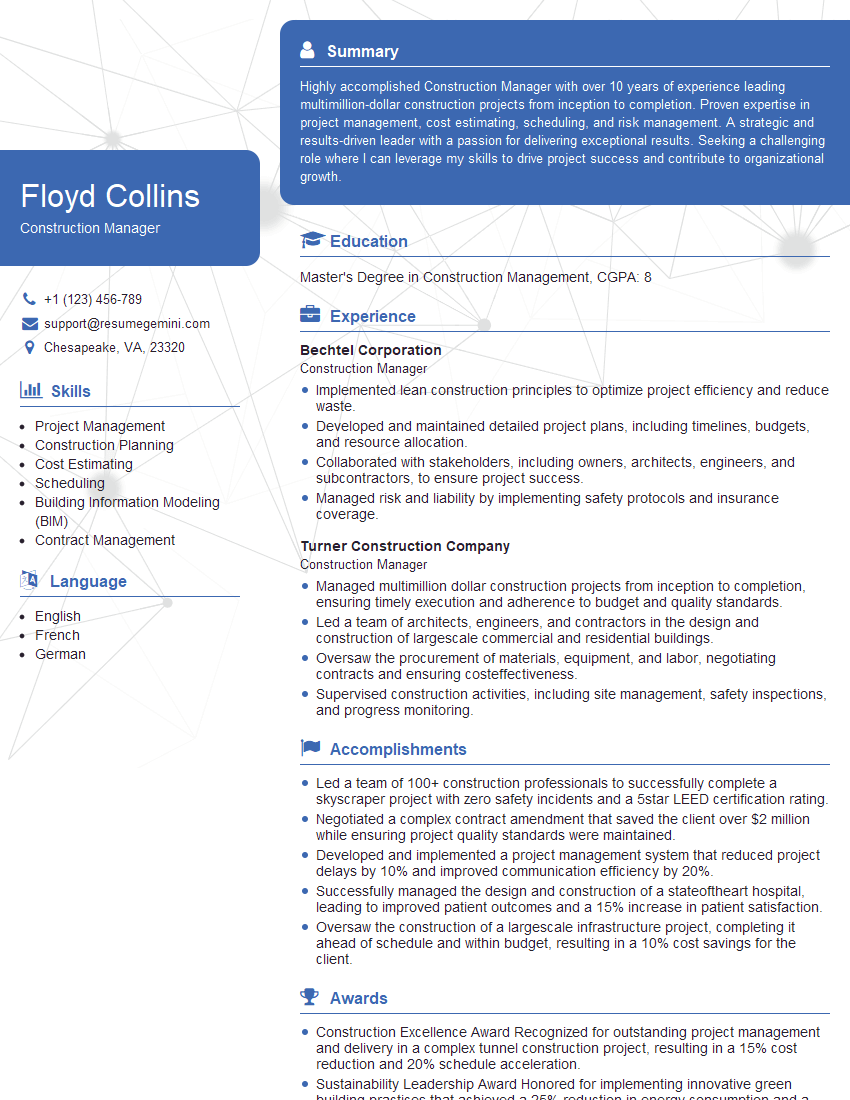
Construction Manager Resume Sample

Project Manager Resume Sample

Project Engineer Resume Sample

Design Engineer Resume Sample

Senior Project Manager Resume Sample

Structural Designer Resume Sample

Civil Engineer Resume Sample

Concrete Engineer Resume Sample

Construction Engineer Resume Sample

Geotechnical Engineer Resume Sample

Structural Engineer Resume Sample

Quality Control Engineer Resume Sample

Materials Engineer Resume Sample
Explore more articles
Users Rating of Our Blogs
Share Your Experience
We value your feedback! Please rate our content and share your thoughts (optional).
What Readers Say About Our Blog
Very informative content, great job.
good