Unlock your full potential by mastering the most common Acoustics and Sound Physics interview questions. This blog offers a deep dive into the critical topics, ensuring you’re not only prepared to answer but to excel. With these insights, you’ll approach your interview with clarity and confidence.
Questions Asked in Acoustics and Sound Physics Interview
Q 1. Explain the difference between sound intensity and sound pressure level.
Sound intensity and sound pressure level (SPL) are both measures of sound, but they represent different aspects. Sound intensity describes the power of a sound wave per unit area, essentially how much energy is flowing through a specific space. It’s measured in Watts per square meter (W/m²). Think of it like the brightness of a light – a higher intensity means a stronger, more powerful sound. Sound pressure level, on the other hand, measures the amplitude of the pressure variations in the air caused by the sound wave. It’s measured in decibels (dB), a logarithmic scale that relates to human perception. SPL is more commonly used because it’s easier to measure with standard microphones and reflects how loud we perceive a sound to be. While related, they aren’t directly proportional; intensity is proportional to the square of the sound pressure. A doubling of sound pressure results in a four-fold increase in intensity.
Example: Imagine two speakers playing the same music. One is much closer to you. The closer speaker will have a higher sound pressure level (it sounds louder) and also a higher sound intensity (it’s delivering more sound energy to your eardrum). However, if you move further away from both speakers, both intensity and SPL will decrease. This illustrates the inverse-square law in acoustics.
Q 2. Describe the concept of reverberation and its impact on room acoustics.
Reverberation is the persistence of sound in a space after the original sound source has stopped. It’s caused by the multiple reflections of sound waves off the room’s surfaces (walls, ceiling, floor, objects). These reflections arrive at the listener’s ears at slightly different times, creating a sense of ‘liveness’ or ‘fullness’ to the sound. The impact on room acoustics is significant; too much reverberation (a long reverberation time) makes speech unclear and music muddy, while too little (a short reverberation time) creates a ‘dead’ or ‘dry’ sound lacking warmth and ambience. The reverberation time is the time it takes for the sound intensity to decrease by 60 dB after the source stops.
Example: Imagine a large, empty cathedral. The sound of a single handclap reverberates for several seconds due to the hard, reflective surfaces. In contrast, a small, carpeted room might have a very short reverberation time, making sounds seem crisp and dry.
Optimizing reverberation is crucial for concert halls, recording studios, and even classrooms; careful material selection and room shape design are key to achieving the desired level of reverberation.
Q 3. How do you measure and analyze sound absorption coefficients?
Sound absorption coefficients represent the fraction of sound energy absorbed by a material at a specific frequency. They range from 0 (complete reflection) to 1 (complete absorption). Measurement involves using a reverberation chamber or an impedance tube.
- Reverberation Chamber Method: This method measures the decay rate of sound in a room with and without the material in question. The difference in decay rates reveals the material’s absorption coefficient.
- Impedance Tube Method: This method is more precise and suitable for small samples. A sound wave is sent through a tube containing the material, and the reflected and transmitted waves are measured to determine the absorption coefficient.
Analysis usually involves plotting absorption coefficients across a range of frequencies, creating an absorption curve that characterizes the material’s performance. This curve helps designers choose suitable materials for various acoustic applications, depending on the frequency range of interest. For example, a material with high absorption coefficients in the mid and high frequencies might be excellent for speech clarity in an office, while a material with better low-frequency absorption might be needed to control booming bass in a home theater.
Q 4. What are the common methods for noise control in buildings?
Noise control in buildings employs various strategies targeting different noise transmission paths:
- Sound Absorption: Using absorptive materials (e.g., acoustic panels, carpets, curtains) to reduce reverberation and sound reflections within a room.
- Sound Insulation: Employing materials and construction techniques (e.g., double-wall constructions, sound-dampening layers) to block the transmission of sound between rooms or from the exterior.
- Sound Barriers: Using physical barriers (e.g., walls, screens) to deflect or block noise propagation.
- Vibration Isolation: Preventing structure-borne noise transmission from machinery or equipment to the building structure.
- Active Noise Cancellation: Using electronic systems that generate anti-phase sound waves to counteract unwanted noise.
Example: In an apartment building, sound insulation between units is crucial. This might involve using double-wall constructions with sound-dampening layers like mineral wool, as well as sealing gaps and cracks in the structure. Sound absorption within apartments could be implemented by using acoustic ceiling tiles, carpets and soft furnishings.
Q 5. Explain the principle of sound insulation and its limitations.
Sound insulation relies on the principle of impeding the transmission of sound waves through a barrier. The effectiveness depends on factors like the barrier’s mass, stiffness, and internal damping. Heavier and more dense materials typically offer better insulation. The sound insulation is quantified by the Sound Transmission Class (STC) rating which is higher for better insulation.
Limitations: Sound insulation isn’t perfect; sound can still transmit through various paths, including:
- Flanking Transmission: Sound travels around or through gaps and openings in the barrier.
- Structure-Borne Noise: Vibrations transmitted through the building structure, bypassing the barrier.
- Airborne Transmission: Sound waves bypassing the barrier through cracks and openings, or resonating at the panel’s natural frequency.
Example: A solid brick wall provides better sound insulation than a thin wooden partition. However, if there are gaps around the wall or if vibrations are transmitted through the floor or ceiling, the overall sound insulation may be significantly reduced. Proper sealing and flanking path isolation are essential to maximize the effectiveness of any sound insulation method.
Q 6. Describe different types of acoustic absorbers and their applications.
Acoustic absorbers are materials designed to transform incident sound energy into other forms of energy, mostly heat, thereby reducing sound reflections. Different types exist, each with its specific characteristics:
- Porous Absorbers: These materials (e.g., fiberglass, mineral wool, foams) have a porous structure that traps sound energy, converting it to heat through friction. They are effective for high-frequency sound absorption.
- Resonance Absorbers: These absorbers (e.g., Helmholtz resonators, panel absorbers) are designed to absorb sound energy at specific frequencies. They function by trapping sound waves in cavities that resonate at specific frequencies, maximizing absorption at these frequencies.
- Membrane Absorbers: These absorbers use a flexible membrane over a cavity to trap and dissipate sound energy efficiently at low frequencies.
Applications:
- Porous absorbers: Widely used in recording studios, home theaters, and offices to reduce echoes and improve speech clarity.
- Resonance absorbers: Often employed in dealing with low-frequency noise problems (bass traps) in rooms or halls with specific reverberation issues.
- Membrane absorbers: Effective in spaces where low-frequency sound absorption is needed, such as concert halls or industrial settings.
Q 7. What are the key considerations for designing an anechoic chamber?
Designing an anechoic chamber—a room designed to absorb virtually all sound reflections—requires meticulous attention to detail. Key considerations include:
- Absorption Material: The walls, ceiling, and floor are lined with highly absorptive materials, typically wedges of sound-absorbing foam designed to minimize sound reflections. These wedges are usually made from a material such as polyurethane foam and must be tapered such that sound is progressively absorbed.
- Chamber Construction: The chamber’s structure is designed to minimize any vibrations that could generate noise or affect measurements. It often involves a double-walled construction with vibration isolation. A floating floor is often incorporated.
- Environmental Control: The chamber’s internal environment (temperature, humidity) is carefully controlled to minimize background noise and interference with measurements.
- Electromagnetic Shielding (optional): Some anechoic chambers also include electromagnetic shielding to block external electromagnetic fields, crucial for very sensitive measurements.
- Size and Shape: The chamber’s size and shape are chosen to minimize the creation of standing waves. Standing waves occur in particular places in a room that may resonate with certain frequencies more strongly than other places in the room, resulting in an unacceptably poor acoustic environment.
Example: The wedges’ design considers the frequency range of interest; longer wedges are needed to absorb low frequencies effectively. The room’s construction minimizes flanking transmission, ensuring that sound waves are not transmitted through gaps in the structure. The internal environment is controlled to eliminate any interference from factors such as air currents and electrical noise.
Q 8. Explain the concept of sound diffraction and its effects.
Sound diffraction is the bending of sound waves as they pass around obstacles or through openings. Imagine throwing a pebble into a calm pond – the waves don’t just travel in a straight line; they bend around objects in their path. Similarly, sound waves, being a form of wave motion, exhibit diffraction.
The extent of diffraction depends on the wavelength of the sound and the size of the obstacle. Lower-frequency sounds (longer wavelengths) diffract more easily around obstacles than higher-frequency sounds (shorter wavelengths). This is why you can often hear low-frequency bass notes from a band even if you’re around a corner, while higher-pitched sounds are more easily blocked.
Effects of Diffraction:
- Reduced sound shadow: Diffraction reduces the formation of a complete sound shadow behind an obstacle. You still get some sound energy reaching the shadow zone.
- Sound propagation around barriers: This enables sound to travel around corners and over hills, impacting noise control design.
- Influence on room acoustics: Diffraction plays a crucial role in how sound behaves within enclosed spaces like concert halls or recording studios, contributing to reverberation and sound coloration.
Example: A large building might significantly block direct sound from a highway. However, diffraction allows some traffic noise to bend around the building’s edges, causing noise pollution in areas that might seem shielded.
Q 9. How do you calculate sound transmission loss through a wall?
Calculating sound transmission loss (STL) through a wall is complex and involves several factors. It’s not a single equation but rather a combination of measurements and calculations. The most common approach uses the following:
1. Mass Law: A basic principle is the mass law, which states that STL increases with the mass of the wall. Heavier walls generally provide better sound insulation. A simplified equation for the mass law is:
STL ≈ 20log10(mf) - 47Where:
STLis the sound transmission loss in dBmis the mass per unit area of the wall (kg/m²)fis the frequency in Hz
2. Material Properties: The mass law provides a starting point, but the actual STL depends on the wall’s material properties, like stiffness and damping. Porous materials, for example, absorb sound energy, improving STL.
3. Transmission Loss Measurements: In practice, we often rely on laboratory measurements. A standardized test method (e.g., ISO 140) measures the sound power transmitted through a wall sample, allowing for precise STL determination at various frequencies.
4. flanking transmission: It is also crucial to consider flanking transmission, sound transmission through other paths such as gaps and flanking structures (floor, ceiling). These need to be accounted for in the overall sound insulation calculation.
5. Software Simulations: Specialized software packages are frequently used for more complex scenarios, considering factors such as wall construction details and room acoustics.
Q 10. What are the common frequency ranges used in acoustic measurements?
The frequency range used in acoustic measurements depends on the application. However, some common ranges include:
- 20 Hz – 20 kHz: This is the audible frequency range for humans. Measurements in this range are crucial for assessing noise levels and sound quality in various environments.
- 100 Hz – 10 kHz: A narrower range, often focusing on speech intelligibility or the perceived quality of musical instruments.
- Infrasound (below 20 Hz): This range is often used in specialized applications like earthquake monitoring or industrial noise analysis. While inaudible to humans, infrasound can cause physical vibrations.
- Ultrasound (above 20 kHz): This range is extensively used in medical imaging (ultrasound), material testing, and non-destructive evaluation.
Many measurements cover the entire audible spectrum (20 Hz – 20 kHz) to provide a comprehensive understanding of the acoustic environment.
Q 11. Describe different types of microphones and their applications in acoustic measurements.
Microphones are crucial tools in acoustic measurements, and several types exist, each with its strengths and applications:
- Condenser Microphones: These are highly sensitive and offer a wide frequency response, making them suitable for general-purpose measurements, recording music, and speech recognition. They require a power source (phantom power or battery).
- Dynamic Microphones: Robust and less sensitive to environmental factors, dynamic microphones are ideal for live sound reinforcement, measuring loud noises, and situations with potential mechanical stress. They don’t require external power.
- Pressure Microphones: Measure only the sound pressure at a single point. These are most often used for standardized sound level measurements and in sound intensity probes.
- Free-field Microphones: Designed to accurately measure sound pressure in a free field (without reflections), minimizing the effects of reflections from nearby surfaces. Used for outdoor measurements, anechoic chamber applications.
- Boundary Microphones: Optimized for placement near reflecting surfaces, like walls or floors. Common in applications where the microphone needs to be positioned close to a source.
The choice of microphone type depends on the measurement objective, the environment, and the desired accuracy. For example, a free-field microphone is preferred for accurate sound level measurements outdoors, while a robust dynamic microphone might be more suitable in a noisy industrial setting.
Q 12. Explain the principles of active noise cancellation.
Active noise cancellation (ANC) works by using a secondary sound wave to counteract an unwanted primary sound wave. It’s based on the principle of destructive interference. Imagine two waves that are identical but out of phase – their peaks and troughs align oppositely. When these waves overlap, they cancel each other out.
How it works:
- A microphone detects the unwanted noise (primary sound wave).
- A signal processor analyzes the noise and generates an anti-noise signal (secondary sound wave) that is 180 degrees out of phase with the noise.
- A speaker emits the anti-noise signal, which interferes destructively with the primary noise, effectively reducing the overall sound level.
Limitations: ANC is most effective at canceling lower frequencies because lower frequency sounds have longer wavelengths, making it easier to generate an effective anti-noise signal. High frequency noise is more difficult to cancel completely. Also, ANC systems often require processing power, and their performance can be affected by variations in the acoustic environment.
Applications: ANC is widely used in noise-canceling headphones, in-car noise reduction systems, and some industrial noise control applications.
Q 13. How do you model sound propagation in the environment using software?
Sound propagation modeling in the environment involves simulating how sound waves travel and interact with the surrounding landscape. Several software packages use different approaches:
- Ray Tracing: This method treats sound as rays that travel in straight lines until they encounter an obstacle (reflection, diffraction, or absorption). Ray tracing is computationally efficient for large-scale outdoor environments but may be less accurate in complex scenarios with significant diffraction.
- Image Source Method: This approach models sound reflections by creating virtual sources that represent the reflected sound waves. It’s effective for predicting sound levels in enclosed spaces with simple geometries.
- Finite Element Method (FEM): A powerful but computationally intensive technique that divides the environment into small elements and solves the wave equation for each element. FEM provides high accuracy for complex geometries and material properties.
- Boundary Element Method (BEM): Similar to FEM, but focuses on the boundaries of the modeled environment, reducing computational burden for some problems.
Software like SoundPLAN, CadnaA, and Odeon are commonly used. These incorporate various sound propagation models and enable users to input environmental data (terrain, buildings, vegetation, etc.) to simulate sound levels at different locations.
The choice of modeling method and software depends on the complexity of the environment, the desired accuracy, and the computational resources available.
Q 14. Describe different methods for measuring sound levels in the field.
Measuring sound levels in the field requires careful consideration of the measurement environment and the objectives. Here are some common methods:
- Sound Level Meter: This is the primary tool for field measurements. It measures sound pressure levels (SPL) in decibels (dB), typically using A-weighting to approximate human hearing sensitivity. Modern sound level meters can measure various parameters, such as Leq (equivalent continuous sound level) and Lmax (maximum sound level).
- Sound Intensity Probes: These measure sound intensity, providing information about both the sound pressure and particle velocity. Sound intensity probes help determine the direction of sound propagation and are useful for source identification and noise control.
- Dosimeters: These are worn by individuals to measure their personal noise exposure over time. They’re particularly useful in occupational settings to assess worker safety.
- Microphone Arrays: An array of microphones can be used for advanced sound source localization and characterization, providing more detailed information about the sources and their contributions to the overall sound field.
Before carrying out any field measurements, it’s crucial to perform a site survey, considering factors like background noise, potential interference, and the appropriate measurement positions. Following standardized measurement protocols (e.g., ISO 1996) ensures the reliability and comparability of the results.
Q 15. What are the standards and regulations related to noise pollution?
Noise pollution regulations vary significantly by location, but generally aim to protect public health and well-being. These regulations often specify permissible noise levels in decibels (dB) for different environments and times of day. For example, residential areas typically have stricter limits than industrial zones. Key standards and regulations often involve:
- Environmental Protection Agency (EPA) guidelines (US): The EPA provides recommendations and guidance on acceptable noise levels, often forming the basis for state and local laws.
- Occupational Safety and Health Administration (OSHA) regulations (US): OSHA sets limits on noise exposure in the workplace to prevent hearing loss.
- International Organization for Standardization (ISO) standards: ISO develops international standards related to acoustics and noise measurement, influencing regulations globally. For example, ISO 1996-2 describes methods for measuring environmental noise.
- Local ordinances: Many cities and towns have specific noise ordinances that address things like construction noise, amplified music, and vehicle noise.
These regulations are crucial for protecting hearing health, reducing stress, and ensuring a decent quality of life. Enforcement often involves noise monitoring, complaint investigations, and penalties for violations.
Career Expert Tips:
- Ace those interviews! Prepare effectively by reviewing the Top 50 Most Common Interview Questions on ResumeGemini.
- Navigate your job search with confidence! Explore a wide range of Career Tips on ResumeGemini. Learn about common challenges and recommendations to overcome them.
- Craft the perfect resume! Master the Art of Resume Writing with ResumeGemini’s guide. Showcase your unique qualifications and achievements effectively.
- Don’t miss out on holiday savings! Build your dream resume with ResumeGemini’s ATS optimized templates.
Q 16. Explain the concept of psychoacoustics and its relevance to sound design.
Psychoacoustics is the scientific study of the perception of sound. It bridges the gap between the physical properties of sound waves and our subjective auditory experience. Instead of just measuring sound pressure levels, it delves into how we perceive loudness, pitch, timbre, and spatial location. This understanding is vital for sound design because it allows creators to manipulate sound to evoke specific emotional responses or achieve particular aesthetic goals.
For example, a sound designer might use psychoacoustic principles to:
- Create a sense of spaciousness: By strategically adding early reflections and reverb, they can make a recording sound larger than the actual recording space.
- Enhance perceived loudness without increasing the actual sound pressure level: Techniques like dynamic range compression and clever equalization can make a track sound louder and punchier.
- Mask unwanted frequencies: Adding a specific sound with similar frequency content to an unwanted noise can reduce its perceptibility. This is especially useful in audio mixing and mastering.
- Influence the mood and atmosphere: The selection of specific instruments, harmonic structures, and sound effects, can evoke feelings of calm, excitement, tension, or joy—all based on psychoacoustic principles.
In essence, psychoacoustics allows sound designers to move beyond purely technical considerations and create emotionally resonant and engaging auditory experiences.
Q 17. How do you design acoustic treatment for a recording studio?
Designing acoustic treatment for a recording studio involves controlling the sound reflections and reverberation within the room. The goal is to create a space with a neutral acoustic signature, minimizing unwanted reflections and ensuring a clear, accurate sound reproduction. This typically involves a multi-step process:
- Room Mode Analysis: First, analyze the room dimensions to identify potential standing waves (room modes) that can cause uneven frequency response. Software tools can simulate this.
- Absorption: Use sound-absorbing materials such as acoustic foam, bass traps (to control low-frequency modes in corners), and acoustic panels on walls and ceilings to reduce reflections and reverberation. The amount and placement of absorption depends on the room size and intended use.
- Diffusion: Incorporate diffusers, which scatter sound waves, to create a more even sound field and reduce the presence of distinct reflections. Diffusers are particularly helpful in preventing ‘flutter echo’.
- Isolation: If external noise is a concern, soundproofing measures are essential. This might involve using sound-isolating materials in the walls, ceiling, and floor, as well as soundproof doors and windows.
- Acoustic Tuning: Once the initial treatment is in place, further fine-tuning might be needed through additional absorption or diffusion. This often involves listening tests and adjustments based on acoustic measurements.
Careful consideration of these aspects ensures that the recording environment faithfully captures the sound without unwanted coloration or artifacts.
Q 18. Describe the principles of room mode analysis.
Room mode analysis identifies the resonant frequencies of a room, which are caused by standing waves. These standing waves occur when sound waves reflect off the walls, floor, and ceiling, creating points of constructive and destructive interference. At certain frequencies, these waves reinforce each other, resulting in peaks in the frequency response (booms), while at others they cancel each other out (nulls). This uneven response can severely affect the sound quality.
The process typically involves:
- Calculating Room Modes: Using the room’s dimensions (length, width, height), one can calculate the frequencies of these standing waves using acoustic formulas. Software tools can automate this.
- Visualizing Modes: Software can generate 3D models showing the pressure distribution of these modes across the room. This visualization helps pinpoint problem areas.
- Identifying Problem Frequencies: The analysis highlights the frequencies where the resonant peaks and dips are most pronounced.
- Acoustic Treatment Strategy: Based on the analysis, one can strategically place acoustic treatment (absorption and diffusion) to mitigate the negative impact of the problematic modes.
Understanding room modes is critical for designing acoustically balanced spaces, like recording studios and listening rooms. Ignoring them can lead to a muddy, uneven sound with certain frequencies being excessively boosted or attenuated.
Q 19. What are the common problems encountered in architectural acoustics?
Common problems in architectural acoustics stem from uncontrolled sound reflections, reverberation, noise transmission, and poor sound isolation. Some typical issues include:
- Excessive Reverberation: In large spaces with hard surfaces, sound can bounce around for too long, making speech unintelligible or music sound muddy.
- Echoes: Distinct reflections from hard surfaces can create distracting echoes, disrupting the clarity of sound.
- Poor Sound Insulation: Insufficient soundproofing allows external noise to penetrate the space, or internal noise to escape, disrupting the intended acoustic environment.
- Flutter Echo: Rapid, repetitive reflections between parallel hard surfaces create a distinct ‘fluttering’ sound.
- Uneven Sound Distribution: In large spaces, sound might not distribute evenly, resulting in ‘dead spots’ where sound is weak and ‘hot spots’ where it is excessively loud.
- Noise from HVAC Systems: HVAC systems can generate significant noise, affecting the acoustics of a space.
Addressing these problems requires careful planning and the application of appropriate acoustic treatments, depending on the nature of the space and its intended use.
Q 20. How do you address sound reflections in a concert hall?
Controlling sound reflections in a concert hall is crucial for achieving optimal sound quality. The goal is to create a reverberant yet clear sound field, ensuring that the sound reaches all listeners with appropriate clarity and richness. This often involves:
- Shape and Design of the Hall: The overall shape and size of the concert hall significantly influence sound reflection patterns. Curved surfaces and strategically placed reflectors can guide sound waves toward the audience.
- Reflective Surfaces: Hard, reflective surfaces like plaster or wood can be used to direct sound towards the audience, enhancing its intensity and clarity. The angle and location of these surfaces are critical.
- Absorptive Materials: While reflection is essential, excessive reverberation needs to be controlled. Strategic placement of absorptive materials (but not excessively) helps regulate reverberation time.
- Variable Acoustics: Some halls incorporate adjustable acoustic elements (like retractable panels) to alter the reverberation time and adapt to different musical genres or performances.
- Computational Acoustic Modeling: Before construction, computer models simulating sound propagation within the concert hall are invaluable in predicting and optimizing its acoustics.
The design process is iterative, often involving detailed acoustic modeling, measurements, and adjustments to achieve the desired balance between reflection and absorption for a superior listening experience.
Q 21. Explain the concept of impedance matching in acoustics.
Impedance matching in acoustics refers to the efficient transfer of sound energy from one medium to another. When sound waves encounter a boundary between two different media (e.g., air and a wall), some energy is reflected, and some is transmitted. Impedance matching aims to maximize the transmitted energy and minimize the reflected energy. Acoustical impedance is analogous to electrical impedance—it represents the resistance to the flow of sound energy.
A high impedance mismatch leads to significant reflection, while a good impedance match allows efficient energy transfer. Consider these examples:
- Loudspeaker design: The design of a loudspeaker cone aims for impedance matching between the speaker and the surrounding air to ensure efficient sound radiation.
- Sound absorption: Porous sound-absorbing materials have a low acoustic impedance compared to air, leading to efficient sound absorption. This is why acoustic foam is effective.
- Architectural acoustics: Materials with impedance values similar to air are less reflective than hard materials with high impedance, improving sound clarity.
Understanding and managing impedance are fundamental to designing efficient acoustic systems. Whether it’s designing a loudspeaker, soundproofing a room, or designing an audio recording environment, appropriate impedance matching is key to optimal sound performance.
Q 22. What is the role of signal processing in acoustic measurements?
Signal processing plays a crucial role in acoustic measurements by allowing us to extract meaningful information from raw acoustic data, which is often noisy and complex. Think of it like this: your microphone captures a jumble of sounds – a conversation, traffic, background hum – but you need to isolate the specific sounds of interest. Signal processing techniques help us achieve this.
Common techniques include:
- Filtering: Removing unwanted frequencies or noise. For example, a high-pass filter could remove low-frequency rumble from a recording of a musical instrument.
- Fourier Transforms: Decomposing complex sounds into their constituent frequencies to analyze the spectral content. This helps identify the different sounds present and their relative intensities.
- Time-Frequency Analysis: Studying how the frequency content of a sound changes over time, useful for analyzing transient sounds like a clap or musical notes.
- Signal Averaging: Reducing noise by averaging multiple recordings of the same sound event.
In a professional setting, signal processing is essential for tasks like noise cancellation in hearing aids, sound localization in robotics, and analyzing acoustic signatures for structural health monitoring.
Q 23. How does temperature affect the speed of sound?
Temperature significantly affects the speed of sound. As temperature increases, the molecules in the air move faster, leading to more frequent collisions and, consequently, faster propagation of sound waves. It’s a direct relationship – higher temperature means higher speed.
The relationship can be approximated by this formula:
v = 331.4 + 0.6Twhere:
vis the speed of sound in meters per second (m/s)Tis the temperature in degrees Celsius (°C)
For example, at 0°C, the speed of sound is approximately 331.4 m/s, while at 20°C it increases to approximately 343.4 m/s. This change in speed needs to be considered for accurate acoustic measurements, especially in outdoor environments where temperature variations can be substantial.
Q 24. Describe the principles of underwater acoustics.
Underwater acoustics is the study of sound propagation in water. It’s a fascinating field with unique challenges and applications, differing significantly from acoustics in air due to water’s higher density and different acoustic impedance.
Key principles include:
- Higher Speed of Sound: Sound travels much faster in water (around 1500 m/s) than in air, due to the higher density and compressibility of water.
- Absorption and Attenuation: Sound waves lose energy as they travel through water due to absorption and scattering. This attenuation is frequency-dependent, with higher frequencies being attenuated more rapidly.
- Refraction: Sound waves bend as they pass through regions of varying water temperature, salinity, and pressure, a phenomenon called refraction. This can lead to complex sound propagation paths.
- Reflection and Scattering: Sound waves reflect off boundaries like the seafloor and scatter off inhomogeneities in the water column, creating echoes and reverberation.
Underwater acoustics has critical applications in sonar for navigation and object detection, marine mammal research, and oceanographic studies. Imagine a submarine using sonar to navigate or scientists using acoustic sensors to study whale calls – these are all based on understanding the principles of underwater acoustics.
Q 25. Explain the concept of critical distance in room acoustics.
The critical distance in room acoustics is the distance from a sound source where the direct sound and the reverberant sound have equal intensity. Before the critical distance, the direct sound dominates, while beyond it, the reverberant sound becomes more prominent.
Imagine you’re listening to a speaker in a concert hall. Close to the speaker, you hear mostly the direct sound. As you move further away, the sound from the reflections off the walls and ceiling (reverberant sound) becomes increasingly significant, eventually matching the intensity of the direct sound at the critical distance. Beyond that point, the reverberant sound will dominate.
The critical distance depends on factors like the room’s size, shape, and absorption characteristics. It’s a crucial parameter in room acoustic design, as it influences the perceived clarity and loudness of sound at different listening positions. A well-designed concert hall will strive for a suitable balance between direct and reverberant sound, often manipulating critical distance to achieve this balance.
Q 26. How do you perform acoustic simulations using finite element analysis?
Finite element analysis (FEA) is a powerful computational technique used to simulate acoustic behavior in complex geometries. It involves dividing the acoustic space into a mesh of smaller elements, each with its own acoustic properties. The software then solves the governing acoustic equations for each element, considering the interactions between elements.
The steps typically involve:
- Geometry Modeling: Creating a 3D model of the acoustic space using CAD software.
- Meshing: Dividing the geometry into a mesh of elements, usually tetrahedra or hexahedra. The mesh density impacts accuracy – finer meshes are more accurate but computationally expensive.
- Material Properties Definition: Assigning acoustic properties like density and sound speed to each element, based on the material in that region.
- Boundary Condition Specification: Defining the acoustic behavior at the boundaries of the model, such as absorbing walls, rigid surfaces, or sound sources.
- Solving the Equations: The FEA software solves the equations that govern sound propagation, such as the Helmholtz equation or the wave equation.
- Post-processing: Visualizing the results, such as sound pressure levels, sound intensity, and frequency response.
FEA is widely used in architectural acoustics, automotive acoustics, and industrial noise control, enabling engineers to predict and optimize the acoustic performance of designs before they are built, saving time and resources. For example, one might use FEA to model the acoustics of a concert hall to optimize the placement of sound absorbers and reflectors for optimal sound quality.
Q 27. What are the common types of acoustic barriers?
Acoustic barriers are structures designed to reduce sound transmission from one area to another. Different types exist, each suitable for different applications and frequencies:
- Solid Barriers: These are typically made of dense, heavy materials like concrete or brick. They are effective at blocking sound across a wide range of frequencies. Think of a sound wall along a highway.
- Porous Barriers: These barriers are made of materials with interconnected pores, like porous concrete or fiberglass. They absorb sound energy, reducing its transmission. They’re often used in interior applications.
- Berms or Earth Barriers: These are mounds of earth used to block sound. They are particularly effective at low frequencies, but require significant space.
- Noise Barriers with Absorbent Surfaces: These combine the blocking effect of a solid barrier with the absorption of porous materials, offering enhanced noise reduction.
The choice of barrier type depends on several factors, including the frequency range of the noise, the required level of attenuation, the available space, and the aesthetic considerations. For instance, a porous barrier might be preferred for a residential area where aesthetics are important, while a solid barrier would be more suitable for reducing high-intensity noise near a busy highway.
Q 28. Describe the impact of environmental factors on sound propagation.
Environmental factors significantly influence sound propagation. These factors can alter the sound’s speed, intensity, and direction, making accurate sound predictions challenging.
Key factors include:
- Temperature Gradients: Temperature variations in the atmosphere cause refraction, bending sound waves towards cooler areas. This effect is pronounced in the early morning or evening when the ground is cooler than the air above.
- Wind: Wind affects sound propagation by altering the speed of sound with respect to the ground and causing refraction. Sound travels faster downwind and slower upwind.
- Humidity: Humidity slightly affects the speed of sound, but its impact is generally smaller than that of temperature or wind.
- Atmospheric Absorption: The atmosphere absorbs sound energy, causing attenuation. The amount of absorption depends on the frequency and atmospheric conditions.
- Ground Effects: The ground surface reflects and absorbs sound, influencing the sound field near the ground. The nature of the ground surface (grass, concrete, etc.) affects the reflection and absorption properties.
Considering these environmental factors is crucial for accurate sound propagation modeling, especially for applications such as environmental impact assessments, outdoor sound predictions, and long-range sound transmissions.
Key Topics to Learn for Acoustics and Sound Physics Interview
- Wave Propagation: Understanding different types of waves (longitudinal, transverse), wave interference, diffraction, and refraction. Practical applications include designing concert halls for optimal sound distribution.
- Room Acoustics: Analyzing sound reflection, absorption, and diffusion within enclosed spaces. Practical applications involve designing sound studios, theaters, and classrooms with optimal acoustic properties.
- Sound Measurement and Instrumentation: Familiarity with decibels, sound level meters, and other acoustic measurement techniques. Practical applications include noise control and environmental impact assessments.
- Architectural Acoustics: Designing spaces to control sound transmission and reverberation. This includes understanding sound insulation principles and noise reduction strategies.
- Psychoacoustics: Exploring the perception of sound by humans, including loudness, pitch, and timbre. Practical applications include designing hearing aids and assistive listening devices.
- Underwater Acoustics: Understanding the propagation of sound in water and its applications in sonar, underwater communication, and marine mammal research.
- Signal Processing Techniques: Applying digital signal processing methods for noise reduction, sound source localization, and acoustic signal analysis.
- Vibration and Noise Control: Understanding the principles of vibration isolation and noise reduction techniques. Practical applications include designing quieter machinery and reducing industrial noise pollution.
Next Steps
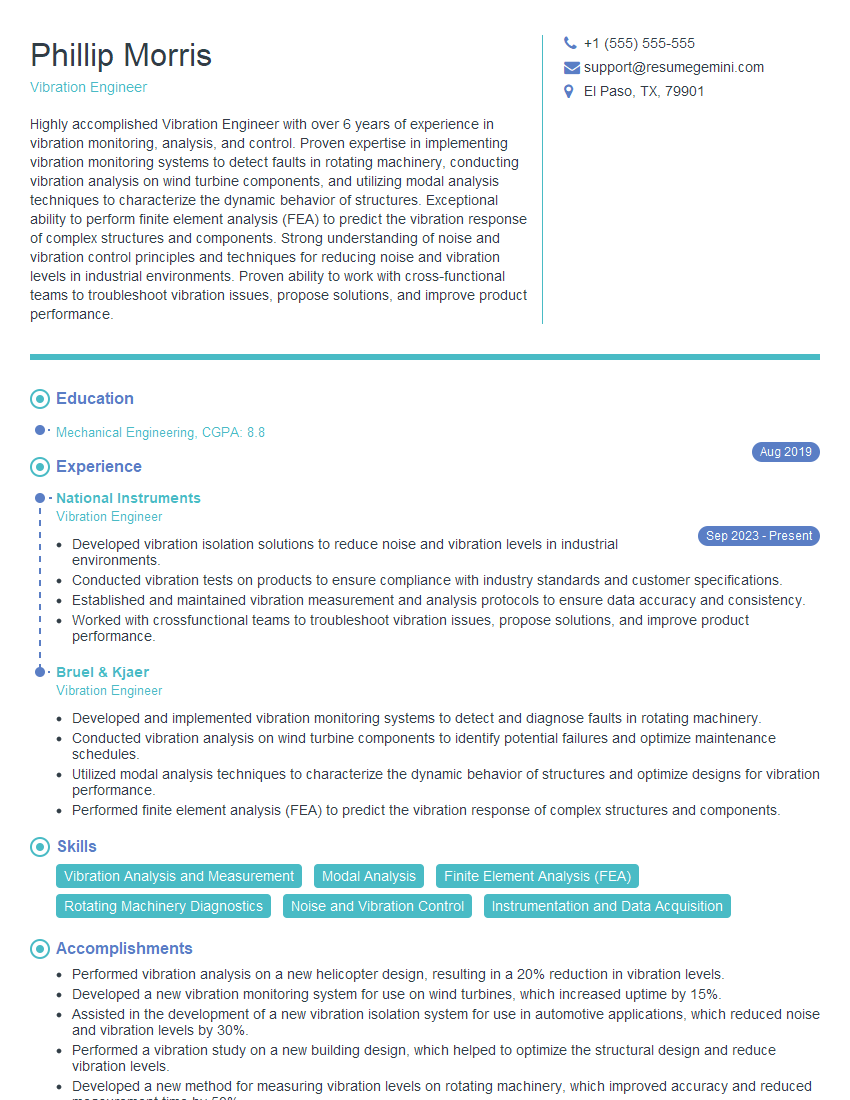
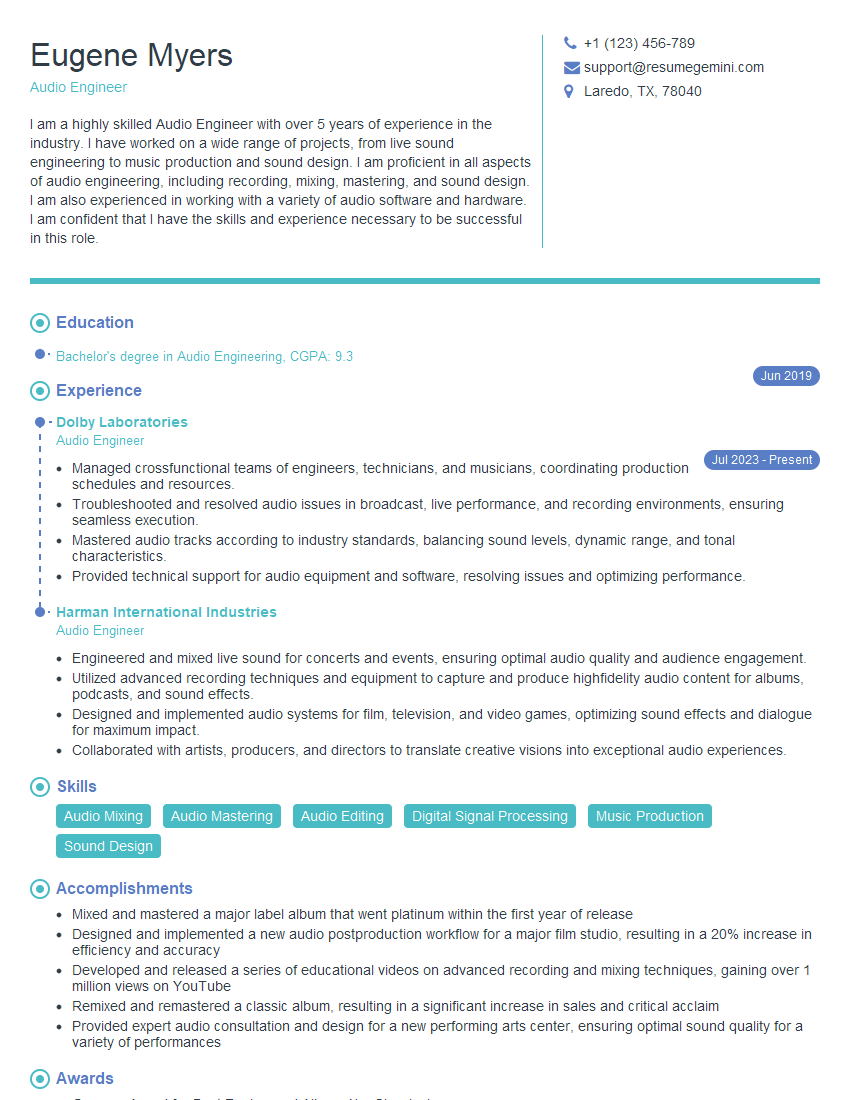
Mastering Acoustics and Sound Physics opens doors to exciting careers in diverse fields, from research and development to engineering and consulting. A strong understanding of these principles is crucial for securing your dream role. To maximize your job prospects, create an ATS-friendly resume that highlights your skills and experience effectively. ResumeGemini is a trusted resource to help you build a professional and impactful resume. We provide examples of resumes tailored to Acoustics and Sound Physics to guide you through the process. Invest time in crafting a compelling resume – it’s your first impression on potential employers!
Explore more articles
Users Rating of Our Blogs
Share Your Experience
We value your feedback! Please rate our content and share your thoughts (optional).
What Readers Say About Our Blog
Very informative content, great job.
good