Feeling uncertain about what to expect in your upcoming interview? We’ve got you covered! This blog highlights the most important Advanced Avionics Troubleshooting interview questions and provides actionable advice to help you stand out as the ideal candidate. Let’s pave the way for your success.
Questions Asked in Advanced Avionics Troubleshooting Interview
Q 1. Explain the troubleshooting process you follow when dealing with an avionics system malfunction.
Troubleshooting an avionics system malfunction follows a systematic process, much like a detective solving a case. It begins with careful observation and data gathering, followed by logical deduction and verification. My approach involves these key steps:
- Safety First: Prioritize safety. If the malfunction compromises flight safety, take immediate corrective action, possibly involving shutting down the affected system or diverting the flight.
- Gather Information: Collect all available data: pilot reports, warning messages, system indications, maintenance logs, and any relevant flight data recorder (FDR) information. What symptoms are present? When did the malfunction start? Under what conditions?
- Isolate the Problem: Use the gathered information to narrow down the potential causes. This may involve checking circuit breakers, fuses, and connectors. Consider the system architecture – a malfunction in one component might affect others.
- Test and Verify: Use built-in test equipment (BITE), external diagnostic tools, and specialized software to pinpoint the faulty component. This might involve running built-in self-tests, checking signal integrity, or performing specific functional tests.
- Repair or Replace: Once the faulty component is identified, it’s either repaired (if possible) or replaced. This often requires following strict maintenance procedures and using certified parts.
- Verification and Documentation: After repair or replacement, thoroughly test the system to confirm functionality. Document all actions taken, including the troubleshooting steps, parts replaced, and test results. This is crucial for future maintenance and regulatory compliance.
For example, if a navigation system is malfunctioning, I might first check the power supply, then the GPS antenna, followed by the internal components of the navigation unit itself. Each step is meticulously documented.
Q 2. Describe your experience with troubleshooting Integrated Modular Avionics (IMA) systems.
My experience with Integrated Modular Avionics (IMA) systems is extensive. IMA systems, with their centralized processing and shared resources, present unique troubleshooting challenges compared to older, standalone systems. The complexity demands a deep understanding of the system architecture, data buses (e.g., ARINC 664), and software interactions.
I’ve worked on troubleshooting IMA systems using sophisticated diagnostic software that allows access to internal system parameters, fault logs, and real-time data. These tools help isolate problems, often pinpointing faulty software modules or hardware components within the integrated modules. A memorable instance involved a failure within a flight management system module within an IMA architecture. Using the system’s diagnostic capabilities, I quickly identified a corrupted software module leading to an incorrect altitude calculation. Replacing the software module solved the problem efficiently.
Troubleshooting IMA requires a solid understanding of the modular architecture, fault tolerance mechanisms, and the extensive diagnostic tools employed to address malfunctions within this integrated environment.
Q 3. How familiar are you with using diagnostic tools and software for avionics troubleshooting?
I am highly proficient in using a wide range of diagnostic tools and software for avionics troubleshooting. My expertise encompasses:
- Built-in Test Equipment (BITE): I’m experienced in interpreting BITE messages to identify faults. This includes understanding the codes and their significance to quickly narrow down potential problem areas.
- Specialized Avionics Test Equipment: I am familiar with using various test sets and simulators to verify component functionality, signal integrity, and data bus communications.
- Diagnostic Software: I’m proficient with various software packages used to analyze flight data, access system logs, and perform advanced diagnostics on different avionics systems, including those within the IMA architecture. This often involves understanding and interpreting complex data streams.
- Aircraft Maintenance Software: My experience extends to using aircraft maintenance software for logging, tracking, and managing repairs and maintenance activities, ensuring compliance with regulations.
For example, I’ve used sophisticated software to analyze GPS data, identify interference sources, and pinpoint the precise location of a faulty component on a communications system. My knowledge extends beyond just using the tools to interpreting and understanding the results they provide.
Q 4. What are the common causes of GPS system errors, and how would you troubleshoot them?
GPS system errors can stem from various sources. Troubleshooting begins with understanding the error message or symptom.
- Antenna Issues: A faulty or improperly installed antenna is a common cause. This may manifest as weak signal strength or complete signal loss. Troubleshooting involves checking antenna connections, integrity, and positioning.
- Interference: Electromagnetic interference (EMI) from other onboard systems or external sources can disrupt GPS signals. Locating and mitigating the interference source is crucial. This might involve shielding or rerouting cables.
- Satellite Availability: Limited satellite visibility, especially during certain weather conditions or geographic locations, can cause positioning errors. In this case, examining the GPS receiver’s satellite constellation view may reveal insufficient satellites for a reliable fix.
- Receiver Malfunction: Internal faults within the GPS receiver itself can also cause errors. This often requires using diagnostic tools to test the receiver’s internal components and verify proper functionality.
- Software Issues: Software bugs or corrupted data in the GPS receiver can lead to errors. Updating the receiver’s firmware often resolves software-related problems.
My troubleshooting process involves systematically checking these areas, starting with the simplest possibilities (like antenna connections) and progressing towards more complex issues (like software problems). Using diagnostic tools and observing signal quality metrics assists in isolating the root cause.
Q 5. Explain your experience with troubleshooting communication systems (e.g., VHF, HF, SATCOM).
My experience with troubleshooting communication systems, including VHF, HF, and SATCOM, is extensive. Each system presents its own set of challenges and troubleshooting methods.
- VHF: Troubleshooting VHF systems commonly involves checking antenna connections, transmitter power output, and receiver sensitivity. Interference from other radio sources is another frequent culprit. Testing involves signal strength measurements and frequency checks.
- HF: HF communication is more complex, often requiring understanding propagation conditions, antenna tuning, and frequency selection. Troubleshooting involves checking for proper antenna matching, signal clarity, and understanding atmospheric conditions’ impact.
- SATCOM: SATCOM systems are even more complex, involving satellite visibility, antenna pointing, and data link protocols. Troubleshooting often involves verifying satellite acquisition, signal quality monitoring, and understanding the specific communication protocols.
A real-world example involved a SATCOM system experiencing intermittent data dropouts. By carefully examining the satellite signal strength data and correlating it with weather conditions, I found the dropouts coincided with periods of high atmospheric disturbance. This pinpointed the issue, and adjustments in signal processing parameters partially mitigated the problem until the equipment could be upgraded.
Q 6. How do you identify and resolve intermittent avionics faults?
Identifying and resolving intermittent avionics faults is challenging, as they are unpredictable and often difficult to replicate. My approach uses a combination of techniques:
- Thorough Documentation: Meticulously documenting the conditions under which the fault occurs is essential. This may involve recording flight parameters, environmental conditions, and system states.
- Data Logging: Utilizing data loggers to continuously monitor system parameters can help identify patterns or correlations related to the fault’s occurrence.
- Stress Testing: If possible, carefully performing stress tests on the system can help trigger the intermittent fault and facilitate diagnosis. This is done in a controlled environment where safety is ensured.
- Component Isolation: Systematically isolating potential sources of failure, one at a time, can help pinpoint the faulty component.
- Signal Tracing: Using oscilloscopes and other signal analysis tools to trace the signals throughout the system may reveal intermittent signal degradation or noise.
For example, I once encountered an intermittent failure in an autopilot system. By analyzing the recorded flight data and environmental data, I noticed the failure correlated with high humidity levels. This led to the discovery of a faulty connector susceptible to corrosion under humid conditions. Replacing the connector permanently solved the intermittent fault.
Q 7. Describe your experience with troubleshooting flight control systems.
Troubleshooting flight control systems requires extreme caution and a deep understanding of flight mechanics and safety regulations. These systems are critical for flight safety, and any malfunction must be addressed with utmost care.
My experience in this area focuses on:
- Understanding the system architecture: Flight control systems are complex, involving multiple sensors, actuators, and control computers. A thorough understanding of the system’s architecture and how its various components interact is essential.
- Utilizing diagnostic tools and software: Specialized tools and software are used to analyze flight control data, check sensor readings, and verify actuator functionality.
- Systematic testing: Troubleshooting involves a systematic approach, systematically checking sensors, actuators, and control computers. This is done in a controlled environment if possible.
- Regulatory compliance: All maintenance and repair activities must adhere to strict regulatory requirements and documentation protocols.
I have worked on troubleshooting flight control systems involving problems with sensors (e.g., faulty airspeed sensors leading to incorrect flight control commands) and actuators (e.g., stuck control surfaces). Each instance required a methodical approach, prioritizing safety and compliance with stringent regulations throughout the process.
Q 8. How familiar are you with the use of schematics, wiring diagrams, and technical manuals for troubleshooting?
Schematics, wiring diagrams, and technical manuals are the bread and butter of avionics troubleshooting. They’re essentially the blueprints and instruction manuals for an aircraft’s complex electrical and electronic systems. I’m highly proficient in using them.
Schematics show the functional relationships between components, illustrating the flow of signals and power. Wiring diagrams provide a physical representation, showing where each wire goes and how components are interconnected. Technical manuals offer detailed explanations of system operation, troubleshooting procedures, and component specifications.
For example, imagine a situation where the aircraft’s transponder isn’t working. I’d first consult the system schematic to understand the signal path from the transponder to the main avionics bus. Then, I’d refer to the wiring diagram to trace the physical connections, checking for broken wires or loose connectors along that path. Finally, the technical manual would provide detailed troubleshooting steps, diagnostic codes, and possible fault locations.
Q 9. What are the safety procedures you follow while troubleshooting avionics systems?
Safety is paramount in avionics troubleshooting. My procedures always start with a thorough pre-flight inspection, ensuring power is disconnected to the system undergoing maintenance to prevent electrical shocks. I always follow the manufacturer’s recommended procedures and use appropriate lockout/tagout procedures to prevent accidental energization of circuits. This involves clearly identifying and isolating the system being worked on, ensuring nobody can inadvertently switch power back on.
I meticulously use appropriate Personal Protective Equipment (PPE), including safety glasses, gloves, and anti-static wrist straps to prevent damage to sensitive components and protect myself from potential hazards. Furthermore, I always adhere to the aircraft’s maintenance manual and any specific safety regulations issued by the relevant authority. Each step of the troubleshooting process is documented meticulously, creating a clear audit trail.
Q 10. Describe your experience with troubleshooting problems related to Air Data Systems.
I have extensive experience troubleshooting Air Data Systems (ADS). These systems are crucial for providing critical flight data like altitude, airspeed, and outside air temperature. Problems in this system can severely impact flight safety.
I’ve encountered issues ranging from faulty pitot-static system components (blocked pitot tubes, leaking static ports) to malfunctioning transducers and faulty data processing units. My troubleshooting approach typically involves using built-in test equipment (BITE), checking for continuity and signal integrity using multimeters and oscilloscopes, and performing calibration checks as per the manufacturer’s specifications. For instance, I once resolved an airspeed indicator inaccuracy by identifying and replacing a faulty pressure transducer after systematically checking the pitot-static system for obstructions and leaks. I’m familiar with various ADS architectures, including those using analog and digital sensors and data processing.
Q 11. How do you document your troubleshooting process and findings?
Documentation is crucial for maintaining aircraft airworthiness and for ensuring efficient troubleshooting in the future. I maintain detailed records of every troubleshooting process using a standardized format. This typically includes:
- Date and time of the fault
- Aircraft identification
- Description of the malfunction
- Steps taken during troubleshooting
- Measurements and test results (including screenshots from test equipment)
- Parts replaced or repaired
- Verification of the repair
- Conclusion and recommendations
I use both digital and paper-based documentation depending on the situation and regulatory requirements, ensuring all information is accurate, complete, and legible. Digital records are especially useful when dealing with complex systems, as they can include images, schematics and recordings of test results.
Q 12. Explain your experience working with different avionics manufacturers’ systems.
Throughout my career, I’ve worked with a variety of avionics manufacturers, including Rockwell Collins, Honeywell, and Garmin. Each manufacturer has its own unique system architecture, troubleshooting procedures, and diagnostic tools. This requires adaptability and a strong understanding of different communication protocols and data formats.
For example, troubleshooting a Garmin GPS system differs from troubleshooting a Honeywell autopilot. The diagnostic tools, software interfaces, and troubleshooting documentation vary significantly between manufacturers. My experience allows me to effectively navigate these differences and leverage the specific knowledge required for each manufacturer’s equipment. I’m comfortable using various diagnostic software packages and specialized test equipment provided by the different manufacturers.
Q 13. How do you prioritize tasks when multiple avionics systems are malfunctioning?
When multiple avionics systems malfunction simultaneously, prioritization is crucial based on the impact on flight safety and the urgency of the situation. I follow a tiered approach:
- Safety-critical systems: I prioritize addressing malfunctions in systems directly impacting flight safety, such as the flight control system, navigation system, and engine instrumentation. These are addressed immediately to ensure safe operation.
- Operational critical systems: Next, I focus on systems essential for efficient flight operation, but not directly critical to safety, such as communication systems or weather radar. The order of addressing these depends on the specific flight situation and the impact on the overall mission.
- Non-critical systems: Malfunctions in non-critical systems, such as entertainment systems or cabin lighting, are dealt with after addressing the safety and operational critical systems.
This approach ensures a structured and effective response to multiple system failures, prioritizing safety and ensuring efficient maintenance.
Q 14. Describe your experience in troubleshooting engine indication and crew alerting systems (EICAS).
Engine Indication and Crew Alerting Systems (EICAS) provide critical information to the flight crew about engine performance and potential problems. Troubleshooting EICAS involves a systematic approach, combining fault code analysis with a thorough understanding of engine operation.
My experience includes diagnosing a variety of EICAS-related issues, such as incorrect engine parameter displays, spurious warnings, and failures in the system’s data acquisition and processing units. I use the EICAS built-in test functions, analyze fault codes, and cross-reference them with engine parameter readings to pinpoint the root cause of the malfunction. For example, an unexpected EICAS warning might be caused by a faulty sensor, a wiring problem, or a malfunction within the EICAS computer itself. A systematic approach involving checking sensor readings, verifying signal integrity, and reviewing maintenance logs is crucial for efficient and accurate troubleshooting in these complex systems.
Q 15. How familiar are you with fault isolation techniques using built-in test equipment (BITE)?
Built-In Test Equipment (BITE) is crucial for rapid fault isolation in avionics. It’s essentially a self-diagnostic system embedded within the avionics unit itself. Instead of relying solely on external testing tools, BITE provides immediate, often location-specific, fault codes and indications. This significantly reduces troubleshooting time and minimizes aircraft downtime.
My experience encompasses a wide range of BITE systems across various aircraft platforms. I’m proficient in interpreting BITE codes, using the associated documentation (BITE manuals and schematics), and using this information to pinpoint faulty components or subsystems. For instance, a BITE code might indicate a specific failure within a flight control computer’s processing unit or a faulty sensor. My process involves systematically checking the indicated component, performing power cycle checks, and potentially running built-in functional tests as guided by the BITE system.
I’m also experienced in using advanced techniques to analyze BITE data logs to identify recurring problems or trends, which is invaluable for preventative maintenance and overall system reliability. Think of BITE as a sophisticated onboard mechanic that gives you clues about where the problem is.
Career Expert Tips:
- Ace those interviews! Prepare effectively by reviewing the Top 50 Most Common Interview Questions on ResumeGemini.
- Navigate your job search with confidence! Explore a wide range of Career Tips on ResumeGemini. Learn about common challenges and recommendations to overcome them.
- Craft the perfect resume! Master the Art of Resume Writing with ResumeGemini’s guide. Showcase your unique qualifications and achievements effectively.
- Don’t miss out on holiday savings! Build your dream resume with ResumeGemini’s ATS optimized templates.
Q 16. What is your experience with troubleshooting flight management systems (FMS)?
Troubleshooting Flight Management Systems (FMS) requires a deep understanding of navigation principles, flight planning algorithms, and the complex interactions between various sensors and computer systems. My experience includes diagnosing malfunctions ranging from minor software glitches to more substantial hardware failures. I’ve worked with various FMS manufacturers and models, becoming adept at interpreting error messages, reviewing data logs (both from the FMS and associated systems like IRS/INS), and cross-referencing these findings with relevant technical documentation.
One challenging case involved an FMS experiencing intermittent navigation errors. Through careful analysis of the data logs, we discovered that the problem stemmed from a faulty GPS antenna connection, causing signal dropout. This highlights the importance of not only understanding the FMS itself but also the wider avionics architecture and how different systems interact.
Furthermore, my experience includes conducting functional tests to verify the integrity of the FMS’s various functions, including flight planning, navigation performance, and data management capabilities. This ensures the system is operating within specified parameters and provides the pilots with reliable and accurate information.
Q 17. How would you handle a situation where a critical avionics system fails during flight?
A critical avionics system failure during flight is a serious situation demanding immediate and decisive action. My approach is structured and prioritized by safety. The first step is to understand the nature and severity of the failure – what system is affected, and what is the immediate impact on flight safety?
- Immediate Actions: Prioritize safety-critical actions. This may involve switching to backup systems (if available), configuring the aircraft for safe flight, and notifying Air Traffic Control (ATC).
- Troubleshooting (As Safe as Possible): Once the immediate safety concerns are addressed, begin a systematic troubleshooting process. This may involve checking circuit breakers, verifying power supply, and consulting the relevant quick reference handbook (QRH) for emergency procedures.
- Data Acquisition: Gather relevant data, including any error messages displayed, sensor readings, and system parameters to help pinpoint the cause of the failure post-flight.
- Post-Flight Analysis: A thorough post-flight analysis is crucial. This involves reviewing the collected data, interviewing the flight crew, and scrutinizing the aircraft’s maintenance logs to understand the root cause of the failure and to implement corrective actions to prevent future occurrences.
The key is calm, efficient, and methodical decision-making. Remember, safety always comes first.
Q 18. Describe your experience with troubleshooting problems related to inertial navigation systems (INS).
Inertial Navigation Systems (INS) are critical for aircraft navigation, especially in situations where GPS signals are unavailable or unreliable. Troubleshooting INS issues requires a solid understanding of gyroscopic principles, accelerometers, and Kalman filtering algorithms. My experience includes diagnosing problems associated with sensor drift, alignment errors, and failures within the INS computer. These problems often manifest as inaccurate navigation information or complete system failure.
One example involved an INS exhibiting significant drift. After checking the system’s power supply and connections, I performed a detailed analysis of the INS alignment data. We eventually discovered that a faulty gyroscope was the root cause. This required a replacement of the faulty component and recalibration of the system. It highlights the precision needed for accurate navigation and the importance of meticulous analysis in identifying malfunctioning components.
Diagnosing INS problems often involves analyzing the output data against known reference points, reviewing system logs for error messages and anomalies, and possibly using specialized testing equipment to validate the sensor performance and alignment accuracy. A thorough understanding of the INS’s operating principles and data processing algorithms is crucial in effective troubleshooting.
Q 19. How familiar are you with the principles of aircraft electrical systems and their relevance to avionics troubleshooting?
Aircraft electrical systems are the backbone of all avionics, providing power and grounding. A thorough understanding of these systems is critical for effective avionics troubleshooting. Many avionics malfunctions are directly related to power issues – insufficient voltage, incorrect grounding, or intermittent power supply. My experience involves tracing power paths, diagnosing wiring problems, and identifying faulty power distribution units.
For example, a seemingly complex avionics malfunction might be resolved by simply replacing a corroded connector in a power bus, or tracing a faulty wire causing a voltage drop that negatively impacts system performance. The relationship is direct – an electrical system fault can easily manifest as an avionics malfunction, hence the importance of understanding how they interact.
I’m familiar with various aircraft electrical architectures, including AC and DC systems, power generation components (generators, batteries), and bus management systems. This foundational knowledge is fundamental to effectively diagnosing and repairing problems across the entire avionics suite.
Q 20. Explain your understanding of the impact of electromagnetic interference (EMI) on avionics systems.
Electromagnetic Interference (EMI) can significantly disrupt the operation of sensitive avionics systems. EMI occurs when unwanted electromagnetic energy interferes with the normal functioning of electronic circuits. Sources of EMI can include other avionics systems, external sources like lightning strikes or radio transmissions, and even internal components within the aircraft itself.
My experience in mitigating EMI problems involves understanding various shielding techniques, using specialized equipment to measure and identify EMI sources, and implementing filtering and grounding improvements to reduce the impact of interference. This can involve troubleshooting issues arising from improperly shielded wiring, or identifying and replacing faulty components susceptible to EMI.
Imagine EMI as radio static interfering with a radio broadcast; it disrupts the clear signal. Similarly, EMI can corrupt data, lead to malfunctioning systems, and even cause complete system failures. Addressing EMI issues often requires a holistic approach, considering the entire avionics ecosystem and the potential sources of interference.
Q 21. Describe your experience with troubleshooting problems related to weather radar systems.
Troubleshooting weather radar systems involves a combination of hardware and software expertise. These systems are vital for pilot safety, providing information about weather patterns and potential hazards. Malfunctions can range from minor display glitches to complete system outages. My experience encompasses diagnosing issues relating to antenna problems, transmitter/receiver malfunctions, signal processing errors, and display issues.
One example involved a weather radar exhibiting weak signal strength. Through systematic testing, we determined that a buildup of ice had accumulated on the antenna, impairing signal transmission. This illustrates the importance of regular inspection and maintenance for weather radar systems, which are frequently exposed to harsh weather conditions.
Troubleshooting these systems involves checking antenna alignment and integrity, verifying transmitter and receiver power levels and signal quality, analyzing processed data for inconsistencies, and running built-in diagnostic tests. A good understanding of signal processing techniques and radar fundamentals is critical for identifying the root causes of malfunctions and implementing effective solutions.
Q 22. How would you troubleshoot a problem with the aircraft’s communication transponders?
Troubleshooting a transponder issue starts with understanding the symptom. Is the transponder completely unresponsive, transmitting incorrectly, or experiencing intermittent failures? We use a methodical approach.
- Initial Checks: Begin with the simplest checks—power supply, antenna connections, and circuit breakers. A visual inspection often reveals loose connections or damaged components. A simple continuity test with a multimeter can confirm power and grounding issues.
- Built-In Test Equipment (BITE): Modern transponders have BITE capabilities, providing error codes or diagnostic information. These codes can pinpoint the problem to a specific subsystem (e.g., the transmitter, receiver, or coder/decoder).
- Signal Tracing: If the BITE isn’t conclusive, we would use signal tracing techniques with an oscilloscope to analyze the signals at various points within the transponder circuit. We’d look for signal loss, distortion, or incorrect modulation.
- Frequency Check: A spectrum analyzer would verify the transponder is transmitting on the correct frequency and within the required power specifications. Incorrect frequency is a common issue.
- Mode S interrogation: For Mode S transponders, we’d use specialized test equipment to send interrogation signals and analyze the responses. This helps identify issues related to data encoding and decoding.
- Documentation Review: Consulting the aircraft’s maintenance manual and the transponder’s technical documentation is crucial. These documents contain schematics, wiring diagrams, and troubleshooting procedures specific to the aircraft model.
For example, I once encountered a transponder that wasn’t responding. Initial checks were normal. The BITE indicated a problem in the transmitter section. Signal tracing with an oscilloscope revealed a faulty high-voltage transistor. Replacing that component resolved the issue.
Q 23. Explain your experience with troubleshooting automatic dependent surveillance-broadcast (ADS-B) systems.
ADS-B troubleshooting involves a multi-faceted approach as it encompasses both the aircraft’s transmitting and receiving capabilities. It relies on GPS data, and this must be checked first.
- GPS Integrity: A faulty GPS receiver provides inaccurate position data, rendering the ADS-B signal unreliable. We’d check the GPS for correct satellite acquisition, signal strength, and position accuracy.
- Antenna Performance: The ADS-B antenna’s integrity and proper installation are crucial. Signal strength measurements and visual inspection for damage are essential steps.
- Data Link Communication: We’d verify the proper transmission and reception of ADS-B data packets using specialized monitoring software and equipment. This would involve checking data integrity and link quality.
- Transmitter Function: Similar to transponder troubleshooting, we need to check the ADS-B transmitter’s power output, frequency accuracy, and signal modulation using an oscilloscope and spectrum analyzer.
- Data Processing: The ADS-B system processes GPS data and converts it into a suitable format for transmission. Issues in this data processing could cause errors in the transmitted information. This could involve reviewing the system’s internal logs for error codes or faulty processing.
- Ground Station Interaction: In certain cases, problems might not be on the aircraft side, but might stem from issues with ground station reception or processing. Cooperation with air traffic control or ground-based equipment is needed to eliminate these external factors.
I recall troubleshooting an ADS-B system where the aircraft wasn’t receiving messages from the ground. After ruling out aircraft-side issues, investigation showed it was a temporary outage on the ground station’s network side, highlighting the importance of considering the entire system.
Q 24. Describe your experience with the troubleshooting of Head-Up Displays (HUDs).
Head-Up Displays (HUDs) are complex systems integrating several technologies. Troubleshooting them requires a structured approach.
- Initial Assessment: We start by determining the nature of the HUD malfunction. Is the display blank, showing partial information, or exhibiting distortion or flickering? Does the problem only occur under specific flight conditions?
- BITE Checks: HUD systems typically have BITE capabilities providing error codes. This gives a starting point for diagnosing the problem.
- Power Supply and Connections: We check the power supply voltage, grounding, and all data and video connections. Loose connectors or power fluctuations are a common cause of HUD problems.
- Image Generation System: The core component generating the HUD image needs testing. This might involve checking the video signal quality, brightness control, and the operation of components such as microdisplays or CRTs (though CRTs are less common today).
- Optical System: The optical system projects the image onto the windshield. Issues here could be related to misalignment, lens defects, or damaged components. We may need alignment tools to adjust the optical path.
- Environmental Factors: HUDs are sensitive to temperature and pressure changes. Checking the system’s operating environment is key, particularly if malfunctions occur at specific altitudes or temperatures.
In one case, a HUD showed a distorted image. After systematically ruling out other problems, we discovered a slight misalignment in the optical system. Fine adjustment restored clear display.
Q 25. How familiar are you with the use of oscilloscopes and multimeters in avionics troubleshooting?
Oscilloscopes and multimeters are indispensable tools in avionics troubleshooting. They provide insights into electronic circuits that other methods miss.
- Multimeter Applications: Multimeters are used for basic measurements: voltage, current, resistance, and continuity. This is crucial for verifying power supply voltages, checking continuity in wiring, and detecting short circuits or open circuits. For example, checking if a component is receiving the correct supply voltage before moving to complex tests.
- Oscilloscope Applications: Oscilloscopes show signal waveforms. This is essential for evaluating signal integrity, identifying signal noise or distortion, and analyzing frequency response. In avionics, this helps analyze data bus signals (ARINC 429, for example), check for signal drops, and confirm that signals are within specifications. For example, analyzing the square wave of a data bus to find anomalies like jitter or signal attenuation.
I routinely use these devices. For example, recently I used a multimeter to check the voltage on a power rail of an autopilot unit and an oscilloscope to analyze the data bus signals going to the flight display, efficiently pinpointing the malfunction.
Q 26. Explain your understanding of ARINC standards and their relevance to avionics troubleshooting.
ARINC standards are crucial for avionics interoperability. They define the specifications for various avionics components and their communication protocols. Understanding ARINC standards is essential for troubleshooting.
- Interoperability: ARINC standards ensure different manufacturers’ equipment can communicate effectively. When troubleshooting a system, knowing the ARINC standard ensures that different parts of the system are communicating according to the defined rules.
- Data Bus Communication: Many ARINC standards deal with data bus communication protocols (ARINC 429, ARINC 629, AFDX). These standards govern how data is transmitted and received, enabling diagnostics using specialized equipment that understands the specific protocol.
- Troubleshooting Tools and Techniques: Knowledge of ARINC standards helps in the selection of appropriate diagnostic tools. For example, an ARINC 429 data bus analyzer is needed to debug problems in a system using that specific protocol.
- Documentation and Interpretation: ARINC standards provide detailed specifications of how systems should behave. This information is found in official documentation and aids in troubleshooting. Deviation from these specifications indicates a possible fault.
I once had a situation where different avionics units weren’t communicating properly. By understanding the specific ARINC standard (ARINC 429), I could correctly use a data bus analyzer to identify a data word parity error, leading to the resolution.
Q 27. Describe your experience working with different types of avionics data buses (e.g., ARINC 429, ARINC 629, AFDX).
Experience with avionics data buses is critical. Different buses have different characteristics and require different troubleshooting techniques.
- ARINC 429: A high-speed, point-to-point data bus commonly used for transmitting relatively small amounts of data. Troubleshooting might involve checking for word parity errors, invalid data labels, or signal timing issues. A dedicated ARINC 429 bus analyzer would be crucial here.
- ARINC 629: A high-speed, multiplexed bus that can handle higher data rates than ARINC 429. Troubleshooting includes identifying errors using protocol-specific analysis tools that understand the communication protocol, including error correction/detection.
- AFDX (Avionics Full Duplex Switched Ethernet): A switched Ethernet network providing high-bandwidth, deterministic communication. Troubleshooting might involve network monitoring tools to identify network congestion, packet loss, or connectivity problems. Ethernet analyzers become essential tools.
My experience spans all three. I’ve used specialized bus analyzers to troubleshoot each type. For instance, I once used a network analyzer to trace the source of packet loss within an AFDX network, which pointed towards a failing network switch.
Q 28. How do you stay updated with the latest advancements in avionics technology and troubleshooting techniques?
Staying updated in avionics is crucial. I utilize various methods:
- Industry Publications: I regularly read trade journals and publications such as Aviation Week and Flight International to stay abreast of new technologies and troubleshooting techniques.
- Manufacturer Training: I attend training courses and workshops provided by avionics manufacturers. These courses cover new technologies and troubleshooting methodologies, often with hands-on experience.
- Conferences and Seminars: Attending conferences and seminars allows me to network with other professionals and learn about the latest advancements in the industry.
- Online Resources: I utilize online resources, such as technical websites and forums to access the latest information and best practices shared by experts in the field.
- Continuous Learning Platforms: Several online platforms provide courses on advanced avionics and troubleshooting techniques. I regularly participate in relevant online modules to enhance my knowledge.
Continuing education ensures I am at the forefront of the field and able to address any evolving challenges that come my way.
Key Topics to Learn for Advanced Avionics Troubleshooting Interview
- Integrated Modular Avionics (IMA): Understanding IMA architecture, data bus communication (e.g., ARINC 429, AFDX), and troubleshooting techniques within this complex system.
- Fault Detection, Isolation, and Recovery (FDIR): Familiarize yourself with FDIR principles, built-in test equipment (BITE) interpretation, and utilizing diagnostic tools to pinpoint and resolve avionics malfunctions.
- GPS and Navigation Systems: Mastering the principles of GPS operation, error sources, and troubleshooting techniques for various navigation systems like inertial navigation systems (INS) and air data systems.
- Flight Management Systems (FMS): Deep understanding of FMS functionality, data sources, flight plan management, and troubleshooting procedures for common FMS issues.
- Communication Systems: Gain expertise in VHF/UHF communication systems, satellite communication, and troubleshooting radio-related problems, including antenna systems.
- Electrical Power Systems: Understand the intricacies of aircraft electrical power generation, distribution, and management, including troubleshooting power-related faults and bus tie systems.
- Practical Application: Develop your ability to apply theoretical knowledge to real-world scenarios. Practice troubleshooting simulations and case studies to build confidence and refine your problem-solving skills.
- Advanced Troubleshooting Methodologies: Explore systematic troubleshooting approaches, fault tree analysis, and the use of specialized diagnostic software.
Next Steps
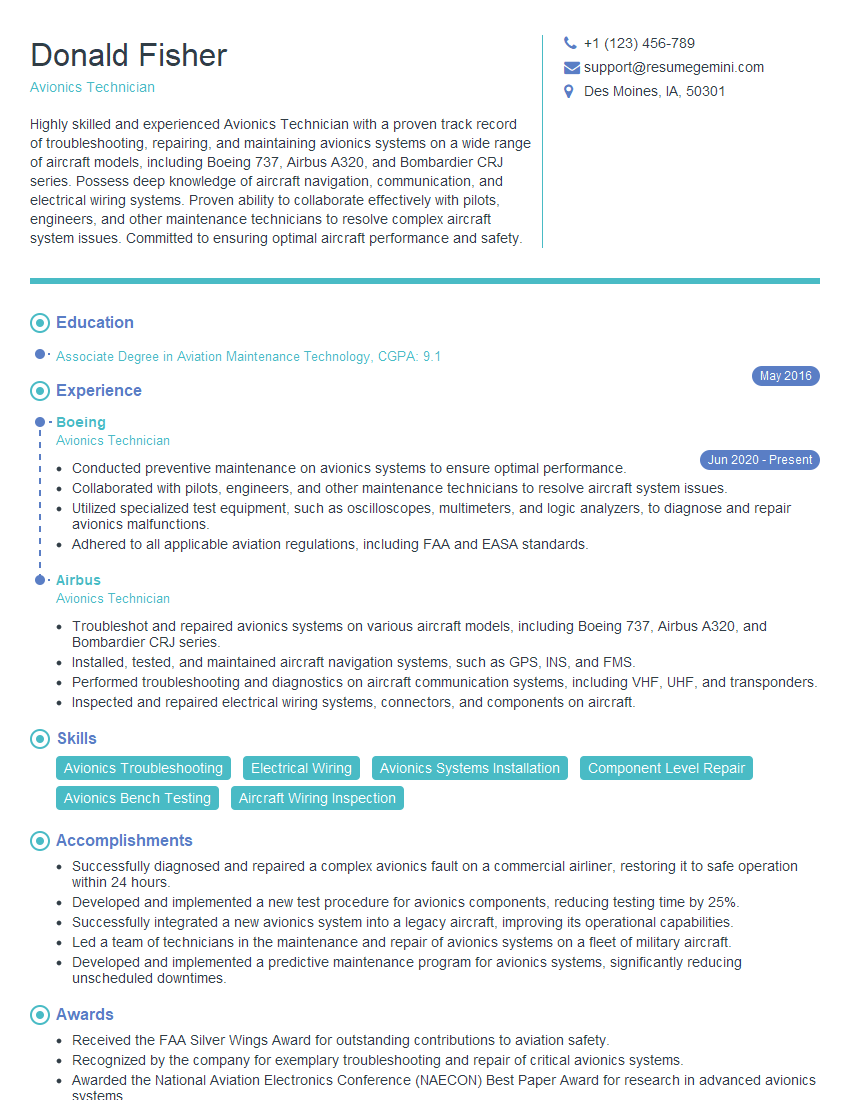
Mastering Advanced Avionics Troubleshooting opens doors to exciting career advancements and higher earning potential within the aerospace industry. A strong resume is crucial for showcasing your expertise to potential employers. Creating an ATS-friendly resume significantly increases your chances of getting your application noticed. ResumeGemini is a trusted resource to help you build a professional and impactful resume that highlights your skills and experience effectively. Examples of resumes tailored specifically to Advanced Avionics Troubleshooting are available through ResumeGemini to guide you in crafting your application.
Explore more articles
Users Rating of Our Blogs
Share Your Experience
We value your feedback! Please rate our content and share your thoughts (optional).
What Readers Say About Our Blog
Very informative content, great job.
good