The right preparation can turn an interview into an opportunity to showcase your expertise. This guide to Advanced knowledge of music theory interview questions is your ultimate resource, providing key insights and tips to help you ace your responses and stand out as a top candidate.
Questions Asked in Advanced knowledge of music theory Interview
Q 1. Explain the difference between diatonic and chromatic scales.
The diatonic and chromatic scales represent fundamentally different approaches to organizing pitches. The diatonic scale, typically a seven-note scale (like the major or minor scales), utilizes intervals derived from the natural harmonic series, resulting in a strong sense of tonal center. Think of it as the ‘alphabet’ of a specific key. It’s built using whole and half steps in a specific pattern (e.g., W-W-H-W-W-W-H in major). This creates a sense of stability and direction within a piece.
In contrast, the chromatic scale comprises all twelve notes within an octave, including all the half steps. It’s like having *all* the letters of the alphabet available at once, regardless of key. This results in a much more ambiguous and fluid harmonic context, often used for expressive purposes, creating tension, or traversing between keys smoothly.
Imagine a keyboard: playing only the white keys gives you a diatonic scale (depending on where you start). Playing all the white and black keys consecutively gives you the chromatic scale.
Q 2. Describe the function of secondary dominants and their role in modulation.
Secondary dominants are chords that function as dominant chords (V chords) but in keys other than the main key of a piece. They act as temporary tonal centers, creating a powerful harmonic pull towards a resolution in a different key, before returning (often) to the main key. They are crucial for smooth and interesting modulation – the process of changing keys.
For instance, in C major, the dominant chord is G major (V). A secondary dominant leading to the subdominant (IV chord) in C major would be D7 (the dominant of G major, which is the subdominant of C major). This D7 chord creates a strong pull toward G major (IV), which then resolves nicely back to C major. This creates a more sophisticated and less predictable harmonic progression.
Think of them as harmonic ‘shortcuts’ or ‘detours’, adding color and excitement to a composition. Their use allows for a more colorful and dynamic harmonic language.
Q 3. Analyze the harmonic progression of a given chord sequence (provide a short example).
Let’s analyze the following chord progression in C major: Cmaj7 - Fmaj7 - Dm7 - G7 - Cmaj7
This progression is very common and utilizes a clear functional harmony:
Cmaj7: Tonic (I)Fmaj7: Subdominant (IV)Dm7: Submediant (vi)G7: Dominant (V)Cmaj7: Tonic (I)
The progression moves smoothly through the traditional functional harmony, creating a satisfying resolution. The G7 chord, the dominant, acts as a strong pull toward the tonic Cmaj7, creating a satisfying cadence.
Other progressions could be more complex, employing secondary dominants, augmented chords, or altered dominants to add color and tension, but this example demonstrates a basic functional harmonic progression.
Q 4. Explain the concept of voice leading and its importance in composition.
Voice leading refers to the smooth and logical movement of individual melodic lines (voices) in a polyphonic texture. It’s about how the individual notes of each voice move from one chord to the next. Good voice leading aims for stepwise motion (movements by a single step) whenever possible, avoiding large leaps which can sound awkward or disjointed. It also prioritizes avoiding parallel fifths or octaves (where two voices move in parallel at the interval of a perfect fifth or octave).
The importance of voice leading lies in its contribution to the overall clarity, smoothness, and listenability of a composition. Poor voice leading can create a muddy texture and obscure the harmonic function. It’s a crucial element in creating a pleasing and well-crafted musical piece. Think of it as the choreography of different melodic lines, ensuring they move gracefully and harmoniously together.
Q 5. Discuss the different types of cadences and their expressive effect.
Cadences are points of arrival in a musical phrase or section, marking a sense of closure or resolution. Several types exist:
- Perfect Authentic Cadence: V – I (e.g., G – C in C major). This is the strongest and most conclusive cadence, providing a strong sense of closure. It’s like the period at the end of a sentence.
- Imperfect Authentic Cadence: V – I, but with a different voicing or an incomplete I chord. Less conclusive than a perfect authentic cadence.
- Plagal Cadence (Amen cadence): IV – I (e.g., F – C in C major). Often used to create a gentler, more peaceful conclusion.
- Deceptive Cadence: V – VI (e.g., G – A in C major). This creates a surprising and unexpected resolution, adding tension and intrigue; the sense of arrival is intentionally unresolved.
The expressive effect of each cadence type is determined by its inherent stability and the context in which it’s used. The perfect authentic provides resolution; the plagal, calmness; and the deceptive, surprise and continuation. Composers carefully choose cadences to shape the emotional trajectory of their music.
Q 6. Explain how to analyze a given fugue subject and answer.
Analyzing a fugue subject and answer involves understanding their melodic and rhythmic characteristics, their intervallic structure, and their role in the overall structure of the fugue.
Subject: The subject is the main melodic idea of the fugue. Analyze its:
- Melody: Note its contour (ascending, descending, or mixed), its range, and any memorable melodic motifs.
- Rhythm: Identify its rhythmic patterns and note their significance in creating rhythmic drive or interest.
- Intervals: Note any characteristic intervals or leaps that define the subject’s melodic character.
Answer: The answer is the subject transposed to a different voice, typically a fifth or fourth above or below. Analyze the answer in the same way as the subject. Look for:
- Transposition: Note the interval of transposition and its effect on the subject’s character.
- Imitation: Observe how closely the answer imitates the subject, and note any alterations or variations.
By comparing the subject and answer, you can understand the basic building blocks of the fugue and how the composer uses imitation to develop the musical ideas.
Q 7. What are the characteristics of a well-formed counterpoint?
Well-formed counterpoint, where two or more independent melodic lines sound together harmoniously, exhibits several key characteristics:
- Avoidance of Parallel Fifths and Octaves: These intervals, when moving in parallel between voices, often sound muddy or dissonant.
- Smooth Voice Leading: Voices should move predominantly in stepwise motion, avoiding large leaps which can disrupt the flow.
- Proper Dissonance Resolution: Dissonances, when used, should resolve appropriately, usually to consonant intervals. Dissonance adds tension, resolution releases it.
- Independence of Voices: Each voice should retain its individual melodic character and not simply duplicate or mimic another.
- Appropriate Rhythmic Variety: A balance between rhythmic similarity and contrast between voices enhances the overall texture.
- Clear Harmonic Function: The counterpoint should contribute to a clear and coherent harmonic structure.
These characteristics ensure that the individual lines remain independent while creating a satisfying and harmonious whole. Think of it like a well-choreographed dance, where each dancer has their own part but all move together gracefully.
Q 8. Describe the principles of musical form (e.g., sonata form, rondo form).
Musical form refers to the large-scale structure of a piece of music. Think of it as the architecture of a musical composition. Different forms provide blueprints for organizing musical ideas. Two prominent examples are sonata form and rondo form.
Sonata Form: Typically found in the first movement of Classical and Romantic sonatas, symphonies, and string quartets, sonata form consists of three main sections: Exposition, Development, and Recapitulation. The Exposition introduces two contrasting themes (often in different keys), establishing the musical material. The Development section explores these themes, often fragmenting, transforming, and modulating them to create musical tension. The Recapitulation restates the themes, usually in the tonic (home) key, providing a sense of resolution and closure. A coda, or concluding passage, might be added.
Rondo Form: Characterized by a recurring main theme (the ‘A’ section) that alternates with contrasting themes (e.g., ‘B’, ‘C’, ‘D’), rondo form provides a clear, memorable structure. The pattern might be A B A C A D A, or similar variations. This form is often used in lighter pieces, providing a sense of lightness and playfulness. The return of the ‘A’ theme acts as a structural anchor, creating a sense of familiarity and predictability amidst the contrasting episodes.
Understanding these forms is crucial for analyzing and composing music, as they represent fundamental organizing principles within Western classical music.
Q 9. Explain the role of inversion, retrograde, and retrograde inversion in twelve-tone composition.
In twelve-tone composition, also known as serialism, the twelve notes of the chromatic scale are arranged in a specific order called a tone row (or prime row). Inversion, retrograde, and retrograde inversion are transformations of this row that create new melodic and harmonic material.
Inversion: Each interval in the tone row is inverted; ascending intervals become descending, and vice-versa. For example, if the prime row contains a major third (ascending), the inversion will have a minor third (descending) in the corresponding position.
Retrograde: The tone row is played backward. This creates a completely different melodic contour and harmonic progression.
Retrograde Inversion: This combines both inversion and retrograde. The tone row is played backward, and each interval is inverted. This often produces the most dramatic transformation of the original tone row.
These techniques ensure that all twelve notes are given equal importance and prevent any single tone from dominating. They are vital for creating complex musical structures and avoiding traditional tonal hierarchies in twelve-tone music.
Q 10. Discuss the different types of musical textures (e.g., monophonic, homophonic, polyphonic).
Musical texture describes the way different melodic lines and harmonic elements interact within a piece of music. It’s essentially the fabric of the sound.
- Monophonic: A single melodic line without accompaniment. Think of a Gregorian chant or a solo violin piece. It’s the simplest texture.
- Homophonic: A primary melody supported by chords. Most popular music, from pop songs to hymns, falls under this category. The melody is the focus, with the chords providing harmonic support.
- Polyphonic: Two or more independent melodic lines that are of equal importance. A fugue, a common form in Baroque music, is a prime example of polyphonic texture. Each voice has its own distinct melodic character, yet they intertwine to create a rich and complex sound.
Understanding texture is crucial for analyzing and interpreting music. A change in texture often signals a change in mood or emphasis within a composition. The composer uses these textures to convey different emotions and dramatic effects.
Q 11. How does the use of rhythm and meter contribute to the overall form and structure of a piece?
Rhythm and meter are fundamental elements that shape the form and structure of a musical piece. Rhythm deals with the duration and arrangement of sounds, while meter provides a framework of regular pulses that organize rhythmic patterns.
Meter: Establishes the pulse or beat of a piece. A piece in 4/4 time has four beats per measure, typically with the first beat being stressed. Changes in meter (e.g., switching from 4/4 to 3/4) can create dramatic effects and mark structural boundaries.
Rhythm: The rhythmic patterns created within the metrical framework contribute greatly to a piece’s character and drive. Syncopation (placing accents on weak beats) creates rhythmic interest and surprise, while repetitive rhythmic figures can build intensity or create a sense of momentum. The use of rhythmic motifs (short repeated patterns) helps to unify sections of music and provide a sense of cohesion.
Think of how a rhythmic ostinato (a persistently repeated rhythmic pattern) in a Baroque piece might underpin a larger structure, or how a sudden change to a complex rhythmic pattern in a contemporary piece signals a dramatic shift in the music’s emotional landscape.
Q 12. Explain the concept of musical tension and release.
Musical tension and release are fundamental elements of musical expression, creating a dynamic interplay that engages the listener. Tension builds anticipation, while release provides resolution and satisfaction.
Tension: Is created through various musical devices, such as dissonance (jarring sounds), unexpected harmonic shifts (modulations), rhythmic complexity, and unresolved melodic lines. Think of a suspenseful movie scene where the music builds intensity, creating anticipation for what’s to come.
Release: Occurs when the tension is resolved. This might involve moving to a consonant chord (pleasing sound), resolving a melodic phrase to a stable pitch, simplifying the rhythm, or returning to a familiar tonal area. This provides a feeling of calm, closure, and satisfaction.
Composers manipulate tension and release to create dramatic impact, emotional depth, and overall musical coherence. The interplay of tension and release is essential to creating a compelling and engaging musical experience.
Q 13. Describe the use of dissonance and consonance in creating musical expression.
Dissonance and consonance are relative terms describing the stability or instability of musical sounds. They are essential tools for musical expression.
Consonance: Refers to a combination of notes that sounds stable and pleasing to the ear. Major and minor triads and perfect intervals (e.g., octaves, perfect fifths) are typically considered consonant. Consonance often evokes feelings of peace, resolution, and stability.
Dissonance: Refers to a combination of notes that sounds unstable and often requires resolution. Dissonance creates tension and anticipation. Augmented and diminished chords, as well as major sevenths and ninths, are commonly used to create dissonance. Dissonance can evoke feelings of unease, anxiety, or excitement, depending on the context.
Composers skillfully manipulate dissonance and consonance to create emotional contrast and dramatic effect. The resolution of dissonance to consonance provides a crucial sense of relief and closure, heightening the impact of the musical experience. Think of the progression from a dissonant chord to a consonant one as a breath of fresh air after holding your breath.
Q 14. What are some common compositional techniques used in different musical periods (e.g., Baroque, Classical, Romantic)?
Compositional techniques vary significantly across different musical periods, reflecting the evolving aesthetics and technologies of each era.
- Baroque (1600-1750): Characterized by elaborate counterpoint, terraced dynamics (sudden shifts in volume), basso continuo (a continuous bass line played by a keyboard instrument and a low-pitched string instrument), and extensive use of ornamentation.
- Classical (1730-1820): Emphasized clarity, balance, and formal structures like sonata form. Homophonic texture became more prevalent, with a clear melodic line supported by chords. Dynamics became more nuanced, and the orchestra expanded in size and sophistication.
- Romantic (1820-1900): Expanded harmonic language, incorporating chromaticism and increased dissonance. Emphasis on emotional expression, larger orchestral forces, and programmatic music (music that tells a story or evokes a specific image).
These are broad generalizations, and individual composers within each period developed unique styles. However, understanding the dominant characteristics of each period allows for a deeper appreciation of the musical innovations and stylistic shifts that occurred over time. Studying these techniques informs our understanding of musical history and helps us appreciate the nuances of different compositional approaches.
Q 15. Analyze the use of specific musical elements (e.g., melody, harmony, rhythm, form) in a given piece of music (provide a short example).
Analyzing a piece of music involves dissecting its fundamental elements: melody, harmony, rhythm, and form. Let’s take a short excerpt from the beginning of Mozart’s Eine Kleine Nachtmusik, the opening theme of the first movement.
Melody: The melody is characterized by its elegant, lyrical quality. It’s primarily conjunct (moving stepwise), with a few leaps for emphasis. The contour is gently undulating, creating a sense of calm and grace. The opening phrase is easily recognizable and memorable, a hallmark of effective melodic construction.
Harmony: The harmony is based on the tonic (G major) and establishes a clear sense of key. It predominantly uses diatonic chords (chords built from the notes of the G major scale), creating a stable and consonant harmonic foundation. Simple chord progressions like G-C-G-D are employed, supporting the melodic movement naturally.
Rhythm: The rhythm is relatively straightforward, mainly employing quarter and eighth notes in a steady tempo. The rhythmic regularity contributes to the overall sense of poise and predictability. The use of simple, flowing rhythms adds to the piece’s graceful character.
Form: This opening is part of a larger sonata form structure. It’s the exposition, presenting the main thematic material (the primary theme we’ve just described, and then a secondary theme later in the exposition). This section sets up the dramatic arc of the entire movement.
In summary, the opening of Mozart’s piece masterfully interweaves these elements to create a beautiful and memorable musical statement. The simplicity of the elements belies the sophisticated interplay that creates such an effective musical experience.
Career Expert Tips:
- Ace those interviews! Prepare effectively by reviewing the Top 50 Most Common Interview Questions on ResumeGemini.
- Navigate your job search with confidence! Explore a wide range of Career Tips on ResumeGemini. Learn about common challenges and recommendations to overcome them.
- Craft the perfect resume! Master the Art of Resume Writing with ResumeGemini’s guide. Showcase your unique qualifications and achievements effectively.
- Don’t miss out on holiday savings! Build your dream resume with ResumeGemini’s ATS optimized templates.
Q 16. Describe the different types of musical scales (e.g., major, minor, modal).
Musical scales are organized sets of notes forming the foundation of melodies and harmonies. They’re defined by their intervals (distances between notes). The most common are major, minor, and modal scales.
- Major Scales: Characterized by a pattern of whole (W) and half (H) steps: W-W-H-W-W-W-H. They sound bright and cheerful. Example: C major (C-D-E-F-G-A-B-C).
- Minor Scales: There are three main types: natural minor (W-H-W-W-H-W-W), harmonic minor (W-H-W-W-H-WW-H), and melodic minor (W-H-W-W-W-W-H ascending, H-W-W-W-H-W-W descending). Natural minor is darker than major; harmonic minor adds a characteristic leading tone for a more dramatic feel; melodic minor is designed for smoother melodic transitions.
- Modal Scales (Church Modes): These are variations of the diatonic scale (7 notes) where each degree can function as the tonic, giving each mode a unique character. Examples include Dorian, Phrygian, Lydian, Mixolydian, Aeolian (natural minor), Locrian. They offer broader harmonic possibilities than major and minor scales.
Understanding these scales provides a deeper appreciation of musical expression. Composers use the unique characteristics of each scale to evoke specific moods and emotional responses.
Q 17. Explain the concept of tonality and atonality.
Tonality refers to a system of organizing music around a central note called the tonic, creating a sense of key. This is achieved through the use of chords and scales which are primarily derived from that central tone. Music in a specific key creates a sense of resolution and stability, pulling the listener towards the tonic. Think of it like a home base in a game – the listener knows where the piece is generally ‘going’. Most Western music from the Baroque period through the Romantic era is tonal.
Atonality, in contrast, lacks a central tonic. It doesn’t gravitate towards a single key, creating a sense of instability and ambiguity. Composers like Arnold Schoenberg pioneered atonality, often using 12-tone technique where all 12 notes of the chromatic scale are used equally without establishing any tonal center. Atonal music is free of the gravitational pull of a key center, leading to unique musical experiences that feel open and exploratory.
The difference between tonality and atonality is fundamental to understanding musical styles. The shift from tonal to atonal music in the early 20th century represents a significant paradigm shift in Western music.
Q 18. Discuss the use of ornamentation in various musical styles.
Ornamentation enhances melodies by adding extra notes or figures, typically short and decorative. The style and function of ornamentation vary across musical periods and styles.
- Baroque: Ornamentation was highly systematized. Composers often left space for improvisation, providing basic melodic lines which performers would embellish with trills, mordents, appoggiaturas, and turns. These were not merely decorative but could also shape phrasing and expression.
- Classical: Ornamentation became more standardized and less improvisatory. Composers often notated specific ornaments, though there was still room for some performer interpretation.
- Romantic: While ornamentation remained important, its use became more integrated into the overall melodic line. Rubato (flexible tempo) and expressive phrasing often served a similar decorative function.
- Jazz: Improvisation and ornamentation are central to jazz styles. Blues notes, grace notes, and various types of embellishments are frequently used to add character and individuality to melodies.
Understanding ornamentation helps in appreciating the richness and nuance of musical expression across different historical periods. It shows how performers interacted with the composer’s intentions and brought their own interpretation and skill to the performance.
Q 19. How does harmony support the melodic line?
Harmony provides the structural foundation that supports and enhances the melodic line. A melody, while beautiful on its own, gains depth and emotional impact when it interacts with a supporting harmonic structure.
Harmony can:
- Provide structural support: Chords establish a harmonic framework that guides the listener’s ear, creating a sense of direction and expectation. The melody typically moves between notes that create consonant or dissonant intervals with the underlying harmony, creating musical tension and resolution.
- Enhance emotional impact: The choice of harmony can greatly influence the mood and emotion conveyed by the melody. For instance, major chords typically create a brighter, more uplifting feel, while minor chords contribute a darker, more melancholic atmosphere. The careful progression of chords creates a dramatic arc in music.
- Create a sense of motion and progression: The movement from one chord to another drives the music forward, creating a sense of momentum and direction. The melodic line often anticipates or follows these harmonic changes, creating a compelling interplay between melody and harmony.
The relationship between melody and harmony is akin to a conversation – the melody speaks, and the harmony provides context, emotional coloring, and structural support. The skillful use of this relationship allows composers to create emotionally rich and captivating music.
Q 20. Explain the concept of musical analysis.
Musical analysis is the systematic study of musical works to understand their structure, meaning, and aesthetic impact. It involves breaking down a piece of music into its constituent parts (melody, harmony, rhythm, form, etc.) and examining how these elements interact to create a unified whole. It’s not just about describing what’s happening but explaining why it’s happening that way.
The process of analysis often involves:
- Identifying the basic elements: Describing the melodic, harmonic, rhythmic, and formal features of the music.
- Analyzing the relationships between elements: Examining how melody and harmony interact, how rhythmic patterns create emphasis or contrast, and how formal structures shape the overall musical experience.
- Interpreting the music’s meaning and effect: Considering the emotional, cultural, and historical contexts that may influence the music’s interpretation.
- Connecting the analysis to broader theoretical concepts: Relating findings to established musical theories and concepts.
Musical analysis allows us to delve deeper into music appreciation, gaining a sophisticated understanding of composition and musical expression. It’s essential for music scholars, composers, performers, and anyone who wants to deepen their understanding of music.
Q 21. What are the different methods for analyzing musical form?
Analyzing musical form involves identifying the underlying structure of a composition. Various methods are employed, depending on the musical style and complexity.
- Formal Schemas: Identifying recurring sections and patterns. Common forms include binary (A-B), ternary (A-B-A), sonata form (exposition, development, recapitulation), rondo (A-B-A-C-A), etc. These provide a framework for understanding how the music unfolds.
- Thematic Analysis: Tracing the development of themes and motifs throughout the piece. This approach helps understand how musical ideas are introduced, developed, and transformed.
- Harmonic Analysis: Analyzing the progression of chords and keys. This reveals the harmonic structure that underlies the melody and rhythm.
- Motivic Analysis: Breaking down the music into smaller musical ideas (motives) and observing how they are developed and transformed throughout the piece.
- Set Theory: Utilizing mathematical techniques to analyze pitch relationships in atonal music, where traditional harmonic analysis may not be as applicable.
These methods are often used in combination to provide a comprehensive understanding of a piece’s form. The choice of method depends on the music’s style and the analyst’s goals. Effective form analysis enhances our appreciation of musical architecture and the composer’s craftsmanship.
Q 22. Describe your approach to analyzing complex musical structures.
Analyzing complex musical structures requires a multi-faceted approach. I begin by identifying the fundamental elements: melody, harmony, rhythm, and form. Then, I delve into their interplay. This involves understanding the hierarchical organization of the piece, from the smallest melodic motives to larger-scale formal sections. I look for patterns, repetitions, variations, and transformations – how musical ideas are developed and interconnected. Tools like Schenkerian analysis, set theory, and various forms of graph theory can be invaluable here. For instance, identifying the underlying tonal structure using Schenkerian analysis reveals the deeper harmonic logic, even in seemingly complex passages. Analyzing the motivic development using a graph can visually represent the transformations and relationships between musical ideas.
Let’s consider a fugue: I would first identify the subject (main theme) and countersubject. Then I’d trace their appearances in different voices, noting inversions, augmentations, diminutions, and retrograde forms. This detailed examination, combined with an understanding of fugal technique, reveals the underlying compositional strategy.
Q 23. What are some common challenges encountered when analyzing music?
Analyzing music presents several challenges. One is the inherent ambiguity in musical notation. Sometimes, a composer’s intentions are unclear, leading to multiple interpretations. For example, a chord could have multiple possible voicings, each affecting its harmonic function. Then there are stylistic differences across periods and genres. A technique common in one era could be unconventional in another. Furthermore, subjective interpretations always exist. What one analyst perceives as a specific technique or structure, another might interpret differently. Finally, accessing and working with original source materials can also be problematic, especially for older compositions.
Q 24. How do you approach resolving ambiguous musical passages?
Resolving ambiguous musical passages requires a thorough investigation of context. I consider the surrounding musical material: the harmony, melody, rhythm, and overall form. For example, a seemingly dissonant chord might be a passing chord or a deliberate chromaticism if the context supports it. I also examine the composer’s style and the broader historical context. Knowing the composer’s typical compositional techniques helps to anticipate their likely choices in ambiguous situations. If necessary, I might explore alternate readings, considering different interpretations of notation or harmonic functions. Ultimately, a reasonable interpretation should explain the passage in relation to the overall structure and style of the piece. I consider the overall aesthetic effect and coherence; the resolution should lead to a musically satisfying and logical reading.
Q 25. Explain the importance of contextual factors in music analysis.
Contextual factors are paramount in music analysis. Understanding the historical context – the composer’s life, the musical styles of the time, social and political influences – helps us to understand the meaning and significance of a piece. For example, analyzing a Baroque sonata without understanding the conventions of Baroque counterpoint would lead to a superficial and incomplete analysis. Similarly, considering the performance practice of a particular era is crucial for accurate interpretation. Knowing how a piece was originally intended to be performed can illuminate aspects that might be otherwise obscure. A composer’s personal letters or writings can reveal deeper intentions, while analysis of related works can illuminate the development of their style. In essence, contextual awareness provides a richer, more nuanced understanding of a piece’s significance.
Q 26. Discuss the relationship between theory and practice in music composition.
Theory and practice are inextricably linked in music composition. Theory provides the framework and tools – scales, modes, harmony, counterpoint, form – that allow composers to create structured, coherent music. However, theory is not a set of rigid rules. It’s a toolbox that composers use creatively. Effective composition requires a deep understanding of theoretical principles, but it also requires intuition, imagination, and a capacity to break and bend those principles in innovative and meaningful ways. A strong theoretical foundation allows composers to explore new possibilities and make informed decisions, while creative freedom lets them develop their personal styles and express unique artistic visions. It’s a constant dialogue between knowledge and innovation.
Q 27. How do you incorporate advanced theoretical concepts into your own compositions?
I incorporate advanced theoretical concepts into my compositions in several ways. For example, I might use advanced harmonic techniques, such as extended harmonies or microtonal systems, to create unique sonorities and expressions. I’m often interested in exploring the boundaries of tonality and atonality. I also draw upon set theory to create more complex and interesting relationships between musical ideas. Motivic development, studied through analytical methods, informs how I develop melodic and rhythmic ideas throughout my work. Understanding formal structures, such as sonata form or arch form, allows me to design large-scale compositions with carefully considered relationships between its sections. I strive for a balance – using advanced theory to enrich my compositions while ensuring that the music remains engaging and accessible.
Q 28. Describe your experience working with different types of notation software.
I’ve worked extensively with various notation software, including Sibelius, Finale, and Dorico. Each has its strengths and weaknesses. Sibelius excels in its intuitive interface and powerful score layout capabilities, while Finale is known for its flexibility and extensive features. Dorico is a more modern option that offers powerful tools for engraving and workflow management. My choice often depends on the specific project’s requirements; for example, Dorico’s advanced features are especially useful when working with large, complex scores. Proficiency in these programs allows for efficient score creation, editing, and printing, ultimately enhancing productivity in my work.
Key Topics to Learn for Advanced Music Theory Interviews
- Advanced Harmony: Understanding complex chord progressions, altered dominants, secondary dominants, and chromaticism. Practical application: Analyzing and composing sophisticated harmonic structures in various styles.
- Counterpoint: Mastery of two-part and multi-part counterpoint, including species counterpoint and free counterpoint. Practical application: Creating contrapuntal textures in compositions and arrangements, analyzing existing works for contrapuntal techniques.
- Form and Analysis: Deep understanding of sonata form, rondo form, theme and variations, and other musical forms. Practical application: Analyzing complex musical works, identifying structural elements, and understanding compositional strategies.
- Orchestration: Knowledge of instrumental ranges, timbres, and idiomatic writing for various instruments and ensembles. Practical application: Arranging music for different ensembles, creating effective and expressive orchestral scores.
- Advanced Compositional Techniques: Exploration of serialism, microtonality, and other advanced compositional methods. Practical application: Creating innovative and experimental musical works, pushing the boundaries of traditional musical forms.
- Music History and Theory Connections: Understanding the historical context of theoretical concepts and their evolution through different musical periods. Practical application: Analyzing music from various historical periods, connecting theoretical concepts to their historical development.
Next Steps
Mastering advanced music theory is crucial for career advancement in fields like composition, music education, music analysis, and orchestration. A strong understanding of these concepts significantly enhances your capabilities and makes you a more competitive candidate. To further boost your job prospects, crafting an ATS-friendly resume is essential. ResumeGemini can help you create a professional and impactful resume that highlights your advanced music theory skills. We offer examples of resumes tailored to candidates with expertise in advanced music theory, ensuring your qualifications shine through.

Music Publisher Resume Sample
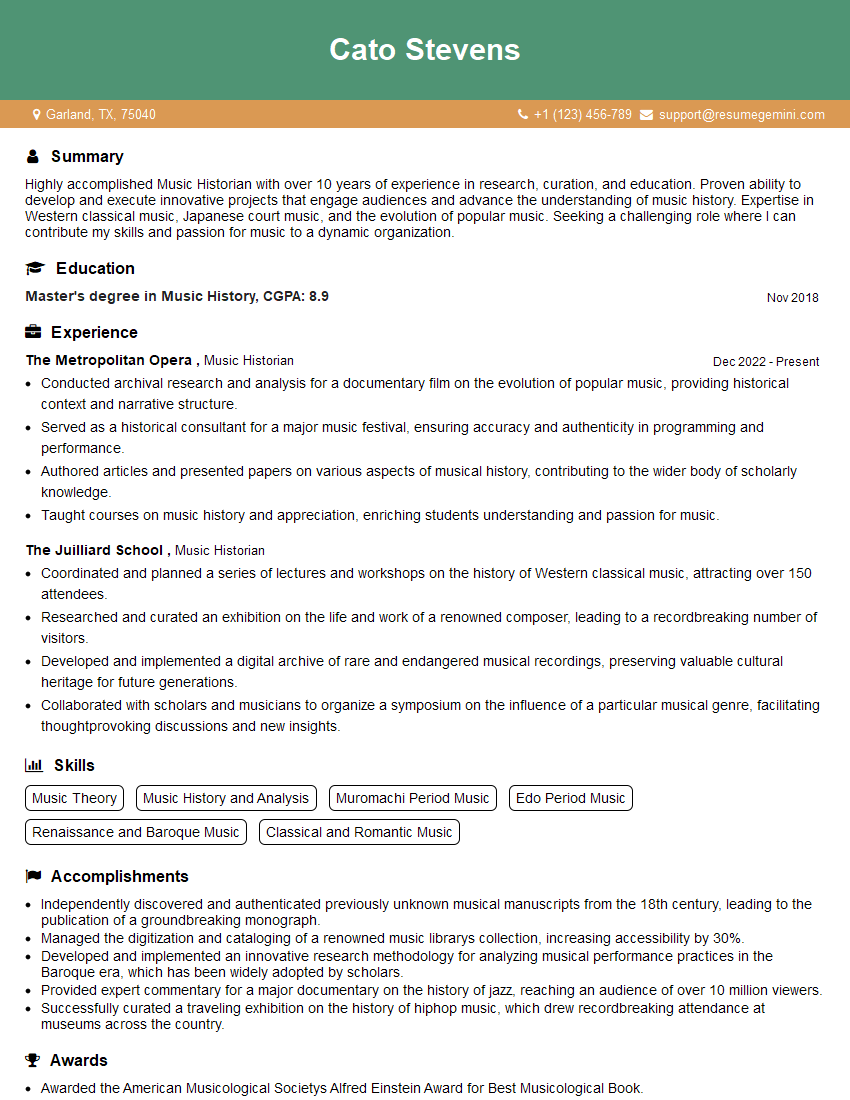
Music Historian Resume Sample
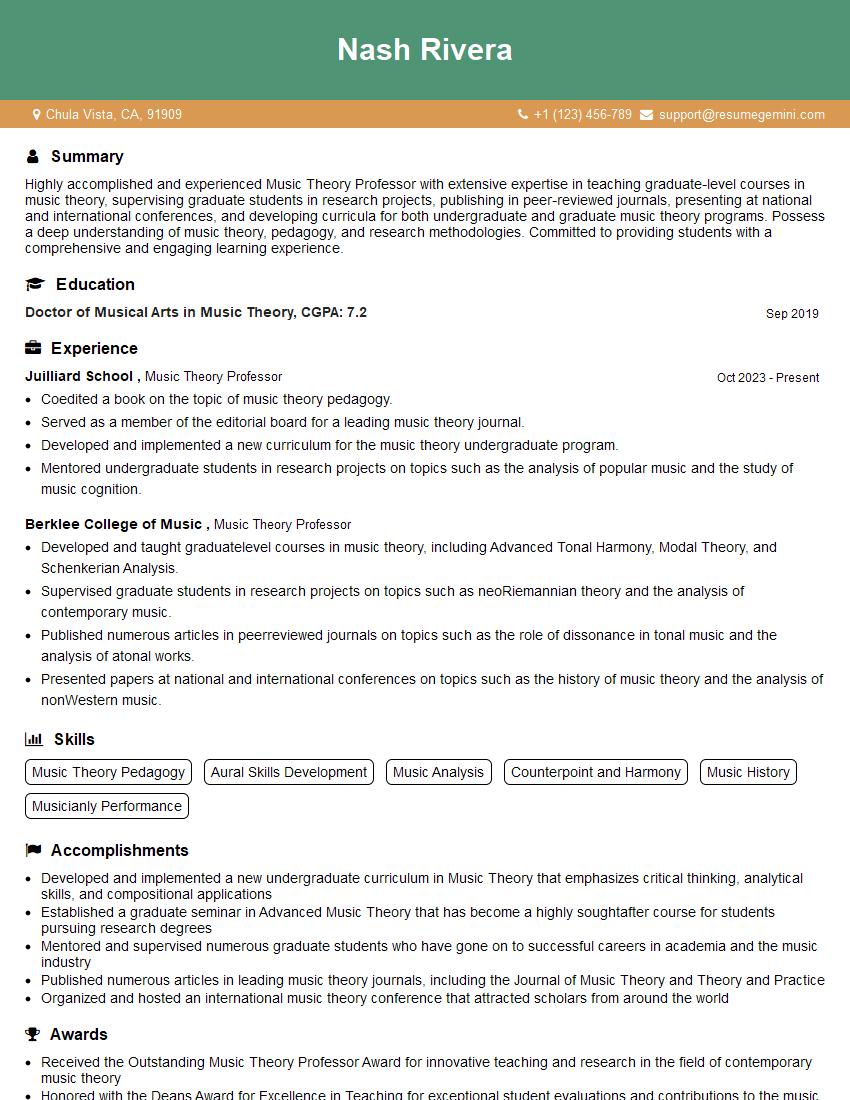
Music Theory Professor Resume Sample

Composition Instructor Resume Sample
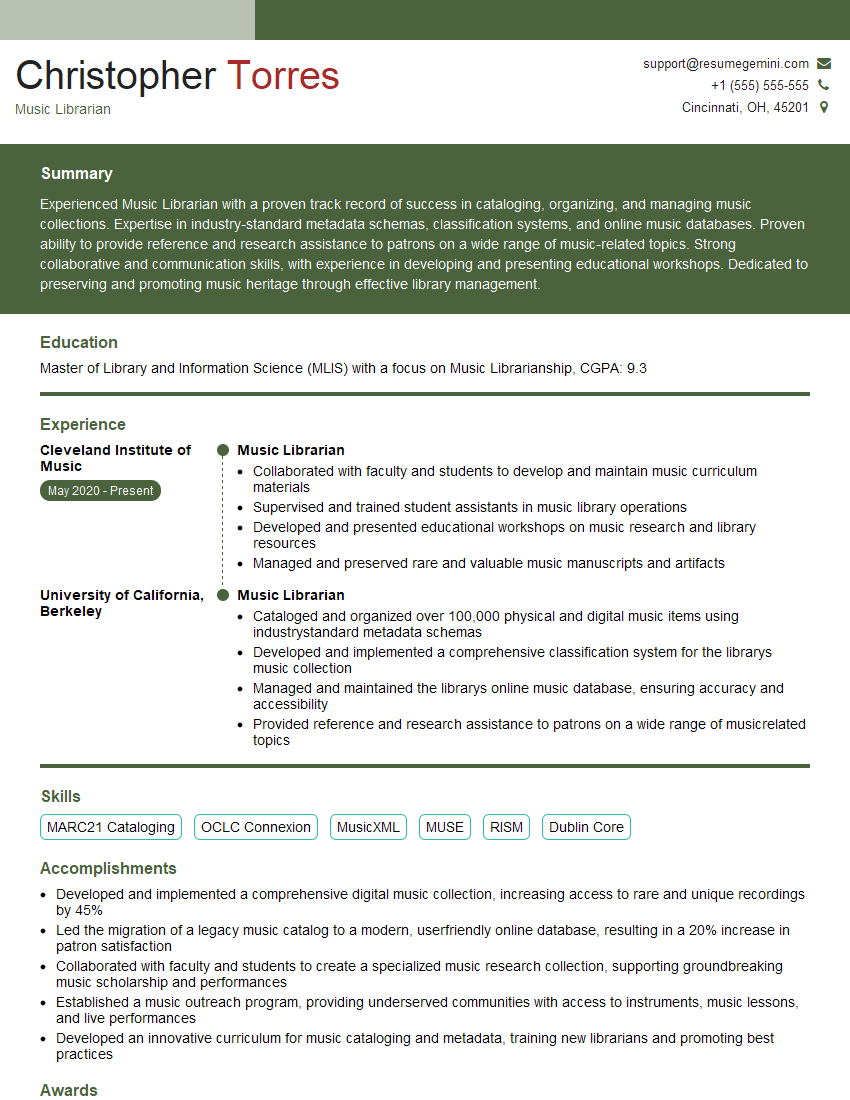
Music Librarian Resume Sample

Composer Resume Sample
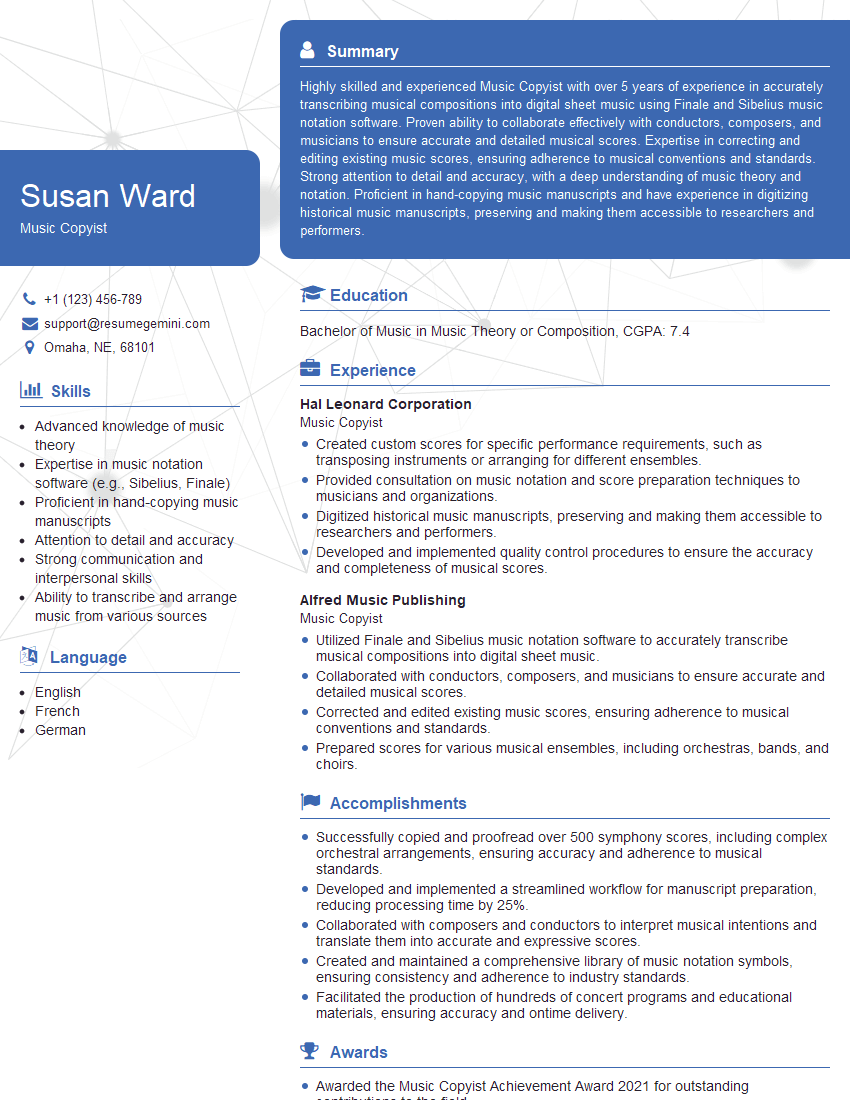
Music Copyist Resume Sample

Conductor Resume Sample
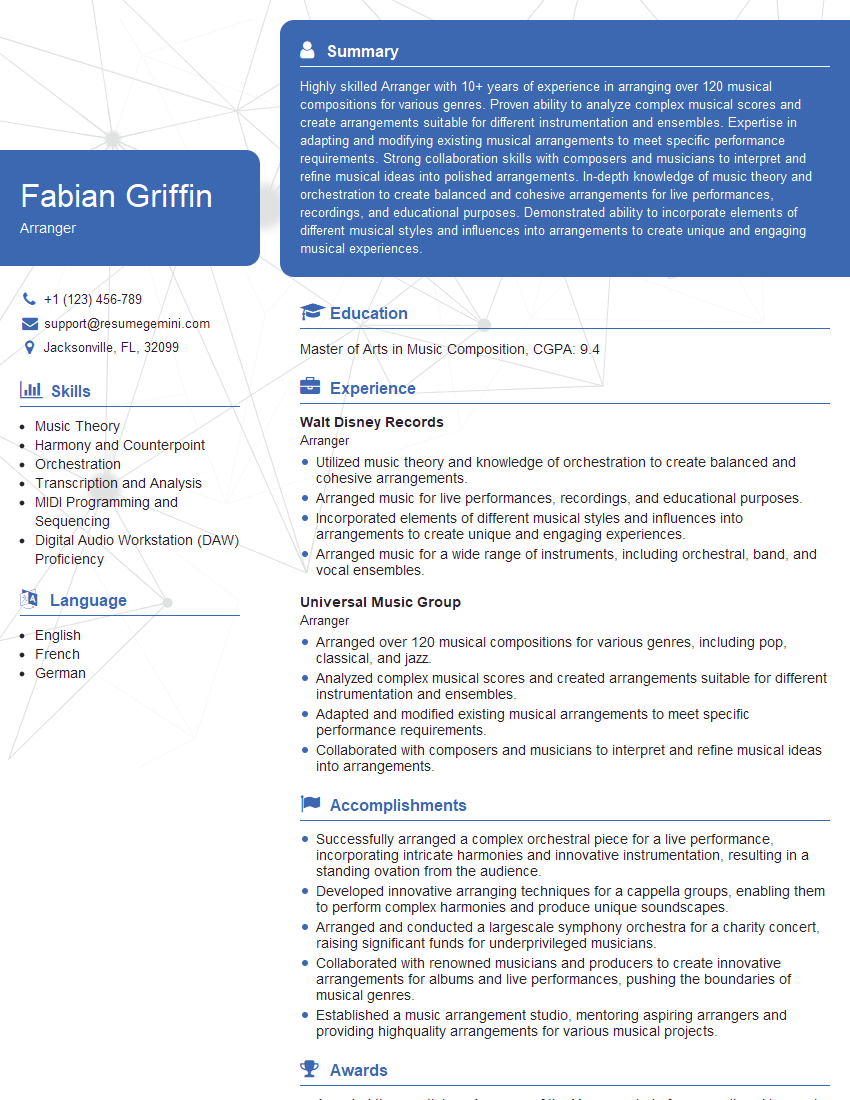
Arranger Resume Sample
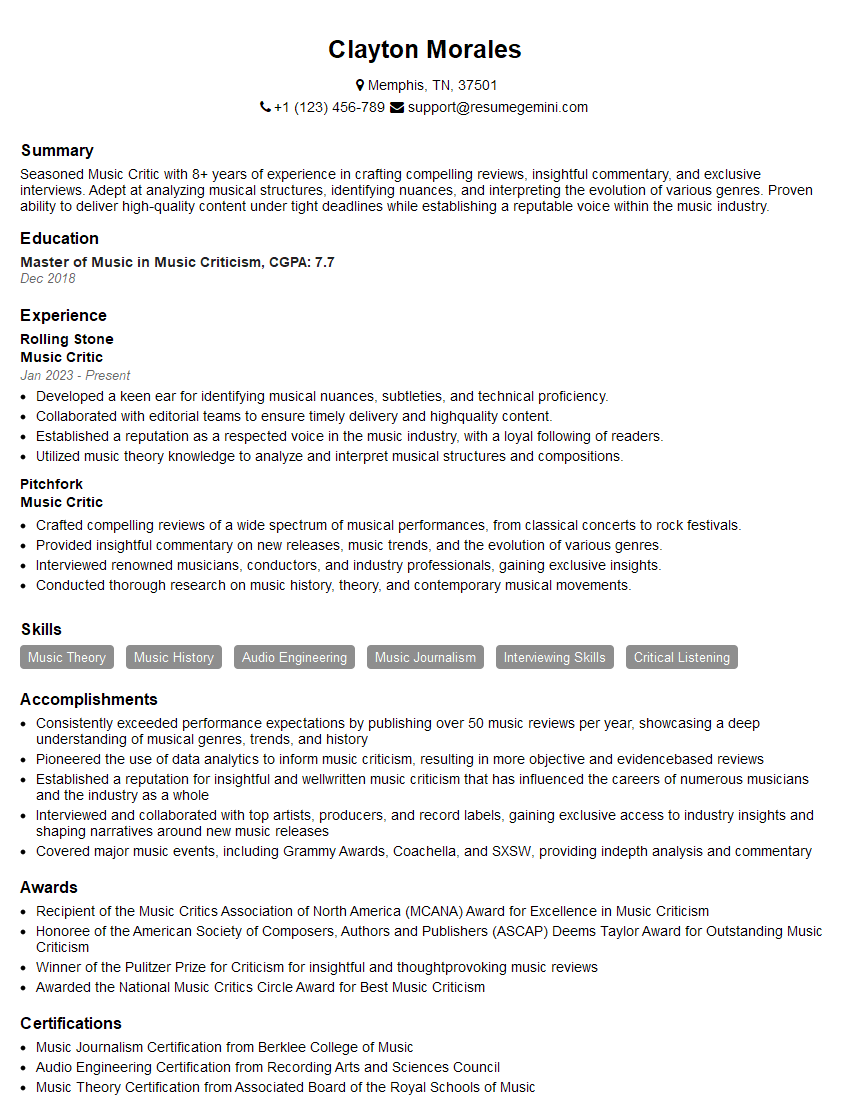
Music Critic Resume Sample
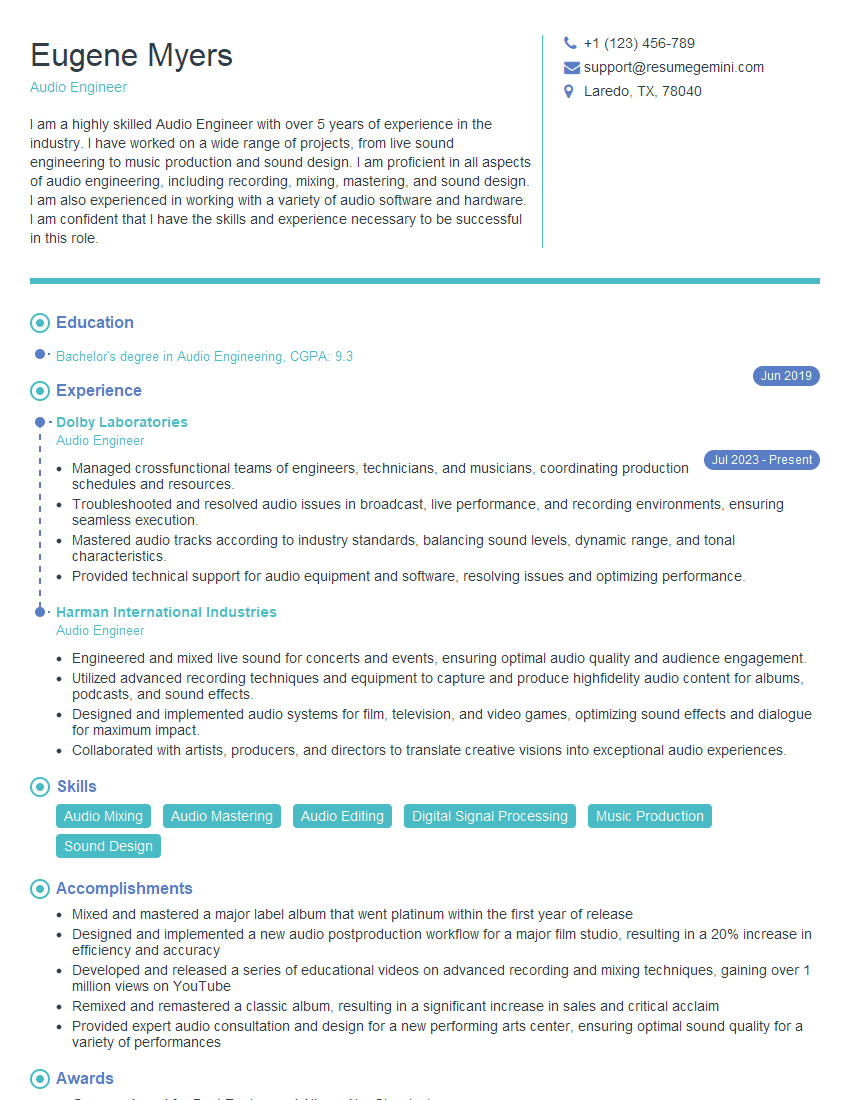
Audio Engineer Resume Sample
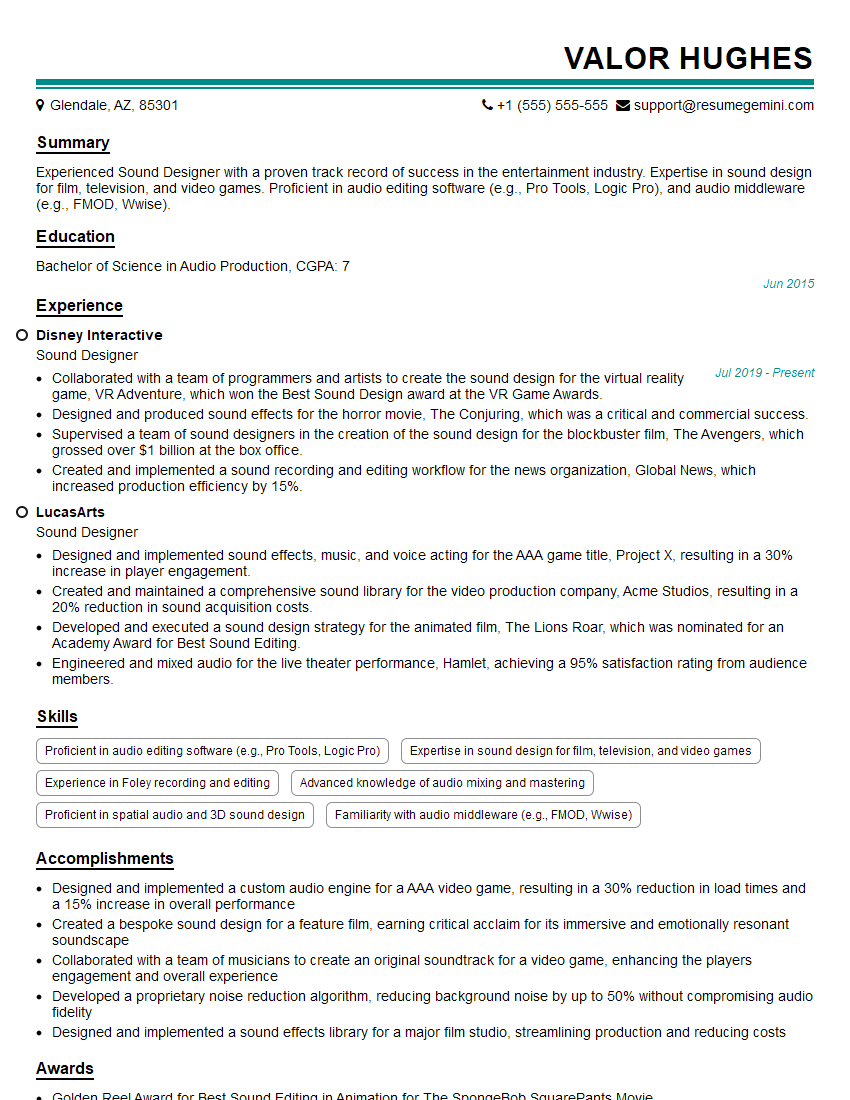
Sound Designer Resume Sample

Music Therapist Resume Sample
Explore more articles
Users Rating of Our Blogs
Share Your Experience
We value your feedback! Please rate our content and share your thoughts (optional).
What Readers Say About Our Blog
Very informative content, great job.
good