Feeling uncertain about what to expect in your upcoming interview? We’ve got you covered! This blog highlights the most important Energy Storage and Grid Integration interview questions and provides actionable advice to help you stand out as the ideal candidate. Let’s pave the way for your success.
Questions Asked in Energy Storage and Grid Integration Interview
Q 1. Explain the different types of energy storage technologies and their applications.
Energy storage technologies are broadly categorized based on their storage mechanism. Each technology boasts unique characteristics making it suitable for specific applications.
- Pumped Hydro Storage (PHS): This mature technology stores energy as potential energy by pumping water uphill to a reservoir. When energy is needed, the water flows downhill, turning turbines to generate electricity. It’s ideal for large-scale, long-duration storage, typically supporting grid stability. Think of it like a giant water tower, releasing water (energy) as needed.
- Batteries (Lithium-ion, Flow, etc.): Batteries store energy electrochemically. Lithium-ion batteries are dominant due to their high energy density and power density, suitable for various applications from electric vehicles to grid-scale storage. Flow batteries, on the other hand, excel in long-duration applications due to their modularity and scalability. They are like rechargeable power banks, but on a massive scale.
- Thermal Storage: This technology uses sensible or latent heat to store energy. Examples include molten salt storage used in concentrated solar power (CSP) plants. They’re particularly useful for dispatching solar energy even after sunset.
- Compressed Air Energy Storage (CAES): Air is compressed during off-peak hours and stored in underground caverns or other suitable containers. When energy is needed, the compressed air is released to drive turbines. It’s well-suited for long-duration storage and can be coupled with renewable sources like wind power.
- Flywheels: These store energy as rotational kinetic energy, similar to a spinning top. They offer fast response times and high power output, making them suitable for frequency regulation and short-duration grid support.
The choice of technology depends heavily on factors like cost, lifespan, power and energy density, response time, and the specific application requirements.
Q 2. Describe the challenges associated with integrating large-scale energy storage into the grid.
Integrating large-scale energy storage into the grid presents several significant challenges:
- Cost: The upfront capital costs of large energy storage systems are substantial, impacting overall project economics.
- Grid Integration Complexity: Integrating large storage systems requires sophisticated power electronics, control systems, and grid infrastructure upgrades to manage bidirectional power flows and ensure grid stability.
- Scalability and Reliability: Ensuring the reliability and safe operation of large numbers of interconnected storage systems is crucial for grid stability.
- Safety and Environmental Concerns: Safety considerations for battery storage systems, including thermal runaway and fire risks, need careful mitigation. Environmental impact, from manufacturing to disposal, is also important.
- Policy and Regulatory Frameworks: Clear policies, regulations, and market mechanisms that adequately value grid services provided by energy storage are needed to encourage investment.
- Lifecycle Management: Managing the lifecycle of storage systems, including maintenance, upgrades, and eventual replacement, poses logistical challenges.
Addressing these challenges requires coordinated efforts from technology developers, grid operators, policymakers, and researchers.
Q 3. How do you determine the optimal size and location of energy storage systems for grid support?
Determining the optimal size and location of energy storage systems involves a multifaceted analysis:
- Load Forecasting: Accurately forecasting energy demand and supply helps determine the required storage capacity to address peak demand or supply fluctuations.
- Renewable Energy Integration: If the primary goal is to integrate renewable energy sources, the size of the storage system should be sufficient to handle intermittency issues. For example, you need a larger system for regions with high wind or solar variability.
- Grid Modeling and Simulation: Power system simulations are used to assess how the storage system interacts with the grid under various conditions. This helps determine the optimal location for minimizing transmission losses and enhancing grid stability.
- Economic Analysis: A cost-benefit analysis, considering the costs of installation, operation, and maintenance, is critical. The potential revenue streams from providing grid services should be factored in. This often involves evaluating different scenarios (e.g., different sizes and locations).
- Siting Constraints: Practical limitations such as land availability, proximity to transmission lines, environmental impact concerns, and permitting requirements are all taken into account.
The process often involves iterative simulations and optimizations to find the best balance between cost, performance, and grid benefits. Software tools employing optimization algorithms are often used in this process.
Q 4. What are the key performance indicators (KPIs) for evaluating energy storage systems?
Key Performance Indicators (KPIs) for evaluating energy storage systems vary depending on the specific application but generally include:
- Round Trip Efficiency (RTE): The ratio of energy output to energy input over a complete charge-discharge cycle. A higher RTE indicates less energy loss.
- Cycle Life: The number of charge-discharge cycles the system can endure before its performance degrades significantly.
- Depth of Discharge (DOD): The percentage of the total stored energy that can be discharged before the system reaches its minimum operating voltage.
- State of Charge (SOC): The current level of energy stored in the system.
- Power Density: The amount of power that can be delivered per unit volume or weight.
- Energy Density: The amount of energy that can be stored per unit volume or weight.
- Response Time: The time it takes for the system to respond to a change in demand.
- Capital Cost and Levelized Cost of Storage (LCOS): These indicators provide crucial insight into the economic viability of the system.
Monitoring these KPIs is essential for ensuring the optimal performance and longevity of energy storage systems and for optimizing their operation to maximize efficiency and lifetime.
Q 5. Explain the role of battery management systems (BMS) in energy storage systems.
A Battery Management System (BMS) is crucial for safe and efficient operation of battery storage systems. It’s essentially the brain of the battery, monitoring and controlling various aspects of the system. Think of it as the car’s engine control unit, but for batteries.
- Cell Voltage Monitoring: The BMS continuously monitors the voltage of individual cells within the battery pack to ensure balanced operation and prevent overcharging or over-discharging.
- Temperature Monitoring: Maintaining optimal temperature is critical for battery performance and safety. The BMS monitors cell temperatures and activates cooling or heating systems as needed.
- State of Charge (SOC) Estimation: The BMS estimates the SOC based on voltage, current, and temperature measurements.
- Charge/Discharge Control: The BMS controls the charging and discharging process to optimize battery life and prevent damage.
- Cell Balancing: The BMS actively balances the state of charge of individual cells to ensure uniform operation and prevent premature aging.
- Safety Protection: The BMS incorporates various safety features, such as over-current protection, over-voltage protection, and short-circuit protection, to prevent damage or hazards.
A well-designed BMS significantly enhances the safety, reliability, and lifespan of battery storage systems.
Q 6. Discuss the different grid services that energy storage can provide.
Energy storage can provide various grid services that enhance grid reliability, efficiency, and integration of renewable energy:
- Frequency Regulation: Energy storage systems can quickly respond to fluctuations in electricity demand, providing fast frequency regulation to maintain grid stability.
- Voltage Support: They can help maintain voltage levels within acceptable limits, particularly in remote areas or during peak demand.
- Peak Shaving: Energy storage can reduce peak demand by charging during off-peak hours and discharging during peak hours, lowering stress on the grid and reducing the need for expensive peaking plants.
- Spinning Reserves/Operating Reserves: Storage can provide backup power instantaneously, ensuring a reliable supply during unexpected outages or sudden surges in demand.
- Black Start Capability: Some storage systems can provide the initial power needed to restart the grid after a major blackout.
- Renewable Energy Smoothing: Storage systems can mitigate the intermittency of renewable sources like solar and wind power, providing a more consistent power supply.
These grid services not only enhance grid reliability but also create revenue streams for storage owners through participation in various electricity markets.
Q 7. How do you model the behavior of energy storage systems in power system simulations?
Modeling energy storage systems in power system simulations requires capturing their dynamic behavior, including charging/discharging rates, energy capacity, efficiency, and control strategies.
Several approaches exist:
- Simplified Models: These models, often used in larger-scale simulations, represent the storage system with simplified equations that capture the essential characteristics, such as input-output power relationship and state of charge. For example, a simple model might use a first-order differential equation to describe the SOC.
- Detailed Models: These models incorporate a more detailed representation of the storage system, including the internal components, control system, and potential losses. They are typically used for more specific analysis, such as evaluating the impact of different control strategies or assessing the performance under various operating conditions. These may utilize more complex equations and might account for factors such as temperature dependencies.
- Component-Based Models: These modular models represent the storage system as a collection of interconnected components, such as the battery cells, inverters, and control system, each modeled independently and then integrated into a larger system simulation. This approach offers greater flexibility and accuracy.
Software packages such as PSS/E, PowerWorld Simulator, and DIgSILENT PowerFactory offer tools and models for simulating energy storage systems within the context of the broader power system. The choice of model depends on the simulation’s objective and the level of detail required.
For instance, a simplified model may suffice for assessing the overall impact of storage on grid frequency, while a detailed model would be necessary to optimize the control strategy of a large battery system.
Q 8. Explain the different control strategies for energy storage systems.
Energy storage system (ESS) control strategies dictate how the system charges, discharges, and interacts with the grid. The choice depends heavily on the ESS’s application and the grid’s needs. Common strategies include:
Frequency Regulation: ESSs rapidly respond to fluctuations in grid frequency, providing immediate balancing power. Think of it like a shock absorber for the grid, preventing voltage drops and blackouts. This typically uses a fast-acting control system with sophisticated algorithms to adjust power output in milliseconds.
Voltage Support: ESSs can regulate voltage levels at specific points on the grid, improving power quality. Imagine a traffic jam – the ESS helps maintain a smooth flow of electricity, preventing bottlenecks.
Peak Shaving/Shifting: ESSs charge during off-peak hours (when electricity is cheaper) and discharge during peak demand, reducing strain on the grid and lowering electricity costs for consumers. This is like filling a water tank overnight and using it during the day when you need more water.
Spinning Reserves: ESSs are kept ready to instantly inject power into the grid in case of a generator trip or other unexpected event. This is akin to a firefighter always standing by, ready to react in an emergency.
Black Start Capability: In some cases, ESSs can provide power to restart parts of the grid after a widespread outage. This is like having a backup generator, essential for restoring critical services.
Demand Charge Management: ESSs can help minimize electricity demand charges by smoothing out peak demand, thereby saving money for businesses and large consumers. Imagine negotiating your electricity bill like you would your phone bill, only paying for what you actually use.
Sophisticated control strategies often involve combinations of these approaches, employing advanced algorithms and machine learning to optimize system performance and maximize economic benefits. The specific control scheme is often modeled and simulated before implementation to ensure stability and safety.
Q 9. Describe the safety considerations associated with energy storage systems.
Safety is paramount in ESS deployment. Risks vary depending on the storage technology used (e.g., lithium-ion batteries, flow batteries, pumped hydro). Key safety considerations include:
Thermal Runaway: In lithium-ion batteries, a cascade of exothermic reactions can lead to overheating, fire, and even explosions. This risk is mitigated through sophisticated thermal management systems, including cooling systems, fire suppression, and early warning detection systems.
Electrical Hazards: High voltages and currents present significant shock and arc flash risks. Proper grounding, insulation, and safety protocols are crucial to protect personnel during installation, operation, and maintenance.
Chemical Hazards: Some battery chemistries use flammable or toxic materials. Proper handling, ventilation, and emergency response plans are essential to minimize environmental and health risks. For example, the release of toxic gases or electrolytes requires specialized cleanup protocols.
Mechanical Hazards: Certain storage technologies involve moving parts (e.g., pumped hydro) that can pose risks if not properly maintained and operated. Regular inspections and maintenance are critical to prevent failures and accidents.
System Integration: Incorrect integration of the ESS into the grid can lead to instability and hazards. Thorough design, testing, and compliance with relevant safety standards are necessary to ensure grid stability and safety.
Safety standards and regulations (e.g., UL, IEEE, IEC) provide guidelines for designing, installing, and operating ESSs safely. Adherence to these standards is vital for minimizing risks.
Q 10. What are the environmental impacts of energy storage technologies?
The environmental impact of energy storage technologies varies significantly depending on the technology used and its lifecycle. Several key considerations include:
Material Sourcing and Manufacturing: The extraction and processing of raw materials (e.g., lithium, cobalt) for battery production can have significant environmental impacts, including habitat destruction and pollution. Sustainable sourcing and responsible manufacturing practices are crucial to minimize these impacts. This includes considering the carbon footprint of the production process.
Operational Emissions: Some storage technologies have operational emissions (e.g., pumped hydro can impact water ecosystems). Others are essentially emission-free during operation.
End-of-Life Management: The disposal of spent batteries can pose significant environmental challenges due to the presence of hazardous materials. Recycling and reuse strategies are essential for mitigating these challenges. Responsible end-of-life management needs to be incorporated into the life-cycle assessment of energy storage technologies.
Land Use: Some technologies, like pumped hydro, require substantial land area, which can impact ecosystems and landscapes.
Life-cycle assessments (LCAs) are increasingly used to evaluate the overall environmental impact of different energy storage technologies, allowing for more informed decisions about technology selection and deployment strategies. The development of sustainable and environmentally friendly energy storage technologies is a crucial area of research and development.
Q 11. How do you address the issue of energy storage degradation over time?
Energy storage degradation is an inevitable challenge. Battery capacity and performance typically decline over time due to various factors, including temperature, depth of discharge, and charging/discharging cycles. Addressing this issue requires a multifaceted approach:
Careful System Design: Choosing appropriate battery chemistries and thermal management systems can significantly extend the lifespan of the storage system. For instance, using a battery management system (BMS) with sophisticated algorithms to optimize charging and discharging strategies is crucial.
Preventive Maintenance: Regular inspections, testing, and maintenance can help identify and address potential issues early on, preventing more severe degradation.
Advanced Control Algorithms: Sophisticated algorithms can optimize the operation of the ESS to minimize degradation. These algorithms might employ machine learning to predict and prevent damage.
Battery Recycling and Second-Life Applications: As batteries age, their performance declines, but they often retain considerable usable capacity. Recycling and repurposing them in less demanding applications (e.g., stationary storage) extends their lifespan and reduces environmental impact.
Predictive Maintenance Using Data Analytics: Using sensor data to monitor battery health and predict potential failures allows for proactive maintenance, optimizing lifespan and reducing unexpected downtime.
The development of new battery chemistries with inherently longer lifespans and improved resilience to degradation is also a critical area of ongoing research. This ongoing effort is critical for ensuring the long-term viability and economic feasibility of energy storage systems.
Q 12. What are the economic aspects of deploying energy storage systems?
The economic aspects of deploying ESSs are complex and depend on several factors, including the specific application, technology used, and market conditions. Key economic considerations include:
Capital Costs: The upfront investment in purchasing and installing ESSs can be substantial, varying significantly depending on the size and technology.
Operational Costs: These include maintenance, replacement, and energy losses during charging and discharging.
Revenue Streams: ESSs can generate revenue through various mechanisms, such as providing grid services (frequency regulation, peak shaving), arbitrage (buying and selling energy at different prices), and backup power provision. Revenue streams and the ability to monetize these services can be highly influential in an ESS’s economic viability.
Lifecycle Costs: A holistic analysis needs to consider all costs over the entire lifespan of the system, including replacement costs and potential salvage value.
Incentives and Policies: Government incentives, subsidies, and regulatory policies can significantly impact the economic viability of ESS projects. Understanding the available incentives is crucial for cost-benefit analysis.
A detailed economic analysis, including a thorough cost-benefit assessment, is essential for evaluating the financial feasibility of ESS projects. Factors like the length of the project’s operational life, interest rates, and inflation must all be factored into a complete financial model.
Q 13. Discuss the regulatory landscape surrounding energy storage deployment.
The regulatory landscape surrounding energy storage deployment is evolving rapidly, varying significantly by region and country. Key regulatory aspects include:
Interconnection Standards: Grid operators have specific requirements for connecting ESSs to the grid, addressing technical aspects like voltage and frequency stability. Navigating these interconnection procedures is essential for deploying energy storage successfully.
Safety Standards: ESSs must meet stringent safety standards to ensure safe operation and minimize risks (e.g., UL, IEEE, IEC standards).
Incentive Programs: Many jurisdictions offer incentives, such as tax credits or rebates, to encourage the deployment of ESSs. These programs may have specific eligibility criteria and application procedures.
Environmental Regulations: Regulations concerning the handling and disposal of battery materials, as well as environmental impact assessments, must be considered.
Permitting and Licensing: Obtaining the necessary permits and licenses can be a complex process, varying depending on location and project scale. Navigating this process requires compliance with all relevant regulations and acquiring the correct documentation.
Staying up-to-date on relevant regulations and policies is crucial for successful energy storage deployment. Collaboration with regulatory agencies and legal professionals is often necessary to ensure compliance.
Q 14. What are the cybersecurity challenges associated with energy storage systems?
Cybersecurity is a growing concern for ESSs, as they become increasingly sophisticated and interconnected. Potential threats include:
Data Breaches: Unauthorized access to ESS data could compromise operational parameters, potentially leading to malfunctions or even malicious attacks. This might expose sensitive operational data or compromise grid stability.
Remote Attacks: Hackers could remotely manipulate ESS control systems, causing malfunctions or disruptions. For instance, a cyberattack might lead to unintended charging or discharging, affecting grid stability or causing physical damage to the system.
Denial-of-Service Attacks: Attacks that overwhelm the system’s control capabilities, rendering it unusable.
Software Vulnerabilities: Flaws in the ESS’s software or firmware could be exploited by hackers.
Mitigating cybersecurity risks requires a multi-layered approach, including:
Robust Authentication and Access Control: Implementing strong passwords and multi-factor authentication to limit access to authorized personnel.
Network Security: Employing firewalls, intrusion detection systems, and other network security measures to protect the ESS from external threats.
Regular Software Updates: Ensuring that the ESS’s software and firmware are regularly updated to patch known vulnerabilities. Using encrypted communication protocols to protect sensitive data and control signals is also important.
Security Audits: Regular security audits to identify and address potential vulnerabilities.
Cybersecurity is a critical consideration in the design, deployment, and operation of modern energy storage systems. The increasing sophistication and network connectivity of these systems highlights the importance of proactive security measures.
Q 15. Explain the concept of frequency regulation using energy storage.
Frequency regulation is the process of maintaining the power system’s frequency at the nominal value (typically 50Hz or 60Hz). Energy storage systems (ESS) play a crucial role by rapidly responding to fluctuations in electricity supply and demand. When demand exceeds supply, the frequency drops. An ESS can quickly discharge power, injecting energy into the grid and preventing a widespread frequency drop, avoiding blackouts. Conversely, when supply exceeds demand, the frequency rises; the ESS can absorb this excess energy, charging up and preventing over-voltage issues. Think of it like a shock absorber for the power grid, smoothing out the bumps in energy supply and demand.
For example, a large-scale ESS like a battery farm can be pre-programmed to automatically respond to frequency deviations detected by grid operators. If the frequency dips below the threshold, the system will automatically discharge, injecting power within milliseconds. This fast response is critical for maintaining grid stability.
Career Expert Tips:
- Ace those interviews! Prepare effectively by reviewing the Top 50 Most Common Interview Questions on ResumeGemini.
- Navigate your job search with confidence! Explore a wide range of Career Tips on ResumeGemini. Learn about common challenges and recommendations to overcome them.
- Craft the perfect resume! Master the Art of Resume Writing with ResumeGemini’s guide. Showcase your unique qualifications and achievements effectively.
- Don’t miss out on holiday savings! Build your dream resume with ResumeGemini’s ATS optimized templates.
Q 16. How does energy storage contribute to grid stability?
Energy storage contributes significantly to grid stability in several ways. Firstly, as discussed above, it provides frequency regulation, preventing large frequency swings that can damage equipment or lead to cascading failures. Secondly, it enhances voltage support. Voltage fluctuations can also be detrimental to the grid; ESS can inject or absorb reactive power to maintain voltage within acceptable limits. Thirdly, it enhances power quality, filtering out disturbances like harmonics and sags. Finally, it offers spinning reserves, acting as a quick-response resource to cover unexpected generator outages or sudden changes in load.
Imagine a scenario where a large power plant trips offline unexpectedly. Without energy storage, this would cause a major frequency dip and possibly a blackout. However, with sufficient ESS capacity in place, the stored energy can seamlessly bridge the gap, preventing a widespread outage and giving time for other generators to ramp up or for demand-side management strategies to kick in.
Q 17. Discuss the role of energy storage in supporting renewable energy integration.
Renewable energy sources like solar and wind are intermittent; their output fluctuates based on weather conditions. Energy storage is essential for integrating these sources seamlessly into the grid. ESS smooths out the intermittency by storing excess energy generated during peak production periods (e.g., sunny midday for solar) and releasing it during periods of low production or high demand (e.g., evening or cloudy days). This ensures a continuous and reliable power supply even when renewables aren’t generating at their full potential.
For instance, a large wind farm can be coupled with a pumped hydro storage plant. During periods of high wind speeds, excess energy can be used to pump water uphill, storing potential energy. When wind speeds decrease, the water can be released, generating electricity to meet demand.
Q 18. Explain the concept of microgrids and the role of energy storage within them.
A microgrid is a localized electricity grid that can operate independently or be connected to the main grid. Energy storage is a critical component of a microgrid, enabling it to operate autonomously during grid outages. This enhances resilience and reliability. ESS in microgrids can provide backup power, frequency regulation, and voltage support, ensuring continuous electricity supply to critical loads even when disconnected from the main grid.
Consider a hospital or a data center powered by a microgrid. During a major grid failure, the microgrid’s ESS can provide uninterrupted power supply, ensuring the continued operation of essential equipment. This is crucial for maintaining critical services and preventing significant losses.
Q 19. Describe the different types of power converters used in energy storage systems.
Various power converters are employed in ESS to manage the flow of energy between the storage system and the grid. Common types include:
- DC-DC Converters: Used to regulate the voltage within the ESS itself, often between battery cells or modules.
- DC-AC Converters (Inverters): Convert the DC power from the storage system into AC power compatible with the grid. These are critical for grid connection.
- AC-DC Converters (Rectifiers): Convert AC power from the grid into DC power for charging the ESS.
- AC-AC Converters: Used for applications requiring voltage or frequency adjustments of the AC power, such as matching different grid frequencies.
The choice of converter depends on the type of energy storage technology used (batteries, pumped hydro, etc.) and the specific requirements of the application. Modern converters often incorporate advanced control algorithms to optimize energy efficiency and grid integration.
Q 20. How do you ensure the reliability and availability of energy storage systems?
Ensuring the reliability and availability of ESS requires a multi-faceted approach:
- Redundancy: Implementing backup systems, like redundant power converters and battery modules, to mitigate single points of failure.
- Regular Maintenance: Performing scheduled inspections, testing, and preventative maintenance to identify and address potential problems before they cause outages.
- Advanced Monitoring and Control Systems: Utilizing sophisticated monitoring systems to track the ESS’s performance in real-time, detecting anomalies and alerting operators to potential issues.
- Thermal Management: Implementing effective cooling systems to prevent overheating, a common cause of battery degradation and failure.
- Battery Management Systems (BMS): Employing sophisticated BMS to monitor individual cell voltages, temperatures, and state of charge, preventing overcharging, over-discharging, and cell imbalances.
Proactive monitoring and maintenance are key to maximizing the lifespan and reliability of ESS, minimizing downtime and ensuring consistent performance.
Q 21. Explain the different methods for forecasting energy storage needs.
Forecasting energy storage needs involves predicting future electricity demand and renewable generation patterns. Several methods are employed:
- Statistical Methods: Utilizing historical data on electricity consumption and renewable generation to develop statistical models that predict future trends.
- Machine Learning (ML): Employing ML algorithms to analyze vast datasets and identify complex patterns, providing more accurate and nuanced forecasts.
- Weather Forecasting: Integrating weather forecasts to predict the output of solar and wind power plants, crucial for determining energy storage requirements.
- Load Forecasting: Predicting electricity demand based on various factors such as time of day, day of the week, season, and economic activity.
- Hybrid Approaches: Combining different methods to leverage the strengths of each approach and improve forecast accuracy.
Accurate forecasting is vital for optimizing the size, capacity, and deployment of ESS, ensuring they meet future energy demands and contribute effectively to grid stability.
Q 22. What are the challenges associated with integrating different types of energy storage technologies?
Integrating diverse energy storage technologies presents several challenges. The primary hurdle lies in their inherent differences in chemistry, power output, energy density, lifespan, and charging/discharging characteristics. For instance, a lithium-ion battery system excels in fast response times and high power density, ideal for frequency regulation, while a pumped hydro storage (PHS) system offers large-scale energy storage capacity but slower response times, better suited for daily load balancing.
- Interoperability: Different storage systems may use varying communication protocols and control systems, making seamless integration complex. A standardized communication interface is crucial to ensure smooth data exchange and coordinated control across multiple storage technologies.
- Safety and Reliability: Combining systems with diverse safety profiles demands careful consideration of potential hazards. Each storage technology has unique safety concerns; for example, thermal runaway in lithium-ion batteries or potential dam failure in PHS. Robust safety protocols and redundancy mechanisms are crucial.
- Economic Optimization: Optimizing the combined performance of different storage systems requires advanced control algorithms capable of considering the specific characteristics and cost-effectiveness of each technology. The goal is to leverage the strengths of each system while minimizing overall operational costs.
- Scalability and Infrastructure: Expanding storage capacity by integrating multiple technologies necessitates careful planning of the infrastructure. This includes consideration of space requirements, grid connection points, and the capacity of the existing grid to handle the additional power flows.
Imagine trying to build a house with bricks, wood, and concrete without a plan – it’s chaotic! Similarly, integrating diverse storage without careful planning and standardization will result in inefficiency and risk.
Q 23. Discuss the importance of standardization in energy storage systems.
Standardization in energy storage systems is paramount for accelerating adoption, reducing costs, and ensuring safety and interoperability. Standardization efforts focus on several key aspects:
- Communication Protocols: Standardized communication protocols, like IEC 61850, enable seamless data exchange between storage systems and the grid management system (GMS). This facilitates effective control and monitoring of multiple storage assets.
- Safety Standards: Harmonized safety standards, such as those developed by UL and IEC, ensure the safety and reliability of energy storage systems across different manufacturers. These standards cover aspects like thermal management, overcharge/discharge protection, and fault detection.
- Interface Specifications: Standardized physical interfaces and connection methods simplify integration of storage systems with various grid components. This includes standardized physical connections, voltage levels, and communication protocols.
- Performance Metrics: Standardized methods for measuring and reporting key performance indicators (KPIs) such as energy efficiency, lifespan, and power output enable better comparison and selection of storage technologies.
Think of it like the standard USB port on your computer. Without it, each device would require a unique connector, leading to confusion and inconvenience. Standardization in energy storage streamlines integration and promotes wider adoption.
Q 24. How do you evaluate the lifetime costs of energy storage systems?
Evaluating the lifetime cost of an energy storage system (ESS) requires a holistic approach that considers both capital expenditure (CAPEX) and operational expenditure (OPEX) over the entire lifespan of the system.
- CAPEX: Includes the initial investment in hardware (batteries, inverters, power converters, balance of system components), installation, and commissioning costs.
- OPEX: Encompasses maintenance costs (preventive and corrective), replacement of components (batteries have a finite lifespan), energy losses during charging and discharging, and the cost of operations and management. This also factors in potential degradation of performance over time which is quantified through models that consider cycling, ambient temperature and other variables.
- Degradation Models: Sophisticated models and simulations are used to estimate the degradation of the energy storage system over time. These models often use historical data, battery chemistry characteristics, and operational conditions. The predicted degradation is then integrated into the financial model to better estimate future replacement costs.
- Levelized Cost of Storage (LCOS): A key metric used to compare the cost-effectiveness of different ESS technologies. LCOS normalizes the total cost of ownership over the system’s lifetime to a per-kWh or per-kW basis, thus facilitating fair comparisons across technologies.
A detailed financial model is built, incorporating these elements and discounted cash flow analysis (DCF) to account for the time value of money. Sensitivity analysis is often performed to evaluate the impact of uncertainties in various cost parameters on the overall LCOS.
Q 25. Explain the impact of energy storage on peak demand reduction.
Energy storage significantly reduces peak demand by shifting energy consumption from peak periods to off-peak hours. During times of low electricity demand (e.g., overnight), energy storage systems charge, storing energy for later use. When demand peaks (e.g., during the evening hours), the stored energy is discharged, reducing the load on the grid and mitigating the need for expensive peaking power plants.
For example, consider a scenario where a factory operates during the day and requires a significant amount of power. By using energy storage, the factory could charge its storage system during off-peak hours at a lower electricity price and then use the stored energy during the day to reduce its peak demand. This reduces the load on the grid during peak times which in turn reduces the need for more expensive power generation resources (such as gas turbines), minimizing strain on the infrastructure and leading to cost savings for both the end-user and the grid operator.
This peak shaving capability improves grid stability and reliability, and it reduces the overall cost of electricity. The reduced stress on the transmission and distribution infrastructure minimizes the need for costly grid upgrades.
Q 26. Describe different energy storage system architectures.
Energy storage system architectures vary widely depending on the application and scale. Here are some key architectural patterns:
- Centralized Architecture: A large-scale energy storage system located at a central point, often connected to a substation or transmission line. This is suitable for large-scale grid-level applications.
- Decentralized Architecture: Multiple smaller energy storage systems distributed across the grid. This can be at the distribution level, near load centers, or even integrated into individual buildings. This approach offers improved resilience and reduces the impact of single-point failures.
- Hybrid Architecture: Combining different types of energy storage technologies within a single system to leverage the advantages of each. For example, a system might combine high-power lithium-ion batteries with long-duration pumped hydro storage.
- Front-of-the-meter (FTM): Energy storage systems connected to the grid upstream of the meter, often serving grid-level services like frequency regulation and peak shaving.
- Behind-the-meter (BTM): Energy storage systems connected downstream of the meter, serving customer-specific applications like backup power, demand charge reduction, and self-consumption of renewable energy.
The choice of architecture depends on factors such as the scale of the application, the desired functionalities, grid infrastructure constraints, and economic considerations.
Q 27. What are the future trends in energy storage technology?
Future trends in energy storage technology are driven by the need for higher energy density, longer lifespan, lower cost, improved safety, and enhanced sustainability.
- Advancements in Battery Chemistry: Research and development focusing on next-generation battery technologies, such as solid-state batteries, lithium-sulfur batteries, and flow batteries, aim to improve energy density, reduce costs, and enhance safety.
- Improved Energy Management Systems (EMS): Sophisticated EMS algorithms will be crucial for optimizing the operation of large-scale energy storage systems, including efficient control, state-of-health monitoring, and predictive maintenance.
- Integration of AI and Machine Learning: Artificial intelligence and machine learning techniques will play an increasing role in optimizing energy storage operation, predicting battery degradation, and improving grid stability.
- Increased focus on Sustainability: The entire lifecycle sustainability of energy storage systems, including responsible sourcing of materials, recycling of components, and environmental impact reduction, will receive greater attention.
- Grid-Forming Inverters: The use of grid-forming inverters to integrate renewable energy and storage resources in a more seamless way is gaining traction. Grid-forming inverters enhance grid stability and resilience.
These advancements promise a future where energy storage plays an even more pivotal role in enabling a cleaner, more reliable, and efficient energy system.
Q 28. How do you assess the suitability of an energy storage system for a given application?
Assessing the suitability of an energy storage system for a specific application requires a systematic evaluation process that considers several key factors:
- Application Requirements: Define the specific needs of the application, including required power and energy capacity, response time, duration of discharge, and desired functionalities (e.g., frequency regulation, peak shaving, backup power).
- Technology Selection: Evaluate different energy storage technologies based on their characteristics and suitability for the specific application requirements. Consider factors like energy density, power density, lifespan, cost, safety, and environmental impact.
- Economic Analysis: Conduct a comprehensive economic analysis including a life-cycle cost assessment (LCCA), considering CAPEX, OPEX, and potential revenue streams (e.g., grid services).
- Grid Integration Considerations: Analyze the technical feasibility of integrating the chosen storage system with the existing grid infrastructure. Evaluate potential impacts on grid stability, voltage regulation, and protection systems.
- Regulatory Compliance: Ensure that the chosen system meets all relevant safety, environmental, and grid codes and standards.
- Risk Assessment: Conduct a thorough risk assessment to identify potential hazards and develop mitigation strategies.
This holistic approach ensures the selected ESS not only meets the operational requirements but also delivers long-term value and adheres to all regulatory and safety standards. Think of it like choosing the right tool for a job – a hammer is not suitable for screwing a screw. Similarly, the right energy storage technology must be selected based on the specific application needs.
Key Topics to Learn for Energy Storage and Grid Integration Interview
- Battery Technologies: Understand the characteristics, applications, and limitations of various battery chemistries (Li-ion, Flow, etc.), including their suitability for grid-scale applications.
- Power Electronics and Converters: Master the fundamentals of power electronics, focusing on inverters, rectifiers, and DC-DC converters used in energy storage systems and their integration with the grid.
- Grid Integration Challenges and Solutions: Explore the technical challenges associated with integrating energy storage into the power grid, such as frequency regulation, voltage support, and ancillary services. Learn about solutions and control strategies.
- Energy Storage System (ESS) Design and Modeling: Familiarize yourself with the components of an ESS (battery, inverter, control system, safety systems) and understand how to model and simulate ESS performance.
- Grid Codes and Standards: Understand the relevant grid codes and standards that govern the connection and operation of ESS within various grid systems.
- Renewable Energy Integration: Explore the synergistic relationship between energy storage and renewable energy sources (solar, wind) and their impact on grid stability and reliability.
- Economic and Policy Aspects: Gain a basic understanding of the economic and policy drivers behind the growth of energy storage and grid integration, including market structures and regulatory frameworks.
- Cybersecurity and Reliability: Discuss the importance of cybersecurity in protecting energy storage systems and the strategies to ensure the reliability and resilience of integrated energy storage solutions.
- Case Studies and Practical Applications: Review real-world examples of successful energy storage and grid integration projects to understand practical applications and challenges faced.
- Problem-Solving and Analytical Skills: Practice problem-solving approaches related to energy storage system design, optimization, and control.
Next Steps
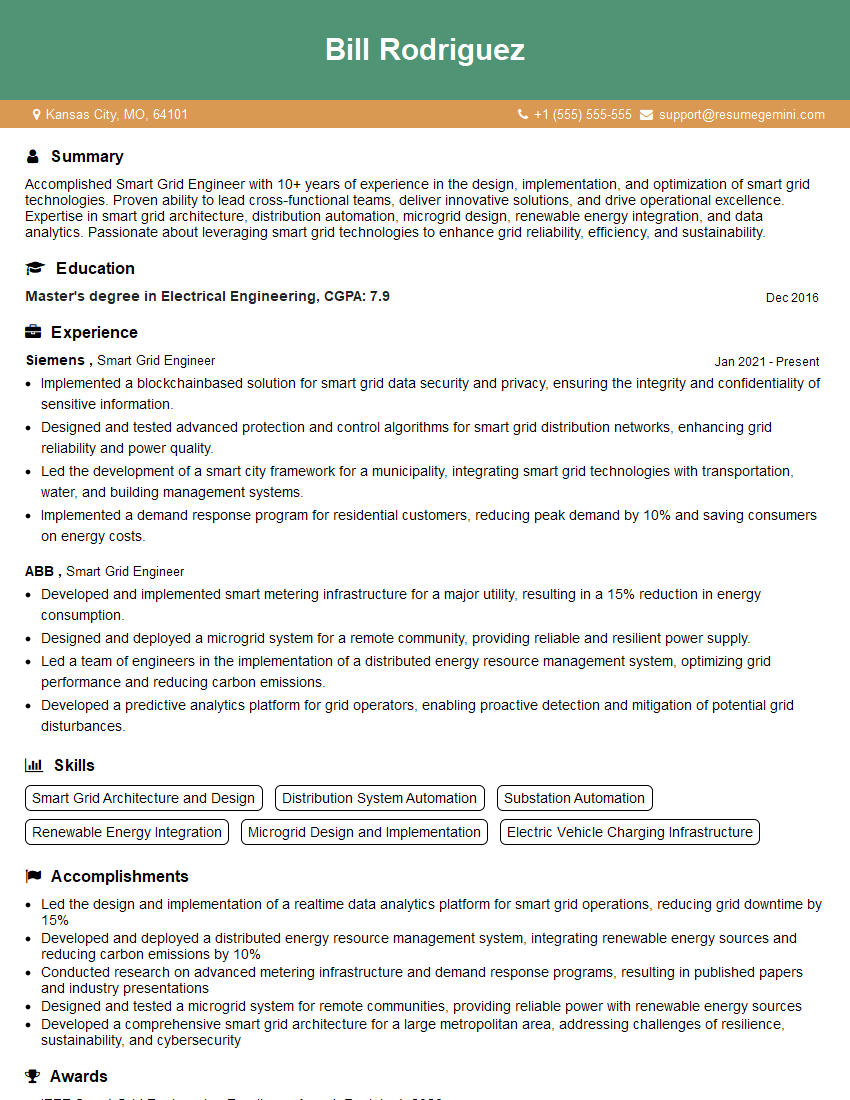
Mastering Energy Storage and Grid Integration opens doors to exciting and impactful careers in a rapidly growing field. To maximize your job prospects, focus on creating an ATS-friendly resume that highlights your skills and experience effectively. ResumeGemini is a trusted resource to help you build a professional and impactful resume. We provide examples of resumes tailored to Energy Storage and Grid Integration to give you a head start. Let ResumeGemini help you showcase your expertise and land your dream job!
Explore more articles
Users Rating of Our Blogs
Share Your Experience
We value your feedback! Please rate our content and share your thoughts (optional).
What Readers Say About Our Blog
Very informative content, great job.
good