Cracking a skill-specific interview, like one for Aerial Rope, requires understanding the nuances of the role. In this blog, we present the questions you’re most likely to encounter, along with insights into how to answer them effectively. Let’s ensure you’re ready to make a strong impression.
Questions Asked in Aerial Rope Interview
Q 1. Describe the different types of rope used in aerial rope access.
Rope selection in aerial rope access is critical for safety and efficiency. The type of rope used depends on factors like the work environment, load requirements, and the specific technique employed. Common rope types include:
- Kernmantle ropes: These are the most common type, featuring a core (kern) surrounded by a protective sheath (mantle). The core bears the majority of the load, while the mantle provides abrasion resistance. Different kernmantle ropes have varying strengths and diameters, suitable for various applications and loads.
- Static ropes: These ropes have minimal stretch, making them ideal for situations requiring precise positioning, like setting up anchor points. Their low elasticity ensures minimal movement under load, enhancing safety.
- Dynamic ropes: Designed for climbing and rappelling, these ropes have a higher degree of stretch. This elasticity helps absorb shock loads during falls, significantly reducing the impact forces on the climber.
- Synthetic fiber ropes: Typically made from materials like nylon, polyester, or aramid, these offer a high strength-to-weight ratio, making them suitable for aerial work. They are generally more resistant to moisture than natural fiber ropes.
Choosing the right rope is not simply about strength; it also considers factors like abrasion resistance, UV resistance, and the rope’s handling characteristics. For instance, a rope used in a harsh, abrasive environment requires a more durable mantle than one used in a clean, controlled setting.
Q 2. Explain the importance of pre-use inspection of rope and equipment.
Pre-use inspection is paramount in aerial rope access. It’s the cornerstone of safety and prevents accidents caused by equipment failure. Before each use, a thorough visual inspection is mandatory. This involves checking for:
- Wear and tear: Look for cuts, abrasions, fraying, or any damage to the sheath or core.
- Kinks and knots: These can significantly weaken the rope and should be avoided.
- Melting or burning: Signs of heat damage indicate potential structural compromise.
- Stiffness or unusual softness: These can indicate damage to the internal structure.
- Proper connection of components: Ensure all carabiners, descenders, and other equipment are correctly connected and secured.
Any doubt about the rope’s integrity necessitates immediate replacement. Remember, working at heights demands uncompromising safety standards. A simple visual inspection can prevent potentially fatal consequences.
Regular inspections, beyond pre-use checks, are also crucial for extending the rope’s lifespan and maintaining its strength. These regular checks, potentially involving more detailed testing, help predict potential issues before they become safety hazards.
Q 3. What are the key components of a safe rope access system?
A safe rope access system is more than just ropes and harnesses; it’s a carefully integrated system. Key components include:
- Anchor points: These are the foundation of the system. They need to be structurally sound and capable of supporting the combined weight of the worker, equipment, and any additional loads. Rigorous checks are essential to ensure the anchor’s integrity.
- Ropes: Appropriate selection of ropes is paramount (as discussed previously), considering static vs. dynamic characteristics, diameter, and material.
- Harness: A properly fitted and inspected harness is crucial for ensuring the worker’s safety. Regular checks should be part of the standard operating procedure.
- Descenders and ascenders: These devices facilitate controlled descent and ascent, enabling efficient and safe movement along the rope.
- Backup systems: Redundancy is essential. A secondary safety line or backup system is crucial to prevent falls in case of primary system failure.
- Communication devices: Clear communication is vital in a rope access team, especially in remote locations or challenging environments. Radios or other communication tools are therefore essential.
A complete and meticulously inspected system reduces potential hazards and promotes safer working practices.
Q 4. Outline the procedures for setting up an anchor point.
Setting up an anchor point is a critical step requiring careful planning and execution. It must be strong enough to support the combined weight of all workers and equipment. The procedure typically involves:
- Site assessment: Identify potential anchor points, considering structural integrity, load capacity, and accessibility.
- Anchor selection: Choose a suitable anchor point, like a strong beam, structural member, or purpose-built anchor.
- Inspection: Thoroughly inspect the chosen anchor point for any signs of damage or weakness.
- Attachment: Securely attach the anchor point using appropriate hardware (e.g., shackles, carabiners, and eye bolts) and ensure multiple points of redundancy where possible.
- Load testing: Apply a test load (exceeding the expected working load) to verify the anchor’s strength and integrity before any work commences.
- Documentation: Document all steps involved, including the type of anchor, attachment method, and load testing results.
Remember, a properly set up anchor point is the foundation of a safe rope access operation. Compromising on this step can have serious consequences.
Q 5. Describe different techniques for ascending and descending ropes.
Ascending and descending ropes involve specialized techniques for safety and efficiency. Common techniques include:
- Ascending:
- Foot ascenders: These clamp onto the rope allowing the climber to ascend efficiently by using their feet and hands.
- Hand ascenders: These ascenders are typically used in conjunction with foot ascenders, providing a secure grip and extra control during ascent.
- Prusik knots: These friction knots allow controlled ascent, offering a simpler alternative to mechanical ascenders.
- Descending:
- Rappelling devices: These devices such as descenders (ATC, 8, etc.) provide controlled descent. Proper technique and regular inspection are crucial for safe operation.
- Controlled descent using friction knots (e.g., Munter hitch): While providing a simpler alternative to mechanical descenders, this requires a high degree of skill and understanding of friction mechanics.
Each technique requires proper training and understanding. Improper technique can lead to serious accidents, emphasizing the importance of thorough training and practice.
Q 6. How do you manage risks associated with working at heights?
Managing risks associated with working at heights requires a multi-layered approach involving planning, execution, and post-operation analysis. Key risk management strategies include:
- Risk assessment: Identifying and evaluating potential hazards associated with the job site.
- Permit-to-work systems: Implementing a formal process for authorizing work, ensuring all safety measures are in place.
- Fall protection systems: Utilizing fall arrest systems, backup lines, and redundant safety measures.
- Equipment inspection: Regular inspection and maintenance of all equipment (ropes, harnesses, descenders, etc.).
- Training and competency: Ensuring all personnel are adequately trained and competent in rope access techniques and safety procedures.
- Emergency procedures: Developing and practicing emergency rescue plans and procedures.
- Weather monitoring: Postponing work if weather conditions pose a safety risk.
Risk management is an ongoing process, requiring constant vigilance and a commitment to safety. It’s not just about following procedures; it’s about a culture of safety ingrained in every aspect of the operation.
Q 7. Explain the importance of communication in a rope access team.
Effective communication is the lifeline of a rope access team. Miscommunication can have catastrophic consequences. Clear communication ensures everyone is aware of the task, potential hazards, and any changes in the plan. Effective communication strategies include:
- Pre-task briefings: A thorough briefing before commencing any work, discussing the task, potential hazards, safety measures, and communication protocols.
- Clear hand signals: Established hand signals for communicating while working at heights, especially when verbal communication is difficult.
- Radio communication: Using radios to maintain communication between team members, particularly in challenging environments.
- Post-task debriefings: Reviewing the operation after completion to identify lessons learned and areas for improvement.
- Designated communication roles: Assigning specific communication responsibilities to team members to ensure clear communication lines.
A strong communication culture within the team fosters trust and reduces the risk of accidents. Remember, clear communication is not just about words; it’s about ensuring every team member is on the same page, both literally and figuratively.
Q 8. What are the emergency procedures in case of a fall?
Emergency procedures following a fall in aerial rope access hinge on swift action and effective communication. The primary goal is to stabilize the situation and prevent further injury.
- Immediate Actions: The first responder should immediately assess the casualty’s condition, providing first aid if needed. Communication is crucial; a second person should contact emergency services and relay the precise location and nature of the incident.
- Rescue Operations: Depending on the severity and location of the fall, a rescue may involve a simple self-rescue (if the casualty is capable) or a complex, multi-person operation involving specialized equipment and techniques. This may require lowering the casualty using a secondary rope system, or employing a rescue system like a ‘Z’ rig or other appropriate method.
- Post-Incident Procedures: After the casualty is safely retrieved, detailed documentation of the event is essential, including a thorough accident report. This report should include a description of the circumstances leading to the fall, the equipment used, and any contributing factors. This information is vital for accident prevention.
During training, we practice various scenarios, including simulated falls, to ensure we’re prepared for any situation. For instance, we’ve practiced rescuing a colleague from a simulated fall using a variety of rescue techniques, emphasizing both speed and safety. This constant practice keeps our skills sharp and enhances our response time.
Q 9. How do you perform a self-rescue?
Self-rescue is a critical skill in aerial rope access, allowing an individual to extricate themselves from a precarious situation without external assistance. This often involves using redundant systems – employing a backup line or device if the primary system fails. The exact method depends on the nature of the situation and the equipment used.
- Assessment: First, assess the situation. Identify the problem (e.g., jammed ascender, rope entanglement) and identify a safe escape path.
- Equipment Check: Check the functionality of all your equipment. If possible, use your backup system. If the primary system is intact and manageable, that is generally the preferred method.
- Systematic Approach: Methodically address the problem. If it’s a jammed ascender, try to clear the blockage. If entangled, carefully untangle the rope. If the primary rope is compromised, initiate a transition to the backup system following established procedures.
- Controlled Descent: Once the issue is addressed, proceed with a controlled descent, maintaining three points of contact at all times.
I once had to perform a self-rescue after my ascender became jammed during an inspection. By carefully removing debris from the ascender mechanism while maintaining a secure grip on the rope, I successfully cleared the jam and continued the descent safely. This emphasizes the importance of regular equipment checks and the understanding of proper self-rescue techniques.
Q 10. Describe your experience with different types of ascenders and descenders.
My experience encompasses a wide range of ascenders and descenders, each with its strengths and weaknesses. I’m proficient with various models, including friction-based devices like the Petzl I’D and the DMM Pivot, and cam-based ascenders such as the Petzl Ascender. For descenders, I’ve used the Petzl Rig and the DMM Phantom, among others.
- Friction-Based Devices: These are generally versatile, suitable for a range of rope diameters and offering a high degree of control. They rely on friction to regulate movement, making them inherently safer in the case of system failure.
- Cam-Based Ascenders: These offer a faster ascent compared to friction-based ascenders. They rely on a cam mechanism to grip the rope and are very efficient for shorter ascents. However, they require careful handling to avoid slippage.
- Descenders: The choice of descender depends on the application. Some offer assisted braking for controlled descents, while others provide greater speed but require more expertise. Understanding the specifications and limitations of each device is crucial.
For example, the Petzl I’D’s braking system offers a high degree of control during descents, making it ideal for less experienced technicians, while the DMM Phantom allows for faster descents but requires a more experienced technician proficient in its handling. The best choice depends on the specific task and the individual’s skill level.
Q 11. What are the limitations of rope access techniques?
Rope access techniques, while highly versatile, have inherent limitations. These limitations must be carefully considered before undertaking any rope access operation.
- Weather Conditions: High winds, heavy rain, and extreme temperatures can significantly impact safety and operational efficiency, often necessitating a work stoppage.
- Accessibility: Rope access isn’t suitable for every situation. Limited access points or complex structural features can hinder operations. For instance, very tight spaces may restrict the use of certain equipment.
- Rope Degradation: Ropes degrade over time due to UV exposure, abrasion, and chemical exposure. Regular inspection and replacement are crucial to mitigate risks associated with rope failure.
- Human Factors: Fatigue, lack of training, and improper technique can lead to accidents. Strict adherence to safety protocols and regular competency assessments are necessary.
For instance, while rope access excels in inspecting tall structures, its use might be limited during a severe thunderstorm due to the risk of lightning strikes. This highlights the importance of performing a thorough risk assessment before commencing any operation.
Q 12. How do you select appropriate personal protective equipment (PPE)?
Selecting appropriate PPE is paramount in ensuring worker safety. The selection process should be based on a comprehensive risk assessment, identifying the specific hazards associated with the task.
- Helmet: A correctly fitting hard hat is essential to protect against falling objects.
- Harness: A full-body harness conforming to relevant safety standards should be selected, ensuring a secure and comfortable fit.
- Gloves: Gloves should provide protection against cuts, abrasions, and chemical exposure, based on the materials being handled.
- Fall Protection Devices: This includes ascenders, descenders, and appropriate carabiners, selected based on rope diameter and expected loads.
- Other PPE: Depending on the task, additional PPE might be required, such as eye protection, respiratory protection, and high-visibility clothing.
For example, when working with abrasive materials, I would select cut-resistant gloves. If working at night, I would use high-visibility clothing to enhance visibility. The key is to always select PPE designed to mitigate the specific hazards of the task at hand.
Q 13. What are the legal and regulatory requirements for working at height?
Legal and regulatory requirements for working at height vary depending on location. However, common principles include adherence to national or regional standards (e.g., OSHA in the US, Work at Height Regulations in the UK).
- Risk Assessments: A thorough risk assessment must be conducted before any work at height commences, identifying potential hazards and implementing control measures.
- Competency Training: Workers must receive appropriate training and certification, demonstrating competency in rope access techniques and the safe use of equipment. Regular refresher training is essential.
- Equipment Inspection: All equipment must undergo regular inspections to ensure it’s in good working order and meets safety standards. This involves visual inspections and load testing where appropriate.
- Permit-to-Work Systems: Permit-to-work systems are often required for high-risk tasks, ensuring that all necessary precautions are in place before work begins.
Ignoring these legal requirements can lead to serious consequences, including fines, legal action, and even criminal charges in cases of injury or fatality. Regular updates on the regulations are vital to maintain compliance.
Q 14. Explain the concept of redundancy in rope access systems.
Redundancy in rope access systems refers to incorporating backup systems or components to mitigate the risk of equipment failure. This is a critical aspect of safety, ensuring that if one system fails, a secondary system is in place to prevent a fall.
- Independent Systems: Redundancy often involves having two completely separate rope systems, with each capable of supporting the worker’s weight. This ensures that if one rope fails, the other can safely support the worker.
- Backup Devices: Using redundant devices, such as a second ascender or descender, provides a backup if the primary device malfunctions.
- Anchor Points: Selecting multiple, independent anchor points further enhances redundancy. If one anchor point fails, the others can provide continued support.
Imagine a scenario where a primary ascender fails. If a secondary ascender is in place, the worker can continue ascending using the backup device, preventing a potential fall. This redundancy is fundamental to the safe practice of aerial rope access. Every precaution is necessary to mitigate risks and prevent falls.
Q 15. How do you manage environmental factors (e.g., wind, rain) during rope access operations?
Managing environmental factors in aerial rope access is paramount to safety. Wind, rain, and even temperature fluctuations significantly impact rope performance and worker safety. We use a multi-pronged approach:
- Wind Assessment: Before commencing any operation, we meticulously assess wind speed and direction. High winds can cause significant sway and instability. We often use anemometers for precise measurements and will postpone operations if wind speeds exceed safe working limits, which are specified in our risk assessments and are dependent on the specific task and location.
- Rain and Wet Conditions: Rain reduces friction between the rope and the anchor points, increasing the risk of slippage. We use techniques like specialized, water-resistant gloves and ensure all our equipment is inspected for wear and tear, paying close attention to areas that might absorb and retain water. We might also employ techniques like using backup ropes or adjusting our working methods depending on the severity of the rain.
- Temperature Considerations: Extreme temperatures (both hot and cold) can affect rope strength and flexibility. In extreme cold, ropes can become brittle and prone to snapping; in extreme heat, they can weaken. We carefully choose ropes rated for the specific temperature range and always monitor the condition of the ropes.
- Risk Assessment and Mitigation: A comprehensive risk assessment is performed before every operation, identifying potential hazards related to environmental factors and outlining appropriate control measures. This includes contingency plans for unexpected weather changes.
For instance, during a recent inspection of a tall structure, we faced unexpectedly high winds. Our pre-planned risk assessment allowed us to immediately halt operations and reschedule the task for a day with more favorable weather conditions. This prevented a potentially dangerous situation.
Career Expert Tips:
- Ace those interviews! Prepare effectively by reviewing the Top 50 Most Common Interview Questions on ResumeGemini.
- Navigate your job search with confidence! Explore a wide range of Career Tips on ResumeGemini. Learn about common challenges and recommendations to overcome them.
- Craft the perfect resume! Master the Art of Resume Writing with ResumeGemini’s guide. Showcase your unique qualifications and achievements effectively.
- Don’t miss out on holiday savings! Build your dream resume with ResumeGemini’s ATS optimized templates.
Q 16. Describe your experience with different types of knots used in rope access.
Knot tying is fundamental to rope access. I’m proficient in various knots, each suited to specific applications. My experience includes:
- Figure-eight knot: Used primarily as a stopper knot to prevent the rope from running through a device, ensuring a secure attachment.
- Bowline: A strong, reliable loop that doesn’t tighten under load, perfect for creating anchor points or attaching equipment.
- Clove hitch: A quick and easy knot often used for attaching a rope to a ring or other object, though it’s essential to secure it with a backup knot.
- Prusik knot: A friction knot used for ascending and descending ropes, crucial for self-rescue scenarios and efficient movement during operations.
- Overhand knot and its variations: This fundamental knot forms the basis for many more complex knots, and mastery of it is essential. Understanding how different variations affect its strength and how to avoid accidental slippage is vital.
I regularly practice knot tying to maintain proficiency and ensure consistent accuracy. Each knot is inspected meticulously before use. It’s not enough to just know the knots; you have to understand their limitations and how they behave under different stresses.
Q 17. How do you ensure the integrity of your rope and equipment after use?
Maintaining rope and equipment integrity is critical. After each use, a thorough inspection and cleaning process is followed:
- Visual Inspection: A careful visual inspection checks for any signs of wear, abrasion, cuts, or damage, including fraying and discoloration. We pay special attention to areas subjected to high friction or stress.
- Cleaning: Ropes are thoroughly cleaned to remove dirt, debris, and any chemical residue which can weaken the fibers. We use appropriate cleaning methods specific to the rope material.
- Storage: Ropes are stored in a cool, dry, and clean environment, away from direct sunlight and sources of heat, in order to prolong their lifespan and prevent damage.
- Regular Testing and Maintenance: Ropes undergo regular testing and inspections in line with industry standards and manufacturer recommendations. This may include strength testing and a careful examination of any stitching or terminations. We meticulously record all inspections and testing.
- Retirement Policy: Ropes are retired from service if they show signs of degradation, reach their service life limit, or have been involved in an incident that could have compromised their structural integrity, even if no visible damage is apparent.
We use a detailed inspection checklist to ensure consistency and to prevent overlooking any potential problems. This rigorous approach safeguards worker safety and prevents costly failures in the field.
Q 18. What are the signs of rope degradation?
Recognizing signs of rope degradation is crucial for preventing accidents. Key indicators include:
- Abrasions and Cuts: These weaken the rope structure and can lead to unexpected failure.
- Fraying or Fuzziness: This indicates the individual fibers are breaking down, reducing strength.
- Discoloration: Significant changes in color, often associated with chemical exposure or UV degradation, can signal weakening.
- Stiffness or Brittleness: Loss of flexibility is a sign of degradation, particularly noticeable in cold weather.
- Melting or Burning: Evidence of melting or burning points to exposure to excessive heat.
- Knot slippage: If a previously tied knot starts to slip, this shows that the rope is losing its ability to hold tension effectively.
Even minor signs of degradation are cause for concern and justify removal of the rope from service. Ignoring these signs can have catastrophic consequences. We’re trained to carefully examine ropes for these signs during our pre-operation and post-operation checks.
Q 19. How do you calculate safe working loads for ropes and equipment?
Calculating safe working loads (SWL) is essential for ensuring worker safety. SWL is not a single number but is determined by several factors:
- Rope Manufacturer Specifications: We always start with the manufacturer’s stated SWL for the specific rope type and diameter. This is often found on the rope itself or its accompanying documentation.
- Environmental Factors: Weather conditions, such as temperature and humidity, can impact rope strength, reducing the effective SWL. We apply appropriate derating factors based on environmental conditions.
- Type of Anchor: The strength of the anchor point and its ability to withstand the load is crucial. The SWL is limited by the weakest link in the system – the rope, the anchor, the hardware, etc.
- Number of Ropes: When using multiple ropes for redundancy, the SWL of the system is determined by the SWL of the weakest individual rope. They do not simply add together.
- Safety Factors: We apply a safety factor, typically 5:1 or 10:1 depending on the risk associated with the operation. This means that the actual load on the rope should never exceed one-fifth or one-tenth of the rope’s rated strength.
For example, if a rope has a manufacturer’s SWL of 2000 lbs and we use a 5:1 safety factor, the actual load on the rope should never exceed 400 lbs. Detailed calculations are documented in every job’s risk assessment.
Q 20. Describe your experience working with different types of anchors.
My experience encompasses a wide range of anchor types, each with its strengths and limitations:
- Structural Anchors: These are fixed points within a structure, such as beams, columns, or embedded anchors. We carefully assess their structural integrity before use, ensuring they can withstand the required load. Proper inspections are vital.
- Natural Anchors: These utilize natural features such as sturdy trees or rock formations. Their stability is carefully assessed and factors such as soil conditions, root systems (for trees) and potential rock falls are always considered and mitigated.
- Mobile Anchors: These include specialized equipment, such as roof anchors, which are temporarily installed on structures. Proper installation and verification of load capacity are paramount.
- Expansion Anchors: These are mechanically driven anchors typically used in concrete. The design of the anchor and the type of concrete must be correctly chosen for the application and load.
Choosing the right anchor is critical. Improper anchor selection can lead to catastrophic failure. Each anchor point is meticulously inspected and tested before use, and appropriate documentation is maintained. The type of anchor used is dictated by the specifics of the job and carefully outlined in the risk assessment.
Q 21. Explain your understanding of different rescue techniques.
My rescue technique knowledge extends to various scenarios and includes:
- Self-Rescue: This is the most crucial technique. I’m proficient in using Prusik knots and other friction hitches to ascend or descend a rope in case of equipment malfunction or other emergencies. Regular practice is essential for maintaining this skill.
- Assisted Rescue: This involves rescuing a colleague. Techniques may include using additional ropes, pulleys, and specialized equipment to safely retrieve the affected worker. This requires excellent communication and teamwork.
- Emergency Evacuation: Plans for emergency evacuation are meticulously created for each task. This might involve lowering a person or using other appropriate rescue systems depending on the location and the nature of the emergency.
- Technical Rescue: This encompasses specialized rescue procedures for complex situations, often requiring additional training and specialized equipment and may involve external rescue teams.
We participate in regular training and drills to ensure we’re prepared for any eventuality. Rescue techniques are not just theoretical; they require constant practice and refinement to maintain proficiency.
Q 22. How do you maintain a professional demeanor in potentially hazardous situations?
Maintaining a professional demeanor in hazardous situations is paramount. It’s about projecting calm confidence, even under pressure, to ensure team safety and operational efficiency. This involves a multi-pronged approach:
- Thorough preparation: Before any operation, I meticulously review the job site, assess potential hazards, and plan contingencies. This proactive approach minimizes surprises and reduces stress.
- Clear communication: I maintain clear, concise communication with my team throughout the operation. This includes pre-job briefings, regular status updates, and immediate reporting of any issues. Think of it like a well-oiled machine; each part needs to know its role and communicate effectively.
- Risk assessment and mitigation: I don’t shy away from identifying potential hazards. Instead, I actively participate in risk assessment, implementing appropriate mitigation strategies before we even begin. This might involve extra safety lines, adjusting techniques, or delaying work until conditions are safer.
- Emotional regulation: In stressful situations, I consciously manage my emotions. This involves deep breathing exercises, positive self-talk, and focusing on the task at hand. Maintaining a calm demeanor reduces anxiety for myself and the team.
- Leading by example: I consistently demonstrate safe practices and adhere to all safety protocols. My actions serve as a role model for my colleagues, reinforcing the importance of safety.
For instance, during a high-angle inspection, a sudden strong gust of wind caused some swaying. Instead of panicking, I calmly signaled for a pause, reassessed the situation, and communicated the adjustment to the team before continuing. My calm response ensured everyone remained focused and safe.
Q 23. Describe your experience working in confined spaces using rope access.
I have extensive experience working in confined spaces using rope access techniques. This often involves inspecting and maintaining infrastructure within chimneys, tanks, or other structures where traditional access methods are impractical or impossible. Key aspects of my experience include:
- Confined space entry procedures: I’m proficient in following all relevant confined space entry protocols, including atmospheric monitoring, ventilation, and rescue planning. Safety is paramount.
- Specialized equipment: I’m adept at utilizing specialized rope access equipment designed for confined space work, including smaller diameter ropes, compact rigging systems, and personal protective equipment (PPE) optimized for limited space.
- Space awareness: Working in confined spaces necessitates heightened awareness of spatial limitations. I am meticulous in planning my movements and ensuring I have sufficient clearance to avoid collisions.
- Communication limitations: Communication in confined spaces can be challenging. I use clear hand signals and pre-arranged communication plans to maintain clear contact with my team members and ground personnel.
- Rescue planning: We always have detailed rescue plans in place, including methods for extraction in case of equipment failure or emergency.
For example, I recently conducted an inspection inside a large industrial chimney. The confined space presented challenges in terms of limited visibility and maneuvering room. By carefully planning my movements and utilizing appropriate equipment, I safely completed the inspection and identified crucial maintenance needs.
Q 24. How do you handle unexpected equipment failure during an operation?
Equipment failure is an inherent risk in aerial rope access. My response is based on a structured approach:
- Immediate assessment: The first step is to immediately assess the nature and severity of the equipment failure. This involves determining the affected component, the extent of the damage, and any potential safety implications.
- Emergency procedures: Based on the assessment, I immediately implement relevant emergency procedures. This could involve securing the position, using backup equipment, or initiating a controlled descent. Safety is always the top priority.
- Communication: I immediately communicate the situation to my team and ground support, ensuring clear and concise information about the problem and the actions being taken.
- Problem solving: I work with my team to assess potential solutions to the equipment failure. This may involve temporarily fixing the issue, replacing the damaged component, or changing the work strategy to minimize reliance on the faulty equipment.
- Documentation: I thoroughly document the incident, including the cause of the failure, the steps taken to address it, and any lessons learned. This helps prevent similar incidents in the future.
During one project, a carbine lock unexpectedly malfunctioned during a descent. I immediately activated my backup system, communicated the situation to my team, and safely descended. Post-incident investigation revealed the faulty component, preventing a recurrence.
Q 25. What are the limitations of your experience with aerial rope access?
While my experience in aerial rope access is extensive, certain limitations exist:
- Specific environment limitations: My experience primarily focuses on industrial and infrastructure applications. My experience with specialized environments, such as heavily forested areas or extremely cold climates, is less extensive.
- Equipment specialization: While proficient with a wide range of equipment, my expertise with specific, highly specialized equipment may be limited. I readily acknowledge this and would engage experts if necessary.
- Scale of operations: My experience mainly involves projects of moderate scale. Larger, more complex operations requiring extensive coordination may require additional support and experience.
- Rescue scenarios: While I have rescue training, my experience with complex high-angle rescue scenarios is limited to simulations and training exercises. The actual execution always involves careful planning and teamwork.
I always prioritize safety and openly communicate any limitations to ensure the project is undertaken appropriately and with necessary expertise.
Q 26. Describe a time you had to adapt your techniques due to unexpected circumstances.
During a window washing project on a high-rise building, unexpected strong winds caused significant swaying. Our planned approach, using a specific anchor point, became unsafe. I immediately adapted by:
- Re-assessing the situation: We immediately stopped work and reassessed the wind conditions and their impact on the safety of our approach.
- Identifying alternative techniques: We decided to temporarily suspend work in the most exposed areas and utilize alternative anchor points on the building to reduce the risk.
- Modifying the work plan: We revised our work plan to accommodate the changing weather conditions, prioritizing safety over schedule.
- Communicating changes: We clearly communicated the altered plan and safety measures to the entire team and project management.
By quickly adapting to the unexpected circumstances and prioritizing safety, we successfully completed the project without incident, demonstrating flexibility and problem-solving skills.
Q 27. How do you stay up-to-date with the latest safety standards and regulations?
Staying current with safety standards and regulations is crucial in our field. I actively maintain my knowledge through several methods:
- Professional memberships: I’m a member of relevant professional organizations that provide updates on industry best practices and regulations.
- Industry publications: I regularly read trade publications and journals that cover advancements in safety technology and regulatory changes.
- Training courses: I actively participate in continuing education courses and workshops to stay abreast of the latest techniques and safety standards. This includes both manufacturer-specific training and general industry-wide updates.
- Networking: I regularly network with other rope access professionals to share information and stay informed about current industry trends and best practices.
- Regulatory websites: I regularly check the websites of relevant regulatory bodies for updates on regulations and compliance requirements.
This ongoing commitment ensures that my practices remain aligned with the latest safety protocols and legal requirements, maximizing safety and operational effectiveness.
Q 28. Describe your experience with rope access training and certifications.
My rope access training and certifications reflect a commitment to safety and professional standards. I hold the following certifications:
- IRATA Level 3: This certification demonstrates my competency in advanced rope access techniques and rescue procedures. This is a globally recognized standard.
- Confined Space Entry Certification: This certification reflects my training and expertise in working safely in confined spaces, including atmospheric monitoring and rescue procedures.
- First Aid and CPR Certification: Essential for immediate response in emergency situations.
- [Insert any other relevant certifications]: Mention any other specific certifications, for instance, those related to working at height, specific equipment, etc.
My training has encompassed both theoretical knowledge and extensive hands-on practical experience under the supervision of qualified instructors. I continually update my certifications to reflect the latest industry standards.
Key Topics to Learn for Aerial Rope Interview
- Rope Systems and Mechanics: Understanding different rope types, their strengths, weaknesses, and appropriate applications in aerial work. This includes knowledge of knot tying, rigging techniques, and load calculations.
- Safety Regulations and Procedures: Familiarity with relevant safety standards, regulations, and best practices for working at heights. This includes understanding fall protection systems, emergency procedures, and risk assessment methodologies.
- Aerial Work Techniques: Proficiency in various aerial rope access techniques, including ascending, descending, traversing, and anchoring. Practical experience and understanding of different equipment usage is crucial.
- Problem-Solving and Troubleshooting: Ability to identify and resolve potential problems related to equipment malfunctions, environmental factors, and unforeseen challenges during aerial operations. This includes quick thinking and decisive action in high-pressure situations.
- Communication and Teamwork: Effective communication skills are vital for coordinating with colleagues and ensuring safety within a team environment. Demonstrate understanding of the importance of clear communication during aerial tasks.
- Maintenance and Inspection: Knowledge of proper inspection procedures for ropes, harnesses, and other equipment to ensure optimal safety and performance. This includes understanding wear and tear patterns and appropriate replacement cycles.
Next Steps
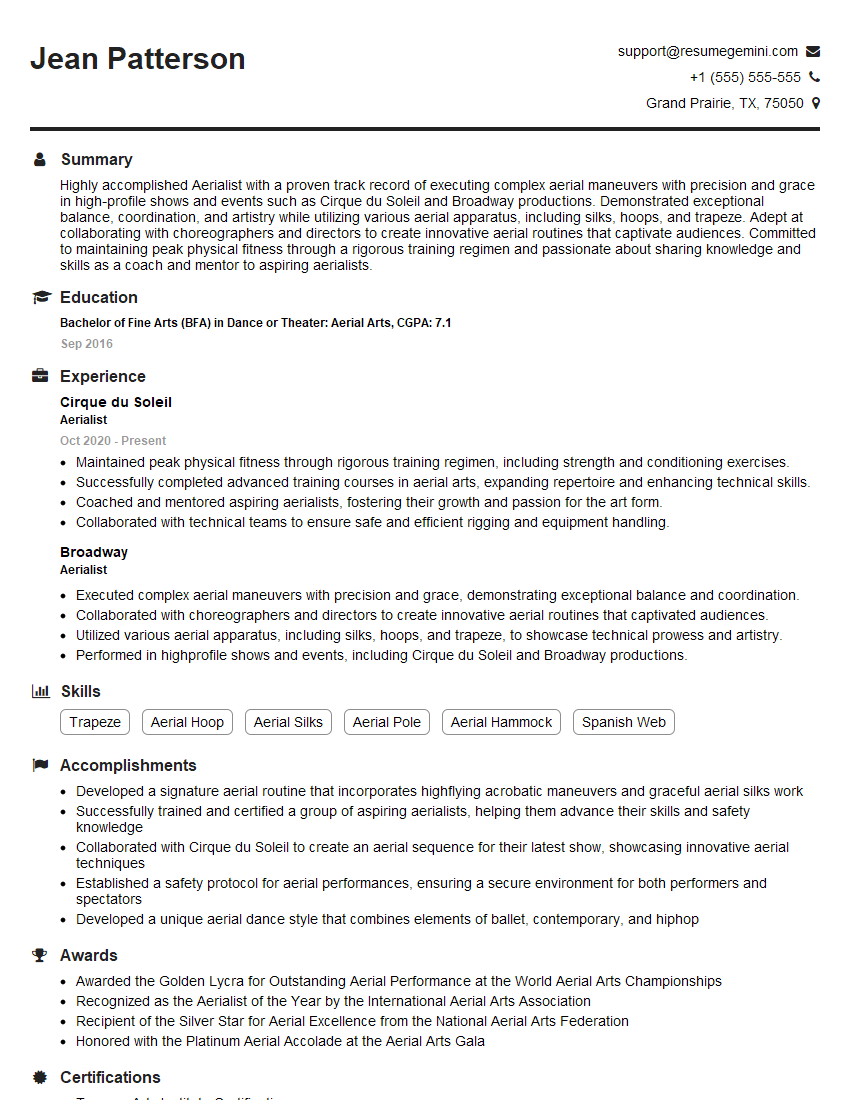
Mastering aerial rope techniques opens doors to exciting career opportunities in various sectors, offering rewarding challenges and strong earning potential. To maximize your job prospects, it’s essential to present your skills and experience effectively through a well-crafted, ATS-friendly resume. ResumeGemini is a trusted resource that can help you build a professional resume tailored to highlight your qualifications for aerial rope positions. Examples of resumes specifically tailored to the Aerial Rope industry are available to help guide your resume creation.
Explore more articles
Users Rating of Our Blogs
Share Your Experience
We value your feedback! Please rate our content and share your thoughts (optional).
What Readers Say About Our Blog
Very informative content, great job.
good