Preparation is the key to success in any interview. In this post, we’ll explore crucial Aerial Surveillance interview questions and equip you with strategies to craft impactful answers. Whether you’re a beginner or a pro, these tips will elevate your preparation.
Questions Asked in Aerial Surveillance Interview
Q 1. Explain the different types of aerial surveillance platforms.
Aerial surveillance platforms are diverse, each offering unique capabilities. They range from small, commercially available Unmanned Aerial Vehicles (UAVs), often called drones, to large, sophisticated manned aircraft.
- Unmanned Aerial Vehicles (UAVs/Drones): These are widely used for their affordability, maneuverability, and ease of deployment in various scenarios, from infrastructure inspection to search and rescue. Different sizes and capabilities exist, from small quadcopters to larger fixed-wing aircraft.
- Manned Aircraft: These include helicopters, fixed-wing airplanes, and even blimps. Helicopters offer excellent hovering capabilities for precise surveillance, while fixed-wing aircraft provide longer endurance and wider coverage areas. Blimps offer persistent surveillance with a unique vantage point.
- High-Altitude Long-Endurance (HALE) platforms: These are specialized aircraft designed for extended missions, often at high altitudes. They provide a broad surveillance area but with limited maneuverability.
- Satellites: While not strictly ‘aerial’, satellites are important for wide-area surveillance, offering a global perspective and regular coverage, albeit with potential latency issues.
The choice of platform depends heavily on mission parameters such as required altitude, coverage area, endurance, payload capacity, and budget.
Q 2. Describe your experience with various sensor payloads (e.g., thermal, optical, LiDAR).
My experience encompasses a wide range of sensor payloads. I’ve worked extensively with:
- Optical Sensors (RGB cameras): These provide high-resolution visual imagery, ideal for detailed observation of objects and events. We often use these for identifying features, damage assessment, and documenting evidence.
- Thermal Sensors (Infrared cameras): These detect heat signatures, enabling surveillance in low-light or complete darkness. This is incredibly useful for locating people, animals, or detecting heat sources that might indicate malfunctions in equipment or potential threats.
- LiDAR (Light Detection and Ranging): This technology uses laser pulses to create precise 3D models of the terrain and objects. I’ve utilized LiDAR for creating detailed maps, measuring the volume of materials, and inspecting infrastructure for damage. For example, in one project, we used LiDAR to create a detailed 3D model of a damaged bridge to assess the extent of the damage before repair.
The selection of sensor payloads is crucial for mission success and depends heavily on the specific objectives of the surveillance operation.
Q 3. What are the legal and regulatory considerations for operating UAVs?
Operating UAVs involves significant legal and regulatory considerations. These vary by country and region but generally include:
- Registration and Licensing: UAVs usually require registration with the relevant aviation authorities. Operators often need to obtain specific licenses or permits based on the type of UAV and the intended operation.
- Flight Restrictions: Specific airspace restrictions exist, such as no-fly zones around airports, critical infrastructure, and populated areas. These are crucial for safety and security.
- Privacy Concerns: Surveillance operations must adhere to strict privacy regulations to protect the rights of individuals. Obtaining necessary permissions and ensuring data is handled responsibly is critical. Informed consent is often a key element.
- Data Security: The data collected during surveillance operations needs to be securely stored and managed to prevent unauthorized access or breaches.
Staying informed about these regulations is essential for legal and responsible UAV operation. Ignoring these can lead to significant penalties.
Q 4. How do you ensure the safety and security of UAV operations?
Safety and security are paramount in UAV operations. My approach involves several key elements:
- Pre-flight checks: Thorough inspections of the UAV and its components are crucial to ensure everything is functioning correctly before takeoff. This includes checking batteries, motors, sensors, and communication systems.
- Flight planning: Careful planning of the flight path, considering weather conditions, airspace restrictions, and potential hazards, is necessary to mitigate risks. This includes using flight planning software to optimize routes.
- Redundancy systems: Employing redundant systems, such as backup batteries and communication links, helps mitigate the risk of failures during a mission.
- Emergency procedures: Establishing clear emergency procedures for various scenarios, such as loss of control or battery failure, is critical. This involves knowing how to perform an emergency landing and securing the UAV.
- Operator training: Ensuring the operator is properly trained and competent to handle the UAV safely and effectively is fundamental. Training should cover various scenarios and contingencies.
A proactive and rigorous approach to safety and security ensures successful and safe missions.
Q 5. Describe your experience with flight planning software.
I have extensive experience with various flight planning software packages, including DroneDeploy, Pix4Dcapture, and Mission Planner. These tools allow me to plan efficient flight paths, considering factors like wind speed, battery life, and airspace restrictions. For instance, in DroneDeploy, I can create detailed flight plans by outlining the area to be surveyed and setting parameters such as altitude and overlap. The software then generates an optimized flight path minimizing flight time and maximizing coverage. I use these tools to ensure each mission is executed safely and efficiently, achieving optimal data acquisition.
Q 6. Explain the process of image acquisition and processing.
Image acquisition involves capturing data from the aerial platform’s sensors. This is followed by post-processing to enhance the data and extract meaningful information.
- Acquisition: This stage involves flying the UAV according to the pre-planned flight path, ensuring the sensors collect data covering the intended area with sufficient overlap for accurate processing.
- Processing: This phase involves several steps:
- Data organization: Organizing the raw image or point cloud data collected during the flight.
- Georeferencing: Assigning geographic coordinates to the imagery and/or point cloud data. This is crucial for integrating it with other geospatial data.
- Orthorectification: Correcting geometric distortions in the imagery to create an orthomosaic (a georeferenced, distortion-free mosaic of images).
- Mosaicing and stitching: Combining overlapping images into a single seamless image.
- Analysis: This might involve creating 3D models, generating digital elevation models (DEMs), or conducting feature extraction based on the specific project requirements.
Software such as Pix4D and Agisoft Metashape are commonly used for image processing, enabling creation of high-quality maps, models and other derived products from the aerial imagery.
Q 7. How do you handle challenging weather conditions during aerial surveillance missions?
Challenging weather conditions present significant obstacles in aerial surveillance. My strategy involves a multi-faceted approach:
- Weather monitoring: I closely monitor weather forecasts before and during missions. This includes wind speed and direction, precipitation, visibility, and temperature. I will postpone missions if conditions exceed the UAV’s operational limits.
- Adaptive planning: If weather conditions are borderline, I might adjust the flight plan to mitigate risks, such as reducing flight altitude or shortening the mission duration.
- Safety equipment: Using appropriate safety equipment such as visual observers and backup communication systems are critical when the weather is deteriorating.
- Emergency procedures: Having pre-defined emergency procedures to handle unexpected weather events is vital to ensuring the safety of both the UAV and personnel.
Safety is my top priority. If conditions become unsafe, I will abort the mission immediately and prioritize the security of the UAV and personnel.
Q 8. What are the common challenges in aerial data analysis?
Analyzing aerial data presents several unique challenges. One major hurdle is the sheer volume of data generated by modern sensors. We’re talking terabytes, even petabytes, of imagery and other data points from various sources like LiDAR, multispectral cameras, and hyperspectral sensors. Processing and managing this volume efficiently requires robust infrastructure and sophisticated algorithms.
Another challenge lies in data heterogeneity. Data comes in various formats and resolutions, potentially from different platforms and sensors, creating inconsistencies that need careful handling during integration and analysis. For example, merging data from a high-resolution drone camera with lower-resolution satellite imagery requires careful consideration of scale, projection, and potential distortions.
Atmospheric conditions also significantly affect data quality. Clouds, haze, and even slight variations in lighting can obscure important details or introduce artifacts into the data, necessitating careful preprocessing and correction techniques. Finally, effective data interpretation often requires specialized domain expertise. Understanding the subtle variations in spectral signatures or identifying small objects within a vast landscape requires both technical skill and a deep understanding of the subject matter, whether it’s agriculture, urban planning, or environmental monitoring.
Q 9. Describe your experience with GIS software and its applications in aerial surveillance.
I have extensive experience using various GIS software packages, including ArcGIS, QGIS, and ERDAS Imagine. My work has consistently involved leveraging these tools to enhance aerial surveillance operations. In one project, we used ArcGIS to georeference high-resolution drone imagery of a construction site. This allowed us to overlay the imagery onto existing CAD drawings and digital elevation models (DEMs), enabling precise measurement of progress, identification of potential hazards, and accurate tracking of materials.
Another application involved QGIS for analyzing large-scale satellite imagery for deforestation monitoring in a remote rainforest region. The open-source nature of QGIS allowed for cost-effective processing and analysis of the extensive dataset. We used its spatial analysis tools to identify areas of significant forest loss and generate detailed reports, contributing to conservation efforts. In short, GIS software is indispensable for managing, analyzing, and visualizing aerial data, turning raw imagery into actionable intelligence.
Q 10. Explain your understanding of different image formats and their suitability for various applications.
Different image formats serve specific purposes in aerial surveillance. Common formats include GeoTIFF, which is excellent for georeferenced imagery and readily integrated with GIS software. Its ability to embed spatial metadata makes it ideal for precise location information. JPEG is widely used for its compression efficiency, resulting in smaller file sizes, making it suitable for quick visualization and transmission but potentially sacrificing some detail.
We also use formats like NITF (National Imagery Transmission Format) and MrSID for handling very large datasets, particularly from satellite imagery. These formats offer superior compression and metadata handling capabilities crucial for managing multi-terabyte datasets. The choice of format depends heavily on the application. For applications needing precise measurements and detailed analysis, lossless formats like GeoTIFF are preferred. When bandwidth or storage space is a concern, compressed formats like JPEG or MrSID become more relevant, although a trade-off in image quality needs to be considered.
Q 11. How do you ensure data integrity and confidentiality in aerial surveillance operations?
Data integrity and confidentiality are paramount in aerial surveillance. We employ a multi-layered approach to ensure both. Data integrity is maintained through rigorous quality control procedures throughout the entire workflow, from data acquisition to analysis. This involves regular calibration of sensors, using redundancy in data collection methods, and applying error-correction algorithms during processing. We also implement comprehensive metadata management, documenting every step of the process to maintain a complete audit trail.
Confidentiality is addressed through secure data storage and access control. We use encrypted storage solutions, access control lists (ACLs), and digital watermarking techniques to protect sensitive information. All personnel involved undergo security clearance and training, and strict protocols are in place to regulate data handling and dissemination. Compliance with relevant regulations, such as GDPR and other privacy laws, is meticulously observed. Data encryption both at rest and in transit is a core element of our security strategy.
Q 12. Describe your experience with post-processing techniques for aerial imagery.
Post-processing of aerial imagery is critical for enhancing data quality and extracting meaningful information. Common techniques include geometric correction to remove distortions caused by lens effects and sensor movement. This might involve using ground control points (GCPs) for accurate georeferencing. Atmospheric correction is another essential step, aiming to remove or reduce the effects of atmospheric scattering and absorption, improving the accuracy of spectral analysis.
Orthorectification transforms images to a map projection, eliminating geometric distortions, making them suitable for precise measurements. We often apply advanced techniques like image fusion, combining data from multiple spectral bands to enhance image clarity and reveal hidden details. For instance, fusing multispectral and panchromatic images provides high spatial resolution imagery with improved spectral information. Noise reduction filters help eliminate artifacts, and image enhancement techniques like contrast stretching improves the visibility of target features.
Q 13. How do you interpret and analyze aerial imagery to identify targets or patterns?
Interpreting and analyzing aerial imagery involves a combination of visual inspection, pattern recognition, and quantitative analysis. Visual inspection is often the first step, using specialized software to examine the imagery for obvious anomalies or targets of interest. This requires training and experience to recognize subtle patterns, distinguishing between natural variations and deliberate human activity. Pattern recognition techniques can be employed to identify recurring features or shapes. This might involve using machine learning algorithms for automated object detection.
Quantitative analysis involves extracting numerical data from the imagery. This could be through pixel-based measurements of features, spectral analysis to identify materials based on their unique spectral signatures, or 3D modeling to create detailed representations of terrain or structures. For instance, analyzing multispectral data can identify areas of stress in vegetation, potentially indicating disease or drought. The combination of these methods allows for thorough investigation and accurate assessment of the aerial data.
Q 14. Explain your understanding of georeferencing and its importance.
Georeferencing is the process of assigning geographic coordinates (latitude and longitude) to points in an image, aligning it with a known map projection. Its importance in aerial surveillance cannot be overstated. Without georeferencing, an image is just a picture; it lacks the crucial spatial context needed for analysis and integration with other geographic information. Georeferenced imagery allows us to accurately measure distances, areas, and locations of objects of interest.
This is crucial for tasks such as monitoring infrastructure, assessing environmental damage, or tracking moving objects. It enables accurate measurement of the size and extent of oil spills, monitoring the progress of construction projects, or determining the precise location of potential threats. In essence, georeferencing transforms a simple image into a valuable spatial dataset that can be used for informed decision-making in various applications.
Q 15. Describe your experience with different types of communication systems used in UAV operations.
Communication systems in UAV operations are critical for real-time control, data transmission, and overall mission success. My experience encompasses a range of systems, from simple line-of-sight radio links to sophisticated beyond-visual-line-of-sight (BVLOS) networks.
- Line-of-Sight (LOS) Radio: This is the simplest method, using radio frequencies to transmit control signals and receive telemetry data. It’s reliable within a certain range but limited by obstacles and distance. I’ve used this extensively in smaller-scale operations and training exercises.
- Wi-Fi/Cellular Data: For extended ranges, Wi-Fi or cellular data networks are often employed. Cellular data offers greater range than Wi-Fi, especially in rural areas where cellular coverage is often better than dedicated Wi-Fi networks. However, reliability and bandwidth can be an issue depending on the network strength. I’ve used these methods extensively in urban and suburban environments.
- Long-Range Radio Systems: These systems, often using specialized frequencies, provide much greater range and reliability than LOS or cellular options. They’re essential for BVLOS operations and often involve specialized antennas and repeaters. I have experience deploying and managing these systems in large-scale surveillance projects, ensuring robust communication even in challenging terrain.
- Satellite Communication: For truly extended ranges or operations in remote areas without terrestrial network coverage, satellite communication is the ultimate solution. It’s expensive but offers unmatched reliability and global coverage. I’ve used this technology in several large-scale projects, including environmental monitoring initiatives.
Choosing the right communication system depends heavily on the mission requirements, budget, and the operational environment. Each system has its strengths and weaknesses, and understanding these is crucial for mission planning and execution.
Career Expert Tips:
- Ace those interviews! Prepare effectively by reviewing the Top 50 Most Common Interview Questions on ResumeGemini.
- Navigate your job search with confidence! Explore a wide range of Career Tips on ResumeGemini. Learn about common challenges and recommendations to overcome them.
- Craft the perfect resume! Master the Art of Resume Writing with ResumeGemini’s guide. Showcase your unique qualifications and achievements effectively.
- Don’t miss out on holiday savings! Build your dream resume with ResumeGemini’s ATS optimized templates.
Q 16. How do you troubleshoot technical issues with aerial surveillance equipment?
Troubleshooting aerial surveillance equipment involves a systematic approach. I start by identifying the nature of the problem, then isolate the source, and finally implement the appropriate solution.
- Identify the Problem: This involves carefully observing the symptoms – is the drone unresponsive? Is the video feed distorted? Is the data logging failing? I carefully document all observations.
- Isolate the Source: Next, I methodically check each component: drone hardware (motors, sensors, etc.), communication systems (radio links, antennas), software (firmware, ground control station software), and even external factors (weather, interference). This often involves checking logs and running diagnostics.
- Implement the Solution: Once the source is identified, I apply the appropriate solution. This could range from simple fixes like recalibrating sensors, replacing faulty components, updating firmware, or diagnosing radio signal interference. If the problem requires more advanced skills, I may need to consult with the manufacturer or seek the help of a specialized technician. For example, I once had an issue where interference from a nearby power line was causing loss of control signal. Identifying and mitigating that source required careful spectrum analysis and the use of a specialized radio antenna.
Thorough documentation is crucial throughout the entire troubleshooting process, ensuring future problems can be solved more easily and efficiently. This also aids in preventative maintenance.
Q 17. What are the advantages and disadvantages of different types of drones?
Different drone types cater to various needs in aerial surveillance. Each has advantages and disadvantages depending on the mission specifics.
- Fixed-Wing Drones: These offer longer flight times and greater range than multirotor drones due to their aerodynamic efficiency. However, they require runways or launch assists and are less maneuverable for close-range inspections. They are ideal for large-area surveillance.
- Multirotor Drones (Quadcopters, Hexcopters, Octocopters): These drones are highly maneuverable, capable of hovering and performing precise movements. They are excellent for close-range inspections, detailed mapping, and operations in confined spaces. However, their flight time is significantly shorter compared to fixed-wing drones.
- Hybrid Drones: These combine features of both fixed-wing and multirotor designs. They offer extended flight times with better maneuverability than purely fixed-wing designs. They provide a good balance of capabilities but are often more complex and expensive.
The choice of drone depends on factors such as mission duration, required maneuverability, payload capacity, and environmental conditions. For instance, a multirotor would be ideal for inspecting a bridge, while a fixed-wing would be better for surveying a large agricultural field.
Q 18. How do you manage data storage and retrieval for large aerial datasets?
Managing large aerial datasets requires a well-defined strategy for storage, organization, and retrieval.
- Data Storage: High-capacity storage solutions are essential. This typically involves network-attached storage (NAS) devices or cloud-based storage solutions, preferably with redundancy to prevent data loss. I often use a combination of on-site NAS for quick access and cloud storage for long-term archiving and disaster recovery.
- Data Organization: A robust file naming convention is crucial. This might involve using date-time stamps, location coordinates, and sensor types to ensure easy identification and retrieval of specific datasets. Metadata is also vital to understand the conditions under which the data was acquired.
- Data Retrieval: Efficient data retrieval involves using database systems and/or specialized GIS software that can query and visualize the data. This might include using keywords, spatial coordinates, or date ranges to find relevant data quickly. I frequently utilize GIS software such as ArcGIS for this purpose, combined with custom scripts for automation.
Data compression techniques, such as lossless compression for imagery that demands high fidelity, are also employed to minimize storage space and improve transfer times. A well-structured workflow is paramount for handling large aerial datasets effectively and efficiently.
Q 19. Describe your experience with creating and presenting aerial surveillance reports.
Creating and presenting aerial surveillance reports requires a combination of technical expertise and clear communication skills.
- Data Analysis: This involves processing the raw data (images, videos, sensor readings) to extract meaningful information. This might involve using image processing software to identify objects or events, or using data analysis tools to understand trends or patterns.
- Report Structure: Reports should be clearly structured and easy to understand, even for non-technical audiences. I usually start with an executive summary, followed by a detailed description of the mission, data acquisition methods, analysis techniques, and findings. Visual aids such as maps, charts, and images are essential for clear communication.
- Presentation: Reports are often presented to clients or stakeholders. This requires effective communication skills to convey complex information concisely and accurately. I use various presentation tools, tailoring my approach to the audience’s technical expertise.
For instance, in a recent project involving infrastructure inspection, I used processed drone imagery to create a 3D model highlighting areas of damage, which was presented alongside quantitative data about the extent of deterioration. This combined approach facilitated clear and impactful communication of the findings.
Q 20. What are the ethical considerations related to aerial surveillance?
Ethical considerations in aerial surveillance are paramount. The use of drones raises concerns regarding privacy, data security, and potential misuse.
- Privacy: Drones can easily capture images and videos of private property or individuals without their knowledge or consent. It’s crucial to operate within legal boundaries and respect individuals’ right to privacy. Obtaining necessary permits and adhering to local regulations is essential.
- Data Security: Collected data needs to be protected from unauthorized access and misuse. Secure storage and transmission methods are necessary, along with clear data handling protocols to ensure confidentiality.
- Potential Misuse: Drones can be used for illegal activities, including surveillance of individuals without consent, harassment, or even malicious acts. Ethical operators must ensure that their work upholds the highest standards of integrity and legality.
A strong ethical framework guides my work, ensuring all operations are conducted responsibly and legally. This involves thorough risk assessment, obtaining appropriate permissions, and implementing robust data protection measures.
Q 21. How do you ensure compliance with relevant regulations and standards?
Compliance with relevant regulations and standards is crucial for safe and legal operation. This involves understanding and adhering to both local and national laws and international best practices.
- FAA Regulations (or equivalent in other countries): This includes obtaining necessary certifications, licenses, and permits for operating drones. I am up to date with all relevant regulations and ensure all operations are conducted in compliance.
- Data Privacy Laws: I am familiar with data privacy laws such as GDPR and CCPA and ensure compliance with all relevant regulations in data collection, storage, and handling. This involves obtaining informed consent where necessary and implementing robust data security measures.
- Safety Standards: Adhering to safety standards is critical. I carefully plan missions to avoid hazards, conduct pre-flight checks, and follow best practices for drone operation. This includes maintaining proper flight logs and incident reports.
Continuous learning and staying updated on the latest regulations and standards is an ongoing process. I actively participate in professional development activities to maintain my knowledge and ensure compliance.
Q 22. Explain your understanding of different types of flight maneuvers.
Flight maneuvers in aerial surveillance are crucial for efficient data acquisition and mission success. They range from simple to complex, each designed to optimize sensor positioning and coverage. Let’s categorize them:
- Basic Maneuvers: These include takeoff, landing, straight and level flight, turns (coordinated and uncoordinated), climbs, and descents. Think of these as the foundational skills – like learning to drive before navigating complex routes.
- Advanced Maneuvers: These involve more precise control and are often mission-specific. Examples include loitering (stationary flight at a specific location), orbiting (circular flight around a point of interest), and various types of approaches (e.g., straight-in approach, circling approach) for precise target acquisition. Imagine a search and rescue operation; orbiting would allow the UAV to continuously scan a specific area.
- Special Maneuvers: These depend heavily on the mission and UAV capabilities. They might include maneuvers like rapid ascents/descents for evasive action or specific camera angles for detailed imagery. For instance, a low-altitude pass for clear ground-level detail would fall into this category.
The choice of maneuver depends on factors like weather conditions, terrain, mission objectives, and the UAV’s capabilities. Careful planning and execution are key for safety and effectiveness.
Q 23. Describe your experience with emergency procedures in UAV operations.
Emergency procedures are paramount in UAV operations. My experience covers a range of scenarios, from minor malfunctions to complete system failures. A robust emergency response plan always includes:
- Loss of Communication (LOS): In this event, the UAV is programmed to return to a designated safe location (e.g., home point) or execute an automated emergency landing procedure. This is often backed up by GPS and inertial navigation systems.
- Low Battery Warning: Upon detecting low battery, the UAV initiates a return-to-home procedure, prioritizing safe landing over continued operation.
- System Malfunction: Depending on the nature of the malfunction (e.g., GPS failure, motor failure), the pilot follows predefined emergency protocols, often prioritizing the safety of the UAV and potentially nearby personnel or property, prioritizing an emergency landing in a safe zone.
- Unexpected Weather Conditions: A sudden change in weather (strong winds, heavy rain) necessitates immediate safe return to base and possibly mission termination. Pre-flight weather briefings and monitoring are crucial.
Regular training and simulations are vital for maintaining proficiency in emergency procedures. It’s not just about following checklists but having the situational awareness to make quick, informed decisions under pressure.
Q 24. How do you manage risk and mitigate potential hazards during missions?
Risk management in aerial surveillance is a multi-layered process. It starts with a thorough pre-mission risk assessment, identifying potential hazards such as:
- Weather: Wind speed, precipitation, visibility significantly impact flight safety and image quality.
- Air Traffic: Collisions with manned aircraft are a serious concern, requiring careful flight planning and adherence to air space regulations.
- Terrain: Obstacles like trees, buildings, and power lines can cause crashes. Thorough site surveys and careful route planning are essential.
- Equipment Malfunctions: Mechanical or electronic failures can lead to loss of control. Regular maintenance and pre-flight checks are crucial.
- Regulatory Compliance: Operating within legal and regulatory boundaries is paramount. This includes obtaining necessary permits and adhering to airspace restrictions.
Mitigation strategies are implemented at each stage: pre-flight checks, redundant systems, weather monitoring, risk matrix development, and emergency response procedures. After every mission, a post-mission debriefing analyzes what went well and areas for improvement. We also incorporate lessons learned from near misses or incidents to refine risk management protocols.
Q 25. How do you collaborate effectively with other team members during a mission?
Effective collaboration is the backbone of successful aerial surveillance missions. My experience shows that clear communication, defined roles, and mutual respect are essential. Here are key aspects:
- Pre-Mission Planning: The team, including pilots, sensor operators, mission specialists, and support staff, collaborate on mission planning, defining objectives, roles, and responsibilities. This avoids ambiguity and ensures everyone is on the same page.
- Real-Time Communication: During missions, clear and concise communication is crucial. This typically involves using dedicated communication channels (e.g., radio, dedicated software platforms) to share information on weather updates, target locations, and any anomalies observed.
- Post-Mission Debriefing: This crucial stage analyzes the mission’s success, identifies areas for improvement, and fosters continuous learning. Open communication allows team members to share feedback and suggestions without fear of reprisal.
- Shared Understanding of Technology: Each member should have a working knowledge of the technology used, fostering collaboration across various specialties.
We rely on a collaborative, open culture; the success of the team depends on open communication and trust.
Q 26. Describe your experience with maintaining and repairing UAV equipment.
UAV maintenance and repair are crucial for safe and reliable operations. My experience spans preventative maintenance, troubleshooting, and repairs. This includes:
- Preventative Maintenance: This involves regular inspections, cleaning, and lubrication of mechanical components; software updates; and battery care. We follow manufacturer’s guidelines strictly, maintaining detailed logs.
- Troubleshooting: When malfunctions occur, systematic troubleshooting is crucial. This often involves checking sensor data, logs, and visual inspection. We use diagnostic tools and follow established protocols.
- Repairs: Minor repairs, such as replacing damaged propellers or fixing minor wiring issues, are often undertaken in-house. For major repairs, we rely on certified technicians or the manufacturer.
- Calibration: Sensors require regular calibration to ensure accurate data. We follow precise procedures using specialized equipment.
Thorough record-keeping is essential, documenting all maintenance and repair activities. This ensures compliance and provides historical data for identifying potential issues or trends.
Q 27. What are your strengths and weaknesses related to aerial surveillance?
My strengths lie in my meticulous approach to pre-mission planning, my ability to adapt quickly to unexpected situations, and my proficiency in using various sensor systems. I’m adept at interpreting data and drawing actionable insights from aerial imagery. I also excel at communicating effectively with diverse teams.
One area for improvement is expanding my knowledge of advanced image processing algorithms. While I can interpret the data effectively, further training in advanced analysis techniques would enhance my value to the team. I am actively working towards this through online courses and professional development opportunities.
Q 28. Describe a time you had to overcome a challenge during an aerial surveillance mission.
During a coastal surveillance mission, unexpected heavy fog rolled in, reducing visibility drastically. Our primary mission objective – monitoring shipping traffic – was severely hampered. The initial plan was compromised, so we had to adapt quickly.
We utilized our UAV’s advanced radar capabilities, which could penetrate the fog to a limited extent. By combining the radar data with our knowledge of predicted shipping routes, we were able to track vessel movement indirectly. This wasn’t ideal, as the radar data wasn’t as detailed as the visual imagery, but it ensured that we still fulfilled a significant portion of our mission objectives. The post-mission debriefing focused on improving the contingency planning for scenarios with reduced visibility. We learned that our backup systems and protocols had proven effective, a crucial lesson for future operations.
Key Topics to Learn for Aerial Surveillance Interview
- Sensor Technologies: Understanding various sensor types (e.g., electro-optical, infrared, radar) and their applications in aerial surveillance, including their strengths, weaknesses, and limitations in different environments.
- Data Acquisition and Processing: Familiarize yourself with the process of collecting, transmitting, and processing data from aerial platforms. Explore techniques for data compression, noise reduction, and image enhancement.
- Aerial Platform Operations: Gain knowledge of different types of aerial platforms (e.g., UAVs, manned aircraft, satellites) and their operational characteristics, including flight planning, mission execution, and safety protocols.
- Image Analysis and Interpretation: Master the skills needed to analyze aerial imagery, identify objects of interest, and extract meaningful information. Explore techniques like object detection, pattern recognition, and change detection.
- Mission Planning and Execution: Understand the complete lifecycle of a surveillance mission, from initial planning and risk assessment to data collection and post-mission analysis.
- Data Security and Privacy: Learn about the ethical and legal considerations surrounding aerial surveillance, including data privacy, security protocols, and regulatory compliance.
- Software and Systems Integration: Familiarize yourself with common software and hardware used in aerial surveillance systems, and how they integrate to form a complete operational system.
- Problem-Solving and Troubleshooting: Develop your ability to identify and solve problems related to data acquisition, processing, and analysis. Practice troubleshooting common technical issues encountered in aerial surveillance operations.
Next Steps
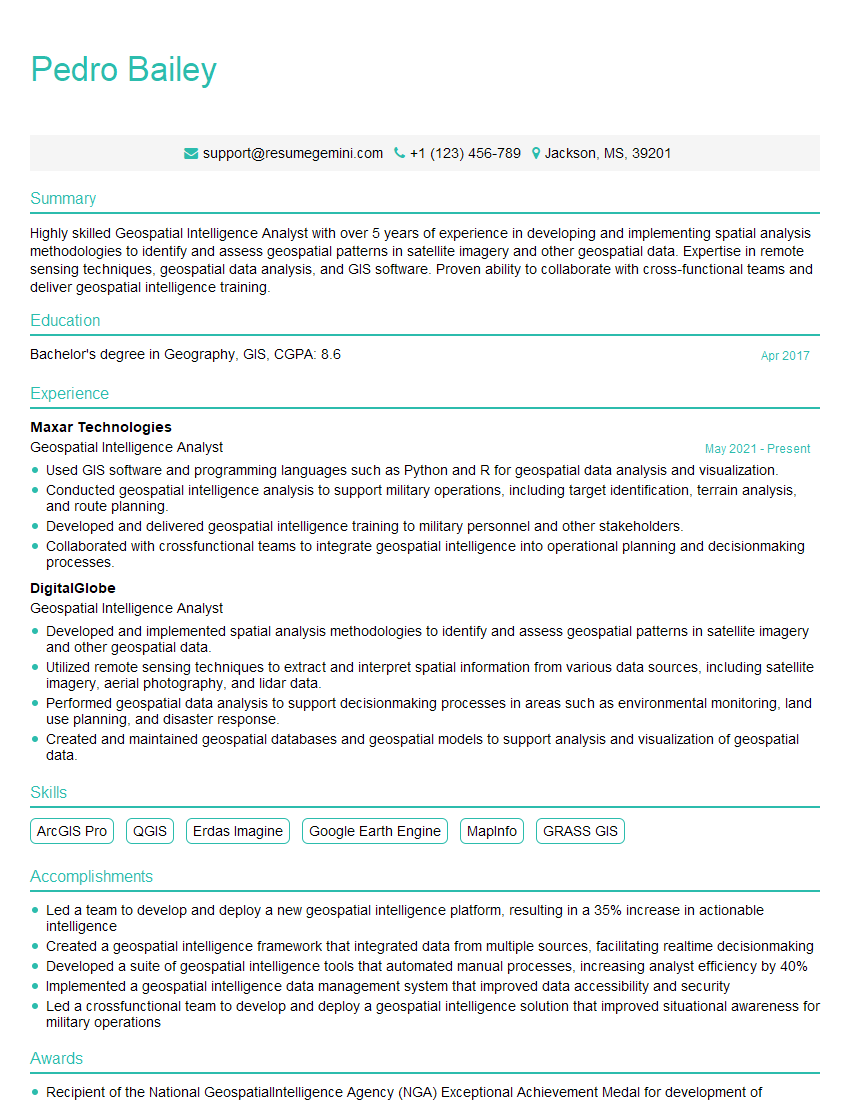
Mastering aerial surveillance opens doors to exciting and impactful careers in various sectors. To significantly improve your job prospects, focus on crafting a compelling and ATS-friendly resume that showcases your skills and experience effectively. ResumeGemini is a trusted resource that can help you build a professional resume that stands out from the competition. ResumeGemini provides examples of resumes tailored to the aerial surveillance field, assisting you in creating a document that highlights your unique qualifications. Invest time in building a strong resume – it’s a critical step in securing your dream role.

Explore more articles
Users Rating of Our Blogs
Share Your Experience
We value your feedback! Please rate our content and share your thoughts (optional).
What Readers Say About Our Blog
Very informative content, great job.
good