The right preparation can turn an interview into an opportunity to showcase your expertise. This guide to Aircraft Accident Investigation interview questions is your ultimate resource, providing key insights and tips to help you ace your responses and stand out as a top candidate.
Questions Asked in Aircraft Accident Investigation Interview
Q 1. Describe the phases of an aircraft accident investigation.
Aircraft accident investigations follow a structured process, typically broken down into several phases. Think of it like solving a complex puzzle, where each piece contributes to the overall picture.
- Accident Notification and Initial Response: This involves securing the accident site, protecting evidence, and notifying relevant authorities. It’s like the first responders at a car crash, securing the area and attending to the injured.
- Fact-Gathering: This crucial phase involves collecting all available data. This includes eyewitness accounts, physical evidence from the wreckage, flight data, weather reports—essentially every piece of the puzzle.
- Data Analysis: This is where the puzzle pieces are examined. Specialists analyze flight data recorders (FDRs), cockpit voice recorders (CVRs), weather data, and witness statements to identify potential causes and contributing factors. It involves meticulous examination and cross-referencing of information.
- Accident Reconstruction: Based on the analyzed data, investigators reconstruct the events leading to the accident. Think of it as putting the puzzle back together, step by step, to understand the sequence of events.
- Findings and Safety Recommendations: The investigation culminates in a final report detailing the accident’s probable cause(s) and any safety recommendations to prevent future occurrences. This is the solution to the puzzle—the understanding of what went wrong and how to avoid it again.
Q 2. Explain the difference between proximate and contributing factors in an accident.
The difference between proximate and contributing factors is crucial in understanding accident causation. Imagine a domino effect: the proximate cause is the final domino that falls and directly leads to the accident, while contributing factors are the dominoes that preceded it, making the final fall more likely.
Proximate Cause: This is the immediate cause of the accident, the event that directly resulted in the damage or injury. For example, in a controlled flight into terrain (CFIT) accident, the proximate cause might be the pilot’s failure to maintain sufficient altitude.
Contributing Factors: These factors increase the likelihood of the proximate cause occurring. In the CFIT example, contributing factors might include inadequate crew resource management, poor weather conditions, or fatigue. These factors didn’t directly cause the crash, but they made it more probable.
Q 3. What are the key data sources used in aircraft accident investigations?
Aircraft accident investigations utilize a wide range of data sources to paint a complete picture of the events. It’s a meticulous process, similar to assembling a jigsaw puzzle from many different pieces.
- Flight Data Recorders (FDRs): These “black boxes” record crucial flight parameters like altitude, airspeed, engine performance, and control inputs.
- Cockpit Voice Recorders (CVRs): These devices record conversations in the cockpit, providing insights into crew actions and communications.
- Wreckage Examination: A detailed examination of the aircraft wreckage reveals significant information about the sequence of events and the forces involved.
- Weather Reports: Meteorological data helps determine the impact of weather conditions on the flight.
- Air Traffic Control Communications: Recordings of radio communications between the flight crew and air traffic controllers are invaluable.
- Maintenance Records: These records provide information on the aircraft’s maintenance history, helping identify potential mechanical failures.
- Pilot Records: Information on the pilot’s training, experience, and medical history is crucial in evaluating human factors.
- Eyewitness Accounts: While less reliable than other sources, eyewitness testimony can provide valuable corroborative evidence.
Q 4. How do you interpret flight data recorder (FDR) data?
Interpreting FDR data requires specialized knowledge and software. Think of it as reading a complex chart that depicts the flight’s entire journey. It is a meticulous and step-by-step analysis.
Investigators use specialized software to analyze the raw data, which often includes thousands of data points. This data is then correlated with other data sources to understand the sequence of events and the aircraft’s performance leading up to the accident. They look for anomalies, deviations from normal flight parameters, or patterns that suggest a contributing factor. For example, a sudden loss of airspeed and an increase in vertical descent rate might suggest an aerodynamic stall.
Q 5. How do you interpret cockpit voice recorder (CVR) data?
CVR data provides insights into the cockpit environment. It’s like listening to the flight crew’s actions and interactions during the critical moments.
Investigators carefully listen to the audio recordings, noting conversations, alarms, and any other sounds that could indicate problems. They correlate this information with FDR data and other evidence to understand the crew’s responses to events, their communication effectiveness, and any potential errors or omissions. For instance, a CVR recording might reveal that a crucial warning was not adequately addressed by the crew.
Q 6. Explain the importance of human factors in aircraft accidents.
Human factors play a significant role in a large percentage of aircraft accidents. It’s about recognizing that people, despite training and procedures, are fallible.
Understanding human factors involves examining the interaction between people and the system (aircraft, procedures, environment). Factors like fatigue, stress, workload, decision-making, communication, and training all play crucial roles. Poorly designed cockpit interfaces or inadequate training can contribute to errors, highlighting the need to consider the human element.
Q 7. Describe various types of human error that can lead to accidents.
Many types of human error can lead to accidents. It is not simply one thing, but rather the interaction of several factors leading to errors.
- Errors of Omission: Failing to perform a necessary action, like forgetting a pre-flight checklist item.
- Errors of Commission: Performing an incorrect action, like selecting the wrong radio frequency.
- Decision Errors: Making poor judgments under pressure, like continuing a flight despite adverse weather conditions.
- Communication Breakdown: Ineffective communication between crew members, leading to misunderstandings and errors.
- Situational Awareness Deficiencies: Failing to recognize a developing hazard, like losing track of altitude or airspeed.
- Workload Management Issues: Being overwhelmed by excessive tasks or demands, leading to errors and missed cues.
These errors can be caused by a range of factors, including fatigue, stress, poor training, or inadequate equipment design.
Q 8. What are some common maintenance-related causes of aircraft accidents?
Maintenance failures are a significant contributor to aircraft accidents. These failures can range from simple oversight to complex systemic issues. Think of it like a car – if you don’t change the oil regularly, the engine could seize up. Similarly, neglecting aircraft maintenance can lead to catastrophic consequences.
Improperly performed maintenance: A mechanic might not correctly tighten a bolt, leading to component failure in flight. For instance, a loose nut on a control surface could compromise flight controls.
Inadequate maintenance scheduling: Failing to adhere to the manufacturer’s recommended maintenance schedule increases the risk of component failure. Think of it like skipping your annual doctor’s checkup – small issues can become major problems if left unchecked.
Parts failures due to wear and tear or manufacturing defects: Components eventually wear out, and if not replaced on time, they can fail. Similarly, faulty parts from the manufacturer can cause unexpected failures. Imagine a faulty engine part causing complete engine failure mid-flight.
Lack of proper documentation and record-keeping: Without accurate maintenance logs, it’s impossible to track issues and ensure preventative maintenance is carried out. This is like a doctor not keeping accurate records of your medical history – important information could be lost.
Q 9. Explain the role of air traffic control in accident prevention.
Air Traffic Control (ATC) plays a crucial role in accident prevention by providing separation between aircraft, guiding them through congested airspace, and managing traffic flow. They are the traffic police of the sky, keeping things organized and safe.
Separation services: ATC ensures sufficient distance between aircraft to prevent collisions. Think of it like a traffic light system, but for airplanes.
Guidance and navigation: ATC guides pilots along specified routes and provides information on weather conditions and potential hazards. This ensures pilots have the best information to make safe decisions.
Emergency response coordination: In the event of an emergency, ATC coordinates rescue efforts and assists in guiding the affected aircraft to safety. This is like emergency services dispatching help – a coordinated response is vital.
Conflict resolution: ATC actively manages potential conflicts between aircraft, preventing near-misses and collisions. They act as a mediator, resolving any potential conflicts before they become dangerous.
However, it is important to note that ATC is not solely responsible for safety. Pilots also have a significant responsibility for their own safety and adhering to ATC instructions.
Q 10. What are the key elements of a comprehensive accident report?
A comprehensive accident report aims to determine the cause of the accident and to recommend measures to prevent similar occurrences in the future. It’s like a detective’s case file, detailing every piece of evidence and piecing together the story.
Factual description of the accident: A detailed timeline of events, including the weather conditions, aircraft status, and crew actions.
Examination of the aircraft: A thorough inspection of the aircraft’s wreckage to identify structural failures or mechanical malfunctions.
Analysis of flight data recorders (FDR) and cockpit voice recorders (CVR): This provides critical data on the aircraft’s performance and the crew’s actions leading up to the accident. Think of these as the ‘black boxes’ providing essential information.
Witness statements: Gathering information from pilots, air traffic controllers, and any other witnesses.
Human factors assessment: Evaluating the role of pilot fatigue, stress, training, and decision-making in the accident. This considers the human element, including errors and decisions.
Probable cause determination: Identifying the most likely cause or combination of causes that led to the accident.
Safety recommendations: Proposals for changes in regulations, training, or aircraft design to prevent future accidents.
Q 11. Describe your experience with accident reconstruction techniques.
My experience with accident reconstruction techniques involves a multidisciplinary approach, using various tools and methodologies to recreate the accident sequence. It’s like putting together a puzzle, but with potentially life-altering implications.
Wreckage examination: Analyzing the physical damage to the aircraft to determine impact forces and failure modes.
Computer simulations: Using specialized software to model the flight dynamics and reconstruct the accident scenario, such as examining the trajectory.
Flight data analysis: Interpreting data from flight recorders to understand the aircraft’s performance and the crew’s actions.
Photogrammetry and 3D modeling: Creating detailed 3D models of the accident site and wreckage to aid in analysis.
Witness interviews and testimony analysis: Corroborating witness accounts with other evidence to build a comprehensive picture of the events.
I’ve been involved in several reconstructions, including a case where the analysis of flight data and witness statements revealed a previously unrecognized design flaw in the aircraft’s landing gear.
Q 12. How do you handle conflicting witness statements during an investigation?
Conflicting witness statements are a common challenge in accident investigations. It requires careful consideration and a methodical approach to determine the most accurate account. It’s like trying to solve a mystery where different people remember things differently.
Independent verification: Cross-referencing witness accounts with other evidence such as flight data, radar data, or physical evidence.
Detailed interviewing techniques: Using structured interviews to elicit clear and consistent information, aiming for factual accuracy.
Bias awareness: Recognizing that memory can be unreliable and that witnesses might be influenced by their emotions or preconceived notions.
Statistical analysis: In cases with multiple conflicting statements, statistical techniques can be used to determine the most probable scenario.
It is crucial to remain impartial and objectively evaluate all evidence, even if it means discarding some witness statements if they are demonstrably inaccurate.
Q 13. What are your proficiency levels with relevant software for data analysis?
I am proficient in several software packages used for data analysis in aviation accident investigation. My skills include:
FlightAware: For tracking flight paths and analyzing historical flight data.MATLABandPython: For advanced statistical analysis, data visualization, and modeling.Reconstruct3Dand similar software: For 3D modeling and reconstruction of accident sites.Specialized flight recorder data analysis software:
My expertise extends to data mining, statistical modeling, and the development of custom scripts for data analysis.
Q 14. How familiar are you with relevant aviation regulations (e.g., FAA, ICAO)?
I possess a thorough understanding of relevant aviation regulations, including those issued by the Federal Aviation Administration (FAA) in the United States and the International Civil Aviation Organization (ICAO). My knowledge encompasses:
FAA regulations (FARs): Including those related to airworthiness, maintenance, pilot certification, and accident reporting.
ICAO Annexes: Specifically Annex 6 (Operation of Aircraft), Annex 8 (Airworthiness of Aircraft), and Annex 13 (Aircraft Accident Investigation).
National regulations: Familiar with the regulatory frameworks of various countries, understanding that they have nuances and differing approaches.
This knowledge is essential for determining compliance, identifying regulatory violations, and formulating recommendations for regulatory improvements based on my investigation findings.
Q 15. Describe your experience with investigating engine failures.
Investigating engine failures requires a systematic approach combining on-site examination with detailed analysis of data. My experience encompasses various engine types, from turboprops to turbofans, and I’ve worked on incidents ranging from in-flight shutdowns to post-accident engine disintegration.
The investigation begins with a thorough visual inspection of the engine, documenting any visible damage, such as cracks, foreign object damage (FOD), or signs of overheating. This is followed by a meticulous examination of components, often requiring disassembly to identify the root cause. We analyze parameters recorded by the engine’s electronic control unit (ECU) to understand the engine’s performance leading up to the failure. This data, alongside flight data recorder (FDR) information, helps reconstruct the sequence of events.
For example, in one investigation, an in-flight engine shutdown was traced back to a faulty fuel pump. Analysis of the ECU data revealed a gradual decrease in fuel flow before the complete shutdown. Further investigation revealed manufacturing defects within the pump itself, leading to a recall of similar parts. Another case involved a bird strike, where careful examination of the engine and analysis of impact debris provided compelling evidence to support the sequence of events and to ensure that appropriate preventative measures, such as bird-strike avoidance training, were implemented.
Career Expert Tips:
- Ace those interviews! Prepare effectively by reviewing the Top 50 Most Common Interview Questions on ResumeGemini.
- Navigate your job search with confidence! Explore a wide range of Career Tips on ResumeGemini. Learn about common challenges and recommendations to overcome them.
- Craft the perfect resume! Master the Art of Resume Writing with ResumeGemini’s guide. Showcase your unique qualifications and achievements effectively.
- Don’t miss out on holiday savings! Build your dream resume with ResumeGemini’s ATS optimized templates.
Q 16. Describe your experience with investigating structural failures.
Investigating structural failures demands a multidisciplinary approach, integrating metallurgical analysis, stress calculations, and a deep understanding of the aircraft’s design and maintenance history. My experience includes investigations involving fatigue cracks, corrosion, impact damage, and manufacturing defects.
The investigation begins with a thorough visual inspection of the affected structure, documenting all visible damage. This is followed by detailed material testing – often requiring sample extraction for microscopic examination under a metallurgical microscope – to determine the cause of failure. Finite Element Analysis (FEA) can help to understand stress distributions and identify potential areas of weakness. We carefully review the aircraft’s maintenance records to see if any previous damage or repairs could have contributed to the failure.
For instance, in one case, a fatigue crack in a wing spar was linked to repeated overloading during cargo operations. Metallurgical analysis revealed that the crack initiated at a stress concentration point and propagated gradually until catastrophic failure. This led to revised operational guidelines to prevent similar incidents, including stricter weight limits and more frequent inspections. Another instance involved a corrosion-related failure traced to inadequate sealant application during a previous repair. This highlighted the importance of proper maintenance procedures and quality control.
Q 17. Explain the concept of ‘Swiss cheese model’ in accident causation.
The Swiss cheese model is a powerful analogy for understanding accident causation. Imagine several slices of Swiss cheese, each representing a layer of defense against potential hazards. Each slice has holes, representing weaknesses or failures within that specific layer – be it maintenance, pilot error, or design flaws.
An accident occurs when the holes in different layers align, creating a pathway from the initial hazard to the final outcome. A single layer of defense might not be enough to prevent an accident; however, a robust system with multiple layers significantly reduces the risk. The model highlights that accidents are seldom caused by a single failure, but rather by a chain of events where multiple latent failures combine.
For example, a pilot might be fatigued (one layer of cheese), the maintenance might have missed a critical flaw in an engine (another layer), and an unexpected weather event (yet another layer) could all contribute to a crash. Each individual factor might not have been enough to cause the accident on its own, but the alignment of their respective weaknesses creates the pathway.
Q 18. How do you prioritize tasks during a complex accident investigation?
Prioritizing tasks during a complex accident investigation requires a structured approach. It’s crucial to establish clear objectives and timelines at the outset. I typically use a risk-based prioritization framework.
First, we assess the immediate safety risks. Securing the scene, recovering the FDR and Cockpit Voice Recorder (CVR), and performing initial assessments of the wreckage are paramount. Next, we prioritize tasks that will provide the most valuable information for understanding the sequence of events. This may involve examining critical components that are likely to yield significant clues, interviewing witnesses, and reviewing relevant maintenance records. We then systematically work through tasks of decreasing priority and urgency, always documenting progress and adapting the plan as new information emerges.
Imagine a scenario where an aircraft crashes into a populated area. The priority shifts towards securing the scene and recovering any survivors, which takes precedence over detailed examination of the wreckage until the immediate danger has subsided. However, the initial investigation, while focusing on safety, does not preclude collecting important evidence.
Q 19. Explain the process of documenting evidence during an investigation.
Documenting evidence during an accident investigation is crucial and requires meticulous attention to detail and chain-of-custody procedures. We use a variety of methods, including photography, videography, detailed sketches, and written reports. Each piece of evidence is carefully labeled, logged, and securely stored to ensure its integrity.
Photography and videography should capture the overall scene, close-ups of critical damage, and the context of the wreckage. Detailed sketches provide precise measurements and locations of damage. We maintain detailed written reports, outlining procedures followed, observations made, and any challenges encountered. A clear chain of custody log tracks the movement of any evidence, ensuring its integrity from the moment of discovery until final analysis. Digital evidence such as flight data and maintenance logs is securely copied and stored, verifying its authenticity.
Consider the importance of maintaining a comprehensive photographic record of a damaged aircraft. Each image should be carefully documented with location, date, and time. Similarly, every piece of recovered debris will be marked and identified with a unique number to prevent any confusion later during the analysis phase.
Q 20. What are your experience with various types of aircraft accidents?
My experience spans a wide range of aircraft accidents, including controlled flight into terrain (CFIT), mid-air collisions, runway excursions, and various types of mechanical failures, as described previously. I have also investigated accidents involving both commercial and general aviation aircraft. I’ve worked on incidents with both single-pilot and multi-pilot crews, encompassing various operational phases.
The investigation process often varies based on the type of accident. For instance, a CFIT accident often requires detailed analysis of terrain data, weather conditions, and pilot decision-making. Conversely, a mechanical failure necessitates a detailed inspection of the aircraft system that caused the malfunction. In each case, the underlying principles of thorough data collection, evidence analysis, and safety recommendations remain the same, though the specific areas of emphasis may vary considerably depending on the unique circumstances.
Q 21. Describe your experience in presenting findings to stakeholders.
Presenting findings to stakeholders requires clear, concise communication that balances technical accuracy with accessibility. My approach involves tailoring the presentation to the audience’s level of understanding, avoiding unnecessary jargon and utilizing visual aids such as charts and diagrams to enhance comprehension.
I typically begin with a summary of the accident, followed by a detailed presentation of the findings, outlining the contributing factors and highlighting any safety recommendations. I strive to provide a complete and objective analysis of the events, focusing on the facts and avoiding speculation. I encourage questions and facilitate open discussion to ensure transparency and address any concerns. The final report is typically distributed formally, and presentations are delivered to ensure all parties are aware of the outcome.
For example, when presenting to a group of pilots, I may use flight path diagrams to illustrate the sequence of events. When presenting to aviation regulators, I provide more technical details, focusing on aspects of compliance and procedural aspects. This customization enhances understanding and acceptance of the findings.
Q 22. How do you manage pressure and stress during a high-pressure investigation?
Aircraft accident investigations are inherently high-pressure environments, demanding meticulous attention to detail under often traumatic circumstances. Managing this pressure requires a multi-pronged approach.
- Self-Care: Prioritizing sufficient sleep, healthy eating, and regular exercise is crucial. Burnout is a real risk, and maintaining physical and mental well-being is paramount. I also utilize mindfulness techniques like meditation to manage stress levels.
- Teamwork: A strong, supportive investigation team is essential. Open communication and mutual respect create a safe space to share burdens and process difficult information. Regular debriefs allow for emotional processing and collaborative problem-solving.
- Structured Approach: Following a methodical investigation process, breaking down complex tasks into manageable steps, and adhering to strict protocols reduces the feeling of being overwhelmed. This allows for focused work and minimizes errors.
- Professional Boundaries: It’s vital to maintain professional boundaries between personal life and the investigation. Knowing when to disengage and seek support from colleagues or mental health professionals is crucial for long-term sustainability.
For example, during the investigation of a complex helicopter crash, I found that scheduling regular breaks and short team meetings to share updates and process difficult findings helped maintain morale and focus. These breaks allowed us to recharge and return to the investigation refreshed and more effective.
Q 23. What are your skills in using accident investigation software?
Proficiency in accident investigation software is indispensable. I’m adept at using various software packages, including but not limited to:
- Flight Data Recorder (FDR) analysis software: Software like FLARM or similar tools allow us to meticulously examine flight data parameters, reconstructing the flight path, analyzing aircraft performance, and identifying anomalies preceding the accident.
- Cockpit Voice Recorder (CVR) analysis software: Software designed for CVR analysis allows for transcription, enhancement of audio quality, and synchronization with other data sources to fully understand the communication between crew members during critical phases of flight.
- 3D modeling and simulation software: Software like CATIA or similar tools allows us to create realistic 3D models of the accident site, aircraft wreckage, and terrain, allowing for a comprehensive visualization of the accident scenario. This is useful for recreating the accident sequence.
- Data management and visualization tools: Tools enabling organization, analysis, and presentation of large datasets from various sources (flight data, weather data, witness statements, etc.) are crucial for efficient investigation management and report generation.
My experience includes using these tools to pinpoint the exact moment of engine failure in a jetliner accident by analyzing FDR data, correlating it with CVR audio, and subsequently mapping it onto a 3D model of the flight path. This provided crucial insights into the causal chain of events.
Q 24. Describe the process of securing the accident site.
Securing an accident site is a critical first step, aiming to preserve evidence and ensure the safety of personnel. The process involves several key steps:
- Establishing a perimeter: A secure perimeter is established to restrict unauthorized access, preserving the integrity of the accident scene. This is often done using physical barriers and security personnel.
- Protecting evidence: All potential evidence – wreckage debris, flight recorders, ground impact marks, witness statements – must be carefully documented, photographed, and secured. This includes preventing any contamination or tampering.
- Safety of personnel: The safety of investigators, emergency responders, and the public is paramount. Hazards like leaking fuel, unstable wreckage, or hazardous materials must be addressed before investigations begin. Appropriate safety gear (PPE) is mandatory.
- Documentation: Meticulous documentation is crucial, including photographs, videos, sketches, and detailed notes of the scene’s initial state. This serves as a permanent record and helps maintain the integrity of the investigation.
- Weather considerations: If necessary, temporary shelters or other measures might be implemented to protect the site from the elements. Adverse weather conditions can severely impact the evidence’s integrity and the safety of personnel.
For example, in a remote mountain crash, securing the site involved coordinating with local authorities to establish access routes, using helicopters to transport personnel and equipment, and establishing temporary base camps to ensure investigator safety and efficiency.
Q 25. How do you collaborate effectively with a multidisciplinary investigation team?
Effective collaboration within a multidisciplinary team is essential for a thorough and unbiased investigation. Key elements include:
- Clear Roles and Responsibilities: Each team member’s role and responsibilities should be clearly defined to avoid duplication of effort and confusion. This fosters efficiency and accountability.
- Open Communication: Regular team meetings, open communication channels, and constructive feedback mechanisms are crucial for sharing information, resolving conflicts, and ensuring everyone is on the same page.
- Respectful Dialogue: A respectful and inclusive environment where team members feel comfortable sharing their expertise, even if it challenges prevailing assumptions, is important. Different disciplines bring unique perspectives.
- Shared Understanding: A shared understanding of the investigation’s goals, methodologies, and timelines is critical. This ensures consistent interpretation of data and cohesive report generation.
- Conflict Resolution: A clearly defined process for resolving conflicts and disagreements should be in place. This prevents stalemate and ensures the investigation remains focused and productive.
In a recent investigation involving a pilot incapacitated mid-flight, effective collaboration between pilots, engineers, medical professionals, and air traffic control experts allowed us to piece together a complex chain of events leading to the accident, highlighting the importance of a multidisciplinary approach.
Q 26. How would you determine the root cause of an accident?
Determining the root cause of an accident requires a systematic and rigorous approach that goes beyond simply identifying the immediate cause. I utilize the “5 Whys” technique and other causal analysis methods:
- Data Collection: Thorough collection of all relevant data – flight data, witness statements, maintenance records, weather reports, etc. – is paramount. This provides a comprehensive understanding of the accident’s context.
- Fact-Finding: The focus is on establishing objective facts, avoiding speculation or premature conclusions. This involves careful analysis of collected data and cross-referencing information from multiple sources.
- Causal Analysis: This involves identifying the chain of events leading to the accident. This often employs techniques like fault tree analysis, fishbone diagrams, and the “5 Whys” (repeatedly asking “Why?” to uncover the root cause). For example, asking “Why did the engine fail?” may lead to a series of “whys” leading to a faulty part.
- Root Cause Identification: The goal is to identify the underlying factor(s) that allowed the accident to occur. This is often a contributing factor to multiple failures. It could be a system failure, human error, or a combination.
- Recommendations: The investigation culminates in recommendations aimed at preventing similar accidents. These may involve changes to procedures, training, maintenance practices, or regulatory oversight.
In the investigation of a runway excursion, using the “5 Whys” helped us uncover that the root cause was a combination of inadequate tire pressure checks and pilot error during landing, which exposed a flaw in the existing safety protocols.
Q 27. How do you ensure the objectivity and impartiality of an investigation?
Maintaining objectivity and impartiality is crucial for the credibility of an investigation. This involves several strategies:
- Independent Investigation: The investigation should be conducted independently from any party that might have a vested interest in the outcome, such as the airline or aircraft manufacturer. This ensures unbiased fact-finding.
- Data-Driven Analysis: Conclusions should be drawn solely from the available evidence, avoiding biases or preconceived notions. This emphasizes a rigorous, scientific approach.
- Transparent Process: The investigation process should be transparent and accountable, ensuring that all stakeholders, including the public, have confidence in the findings and recommendations.
- Documented Procedures: Adhering to standardized investigation procedures and protocols ensures consistency and minimizes the possibility of bias entering the process.
- Peer Review: Having the investigation’s findings reviewed by independent experts helps to identify any potential biases or flaws in the analysis and strengthen the overall integrity.
In investigations, transparency is key. For instance, publishing detailed investigative reports, which includes all collected data and methodology, and making them publicly accessible fosters transparency and accountability, building confidence in the integrity of the investigation’s findings.
Q 28. What are your professional development plans related to aviation safety?
My professional development plans in aviation safety focus on continuous improvement and staying abreast of the latest advancements. These include:
- Advanced Training: Pursuing advanced training courses in areas such as human factors in aviation, accident reconstruction techniques, and data analytics. This will strengthen my ability to interpret complex data and identify contributing factors in accidents.
- Staying Current: Actively participating in professional development workshops, conferences, and seminars related to aviation safety and accident investigation. This helps me stay updated on best practices and emerging trends.
- Networking: Building and maintaining a strong professional network with other experts in the field. Collaborating and exchanging knowledge with colleagues enhances my understanding and problem-solving skills.
- Research: Engaging in independent research on specific aspects of aviation safety, focusing on areas such as the use of AI in accident investigation or the effectiveness of new safety technologies. This will contribute to the development of new and more effective investigation techniques.
- Mentorship: Mentoring junior investigators to share knowledge and experience, fostering the next generation of aviation safety professionals. This helps cultivate expertise and maintains a high standard of professionalism.
Specifically, I plan to pursue certification as a Human Factors specialist in aviation to better understand the role of human error in accidents. This is crucial for developing effective preventative measures.
Key Topics to Learn for Aircraft Accident Investigation Interview
- Human Factors in Aviation Accidents: Understanding pilot error, crew resource management, and the impact of fatigue, stress, and other human limitations on accident causation. Practical application: Analyzing cockpit voice recorder (CVR) and flight data recorder (FDR) data to identify human factors contributing to an accident.
- Aircraft Systems and Mechanics: Comprehensive knowledge of aircraft systems (flight controls, engines, avionics, etc.) and their potential failure modes. Practical application: Determining the sequence of events leading to a mechanical failure and its contribution to the accident.
- Accident Investigation Methodology: Mastering the systematic approach to accident investigation, including the use of the “5 Whys” technique, fault tree analysis, and other investigative tools. Practical application: Applying investigative principles to reconstruct the accident sequence and identify causal factors.
- Regulatory Compliance and Aviation Safety Regulations: Thorough understanding of relevant national and international aviation regulations and their role in accident prevention. Practical application: Evaluating the compliance of aircraft maintenance procedures and operator practices with safety regulations.
- Data Analysis and Interpretation: Proficiency in analyzing various types of data (flight data, maintenance records, witness statements, etc.) and drawing accurate conclusions. Practical application: Using statistical analysis to identify trends and patterns in accident data.
- Accident Reporting and Documentation: Skill in preparing clear, concise, and comprehensive accident reports that accurately reflect the findings of the investigation. Practical application: Presenting your findings effectively in a formal report and during presentations.
- Emergency Response and Procedures: Understanding emergency response procedures and their effectiveness in mitigating accident consequences. Practical application: Analyzing the effectiveness of emergency response actions and identifying areas for improvement.
Next Steps
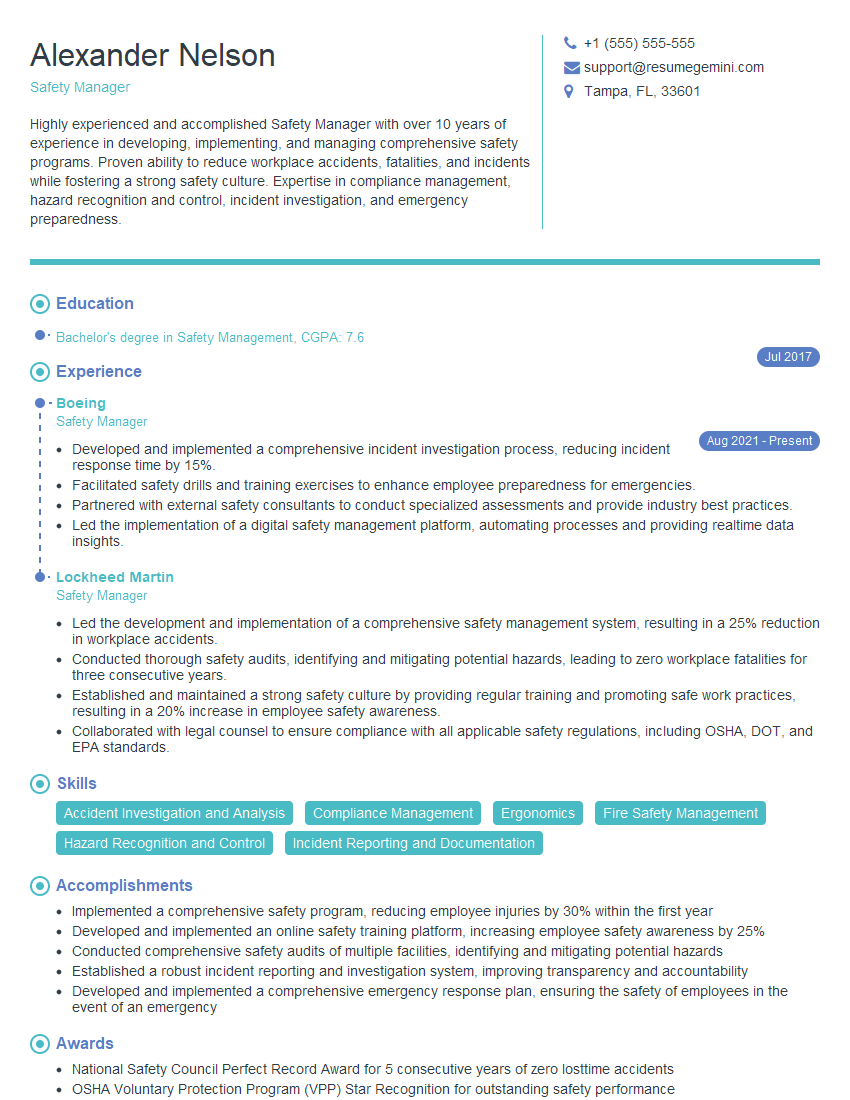
Mastering Aircraft Accident Investigation opens doors to a challenging and rewarding career, offering significant opportunities for professional growth and contributing to enhanced aviation safety worldwide. To significantly boost your job prospects, creating an ATS-friendly resume is crucial. ResumeGemini is a trusted resource that can help you build a professional and impactful resume tailored to the specific demands of this field. Examples of resumes tailored to Aircraft Accident Investigation are available to guide you through the process.
Explore more articles
Users Rating of Our Blogs
Share Your Experience
We value your feedback! Please rate our content and share your thoughts (optional).
What Readers Say About Our Blog
Very informative content, great job.
good