Every successful interview starts with knowing what to expect. In this blog, we’ll take you through the top AISC 360 interview questions, breaking them down with expert tips to help you deliver impactful answers. Step into your next interview fully prepared and ready to succeed.
Questions Asked in AISC 360 Interview
Q 1. Explain the difference between LRFD and ASD design methods.
AISC 360 offers two primary design methods: Load and Resistance Factor Design (LRFD) and Allowable Stress Design (ASD). The core difference lies in how they handle uncertainties and safety factors. LRFD is a limit states design method, meaning it aims to ensure the structure remains functional under various load conditions, considering the probability of failure. ASD, on the other hand, is a working stress design method that uses allowable stresses based on material properties and safety factors applied directly.
LRFD uses resistance factors (Φ) to reduce the member’s calculated resistance, and load factors (γ) to increase the factored loads. This accounts for uncertainties in both material strength and applied loads. The design equation is: ΦR ≥ γ1D + γ2L, where R is the member resistance, D is dead load, and L is live load. Think of it as a safety net – we reduce the predicted strength of the structure and increase the predicted load to ensure a significant margin of safety.
ASD, conversely, uses a single factor of safety (often built into the allowable stresses) to address uncertainties. The design equation is simpler: S ≤ R/Ω, where S is the applied stress, R is the nominal resistance, and Ω is the safety factor. This approach might seem simpler, but LRFD offers a more sophisticated and refined probabilistic approach to safety.
In practice, LRFD is now much more commonly used in the US for structural steel design due to its more sophisticated accounting of uncertainties and consequently, potentially more efficient designs.
Q 2. Describe the various types of steel connections and their applications.
Steel connections are crucial for transferring loads between structural members. Their type depends heavily on the forces involved and the overall structural configuration. Here are some common types:
- Bolted Connections: These are widespread due to their ease of fabrication and erection. Types include slip-critical connections (where bolts are tightened to prevent slippage under load) and bearing-type connections (where loads are transferred through bearing on the bolt shank).
- Welded Connections: Offer high strength and stiffness but require skilled welders and adherence to stringent quality control procedures. They can be full-penetration welds or partial-penetration welds, depending on the design requirements.
- Riveted Connections: Though less common now, riveted connections are still found in older structures. They’re durable but labor-intensive.
- High-Strength Bolted Connections: These utilize high-strength bolts, often in shear, with the capacity exceeding that of typical standard bolts. These are widely adopted for higher capacity connections.
Applications vary widely. For instance, a simple beam connection might involve bolted or welded angles to transfer shear and moment, while a column base might use a welded base plate to transfer the axial column load to the foundation.
Q 3. How do you account for shear and moment in beam design according to AISC 360?
AISC 360 provides detailed procedures for designing beams to resist shear and moment. The design process involves checking for both flexural (bending) and shear failures.
Shear Design: The shear strength of a beam is determined by considering the yield strength of the steel and the shear area. The design equation often involves a resistance factor (Φ) and accounts for the effects of shear stress concentration. Checking the shear stress against the allowable shear stress (or factored resistance, in LRFD) ensures that the beam won’t fail due to shear rupture or excessive deformation.
Moment Design: The moment capacity of a beam section is determined by evaluating the section’s moment of inertia and the yield strength of the steel. The designer checks the bending moment applied on the beam against its moment capacity (factored resistance, using a resistance factor in LRFD). The process may also include checking for lateral-torsional buckling if applicable, particularly for slender beams. For instance, beams carrying heavy loads and spanning considerable lengths need to be reviewed for lateral-torsional buckling, as it can significantly reduce the moment resistance.
Example: A beam carrying a factored load might need to be checked against shear capacity using a formula incorporating a resistance factor and the yield strength, and then subsequently compared against moment capacity obtained using appropriate section properties and resistance factor to prevent flexural yielding or buckling.
Q 4. What are the key provisions of AISC 360 related to column design?
AISC 360 addresses column design with provisions addressing various failure modes, including buckling and yielding. Key provisions include:
- Effective Length: Considering the end conditions of the column using the effective length factor (K), which reflects the column’s support conditions and affects the buckling behavior.
- Slenderness Ratio: Determining the column’s slenderness ratio (KL/r), which compares the column’s effective length to its radius of gyration. A high slenderness ratio indicates a greater susceptibility to buckling.
- Buckling Curves: Using appropriate buckling curves to determine the critical stress for different steel grades and slenderness ratios. These curves account for the material’s stress-strain behavior under compression.
- Interaction Equations: In the case of columns subjected to both axial load and bending moments (common in most practical situations), the design involves checking using interaction equations accounting for combined effects. These usually ensure the member remains safe against combined stress.
- Material Properties: Selecting appropriate material properties, including yield strength and modulus of elasticity, in line with the chosen steel grade.
In short: AISC 360 ensures columns are designed to withstand both compressive yielding and buckling failure modes, taking into account the column’s geometry, support conditions, and the applied loads. This rigorous analysis ensures the columns remain safe and stable.
Q 5. Explain the concept of effective length factor (K) in column design.
The effective length factor (K) in column design represents the equivalent length of a column with fixed ends that would buckle under the same load as the actual column with different end conditions. In essence, it modifies the actual column length to account for the impact of support conditions. The critical buckling stress of a column depends on its unsupported length. Columns with fixed ends can withstand greater load before buckling. K modifies this unsupported length, allowing us to calculate the effective length, and then the critical buckling stress using a simple formula.
Values of K typically range from 0.5 (fixed-fixed) to 2.0 (pinned-free), reflecting the relative stiffness of different supports. A K-value of 1.0 represents pinned-pinned supports.
Determining K: Determining the K factor involves analyzing the column’s bracing and support system. This often involves stability analysis or using simplified methods based on the column’s end conditions and the stiffness of the bracing members.
Q 6. How do you determine the allowable compressive stress in a column?
Allowable compressive stress in a column is determined differently in ASD and LRFD and is governed primarily by the column’s slenderness ratio (KL/r).
ASD: ASD utilizes allowable stress tables or equations that directly provide the allowable compressive stress based on the slenderness ratio and the steel grade. These values already incorporate the safety factor. If the slenderness ratio is low (a stocky column), the allowable stress is governed by yield strength, but for higher slenderness ratios (slender columns), the buckling capacity becomes the limit, and the allowable stress reduces significantly.
LRFD: In LRFD, the critical buckling stress is calculated using equations related to the Euler buckling formula and then reduced by the resistance factor (Φ). The critical stress, reduced by the resistance factor, now gives the factored resistance, which should then be compared with the factored axial load.
In summary: Both methods consider buckling, but LRFD uses a more explicit and direct probabilistic approach, involving resistance factors and factored loads; whereas, ASD incorporates these factors implicitly within the allowable stress values.
Q 7. Describe the process of designing a simple beam connection.
Designing a simple beam connection, such as a beam-to-column connection, involves several steps:
- Determine the loads: Calculate the shear and moment forces transferred from the beam to the column.
- Select the connection type: Choose an appropriate connection type based on cost, constructability, and design requirements (e.g., welded or bolted connections using angles, tees, or other shapes).
- Preliminary Design: Select tentative sizes of connection elements (e.g., angles, bolts, or welds) based on experience and engineering judgment. This step ensures the connection has sufficient capacity.
- Verify Capacity: Perform detailed analysis of the connection, taking into account shear, moment, and potential for bolt bearing failure or weld fatigue, as applicable. AISC 360 provides equations and design provisions to check this capacity, including relevant strength factors.
- Check for Deformability: Ensure the connection’s stiffness is adequate, addressing the issue of excessive deformation under load. AISC 360 has provisions for evaluating deformation.
- Detailing: Create detailed drawings specifying the dimensions, bolt sizes, weld types, and other geometrical properties. Accurate detailing is essential for proper fabrication and erection.
Example: A simple bolted connection might involve attaching an angle to the beam and column flanges using multiple bolts to transfer shear and moment. The design would then check the strength of the bolts in shear and bearing, as well as the capacity of the angle section to resist bending.
Q 8. Explain the design considerations for composite beams.
Designing composite beams, which combine steel and concrete, requires careful consideration of several factors. The key is to leverage the strengths of both materials – steel’s high tensile strength and concrete’s compressive strength – to create a highly efficient structural member.
Interaction between Steel and Concrete: The primary design consideration is how the steel and concrete interact under load. This involves ensuring adequate shear connection between them. This connection is typically achieved using shear studs welded to the top flange of the steel beam. The number and size of these studs are critical in transferring shear forces effectively from the concrete slab to the steel beam. Insufficient shear connection will lead to slippage and reduced composite action.
Effective Section Properties: Once the shear connection is established, the next step is to determine the effective section properties of the composite beam. This involves calculating the transformed section, considering the modular ratio (the ratio of the modulus of elasticity of steel to that of concrete). The transformed section allows for analysis using standard beam theory. The effective moment of inertia (Ieff) is crucial for calculating deflections and stresses.
Strength and Serviceability Limits: The design must satisfy both strength and serviceability limit states. Strength limits involve checking for flexural and shear capacity, considering both steel and concrete contributions. Serviceability limits focus on controlling deflections and vibrations to ensure the beam performs adequately under service loads. Excessive deflection could lead to architectural and functional problems.
Example: Imagine designing a composite beam for a floor system in a multi-story building. We’d select appropriate steel beams (e.g., W-shapes), determine the required concrete slab thickness, calculate the number and size of shear studs needed for adequate shear transfer, and then analyze the resulting composite section for flexure, shear, and deflection, ensuring compliance with AISC 360.
Q 9. How do you address lateral-torsional buckling in beam design?
Lateral-torsional buckling (LTB) is a failure mode where a beam bends and twists simultaneously under compression, usually when it is unsupported laterally. Addressing LTB is crucial to ensure the safety of steel beams. The AISC 360 provides several methods to handle LTB.
Unbraced Length: The first and most important step is to determine the unbraced length (Lb) of the beam segment. This is the distance between points of lateral support, which restrain both lateral displacement and twist. A shorter unbraced length increases the resistance to LTB.
Design Methods: AISC 360 offers different design approaches. One common approach is to check the nominal flexural strength (Mn) against the factored moment (Mu). If Mu exceeds Mn, the section doesn’t have sufficient resistance to LTB, and modifications are necessary. This often involves selecting a stronger section, reducing the span, or adding lateral bracing.
Lateral Bracing: Providing intermediate bracing along the beam’s length is a highly effective way to reduce the unbraced length, significantly increasing resistance to LTB. Bracing can be achieved using various methods, including simple angles, channels, or more sophisticated bracing systems.
Section Selection: Selecting a section with a larger moment of inertia (I) and a greater section modulus (Sx) will inherently increase LTB resistance. Sections with a compact shape generally perform better than those with slender elements.
Example: Consider a long, simply supported beam carrying a significant load. The designer needs to determine the unbraced length, calculate the critical moment for LTB using appropriate AISC 360 equations, and compare this value to the factored moment. If the factored moment exceeds the critical moment, additional bracing or a stronger section will be required.
Q 10. What are the different types of bracing systems used in steel structures?
Bracing systems in steel structures are vital for providing lateral stability and resisting lateral loads. Several types exist, each suited to different conditions and design requirements.
1. Diagonal Bracing: This is a common system employing diagonal members to connect joints, transferring lateral forces to the foundations. K-bracing and X-bracing are popular configurations, offering various degrees of efficiency and stiffness.
2. K-Bracing: Forms a ‘K’ shape, which is generally preferred over X bracing due to lower stress concentrations at the connections.
3. X-Bracing: This configuration uses diagonal members that cross each other, forming an ‘X’. While simple, it can induce significant stress concentrations at the connections.
4. Eccentric Bracing: This system uses a relatively flexible bracing member connected eccentrically to the main structural frame. This system is advantageous for energy dissipation during seismic events.
5. Moment Frames: These frames rely on the flexural stiffness of the columns and beams to resist lateral loads. Connections in moment frames are designed to resist both moment and shear forces. These frames are preferred when high seismic loads are anticipated.
6. Shear Walls: Composed of closely-spaced steel studs or plates, shear walls provide significant resistance against lateral loads. They are often used in high-rise buildings or structures in seismic zones.
Selection Considerations: The choice of bracing system depends on factors such as the building’s height, location (seismic zone), anticipated loading, and aesthetic requirements. Cost-effectiveness and constructability also play a significant role.
Example: A tall office building in a seismic zone would likely benefit from a combination of moment frames and shear walls, while a low-rise industrial building might use simpler diagonal bracing.
Q 11. Explain the design criteria for steel base plates.
Steel base plates transfer the loads from columns to their supporting foundations. Proper design is crucial to prevent excessive bearing stresses and ensure structural integrity. The design criteria are primarily dictated by AISC 360.
Bearing Pressure: The base plate must be designed to ensure the bearing pressure on the concrete foundation remains below the allowable bearing capacity of the concrete. The allowable bearing capacity is determined by the concrete’s compressive strength and other factors like the geometry of the supporting area.
Shear Capacity: The base plate must also have sufficient shear capacity to resist the shear forces that may arise at the interface between the base plate and the column. These shear forces are usually relatively small compared to the bearing pressure and are generally not the limiting factor.
Bending Stress: The base plate will experience bending stresses due to the eccentricity between the column’s centroid and the base plate’s centroid. These stresses must be checked and ensured they are within acceptable limits as per AISC 360.
Thickness Calculation: The thickness of the base plate is determined to ensure that the bending stresses and deflection are within permissible limits. Design charts and equations provided in steel manuals or design codes can assist in determining the required thickness.
Weld Design: The welds connecting the base plate to the column must be adequately designed to resist both shear and moment forces, ensuring the connection is strong enough to transfer loads from the column to the base plate.
Example: Suppose we’re designing a base plate for a column with a given load. We first determine the required area of the base plate based on the allowable bearing pressure of the concrete. Next, we select the plate thickness to satisfy bending stress limitations. Finally, we design appropriate weld sizes to connect the base plate and the column according to the weld requirements stipulated in the AISC 360.
Q 12. How do you select appropriate weld sizes for steel connections?
Selecting appropriate weld sizes for steel connections involves considering several factors outlined in AISC 360. The primary goal is to ensure the weld has sufficient strength to transfer the required forces and is free of defects that would compromise its performance.
Strength of Connected Members: The weld size should not exceed the strength of the connected members; otherwise, the weld would be stronger than the members, leading to failure in the members prior to the weld failing. The strength of the members is influenced by their material properties and cross-sectional dimensions.
Load Transfer Mechanism: The weld must be capable of transferring all loads, including shear, tension, bending, and moment. The type of weld and its size are chosen according to the load and geometry of the connection.
Weld Size and Strength: The weld size is directly related to its strength. Larger welds generally provide higher strength. A weld’s strength is also dependent on the weld type (e.g., fillet weld, groove weld), the electrode type, and the welder’s qualifications.
Weld Details and Code Compliance: AISC 360 provides detailed guidelines on permissible weld sizes, configurations, and welding procedures. These guidelines must be meticulously followed to ensure the safety and serviceability of the connection. The design should comply with the AWS (American Welding Society) standards.
Example: If designing a fillet weld for a simple lap joint subjected to shear, we would select the weld size based on the applied shear force, the length of the weld, and the allowable shear stress of the weld metal as specified in AISC 360. We would also ensure the weld complies with the requirements of relevant AWS standards.
Q 13. Describe the process of checking for bolt shear and tension.
Checking for bolt shear and tension is a fundamental aspect of designing bolted connections in steel structures. AISC 360 provides detailed guidance on this. The goal is to ensure that the bolts are adequately sized to withstand the applied loads without failure.
Bolt Shear: Shear occurs when a force tends to slice through the bolt. The design process involves calculating the shear force acting on each bolt and comparing it to the allowable shear strength of the bolt. The allowable shear strength depends on the bolt diameter, material properties (grade), and any applicable shear strength reduction factors from the AISC 360.
Bolt Tension: Tension develops when a force tends to pull the bolt apart. This is often significant in connections subjected to significant tensile loads. The allowable tensile strength of the bolt is calculated considering the bolt’s diameter, material properties, and any applicable tensile strength reduction factors (like those accounting for threads). The calculation accounts for the tensile capacity of the bolt and the tension induced by the external load.
Bearing Failure: It’s important to check the bolt for bearing failure. This occurs when the bolt’s contact surface with the connected members is subjected to excessive pressure. The allowable bearing stress is determined using the bolt’s diameter, the thickness of the connected members, and the material properties.
Example: Let’s say we’re designing a connection that transfers a tensile force using several bolts. We’d first calculate the shear force and tensile force acting on each bolt. Then, using the bolt’s diameter and material properties (specified as bolt grade), we’d determine the allowable shear strength and tensile strength from AISC 360. We’d compare the calculated forces with the allowable strengths. If the calculated forces exceed the allowable strengths, a larger bolt diameter or more bolts are necessary.
Q 14. Explain the design considerations for moment connections.
Moment connections in steel structures are designed to transfer both moment and shear forces between connected members. Designing these connections requires careful consideration of several factors.
Types of Moment Connections: There are several types of moment connections, including fully-restrained (FR) connections and partially-restrained (PR) connections. FR connections completely restrain both the rotation and translation of the connected member, whereas PR connections allow for some degree of rotation or translation. The choice depends on the structural system’s overall behavior and seismic considerations.
Stiffness Requirements: Moment connections need to possess adequate stiffness to ensure that the frame behaves as intended under load. Stiffness is influenced by the connection’s geometry, bolt pattern, and the type and size of welds or bolts used.
Strength Requirements: The connection’s strength must be sufficient to resist the anticipated moment and shear forces. This involves checking the capacity of the bolts, welds, and connected members themselves. Failure in any of these components can lead to collapse.
Ductility: Especially in seismic zones, the connection’s ductility is crucial. Ductility refers to the connection’s ability to deform plastically before failure, allowing it to absorb energy and dissipate seismic forces. This is often achieved through careful design of the connection’s geometry and detailing.
Fabrication and Construction: The connection’s design should also consider fabrication and construction aspects. Ease of fabrication, ease of erection, and field weldability often need to be considered in the design process.
Example: In designing a moment frame for a tall building, the connections would be carefully detailed as FR connections capable of resisting large moments and shear forces, possibly using double web angles and adequately sized bolts and welds. These connections would undergo rigorous analyses to ensure their strength, stiffness, and ductility meet the stringent requirements.
Q 15. What are the limitations of using AISC 360?
AISC 360, while a comprehensive standard, has limitations. It primarily focuses on the design of buildings and doesn’t directly address all structural types. For example, it offers limited guidance on specialized structures like bridges, offshore platforms, or industrial facilities. Additionally, it assumes certain material properties and fabrication tolerances, which might not always be perfectly met in reality. Finally, AISC 360 is a prescriptive code; it provides design equations and procedures, but it may not always be the most economical or optimal solution for every unique design challenge. The engineer needs to exercise professional judgment and consider factors outside the strict limits of the code, such as constructability and potential code interpretations.
For instance, the code relies on simplified models for certain phenomena (like buckling) which might not be fully representative of complex structural behaviour. In such cases, more advanced analysis methods may be needed, going beyond the simpler design checks provided in the code.
Career Expert Tips:
- Ace those interviews! Prepare effectively by reviewing the Top 50 Most Common Interview Questions on ResumeGemini.
- Navigate your job search with confidence! Explore a wide range of Career Tips on ResumeGemini. Learn about common challenges and recommendations to overcome them.
- Craft the perfect resume! Master the Art of Resume Writing with ResumeGemini’s guide. Showcase your unique qualifications and achievements effectively.
- Don’t miss out on holiday savings! Build your dream resume with ResumeGemini’s ATS optimized templates.
Q 16. How do you account for wind loads in the design of steel structures?
Wind loads are incorporated into steel structure design using the procedures outlined in ASCE 7, the standard for minimum design loads for buildings and other structures. AISC 360 then uses these calculated loads to design the members. The process typically involves determining the wind pressure on the building’s surface based on its location, height, and exposure category. This pressure is then converted to equivalent forces acting on the structural frame. We consider the effects of wind on different parts of the structure – the overall stability and the individual member stresses.
For example, a high-rise building in a coastal area would experience significantly higher wind pressures than a low-rise building in a sheltered inland location. The structural engineer must accurately determine these pressures and incorporate them into the design to ensure the structure’s safety and stability.
Software packages, such as RISA-3D or ETABS, are commonly used to perform the wind load analysis and structural calculations. These programs take into account various factors, including wind speed, terrain, and building shape.
Q 17. How do you account for seismic loads in the design of steel structures?
Seismic design of steel structures is governed by ASCE 7, which specifies the seismic loads based on the structure’s location, soil conditions, and occupancy. AISC 360 then utilizes these loads for the design of the individual components. Seismic design involves considering the dynamic response of the structure to ground shaking. The goal is to ensure the structure can withstand seismic events without collapse, even if some damage occurs.
This process involves determining the building’s seismic forces, analyzing its response to those forces and designing members and connections to resist both the static and dynamic forces. It’s crucial to consider both strength and ductility. Ductile structures have the ability to deform significantly without fracturing which is highly desirable in seismic events. Connections are particularly important – we need to ensure ductile connections in order to prevent brittle failures. Detailed analysis, often using sophisticated software that employs methods like response-spectrum analysis, is typically necessary.
A common approach involves designing a moment-resisting frame or a braced frame to dissipate seismic energy. Different steel sections and connection types are suitable for different seismic design categories.
Q 18. Explain the concept of stability in steel structures.
Stability in steel structures refers to the structure’s ability to resist collapse due to buckling or overturning. Buckling occurs when a slender compression member fails due to lateral instability, while overturning happens when the applied forces exceed the structure’s resistance to rotation. Stability is critical because even relatively small loads can cause catastrophic failure if stability is not adequately addressed.
Several factors influence stability, including member slenderness (length-to-radius of gyration ratio), material properties (yield strength, elastic modulus), and boundary conditions (how the member is supported). AISC 360 provides equations and design criteria to check for both local and overall stability. These checks ensure that the structural members are adequately sized and designed to prevent buckling under the expected loads.
Consider a long, slender column: a critical design aspect is to ensure it won’t buckle under its own weight and applied loads. Adding bracing or using a more robust section can significantly improve stability.
Q 19. What are the common failure modes of steel structures?
Steel structures can fail in several ways. Some common failure modes include:
- Fracture: The steel material exceeds its ultimate tensile strength causing a brittle fracture. This is usually due to high stress concentrations or low ductility in the steel.
- Buckling: Slender compression members bend and fail under compressive loads before reaching their yield strength.
- Yielding: Excessive plastic deformation of the steel, resulting in permanent deformation and potential loss of structural integrity. This can be seen as noticeable bending or distortion.
- Fatigue: Repeated cyclic loading can lead to crack initiation and propagation, eventually causing failure even at stresses below the yield strength.
- Connection Failure: Failure of bolted or welded connections can be a critical failure mode.
- Overturning: The structure tips over due to insufficient resistance to overturning moments.
Understanding these failure modes is crucial in designing safe and reliable steel structures. Proper material selection, detailed analysis, and careful detailing of connections are essential to mitigating these risks.
Q 20. How do you check for deflection limits in beam design?
Deflection limits in beam design are checked to ensure serviceability. Excessive deflection can cause damage to non-structural elements like ceilings, walls, and finishes, and can also lead to unacceptable vibrations or an unsatisfactory aesthetic appearance. AISC 360 specifies allowable deflection limits as a fraction of the span length.
The deflection is typically calculated using elastic beam theory, taking into account the applied loads, beam’s material properties, and its cross-sectional geometry. Simplified formulas and more detailed analysis methods are available. Software like RISA-3D or STAAD.Pro can automatically calculate deflections for various loading scenarios.
For example, a typical limit might be L/360 (span length divided by 360) for live loads and L/240 for live plus dead loads. If the calculated deflection exceeds these limits, the beam size needs to be increased or alternative design solutions explored.
Q 21. Describe the process of designing a steel column base.
Designing a steel column base involves several steps. First, the column load (axial load, bending moment, and shear) is determined from the structural analysis. Next, the base plate dimensions are determined such that the bearing pressure on the concrete foundation is within the allowable limits. Then we choose appropriate anchor bolts that can safely transfer the column load to the foundation. The base plate is designed to ensure adequate strength and stiffness to distribute the column load effectively. Finally, it’s essential to check for shear capacity of the bolts and the concrete.
The design process considers several factors, including:
- Column load: The magnitude and distribution of forces acting on the column base.
- Concrete strength: The compressive strength of the concrete foundation.
- Bolt properties: Strength, diameter, and spacing of anchor bolts.
- Base plate dimensions: Size and thickness of the steel base plate.
- Welding details: If welding is used to connect the base plate to the column.
Software like AISC Steel Base Plate design tools or other structural analysis software can greatly simplify the design process, ensuring compliance with AISC 360 and providing optimized designs.
Q 22. What are the different types of steel sections and their properties?
AISC 360 covers a wide variety of steel sections, each with unique properties impacting structural performance. Think of it like choosing the right tool for a job – a screwdriver for screws, a hammer for nails. Similarly, different steel sections are suited for different structural demands.
- Wide Flange (W-Shapes): These are the workhorses of steel construction. Their I-shape maximizes bending resistance with high strength-to-weight ratio. You’ll see them frequently in beams and columns. Their properties include section modulus (resistance to bending), moment of inertia (resistance to bending deformation), and area (related to axial load capacity). For example, a W12x26 has a much higher capacity than a W6x12.
- American Standard Channels (C-Shapes): These have a C-shape and are often used as beams or bracing members, offering a good balance of bending and shear capacity. They’re useful in situations where space is limited.
- American Standard Angles (L-Shapes): These are L-shaped sections useful in bracing, connecting members, or as purlins. They are frequently used in smaller scale structures or as connection elements.
- Hollow Structural Sections (HSS): These include square, rectangular, and round shapes. They are advantageous where high torsional stiffness is required, like in tubular columns. Their hollow nature provides more efficient material use compared to solid sections.
- Tee Sections (T-Shapes): These are created by cutting a wide-flange beam in half. They are commonly used as beams or as parts of built-up members.
AISC steel manuals provide detailed information, including dimensions, weight, and section properties, crucial for designing with these members. Each section’s geometry determines its resistance to different types of loads.
Q 23. Explain the concept of slenderness ratio in column design.
The slenderness ratio is a critical parameter in column design, determining how prone a column is to buckling under compressive loads. Imagine a long, thin straw versus a short, thick one – the long straw will buckle more easily. The slenderness ratio quantifies this susceptibility.
It’s calculated as the ratio of the effective length (Le) to the least radius of gyration (r): KL/r
Where:
Kis the effective length factor, accounting for end conditions (fixed, pinned, etc.). This factor modifies the actual length to reflect the column’s effective length under load conditions.Lis the unsupported length of the column.ris the least radius of gyration, a measure of the column’s cross-sectional shape and how its material is distributed. A larger radius of gyration indicates better resistance to buckling.
A higher slenderness ratio indicates a more slender and weaker column, more susceptible to buckling. AISC 360 uses the slenderness ratio to categorize columns into different categories (short, intermediate, long) impacting the design approach, typically involving different equations for strength calculations.
Q 24. How do you determine the design strength of a welded connection?
Determining the design strength of a welded connection is a multi-step process involving several checks. Think of it like assessing the strength of a chain – its strength is only as good as its weakest link.
The design strength is governed by the weakest of several potential failure modes:
- Weld Strength: The capacity of the weld itself, determined by the weld size, type (fillet, groove), and electrode strength. AISC provides allowable stresses for various weld types.
- Base Metal Strength: The capacity of the connected members. The weld might be stronger than the connected steel, thus limiting the overall strength. Consider the tensile, shear, or bending strength of the connected steel elements.
- Fracture in the Base Metal: Potential cracking near the weld due to stress concentrations. This needs to be considered during weld detail design and inspection.
- Weld Distortion: Excessive heat during welding might cause distortion, potentially leading to reduced performance.
The design strength is then determined by considering the applicable limit states in AISC 360 and calculating the resistance of each failure mode. The minimum of these resistance values defines the design strength of the welded connection.
Example: You might have a weld with a high allowable strength, but the base metal is weaker. The weaker base metal, therefore, dictates the design strength of the connection.
Q 25. Describe the process of designing a tension member.
Designing a tension member involves ensuring it can safely withstand the tensile forces applied. Think of a crane hook lifting a heavy load – the hook is in tension. The design process follows these key steps:
- Determine the Tensile Force: Calculate the tensile force acting on the member based on the applied loads.
- Select a Suitable Section: Choose a cross-section (e.g., a wide-flange, angle, or plate) capable of resisting the tensile force. Consider factors like cost, availability, and ease of fabrication.
- Check for Tensile Yielding: Ensure that the tensile stress induced by the calculated tensile force does not exceed the allowable tensile yield strength of the selected material as per AISC 360.
- Check for Tensile Rupture: Verify that the tensile stress does not exceed the allowable tensile rupture strength. This is especially critical for brittle materials.
- Check for Block Shear: Evaluate the resistance against block shear failure. Block shear is a failure mode where a portion of the material near the connection shears off.
- Check for Net Section Fracture: Consider holes due to bolts or welds, which reduce the net area available to resist tensile stress. AISC provisions account for the effect of these holes.
The design process iterates until a section is found that satisfies all the above checks, ensuring a safe and efficient design.
Q 26. What are the common design checks for steel members?
Common design checks for steel members ensure they meet safety and performance requirements. These checks often overlap and need to be considered in combination.
- Strength Checks: These verify that the member can withstand the applied loads without yielding or fracturing, covering tension, compression, bending, shear, and torsion.
- Stability Checks: These address the susceptibility to buckling (in compression members) or lateral-torsional buckling (in beams), often using slenderness ratio considerations as discussed earlier.
- Deflection Checks: These limits excessive deformations that could impair functionality or aesthetics. Allowable deflections are typically specified in design codes or by clients.
- Connection Checks: Ensure that the connections (welds, bolts) can safely transmit the loads between members. Connection design is a significant part of the overall structural design.
- Fatigue Checks: If cyclic loads are anticipated, these checks are necessary. They account for the potential for fatigue failure under repeated stress cycles.
- Ductility Checks: Verify that the design allows for sufficient deformation before failure, leading to a more predictable and safer collapse.
AISC 360 provides detailed guidance on performing these checks, ensuring a robust and reliable steel structure.
Q 27. Explain the use of load combinations in the design of steel structures.
Load combinations are crucial in structural design because structures rarely experience only one type of load at a time. AISC 360 uses load combinations to account for various load scenarios that might occur simultaneously, ensuring the structure can withstand these combined effects.
Imagine a building experiencing both dead load (weight of the structure) and live load (people, furniture). Load combinations are used to represent realistic situations. These combinations are factored to account for uncertainties in load estimation and material properties.
The basic format of a load combination is expressed as: U = γD + γL + γW +...
Where:
Uis the factored load effect (e.g., factored moment, factored shear).γare load factors defined in AISC 360 (these factors are multiplied by each load type to account for variability).Drepresents dead load.Lrepresents live load.Wrepresents wind load....represents other loads like snow, seismic, etc.
AISC 360 specifies various load combinations, representing different load scenarios. The structure needs to satisfy all the specified combinations to ensure its safety.
Q 28. How do you select appropriate fasteners for steel connections?
Selecting appropriate fasteners is critical for safe and reliable connections. The choice depends on several factors, including:
- Load Type and Magnitude: The type of force (tension, shear, or a combination) and its magnitude dictate the fastener’s strength requirements. A high shear load demands stronger fasteners.
- Material Properties: The strength and ductility of the connected materials influence the selection process. Stronger materials might necessitate larger and stronger fasteners.
- Connection Type: The type of connection (bolted, welded, or riveted) dictates the types of fasteners needed. Bolted connections use bolts, welds utilize electrode material, etc.
- Slip Resistance: For bolted connections, it’s crucial to consider slip resistance, ensuring that the fasteners do not slip under load. This may involve considering pretensioning and bearing strength calculations.
- Ease of Installation: Practical installation aspects also play a role, balancing strength with efficiency of construction. Difficult-to-install fasteners might add cost and time.
AISC 360 provides guidelines and design equations for bolted and welded connections, facilitating informed fastener selection. The design must account for several factors such as shear, bearing, and tension strength, ensuring the fastener can adequately transmit the intended loads.
Key Topics to Learn for AISC 360 Interview
- Load and Resistance Factor Design (LRFD): Understand the fundamental principles of LRFD, including load combinations and resistance factors. Be prepared to discuss its application in design scenarios.
- Member Design: Master the design of common structural members like beams, columns, and connections. Practice calculating stresses and deflections under various loading conditions.
- Connection Design: Gain a thorough understanding of different connection types (bolted, welded, etc.) and their design procedures. Be able to select appropriate connections based on structural requirements.
- Stability Design: Familiarize yourself with the concepts of buckling and lateral-torsional buckling, and how to address them in design. Practice applying relevant design equations and checks.
- Steel Material Properties: Develop a strong understanding of steel material properties, including yield strength, tensile strength, and ductility, and how these affect structural behavior.
- Code Interpretations: Practice interpreting relevant sections of the AISC 360 code. Be ready to discuss specific code provisions and their implications for design.
- Practical Application: Prepare examples from projects or coursework demonstrating your ability to apply AISC 360 principles to real-world design problems. Focus on the problem-solving process and your design rationale.
- Software Proficiency: Mention any relevant structural analysis software (e.g., RISA, ETABS) you are proficient in and how you’ve utilized them in conjunction with AISC 360.
Next Steps
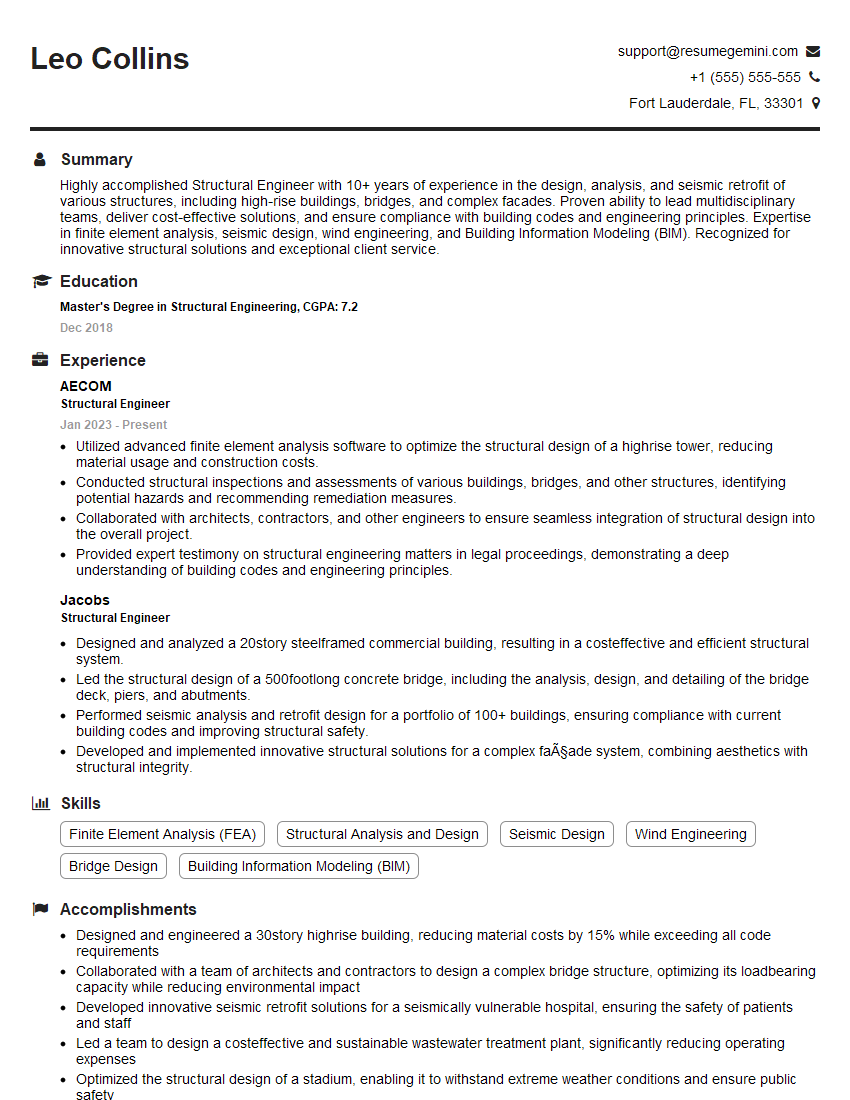
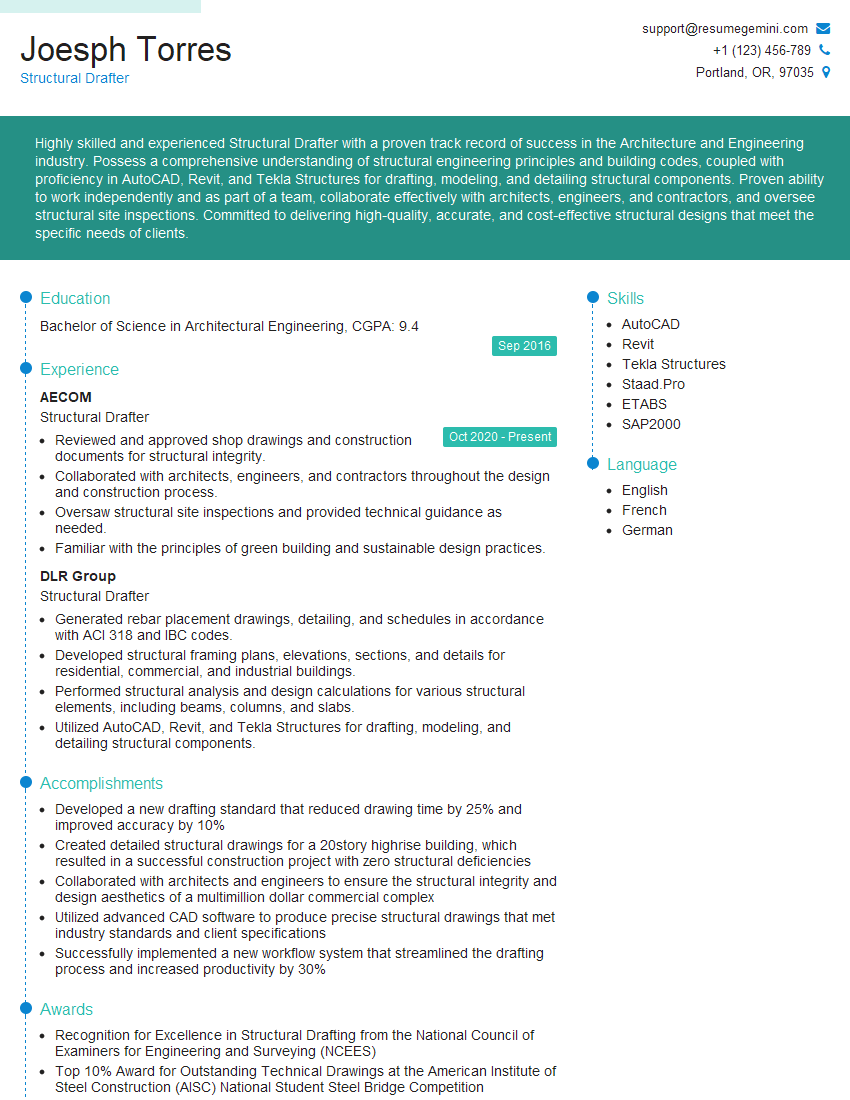
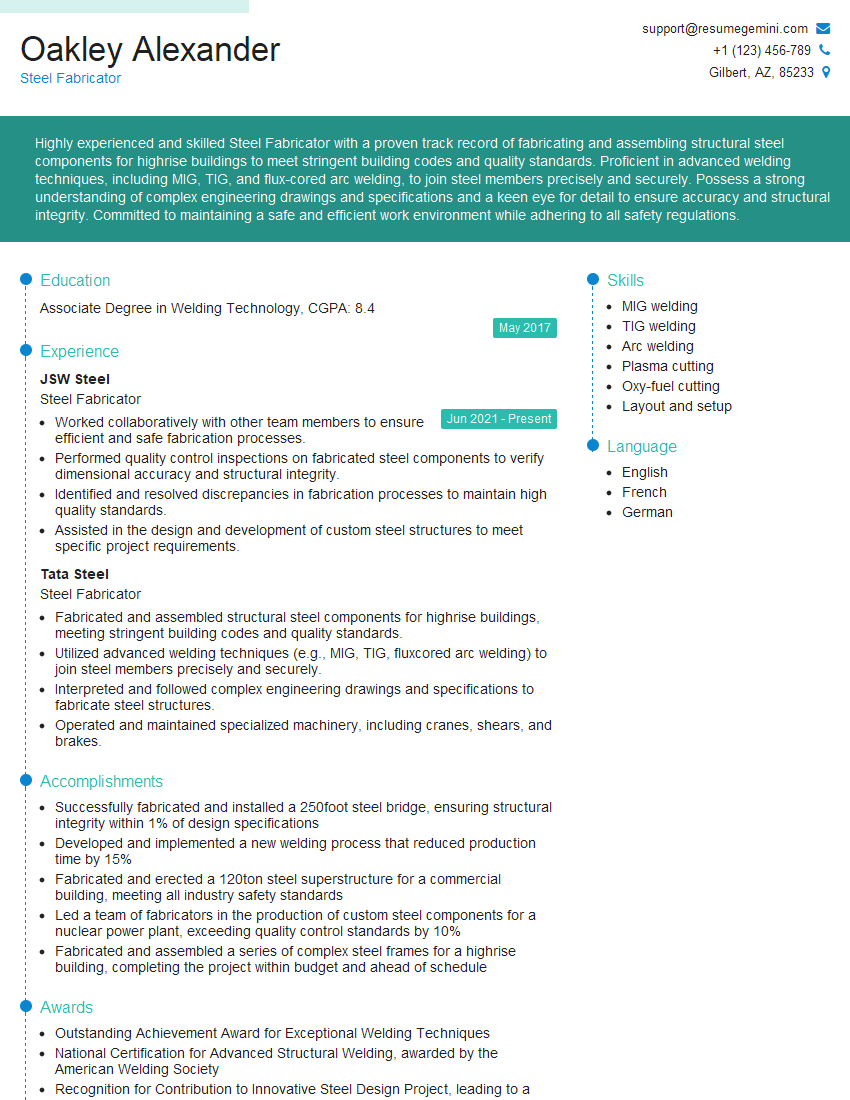
Mastering AISC 360 is crucial for career advancement in structural engineering. A strong understanding of this code is highly sought after by employers and demonstrates your competency and commitment to safe and efficient design. To maximize your job prospects, create an ATS-friendly resume that effectively highlights your skills and experience. We highly recommend using ResumeGemini to build a professional and impactful resume that grabs the attention of recruiters. ResumeGemini provides examples of resumes tailored to AISC 360 to help you get started. Take the next step towards your dream career today!


Explore more articles
Users Rating of Our Blogs
Share Your Experience
We value your feedback! Please rate our content and share your thoughts (optional).
What Readers Say About Our Blog
Very informative content, great job.
good