Interviews are more than just a Q&A session—they’re a chance to prove your worth. This blog dives into essential Anatomical Illustration interview questions and expert tips to help you align your answers with what hiring managers are looking for. Start preparing to shine!
Questions Asked in Anatomical Illustration Interview
Q 1. Describe your experience with different anatomical illustration techniques (e.g., pen and ink, digital painting, 3D modeling).
My experience in anatomical illustration spans a wide range of techniques, each offering unique advantages. I’m proficient in traditional pen and ink, which allows for precise line work and a classic aesthetic, perfect for capturing fine details like bone textures or nerve pathways. I frequently use this method for creating detailed, high-contrast images for textbooks or scientific publications. For instance, I recently used pen and ink to illustrate the intricate branching pattern of the pulmonary arteries for a cardiology textbook. Digital painting offers greater flexibility and ease of revision. Software like Photoshop allows me to experiment with color, shading, and layering to create more dynamic and visually appealing images, particularly useful for medical presentations or public outreach materials. An example of this would be a digital painting I created showcasing the layers of the skin, emphasizing the different textures and cellular structures. Finally, 3D modeling, using software like Blender or ZBrush, is invaluable for creating complex anatomical models that can be viewed from any angle and easily manipulated. This is particularly helpful when illustrating complex three-dimensional structures like the skull or the heart. I recently used 3D modeling to create an interactive model of the human brain for a neuroscience education platform.
Q 2. Explain your process for creating accurate and aesthetically pleasing anatomical illustrations.
My process for creating accurate and aesthetically pleasing anatomical illustrations is iterative and involves several key steps. It begins with thorough research and reference gathering. I consult anatomical atlases, textbooks, and online resources, ensuring the latest scientific understanding underpins my work. Next, I create a detailed sketch, focusing on the overall composition and the accurate representation of the anatomical structures. This sketch acts as a blueprint, guiding the subsequent steps. I then meticulously refine the sketch, paying close attention to proportion, perspective, and anatomical detail. The choice of technique (pen and ink, digital painting, 3D modeling) depends on the specific needs of the project and the desired aesthetic. For example, for a medical textbook focusing on precision, I’d likely favor pen and ink, whereas for a more artistic representation in a museum exhibit, I might opt for digital painting. Throughout the process, I continuously review and refine the illustration, ensuring anatomical accuracy and visual appeal are in balance. The final step involves color correction and final touches, bringing the illustration to its full potential.
Q 3. How do you ensure the anatomical accuracy of your illustrations?
Ensuring anatomical accuracy is paramount. I employ several strategies to achieve this. First, I meticulously cross-reference my work with multiple reputable sources, comparing different anatomical atlases and textbooks to avoid inconsistencies. Second, I consult with anatomical experts (e.g., anatomists, surgeons, medical illustrators) throughout the process, seeking their feedback and validation to catch any potential errors. This peer review step is crucial in confirming the accuracy of my depictions. Third, I use anatomical terminology consistently and precisely in my illustrations, including labels and annotations where necessary. For example, when illustrating muscle origins and insertions, I carefully check the precise attachment points to ensure accuracy. Finally, I maintain a rigorous system of documentation and version control to track changes and corrections made during the illustration process, ensuring traceability and easy review.
Q 4. What software and tools are you proficient in for anatomical illustration?
My proficiency spans a variety of software and tools. For digital painting, I’m highly skilled in Adobe Photoshop and Adobe Illustrator, utilizing their features for precise line work, color manipulation, and layering. For 3D modeling, my expertise lies in Blender and ZBrush, allowing me to create complex anatomical models with realistic textures and details. I’m also proficient in Adobe InDesign for preparing illustrations for publication, ensuring optimal layout and resolution. In addition to software, I utilize a range of traditional art tools, including various pens, pencils, and brushes, depending on the specific needs of the project. This blend of traditional and digital skills allows me to adapt my workflow to diverse illustration requirements.
Q 5. How do you handle feedback and revisions on your anatomical illustrations?
Handling feedback and revisions is an integral part of the illustration process. I actively solicit feedback from clients and experts throughout the project, encouraging open communication and constructive criticism. I view feedback as an opportunity to enhance the accuracy and clarity of the illustrations. When receiving feedback, I carefully analyze each comment and assess its validity concerning both artistic and scientific aspects. I then implement revisions systematically, documenting the changes made and explaining my rationale for each decision. This documented process promotes transparency and allows clients to easily understand the modifications implemented. I maintain a professional and collaborative approach, valuing the expertise and perspectives of others to improve the quality of the final product.
Q 6. Describe your experience illustrating different anatomical systems (e.g., skeletal, muscular, nervous).
My experience encompasses illustrating various anatomical systems. I have extensively worked on skeletal illustrations, focusing on bone morphology, articulation, and joint movements. This has included creating detailed depictions of individual bones as well as complete skeletal systems for different species. My experience with muscular system illustrations involves depicting muscle origins, insertions, actions, and innervation. I’ve illustrated muscle groups individually and in context with the skeletal system, creating images that emphasize functional relationships. Furthermore, I’ve created numerous illustrations of the nervous system, showcasing the intricate network of nerves, brain structures, and spinal cord components. For example, I’ve detailed the pathways of cranial nerves, the organization of the cerebellum and cerebrum, and the anatomy of spinal nerves. This broad experience ensures I can accurately and effectively represent anatomical details across multiple systems.
Q 7. How do you approach illustrating complex anatomical structures?
Illustrating complex anatomical structures requires a strategic approach. I begin by breaking down the complex structure into smaller, more manageable components. This allows for a clearer understanding of the individual parts and their relationships. Then, I use layering and transparency techniques (in digital illustration) or careful shading and line work (in traditional illustration) to create depth and highlight the spatial relationships between the various elements. I often employ cross-sectional views, cutaways, or 3D modeling to help visualize intricate structures like the brain or the heart. For example, when illustrating the human heart, I might use cross-sectional views to show the chambers and valves, complemented by 3D models to convey the overall structure. The use of color coding, labels, and clear annotations is also crucial to enhancing comprehension and reducing visual complexity. By combining these techniques, I ensure that even the most challenging structures are presented in a clear, accurate, and engaging manner.
Q 8. Explain your understanding of anatomical terminology and nomenclature.
Anatomical terminology and nomenclature are crucial for clear and unambiguous communication in the field. It’s a standardized system of names and descriptions for all the structures within the human body, ensuring everyone, from anatomists to medical professionals, understands each other. This includes directional terms (e.g., superior, inferior, medial, lateral), planes of section (e.g., sagittal, transverse, coronal), and specific names for bones, muscles, organs, and vessels. Think of it as a precise language for the body.
For instance, instead of saying ‘the bone in your upper arm,’ we use ‘humerus.’ This precision prevents ambiguity and ensures accuracy in communication, especially vital in medical contexts. Furthermore, understanding roots, prefixes, and suffixes within anatomical terms (e.g., ‘cardio’ relating to the heart, or ‘epi’ meaning above) helps in deciphering complex terms and allows for quicker learning and retention.
- Directional Terms: These describe the location of one body part relative to another (e.g., proximal vs distal, anterior vs posterior).
- Planes of Section: These describe how a body part is divided to show internal structures (e.g., a sagittal section divides the body into left and right halves).
- Regional Terminology: This system specifies the names for different regions of the body (e.g., cephalic for the head, brachial for the arm).
Q 9. How do you maintain consistency in style and accuracy across multiple illustrations?
Maintaining consistency in style and accuracy across multiple illustrations is paramount. I achieve this through a rigorous process. Firstly, I create a comprehensive style guide for each project which dictates aspects like line weight, shading techniques, color palettes, and labeling conventions. This style guide acts as a blueprint, ensuring uniformity across all illustrations.
Secondly, I meticulously reference reliable anatomical atlases and textbooks, ensuring that the depiction of every structure is accurate and aligns with established anatomical knowledge. Cross-referencing sources is crucial to avoid errors and ensures a high level of consistency. Regular quality checks and peer reviews also play a significant role in catching any inconsistencies early on. Finally, I use digital tools and techniques that facilitate consistency, such as creating custom brushes and layer styles, allowing for easily replicable elements across different illustrations.
For example, if I’m illustrating the human heart for a series of educational posters, I would maintain a consistent color scheme for different chambers, ensure consistent representation of valves, and use the same font and size for all labels. Any deviations from the style guide would be documented and approved to maintain a professional aesthetic.
Q 10. Describe your experience with working from anatomical specimens, photographs, or other sources.
My experience encompasses working with a variety of sources – anatomical specimens, photographs, and 3D models. Working directly from anatomical specimens offers unparalleled detail and understanding of the three-dimensional relationships of structures, allowing for accurate depiction of their form, texture, and inter-relationships. However, access to specimens is not always possible, and ethical considerations need to be prioritized. High-resolution photographs serve as invaluable resources, offering clear views of surface anatomy and internal structures. Medical imaging data, including CT and MRI scans, provide detailed cross-sectional views that enhance accuracy, particularly for illustrating complex internal organs.
For instance, during the illustration of a specific muscle group, access to a cadaveric specimen would provide unparalleled detail on muscle fiber orientation and attachments. However, for the visualization of complex internal structures, a combination of MRI scans and anatomical textbooks would be employed to build an accurate and comprehensive illustration.
Q 11. How do you adapt your illustration style to different publication requirements?
Adapting illustration style to different publication requirements involves understanding the target audience and the publication’s aesthetic. A children’s textbook requires a simpler style compared to a medical journal. The level of detail, color palettes, and overall complexity must be adjusted accordingly. For example, a simple line drawing might suffice for a basic anatomy textbook, while a medical journal may require complex, highly detailed illustrations with realistic shading and texturing.
I often work with clients to understand their specific needs and expectations. This collaborative approach allows me to tailor my style to perfectly fit the intended use. This might involve using a specific color scheme as dictated by the publication’s branding or employing a particular level of anatomical detail matching the target audience’s knowledge.
Q 12. How do you manage your time and prioritize tasks when working on multiple projects?
Managing multiple projects requires effective time management and prioritization. I employ project management tools to track deadlines and tasks. Breaking down large projects into smaller, manageable tasks helps to avoid feeling overwhelmed. Prioritization is key—I focus on the most urgent and critical tasks first, using tools like task lists and calendars to allocate sufficient time for each element.
I regularly review my progress and adjust my schedule as needed, adapting to unexpected delays or changes in project requirements. Effective communication with clients is crucial to keep them informed of progress and manage expectations. Moreover, I maintain a flexible schedule to accommodate the demands of each project whilst also ensuring I don’t compromise the quality of my illustrations.
Q 13. Describe your experience collaborating with other professionals (e.g., physicians, editors).
Collaboration with physicians, editors, and other professionals is fundamental. I engage in close dialogue to ensure the illustrations accurately reflect the scientific content and are easily understood by the intended audience. Physicians provide valuable feedback on anatomical accuracy and clarity. Editors offer crucial insights into the overall aesthetic and readability, ensuring that the illustrations fit the publication’s guidelines and style. Open communication and regular feedback sessions ensure a cohesive and accurate final product.
For example, when creating illustrations for a surgical textbook, I would closely collaborate with surgeons to ensure the accuracy of the anatomical depictions, particularly regarding surgical approaches and related anatomical landmarks. Regular feedback loops allow for revisions and refinements to meet the medical accuracy and artistic requirements of the project.
Q 14. How do you ensure your illustrations are accessible to a wide audience?
Accessibility is critical. My illustrations aim to be inclusive to a broad audience, including those with visual impairments. I strive to create clear and concise visuals, avoiding unnecessary clutter or complex details. I use clear labeling and annotations, employing simple language and avoiding jargon whenever possible. Where appropriate, I may utilize alternative text descriptions for images to enhance accessibility for visually impaired individuals using screen readers. This ensures that the information is easily understandable and usable by as wide a range of people as possible.
For example, when illustrating a complex anatomical structure, I might create a simplified version alongside the more detailed illustration, catering to audiences with varying levels of anatomical knowledge. I would also ensure that any color schemes chosen have sufficient contrast to ensure readability for individuals with color blindness.
Q 15. What are your strengths and weaknesses as an anatomical illustrator?
My greatest strength as an anatomical illustrator lies in my meticulous attention to detail and my deep understanding of human anatomy. I’ve spent years studying anatomical texts, dissecting specimens (under appropriate supervision, of course!), and honing my artistic skills to accurately represent complex structures. I can seamlessly integrate artistic flair with scientific precision. A weakness I’m actively working on is time management on particularly complex projects. While my dedication ensures accuracy, it sometimes means I need to improve my efficiency in prioritizing tasks to meet deadlines consistently.
Career Expert Tips:
- Ace those interviews! Prepare effectively by reviewing the Top 50 Most Common Interview Questions on ResumeGemini.
- Navigate your job search with confidence! Explore a wide range of Career Tips on ResumeGemini. Learn about common challenges and recommendations to overcome them.
- Craft the perfect resume! Master the Art of Resume Writing with ResumeGemini’s guide. Showcase your unique qualifications and achievements effectively.
- Don’t miss out on holiday savings! Build your dream resume with ResumeGemini’s ATS optimized templates.
Q 16. How do you stay up-to-date with the latest advancements in anatomical illustration techniques and technology?
Staying current in this field is crucial. I regularly attend conferences like those hosted by the Association of Medical Illustrators, subscribe to journals like ‘The Anatomical Record’ and ‘Clinical Anatomy’, and actively engage with online communities of medical illustrators. I also explore new software and technologies, such as advancements in 3D modeling and animation software, to improve my workflow and the quality of my illustrations. Online courses and workshops focusing on new techniques in digital art and anatomical rendering also form a part of my continuous learning process.
Q 17. Describe a challenging anatomical illustration project and how you overcame the challenges.
One particularly challenging project involved illustrating the intricate vascular system of the human brain for a neurosurgical textbook. The sheer complexity of the arteries, veins, and capillaries, their three-dimensional arrangement, and the need to present them clearly for a medical audience was daunting. To overcome this, I first created detailed anatomical studies from various sources, including anatomical atlases, MRI scans, and 3D models. I then utilized layered digital painting techniques in software like Photoshop, building up the complexity gradually, layer by layer, ensuring each vessel was accurately placed and proportionally sized. This iterative approach, along with regular consultation with the neurosurgeon commissioning the work, allowed me to deliver an accurate and visually compelling illustration that met the exacting requirements of the project.
Q 18. How do you balance artistic expression with anatomical accuracy?
Balancing artistic expression with anatomical accuracy is the core challenge, and arguably the art, of anatomical illustration. Think of it like a tightrope walk: you need both precision and creativity. I achieve this balance by focusing on clear anatomical representation first. The accuracy of the structures, their relationships, and their proportions are paramount. Once the anatomical foundation is solid, I use artistic techniques like shading, color, and composition to enhance the illustration’s clarity and visual appeal without compromising anatomical accuracy. For example, subtle variations in color might highlight specific structures without altering their form.
Q 19. Explain your understanding of copyright and intellectual property related to anatomical illustrations.
Understanding copyright and intellectual property is essential. Anatomical illustrations, unless they are purely schematic or based on publicly available datasets, are usually protected by copyright. This means the creator holds the exclusive right to reproduce, distribute, and adapt their work. I always ensure I have the necessary permissions and licenses before using any pre-existing images or data. Furthermore, I clearly define the ownership and usage rights of my illustrations in contracts with clients, specifying whether the copyright remains with me or is transferred to the client. It’s crucial to protect both the creator’s rights and the client’s ability to use the illustration legally.
Q 20. How do you handle requests for illustrations that fall outside your area of expertise?
When faced with a request outside my area of expertise (for instance, veterinary anatomy or botanical illustration), I’m always upfront and honest. I’ll discuss the limitations of my expertise and suggest alternative solutions. This might involve recommending another illustrator specializing in that specific area or collaborating with an expert in the relevant field. Maintaining transparency and prioritizing the client’s needs is key. It’s better to refer a project than to produce inaccurate or misleading work.
Q 21. What is your understanding of different anatomical planes and sections?
Anatomical planes and sections are fundamental to understanding the spatial relationships of anatomical structures. The three primary planes are:
- Sagittal Plane: A vertical plane that divides the body into left and right halves. A midsagittal plane divides the body into equal left and right halves.
- Frontal (Coronal) Plane: A vertical plane that divides the body into anterior (front) and posterior (back) portions.
- Transverse (Axial) Plane: A horizontal plane that divides the body into superior (upper) and inferior (lower) portions.
Q 22. How do you illustrate variations in anatomical structures?
Illustrating anatomical variations requires a nuanced approach that goes beyond depicting a single ‘ideal’ structure. It involves showcasing the range of normal anatomical differences observed across individuals. This is crucial because human anatomy isn’t uniform; significant variations exist in size, shape, and even the presence or absence of certain structures.
- Multiple Views: I often present multiple examples side-by-side to directly compare different variations of the same structure. For example, showing three variations of the branching pattern of the coronary arteries highlights the common variations in this critical circulatory network.
- Detailed Labeling: Clear and concise labels are essential for differentiating these variations. For example, labeling a particular muscle attachment point as “typical” versus “variant A” and “variant B” clarifies the anatomical differences.
- Statistical Data (if applicable): Integrating statistical data regarding the prevalence of a specific variation adds another layer of scientific rigor and context to the illustration. For instance, indicating that “variant B” is found in approximately 15% of the population increases the educational impact.
- Textual Explanations: I complement illustrations with concise, accurate descriptions of the variations and their clinical significance. This ensures a comprehensive understanding, especially when depicting subtle differences that may not be immediately apparent from the image alone.
By employing these strategies, I create illustrations that not only accurately represent anatomical diversity but also enhance the reader’s understanding of the clinical relevance of these variations.
Q 23. How do you use color and shading to enhance the clarity and understanding of anatomical structures?
Color and shading are fundamental tools in anatomical illustration, serving to both clarify complex structures and improve the overall aesthetic appeal. My approach emphasizes strategic color selection and shading techniques to highlight key features and guide the viewer’s eye.
- Anatomical Color Coding: I consistently adhere to established color conventions for tissues and organs (e.g., red for arteries, blue for veins, etc.), ensuring immediate recognition. Departures from these conventions, if needed, are clearly documented in a legend.
- Depth and Dimension through Shading: Light source directionality is crucial for creating realism and highlighting three-dimensional aspects of structures. Subtle shading and highlights guide the eye along the contours of muscles, bones, and organs, making them easier to visualize.
- Highlighting Key Structures: I use color intensity or saturation strategically to emphasize specific features such as the origin and insertion points of muscles, or the branching pattern of a nerve plexus. This can use a more vivid or slightly different shade to indicate the areas of focus without sacrificing accuracy.
- Transparency Effects: For complex overlapping structures, controlled transparency allows viewers to understand the spatial relationships between them. For example, showing partially transparent layers of muscle over bone creates a clear representation of underlying structures.
Careful consideration of color and shading improves not just the visual appeal, but also significantly enhances the educational value of anatomical illustrations. The correct use of color and shading can transform a complex drawing into a comprehensive and easily understandable representation of the human body.
Q 24. Explain your experience with creating anatomical illustrations for different media (e.g., print, web, video).
My experience spans various media, each presenting unique challenges and opportunities. I’ve worked extensively on illustrations for print, web, and video applications.
- Print Media: For print, high-resolution images with exceptional detail and clarity are crucial. I carefully consider ink limitations and optimize my illustrations for printing on various substrates (paper, cardstock, etc.). I ensure the artwork is designed to reproduce well while retaining fine detail, even at smaller sizes. A recent project involved creating illustrations for a high-quality medical textbook, requiring careful attention to detail and color consistency across many pages.
- Web Media: Web illustrations often require smaller file sizes and optimized formats for fast loading times. I create images in vector formats (SVG) whenever feasible, ensuring scalability without loss of quality. For complex animations, I’ve utilized tools that offer smooth interactive experiences.
- Video Media: Producing anatomical animations for educational videos requires a deep understanding of anatomical structure and motion. I employ both 2D and 3D animation techniques to produce dynamic and engaging visuals. I work closely with video editors to seamlessly integrate the illustrations into the overall presentation.
Adapting my illustration style to the demands of each medium has been a critical skill for successfully completing a diverse range of projects.
Q 25. Describe your approach to creating illustrations for educational purposes.
Creating illustrations for educational purposes requires a different approach than those intended for medical professionals. My strategy focuses on simplifying complex anatomy without sacrificing accuracy.
- Simplified Representation: I avoid overwhelming detail, focusing on the essential aspects of a structure. For example, illustrating the skeletal system for a high school textbook may not require the same level of bone detail as a medical atlas.
- Clear and Concise Labeling: Labels are unambiguous and easy to understand for the intended audience. I often use color-coding and visual cues to further aid comprehension.
- Visual Hierarchy: I use size, color, and placement to emphasize important elements, guiding the eye to the most crucial information. This ensures viewers focus on the key anatomical features and relationships.
- Contextualization: I often include illustrations that demonstrate the structure’s function within the larger context of the body. For example, showcasing a muscle’s action during movement improves understanding.
- Interactive Elements (if applicable): For digital applications, I incorporate interactive elements such as clickable labels, pop-up definitions, or 3D models, creating engaging learning experiences.
The goal is to create visually engaging, easy-to-understand illustrations that promote learning and retention for the target audience. I always keep in mind the cognitive level of the learners and adapt my approach accordingly.
Q 26. How do you ensure the ethical considerations when illustrating anatomical material?
Ethical considerations are paramount when illustrating anatomical material. My approach involves meticulous attention to detail, accuracy, and respect for human dignity.
- Accurate Representation: I strive for anatomical accuracy based on reliable scientific sources. Any deviation from established anatomical knowledge is clearly noted and justified.
- Avoiding Stereotyping: I carefully avoid any representation that reinforces harmful stereotypes related to race, gender, or body type. I aim for diverse and inclusive representations.
- Informed Consent (when applicable): When using images derived from real individuals, I ensure appropriate informed consent procedures have been followed. This is particularly relevant when working with clinical images or using photographic references.
- Respectful Depiction: The overall presentation of the illustrations should maintain respect for human dignity. I avoid sensationalism or gratuitous exposure of sensitive anatomical areas.
- Attribution and Credit: I always properly attribute sources of information and images to avoid plagiarism and ensure academic honesty.
Ethical practice is deeply intertwined with the integrity and credibility of anatomical illustrations. My commitment to ethical considerations forms the basis of my work.
Q 27. What is your experience with creating illustrations for medical textbooks or journals?
I possess considerable experience creating illustrations for medical textbooks and journals. These projects demand a high level of accuracy and precision, adhering to strict editorial guidelines.
- Collaboration with Authors and Editors: I work closely with authors and editors throughout the illustration process to ensure the artwork aligns with the text and meets the journal’s or publisher’s specifications. Feedback is incorporated iteratively.
- Adherence to Style Guides: I carefully adhere to the specific style guides and formatting requirements of each publication, ensuring consistency in labeling, color schemes, and image resolution.
- High-Resolution Artwork: Illustrations for print publications require exceptionally high resolution to ensure sharp reproduction. I create images at resolutions significantly higher than the final printed size.
- Accurate Labeling and Captions: Precise and informative labeling is essential. I provide clear captions that fully describe the illustrated anatomy and its clinical relevance.
- Peer Review (when applicable): Some projects involve submitting artwork to peer review for assessment of accuracy and clarity before final publication.
These projects have honed my skills in creating detailed, accurate, and scientifically sound anatomical illustrations tailored to the specific requirements of medical publications.
Q 28. How do you handle requests for revisions from clients or editors?
Handling revisions from clients or editors is a standard part of the illustration process. I approach revisions with a collaborative and professional attitude.
- Clear Communication: I maintain open and clear communication throughout the process. I request specific feedback and clarify any uncertainties.
- Organized Approach to Revisions: I keep meticulous records of changes requested, making it easy to track progress and ensure all revisions are addressed.
- Understanding the Rationale Behind Revisions: I strive to understand the reasoning behind any revisions, often consulting with clients or editors to ensure a shared understanding of the desired outcome.
- Iterative Process: I may present multiple revisions to incorporate feedback effectively. This iterative process ensures the final product aligns with client expectations and maintains scientific accuracy.
- Time Management: I manage my time effectively to address revisions promptly and within agreed-upon deadlines.
My ability to manage revisions efficiently and professionally contributes to the success of projects and ensures client satisfaction.
Key Topics to Learn for Anatomical Illustration Interview
- Human Anatomy Fundamentals: Deep understanding of skeletal, muscular, nervous, circulatory, and other key systems. Prepare to discuss anatomical terminology and variations.
- Illustration Techniques: Mastery of various mediums (digital painting, traditional drawing, 3D modeling) and software (e.g., Adobe Photoshop, Illustrator, Procreate, Blender). Be ready to showcase your technical skills and artistic style.
- Anatomical Accuracy and Proportion: Discuss your approach to ensuring precise and scientifically accurate representations. Highlight your understanding of perspective, light and shadow, and anatomical detail.
- Medical Illustration Principles: Understanding the specific needs and considerations for creating illustrations for medical textbooks, publications, or presentations. This includes clarity, conciseness, and effective communication of complex information.
- Workflow and Collaboration: Describe your process from initial concept to final product, including research, sketching, refinement, and feedback integration. Discuss collaborative experiences and your ability to work with medical professionals.
- Artistic Style and Presentation: Showcase a portfolio demonstrating a consistent and professional style. Be prepared to discuss your artistic choices and explain how your style contributes to effective communication.
- Problem-Solving in Illustration: Discuss your approach to overcoming challenges in anatomical representation, such as complex structures or ambiguous anatomical variations. Showcase your ability to adapt and find creative solutions.
Next Steps
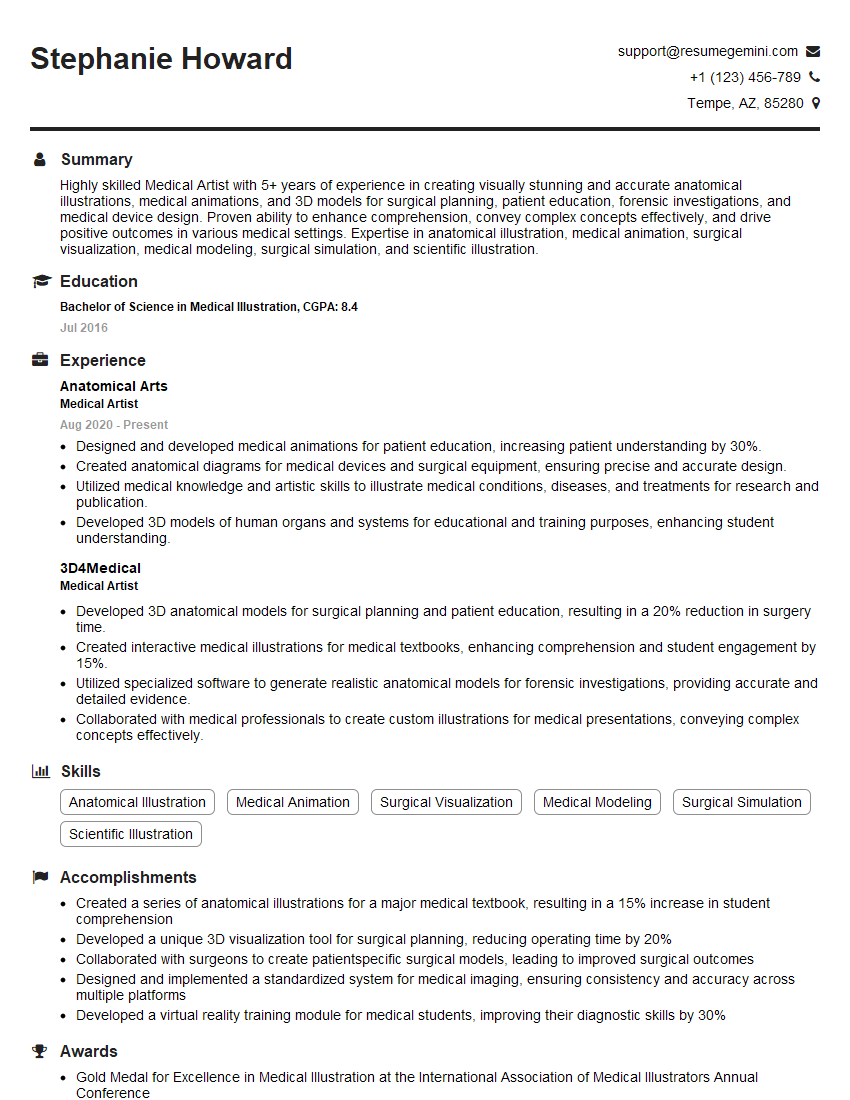
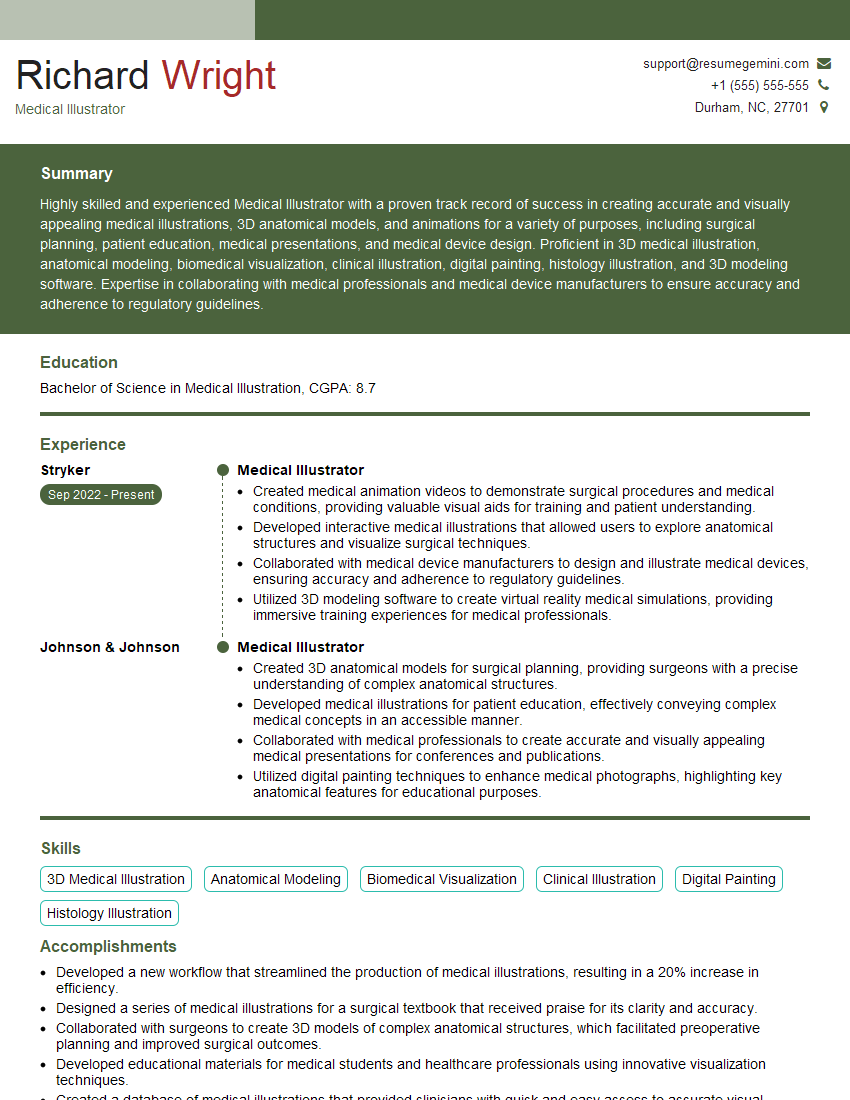
Mastering Anatomical Illustration opens doors to exciting careers in medical publishing, education, research, and pharmaceutical industries. A strong and targeted resume is crucial for showcasing your skills and experience to potential employers. Building an ATS-friendly resume increases your chances of getting your application noticed. ResumeGemini is a trusted resource that can help you craft a compelling and effective resume, optimized for Applicant Tracking Systems. Examples of resumes tailored to Anatomical Illustration are available on ResumeGemini to help guide your process. Take the next step towards your dream career – build a powerful resume with ResumeGemini today!
Explore more articles
Users Rating of Our Blogs
Share Your Experience
We value your feedback! Please rate our content and share your thoughts (optional).
What Readers Say About Our Blog
Very informative content, great job.
good