Preparation is the key to success in any interview. In this post, we’ll explore crucial ANSI/AWS D14.1 Welding Fabrication Symbols interview questions and equip you with strategies to craft impactful answers. Whether you’re a beginner or a pro, these tips will elevate your preparation.
Questions Asked in ANSI/AWS D14.1 Welding Fabrication Symbols Interview
Q 1. Explain the significance of the reference line in a welding symbol.
The reference line in a welding symbol is the foundation of the entire symbol. Think of it as the spine of the symbol; everything else branches off from it. It indicates the location where the weld is to be applied. The reference line itself doesn’t represent a weld; it simply points to where the welding is required on the drawing. It’s crucial because it establishes a clear visual connection between the symbol and the specific joint in the drawing. Without it, the location of the weld would be ambiguous. Imagine trying to build something without knowing where to place a critical part – that’s what a missing or unclear reference line would be like in a welding drawing.
Q 2. Describe the different types of weld symbols and their applications.
ANSI/AWS D14.1 defines various weld symbols, each representing a different type of weld. The most common types include:
- Fillet Weld: A weld that fills the corner formed by two intersecting surfaces. It’s like gluing two pieces of wood together at a corner. Used extensively in many structures for their relatively simple application and good strength.
- Groove Weld: This weld fills a groove prepared in the edges of the parts to be joined. Think of it like a ‘V’ shaped gap that needs to be filled with weld metal. Used for joining thicker materials or where higher strength is critical. Different types include ‘V’, ‘U’, ‘J’ and ‘Bevel’ grooves, depending on the preparation.
- Plug and Slot Weld: These welds fill holes or slots in one of the joined surfaces. Think of them as circular or rectangular reinforcement welds. Commonly used for joining thinner materials or when a flush finish is desired.
- Spot Weld (Resistance Welding): Used primarily with sheet metal, this weld creates a localized fusion between the two pieces. While not explicitly covered in the graphic conventions of D14.1, this is a significant welding process. This symbol differs significantly from the others as it does not follow the same conventions regarding reference lines.
The choice of weld symbol depends on the joint design, material thickness, and required strength. For instance, a fillet weld might suffice for a light-duty frame, while a groove weld would be necessary for a structural steel beam.
Q 3. How are weld sizes indicated in a welding symbol?
Weld sizes are indicated in the welding symbol using dimensions. For fillet welds, the size is indicated as a number placed on the reference line, representing the leg length of the weld. For groove welds, it is generally more complex. The dimensions might indicate the depth, width, and root opening. The specific way this is shown is dependent on the specific groove shape (e.g., ‘V’ groove, ‘U’ groove, etc). The units are usually millimeters (mm) or inches (in), and the appropriate units should be clearly indicated on the drawing. For example, 6mm indicates a 6mm fillet weld leg length.
Q 4. What do the arrow side and opposite side of a welding symbol represent?
The arrow side of the welding symbol indicates the surface to which the weld is applied. This is the side of the joint that will be directly welded. The opposite side shows supplemental information which may include things like the type of weld (e.g., complete penetration), or requirements for weld finishing. The opposite side can be considered a ‘detail side’ or ‘specification side’. It provides additional instructions or specifications related to the weld on the arrow side. If something is only shown on the opposite side, it means that detail only applies to that side of the weldment.
Imagine a building: the arrow side is like the visible exterior you are constructing, while the opposite side shows the internal structure or hidden details of the construction.
Q 5. Explain the meaning of various welding process designations (e.g., SMAW, GMAW).
Welding process designations in welding symbols indicate the method used to create the weld. Some common examples include:
- SMAW (Shielded Metal Arc Welding): This is commonly known as stick welding, where an electrode coated with flux is used. It’s a versatile process but often less efficient than others for high volume applications.
- GMAW (Gas Metal Arc Welding): Often called MIG (Metal Inert Gas) welding, this process uses a continuously fed wire electrode and a shielding gas. It’s known for its high deposition rate and good quality welds.
- GTAW (Gas Tungsten Arc Welding): Also known as TIG (Tungsten Inert Gas) welding, this method uses a non-consumable tungsten electrode. It’s ideal for high-quality welds in applications that require precision and cleanliness.
These abbreviations are placed within the welding symbol to clarify which method should be used. Choosing the right process is critical to meet the required quality and strength of the weld.
Q 6. Interpret a welding symbol with a fillet weld, specifying its size and location.
Let’s say we have a welding symbol with a reference line, a fillet weld symbol on the arrow side, and a dimension ‘5mm’ placed on the reference line. This indicates a 5mm fillet weld on the joint indicated by the reference line. If there is no detail on the opposite side of the reference line, we are assuming the weld is to be made on both sides of the joint (both members are to receive weld bead). The location is determined by the reference line’s placement on the drawing itself. A diagram should be included in the overall welding plan to show the specific joint this relates to.
Q 7. Interpret a welding symbol with a groove weld, specifying its type and preparation.
A welding symbol for a groove weld will show more details. It might have a ‘V’, ‘U’, ‘J’, or ‘Bevel’ symbol on the arrow side to specify the type of groove preparation. Dimensions on the reference line and the opposite side would specify weld size (depth, width, root opening). For example, a ‘V’ groove symbol with dimensions 10mm depth, 5mm root opening, and a 3mm width would indicate a ‘V’ groove weld with these specifications. The specific requirements for the joint preparation are also specified as notes or are visually shown on the drawing itself. This information is crucial for proper weld preparation and ensuring the final weld quality.
Q 8. How are weld interruptions indicated on a welding symbol?
Weld interruptions, meaning breaks in a continuous weld, are indicated on a welding symbol using a short dash or a series of short dashes placed within the weld symbol’s reference line. The length of the dash(es) is not significant; it simply signifies the interruption itself. The spacing between these dashes doesn’t represent a specific measurement but clearly indicates multiple breaks in the weld. Think of it like a pause in a sentence – it breaks the continuous flow.
For example, a continuous weld would simply have a solid line representing the weld, while an interrupted weld would be represented by a line with one or more short dashes across it. _ _ _ would show the weld is interrupted. The exact placement of the interruption(s) may need further clarification on the drawing itself.
Q 9. Explain the significance of the contour symbol.
The contour symbol, found near the tail of the welding symbol, dictates the shape of the weld’s reinforcement. It’s crucial for specifying the finished weld profile. A common mistake is to overlook this small detail; however, the resulting weld bead’s shape significantly impacts structural integrity and aesthetic requirements. Different contour symbols depict convex, concave, or flush welds.
For instance, a convex contour means the weld protrudes above the base metal’s surface, like a small mountain range. A concave contour indicates the weld is recessed below the surface, creating a valley. A flush contour signifies that the weld is even with the surface. These differences are vital for determining if a weld meets specifications and is suitable for its intended use. Imagine building a bridge – a perfectly flush weld might be preferable to a protruding one for aerodynamic reasons and to prevent material build-up.
Q 10. How are field welds differentiated from shop welds on a drawing?
The distinction between shop and field welds is usually made using a small ‘F’ (for field) appended to the welding symbol or by a note directly referencing field versus shop welds. This is critical for logistical and quality control purposes, as field welds are often performed under less-controlled conditions than those done in a shop environment. Different welding procedures and welder qualifications might be required for field work.
Imagine a large structure like a skyscraper. Much of the welding is done in the controlled environment of a fabrication shop. However, some welding might need to be done on-site, which is considered field welding. The symbol ‘F’ would clearly identify such welds in the drawing.
Q 11. Describe the difference between a continuous and intermittent weld.
A continuous weld runs uninterrupted along the entire length of the joint. It’s like a solid line of weld metal, providing consistent strength throughout. An intermittent weld, however, is applied in a series of shorter segments, separated by gaps. Think of it as a dashed line instead of a solid one.
Choosing between continuous and intermittent welds depends on the application. Continuous welds offer maximum strength, while intermittent welds are used when full weld strength along the joint’s entire length isn’t necessary or practical. Intermittent welds might be chosen to reduce costs or accommodate specific design requirements.
Q 12. How is the length of an intermittent weld indicated?
The length of an intermittent weld is usually indicated using two dimensions: the length of the weld itself (weld length) and the spacing between consecutive welds (pitch or spacing). These values are typically shown as a fraction or decimal value, following a specific format, usually ‘length of weld’ / ‘pitch’ or ‘length’ / ‘space’. For example, 1/2 would indicate 1/2 inch long welds, 1/2-1 would indicate 1/2 inch long welds spaced 1 inch apart.
Sometimes, only the weld length is specified, indicating equal spacing between each segment. Always refer to the drawing’s legend or notes for the exact unit of measurement (inches or millimeters). Inaccurate representation can lead to weakened joints, hence precision is paramount.
Q 13. Explain the meaning of various weld joint types (e.g., butt, lap, tee).
Different weld joint types are chosen based on the geometry of the parts being joined and the required structural characteristics. Here are the basics:
- Butt Joint: Two pieces are butted together end-to-end, with the weld filling the gap between them. Think of welding two strips of metal together to make a longer strip.
- Lap Joint: Two pieces overlap each other, and the weld is placed on the overlapped portion. Imagine placing one piece of metal on top of another and then welding across the overlap.
- Tee Joint: One piece joins another at a right angle, like the shape of the letter ‘T’. This often involves welding the legs of the ‘T’ together.
Understanding these joints is fundamental. For example, a butt joint is best for achieving maximum strength in a straight line, while a lap joint might be preferred for ease of assembly.
Q 14. What are the implications of incorrect welding symbol interpretation?
Incorrect interpretation of welding symbols has serious consequences, potentially leading to catastrophic failures. Misunderstanding the type of weld, its dimensions, or its location can result in a weakened joint, which might fail under load, causing damage, injury, or even death. This is particularly crucial in safety-critical applications such as bridges, pipelines, or aircraft.
Imagine a scenario where the symbol indicates an intermittent weld, but the welder mistakenly applies a continuous one. This could lead to unnecessary material usage and potentially an inferior, weaker weld. Or, if the welder misinterprets the required weld size, the structural integrity of the entire assembly might be compromised. Therefore, accurate understanding of the standard is non-negotiable.
Q 15. How are special process requirements indicated on a welding symbol?
Special process requirements, such as the use of specific welding procedures or post-weld heat treatments, are indicated on a welding symbol using a reference designation. This is typically a letter or number placed within the tail of the symbol. The specific process is then detailed elsewhere in the drawing or in a separate welding procedure specification. Think of it like a shorthand reference – the symbol points to the detailed instructions.
For example, if a specific PWHT (Post-Weld Heat Treatment) is required, a letter like ‘A’ might be placed in the tail. Elsewhere on the drawing, under the title ‘Welding Procedure Specifications’, ‘A’ would be defined as ‘PWHT per Procedure 12345’. This ensures clarity and avoids cluttering the symbol itself with unnecessary details.
- Example: A symbol with ‘P’ in the tail could reference a specific preheating procedure.
Career Expert Tips:
- Ace those interviews! Prepare effectively by reviewing the Top 50 Most Common Interview Questions on ResumeGemini.
- Navigate your job search with confidence! Explore a wide range of Career Tips on ResumeGemini. Learn about common challenges and recommendations to overcome them.
- Craft the perfect resume! Master the Art of Resume Writing with ResumeGemini’s guide. Showcase your unique qualifications and achievements effectively.
- Don’t miss out on holiday savings! Build your dream resume with ResumeGemini’s ATS optimized templates.
Q 16. Interpret a welding symbol indicating a specific type of weld metal.
The type of weld metal is indicated in the welding symbol by specifying the filler metal designation. This is typically done in the reference designation area of the symbol, similar to how special processes are indicated. The designation will directly correlate to a standard or specification that defines the chemical composition and mechanical properties of the filler metal. This ensures that the correct material is used, ensuring quality and avoiding potential issues.
Example: Let’s say the symbol has ‘E7018’ in the reference tail. This indicates that the weld should be made with a filler metal complying with the AWS A5.1 specification for E7018 electrodes, known for their high strength and good low-temperature toughness.
Q 17. How are weld surface conditions indicated in a welding symbol?
Weld surface conditions, such as the need for grinding or machining, are specified using the finish symbol. This symbol is placed on the arrow side of the welding symbol. Different symbols or specifications indicate different levels of surface finish required. It’s crucial for aesthetics and functionality, depending on the application.
Example: A symbol featuring a small ‘C’ near the arrow would indicate a requirement for a convex surface finish. A symbol with a ‘G’ might denote the necessity for grinding to a specified surface roughness.
Q 18. Explain the significance of the backing symbol.
The backing symbol, a small rectangle placed at the bottom of the arrow, indicates that a backing material (like a backing strip) is to be used during the welding process. This is important for several reasons: it helps control the weld bead geometry, reduces weld spatter, prevents burn-through on thinner materials, and can speed up the welding process.
The presence of this symbol ensures the welder understands this essential detail, preventing potential issues that would arise from performing a welding process that would require a backing material to one which does not.
- Example: In welding thin sheet metal, a backing material is often used to provide support and prevent weld defects.
Q 19. Describe the purpose of the finish symbol.
The finish symbol, located on the arrow side of the welding symbol, specifies the required surface condition of the completed weld. This is critical for functionality, appearance, and dimensional accuracy. It dictates whether grinding, machining, or other finishing processes are necessary to achieve the desired result. A lack of appropriate finishing could compromise a product’s performance or aesthetics.
Example: A specified surface finish might be required for pressure vessel applications to ensure smooth surfaces and prevent stress concentrations. The finish symbol communicates these requirements concisely and clearly to the welders.
Q 20. How are multiple welds indicated on a single symbol?
Multiple welds on a single joint are indicated by stacking the individual weld symbols one above the other. Each symbol represents a different weld pass or a different type of weld. This allows for a comprehensive representation of a complex welding process in a compact manner. This avoids creating multiple and potentially confusing symbols. It maintains organization.
Example: To represent a weld with a root pass followed by a fill pass and a cover pass, three stacked symbols would be used, each showing the size and type for that specific pass.
Q 21. What are the limitations of using welding symbols?
While welding symbols are incredibly efficient and useful, they do have limitations. They are primarily graphical and cannot fully capture the nuances of complex welding procedures. They rely on additional documentation like written specifications and procedure qualifications. Also, symbols can be misinterpreted if not drawn accurately or if the associated reference documents aren’t available. Finally, symbols are only as good as the knowledge and skill of the person interpreting them. Thus, proper training is vital.
- Example: A symbol might indicate a specific weld size, but it may not specify the exact welding parameters such as current and voltage, requiring those details to be sourced elsewhere.
Q 22. What is the significance of the flank weld symbol?
The flank weld symbol, in ANSI/AWS D14.1, indicates a weld that is applied to the side of a member, typically used to reinforce a joint or provide additional strength. Think of it like adding extra support to a structure. It’s represented by a small triangle pointing towards the side of the member where the weld is located. The symbol itself doesn’t dictate the weld type; that’s specified separately (e.g., fillet, groove). The crucial aspect is its location: it’s not on the joint itself, but rather on a facing surface.
For example, imagine a steel plate that needs extra strength along an edge; a flank weld, indicated by the triangle on the welding symbol, would be added to that edge to provide the necessary reinforcement. This helps prevent things like buckling or bending under stress.
Q 23. How are tolerances indicated for welds?
Tolerances for welds, crucial for ensuring quality and fit, are specified in ANSI/AWS D14.1 using dimensions and symbols on the welding symbol itself. Instead of explicitly stating ‘±1 mm’, for instance, the standard uses symbols and references to other sections of the drawing or specification for detailed tolerance information.
For example, a dimension on the symbol might state ‘6mm’ for the weld size. The accompanying specification would then clarify acceptable deviations from this size. This could be expressed as a plus/minus tolerance (e.g., ±0.5mm) or a range (e.g., 5.5mm to 6.5mm). It’s crucial to understand that the welding symbol itself provides only part of the picture; the related documentation must also be consulted. Missing details can lead to improper welds and structural failures.
Q 24. How are specific weld testing requirements indicated?
Specific weld testing requirements are indicated on the welding symbol using reference letters or numbers, which correlate to a separate test specification or procedure. This avoids cluttering the symbol with too much detail and improves clarity. The reference directs the fabricator to the detailed description of the tests to be performed. These tests typically cover things like tensile strength, bend tests, and radiographic inspection.
For instance, the symbol might contain a letter ‘A’, which in the relevant documentation, would specify that the weld must undergo a radiographic examination (RT) to detect internal flaws. A different letter, say ‘B’, might reference a specific tensile strength test to ensure that the weld meets the required strength.
Q 25. Differentiate between complete joint penetration and partial joint penetration.
The key difference between complete joint penetration (CJP) and partial joint penetration (PJP) lies in how deeply the weld penetrates the joint. CJP means the weld completely fills the joint, fusing the base materials through their entire thickness. Think of it like perfectly gluing two pieces of wood together, leaving no gap. PJP, on the other hand, only penetrates partway through the base material’s thickness. Imagine only partially gluing the wood, leaving a slight gap.
CJP is typically stronger and preferred for applications where high structural integrity is crucial. PJP is sometimes acceptable for less critical applications or when complete penetration is impractical. These distinctions are clearly indicated on the welding symbol itself using specific notations and sometimes additional notes or cross-referencing.
Q 26. How would you determine the correct welding procedure from a drawing?
Determining the correct welding procedure from a drawing involves several steps. First, you’ll need to carefully examine the welding symbol to determine the type of weld, size, process, and any other specific requirements. The symbol might contain a reference number or letter, often in a reference box. This reference ties the symbol to a welding procedure specification (WPS) document. This WPS contains detailed information on such things as the type of filler metal, preheating temperature, welding parameters, and post-weld heat treatment.
For example, a number ‘WPQ-123’ on the welding symbol directs the welder to a document numbered ‘WPQ-123’ to find the complete procedure to use for that specific weld. You should never guess which procedure to use – always carefully locate and use the referenced WPS document.
Q 27. Explain the importance of adhering to the AWS D14.1 standard.
Adhering to the AWS D14.1 standard is paramount for several reasons. First, it ensures consistency and quality in welding fabrication. It is a widely accepted standard and using it ensures communication clarity between engineers, welders, and inspectors. Using a consistent standard minimizes misinterpretations and errors in production.
Second, it ensures the safety and reliability of welded structures. By following the guidelines of the standard, we produce structures that are safe, strong, and reliable in operation. Following AWS D14.1 helps avoid costly mistakes and potential structural failures that could endanger human life or cause environmental damage. Third, it promotes legal compliance. The standard provides benchmarks to ensure the fabrication meets various safety and legal requirements.
Q 28. Describe a situation where you had to interpret a complex welding symbol.
I once encountered a welding symbol that included a staggered arrangement of multiple welds, each with its own specific requirements, including a counter-bore and a special filler material. The symbol itself was complex, incorporating multiple lines, arrows, and reference numbers. The challenge lay in deciphering the order of the welds, ensuring that the counter-bore dimensions were correct for each and finding the appropriate WPS documents for each specific weld in the arrangement.
To resolve this, I systematically analyzed each component of the symbol, carefully reviewing each dimension and reference number. I created a step-by-step plan outlining the welding sequence, the required dimensions for each stage, and the specific WPSs for the various weld types and materials. This methodical approach ensured that the welds were executed correctly, meeting all specifications and producing a structurally sound and safe component.
Key Topics to Learn for ANSI/AWS D14.1 Welding Fabrication Symbols Interview
- Basic Symbol Components: Understanding the fundamental elements of a welding symbol, including the reference line, arrow, and other key indicators.
- Weld Types: Familiarize yourself with various weld types represented by the symbols (e.g., fillet welds, groove welds, plug welds) and their respective applications.
- Weld Dimensions: Mastering the interpretation of dimensions such as weld size, length, and spacing as indicated on the symbol.
- Contour Symbols: Learn to interpret symbols indicating weld contour and finishing requirements (e.g., concave, convex).
- Finishing Symbols: Understanding symbols for weld finishing processes such as grinding, chipping, or machining.
- Location of Welds: Accurately identifying where welds should be placed based on symbol placement and indications.
- Supplementary Symbols: Understanding the meaning and application of supplementary symbols, including those for specific welding processes or materials.
- Practical Application: Practice interpreting complex welding symbols found in real-world fabrication drawings and blueprints. Consider working through example drawings to build proficiency.
- Problem-Solving: Develop the ability to analyze incomplete or ambiguous symbols and determine the most likely intended weld configuration.
- Code Compliance: Understand the importance of adhering to ANSI/AWS D14.1 standards and the implications of incorrect interpretation.
Next Steps
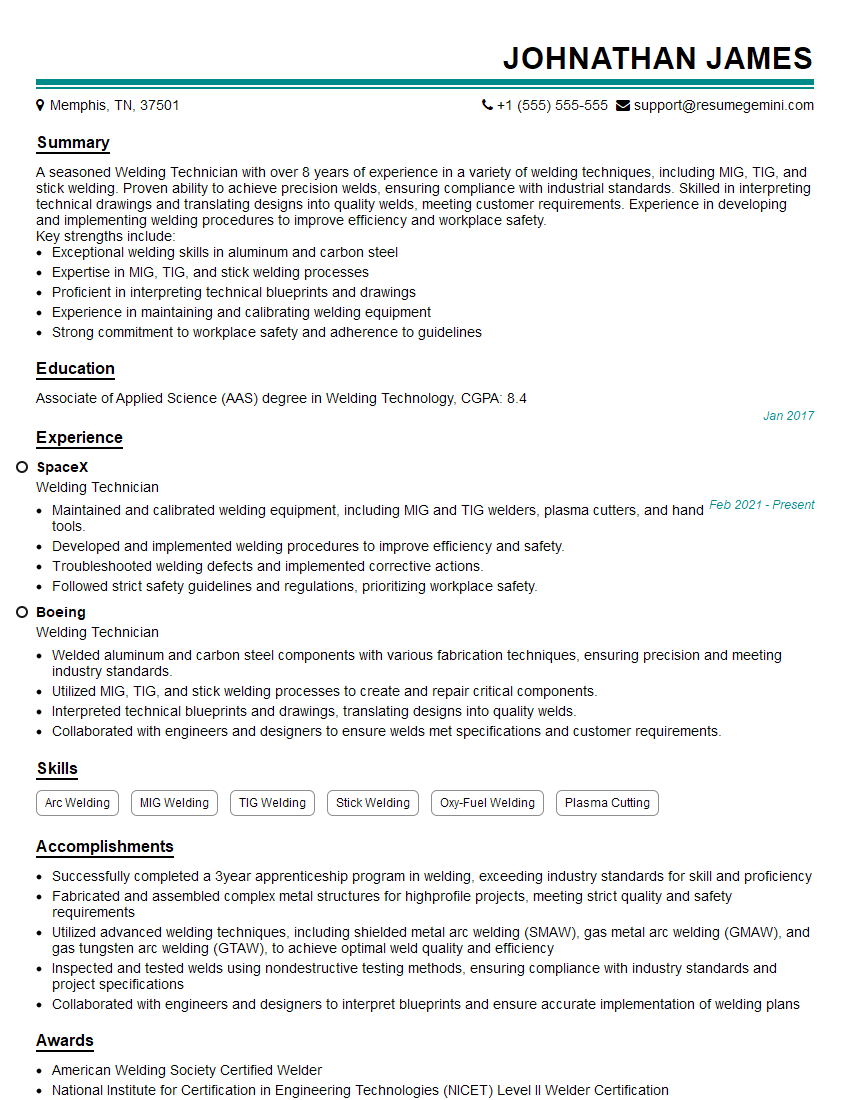
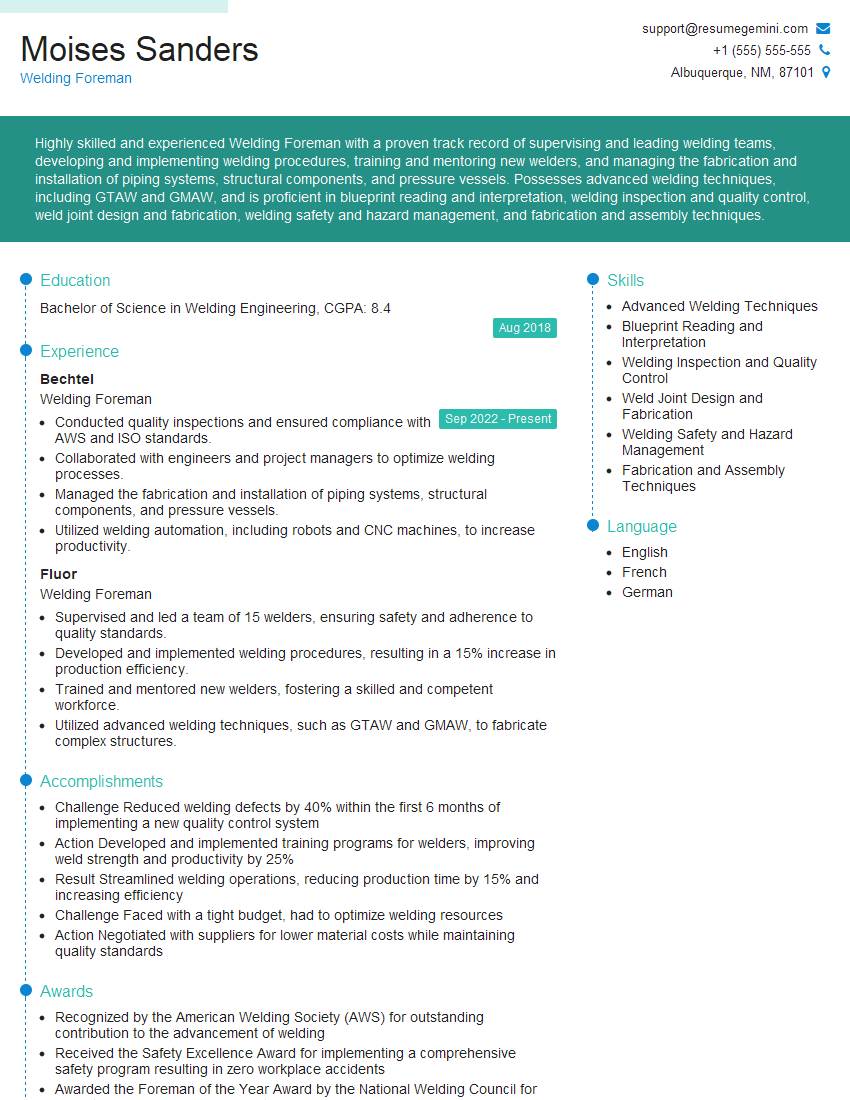
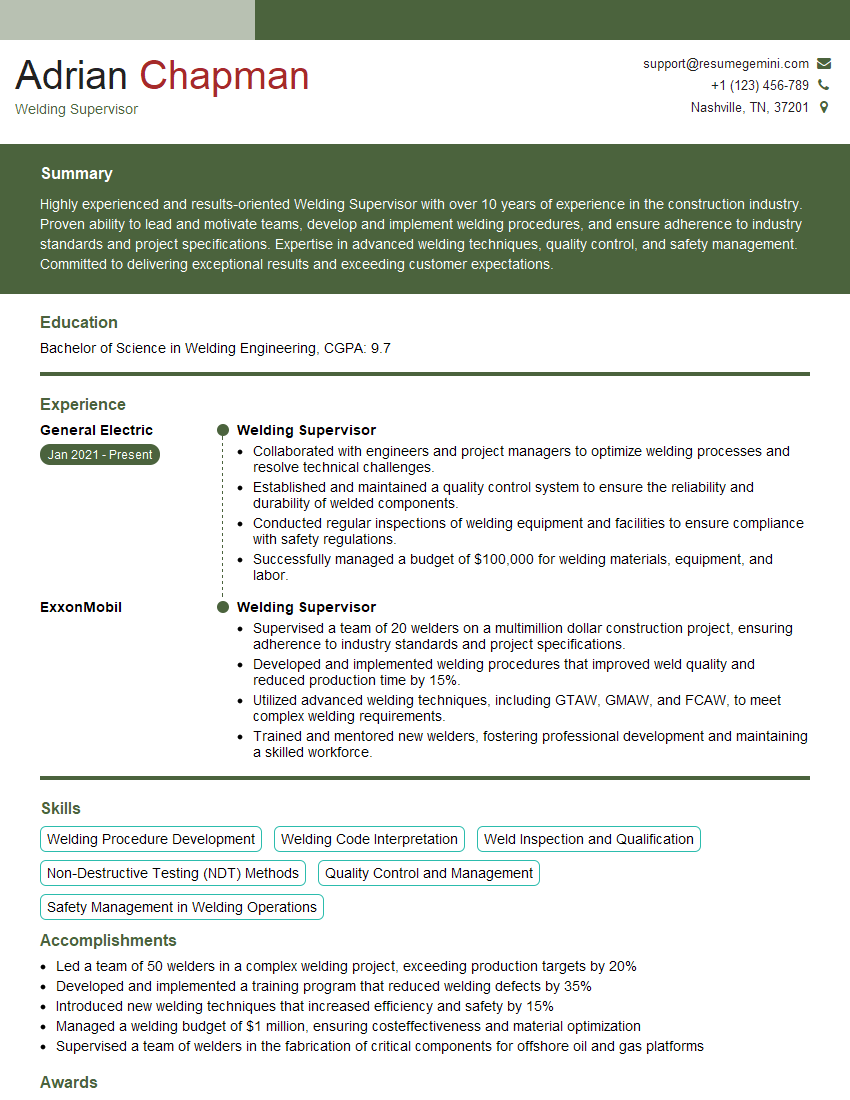
Mastering ANSI/AWS D14.1 Welding Fabrication Symbols is crucial for career advancement in welding engineering, fabrication, and inspection roles. A strong understanding of these symbols demonstrates technical proficiency and attention to detail, highly valued by employers. To increase your chances of securing your dream position, create an ATS-friendly resume that highlights your skills and experience effectively. ResumeGemini is a trusted resource that can help you build a professional and impactful resume. Examples of resumes tailored to ANSI/AWS D14.1 Welding Fabrication Symbols are available to guide you through this process.



Explore more articles
Users Rating of Our Blogs
Share Your Experience
We value your feedback! Please rate our content and share your thoughts (optional).
What Readers Say About Our Blog
Very informative content, great job.
good