The thought of an interview can be nerve-wracking, but the right preparation can make all the difference. Explore this comprehensive guide to API 510 Pressure Vessel Inspection interview questions and gain the confidence you need to showcase your abilities and secure the role.
Questions Asked in API 510 Pressure Vessel Inspection Interview
Q 1. Explain the scope and purpose of API 510.
API 510, “Pressure Vessel Inspection Code,” provides minimum requirements for inspecting, repairing, altering, and rerating in-service pressure vessels. Its purpose is to ensure the safe and reliable operation of pressure vessels by establishing a standardized inspection program to identify potential problems and prevent catastrophic failures. This is crucial because pressure vessels contain high-pressure fluids or gases, and a failure can have devastating consequences.
The scope covers various aspects, including initial inspections, periodic inspections, and inspections after repairs or modifications. It applies to a wide range of pressure vessels used across industries like oil and gas, chemical processing, and power generation. Think of it as a comprehensive guide for maintaining the structural integrity of these critical components.
Q 2. Describe the different types of pressure vessel inspections.
API 510 outlines several types of pressure vessel inspections, each serving a specific purpose:
- Initial Inspection: Performed before the vessel is put into service to verify compliance with design specifications and ensure its fitness for purpose.
- In-Service Inspection: Routine inspections carried out during the vessel’s operational life to detect any deterioration or damage. These can be further categorized into:
- Internal Inspection: Requires entry into the vessel for a thorough visual examination and potentially other NDE methods.
- External Inspection: Visual examination of the vessel’s exterior, looking for signs of corrosion, damage, or leakage.
- Special Inspection: Triggered by specific events, such as a significant process upset, a near-miss incident, or a change in operating conditions. These are often more thorough than routine inspections.
- Repairs and Alterations Inspection: Performed after repairs or modifications to ensure that the work was done correctly and that the vessel’s integrity has been restored.
The type of inspection chosen depends on factors like the vessel’s age, operating conditions, and history. For example, an older vessel operating in a harsh environment would require more frequent and thorough inspections than a newer vessel in a benign environment.
Q 3. What are the key components of a pressure vessel inspection plan?
A comprehensive pressure vessel inspection plan is vital for safety and compliance. Key components include:
- Vessel Identification and History: Unique identification number, material, design specifications, operating history, previous inspection reports.
- Inspection Scope and Frequency: Details of the inspections to be performed (internal, external, NDE), frequency of inspections, and justification for the schedule.
- Inspection Procedures: Clear instructions on how the inspection will be carried out, including safety precautions, access requirements, and data recording methods.
- Inspection Personnel Qualifications: Qualifications and certifications of inspectors involved. API 510 emphasizes the need for competent and experienced inspectors.
- Non-Destructive Examination (NDE) Methods: Specification of which NDE methods will be used (e.g., ultrasonic testing, radiographic testing, magnetic particle testing) based on the material, accessibility, and potential types of defects.
- Acceptance Criteria: Clearly defined criteria for accepting or rejecting the vessel based on the inspection findings. These criteria will be in line with API 510 guidelines and industry standards.
- Documentation and Reporting: A system for documenting all inspection activities, including findings, repairs, and recommendations. Comprehensive reporting is critical for maintaining a history of the vessel’s condition.
A well-structured plan ensures consistent and thorough inspections, minimizes risks, and provides a valuable record of the vessel’s condition over time. A poorly developed plan increases the likelihood of missing critical defects.
Q 4. How do you determine the inspection frequency for a pressure vessel?
Determining the inspection frequency for a pressure vessel is a critical aspect of risk management. API 510 doesn’t prescribe a single frequency but provides guidance based on several factors:
- Vessel Age and Material: Older vessels and those made of materials susceptible to degradation (e.g., carbon steel in corrosive environments) require more frequent inspections.
- Operating Conditions: Harsh operating conditions (high temperature, pressure, corrosive fluids) necessitate more frequent inspections.
- Inspection History: Past inspection findings will influence future inspection frequency. A history of corrosion or other defects will lead to a more rigorous inspection schedule.
- Process Fluid: The corrosiveness of the contained fluid significantly impacts inspection frequency. Highly corrosive fluids demand frequent checks.
- Risk Assessment: A formal risk assessment should be conducted to evaluate the potential consequences of a vessel failure. High-risk vessels require more frequent inspections.
For example, a new stainless steel vessel operating at moderate temperature and pressure with a benign process fluid might have a longer inspection interval compared to an older carbon steel vessel operating at high temperature and pressure with a highly corrosive fluid. The decision often involves a risk-based approach, carefully considering all these factors and documented in the inspection plan.
Q 5. Explain the process of evaluating pressure vessel corrosion.
Evaluating pressure vessel corrosion involves a multi-step process that combines visual inspection, measurements, and potentially NDE techniques.
- Visual Inspection: This is the first step, involving a thorough visual examination of the vessel’s interior and exterior surfaces for signs of corrosion, such as pitting, rust, scaling, or general thinning. This often includes the use of boroscopes for hard-to-reach areas.
- Thickness Measurements: Precise thickness measurements using ultrasonic testing (UT) are critical. These measurements are taken at various locations, focusing on areas identified as potentially corroded during visual inspection. The measurements are compared to the minimum allowable thickness (MAT) specified in the design or code. If the thickness is below the MAT, corrective action is required.
- NDE Techniques: Advanced NDE methods such as UT, radiographic testing (RT), or magnetic particle testing (MT) can be employed to detect internal corrosion or defects that are not visible to the naked eye. These techniques provide a more detailed assessment of the corrosion extent.
- Corrosion Rate Determination: By comparing thickness measurements from multiple inspections, the corrosion rate can be calculated. This information is vital for predicting future corrosion and adjusting the inspection frequency.
- Documentation and Reporting: All findings, including locations of corrosion, measured thicknesses, and NDE results, should be meticulously documented and reported, along with recommendations for repair or replacement if necessary.
Think of it like a doctor’s checkup – the visual examination is the initial assessment, followed by more detailed tests (NDE) if necessary to diagnose the extent and severity of the issue.
Q 6. What are the common causes of pressure vessel failures?
Pressure vessel failures are often catastrophic events, and understanding their root causes is crucial for prevention. Common causes include:
- Corrosion: A major contributor, especially in aggressive environments. Different types of corrosion (uniform, pitting, stress corrosion cracking) can weaken the vessel’s structure.
- Fatigue: Repeated cyclical loading, even within the vessel’s allowable stress limits, can lead to fatigue cracks and eventual failure. Thermal cycling and pressure fluctuations are common culprits.
- Brittle Fracture: A sudden catastrophic failure resulting from a crack propagating rapidly through the vessel’s material at low temperatures or due to material embrittlement.
- Creep: Slow deformation of the material under sustained high temperature and stress, causing thinning and eventual failure. Common in high-temperature applications.
- Overpressure: Exceeding the vessel’s design pressure is a direct cause of failure, often due to equipment malfunction, operational errors, or inadequate safety systems.
- Design Defects: Poor design, incorrect material selection, or fabrication flaws can compromise the vessel’s structural integrity.
- Improper Maintenance: Neglecting routine inspections and maintenance increases the risk of undetected defects that can lead to failure.
Thorough inspections, adherence to codes and standards, proper maintenance, and operator training are crucial in mitigating these risks. The consequences of failure are substantial, ranging from equipment damage and production losses to serious injury or fatality.
Q 7. Describe the different types of Non-Destructive Examination (NDE) methods used in pressure vessel inspection.
Various Non-Destructive Examination (NDE) methods are employed in pressure vessel inspections to detect internal flaws without damaging the vessel. The choice of method depends on factors such as material type, accessibility, and the type of defect expected.
- Ultrasonic Testing (UT): Uses high-frequency sound waves to detect internal flaws like cracks, corrosion, and inclusions. It’s versatile and widely used for thickness measurements.
- Radiographic Testing (RT): Employs X-rays or gamma rays to create images of the vessel’s internal structure, revealing internal flaws such as cracks, porosity, and weld defects.
- Magnetic Particle Testing (MT): Suitable for ferromagnetic materials, it uses magnetic fields to detect surface and near-surface cracks. A magnetized part is exposed to ferromagnetic particles, which are attracted to any crack, revealing it visually.
- Liquid Penetrant Testing (PT): Detects surface-breaking flaws in any material. A dye penetrant is applied, and after cleaning, a developer draws the penetrant out of the flaw, making it visible.
- Eddy Current Testing (ECT): Uses electromagnetic induction to detect surface and subsurface flaws in conductive materials. It’s particularly useful for detecting corrosion and cracks in tubing and welds.
Each NDE method has its strengths and limitations. Often a combination of methods is used to achieve a comprehensive inspection, ensuring thorough detection of various potential defects. For instance, UT is frequently paired with RT for comprehensive internal assessment.
Q 8. How do you interpret NDE results?
Interpreting NDE (Non-Destructive Examination) results in API 510 pressure vessel inspections requires a thorough understanding of the techniques used and the relevant codes and standards. It’s not simply about identifying defects; it’s about assessing their significance and impact on the vessel’s integrity.
For instance, if ultrasonic testing (UT) reveals a flaw, we need to consider its size, location, orientation, and type. A small, shallow surface crack might be insignificant, while a large, deep, through-wall crack could necessitate immediate repair or replacement. We then consult relevant codes like ASME Section VIII, Division 1, to determine the acceptability criteria based on flaw size and location. Radiographic testing (RT) interpretation involves identifying discontinuities and assessing their severity based on image quality and clarity. We carefully examine the radiographs to detect inconsistencies like porosity, inclusions, or cracks. Magnetic particle testing (MT) and liquid penetrant testing (PT) results are interpreted by identifying the presence and extent of surface-breaking defects.
This process often involves comparing findings to acceptance criteria, assessing the severity of any detected flaws using established evaluation methods, and considering the vessel’s operating conditions and history. We may use quantitative assessments such as crack depth or area to determine the defect severity. For example, in the case of corrosion, we’d measure the depth of pitting and calculate the remaining wall thickness to assess if it meets the minimum required thickness per code.
Q 9. Explain the importance of proper documentation in pressure vessel inspection.
Proper documentation is paramount in pressure vessel inspection for several critical reasons. It serves as a verifiable record of the inspection’s scope, findings, and recommendations, ensuring accountability and traceability.
- Legal Compliance: Thorough documentation is crucial for meeting regulatory requirements and demonstrating compliance with safety standards. In the event of an incident, documentation can provide vital evidence in legal proceedings.
- Integrity Management: Accurate records allow for tracking the vessel’s condition over time, enabling proactive maintenance and preventing unexpected failures. This supports effective integrity management programs.
- Communication and Collaboration: Clear and comprehensive documentation facilitates effective communication among inspectors, engineers, and maintenance personnel. It allows everyone to be on the same page regarding the vessel’s condition and necessary actions.
- Decision Making: The inspection report forms the basis for critical decisions regarding repairs, replacements, or continued operation of the pressure vessel. Incomplete or inaccurate documentation can lead to flawed decisions with potentially severe consequences.
Documentation should include details of the inspection methods used, the findings (including photos and sketches), the evaluation of defects, recommendations for repair or further investigation, and the inspector’s qualifications and certifications. Imagine a scenario where a flaw was missed due to poor documentation – the consequences could be catastrophic.
Q 10. How do you handle discrepancies found during inspection?
Discrepancies found during inspection require a systematic approach to resolution. This involves identifying the root cause of the discrepancy, evaluating its significance, and developing a plan to address it. The process starts with a thorough review of the inspection data and comparing it to the original design specifications and operational history.
For example, if the measured wall thickness of a vessel is less than the minimum required thickness, it could be due to corrosion, erosion, or an initial manufacturing defect. We would then investigate the cause of the discrepancy. Is it localized corrosion? If so, is it active or inactive? We’d document our findings and take appropriate actions, which might include:
- Further Investigation: Conduct additional NDE to determine the extent of the discrepancy.
- Fitness-for-Service Assessment: If the discrepancy is significant, we may conduct a Fitness-for-Service (FFS) assessment to determine whether the vessel can continue to operate safely.
- Repair or Replacement: Based on the FFS assessment or code requirements, a repair or replacement plan would be developed and implemented.
- Documentation: All findings, analyses, and actions taken must be meticulously documented.
Each discrepancy needs to be treated on a case-by-case basis, considering the specific circumstances and potential risks involved. It’s not about simply labeling a discrepancy; it’s about fully understanding it and implementing a solution that guarantees the safe and reliable operation of the pressure vessel.
Q 11. What are the requirements for pressure vessel repair and maintenance?
Pressure vessel repair and maintenance must adhere to strict codes and standards, primarily ASME Section VIII, Division 1, and API 510. These guidelines dictate the acceptable methods, materials, and procedures for repairs and ensure that the repaired vessel maintains its structural integrity and safety.
Requirements include:
- Qualified Personnel: Repairs must be performed by qualified welders and inspectors who are certified to the relevant codes and standards.
- Approved Materials: Only approved materials, meeting specified chemical composition and mechanical properties, are permitted for repairs. This is crucial for ensuring weld integrity and avoiding material incompatibility.
- Welding Procedures: Welding procedures must be qualified and documented, ensuring consistent weld quality and meeting the required mechanical properties.
- Post-Weld Examination: Non-destructive examinations (NDE), such as RT and UT, are typically performed to verify the quality of the repair and detect any potential flaws.
- Documentation: Detailed records of the repair process, including materials used, welding procedures, and inspection results, must be maintained. This documentation is vital for future inspections and maintenance.
A common example is a repair of a corroded area. This would involve removing the corroded material, cleaning the surface thoroughly, and then welding a patch or applying a corrosion-resistant coating, followed by NDE verification. The entire process must be documented rigorously, ensuring traceability and compliance.
Q 12. What is the role of API 510 in pressure vessel integrity management?
API 510, “Pressure Vessel Inspection Code: Maintenance, Inspection, Rating, Repair and Alteration,” plays a vital role in pressure vessel integrity management by providing a comprehensive framework for inspecting, maintaining, and repairing pressure vessels. It’s a widely recognized standard that guides the inspection process, ensuring consistent and reliable assessments of pressure vessel integrity.
Specifically, API 510:
- Provides Inspection Procedures: It outlines the methods and techniques for conducting thorough inspections, including visual inspections, NDE, and leak tests.
- Defines Inspection Intervals: API 510 helps determine the appropriate frequency of inspections based on factors such as vessel design, operating conditions, and material properties. This ensures timely detection of potential problems.
- Specifies Repair and Alteration Procedures: The code provides guidance on acceptable methods for repairing and altering pressure vessels, ensuring the repaired vessel maintains its structural integrity.
- Guides Risk Assessment: It encourages a risk-based approach to inspection and maintenance, enabling resources to be focused on the most critical aspects of the vessel’s integrity. By prioritizing risks, maintenance budgets are managed effectively.
- Promotes Documentation: API 510 emphasizes meticulous documentation of all inspection findings, repairs, and maintenance activities, contributing to comprehensive integrity management programs.
In short, API 510 provides a structured approach to maintaining the integrity of pressure vessels, preventing catastrophic failures, and ensuring operational safety.
Q 13. Describe your experience with different types of pressure vessels (e.g., storage tanks, reactors).
My experience encompasses a broad range of pressure vessels, including storage tanks, reactors, and heat exchangers. I’ve worked on various types of construction materials, from carbon steel to stainless steel and exotic alloys, across different industries such as petrochemical, refining, and pharmaceutical.
Storage Tanks: I’ve inspected numerous atmospheric and low-pressure storage tanks, focusing on external corrosion, internal fouling, and bottom corrosion. These often involve extensive external visual inspections, along with inspections of the tank floor and supports.
Reactors: Reactor inspections are more complex and often involve intricate internal inspections, potentially utilizing remote inspection technologies due to their hazardous and inaccessible operating environments. These assessments may require specialized NDE methods to detect flaws in high-pressure zones or piping connections. Emphasis is often placed on the integrity of the shell, heads, and internal components, carefully examining areas prone to high temperatures and pressures.
Heat Exchangers: Inspections of heat exchangers focus on tube integrity, shell-side corrosion, and fouling. This often requires specific techniques like eddy current testing for tube inspection. The focus here is on the tube sheet and the individual tubes themselves, as leaks in this system can be costly and potentially hazardous.
In each case, I tailor my approach to the specific vessel type and its operating conditions, always prioritizing safety and compliance with relevant codes and standards.
Q 14. Explain the concept of Fitness-For-Service (FFS).
Fitness-for-Service (FFS) is a risk-based assessment approach used to determine whether a pressure vessel with flaws or damage can continue to operate safely. Rather than automatically condemning a vessel with defects, FFS assesses whether the remaining structural integrity is sufficient for continued operation under the intended service conditions.
The process typically involves:
- Defect Characterization: Thorough identification and characterization of all defects, including size, location, orientation, and type.
- Stress Analysis: Determining the stresses acting on the vessel, considering pressure, temperature, and other relevant factors.
- Failure Assessment: Evaluating the potential for failure due to the identified defects under the prevailing stress conditions. This may involve using specialized software and applying established assessment procedures.
- Risk Evaluation: Assessing the likelihood and consequences of failure, considering the safety implications and potential economic losses.
- Decision Making: Based on the assessment, a determination is made regarding whether the vessel is fit for continued service, requiring repairs, or needing replacement.
FFS is particularly useful when dealing with aging equipment where minor flaws are often encountered. By conducting a thorough FFS assessment, we can prevent unnecessary replacements and optimize maintenance strategies. For instance, if a small crack is identified and the FFS assessment shows that it’s not critical, it might be monitored rather than immediately repaired, saving time and resources.
Q 15. How do you apply API 579-1/ASME FFS standards during inspection?
API 579-1/ASME FFS (Fitness-for-Service) standards are applied during pressure vessel inspections to assess the structural integrity of components that have discovered flaws or damage. Instead of automatically condemning a vessel, these standards provide a framework for evaluating whether the vessel can continue to operate safely despite the identified defects.
The process typically involves:
- Defect Characterization: Precisely defining the size, shape, location, and type of the flaw (e.g., crack, corrosion).
- Stress Analysis: Determining the stresses acting on the vessel, including operational and residual stresses. This often involves finite element analysis (FEA).
- Material Properties: Evaluating the material’s mechanical properties, such as yield strength and fracture toughness, to understand its ability to withstand the identified stresses and flaws.
- Failure Assessment: Employing appropriate assessment methods (e.g., fracture mechanics, limit load analysis) from API 579-1/ASME FFS to determine if the flaw poses an unacceptable risk to continued operation.
- Repair or Replacement: Based on the assessment, recommendations are made for repair, replacement of the component, or continued operation under specific monitoring conditions.
For instance, if a corroded area is found on a pressure vessel, API 579-1 would guide us in determining if the remaining thickness is sufficient to withstand the operating pressure, considering factors such as corrosion rate and remaining life. If it’s not, the standard provides methodologies to determine acceptable repair techniques or if replacement is necessary.
Career Expert Tips:
- Ace those interviews! Prepare effectively by reviewing the Top 50 Most Common Interview Questions on ResumeGemini.
- Navigate your job search with confidence! Explore a wide range of Career Tips on ResumeGemini. Learn about common challenges and recommendations to overcome them.
- Craft the perfect resume! Master the Art of Resume Writing with ResumeGemini’s guide. Showcase your unique qualifications and achievements effectively.
- Don’t miss out on holiday savings! Build your dream resume with ResumeGemini’s ATS optimized templates.
Q 16. What are the limitations of API 510?
API 510 is a valuable standard, but it does have limitations. It primarily focuses on the inspection of pressure vessels and doesn’t address other critical aspects of process safety. Some limitations include:
- Limited Scope: API 510 doesn’t cover all types of pressure vessels (e.g., some specialized designs). It also does not delve into detailed material degradation mechanisms beyond basic corrosion and erosion.
- Prescriptive Approach: While it provides guidelines, it can be quite prescriptive, potentially leading to unnecessary repairs or replacements if not carefully applied. A rigid adherence without considering factors specific to the vessel could be costly.
- Lack of Risk-Based Approach: Older editions of API 510 were less focused on risk-based inspection compared to current practices. RBI offers a more optimized approach to inspection, allocating resources to the most critical areas.
- No Comprehensive Guidance on Modern Materials and Manufacturing Techniques: Advances in materials science and manufacturing processes are not always fully covered in the standard.
To mitigate these limitations, it’s essential to use API 510 in conjunction with other relevant codes and standards and to incorporate a comprehensive risk-based inspection program.
Q 17. Describe your experience with risk-based inspection (RBI).
I have extensive experience implementing Risk-Based Inspection (RBI) programs for pressure vessels. RBI is a proactive approach that shifts the focus from time-based inspections to risk-based assessments. It helps to optimize inspection resources by prioritizing inspections based on the likelihood of failure and the consequences of that failure.
My experience includes:
- Developing RBI models: This involves identifying potential failure mechanisms, assessing the probability of failure using data analysis and expert judgment (e.g., historical inspection data, operating conditions, material properties), and evaluating the consequences of failure (e.g., environmental impact, personnel safety, production downtime).
- Implementing RBI software: Using specialized software to build and manage RBI programs, calculating risk scores, and generating inspection plans.
- Creating inspection plans: Developing customized inspection plans based on the RBI analysis, allocating inspection resources effectively, and specifying the appropriate inspection techniques.
- Tracking inspection results: Monitoring the inspection data and updating the RBI model to reflect the condition of the assets.
For example, in one project, we used RBI to prioritize inspection of a large ammonia storage tank. By analyzing corrosion rates and considering the potential for catastrophic failure due to brittle fracture, we identified specific areas requiring more frequent and detailed inspections, optimizing inspection scheduling and resource allocation.
Q 18. How do you determine the acceptable level of risk for a pressure vessel?
Determining the acceptable level of risk for a pressure vessel involves a multifaceted process that balances safety, economic considerations, and regulatory requirements.
This process often involves:
- Defining Risk Criteria: Establishing clear criteria for what constitutes an acceptable level of risk, often expressed in terms of probability of failure and consequence severity. This may involve using risk matrices and tolerable risk levels. These risk criteria might be influenced by industry standards, regulatory requirements, and company policies.
- Risk Assessment: Quantifying the risk associated with the pressure vessel using various methods, including probabilistic risk assessments (PRA) and qualitative risk assessments.
- Cost-Benefit Analysis: Balancing the cost of implementing risk mitigation measures (e.g., more frequent inspections, repairs) with the potential cost of failure.
- Regulatory Compliance: Ensuring that the accepted risk level complies with all applicable regulations and codes.
A common approach involves using a risk matrix that plots the probability of failure against the consequences of failure. The resulting risk level is then compared to predefined acceptance criteria. For example, a high-consequence, high-probability failure would require immediate corrective action, while a low-consequence, low-probability failure might be considered acceptable with ongoing monitoring.
Q 19. How do you communicate technical information to non-technical audiences?
Communicating complex technical information to non-technical audiences requires careful planning and clear, concise language. I use several techniques:
- Analogies and Visual Aids: Simplifying complex concepts using relatable analogies and visuals (e.g., diagrams, charts). For example, explaining pressure vessel integrity using the analogy of a balloon under pressure.
- Plain Language: Avoiding technical jargon and using everyday language. If technical terms are unavoidable, I provide simple definitions.
- Storytelling: Using stories and real-world examples to illustrate key points and make the information more memorable.
- Interactive Communication: Encouraging questions and feedback to ensure understanding. I tailor the level of detail to the audience’s understanding.
- Summarization: Providing concise summaries at the beginning and end of presentations or reports.
For example, when explaining the risk of corrosion in a pressure vessel to a plant manager, I might use an analogy to rust on a car, relating it to the weakening of the vessel’s structure and the potential for catastrophic failure. Visual aids like photographs of corroded metal would also enhance understanding.
Q 20. Describe a situation where you had to make a critical decision during an inspection.
During an inspection of a refinery’s hydrogen storage sphere, we discovered significant thinning due to sulfide stress cracking in a localized area. The initial assessment suggested the sphere might need to be taken out of service, resulting in significant production losses.
The critical decision involved weighing the risk of continued operation versus the immediate cost and disruption of taking the sphere offline. This required a thorough review of the remaining life assessment, considering the specific location and extent of the cracking, and determining if the sphere could be operated safely under more stringent monitoring conditions until a planned shutdown for repairs.
After consulting with metallurgy experts and carefully reviewing the API 579-1/ASME FFS guidelines, we developed a plan that allowed for continued operation with enhanced inspection frequency and close monitoring of the critical area. This significantly reduced the immediate economic impact while ensuring safety. The sphere was later successfully repaired during a scheduled turnaround.
Q 21. What are the safety precautions you take during pressure vessel inspection?
Safety is paramount during pressure vessel inspections. My standard safety precautions include:
- Permit-to-Work System: Always adhering to a strict permit-to-work system, ensuring all necessary safety measures are in place before commencing any inspection activities.
- Lockout/Tagout Procedures: Properly isolating and locking out all energy sources to the vessel before entering confined spaces or performing any work on the vessel.
- Personal Protective Equipment (PPE): Wearing appropriate PPE, including hard hats, safety glasses, gloves, and protective clothing, depending on the tasks.
- Confined Space Entry Procedures: Following strict confined space entry procedures, including atmospheric testing for oxygen levels, flammability, and toxic gases, and using appropriate respiratory protection if necessary.
- Fall Protection: Employing appropriate fall protection measures when working at heights.
- Emergency Procedures: Being familiar with emergency procedures, including evacuation plans and communication protocols.
- Hot Work Permits: If any hot work is required (e.g., welding), securing the appropriate hot work permits and ensuring compliance with all fire safety regulations.
Regular safety briefings and toolbox talks are crucial to maintaining a safe working environment. I never compromise on safety, and always prioritize the well-being of myself and my team.
Q 22. Explain your understanding of pressure vessel codes and standards (ASME Section VIII, etc.).
Pressure vessel codes and standards, primarily ASME Section VIII, are the foundational documents that dictate the design, fabrication, inspection, and testing requirements for pressure vessels. These codes ensure the safe operation of vessels that contain pressurized fluids. ASME Section VIII, for example, is divided into two parts: Division 1, which covers vessels built using established design and fabrication methods, and Division 2, which uses a more advanced and rigorous design-by-analysis approach. Other relevant standards include those from API (American Petroleum Institute), such as API 650 (for welded tanks) and API 620 (for tanks operating at low pressure). These codes specify material requirements, welding procedures, non-destructive examination (NDE) techniques, and pressure testing requirements, all geared towards minimizing risk of failure.
Understanding these codes goes beyond simply reading them. It involves comprehending the underlying engineering principles, interpreting the complex requirements, and applying them correctly during inspections. For instance, recognizing the difference between allowable stress values for different materials at varying temperatures is crucial for assessing the structural integrity of a vessel. Equally important is understanding the various NDE methods, like radiographic testing (RT), ultrasonic testing (UT), and magnetic particle testing (MT), and their application to detect flaws. Failure to properly understand and apply these codes can lead to catastrophic consequences.
Q 23. How do you ensure compliance with relevant regulations and codes?
Ensuring compliance with relevant regulations and codes is paramount in pressure vessel inspection. My approach involves a multi-faceted strategy. Firstly, I meticulously review all available documentation: design calculations, material certifications, welding procedures, and previous inspection reports. This allows me to understand the vessel’s history and verify its compliance with the original design specifications. Secondly, I conduct thorough visual inspections, checking for corrosion, dents, deformation, and any other visible signs of damage. This is followed by appropriate NDE techniques according to the vessel’s design and operating conditions and the applicable code. I document all findings, deviations, and corrective actions in detailed reports. Thirdly, I work closely with the client and engineering personnel to address any identified non-compliances. This might involve recommending repairs, implementing modifications, or adjusting the operating parameters. I ensure that all repairs and modifications meet the requirements of the relevant codes and are properly documented. Finally, I maintain meticulous records, storing all inspection data securely and ensuring its ready availability for audits and future inspections. Essentially, my commitment to compliance is a continuous process of verification, documentation, and corrective action.
Q 24. What are your strengths and weaknesses as a pressure vessel inspector?
My strengths lie in my detailed approach to inspections, my strong understanding of relevant codes and standards (including ASME Section VIII, API 650, and API 620), and my ability to communicate complex technical information clearly and concisely to both technical and non-technical audiences. I am also adept at problem-solving and finding practical solutions to complex inspection challenges. For example, I once identified a hidden crack in a vessel using a combination of UT and RT which was initially missed by other inspectors, preventing a potential catastrophic failure.
My area for improvement is delegation. While I am meticulous in my work, I sometimes find it challenging to delegate tasks, preferring to maintain a hands-on approach. I am actively working on this through conscious effort to build trust in my team and to recognize the skills and competencies of others.
Q 25. Describe your experience with using inspection software or tools.
I have extensive experience utilizing various inspection software and tools. This includes data acquisition systems for NDE equipment, allowing me to capture and analyze data from UT, RT, and MT inspections. I am proficient in using specialized software for generating reports, managing inspection data, and creating 3D models of vessels based on scan data for better visualization of potential defects. I also have experience using software for calculating remaining life and performing risk assessments. Software such as AutoPIPE for stress analysis and PV Elite for pressure vessel design are familiar tools I can effectively utilize. The use of these tools not only increases the accuracy and efficiency of inspections but also assists in creating comprehensive and easily interpretable reports.
Q 26. How do you stay up-to-date with the latest advancements in pressure vessel inspection techniques?
Staying current in pressure vessel inspection demands continuous professional development. I actively participate in industry conferences and workshops, attending seminars on advanced NDE techniques and new code interpretations. I am a member of professional organizations like ASME and regularly review their publications and updates to the codes and standards. I also subscribe to industry journals and online resources which provide insights into the latest research and advancements in materials science, failure analysis, and inspection methodologies. This ensures that my knowledge remains current with evolving best practices in the field, allowing me to implement the most effective and reliable inspection strategies.
Q 27. How would you handle a situation where you disagree with your supervisor’s decision regarding an inspection?
Handling disagreements with a supervisor regarding an inspection requires a professional and ethical approach. My first step would be to clearly and respectfully articulate my concerns, providing specific evidence and technical justification for my viewpoint. I would focus on the safety implications and the potential risks associated with the supervisor’s decision. I would aim for a collaborative discussion, seeking to understand their rationale and explore alternative solutions that address both safety and efficiency. However, if after a thorough discussion, the disagreement persists and I believe a safety issue exists, I would escalate the matter to higher management, ensuring that all concerns are documented in writing and supported by technical data. Ultimately, my priority would be to ensure the safe operation of the vessel, even if it requires escalating the disagreement through the appropriate channels.
Q 28. What are your salary expectations?
My salary expectations are commensurate with my experience, skills, and the market rate for experienced API 510 inspectors with my qualifications and level of expertise. I am open to discussing a specific salary range after learning more about the role and responsibilities involved. I am confident that my contributions would justify a competitive compensation package that reflects the value I bring to the team.
Key Topics to Learn for API 510 Pressure Vessel Inspection Interview
Preparing for your API 510 Pressure Vessel Inspection interview requires a thorough understanding of both theory and practical application. Focus your studies on these key areas to maximize your success:
- Code Requirements and Standards: Deeply understand the relevant sections of API 510 and related codes, focusing on their practical implications for inspection planning and execution.
- Inspection Techniques and Methods: Master various inspection methods, including visual inspection, non-destructive testing (NDT) techniques (e.g., UT, MT, PT), and their applications in identifying potential flaws in pressure vessels.
- Corrosion Mechanisms and Mitigation: Gain a strong understanding of different types of corrosion (e.g., uniform, pitting, stress corrosion cracking) and their impact on pressure vessel integrity. Be prepared to discuss corrosion prevention and mitigation strategies.
- Weld Inspection and Evaluation: Focus on the critical aspects of weld inspection, including weld defects identification, acceptance criteria, and repair procedures. Understand the importance of weld quality in pressure vessel safety.
- Documentation and Reporting: Practice creating clear and concise inspection reports, including detailed observations, findings, and recommendations. Accurate and thorough documentation is crucial.
- Risk-Based Inspection (RBI): Familiarize yourself with RBI principles and how they are applied to prioritize inspections and optimize maintenance strategies for pressure vessels.
- Repair and Alteration Procedures: Understand the procedures for repairing and altering pressure vessels while adhering to relevant codes and standards. Be prepared to discuss the necessary documentation and approvals.
- Pressure Vessel Design and Construction: A foundational understanding of pressure vessel design principles will help you interpret inspection findings and assess potential risks more effectively.
- Problem-Solving and Decision-Making: Practice analyzing real-world scenarios and developing solutions to potential inspection challenges. Be ready to discuss your problem-solving approach.
Next Steps
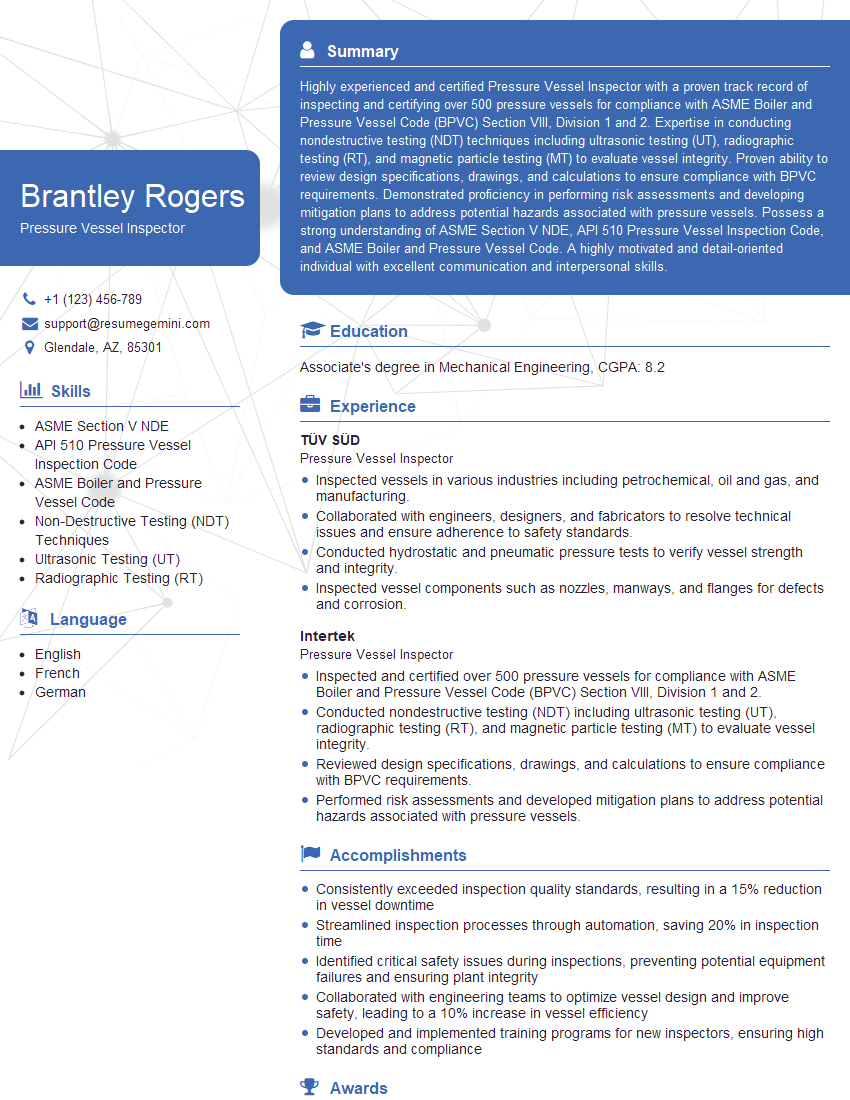
Mastering API 510 Pressure Vessel Inspection significantly enhances your career prospects in the energy and process industries, opening doors to advanced roles and higher earning potential. To stand out, create a compelling resume that showcases your skills and experience effectively. An ATS-friendly resume is crucial for getting your application noticed by recruiters. ResumeGemini is a trusted resource that can help you build a professional and impactful resume tailored to your specific skills and experience. Examples of resumes tailored to API 510 Pressure Vessel Inspection are available, providing you with a head start in crafting your perfect application.
Explore more articles
Users Rating of Our Blogs
Share Your Experience
We value your feedback! Please rate our content and share your thoughts (optional).
What Readers Say About Our Blog
Very informative content, great job.
good