Preparation is the key to success in any interview. In this post, we’ll explore crucial Experience in creating visual effects for film, television, and games interview questions and equip you with strategies to craft impactful answers. Whether you’re a beginner or a pro, these tips will elevate your preparation.
Questions Asked in Experience in creating visual effects for film, television, and games Interview
Q 1. Explain your experience with different compositing software (e.g., Nuke, After Effects, Fusion).
My compositing experience spans several industry-standard software packages. Nuke is my go-to for high-end feature film work, particularly when dealing with complex shots involving extensive keying, roto, and paint. Its node-based workflow allows for incredibly flexible and non-destructive compositing, crucial for iterative refinement and collaborative projects. I frequently leverage Nuke’s powerful tools for things like advanced color correction using its color warp and primaries nodes, and sophisticated roto techniques with the roto node and planar trackers.
After Effects, on the other hand, excels in its speed and accessibility for smaller projects, quick turnaround tasks, and motion graphics. It’s perfect for compositing simpler shots, creating 2D effects, and incorporating motion tracking data. Its intuitive interface makes it a great tool for rapid prototyping and quick fixes.
Finally, Fusion, with its strengths in 3D compositing, is invaluable for projects needing more complex 3D particle effects, simulations, and advanced lighting. I’ve used it on several projects where integrating CG elements seamlessly into live-action footage demanded its power. The ability to work non-destructively with its node-based system mirrors Nuke’s advantages, enabling consistent project management and iterative problem-solving.
Q 2. Describe your workflow for creating realistic fire simulations.
Creating realistic fire simulations involves a multi-stage process. I typically begin with a base simulation, often using a dedicated software like Houdini or FumeFX. These packages offer robust tools to simulate the physics of fire, including heat transfer, smoke plumes, and turbulent airflows. The key is to carefully control parameters such as density, temperature, and wind to achieve a believable appearance.
Once the simulation is rendered, the next step is to refine the look in a compositing software like Nuke or After Effects. This involves adjusting color, adding subtle details like flickering embers and glowing hot spots, and enhancing the overall contrast and saturation. I frequently employ techniques like light wraps to integrate the fire seamlessly into the scene’s existing lighting.
For example, on a recent project involving a burning building, I used Houdini to create the core fire simulation. We carefully adjusted parameters to reflect the specific type of material burning, the wind conditions, and the ambient light levels. Afterwards, I used Nuke to enhance the look of the flames, added subtle details, and carefully integrated them with the scene’s existing lighting and shadows. The final result was a realistic portrayal of a raging inferno.
Q 3. How do you handle complex lighting challenges in a 3D environment?
Handling complex lighting challenges in 3D requires a strong understanding of light behavior and the software’s lighting capabilities. I often start by analyzing reference images and videos to understand how light interacts with the scene. This step is crucial for establishing the overall mood and realism of the final render.
Then, I strategically place and adjust lights within the 3D scene. This involves a combination of key, fill, and rim lights to create depth and volume. I frequently use area lights, IES profiles (for accurate real-world light source representation), and environment maps to create realistic and complex reflections and refractions.
Advanced techniques like global illumination (GI) are crucial to accurately simulating the interactions of light bouncing within the environment. Ray tracing and path tracing (which I’ll elaborate on in a later answer) are vital for producing highly realistic results.
For instance, in a recent project, we had to render a night scene in a city street. Achieving photorealistic reflections and refractions in wet streets required carefully adjusting GI settings, implementing high-resolution environment maps capturing the city skyline, and simulating the light scattering on the water particles.
Q 4. What are your preferred methods for creating realistic human skin textures?
Creating realistic human skin textures requires a layered approach. I usually start with a high-resolution base texture, often obtained from photogrammetry or high-quality scans. This base texture forms the foundation for subsequent refinements.
Subsurface scattering is a crucial aspect of realistic skin. I use techniques to simulate the way light penetrates and scatters beneath the skin’s surface, creating a sense of translucency and subtle color variations. I incorporate fine details such as pores, wrinkles, and blemishes, often hand-painted or procedurally generated using tools like Substance Painter or Mari.
Finally, I add variations in color, shading, and texture to mimic the effects of blood vessels, skin tone variations and imperfections. A crucial step is to refine the normals and displacement maps to add subtle bumps and irregularities. This entire process focuses on achieving a level of detail and variation that closely mirrors real human skin.
For example, when creating a character for a recent film, we used high-resolution photogrammetry scans of a real actor’s face to create the base texture. We then added subsurface scattering effects using dedicated shader nodes, and carefully hand-painted subtle details to further enhance realism.
Q 5. Explain your understanding of different rendering techniques (e.g., ray tracing, path tracing).
Rendering techniques like ray tracing and path tracing are crucial for achieving photorealism. Ray tracing simulates light by tracing the path of individual light rays from the light source to the camera. This method handles reflections and refractions accurately, creating realistic specular highlights and reflections.
Path tracing, a more advanced technique, tracks the path of light rays as they bounce around the scene, including indirect illumination from multiple reflections and refractions. This method produces more realistic and accurate global illumination (GI), resulting in a more natural and believable lighting effect.
The choice between ray tracing and path tracing often depends on the project’s requirements and available rendering time. Ray tracing is generally faster but less accurate, while path tracing produces higher quality results but can be significantly slower. Many modern rendering engines combine both methods to optimize speed and quality.
Q 6. How do you approach creating believable character animations?
Creating believable character animation is an iterative process requiring a deep understanding of human anatomy, movement, and acting principles. I begin by studying reference material, including videos and anatomical studies, to thoroughly understand the character’s movements and expressions.
I usually start with key poses and then refine the animation using secondary actions and subtle details. This includes things like muscle deformation, weight shifts, and follow-through actions. The goal is to add a sense of realism and naturalness.
Software like Maya or Blender plays a critical role, providing tools to manipulate the character’s skeleton and skin, fine-tuning movements and expressions through various animation techniques, and ensuring realistic interaction with the environment.
For example, animating a character running requires attention to foot placement, arm swing, body rotation, and subtle changes in posture. It requires detailed understanding of how human biomechanics translate to visual motion.
Q 7. Describe your experience with motion capture data and its integration into VFX pipelines.
Motion capture (mocap) data is incredibly valuable in creating realistic character animations. My experience with mocap involves various stages, starting with the capture process itself, often using optical or inertial systems. Optical systems use cameras to track markers on the actor, while inertial systems employ sensors embedded in a suit.
Once captured, the data needs to be cleaned and processed, which includes removing noise, fixing glitches, and retargeting the animation to the 3D character rig. This often requires specialized software like MotionBuilder or similar tools that provide sophisticated editing and manipulation capabilities.
After cleaning and retargeting, the mocap data is integrated into the animation pipeline. However, mocap data isn’t perfect and often requires extensive manual cleanup, adjustment, and editing to improve the performance and conform to the character’s specific needs. The final step often involves blending the mocap animation with hand-animated keyframes to ensure naturalness and character expressiveness.
For example, in one project we used optical mocap to capture a character’s fight scene. After cleaning the data in MotionBuilder, we retargeted it to our 3D character rig. We then meticulously refined the animation by adding subtle details, adjusting timings, and blending the mocap with hand-keyed animations to achieve a stylized yet realistic combat sequence.
Q 8. How would you troubleshoot a rendering issue that produces artifacts?
Troubleshooting rendering artifacts involves a systematic approach. Artifacts, those visual imperfections in a rendered image, can stem from many sources. My first step is to isolate the problem. Is it affecting the entire render or a specific area? Does it change depending on render settings or specific geometry?
I’d start by checking the scene for potential culprits:
- Geometry issues: Overlapping polygons, flipped normals, or degenerate triangles can cause strange shading and visual glitches. I’d use my 3D software’s tools to check for these problems.
- UV Mapping problems: Incorrect UV unwrapping can lead to texture distortions and seams. I’d carefully examine the UV map in my 3D software, often visualizing it on a planar projection to identify issues.
- Material issues: Incorrect shader settings, especially involving transparency, refraction, or reflections, can produce artifacts. I’d systematically check the parameters of each material, paying close attention to potentially problematic settings like roughness, metallicness, or transparency values. I might even temporarily disable materials to see if they are indeed the source.
- Lighting issues: Overly bright lights, incorrect light settings, or shadow artifacts often cause problems. I’d review the lighting setup, checking for conflicting light sources, shadow acne (small, dark artifacts near shadow edges), or extreme brightness values that could lead to bloom artifacts.
- Render settings: Incorrect anti-aliasing settings, insufficient samples, or other rendering parameters can be problematic. I would gradually increase the sampling rate (ray tracing, path tracing etc), and experiment with different anti-aliasing techniques to resolve those.
If the problem persists, I would systematically disable parts of the scene to isolate the source of the artifact. I leverage render layers to isolate and diagnose problems more effectively. Finally, consulting online resources, relevant documentation or the software’s community forums is always beneficial. Experience helps to identify common patterns and speeds up the troubleshooting process significantly.
Q 9. Explain your experience with different particle systems and their applications.
I have extensive experience with various particle systems, from the built-in systems in packages like Houdini, Maya, and Unreal Engine to custom-built systems. The choice of system depends heavily on the project’s scale, the desired level of realism, and the performance requirements.
For instance, simple effects like sparks or dust particles in a game might be efficiently handled by a built-in system, using a relatively low-poly model and a simple emitter. However, for complex effects like realistic smoke, fire, or water in a film, a more sophisticated system – potentially a combination of simulation and procedural techniques – is needed. I’ve worked with fluid simulation systems to create realistic water effects for a historical drama, where accuracy was paramount. This involved precise control over fluid dynamics, buoyancy and viscosity parameters. For a fantasy film, I used a custom particle system in Houdini to create magical energy effects, requiring a lot of artistic interpretation and tweaking to achieve the desired look.
My experience extends to using different particle attributes to customize effects. For example, I can use age, velocity, and color attributes to create compelling animations, such as decaying embers, swirling smoke or an explosive blast. I’m also proficient in optimizing particle systems for performance; this often involves techniques like particle culling or level of detail (LOD) to manage the computational cost, particularly important in real-time applications.
Q 10. Describe your process for creating convincing environmental effects (e.g., rain, snow).
Creating convincing environmental effects like rain or snow requires a multi-faceted approach. It’s not just about visually replicating the elements but also simulating their physical behavior and interaction with the environment. I generally start with a base simulation, whether that’s a particle system for rain and snow, or a more physically-based simulation for things like fog and mist.
For rain, I would typically use a particle system, carefully adjusting parameters like particle size, density, and velocity to match the desired intensity and realism. I would also simulate the impact of the rain on surfaces, creating splashes and wetness effects using displacement maps or custom shaders. For snow, I might use a similar approach, but with different particle properties and potentially adding elements like wind to create drifting snow.
Subtlety is key. Details such as the way rain droplets refract light, or how snow accumulates on surfaces, heavily influence realism. I would use subsurface scattering techniques to enhance the realism of snow, capturing its translucency and soft scattering properties. And to create an atmosphere, I’d use volumetric lighting and fog effects, carefully integrating them with the rain or snow simulation to create depth and mood.
Finally, I always iterate and refine the effects through multiple passes and iterations, adjusting various parameters and experimenting with different techniques until I achieve a satisfactory result. This iterative process is crucial for achieving that photorealistic look.
Q 11. How familiar are you with procedural generation techniques for environments or assets?
I’m very familiar with procedural generation techniques. These are invaluable for creating large-scale environments, assets, and even effects in a time and cost-effective way. They eliminate the need for manual modeling and texturing of every element, especially when dealing with massive and complex environments.
I’ve utilized procedural techniques in several projects. For example, I used Houdini’s VOP network to create a complex, procedurally generated city for a background plate in a science fiction film. This involved creating algorithms to determine building heights, road layouts, and even the placement of details such as windows and streetlights. The result was a believable, sprawling city that would have been impossible to create manually in the given timeframe.
Procedural generation is also useful for creating variations of assets. For instance, I might generate numerous unique rock formations using a noise function and a displacement modifier, or generate foliage with various shapes and sizes via L-systems.
My experience includes using various techniques like noise functions (Perlin, Simplex), L-systems, and even more advanced techniques like cellular automata to create diverse and unpredictable results while still maintaining artistic control. I can effectively blend procedural generation with handcrafted assets to achieve a balance between artistic vision and efficiency.
Q 12. What are some common challenges faced in matchmoving, and how have you overcome them?
Matchmoving, the process of aligning digital content with live-action footage, presents many challenges. One of the biggest is camera motion estimation, particularly when dealing with complex camera movements or poor tracking features in the scene. For example, scenes with little distinct features or rapid camera motion can result in inaccurate tracking.
Another common issue is the presence of moving objects or occlusion in the scene. If objects move independently within the shot, it becomes challenging to achieve consistent tracking. Occlusions, where objects obstruct the view of tracking points, further complicate the process.
To overcome these challenges, I employ several strategies. For scenes with limited features, I explore using additional reference footage or 3D models to supplement the existing footage. I might also use more sophisticated tracking software, such as PFTrack or Boujou, that offer advanced algorithms to deal with these challenging conditions. When dealing with moving objects, I carefully select tracking points that remain relatively static throughout the shot, or I use techniques like planar tracking to track larger areas rather than individual points.
Careful planning and preparation are also essential. Knowing the types of shots I will be working with beforehand allows me to choose the appropriate techniques and prepare the footage accordingly. This often involves shooting with a clear understanding of the tracking needs. Finally, iterative refinement is always required; multiple passes and careful adjustments are necessary to achieve a perfect match.
Q 13. Explain your understanding of color grading and its impact on the final visual result.
Color grading is the art of adjusting the color and tonal values of an image or video to enhance its visual appeal, mood, and storytelling. It’s a crucial step in post-production, significantly influencing the final look and feel of a film or game.
My understanding extends beyond mere color correction – adjusting for inconsistencies in lighting or exposure. It’s about crafting a specific visual style that supports the narrative. For example, I might use a desaturated palette to evoke a sense of sadness or nostalgia, or a vibrant, high-contrast look for an action scene.
I’m proficient with various color grading tools such as DaVinci Resolve, Baselight, and even built-in color grading tools within compositing software like Nuke. I use techniques like curves, color wheels, and lift/gamma/gain adjustments to fine-tune the colors, contrast, and saturation. I also consider the overall color palette and how different colors interact with each other to create a cohesive and visually appealing image. The lighting of a scene, along with its color temperature, plays a crucial role in guiding my color grading decisions.
Color grading isn’t just about making things look ‘pretty’. It’s about creating a consistent visual language, setting the tone and mood, and unifying various shots into a single, compelling narrative. A skilled colorist can subtly guide the audience’s emotions and enhance the effectiveness of the storytelling.
Q 14. How do you manage large datasets and maintain organization in a collaborative VFX pipeline?
Managing large datasets and maintaining organization in a collaborative VFX pipeline is paramount. Chaos can quickly lead to missed deadlines and errors. My approach centers on a combination of established best practices and efficient file management tools.
We rely heavily on version control systems like Shotgun or Ftrack. These systems track changes, manage assets, and facilitate communication among team members. Each asset is properly named and organized using a standardized naming convention. We use clearly defined project folders, structured to separate source files, renders, and intermediate files. Using a consistent pipeline, with clearly defined stages from modeling to compositing, maintains organization. This also allows for easy tracking of progress and efficient problem-solving.
Furthermore, efficient data management software helps. We leverage cloud storage solutions such as Amazon S3 or Google Cloud Storage for large assets, enabling easy access and backups. Data compression techniques are frequently employed to reduce file sizes without sacrificing quality.
Regular backups and rigorous quality checks are essential parts of our pipeline. We implement thorough reviews at different stages of the project to catch potential issues early, and ensure consistency in the final product. This collaborative approach, with clear communication protocols, is vital for managing large and complex VFX projects efficiently and successfully.
Q 15. Describe your experience with version control systems (e.g., Perforce, Git).
Version control systems are crucial for collaborative VFX work. I have extensive experience with both Perforce and Git, choosing the system best suited to the project’s needs. Perforce, with its robust branching and merging capabilities, is often preferred for large-scale productions with many artists working concurrently on the same assets, minimizing the risk of conflicts. Its centralized architecture provides a clear audit trail, essential for tracking changes and resolving issues.
Git, on the other hand, is incredibly versatile and well-suited for smaller teams or individual workflows. Its decentralized nature offers greater flexibility and allows for offline work. I’ve used Git extensively for personal projects and smaller studio assignments, appreciating its speed and ease of use for smaller asset management. In either system, I meticulously maintain a clean commit history with descriptive messages, making it easy to trace changes and revert to earlier versions if necessary. A well-documented workflow is critical for maintainability and collaboration.
Career Expert Tips:
- Ace those interviews! Prepare effectively by reviewing the Top 50 Most Common Interview Questions on ResumeGemini.
- Navigate your job search with confidence! Explore a wide range of Career Tips on ResumeGemini. Learn about common challenges and recommendations to overcome them.
- Craft the perfect resume! Master the Art of Resume Writing with ResumeGemini’s guide. Showcase your unique qualifications and achievements effectively.
- Don’t miss out on holiday savings! Build your dream resume with ResumeGemini’s ATS optimized templates.
Q 16. Explain your approach to problem-solving when faced with unexpected technical issues.
My approach to problem-solving involves a systematic breakdown of the issue. First, I replicate the problem to ensure reproducibility. Then, I systematically eliminate possible causes, starting with the simplest explanations. This might involve checking file paths, reviewing recent code changes, or testing different render settings. I utilize debugging tools extensively, and I leverage online resources, forums, and the collective knowledge of my team. If the issue persists, I create a concise, well-documented bug report with steps to reproduce, expected behavior, and observed behavior. This allows others to contribute to the solution. For example, I once encountered a strange rendering artifact in a complex scene. By systematically isolating the problem, I discovered it was a conflict between two shaders. Documenting the issue with images and log files allowed the team to quickly pinpoint and resolve the problem.
Q 17. How do you collaborate effectively with other members of a VFX team?
Effective collaboration in VFX is paramount. I believe in open communication, active listening, and a collaborative spirit. I use project management tools like Shotgun to track progress, assign tasks, and provide clear updates. Regularly scheduled meetings and daily stand-ups help maintain momentum and address any emerging challenges promptly. I actively seek feedback from my peers and offer constructive criticism in return, fostering a supportive and learning environment. Clear and consistent communication, especially regarding asset handoffs and versioning, is crucial to avoid conflicts and streamline the pipeline. For example, we might establish a specific naming convention for assets to avoid confusion and ensure everyone is working on the most recent version.
Q 18. Describe your experience working with different file formats and codecs.
Experience with various file formats and codecs is essential in VFX. I’m proficient with industry-standard formats like OpenEXR (for high dynamic range images), Alembic (for caching complex geometry), and various video codecs such as ProRes and DNxHD. Understanding the strengths and limitations of each format is key to optimizing storage, workflow, and rendering performance. For instance, choosing between EXR and JPEG depends on the need for high dynamic range and color accuracy, versus file size and compression. I’m familiar with tools and techniques for format conversion and transcoding, ensuring compatibility across different software packages and platforms. My experience includes handling issues related to data loss or corruption during file conversion, highlighting the importance of backups and using reliable conversion tools.
Q 19. How do you ensure the quality of your work meets industry standards?
Maintaining industry-standard quality involves a multi-faceted approach. This begins with a thorough understanding of the project’s creative vision and technical requirements. I adhere to strict quality control procedures, involving regular self-reviews and peer reviews at various stages of production. This includes checking for technical issues like artifacts, flickering, or incorrect color spaces. Furthermore, I utilize automated quality control tools wherever possible, identifying and resolving issues early. For instance, using image comparison tools to detect subtle differences between rendered frames and ensuring consistent lighting and shading across the entire sequence. A strong understanding of the client’s expectations is also critical to meeting those standards, so open communication throughout is essential.
Q 20. Explain your understanding of different camera projection techniques.
Camera projection techniques are fundamental to VFX. I understand various projection models like perspective projection (used for most cameras), orthographic projection (for technical drawings or architectural visualizations), and cylindrical or spherical projections (for panoramic effects). A key aspect is understanding the relationship between the camera’s focal length, field of view, and image distortion. This is crucial for accurately matching CGI elements to live-action footage. For example, I would use a perspective projection when integrating a digital creature into a live-action scene, ensuring the creature’s perspective matches that of the live-action elements, respecting the camera’s position and lens characteristics. Accurate projection ensures seamless integration and a believable final result.
Q 21. How familiar are you with different image processing techniques (e.g., noise reduction, sharpening)?
I have extensive experience with a range of image processing techniques, critical for enhancing and refining VFX work. Noise reduction techniques, like bilateral filtering or more advanced AI-based methods, are used to clean up noisy footage or render passes. Sharpening techniques, such as unsharp masking or more sophisticated methods like Laplacian sharpening, enhance detail and definition. Beyond these, I also utilize color correction, color grading, and various compositing techniques to refine the final image. The choice of method depends on the specific situation. For instance, I might use a gentle noise reduction filter on a live-action plate to avoid blurring detail, or a stronger filter on a render pass with high noise levels. The key is to achieve optimal visual results while preserving the integrity of the image.
Q 22. How do you optimize your workflow for efficient rendering and compositing?
Optimizing my workflow for efficient rendering and compositing involves a multi-pronged approach focusing on asset optimization, efficient rendering techniques, and smart compositing strategies. It’s like building a finely tuned engine – every part needs to work harmoniously.
- Asset Optimization: Before even thinking about rendering, I ensure my models are low-poly and efficiently textured. Unnecessary geometry and high-resolution textures significantly impact render times. For example, I might use normal maps and displacement maps to add surface detail without increasing polygon count. I also bake lighting and occlusion maps to reduce real-time calculations during rendering.
- Render Settings: I carefully select appropriate render settings based on project requirements. For instance, using ray tracing for high-quality renders, but only where absolutely necessary, while relying on simpler algorithms for less demanding shots. I also experiment with render layers to isolate elements and facilitate compositing.
- Render Management: I leverage render farms or cloud-based rendering services for large projects, distributing the workload across multiple machines. This drastically reduces render times. For smaller projects, I make sure my render settings and scene organization are optimized for my local hardware.
- Compositing: My compositing workflow focuses on minimizing the number of layers and using efficient compositing techniques. Pre-compositing elements where possible, leveraging features like color correction and depth passes significantly reduces the overall workload.
For example, on a recent project involving a large city scene, optimizing assets reduced render times by over 50%, allowing us to meet a tight deadline. This involved using procedural techniques for creating repetitive elements, like buildings, and employing level-of-detail (LOD) modeling.
Q 23. Explain your experience with creating photorealistic renders.
Creating photorealistic renders involves a deep understanding of lighting, materials, and subtle details. It’s more than just technically accurate; it’s about creating a believable image that evokes emotion. Think of it as painting with light and shadow.
- Lighting: Accurate lighting is paramount. I utilize techniques such as global illumination (GI) and physically-based rendering (PBR) to simulate realistic lighting interactions. This involves understanding light sources, bounces, and shadows. I might use HDRI (High Dynamic Range Imaging) environments for accurate lighting conditions.
- Materials: Photorealistic renders require accurate material representation. I meticulously create materials with realistic properties, using techniques like subsurface scattering for skin or metallic reflections for metal objects. This is crucial for conveying the tactile quality of objects.
- Detailing: Subtle details make all the difference. This includes things like atmospheric effects (fog, haze), camera effects (depth of field, motion blur), and post-processing techniques to enhance realism. I often use techniques like ambient occlusion to add depth and realism to the scene.
- References: Extensive referencing from real-world photography and materials is crucial for achieving photorealism. Comparing my renders to reference images helps me identify areas needing improvement.
For instance, in a recent project involving a character close-up, achieving realistic skin required careful attention to subsurface scattering, subtle pores, and realistic lighting.
Q 24. Describe your understanding of color spaces and color management.
Color spaces define how colors are represented digitally. Color management ensures consistency across different devices and software. It’s like having a universal language for color.
- Color Spaces (e.g., sRGB, Adobe RGB, Rec.709): Each color space has a different gamut (range of reproducible colors). sRGB is commonly used for web and general display, while Adobe RGB offers a wider gamut, beneficial for print. Rec.709 is a standard for HDTV. Selecting the right color space is crucial for accurate color reproduction.
- Color Profiles: These profiles describe the characteristics of a specific device (monitor, printer, scanner). They’re essential for consistent color representation across various devices. Mismatched profiles lead to color shifts and inaccuracies.
- Color Management Workflow: This involves setting up a consistent color space throughout the pipeline, from acquisition (scanning, shooting) to post-processing and output (print, screen). Software like Adobe Photoshop and After Effects provide robust color management features. Using a calibrated monitor is essential for accurate color assessment.
For instance, when working on a project for film, I’d use the Rec.709 color space and ensure my monitor is calibrated to industry standards. Failure to do so can lead to colors appearing drastically different on the final output compared to my workspace.
Q 25. How do you handle feedback from clients or directors?
Handling feedback from clients or directors requires clear communication, active listening, and a collaborative approach. It’s a dance of creative compromise and technical feasibility.
- Active Listening: I carefully listen to understand their vision and concerns, asking clarifying questions to ensure I grasp their feedback completely. Often, their comments aren’t about the technical aspects but the overall artistic impact.
- Clear Communication: I clearly explain the technical limitations and possibilities, offering alternative solutions if necessary. Visual aids are very helpful in these scenarios.
- Iterative Process: I approach feedback iteratively, presenting revisions and incorporating changes based on their input. This ensures their vision is progressively realized.
- Documentation: Maintaining detailed records of changes and revisions helps track progress and manages expectations.
For example, a director might request a more intense explosion. While I could technically create one, it might impact render times and other aspects of the scene. I’d discuss the trade-offs and offer alternative approaches, such as enhancing the existing explosion’s lighting or adding camera shake to intensify the feeling.
Q 26. Explain your experience with different 3D modeling software (e.g., Maya, 3ds Max, Blender).
My experience encompasses Maya, 3ds Max, and Blender, each with its own strengths and weaknesses. Choosing the right software depends on project requirements and personal preference. It’s like choosing the right tool for a specific job.
- Maya: A powerful industry standard, especially strong in animation and character modeling. Its robust toolset and extensive plugin ecosystem are invaluable for complex projects. I’ve used Maya extensively for high-end visual effects work.
- 3ds Max: Another industry standard, particularly favored for architectural visualization and environmental modeling. Its procedural modeling capabilities are excellent for creating large-scale environments efficiently. I’ve employed 3ds Max for creating realistic environments and complex structures.
- Blender: A versatile and open-source option, excellent for both beginners and experienced artists. Its integrated pipeline from modeling to rendering makes it incredibly efficient. I’ve used Blender for quick prototyping and personal projects where speed and cost-effectiveness are paramount.
The choice depends on the project. For a character-focused animation, Maya might be ideal; for a vast city environment, 3ds Max might be more efficient, and for quick concept work, Blender’s flexibility and speed are unmatched.
Q 27. Describe your understanding of real-time rendering techniques used in games.
Real-time rendering in games demands efficient techniques to maintain a smooth frame rate. This requires optimizing both geometry and shaders to minimize processing demands. Think of it like a high-speed juggling act where every element must be perfectly coordinated.
- Level of Detail (LOD): Using simplified models at greater distances maintains frame rate without sacrificing visual fidelity close-up. It’s like having different versions of an asset for different viewing distances.
- Shader Optimization: Shaders determine how surfaces appear. Efficient shaders minimize calculations per pixel. I make use of techniques like normal maps and parallax mapping to create detail without high polygon counts.
- Instancing: Repeating similar objects, like trees in a forest, uses significantly less memory and processing power than individual models. It’s like using a stamp instead of drawing each element separately.
- Culling: The rendering engine only renders visible objects, ignoring those behind walls or outside the camera’s view. It’s like only focusing on what the player sees.
For example, in a game with a vast landscape, LOD is essential for maintaining consistent frame rates, and instancing is used for rendering large forests or fields of crops without performance issues. Efficient shaders are essential for realistic visual effects while maintaining performance.
Q 28. How do you balance artistic vision with technical limitations?
Balancing artistic vision with technical limitations is a constant negotiation. It requires creative problem-solving and a willingness to adapt. It’s like sculpting with clay, where the medium dictates certain forms.
- Early Collaboration: Discussing limitations early with the team helps prevent costly rework. Open communication is key.
- Iterative Refinement: Start with a simplified version of the vision, iteratively adding detail while monitoring performance. It’s about building gradually.
- Creative Problem Solving: Limitations often necessitate creative solutions. For example, rather than rendering a complex particle system, I might use a pre-rendered video or animated texture to achieve a similar effect.
- Compromise: Sometimes, compromise is necessary. This involves accepting that the final product may not perfectly match the initial vision due to technical constraints. Finding the right balance between artistic integrity and technical feasibility is paramount.
For example, on a project with limited render capacity, I might replace highly detailed textures with simpler versions, ensuring the overall artistic style is maintained while staying within technical constraints. This involves focusing on what is most impactful visually rather than pursuing every fine detail.
Key Topics to Learn for VFX Interview Success
- Software Proficiency: Demonstrate expertise in industry-standard software like Maya, Houdini, Nuke, After Effects, Substance Painter, and others relevant to your experience. Be prepared to discuss your workflows and preferred tools.
- Pipeline Understanding: Explain your understanding of the VFX pipeline, from asset creation and animation to compositing and final delivery. Showcase your knowledge of different stages and their interdependencies.
- Technical Skills: Highlight your skills in areas like 3D modeling, texturing, rigging, animation, lighting, shading, compositing, simulation (fluids, fire, cloth), and rendering. Be prepared to discuss technical challenges and your problem-solving approaches.
- Creative Problem Solving: Showcase how you approach creative challenges, such as achieving specific visual effects within time and budget constraints. Provide examples of innovative solutions you’ve implemented.
- Collaboration & Communication: Discuss your experience working in collaborative environments, communicating effectively with directors, producers, and other artists. Highlight instances where you effectively conveyed technical information to non-technical audiences.
- Project Management & Organization: Explain your ability to manage your time effectively, prioritize tasks, and meet deadlines. Discuss your experience with version control and project tracking methods.
- Portfolio Presentation: Practice articulating your portfolio’s strengths, emphasizing the technical skills and creative approaches used in each project. Be ready to discuss the challenges and your problem-solving methods for each project.
- Industry Trends & Innovation: Stay up-to-date on current trends and technologies in the VFX industry. Be prepared to discuss your knowledge of emerging techniques and software.
Next Steps
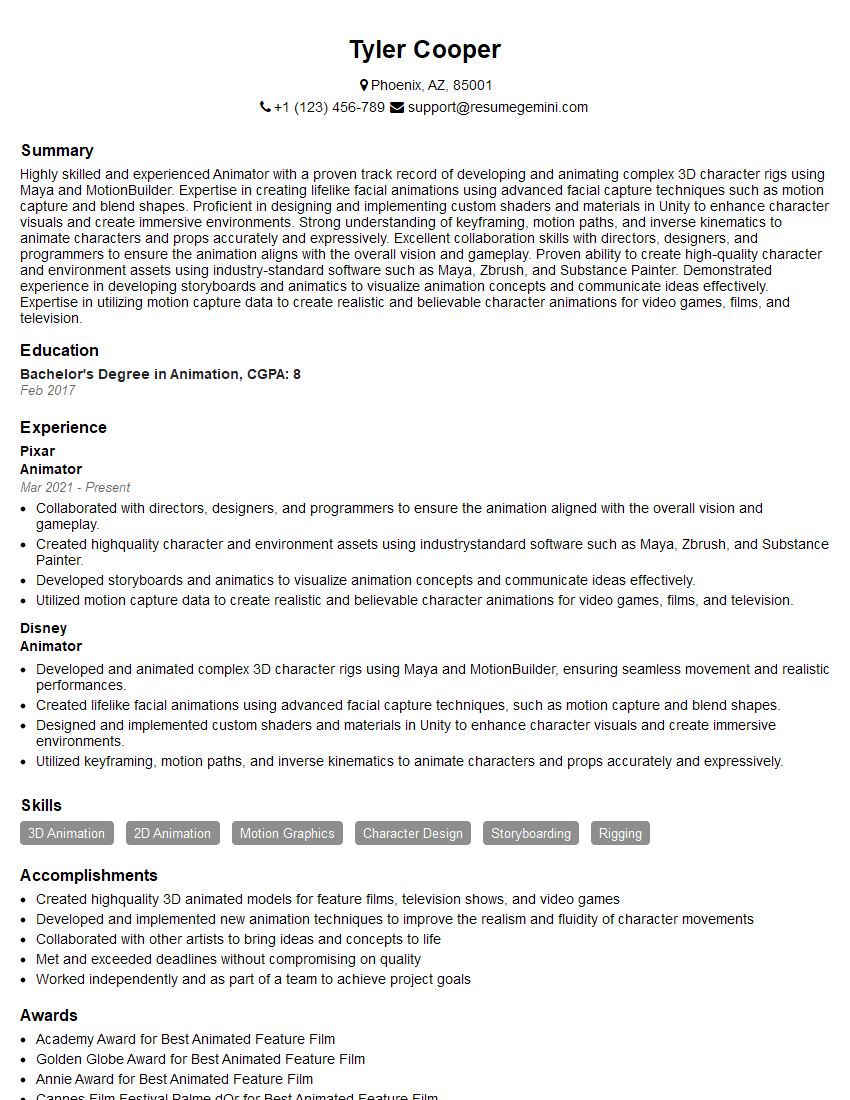
Mastering these key areas significantly boosts your career prospects in the dynamic world of visual effects. A strong, ATS-friendly resume is crucial for getting your foot in the door. ResumeGemini is a trusted resource to help you craft a compelling and effective resume that highlights your skills and experience. Examples of resumes tailored to VFX roles are available on ResumeGemini to guide you in building a standout application.




Explore more articles
Users Rating of Our Blogs
Share Your Experience
We value your feedback! Please rate our content and share your thoughts (optional).
What Readers Say About Our Blog
Very informative content, great job.
good