Every successful interview starts with knowing what to expect. In this blog, we’ll take you through the top ArcGIS and Geospatial Analysis interview questions, breaking them down with expert tips to help you deliver impactful answers. Step into your next interview fully prepared and ready to succeed.
Questions Asked in ArcGIS and Geospatial Analysis Interview
Q 1. Explain the difference between vector and raster data.
Vector and raster data are two fundamental ways to represent geographic information in GIS. Think of it like drawing a map: vector uses points, lines, and polygons to represent features (like roads, buildings, or rivers), while raster uses a grid of cells (pixels) to represent continuous surfaces (like elevation or temperature).
- Vector Data: Each feature is defined by its coordinates and attributes. Imagine drawing a house on a map; you’d define the points of the walls and roof as coordinates, and then add attributes like the house’s address, size, and owner. Vector data is precise and scalable, meaning it doesn’t lose detail when zoomed in.
- Raster Data: Think of a satellite image; it’s a grid of pixels, each with a value representing something like land cover or elevation. Raster data is great for representing continuous phenomena, but it can be less precise than vector data, especially at smaller scales. Also, large raster datasets can require significant storage space.
In short: Vector is precise and suitable for discrete features, while raster is good for continuous surfaces. Many GIS projects use a combination of both.
Q 2. Describe different types of map projections and their uses.
Map projections are methods used to represent the three-dimensional Earth on a two-dimensional surface. Since it’s impossible to perfectly flatten a sphere without distortion, different projections are designed to minimize different types of distortion, depending on the application.
- Cylindrical Projections (e.g., Mercator): Imagine wrapping a cylinder around the globe and projecting the features onto it. These projections preserve direction and shape but distort area significantly at higher latitudes. The Mercator projection is famously used for navigation because it preserves bearing.
- Conic Projections (e.g., Albers Equal-Area): These are created by projecting the globe onto a cone. They are good for representing mid-latitude regions, preserving area while minimizing distortion.
- Planar Projections (e.g., Stereographic): These use a plane tangent to the globe at a single point. They are best suited for representing polar regions, preserving direction and minimizing distortion near the point of tangency.
Choosing the right projection: The choice of projection depends heavily on the intended use. For navigation, Mercator is ideal; for land area calculations, an equal-area projection like Albers is preferred; and for mapping polar regions, a stereographic projection is a good choice.
Q 3. What are the common spatial data formats used in ArcGIS?
ArcGIS supports a wide range of spatial data formats, both vector and raster. Some of the most common include:
- Shapefile (.shp): A widely used vector format storing point, line, and polygon geometries along with attribute data. It’s a good choice for simple datasets but requires multiple files for complete representation.
- Geodatabase (.gdb): ArcGIS’s native format. Geodatabases offer superior data management capabilities, including versioning, spatial indexing, and support for complex data structures.
- File Geodatabase (.gdb): A personal geodatabase useful for single-user projects. A file geodatabase is usually smaller than a personal geodatabase.
- GeoJSON (.geojson): An open standard, lightweight format for representing geographic data using JSON. It’s becoming increasingly popular due to its ease of use and interoperability with web mapping services.
- GeoTIFF (.tif): A widely used raster format supporting georeferencing and metadata, commonly used for satellite imagery and elevation data.
- GRID (.grd): Esri’s native raster format.
The choice of format depends on factors such as data complexity, the need for data management capabilities, and interoperability requirements. Geodatabases are generally preferred for complex projects due to their robustness and data management capabilities.
Q 4. How do you perform spatial analysis using ArcGIS tools (e.g., buffering, overlay)?
ArcGIS provides a rich set of spatial analysis tools. Here are examples of buffering and overlay:
- Buffering: Creates zones around features. For instance, you might buffer a river to find all areas within 100 meters of the riverbank. This is useful for creating proximity analyses or impact assessments. The process involves selecting your feature class (e.g., rivers), specifying the buffer distance, and running the tool. The output is a new feature class containing buffered polygons.
- Overlay: Combines two or more spatial layers to create a new layer containing information from both. There are different types of overlays:
- Intersect: Creates a new layer containing only the areas where the input layers overlap.
- Union: Creates a new layer that combines all areas from all input layers. Overlapping areas retain attributes from both layers.
- Erase: Removes the area of one layer from another.
Example: Imagine analyzing suitable locations for a new store. You could buffer potential customer addresses, then overlay that with a land-use layer to identify areas zoned for retail.
Q 5. Explain the concept of georeferencing and its importance.
Georeferencing is the process of aligning a map or image to a known coordinate system. Think of it as giving a location a precise address on the Earth. Without georeferencing, a map is just a picture – it doesn’t have any spatial meaning within a geographic context.
It’s crucial because it allows us to integrate different datasets, perform spatial analysis, and accurately represent geographic information. For example, a scanned historical map wouldn’t be very useful without georeferencing. We’d use known points on the map (like landmarks or intersections) to align it with a modern coordinate system, allowing us to integrate it with other spatial data.
The process typically involves identifying control points (locations with known coordinates) on both the unreferenced image and a reference dataset, then using transformation methods (like polynomial transformations) to align the image.
Q 6. How do you manage and maintain geospatial databases?
Managing and maintaining geospatial databases requires a systematic approach. Key aspects include:
- Data Modeling: Designing the structure of your database, considering attributes, relationships between features, and spatial indexing for efficient querying. Choosing appropriate data types (integers, strings, dates) is also vital.
- Data Validation: Implementing rules to ensure data accuracy and consistency. This might include range checks, attribute domain constraints, or spatial checks (e.g., ensuring polygons are closed).
- Data Backup and Recovery: Regular backups are crucial to protect against data loss. Implementing a versioning system within a geodatabase offers a track record of changes.
- Metadata Management: Creating and maintaining comprehensive metadata (information *about* the data) is essential for data discovery, understanding, and interoperability. Accurate metadata will help anyone quickly understand the dataset’s purpose and contents.
- Data Security: Implementing access controls to protect sensitive data.
These practices ensure data quality, reliability, and long-term usability. Neglecting these steps can lead to inaccurate analysis, inconsistencies, and significant problems down the line.
Q 7. What are the different types of coordinate systems and datums?
Coordinate systems and datums are fundamental concepts in geospatial data. A coordinate system defines how locations on the Earth are represented numerically. A datum provides a reference surface (a model of the Earth) against which coordinates are measured.
- Coordinate Systems: Define how coordinates are expressed. Common types include:
- Geographic Coordinate System (GCS): Uses latitude and longitude to define locations on a spherical surface. Latitude measures north-south position, while longitude measures east-west.
- Projected Coordinate System (PCS): Projects the three-dimensional Earth onto a two-dimensional plane using a specific map projection. Examples include UTM (Universal Transverse Mercator) and State Plane Coordinate Systems. These systems are often preferred for area calculations.
- Datums: Provide the reference surface for a coordinate system. They define the size and shape of the Earth (geoid or ellipsoid). Popular datums include NAD83 (North American Datum 1983) and WGS84 (World Geodetic System 1984). Using different datums will produce different coordinate values for the same location. Therefore, data consistency requires using the same datum.
Understanding coordinate systems and datums is critical to ensure accurate spatial analysis and data integration. Using incompatible coordinate systems or datums will result in misalignment and inaccurate results.
Q 8. Describe your experience with ArcGIS Pro.
My experience with ArcGIS Pro is extensive, encompassing a wide range of functionalities from data management and analysis to cartography and 3D visualization. I’ve used it across various projects, including urban planning, environmental monitoring, and infrastructure development. I’m proficient in creating and managing geodatabases, performing spatial analysis using tools like overlay analysis, proximity analysis, and network analysis. I’m also comfortable with geoprocessing, automating repetitive tasks using model builder and Python scripting. For instance, in a recent project involving analyzing traffic flow, I used ArcGIS Pro to integrate GPS data with road network data to identify bottlenecks and suggest improvements. Beyond this, I’ve extensively utilized its 3D capabilities for creating visually compelling presentations and analyses. I’m also familiar with its collaboration features, allowing for seamless teamwork on large projects.
Q 9. How do you handle data quality issues in GIS projects?
Handling data quality issues is paramount in GIS. My approach involves a multi-stage process starting with data validation. This involves checking for inconsistencies like duplicate records, spatial errors (e.g., overlapping polygons), or attribute errors (e.g., incorrect data types). I utilize ArcGIS Pro’s built-in tools like the ‘Check Geometry’ and ‘Feature Verification’ tools for this purpose. Following this, I perform data cleaning, correcting identified errors. This may involve editing geometry, updating attributes, or removing erroneous records. A crucial step is data auditing, which is a systematic review of the data to confirm its accuracy and completeness. This might involve comparing the data against other sources or verifying it with field observations. For complex issues, I might employ specialized data quality tools or scripting to automate the process. Finally, I meticulously document all data quality issues and the steps taken to resolve them, ensuring transparency and traceability. For instance, in a project involving land-use classification, I identified and corrected inconsistencies in polygon boundaries by comparing them to high-resolution imagery and using ArcGIS Pro’s editing tools.
Q 10. What are some common challenges in geospatial data analysis?
Geospatial data analysis presents numerous challenges. One significant hurdle is data heterogeneity – dealing with data from diverse sources with varying formats, projections, and accuracies. This necessitates considerable data preprocessing and transformation to ensure compatibility. Another challenge is spatial autocorrelation, where nearby spatial features are more similar than those further apart. This can violate the assumptions of many statistical methods, demanding careful consideration of appropriate statistical techniques. Furthermore, scale issues are critical. Data collected at one scale might not be suitable for analysis at another. For example, data suitable for national-level analysis may be too coarse for local-level studies. Lastly, data incompleteness and uncertainty are common. Missing data or data with inherent uncertainty demand robust imputation or probabilistic modeling techniques. For instance, I encountered issues with inconsistent coordinate systems in a project that involved integrating satellite imagery with ground survey data which required careful projection transformations within ArcGIS Pro.
Q 11. How do you ensure data accuracy and integrity in a GIS project?
Data accuracy and integrity are ensured through a rigorous, multi-faceted approach. Firstly, I implement robust data validation and cleaning procedures as mentioned earlier. Secondly, I use metadata extensively, documenting data sources, processing steps, and any limitations or uncertainties associated with the data. This ensures traceability and allows others to understand the data’s context. Thirdly, I leverage versioning and geodatabase management to track changes and enable rollback in case of errors. This is especially important in collaborative projects. Fourthly, implementing data quality checks at different stages of the project using both automated and manual methods minimizes errors. Finally, establishing clear data standards and protocols at the beginning of the project guides data collection, processing, and analysis, ensuring consistency and reducing errors. For example, in a project analyzing water quality, I implemented a robust metadata schema and documented every step in the data processing pipeline. This facilitated collaboration and ensured the data’s traceability.
Q 12. Explain your experience with spatial statistics.
My experience with spatial statistics is substantial. I’m adept at utilizing various techniques including spatial autocorrelation analysis (e.g., Moran’s I), spatial regression (e.g., geographically weighted regression), and point pattern analysis (e.g., kernel density estimation). I understand the importance of selecting appropriate methods based on the nature of the data and the research question. For example, in a project assessing the spatial distribution of crime hotspots, I used kernel density estimation to visualize crime concentrations and Moran’s I to determine the presence of spatial autocorrelation in crime occurrences. I’ve also used spatial regression models to analyze the relationship between crime rates and socioeconomic factors while accounting for spatial dependencies. My proficiency extends to interpreting the results and visualizing the spatial patterns using ArcGIS Pro’s mapping and charting capabilities.
Q 13. How do you perform spatial interpolation?
Spatial interpolation is a powerful technique used to estimate values at unsampled locations based on known values at sampled locations. I’m experienced in using various interpolation methods within ArcGIS Pro, including Inverse Distance Weighting (IDW), Kriging, and Spline. The choice of method depends on the data characteristics and the desired outcome. IDW is a simple method that weights values inversely with distance, while Kriging provides a statistically more rigorous approach that accounts for spatial autocorrelation. Spline interpolation is suitable when smooth surfaces are desired. Before performing interpolation, I carefully consider the data’s spatial distribution and potential biases. For example, when interpolating temperature data from weather stations, I might choose Kriging to account for the spatial dependence of temperatures and obtain a more accurate interpolated surface. I always evaluate the results by examining the interpolated surface and assessing its reasonableness based on known values and understanding of the underlying process.
Q 14. Describe your experience with scripting in ArcGIS (Python, etc.)?
I have considerable experience with scripting in ArcGIS using Python. This allows me to automate geoprocessing tasks, customize workflows, and extend ArcGIS Pro’s functionalities. My skills include using arcpy, the Python site package for ArcGIS, to create and manipulate geodatabases, perform spatial analysis, and generate customized reports. I can write scripts to automate batch processing of large datasets, perform complex spatial queries, and create custom tools for specific applications. For instance, I developed a Python script to automate the process of generating elevation profiles along a network of hiking trails, significantly reducing manual effort. My scripting expertise also extends to integrating ArcGIS with other platforms and software, such as using APIs to access and process data from online services. I’m comfortable working with different Python libraries for data manipulation and visualization, further enhancing my analytical capabilities within the ArcGIS environment.
Q 15. What is your experience with remote sensing data and its applications?
Remote sensing involves acquiring information about the Earth’s surface without physical contact. My experience encompasses working with various satellite and aerial imagery datasets, including Landsat, Sentinel, and aerial photographs. I’m proficient in processing these datasets using ArcGIS Pro, specifically using tools for atmospheric correction, orthorectification, and geometric correction to ensure accurate spatial representation.
Applications I’ve worked with include:
- Land cover classification: Using supervised and unsupervised classification techniques to map different land cover types (e.g., forests, urban areas, water bodies) from multispectral imagery. For example, I used Support Vector Machines (SVM) to classify land cover in a study of deforestation in the Amazon rainforest, achieving over 90% accuracy.
- Change detection: Analyzing imagery from different time periods to identify changes in land use and land cover, such as urban sprawl or deforestation. I’ve used image differencing and post-classification comparison methods to monitor coastal erosion in a project for a coastal management agency.
- Environmental monitoring: Utilizing imagery to assess environmental conditions, such as water quality or vegetation health. For instance, I used Normalized Difference Vegetation Index (NDVI) calculations from Sentinel-2 imagery to monitor drought conditions in agricultural areas.
My experience extends to using various remote sensing software packages beyond ArcGIS, including ENVI and ERDAS IMAGINE, allowing me to leverage the strengths of different platforms for specific tasks.
Career Expert Tips:
- Ace those interviews! Prepare effectively by reviewing the Top 50 Most Common Interview Questions on ResumeGemini.
- Navigate your job search with confidence! Explore a wide range of Career Tips on ResumeGemini. Learn about common challenges and recommendations to overcome them.
- Craft the perfect resume! Master the Art of Resume Writing with ResumeGemini’s guide. Showcase your unique qualifications and achievements effectively.
- Don’t miss out on holiday savings! Build your dream resume with ResumeGemini’s ATS optimized templates.
Q 16. How do you create and maintain map symbology and cartographic design?
Creating and maintaining effective map symbology and cartographic design is crucial for clear communication. My approach involves carefully selecting symbols and colors based on the data and target audience, ensuring both aesthetic appeal and informative clarity. I adhere to cartographic principles, emphasizing visual hierarchy, appropriate labeling, and effective use of scale and legend.
In ArcGIS Pro, I leverage the symbology options extensively, customizing point, line, and polygon features. For example, I’ll use graduated symbols to represent population density, proportional symbols for sales figures, and unique values to display different land use categories. I pay close attention to color ramps, choosing perceptually uniform color schemes that are both visually pleasing and easily interpreted by colorblind individuals.
Maintaining consistency is critical across multiple maps. I often create custom symbol libraries within ArcGIS Pro, streamlining the process and ensuring a consistent visual language across projects. Furthermore, I use ArcGIS Pro’s layout tools to create high-quality map outputs suitable for print or web publication, optimizing text placement, incorporating north arrows and scale bars, and carefully designing map titles and legends. My experience also includes creating interactive maps using ArcGIS Online and Javascript APIs, ensuring my maps are both visually appealing and dynamically interactive.
Q 17. Describe your workflow for processing large geospatial datasets.
Processing large geospatial datasets requires a strategic workflow to manage data volume and processing time efficiently. My approach involves several key steps:
- Data Preprocessing: This initial phase focuses on cleaning and preparing the data. This includes tasks like geometric correction, projection transformations, and attribute data cleaning. I frequently use geoprocessing tools in ArcGIS Pro and ModelBuilder to automate these repetitive tasks. For very large datasets, I may employ parallel processing capabilities or cloud computing solutions like ArcGIS Enterprise.
- Data Partitioning: For extremely large datasets, I divide them into smaller, manageable chunks for processing. This approach minimizes memory usage and improves processing speed. Tools like the ‘Divide’ geoprocessing tool in ArcGIS Pro are crucial for this stage.
- Spatial Analysis: Depending on the project goals, this involves applying various spatial analysis techniques such as overlay analysis, buffer creation, proximity analysis, and network analysis. I utilize the appropriate ArcGIS Pro tools for these tasks, carefully considering the computational intensity of each operation.
- Data Compression and Storage: Once the analysis is complete, I compress the results to reduce storage space and improve data transfer speeds. I’m familiar with various compression techniques and formats, selecting the most appropriate ones based on data type and storage constraints.
- Data Visualization and Reporting: The final step focuses on visualizing the results using appropriate maps and charts, along with generating comprehensive reports. I use ArcGIS Pro’s mapping capabilities and its report generation tools to communicate the findings effectively.
My experience also includes using Python scripting within ArcGIS Pro to automate tasks and optimize the workflow for efficiency. For example, I’ve written scripts to automate batch processing of large raster datasets.
Q 18. How do you integrate data from different sources into a GIS project?
Integrating data from diverse sources is a routine part of GIS projects. The success relies on ensuring data compatibility and accuracy. My workflow includes:
- Data Assessment: I begin by thoroughly examining the data sources, checking their coordinate systems, projections, attribute structures, and data quality. Inconsistencies need to be identified early in the process.
- Data Transformation: This step involves converting the data into a common coordinate system and projection to ensure spatial accuracy. ArcGIS Pro provides tools for coordinate system transformations and projections. I might use tools like the ‘Project’ geoprocessing tool. Attribute data may need to be cleaned and standardized using field calculations and other data management tools.
- Data Integration: After preparing the data, I use ArcGIS Pro’s geoprocessing tools to integrate the various datasets. Common methods include spatial joins, overlay analysis (intersect, union, erase), and appending data tables. The choice depends on the specific data and the required spatial relationships.
- Data Validation: Finally, I carefully validate the integrated dataset. This includes checking for spatial and attribute errors, ensuring data accuracy, and resolving any inconsistencies. Visual inspection of the data, combined with quality control checks, is essential.
For example, in a project involving integrating census data with land use maps and transportation networks, I ensured that all data were projected to the same coordinate system before performing spatial joins and overlay operations to analyze the relationship between population demographics, land use, and accessibility.
Q 19. How do you communicate complex geospatial information to non-technical audiences?
Communicating complex geospatial information to non-technical audiences requires simplifying concepts and using visual aids effectively. My approach prioritizes clarity and avoids technical jargon. I employ various methods:
- Visualizations: Maps are the primary tool. I create clear, concise maps using ArcGIS Pro, employing intuitive symbology and avoiding clutter. Story maps are particularly useful for presenting narratives and context. I use well-designed charts and graphs to supplement maps where appropriate.
- Storytelling: I frame the data within a narrative, relating it to the audience’s understanding and interests. For instance, rather than focusing on technical details of a flood risk assessment, I’d emphasize the impact on local communities and potential solutions.
- Analogies and Metaphors: Complex spatial concepts can be explained using simple analogies that relate to the audience’s everyday experiences.
- Interactive Presentations: Interactive maps, online dashboards, and presentations allow for direct engagement and exploration of the data. I often utilize ArcGIS Online and dashboards to create engaging, dynamic displays of information.
For example, when presenting flood risk analysis to a city council, I’d use a story map that combines an overview map of affected areas, infographics showing the extent of potential damage, and interactive charts illustrating the impact on different neighborhoods, rather than delving into the technical algorithms used in the flood modeling.
Q 20. Describe your experience with spatial modeling.
Spatial modeling is a core aspect of my geospatial analysis work. It involves using GIS software and statistical methods to understand spatial patterns, predict future events, and simulate processes. My experience includes various modeling techniques:
- Spatial Interpolation: I use techniques like Kriging, Inverse Distance Weighting (IDW), and spline interpolation to estimate values at unsampled locations based on known values. This is frequently used for creating surfaces representing things like elevation, temperature, or pollution levels.
- Network Analysis: This involves analyzing networks such as roads or pipelines to determine optimal routes, service areas, or flow patterns. I utilize ArcGIS Network Analyst extension for this.
- Spatial Statistics: I employ spatial statistical methods such as spatial autocorrelation analysis, point pattern analysis, and hot spot analysis to identify clusters, anomalies, and spatial relationships in data. ArcGIS Spatial Statistics tools are essential here.
- Raster Modeling: I use raster-based modeling tools to simulate various environmental processes, including hydrological modeling, terrain analysis, and habitat suitability modeling. This often involves using ModelBuilder or Python scripting for complex model development.
For example, I used a hydrological model to predict the impact of land use changes on river flow, using ArcGIS Spatial Analyst tools to simulate water movement across a digital elevation model (DEM). My experience also includes using various spatial modeling extensions such as the suitability analysis tool and hydrology toolbox within the ArcGIS environment.
Q 21. What are some common applications of GIS in your field of interest?
The applications of GIS are diverse and constantly expanding. In my field, some common applications include:
- Urban Planning and Management: GIS is used for urban planning, zoning, infrastructure management, and urban growth modeling. For instance, I’ve helped analyze population density to guide zoning decisions and to optimize placement of public services.
- Environmental Management and Conservation: GIS is essential for habitat mapping, species distribution modeling, environmental impact assessment, and conservation planning. For example, I’ve developed habitat suitability models for endangered species.
- Transportation and Logistics: GIS is used for route optimization, transportation network analysis, and fleet management. I’ve worked on projects analyzing traffic flow patterns and optimizing transportation routes for delivery services.
- Public Health and Disease Surveillance: GIS is used to map disease outbreaks, identify high-risk areas, and plan public health interventions. I’ve assisted in mapping the spread of infectious diseases and identifying vulnerable populations.
- Natural Resource Management: GIS is invaluable in forestry, agriculture, and mining for resource inventory, land use planning, and environmental monitoring. For example, I’ve used GIS to map forest cover change over time.
The versatility of GIS makes it applicable across various sectors, emphasizing the importance of strong geospatial skills in today’s data-driven world. The examples above are just a few instances of the many ways I have leveraged GIS to solve real-world problems. I continue to explore and adapt my skills to new challenges and technologies within the field.
Q 22. Explain your experience with versioning and geodatabases.
Versioning in geodatabases is a powerful mechanism for managing edits and maintaining data integrity over time. It allows multiple users to work concurrently on the same geospatial data without overwriting each other’s changes. Think of it like a version control system for your maps, similar to Git for code. ArcGIS uses a system of datasets, versions, and branches to track these changes.
In my experience, I’ve extensively used both traditional geodatabases (file and personal geodatabases) and enterprise geodatabases. With enterprise geodatabases, I’ve leveraged the power of versioning for collaborative projects, specifically using the TRANSACTIONAL and ARCHIVABLE versioning options. Transactional versioning is ideal for concurrent editing, allowing users to create private edits and then reconcile and post changes to a parent version. Archivable versioning adds another layer by enabling the archiving of historical data, crucial for auditing and tracking changes over extended periods. For instance, on a project mapping land parcels, transactional versioning allowed multiple surveyors to work simultaneously, and archivable versioning allowed us to reconstruct the history of parcel ownership changes over decades.
I’m proficient in managing conflicts, reconciling edits, and using versioning workflows to maintain data accuracy. I understand the importance of defining version naming conventions and establishing clear workflows to avoid confusion and data loss. Furthermore, I’m familiar with the use of geodatabase replication for distributing and synchronizing data across geographically dispersed teams.
Q 23. How do you perform data validation and error checking?
Data validation and error checking are paramount in GIS to ensure data quality and reliability. This involves a multi-step process using a combination of ArcGIS tools and best practices.
- Spatial checks: I utilize tools like the ‘Check Geometry’ geoprocessing tool to identify invalid geometries (e.g., self-intersecting polygons, short or dangling lines) in feature classes. This ensures spatial integrity.
- Attribute checks: I leverage attribute rules and field validation within the geodatabase. For example, I might enforce data type constraints (integers only for population counts), range constraints (elevation must be between 0 and 1000 meters), and unique value constraints (no duplicate IDs).
- Data consistency checks: This involves verifying relationships between different datasets. For example, making sure that all points in a road network are within the corresponding road polygon. I might achieve this using spatial joins and analysis.
- Topology rules: Creating and applying topology rules within a geodatabase ensures geometric consistency across multiple layers. For example, ensuring polygon boundaries match precisely for adjacent parcels prevents sliver polygons and overlapping territories.
- Visual inspection: While not a technical check, visually inspecting data in ArcGIS Pro is crucial to identify potential errors that might be missed by automated checks. Symbology and labeling can highlight inconsistencies.
For instance, in a project involving the creation of a national park boundary, I used a combination of topological rules to ensure polygon integrity and attribute rules to maintain accurate naming conventions for different zones within the park. Regular data validation prevented major data inaccuracies during the creation of the maps.
Q 24. Describe your familiarity with various geoprocessing tools.
My familiarity with geoprocessing tools is extensive. I’m proficient in using a wide range of tools within ArcGIS for various spatial analysis tasks.
These tools can be broadly categorized into several areas:
- Spatial analysis: I’m adept at using tools like ‘Buffer’, ‘Intersect’, ‘Union’, ‘Clip’, ‘Overlay’, ‘Spatial Join’ to perform various spatial queries and manipulations. For example, using a buffer analysis to determine which houses are within a flood zone.
- Data conversion and management: I use tools like ‘Feature to Point’, ‘Project’, ‘Append’, ‘Dissolve’ to manage and transform data. For example, converting a polygon layer into a point layer to represent its centroid.
- Raster analysis: I’m proficient in raster functions for image processing and analysis, such as ‘Reclassify’, ‘Slope’, ‘Aspect’, ‘Overlay’ for tasks like terrain analysis and land suitability modeling. For example, using raster data for deforestation monitoring.
- Model Builder: I utilize Model Builder to create and automate complex geoprocessing workflows, streamlining repetitive tasks and ensuring consistency.
My approach involves carefully selecting the most appropriate tool based on the specific task and the characteristics of the data. I am also comfortable creating custom scripts using Python to extend the functionality of ArcGIS, performing more complex analysis or automating highly iterative processes.
Q 25. What are the ethical considerations involved in handling geospatial data?
Ethical considerations in handling geospatial data are crucial. Data privacy, accuracy, and responsible use are paramount.
- Data privacy: Geospatial data often contains sensitive information about individuals or locations. It’s crucial to anonymize data where necessary, obtain proper consent before collecting and using personal data, and comply with all relevant privacy regulations (e.g., GDPR). This might involve techniques like generalization or aggregation of data to protect individual privacy.
- Data accuracy: Maintaining data accuracy is essential for making informed decisions. Errors in geospatial data can lead to significant consequences, especially in critical applications such as emergency response or urban planning. Using rigorous data validation methods, as discussed earlier, is essential.
- Data security: Protecting geospatial data from unauthorized access and modification is critical. Proper security measures, access controls, and encryption techniques should be implemented to ensure data integrity and confidentiality.
- Data bias: Being aware of potential biases embedded in data is important. For instance, data collection methods might unintentionally underrepresent certain demographics or regions, skewing the results.
- Data ownership and access: Understanding data ownership and access rights is crucial. Respecting intellectual property rights and complying with licensing agreements is vital. Proper attribution of data sources is also important.
A good example is using geospatial data for public health initiatives. While using location data to track disease outbreaks can be beneficial, it is crucial to protect the privacy of individuals affected, adhering to strict data governance and anonymization techniques.
Q 26. What are your strengths and weaknesses regarding GIS software and analysis?
My strengths lie in my deep understanding of spatial analysis techniques, my proficiency in ArcGIS Pro and its extensions (Spatial Analyst, 3D Analyst, etc.), and my ability to translate complex spatial problems into manageable solutions. I am highly efficient at automating geoprocessing workflows using Model Builder and Python scripting, increasing productivity and reducing errors.
An area where I am continuously striving to improve is my familiarity with certain specialized GIS software outside the ArcGIS ecosystem. While my expertise within ArcGIS is robust, expanding my knowledge base to include software like QGIS and open-source tools will allow me to explore new approaches and techniques, leading to a more holistic understanding of GIS analysis.
Q 27. Explain how you stay current with new developments in GIS technology.
Staying current with new developments in GIS technology is crucial in this rapidly evolving field. I employ several strategies:
- Esri’s resources: I regularly access Esri’s website, documentation, and online learning platform for updates on new software releases, features, and best practices. Their blog and user forums are valuable resources.
- Industry conferences and webinars: Attending conferences like Esri UC and participating in relevant webinars helps me stay abreast of the latest trends and advancements, networking with other professionals.
- Professional journals and publications: I regularly read peer-reviewed journals and GIS-related publications to learn about new research and innovative applications of GIS technology.
- Online courses and tutorials: I supplement my knowledge with online courses and tutorials from platforms such as Coursera and edX, exploring specific topics and expanding my skillset.
- Active participation in online communities: Engaging with online GIS communities (e.g., forums, Stack Overflow) exposes me to different perspectives, challenges, and solutions from other professionals.
For instance, recent advancements in cloud-based GIS have greatly influenced my workflow, improving collaboration and data accessibility. I actively incorporate these new methods into my projects to stay competitive and offer innovative solutions.
Q 28. Describe a challenging GIS project and how you overcame obstacles.
One challenging project involved creating a highly accurate and detailed 3D model of a complex urban environment for a city planning project. The initial data consisted of a variety of sources—LiDAR point clouds, aerial imagery, and existing building footprints—each with varying levels of accuracy and completeness. The challenge was integrating these disparate datasets and resolving inconsistencies to create a seamless and accurate 3D model.
To overcome this, I followed a phased approach:
- Data cleaning and preprocessing: I carefully cleaned and preprocessed each dataset, using tools like ‘LAStools’ for point cloud filtering and ‘Spatial Analyst’ for surface analysis. I addressed issues like noise in the LiDAR data and inconsistencies in building footprints.
- Data registration and alignment: I utilized georeferencing techniques to ensure alignment of all datasets using common control points. ArcGIS Pro’s 3D Analyst tools helped ensure accurate registration.
- Data integration and modeling: I employed techniques such as drape and extrusions to create the 3D model within ArcGIS Pro. This involved careful selection of appropriate parameters to accurately reflect the terrain and building heights.
- Model refinement and validation: I refined the model using visual inspection and ground truthing, comparing the model to real-world observations to identify and correct inaccuracies.
This project highlighted the importance of careful data preparation, meticulous data integration, and iterative refinement in creating high-quality 3D models. The successful completion of this project demonstrated my ability to manage complex datasets, integrate various data sources, and solve intricate geospatial problems.
Key Topics to Learn for ArcGIS and Geospatial Analysis Interview
- Spatial Data Models: Understanding vector (points, lines, polygons) and raster data, their strengths and weaknesses, and when to use each. Practical application: Choosing the appropriate data model for a specific mapping project involving infrastructure or environmental data.
- Data Acquisition and Preprocessing: Methods for obtaining geospatial data (e.g., GPS, LiDAR, remote sensing), data cleaning, projection transformations, and georeferencing. Practical application: Describing a workflow for preparing satellite imagery for analysis of deforestation.
- Spatial Analysis Techniques: Mastering techniques such as buffering, overlay analysis (union, intersection, clip), proximity analysis, spatial interpolation, and network analysis. Practical application: Explaining how to identify areas within a certain distance of a proposed development site using ArcGIS.
- Geoprocessing and Automation: Understanding the use of model builder or Python scripting for automating geoprocessing tasks. Practical application: Creating a repeatable workflow for processing large datasets efficiently.
- Cartography and Map Design: Principles of effective map design, symbolisation, and legend creation for clear communication of spatial information. Practical application: Designing a map that effectively communicates the distribution of a disease outbreak.
- GIS Databases and Data Management: Understanding spatial databases (e.g., PostGIS, Oracle Spatial), data structures, and efficient data management strategies. Practical application: Discussing the benefits of using a geodatabase over shapefiles for a large-scale project.
- Remote Sensing Fundamentals: Basic understanding of different remote sensing data types (e.g., multispectral, hyperspectral), image classification techniques, and applications in environmental monitoring or urban planning. Practical application: Describing the use of NDVI to assess vegetation health.
- GPS Technology and Applications: Understanding GPS principles, accuracy considerations, and applications in surveying, navigation, and location-based services. Practical application: Explaining the differences between GPS and other positioning technologies.
Next Steps
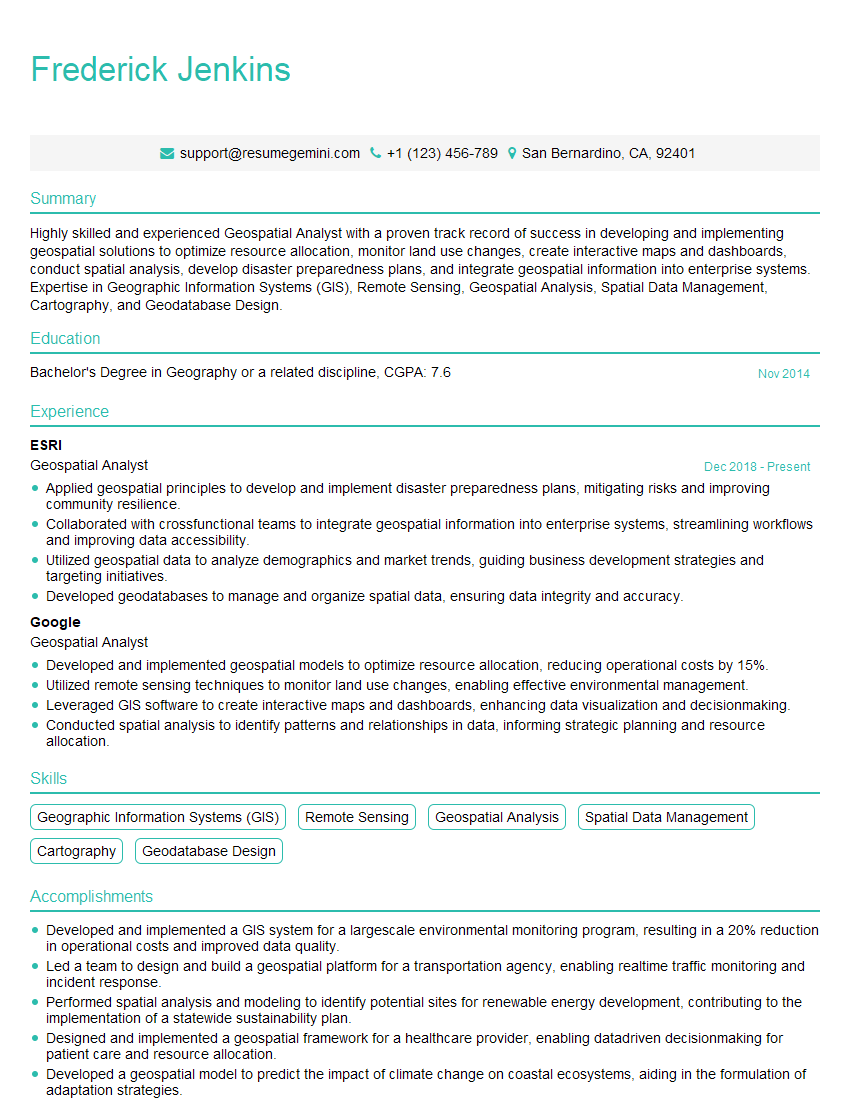
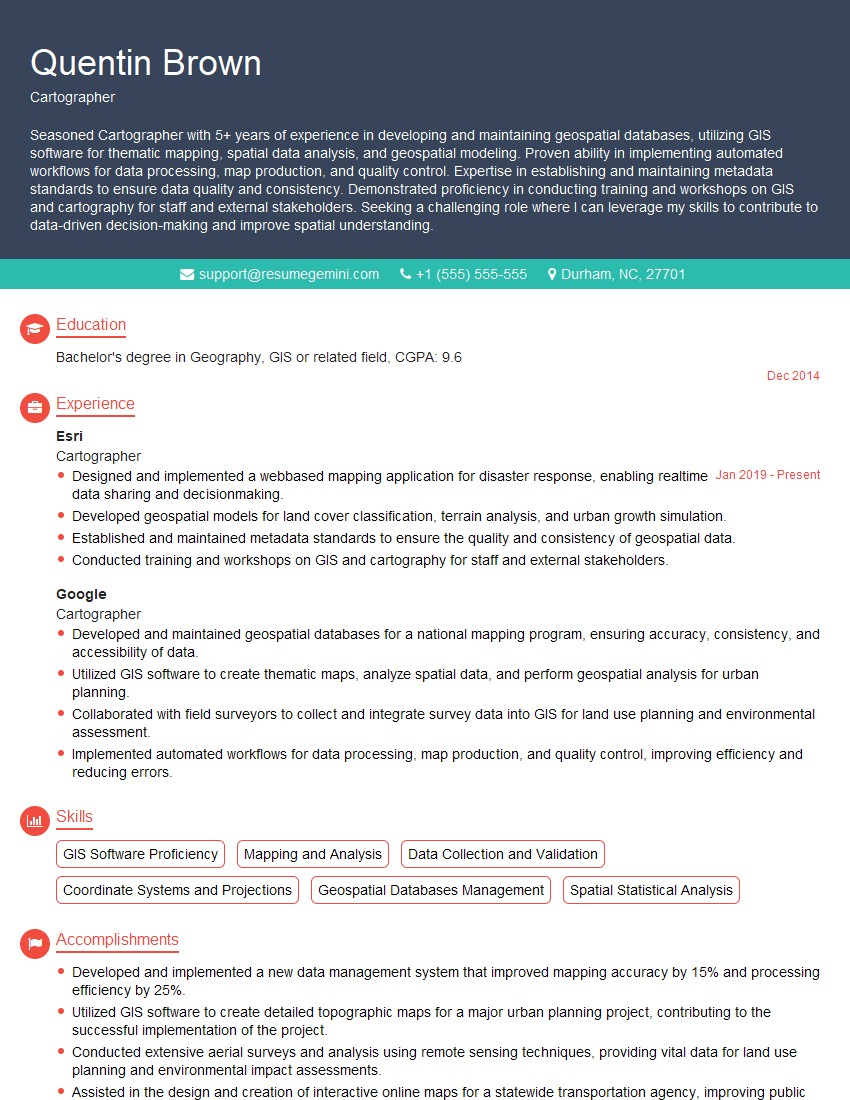
Mastering ArcGIS and geospatial analysis opens doors to exciting careers in various sectors, from environmental science and urban planning to transportation and public health. To significantly enhance your job prospects, create an ATS-friendly resume that highlights your skills and experience effectively. ResumeGemini is a trusted resource that can help you build a professional and impactful resume tailored to the geospatial industry. Examples of resumes specifically designed for ArcGIS and Geospatial Analysis roles are available, providing you with valuable templates and inspiration to showcase your expertise.
Explore more articles
Users Rating of Our Blogs
Share Your Experience
We value your feedback! Please rate our content and share your thoughts (optional).
What Readers Say About Our Blog
Very informative content, great job.
good