Preparation is the key to success in any interview. In this post, we’ll explore crucial Architectural Glass interview questions and equip you with strategies to craft impactful answers. Whether you’re a beginner or a pro, these tips will elevate your preparation.
Questions Asked in Architectural Glass Interview
Q 1. Explain the difference between annealed, tempered, and laminated glass.
The key difference between annealed, tempered, and laminated glass lies in their strength and safety characteristics, achieved through different processing methods. Annealed glass, also known as float glass, is the standard, ordinary glass we see everyday. It’s relatively inexpensive and easy to cut, but it shatters into sharp, dangerous shards upon impact. Tempered glass, on the other hand, undergoes a heat treatment process, making it four to five times stronger than annealed glass. When it breaks, it crumbles into small, relatively harmless pieces, making it much safer for applications like automotive side and rear windows and shower enclosures. Laminated glass consists of two or more layers of glass bonded together by a layer of interlayer material, typically polyvinyl butyral (PVB). This interlayer holds the glass fragments together even if the glass breaks, preventing penetration and offering enhanced safety and sound insulation. Imagine a car windshield: that’s laminated glass; it keeps the glass fragments in place in an accident.
- Annealed: Standard glass, brittle, breaks into sharp shards.
- Tempered: Heat-strengthened, four to five times stronger, breaks into small, relatively harmless pieces.
- Laminated: Multiple layers bonded together, holds fragments upon breakage, enhanced safety and sound insulation.
Q 2. Describe the various types of glass coatings and their applications.
Glass coatings enhance the performance of glass by adding specific properties. These coatings are incredibly thin layers applied to the surface, usually through a chemical vapor deposition (CVD) or sputtering process. Different coatings offer various benefits:
- Low-E (Low-Emissivity): These coatings reflect infrared radiation, reducing heat transfer through the glass. This improves energy efficiency, keeping buildings warmer in winter and cooler in summer. Think of a thermos: the low-E coating acts similarly, minimizing heat loss.
- Solar Control: These coatings reduce the amount of solar heat gain entering a building, reducing cooling loads. They often have a slightly reflective or tinted appearance.
- Self-Cleaning: These coatings use titanium dioxide (TiO2) to catalyze the breakdown of dirt and grime, allowing rainwater to easily wash them away. This significantly reduces the need for manual cleaning, particularly useful for high-rise buildings.
- Anti-Reflective: These coatings minimize light reflection, improving visibility and reducing glare. This is often used in display cases or museum exhibits.
The application of these coatings depends greatly on the intended use of the glass. For instance, a low-E coating is crucial for energy-efficient windows, while a solar control coating would be preferred in buildings with significant solar exposure.
Q 3. What are the key considerations for designing a curtain wall system?
Designing a curtain wall system involves numerous critical considerations. These systems are typically high-performance facades that are subject to significant environmental forces.
- Structural Integrity: The system must withstand wind loads, seismic activity, and its own weight. Detailed structural analysis is paramount. This includes calculations of wind pressure and consideration for thermal expansion and contraction.
- Air and Water Tightness: The system should prevent air infiltration and water leakage. Proper sealing and flashing are vital to ensure building performance.
- Thermal Performance: Energy efficiency is a key driver. The selection of appropriate glass types, spacers, and sealants directly impacts the building’s energy consumption.
- Aesthetics: The design must integrate with the overall building architecture and meet the client’s design intent. This includes factors like the type of glass, framing system, and color.
- Accessibility and Maintenance: The system must allow for easy access for cleaning and maintenance. This is particularly crucial for large-scale curtain walls.
- Cost-Effectiveness: Balancing performance, aesthetics, and budget is a crucial aspect of curtain wall design.
A poorly designed curtain wall can lead to significant issues, including leaks, energy loss, and structural problems. Therefore, a thorough understanding of all these factors is essential.
Q 4. How do you calculate the structural load capacity of a glass panel?
Calculating the structural load capacity of a glass panel is a complex process that requires specialized software and engineering expertise. It’s not something that can be done with a simple formula. The calculation involves several steps:
- Determining the applied loads: This includes dead load (the weight of the glass itself), live load (snow, people, etc.), and wind load (the pressure exerted by wind). Wind load calculations are particularly critical for large glass panels and are often determined using wind tunnel testing or sophisticated computational fluid dynamics (CFD).
- Selecting appropriate glass type and thickness: The strength of the glass directly impacts its load-bearing capacity. Tempered glass is significantly stronger than annealed glass.
- Analyzing the support system: The way the glass is supported (e.g., point supports, continuous supports) has a massive influence on its capacity. The design of the framing system is equally crucial.
- Using Finite Element Analysis (FEA): FEA software is typically used to model the glass panel and its support structure, allowing engineers to simulate the stress distribution under different load conditions.
- Applying safety factors: Engineers apply safety factors to account for uncertainties and ensure the system’s reliability. These factors depend on the load type, glass type and relevant building codes.
The outcome of this analysis provides the maximum load the glass panel can safely withstand. Ignoring this step can lead to catastrophic glass failure.
Q 5. Explain the process of insulating glass unit (IGU) fabrication.
Insulating Glass Units (IGUs), also known as double or triple-glazed windows, are fabricated through a precise process aimed at creating a highly energy-efficient glazing system. Here’s a step-by-step outline:
- Glass Selection and Cutting: The appropriate type and thickness of glass are selected based on performance requirements (e.g., solar control, low-E). The glass sheets are cut to the desired size and shape.
- Spacer Bar Installation: Spacer bars, typically made of aluminum or warm-edge technology materials (to reduce thermal bridging), are placed around the perimeter of the glass sheets. These spacers maintain the air gap between the glass panes.
- Desiccant Placement: A desiccant (a drying agent) is placed inside the spacer bar to absorb any moisture present during the assembly process. This is critical for preventing condensation and fogging within the IGU.
- Sealing: A butyl sealant is applied to the spacer bar to create an initial seal around the perimeter of the glass. This sealant provides a primary barrier against moisture.
- Secondary Sealant Application: A structural silicone sealant is applied over the butyl sealant to create a strong, durable, and weather-resistant seal.
- Assembly and Quality Control: The assembled IGU undergoes quality control checks to ensure that the seals are intact, and the unit is free of defects.
The entire fabrication process takes place in a controlled environment to minimize moisture contamination. The resulting IGU offers superior insulation compared to single-pane glass, saving energy and improving comfort.
Q 6. What are the common methods for sealing glass in a window or door frame?
Several methods are used to seal glass in window or door frames, each offering varying levels of performance and aesthetics. The choice depends on factors like the type of frame material and desired weather tightness.
- Glazing Beads: These are small, decorative beads that are applied to the exterior of the frame to hold the glass in place. While aesthetically pleasing, they are not highly weather-resistant and are usually used in combination with other sealing methods.
- Butyl Sealant: This is a highly elastic and water-resistant sealant commonly used in the fabrication of IGUs. It’s applied to the frame and glass before the glazing is installed, creating a primary seal.
- Silicone Sealant: This is a robust sealant providing excellent weather resistance and durability. It is often used as a secondary sealant over butyl, or to seal the gap between the glass and frame in some applications.
- Mechanical Fasteners: These are used for securing the glass within the frame, offering superior structural integrity. Examples include clips, screws, and channels. They often work in conjunction with sealants.
Often, a combination of these methods is employed to achieve optimal sealing performance. A properly sealed unit is crucial for preventing air leakage, water intrusion, and energy loss.
Q 7. Describe different types of glass failure and their causes.
Glass failure can manifest in various ways, and understanding the causes is essential for preventing future incidents and ensuring structural integrity.
- Thermal Stress: Rapid temperature changes can cause thermal stress, leading to cracking or shattering, particularly in large glass panels or those with poor thermal properties. This can be exacerbated by improper design or installation.
- Mechanical Stress: Excessive loads, impacts, or improper handling can cause mechanical stress, resulting in fractures or breakage. This is why careful handling and proper installation are crucial.
- Chemical Attack: Exposure to aggressive chemicals can weaken or damage the glass surface, making it susceptible to failure. This is particularly relevant in industrial settings or areas with high levels of air pollution.
- Edge Damage: Damage to the edges of the glass during processing or installation can create stress concentrations, leading to cracks or fractures that propagate through the panel. Precise cutting and handling are crucial in preventing such issues.
- Nickel Sulfide (NiS) Inclusions: Small NiS inclusions in tempered glass can sometimes undergo a transformation process, creating internal pressure that leads to spontaneous shattering. Although rare, this is a significant safety concern.
Careful material selection, proper design, installation, and regular inspection can greatly minimize the risk of glass failure. Understanding the specific causes of failure is key to prevent future occurrences.
Q 8. How do you ensure the safety and security of glass installations?
Ensuring the safety and security of glass installations is paramount. It involves a multi-faceted approach encompassing material selection, design considerations, and proper installation techniques. We begin by specifying appropriate glass types based on the intended use and potential impact forces. For instance, laminated glass, with its interlayer of PVB (polyvinyl butyral), significantly improves impact resistance and holds the glass shards together in case of breakage, preventing injury. For high-security applications, we might utilize tempered glass, known for its high strength, or even bullet-resistant glass, which incorporates multiple layers of glass and interlayers to withstand ballistic impact.
Beyond material selection, design plays a crucial role. We carefully consider the glass’s location, potential loads (wind, snow, seismic activity), and the risk of human impact. For instance, strategically placed handrails and protective films can mitigate the risk of accidental breakage. Proper installation is equally vital. We ensure the use of correct fasteners, appropriate sealants to prevent water ingress, and meticulous attention to detail during the entire installation process. Regular inspections and maintenance further contribute to long-term safety and security.
For example, in a recent high-rise residential project, we specified laminated glass for balconies and exterior walls to minimize the risk of injury from accidental breakage. For the ground floor, we used tempered glass to withstand potential impact from collisions. This layered approach ensured optimal safety without compromising the building’s aesthetic appeal.
Q 9. What are the relevant building codes and standards for architectural glass?
Building codes and standards for architectural glass vary depending on location and jurisdiction, but some common standards and guidelines we consistently adhere to include those from ASTM International (American Society for Testing and Materials) and ANSI (American National Standards Institute). These standards specify requirements for glass type, thickness, strength, and testing methods. Specific codes often address aspects like wind loads, impact resistance, and safety glazing requirements for specific applications like doors, windows, and railings. For example, ASTM E1300 covers the standards for the testing of impact resistance for glazing materials. Furthermore, we always check local building codes to ensure compliance. Ignoring these codes can lead to significant legal issues, safety risks, and project delays.
A crucial aspect of compliance involves meticulous documentation. We maintain detailed records of the glass specifications, testing results, and installation procedures to demonstrate adherence to the relevant standards. This documentation is critical not only for regulatory compliance but also for potential future claims or maintenance.
Q 10. What are the environmental considerations in specifying architectural glass?
Environmental considerations are increasingly significant in specifying architectural glass. We prioritize options that minimize the environmental footprint throughout the product lifecycle. This starts with selecting glass made from recycled content. Many manufacturers offer glass with high recycled content, significantly reducing the demand for raw materials. We also consider the embodied energy of the glass—the energy required to manufacture and transport it. Low-emissivity (Low-E) coatings are often specified to improve energy efficiency in buildings, reducing the need for heating and cooling. These coatings reflect infrared radiation, helping maintain a comfortable indoor temperature while minimizing energy consumption.
Beyond the glass itself, we evaluate the environmental impact of the entire glazing system, including the framing materials and sealants used. Sustainable framing materials like recycled aluminum are often preferred, and we carefully select sealants with low VOC (volatile organic compound) content to minimize indoor air pollution. Proper disposal of waste glass is also crucial, ensuring that the materials are recycled rather than ending up in landfills. This holistic approach reflects our commitment to sustainability.
Q 11. Explain the importance of proper ventilation in glazed structures.
Proper ventilation in glazed structures is critical for several reasons. Firstly, it ensures adequate air exchange, removing stale air and introducing fresh air to maintain a healthy indoor environment. This is especially important in spaces with high occupancy or the presence of moisture-generating activities, such as kitchens and bathrooms. Inadequate ventilation can lead to the buildup of moisture, resulting in condensation, mold growth, and potential structural damage. Secondly, proper ventilation contributes to thermal comfort. By controlling air movement and temperature gradients, ventilation systems can prevent overheating or excessive cooling, thus improving energy efficiency and comfort.
In design, we consider various ventilation strategies, including natural ventilation through operable windows or skylights and mechanical ventilation using fans or HVAC systems. The selection of ventilation methods depends on factors such as building size, climate, and occupancy levels. We incorporate ventilation strategies during the design phase, ensuring that the glazing system integrates seamlessly with the building’s overall ventilation plan. For example, in a museum setting, we’d focus on climate control and careful air filtration to protect artifacts, needing precise ventilation design to prevent damage from condensation or pollutants.
Q 12. Describe your experience with different types of glass fasteners.
My experience with glass fasteners is extensive, encompassing a range of options suitable for various applications and glass types. These include mechanical fasteners such as screws, bolts, and clamps, as well as adhesive systems. Mechanical fasteners are commonly used for securing glass to frames and supports, while adhesive systems offer a more seamless aesthetic. The selection of fasteners depends heavily on factors such as glass thickness, load requirements, and the type of frame material. For example, stainless steel fasteners are often preferred for their corrosion resistance in exterior applications, whereas less robust materials are acceptable for interior use.
I have experience using specialized fasteners designed for specific applications, such as spider fittings for point-fixed glazing systems or silicone structural glazing systems that utilize silicone sealant as both an adhesive and structural component. Each fastener type demands careful consideration of its load-bearing capacity, corrosion resistance, and aesthetic compatibility with the overall design. In my experience, proper installation is just as vital as fastener selection – improper installation can compromise the integrity of the entire glazing system. I have worked extensively with manufacturers to ensure the use of appropriate fasteners and installation methods.
Q 13. How do you handle challenges related to glass tolerances and imperfections?
Handling challenges related to glass tolerances and imperfections requires careful planning and a proactive approach. Glass manufacturing inherently involves slight variations in dimensions and surface quality. We address these challenges through meticulous detailing and quality control. During the design phase, we incorporate tolerances into the drawings, acknowledging potential variations in glass dimensions. This allows for flexibility during the installation process. Detailed shop drawings provide precise information to fabricators, minimizing discrepancies.
We also specify rigorous quality control procedures to ensure that the glass meets the required standards before installation. This includes visual inspection and potentially more precise measurements. If imperfections are detected, we work with the fabricator to identify acceptable alternatives or to make necessary adjustments in the design. In some instances, minor imperfections might be acceptable within certain tolerances, while in other instances, it might be necessary to replace the glass panel.
For example, on a recent project, slight variations in glass thickness necessitated minor adjustments to the supporting structure during installation. Early detection and proactive adaptation prevented delays and ensured a high-quality outcome.
Q 14. What software are you proficient in for designing and detailing glass elements?
I am proficient in several software packages commonly used for designing and detailing glass elements. My expertise includes AutoCAD, Revit, and Tekla Structures. AutoCAD provides the precision needed for 2D drafting and detailing of glass components, ensuring accurate dimensions and connections. Revit allows for the creation of 3D models of the entire building, incorporating detailed glass elements and facilitating coordination with other disciplines. Tekla Structures is particularly useful for complex structural glazing systems, providing powerful tools for modeling and analysis.
Furthermore, I’m familiar with specialized glass design software that enables advanced analysis of glass performance under various loads and environmental conditions. This software helps in optimizing glass selection, ensuring that the glazing system meets the required safety and performance standards. My proficiency in these programs enables me to create detailed and accurate drawings, models, and analyses, ensuring a seamless design and construction process for the glass elements of any project.
Q 15. How do you manage a glass project budget and schedule?
Managing a glass project budget and schedule requires a proactive, multi-stage approach. It begins with a thorough understanding of the project scope, including the type and quantity of glass, the complexity of the design, and any specialized fabrication or installation requirements.
Firstly, a detailed cost breakdown is essential. This includes material costs (glass, framing, sealants, etc.), labor costs (fabrication, installation, cleaning), permits, transportation, and contingency for unforeseen circumstances (e.g., material defects, weather delays). We use specialized software to create accurate estimates and track expenses in real-time. We regularly compare actual costs against the budget and adjust the plan as needed.
Scheduling is equally vital. Critical Path Method (CPM) scheduling helps identify tasks with the longest durations and those that impact subsequent phases. This allows us to prioritize tasks and identify potential bottlenecks early on. For instance, the fabrication of specialized glass units might have a longer lead time and needs to be scheduled well in advance. Regular progress meetings with the team, subcontractors, and clients are crucial for monitoring progress, addressing potential delays and making necessary adjustments to the schedule. We also use Gantt charts to visually represent the schedule and track progress.
Career Expert Tips:
- Ace those interviews! Prepare effectively by reviewing the Top 50 Most Common Interview Questions on ResumeGemini.
- Navigate your job search with confidence! Explore a wide range of Career Tips on ResumeGemini. Learn about common challenges and recommendations to overcome them.
- Craft the perfect resume! Master the Art of Resume Writing with ResumeGemini’s guide. Showcase your unique qualifications and achievements effectively.
- Don’t miss out on holiday savings! Build your dream resume with ResumeGemini’s ATS optimized templates.
Q 16. Explain your experience with different types of glass cleaning and maintenance.
Glass cleaning and maintenance vary considerably depending on the type of glass, its location, and the surrounding environment. For instance, exterior glass in a coastal city will require more frequent cleaning to combat salt spray and airborne debris than interior glass in a climate-controlled office building.
I have experience with various methods, including:
- Manual Cleaning: Using squeegees, brushes, and appropriate cleaning solutions (avoiding harsh chemicals that might damage the glass). This is suitable for smaller areas or intricate designs.
- Power Washing: Using high-pressure water jets for thorough cleaning of large areas, but requires careful control to avoid damage, especially with delicate glass types.
- Specialized Cleaning Agents: Using specialized chemicals and solutions designed for various types of glass coatings (e.g., low-e coatings). Using the wrong solution can damage the coating and compromise its performance.
- Automated Cleaning Systems: These systems are becoming increasingly common for high-rise buildings and utilize robotic systems for regular cleaning. This minimizes the risk of human error and injury.
Regular maintenance also involves inspecting the glazing system for any signs of damage or deterioration (cracks, seal failures, etc.). This is crucial to prevent further damage and ensure the long-term integrity of the glass.
Q 17. Describe your approach to problem-solving in a complex glass installation.
My approach to problem-solving in complex glass installations is methodical and collaborative. I begin by thoroughly understanding the problem through observation and documentation. This might involve reviewing drawings, specifications, and site conditions.
Next, I gather relevant data, including material properties, relevant codes, and manufacturer guidelines. This helps to narrow down the potential causes of the issue. I then formulate several possible solutions and evaluate their feasibility, practicality, and cost-effectiveness.
Communication is key, so I collaborate with engineers, architects, fabricators, and subcontractors to discuss potential solutions and reach a consensus. This includes assessing risk and developing contingency plans in case the chosen solution doesn’t resolve the problem completely.
For example, if a glass panel was found to have a minor crack during installation, I would first assess the severity of the crack, its location within the panel and consider the structural implications. Depending on the assessment, solutions might include replacing the panel, repairing it using specialized techniques, or even adjusting the supporting framework.
Q 18. What are the advantages and disadvantages of different glass types for specific applications?
Different glass types offer varying advantages and disadvantages depending on the application. Here are a few examples:
- Annealed Glass: Relatively inexpensive, easy to cut and fabricate. However, it’s prone to shattering into sharp pieces upon breakage, limiting its suitability for safety-critical applications.
- Tempered (Heat-Strengthened) Glass: Much stronger and safer than annealed glass; breaks into small, relatively harmless pieces. Ideal for applications requiring high strength and safety (e.g., automotive, shower enclosures). However, it’s more expensive and cannot be easily cut or modified after tempering.
- Laminated Glass: Consists of two or more layers of glass bonded together with a polymer interlayer. Offers superior safety and security, as the interlayer holds the glass fragments together in case of breakage. Also provides enhanced sound insulation and UV protection. However, it’s more expensive and can be more challenging to work with.
- Insulating Glass Units (IGUs): Consist of two or more panes of glass separated by an air or gas-filled spacer. Provide excellent thermal insulation and noise reduction. However, they are more complex and expensive than single-pane glass.
- Low-Emissivity (Low-E) Glass: Coated glass that reflects infrared radiation, reducing heat transfer. Excellent for energy efficiency but can be more sensitive to cleaning and certain chemicals.
The choice of glass type is determined by factors such as structural requirements, safety considerations, thermal performance needs, acoustic requirements, budget constraints, and aesthetic preferences.
Q 19. How do you ensure the quality control of glass throughout the project lifecycle?
Ensuring quality control throughout the project lifecycle is crucial. This begins with careful selection of suppliers who adhere to strict quality standards and provide necessary certifications. We carefully inspect all glass deliveries, verifying that they meet the specified dimensions, quality, and type. This includes checking for any visible defects like scratches, cracks, or imperfections.
During fabrication, regular quality checks are conducted to ensure that the glass is being processed correctly. This may include verifying the dimensions of cut glass, the proper application of coatings, and the integrity of any laminated or insulated glass units.
During installation, meticulous workmanship is critical. We use appropriate handling techniques to prevent damage to the glass during transportation and installation. We meticulously check the alignment and proper sealing of the glass units, ensuring that they are securely fastened and watertight. Finally, a thorough inspection is carried out upon project completion to verify that the glass installation meets all design specifications and quality standards.
Q 20. Explain your experience with different glazing systems (e.g., stick, unitized).
I have extensive experience with various glazing systems, including stick and unitized systems.
Stick Systems: Involve the individual framing members being assembled on-site. This allows for flexibility in design, but it also requires skilled labor and careful coordination on-site, making it potentially more time-consuming and prone to errors. They are often preferred for projects where design flexibility is paramount or the building geometry is complex.
Unitized Systems: Glazing units are pre-assembled in a factory and then installed as complete modules on-site. This leads to faster installation times, improved quality control (as much of the work is done under controlled factory conditions), and potentially reduced on-site labor costs. They are highly suitable for large, repetitive façade projects where precision and speed are important. However, the initial costs are typically higher.
The choice between these systems often depends on the project scope, budget, and project timeline. For example, large commercial buildings often favour unitized systems, while smaller projects or projects with intricate designs may be better suited to stick systems.
Q 21. How do you address potential issues related to thermal bridging in glass facades?
Thermal bridging occurs when heat flows through the building envelope due to conductive elements—in this case, the framing system in a glass façade. This leads to heat loss in winter and heat gain in summer, reducing energy efficiency and potentially increasing heating and cooling costs.
We address this issue by employing several strategies:
- Thermal Breaks: Incorporating thermal breaks in the framing system. These breaks are typically made of non-conductive materials (e.g., polyamide) that interrupt the continuous flow of heat through the metal framing members.
- Optimized Frame Design: Using framing systems with minimal metal sections to reduce the overall area susceptible to thermal bridging. This includes employing slimmer profiles and optimizing the spacing between framing members.
- High-Performance Glass: Using insulating glass units (IGUs) filled with low-conductivity gas (e.g., argon or krypton) to enhance thermal performance. This significantly reduces the heat flow through the glass itself.
- Low-E Coatings: Applying low-emissivity (low-E) coatings to the glass to reflect infrared radiation and further reduce heat transfer.
By combining these strategies, we can significantly mitigate thermal bridging and create more energy-efficient glass facades.
Q 22. What are the different types of glass used in fire-rated assemblies?
Fire-rated glass assemblies require specialized glass types designed to withstand high temperatures and maintain structural integrity during a fire. The goal is to contain the fire and limit its spread, buying valuable time for evacuation. Common types include:
- Wired Glass: While less common now due to safety concerns (shattering into sharp pieces), wired glass was historically used because the wire mesh provides some structural integrity during a fire. However, its strength is limited, and modern alternatives are preferred.
- Laminated Glass: This is a much safer and more effective option. Multiple layers of glass are bonded together with a PVB (polyvinyl butyral) interlayer. During a fire, the PVB interlayer helps to hold the glass together, preventing shattering and maintaining a barrier for a longer duration. The thickness and type of PVB significantly impacts the fire-rating.
- Fire-Rated Laminated Glass: This is a specialized type of laminated glass incorporating intumescent materials within the interlayer. These materials expand significantly when exposed to heat, further enhancing the fire resistance and maintaining opacity.
- Ceramic Glass: This type offers superior fire resistance compared to traditional glass, maintaining its structural integrity at extremely high temperatures. It’s often used in high-security applications.
The choice of glass depends on the specific fire-rating required (e.g., 30-minute, 60-minute, or 90-minute rating), the design requirements, and the budget. Code compliance is paramount, and selecting the correct fire-rated glass is crucial for occupant safety.
Q 23. Describe your experience working with specialized glass such as smart glass or self-cleaning glass.
I’ve had extensive experience with smart glass and self-cleaning glass in several high-profile projects. Smart glass, also known as electrochromic glass, allows for dynamic light transmission control. It can switch between transparent and opaque states with the application of an electric current. This is incredibly useful for optimizing daylighting, reducing glare, and improving energy efficiency. I’ve worked on a project where we incorporated smart glass into a high-rise office building’s facade, allowing occupants to control the amount of sunlight entering their workspace, dramatically increasing comfort and reducing the need for artificial lighting.
Self-cleaning glass uses a titanium dioxide coating that reacts with ultraviolet light to break down dirt and grime. This reduces the need for frequent cleaning, resulting in lower maintenance costs and enhanced aesthetics. I recently completed a project featuring self-cleaning glass on a museum’s exterior. Its self-cleaning properties significantly lowered maintenance and ensured the building’s pristine appearance.
Working with these specialized glasses requires careful consideration of their electrical requirements, integration with building management systems (BMS), and potential limitations in terms of transparency and light transmission when compared to standard glass.
Q 24. How do you interpret and apply architectural drawings and specifications related to glass?
Interpreting architectural drawings and specifications for glass is a critical step in ensuring successful project execution. I start by thoroughly reviewing the drawings to identify the type, size, thickness, and quantity of each glass element. This includes carefully checking details such as glass type (laminated, tempered, insulated), coatings (low-E, self-cleaning), and any specific performance requirements.
Specifications provide critical information regarding the required performance standards. I look for details on things like: Visible light transmittance (VLT), solar heat gain coefficient (SHGC), U-value (thermal insulation), acoustic performance requirements, and safety standards. I also examine the details of the framing systems, ensuring that the glass selection is compatible with the chosen frame and sealants.
Any discrepancies between the drawings and specifications are immediately flagged and resolved through communication with the architect and engineering team. This meticulous review prevents costly mistakes and ensures that the final product meets the client’s expectations and complies with all building codes.
Q 25. What are the common challenges associated with installing large-scale glass elements?
Installing large-scale glass elements presents unique challenges, primarily due to their size, weight, and fragility. Some key challenges include:
- Transportation and Handling: Large glass panels require specialized transportation and handling equipment to prevent damage during delivery and installation. Precise lifting and positioning are crucial.
- Structural Considerations: The supporting structure needs to be meticulously designed and engineered to withstand the significant weight of the glass. Any deflection or movement in the structure can lead to cracking or failure.
- Installation Precision: Accurately aligning and sealing large glass panels requires precision and skilled craftsmanship to prevent water ingress and ensure structural integrity. Proper sealing is vital to prevent leaks.
- Safety Precautions: Working at heights with large glass panels demands stringent safety protocols and protective measures to prevent accidents.
- Weather Conditions: Adverse weather conditions can significantly impact the installation process and potentially damage the glass. Careful planning and scheduling are necessary to mitigate these risks.
Overcoming these challenges often involves meticulous planning, the use of specialized equipment, and a highly skilled installation team with experience handling large-scale glass projects.
Q 26. Describe your experience with different sealant types and their application techniques.
My experience encompasses a wide range of sealant types, each with its unique properties and application techniques. The selection of the right sealant is crucial for ensuring the long-term performance and durability of the glazing system. Common sealants include:
- Silicone Sealants: These are versatile and widely used, offering good adhesion to various substrates. However, different types exist, some with enhanced UV resistance or flexibility.
- Polyurethane Sealants: These offer excellent durability and adhesion, particularly in demanding applications. They are often chosen for their high strength and elasticity.
- Butyl Sealants: These are known for their excellent weather resistance and watertightness. They are often used as primary sealants in insulated glazing units (IGUs).
Proper application techniques are equally important. This includes surface preparation (cleaning, priming), correct sealant application (tooling, joint design), and ensuring adequate curing time. I always follow manufacturer’s instructions meticulously and adhere to best practices to avoid issues like sealant failure, cracking, or water leaks. I’ve found that consistent training for my installation team is key to ensuring quality sealant application.
Q 27. Explain your understanding of the energy performance of different glass types.
The energy performance of glass is a crucial consideration in modern building design. Different glass types exhibit varying levels of thermal insulation and solar control. Key performance indicators include:
- U-value: This represents the rate of heat transfer through the glass. Lower U-values indicate better insulation and reduced energy loss. Double or triple glazed units with low-E coatings significantly improve the U-value.
- Solar Heat Gain Coefficient (SHGC): This measures the fraction of solar radiation admitted through the glass. Lower SHGC values reduce solar heat gain, minimizing cooling loads in hot climates. Low-E coatings play a major role in reducing SHGC.
- Visible Light Transmittance (VLT): This indicates the amount of visible light transmitted through the glass. Higher VLT values maximize daylighting, reducing the need for artificial lighting.
Selecting the appropriate glass type depends on the climate and building design. For example, in cold climates, prioritizing a low U-value is important for reducing heating loads. In hot climates, a low SHGC is crucial to minimize cooling loads. The balance between maximizing daylighting (high VLT) and minimizing solar heat gain (low SHGC) needs careful consideration.
Q 28. What is your experience with the sustainability aspects of glass procurement and disposal?
Sustainability is a critical aspect of my work, encompassing both procurement and disposal of glass. In procurement, I prioritize using recycled content glass whenever possible. Many manufacturers now offer glass with high recycled content, minimizing the environmental impact of new glass production. I also evaluate the embodied carbon of different glass types, selecting options with lower carbon footprints. This often involves researching the manufacturing processes and transportation distances.
For disposal, I focus on responsible recycling practices. Working with reputable demolition and recycling companies ensures that glass is processed appropriately and reused, rather than ending up in landfills. I actively seek opportunities to reuse glass elements whenever feasible, such as incorporating salvaged glass into new designs. In many regions, glass recycling programs offer a sustainable alternative to disposal, diverting waste from landfills and reducing the need for virgin materials in future projects.
Key Topics to Learn for Architectural Glass Interview
- Types of Architectural Glass: Explore various glass types (e.g., annealed, tempered, laminated, insulated, coated) and their properties, including strength, thermal performance, and acoustic properties.
- Glass Fabrication and Processing: Understand the manufacturing processes, including cutting, grinding, polishing, heat treatment, and lamination. Be prepared to discuss quality control and common defects.
- Architectural Design Considerations: Discuss how glass selection impacts building design, considering factors like aesthetics, energy efficiency, safety, and structural integrity. Consider case studies of successful glass integration in building projects.
- Building Codes and Regulations: Familiarize yourself with relevant building codes and safety standards related to glass installation and usage. Understand the implications of different glass types in meeting these standards.
- Structural Engineering of Glass: Understand the principles of glass stress, load-bearing capacity, and the use of supporting systems (e.g., spandrel beams, mullions). Be able to discuss potential failure points and mitigation strategies.
- Energy Performance and Sustainability: Explore the role of glass in energy efficiency, including low-E coatings, solar control, and thermal insulation. Discuss sustainable glass options and their environmental impact.
- Installation and Maintenance: Understand best practices for glass installation, including sealant selection, glazing techniques, and proper maintenance procedures to ensure longevity and safety.
- Problem-Solving and Troubleshooting: Be prepared to discuss common challenges in architectural glass projects (e.g., breakage, leaks, condensation) and the steps involved in identifying and resolving these issues.
Next Steps
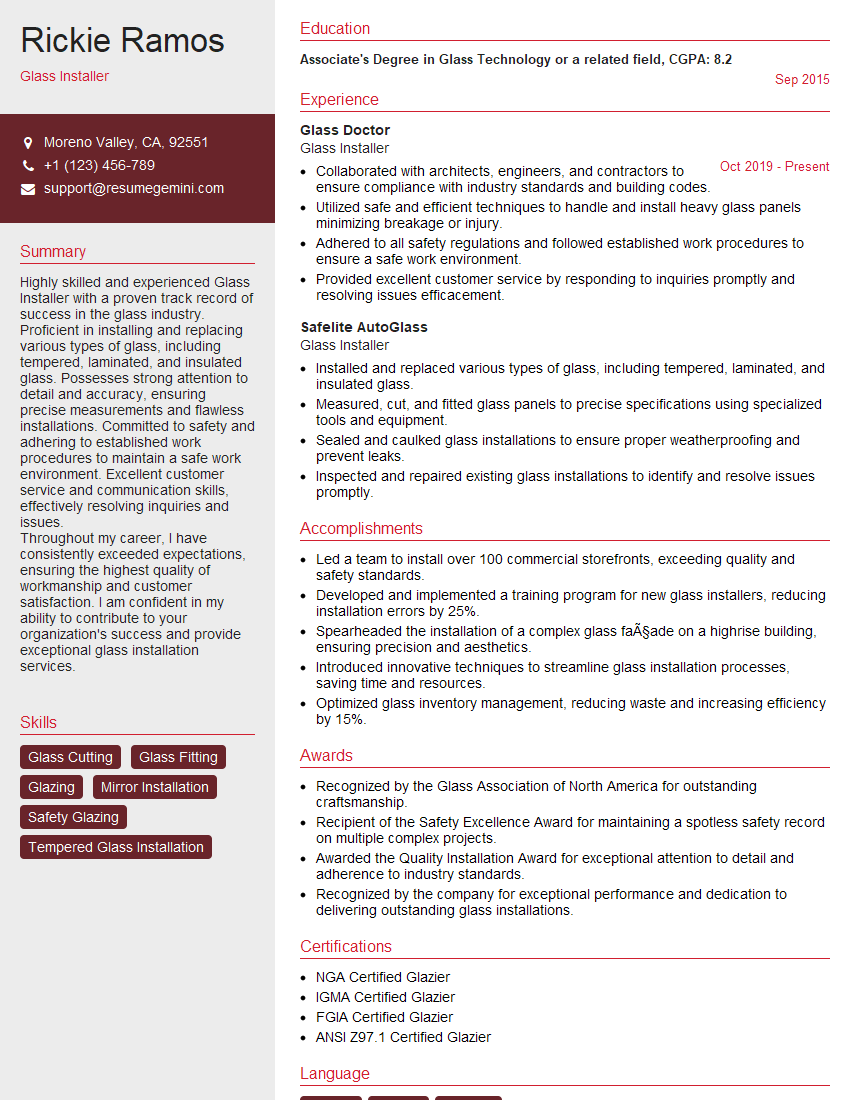
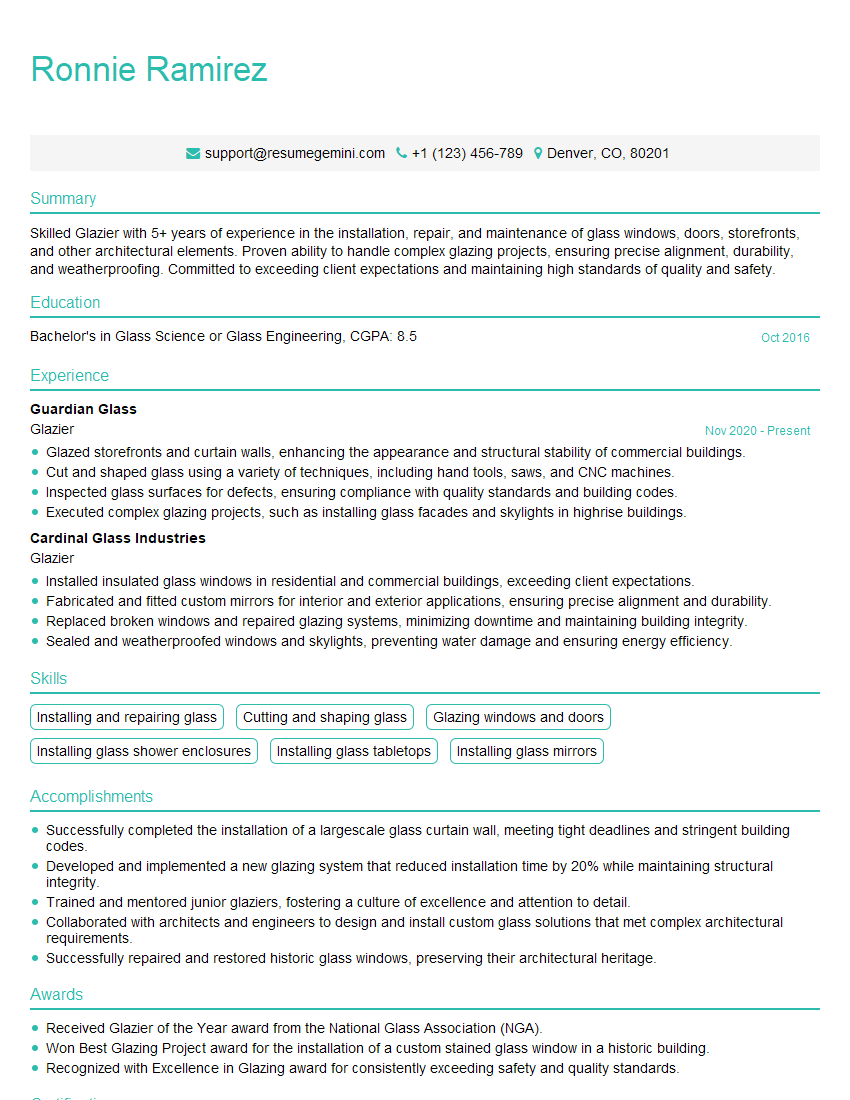
Mastering the principles of architectural glass is crucial for a successful and rewarding career. A deep understanding of this field opens doors to exciting opportunities in design, construction, and project management. To maximize your job prospects, focus on crafting an ATS-friendly resume that showcases your skills and experience effectively. ResumeGemini is a trusted resource for building professional resumes that stand out. They provide examples of resumes tailored to the Architectural Glass industry, helping you present your qualifications in the best possible light. Take advantage of these resources to boost your job search and land your dream role.
Explore more articles
Users Rating of Our Blogs
Share Your Experience
We value your feedback! Please rate our content and share your thoughts (optional).
What Readers Say About Our Blog
Very informative content, great job.
good