Interviews are opportunities to demonstrate your expertise, and this guide is here to help you shine. Explore the essential Artificial Intelligence in Production interview questions that employers frequently ask, paired with strategies for crafting responses that set you apart from the competition.
Questions Asked in Artificial Intelligence in Production Interview
Q 1. Explain the difference between model training and model deployment.
Model training is the process of teaching a machine learning algorithm to learn patterns from data. Think of it like educating a child – you provide examples (data), and the algorithm (the child) learns to recognize patterns and make predictions. This happens offline, often on powerful computers. Model deployment, on the other hand, is the process of making that trained model accessible and usable in a real-world application. This is like sending that educated child to work – they are now using their learned skills to solve real-world problems, often in a continuous and dynamic environment.
For example, training a model to classify images of cats and dogs involves feeding it thousands of labeled images. Once trained, deploying this model might involve integrating it into a mobile app that can identify cats and dogs in real-time pictures taken by users.
Q 2. Describe your experience with MLOps and its role in AI production.
MLOps (Machine Learning Operations) is the set of practices that aims to streamline the entire machine learning lifecycle, from model development to deployment and monitoring. It’s essentially DevOps for machine learning. My experience includes designing and implementing MLOps pipelines using tools like Jenkins, Airflow, and Kubeflow. This involves automating tasks like data versioning, model training, testing, deployment, and monitoring. In a recent project, we used MLOps to deploy a fraud detection model, reducing manual intervention and speeding up the deployment process by 75%. This significantly improved the model’s time-to-market and allowed for quicker iterations and improvements.
MLOps’ role in AI production is crucial because it ensures that AI models are developed, deployed, and maintained efficiently and reliably. Without it, managing and scaling AI projects becomes incredibly complex and error-prone.
Q 3. How do you ensure the scalability and reliability of AI models in production?
Ensuring scalability and reliability of AI models in production requires a multi-faceted approach. Scalability means the model can handle increasing amounts of data and requests without significant performance degradation. Reliability ensures the model consistently produces accurate and dependable results. Key strategies include:
- Microservices Architecture: Breaking down the model into smaller, independent services allows for horizontal scaling – easily adding more instances of each service to handle increased load.
- Cloud-based infrastructure: Leveraging cloud platforms like AWS, Azure, or GCP provides on-demand scalability and resource management. We can automatically scale up or down based on real-time demand.
- Model optimization: Techniques like model quantization, pruning, and knowledge distillation reduce model size and computational requirements, improving efficiency and scalability.
- Robust monitoring and alerting: Continuous monitoring of model performance and infrastructure health allows for proactive identification and resolution of issues, maintaining reliability. We implement alerts for latency spikes, error rates, and data quality issues.
In one project, we used Kubernetes to orchestrate the deployment of our model as microservices, enabling seamless scaling based on traffic patterns. This ensured high availability and consistently low latency.
Q 4. What are the key challenges in deploying AI models to production environments?
Deploying AI models to production presents numerous challenges:
- Data drift: The distribution of data in production might differ from the training data, leading to model performance degradation.
- Infrastructure complexities: Setting up and managing the necessary infrastructure can be complex and resource-intensive.
- Model explainability and interpretability: Understanding why a model makes specific predictions is crucial for trust and debugging, yet many powerful models lack this.
- Integration with existing systems: Seamlessly integrating AI models into existing business workflows can be challenging.
- Security and privacy concerns: Protecting sensitive data used for training and inference is paramount.
- Monitoring and maintenance: Continuously monitoring and maintaining deployed models requires dedicated resources and expertise.
For instance, a model trained on historical sales data might fail to predict future sales accurately if market conditions change unexpectedly.
Q 5. Explain different model monitoring techniques and their importance.
Model monitoring is crucial for maintaining model performance and identifying potential problems. Several techniques are used:
- Performance metrics tracking: Regularly monitoring key performance indicators (KPIs) such as accuracy, precision, recall, and F1-score helps detect performance degradation.
- Data quality monitoring: Assessing the quality and distribution of input data ensures the model receives relevant and reliable information.
- Concept drift detection: Techniques like Kullback-Leibler divergence measure the difference between the distribution of training data and real-time data, alerting to potential drift.
- Statistical process control: Applying statistical methods to monitor model outputs and identify unusual patterns.
- A/B testing: Comparing the performance of different model versions or alternative approaches helps optimize model selection and deployment.
Effective monitoring allows for timely interventions, preventing significant performance drops and ensuring continuous model reliability.
Q 6. How do you handle model drift and degradation in a production setting?
Model drift, where a model’s performance degrades over time due to changes in the input data distribution, is a common challenge. Addressing it requires a proactive strategy:
- Retraining: Regularly retraining the model with updated data is often the most effective solution. This can be automated using MLOps pipelines.
- Adaptive models: Employing models that can adapt to changing data distributions without requiring complete retraining, such as online learning algorithms.
- Ensemble methods: Combining multiple models can increase resilience against drift, as individual models may drift differently.
In a previous project, we implemented an automated retraining pipeline that updated our fraud detection model weekly with fresh transaction data, minimizing the impact of concept drift.
Q 7. Describe your experience with containerization (Docker, Kubernetes) for AI models.
Containerization, using technologies like Docker and Kubernetes, is essential for deploying and managing AI models in production. Docker creates consistent, isolated environments for the model and its dependencies, ensuring consistent execution across different environments. Kubernetes orchestrates the deployment and management of these containers, enabling scalability and high availability.
My experience includes building Docker images for various AI models, including those built using TensorFlow and PyTorch. We used Kubernetes to deploy these models on a cloud-based infrastructure, achieving automatic scaling and fault tolerance. This allowed us to efficiently manage multiple model versions and easily roll back to previous versions if necessary.
For example, a Dockerfile would define all the software requirements (Python version, libraries, model weights) needed to run a model. Kubernetes then handles deploying and managing multiple instances of this Docker image across a cluster of servers, ensuring high availability and scalability.
Q 8. How do you manage model versioning and rollback strategies?
Model versioning is crucial for managing the evolution of AI models in production. Think of it like version control for code, but for your machine learning models. We use a system that tracks every change, allowing us to easily revert to previous versions if needed. This is essential for debugging, A/B testing, and disaster recovery.
Rollback strategies are the procedures we follow when a deployed model malfunctions or performs poorly. This might involve automatically reverting to the previous stable version, or a more manual process involving human review and validation before deploying a replacement. We employ a combination of automated and manual rollback processes, ensuring a rapid response to issues while maintaining safety.
- Version Control: We utilize tools like MLflow or DVC to track model versions, metadata (training data, parameters, performance metrics), and even the code used to train the model. This creates an auditable trail of changes.
- Rollback Mechanisms: We often integrate rollback capabilities directly into our CI/CD pipeline. This allows for automated rollback to a previous version based on pre-defined monitoring thresholds (e.g., if accuracy drops below a certain level).
- Canary Deployments: Before full deployment, we often release a new model to a small subset of users (a canary deployment). This allows for real-world testing and early detection of problems before widespread impact.
For example, imagine a fraud detection model. If a new version unexpectedly starts flagging legitimate transactions, our rollback strategy immediately reverts to the previous stable version, minimizing financial and reputational damage.
Q 9. Explain your experience with CI/CD pipelines for AI model deployment.
CI/CD (Continuous Integration/Continuous Delivery) pipelines are the backbone of efficient and reliable AI model deployment. It’s like an automated assembly line for your models, ensuring a smooth transition from development to production. My experience includes designing and implementing pipelines that automate various stages, from model training and testing to deployment and monitoring.
We typically use tools like Jenkins, GitLab CI, or cloud-specific services (e.g., AWS CodePipeline, Azure DevOps). The pipeline is designed to be modular and easily adaptable to different model types and deployment environments.
# Example CI/CD stages
stage: Build
stage: Test
stage: Deploy (staging)
stage: Deploy (production)
stage: Monitor
Each stage involves specific steps such as building model containers, running unit and integration tests, deploying to various environments (staging, production), and continuous monitoring of model performance using metrics and alerts. In a real-world scenario, a change in the model’s training data would trigger the pipeline, automatically retraining, testing, and redeploying the updated model. This ensures the model is always up-to-date and performing optimally.
Q 10. How do you ensure the security and privacy of AI models in production?
Security and privacy are paramount when deploying AI models in production. It’s not just about protecting the model itself, but also the data it uses and the inferences it generates. We implement a multi-layered security approach.
- Data Encryption: Data at rest and in transit is encrypted using industry-standard encryption algorithms (AES-256, etc.).
- Access Control: Strict access control mechanisms (role-based access control or RBAC) limit access to sensitive data and model artifacts based on user roles and permissions.
- Model Protection: We employ techniques like model watermarking and obfuscation to protect the model’s intellectual property and prevent unauthorized copying or reverse engineering.
- Regular Security Audits: We conduct regular security assessments and penetration testing to identify and mitigate vulnerabilities. This includes vulnerability scanning of our infrastructure and code base.
- Compliance: We adhere to relevant data privacy regulations like GDPR, CCPA, etc., ensuring our models and data handling practices comply with legal requirements.
For example, in a healthcare setting, protecting patient data is critical. We utilize differential privacy techniques to minimize the risk of re-identification during model training and inference while still maintaining model accuracy. This is a balance that needs careful consideration.
Q 11. Discuss your experience with different cloud platforms (AWS, Azure, GCP) for AI deployment.
I have extensive experience deploying AI models across various cloud platforms – AWS, Azure, and GCP. Each platform offers unique strengths and weaknesses.
- AWS: AWS SageMaker is a comprehensive platform for building, training, and deploying ML models. It offers a wide range of services, including managed infrastructure, pre-trained models, and tools for model monitoring.
- Azure: Azure Machine Learning provides similar capabilities to SageMaker, with strong integration with other Azure services. It’s a good choice for organizations already invested in the Microsoft ecosystem.
- GCP: Google Cloud AI Platform offers a robust platform for building and deploying machine learning models, known particularly for its strengths in deep learning and its integration with other Google services.
The choice of platform often depends on factors like existing infrastructure, specific model requirements, cost considerations, and team expertise. For example, if we’re working with large-scale deep learning models, GCP’s infrastructure might be a better fit due to its specialized hardware and software. Conversely, if we are already heavily invested in AWS services for other aspects of our business, sticking with AWS SageMaker would provide significant synergies.
Q 12. How do you optimize AI model performance for production environments?
Optimizing AI model performance in production involves several strategies, focusing on both model efficiency and resource utilization. This often requires a shift from the accuracy-focused development phase to a focus on latency and throughput.
- Model Compression: Techniques like pruning, quantization, and knowledge distillation reduce model size and computational complexity without significantly impacting accuracy. This leads to faster inference times and lower resource consumption.
- Hardware Acceleration: Utilizing GPUs, TPUs, or specialized hardware significantly accelerates model inference. Choosing the appropriate hardware based on the model and workload is crucial.
- Model Optimization: Techniques like selecting efficient model architectures, optimizing hyperparameters, and using appropriate training strategies can improve both speed and accuracy.
- Batch Processing: Processing requests in batches rather than individually can reduce latency and overhead, particularly for tasks that can be parallelized.
- Caching: Caching frequently accessed model outputs can reduce the number of inference calls required, improving response times.
- Load Balancing: Distributing the workload across multiple instances to ensure high availability and responsiveness.
For instance, if our model is deployed to a mobile app, model compression becomes vital to reduce the app’s size and improve battery life. Optimizing for speed is critical for real-time applications like autonomous driving.
Q 13. Explain different strategies for handling imbalanced datasets in production.
Imbalanced datasets, where one class significantly outnumbers others, are a common challenge in production. This can lead to models biased towards the majority class and poor performance on the minority classes, often the ones of most interest (e.g., fraud detection). There are several strategies to handle this.
- Resampling: This involves either oversampling the minority class (creating synthetic samples) or undersampling the majority class. Techniques like SMOTE (Synthetic Minority Over-sampling Technique) are commonly used for oversampling.
- Cost-Sensitive Learning: This approach assigns different weights or costs to misclassifications of different classes. Misclassifying a minority class instance is given a higher cost, encouraging the model to pay more attention to these instances.
- Ensemble Methods: Combining multiple models trained on different subsets of the data or with different resampling strategies can improve overall performance and robustness.
- Anomaly Detection Techniques: If the minority class represents anomalies, anomaly detection algorithms (like One-Class SVM) can be more effective than standard classification models.
Consider a credit card fraud detection system. Fraudulent transactions are far fewer than legitimate ones. Using cost-sensitive learning, we assign a much higher penalty to misclassifying fraudulent transactions as legitimate, pushing the model to improve its performance on this critical minority class.
Q 14. How do you address bias and fairness concerns in AI models?
Addressing bias and fairness concerns in AI models is crucial for ethical and responsible AI development. Bias can arise from biased data, model design, or deployment practices. Mitigating these requires a multifaceted approach.
- Data Analysis and Preprocessing: Carefully analyze the training data for biases. Techniques like data augmentation, reweighting, or adversarial debiasing can help mitigate biases present in the data.
- Fairness-Aware Algorithms: Employ algorithms designed to incorporate fairness constraints directly into the model training process. Examples include algorithms focusing on equal opportunity or demographic parity.
- Model Monitoring and Auditing: Continuously monitor the model’s performance across different demographic groups. Regularly audit the model for fairness violations and take corrective actions if needed.
- Explainable AI (XAI): Utilize XAI techniques to gain insights into the model’s decision-making process, which can help identify potential biases and improve transparency.
- Human-in-the-Loop: Integrate human oversight into the model’s decision-making process, particularly in high-stakes applications. Humans can intervene to correct unfair or biased outcomes.
For example, in a loan application system, a biased model might unfairly discriminate against certain demographic groups. By carefully examining the data for biases and using fairness-aware algorithms, we can strive to build a more equitable and just system. Regular auditing and human oversight are crucial to maintain fairness over time.
Q 15. What are the key metrics you use to evaluate the performance of AI models in production?
Evaluating AI models in production requires a multifaceted approach, going beyond simple accuracy metrics. We need to consider both performance and business impact. Key metrics fall into several categories:
- Performance Metrics: These directly assess the model’s accuracy, speed, and resource consumption. Examples include:
- Accuracy/Precision/Recall/F1-score: Standard metrics for classification tasks, showing how well the model correctly identifies positive and negative cases. For example, in fraud detection, high precision is crucial to minimize false positives, while high recall is essential to catch most fraudulent transactions.
- Mean Squared Error (MSE) or Root Mean Squared Error (RMSE): Common for regression tasks, measuring the average difference between predicted and actual values. In a price prediction model, lower MSE indicates better accuracy.
- Latency: How long it takes the model to generate a prediction. Crucial for real-time applications like self-driving cars or recommendation systems. A high latency can severely impact user experience.
- Throughput: The number of predictions the model can make per unit of time. Important for high-volume applications.
- Business Metrics: These metrics connect model performance to tangible business outcomes. Examples include:
- Conversion rate: How often a prediction leads to a desired action (e.g., a purchase after a recommendation).
- Customer satisfaction: Measured through surveys or feedback, reflecting how happy users are with the model’s output. In a chatbot, high customer satisfaction is key.
- Cost savings: Quantifies the financial benefits of using the AI model (e.g., reduced fraud, optimized resource allocation).
- Monitoring Metrics: These track the health and stability of the model in production. Examples include:
- Model drift: Measures how much the model’s performance degrades over time due to changes in the input data distribution.
- Data quality: Assesses the quality of the data being fed into the model. Poor data quality can lead to inaccurate predictions.
- Resource utilization: Monitors CPU, memory, and disk usage to ensure the model runs efficiently and doesn’t consume excessive resources.
By tracking these metrics, we can identify potential issues, optimize the model’s performance, and ensure it consistently delivers business value.
Career Expert Tips:
- Ace those interviews! Prepare effectively by reviewing the Top 50 Most Common Interview Questions on ResumeGemini.
- Navigate your job search with confidence! Explore a wide range of Career Tips on ResumeGemini. Learn about common challenges and recommendations to overcome them.
- Craft the perfect resume! Master the Art of Resume Writing with ResumeGemini’s guide. Showcase your unique qualifications and achievements effectively.
- Don’t miss out on holiday savings! Build your dream resume with ResumeGemini’s ATS optimized templates.
Q 16. How do you handle errors and exceptions during AI model execution?
Handling errors and exceptions is paramount in AI model execution. A robust error handling strategy involves several steps:
- Exception Handling: We use
try-exceptblocks (or equivalent in other languages) to catch and handle predictable errors, such as invalid input data or network issues. For example: try: prediction = model.predict(input_data) except ValueError as e: log_error("Invalid input data: "+ str(e)) # Log the error and take appropriate action, like sending an alert or using a default prediction.- Monitoring and Alerting: We implement comprehensive monitoring using tools like Prometheus, Grafana, or Datadog to track key metrics and receive alerts when anomalies are detected (e.g., high error rates, increased latency). This allows us to proactively identify and address issues.
- Logging: Detailed logging is crucial. We log all predictions, including inputs, outputs, and any errors encountered. This helps us debug problems, analyze model performance, and identify patterns. We use structured logging formats (e.g., JSON) to facilitate efficient analysis.
- Fallback Mechanisms: In critical applications, we implement fallback mechanisms. If the AI model fails, a backup system (e.g., a simpler rule-based model) takes over to ensure continuous operation. For example, in a recommendation system, a fallback could be providing random recommendations if the AI model is unavailable.
- Automated Retraining: In some cases, model retraining might be triggered automatically based on performance degradation or changes in data distribution. This helps maintain the model’s accuracy over time.
The key is to design a system that is resilient to failures and can gracefully handle unexpected situations, ensuring minimal disruption to users and business operations.
Q 17. Describe your experience with different logging and monitoring tools for AI models.
My experience encompasses a range of logging and monitoring tools, each with its strengths and weaknesses. I’ve worked extensively with:
- Prometheus & Grafana: A powerful combination for monitoring metrics. Prometheus collects time-series data, and Grafana provides an intuitive dashboard for visualization and alerting.
- Datadog: A comprehensive monitoring platform offering log management, metrics, and tracing capabilities. Its unified view simplifies the monitoring of complex systems.
- Elastic Stack (ELK): Combines Elasticsearch for log storage, Logstash for log processing, and Kibana for log visualization. It’s very flexible but requires more configuration than simpler tools.
- MLflow: Specifically designed for tracking and managing the machine learning lifecycle, including model experiments, parameters, metrics, and artifacts. It’s particularly useful for managing multiple model versions and A/B testing.
The choice of tools depends on the complexity of the system and the specific monitoring needs. For example, a simple model might only need basic logging, whereas a large-scale system would benefit from a more comprehensive solution like Datadog. In all cases, consistent and well-structured logging is paramount.
Q 18. How do you collaborate with other teams (e.g., DevOps, data engineers) in an AI production environment?
Collaboration is key in AI production. I’ve found that successful deployment requires close collaboration with several teams:
- DevOps: We work closely with DevOps engineers to ensure smooth model deployment and infrastructure management. This includes containerization (Docker), orchestration (Kubernetes), and CI/CD pipelines for efficient and reliable deployment.
- Data Engineers: We rely on data engineers for data ingestion, preprocessing, feature engineering, and data pipeline management. Understanding the limitations and capabilities of the data pipeline is crucial for selecting appropriate models and ensuring consistent data quality.
- Business Stakeholders: We regularly interact with business stakeholders to define clear objectives, align model performance with business needs, and communicate results effectively. Understanding their requirements helps us prioritize development and ensures the model addresses actual business problems.
- Security Teams: Collaboration with security teams is crucial to ensure the security and privacy of model data and predictions. Model security considerations (e.g., adversarial attacks, data poisoning) should be integrated throughout the development lifecycle.
Effective collaboration often involves regular meetings, shared documentation (e.g., using Confluence or Notion), and clear communication channels (e.g., Slack). I generally favor Agile methodologies with iterative development cycles and frequent feedback loops, enabling rapid adaptation to changing requirements and challenges.
Q 19. Explain your experience with different AI model architectures (e.g., CNNs, RNNs, Transformers).
I have extensive experience with various AI model architectures, each suited for different tasks:
- Convolutional Neural Networks (CNNs): Excel in processing image and video data. I’ve used CNNs for image classification (identifying objects in images), object detection (locating and classifying objects), and image segmentation (partitioning an image into meaningful regions). For example, a CNN could be used to identify defects in manufactured parts based on images.
- Recurrent Neural Networks (RNNs): Particularly well-suited for sequential data like text and time series. I’ve employed RNNs (especially LSTMs and GRUs) for natural language processing tasks such as sentiment analysis, machine translation, and time series forecasting (predicting stock prices, for instance).
- Transformers: Have revolutionized natural language processing, demonstrating superior performance in tasks like machine translation, text summarization, and question answering. I’ve used transformers (like BERT, GPT) for building chatbots and improving search engine functionalities.
The choice of architecture depends heavily on the data type and the specific task. Understanding the strengths and weaknesses of each architecture is crucial for selecting the most appropriate model.
Q 20. How do you choose the right AI model for a given production task?
Choosing the right AI model for a given production task is a critical decision. It’s not just about accuracy; it’s about finding the best balance between accuracy, efficiency, interpretability, and maintainability. My approach involves several steps:
- Clearly Define the Problem: First, we need a precise definition of the problem, including the input data, desired output, and key performance indicators (KPIs).
- Data Analysis: Thorough data analysis is essential. We examine the data’s characteristics (size, type, distribution, quality) to understand its suitability for various model architectures.
- Model Selection: Based on the problem definition and data analysis, we select candidate model architectures. For example, image data might suggest CNNs, sequential data RNNs, and structured data decision trees or gradient boosting machines.
- Experimentation and Evaluation: We conduct experiments with different models using appropriate evaluation metrics. A/B testing can be very helpful to compare different approaches.
- Resource Constraints: We consider computational resources, latency requirements, and power consumption when selecting a model. A complex model may provide higher accuracy, but might not be feasible for resource-constrained environments.
- Interpretability and Maintainability: For certain applications (e.g., healthcare, finance), model interpretability is crucial. Simpler models might be preferred for their better explainability. We also prioritize models that are easy to maintain and update.
The selection process is often iterative, involving adjustments based on experimental results and feedback from stakeholders.
Q 21. Describe your experience with different model optimization techniques.
Model optimization is a crucial step to improve performance and efficiency. My experience includes various techniques:
- Hyperparameter Tuning: We systematically explore different hyperparameter settings (e.g., learning rate, number of layers, regularization strength) to find the optimal configuration for a given model. Techniques include grid search, random search, and Bayesian optimization.
- Model Architecture Search (NAS): For complex tasks, automating the search for the best model architecture can significantly improve performance. NAS algorithms explore a vast space of possible architectures, finding models that outperform manually designed ones.
- Quantization: Reduces the precision of model weights and activations, making the model smaller and faster. This is particularly useful for deployment on resource-constrained devices.
- Pruning: Removes less important connections or neurons in a neural network, reducing its size and improving its efficiency without significantly impacting accuracy.
- Knowledge Distillation: Trains a smaller, faster student model to mimic the behavior of a larger, more accurate teacher model. This allows us to deploy a more efficient model without sacrificing much accuracy.
- Transfer Learning: Leverages pre-trained models on large datasets as a starting point for a new task. This can significantly reduce training time and improve performance, especially when data is limited.
The choice of optimization techniques depends on the specific model, task, and resource constraints. Often, a combination of techniques is employed to achieve optimal results.
Q 22. How do you handle data preprocessing and feature engineering for AI models in production?
Data preprocessing and feature engineering are crucial steps for deploying successful AI models. Think of it like preparing ingredients for a recipe – the better the preparation, the better the final dish. In production, this involves a robust pipeline that handles data cleaning, transformation, and feature creation efficiently and scalably.
- Data Cleaning: This involves handling missing values (imputation or removal), outlier detection and treatment, and dealing with inconsistencies in data formats. For example, imagine an e-commerce dataset with missing prices; we might impute them using the average price of similar products.
- Data Transformation: This often involves scaling features (e.g., using standardization or min-max scaling to ensure features have a similar range), encoding categorical variables (e.g., one-hot encoding or label encoding), and handling skewed distributions (e.g., using log transformations).
- Feature Engineering: This is where we create new features from existing ones to improve model performance. For example, in a time series prediction, we might create features like rolling averages or lagged values. In image recognition, we might extract features using techniques like convolutional neural networks.
In production, this pipeline needs to be automated and monitored for data drift – where the characteristics of the input data change over time, potentially degrading model performance. Techniques like concept drift detection are vital for proactive intervention.
Q 23. Explain your experience with different deployment strategies (e.g., A/B testing, canary deployments).
Deployment strategies are key for minimizing risk and ensuring a smooth transition to production. I have experience with several methods, including A/B testing and canary deployments, which are crucial for reducing disruption and validating new model versions.
- A/B Testing: This involves deploying a new model alongside the existing one, directing a portion of traffic to the new model. By comparing the performance metrics (e.g., accuracy, latency, error rate) of both models, we can objectively assess the improvement offered by the new version before fully deploying it. For example, a recommendation system might use A/B testing to compare click-through rates of recommendations generated by old and new models.
- Canary Deployments: This is a gradual rollout strategy. We start by deploying the new model to a small subset of users or servers, monitoring performance closely. If everything looks good, we gradually increase the traffic routed to the new model. This minimizes the impact of any unforeseen issues.
- Blue/Green Deployments: We maintain two identical environments (blue and green). The current model runs on one environment, and the new model is deployed to the other. Once the new model is fully tested and validated, we switch traffic to the green environment.
The choice of strategy depends on factors like the criticality of the application, the risk tolerance, and the potential impact of a failure.
Q 24. How do you manage the cost of running AI models in production?
Cost management is a critical aspect of running AI models in production. It involves optimizing resource utilization, selecting cost-effective infrastructure, and monitoring spending closely. This is done through a multi-pronged approach.
- Efficient Model Selection: Choosing the right model architecture and hyperparameters is crucial. Smaller, less complex models generally have lower computational costs.
- Hardware Optimization: Utilizing appropriate hardware such as GPUs or specialized AI accelerators can significantly reduce inference time and cost. Cloud providers offer various options; selecting the most suitable instance type is key.
- Model Quantization and Pruning: These techniques reduce the size and complexity of the model, thus decreasing memory usage and computational requirements.
- Auto-Scaling: Dynamically adjusting the number of instances based on demand ensures that resources are allocated efficiently. This avoids paying for idle resources during periods of low traffic.
- Regular Monitoring and Optimization: Continuously monitor resource usage and identify areas for optimization. This could involve adjusting model parameters, switching to a more efficient algorithm, or optimizing the data pipeline.
Cost optimization is an ongoing process. Regular reviews and adjustments ensure that we maintain a balance between performance and cost-effectiveness.
Q 25. Describe your experience with different AI model explainability techniques.
Model explainability is crucial for building trust and understanding how AI models make decisions. Different techniques offer various levels of insight, and choosing the right one depends on the model type and the desired level of detail.
- LIME (Local Interpretable Model-agnostic Explanations): This approach approximates the behavior of a complex model locally by creating simpler, interpretable models around specific instances. It’s useful for understanding individual predictions.
- SHAP (SHapley Additive exPlanations): This method uses game theory to attribute contributions to each feature in a prediction. It provides a global view of feature importance.
- Decision Trees and Rule-Based Models: These models are inherently interpretable since their decision-making process can be easily traced through a series of rules.
- Feature Importance from Gradient-Based Models: For models like neural networks, examining the magnitude of gradients or weights can provide insights into the importance of different features.
In practice, I often use a combination of these techniques to gain a comprehensive understanding of the model’s behavior. The choice of method depends greatly on the complexity of the model and the level of detail needed for explanation.
Q 26. How do you ensure the maintainability and updatebility of AI models in production?
Maintaining and updating AI models in production is an ongoing process. It requires establishing robust version control, monitoring systems, and retraining strategies. This involves thinking ahead and setting up infrastructure that allows for changes and updates without disruptions.
- Version Control: Utilizing a version control system (like Git) to track changes to the model code, data preprocessing pipeline, and deployment scripts. This ensures that we can easily revert to previous versions if needed.
- Continuous Integration/Continuous Deployment (CI/CD): Implementing a CI/CD pipeline automates the building, testing, and deployment of model updates, reducing manual effort and risk.
- Monitoring and Alerting: Regularly monitor model performance metrics (e.g., accuracy, latency, error rate) and set up alerts for significant deviations from expected behavior. This allows for timely detection and remediation of problems.
- Retraining Strategy: Establishing a plan for retraining the model periodically using fresh data to account for concept drift and maintain accuracy. This might involve scheduled retraining or triggered retraining based on performance degradation.
Maintainability and updatability are not merely technical tasks; they are about establishing a robust, adaptable workflow that simplifies the lifecycle management of AI models in a real-world setting.
Q 27. What are your strategies for debugging and troubleshooting AI models in production?
Debugging and troubleshooting AI models in production can be challenging, but a systematic approach is key. It involves leveraging monitoring tools, logging, and various debugging techniques.
- Comprehensive Logging: Implementing detailed logging throughout the data pipeline and model inference process enables effective tracing of issues. Logs should capture relevant information like input data, model predictions, and error messages.
- Monitoring Dashboards: Utilizing dashboards to visualize key performance indicators (KPIs) helps to identify anomalies and trends that might indicate problems. This allows for proactive detection of issues.
- A/B Testing and Rollbacks: In case of unexpected behavior, A/B testing can help to isolate the cause of the problem. The ability to quickly rollback to a previous version is vital for minimizing the impact of failures.
- Data Analysis: Examining the input data for anomalies or unexpected patterns that might be contributing to model errors. Understanding the data distribution and identifying potential biases are crucial steps.
Effective debugging requires a blend of technical skills, a systematic approach, and the ability to use available tools effectively to analyze the issue and identify the root cause. Often, a combination of approaches is needed to isolate and solve the problem.
Q 28. How do you handle the ethical considerations of deploying AI models in production?
Ethical considerations are paramount when deploying AI models. It’s crucial to address potential biases, fairness issues, and privacy concerns from the outset. This is not simply a checklist; it’s an ongoing conversation and iterative process.
- Bias Detection and Mitigation: Actively assess and mitigate biases in the data and model. This involves using techniques to identify and correct biases, potentially through data augmentation or algorithmic adjustments.
- Fairness Evaluation: Evaluating the model’s fairness across different demographic groups to ensure equitable outcomes. This may involve employing fairness metrics or employing techniques that ensure representation of various groups.
- Privacy Preservation: Protecting user privacy by using appropriate techniques for data anonymization and secure data handling. Compliance with relevant regulations (e.g., GDPR) is crucial.
- Transparency and Explainability: Providing transparent explanations of how the model works and its decision-making process to build trust and accountability. This often involves utilizing model explainability techniques discussed earlier.
- Human Oversight and Control: Maintaining human oversight in the model’s operation to ensure that it’s used responsibly and ethically. This could involve establishing a review process or setting limits on the model’s autonomy.
Addressing ethical considerations is an iterative process, requiring ongoing evaluation and adaptation as the model evolves and the context changes. It’s a responsibility that extends beyond the technical aspects of model development and deployment.
Key Topics to Learn for Artificial Intelligence in Production Interview
- Model Deployment Strategies: Understanding various deployment methods (cloud, on-premise, edge), containerization (Docker, Kubernetes), and their trade-offs. Consider practical scenarios like optimizing for latency vs. cost.
- MLOps (Machine Learning Operations): Grasping the principles of CI/CD for machine learning models, including version control, automated testing, monitoring, and model retraining. Explore real-world challenges like managing model drift and ensuring data quality.
- Scalability and Performance Optimization: Discuss techniques for scaling AI models to handle large datasets and high traffic, including distributed training and inference optimization. Think about how to measure and improve model performance in production environments.
- Data Pipelines and Infrastructure: Familiarize yourself with building robust and efficient data pipelines for model training and inference. Explore cloud-based data warehousing and processing solutions.
- Monitoring and Alerting: Understand the importance of monitoring model performance in production, setting up alerts for anomalies, and implementing strategies for proactive issue resolution. Consider the impact of unexpected model behavior on the business.
- Ethical Considerations and Bias Mitigation: Explore the ethical implications of deploying AI models in production, including fairness, accountability, and transparency. Discuss techniques for identifying and mitigating bias in datasets and models.
- Security and Privacy: Understand how to secure AI models and data in production environments, addressing vulnerabilities and complying with relevant regulations (e.g., GDPR). Consider practical approaches to data anonymization and encryption.
Next Steps
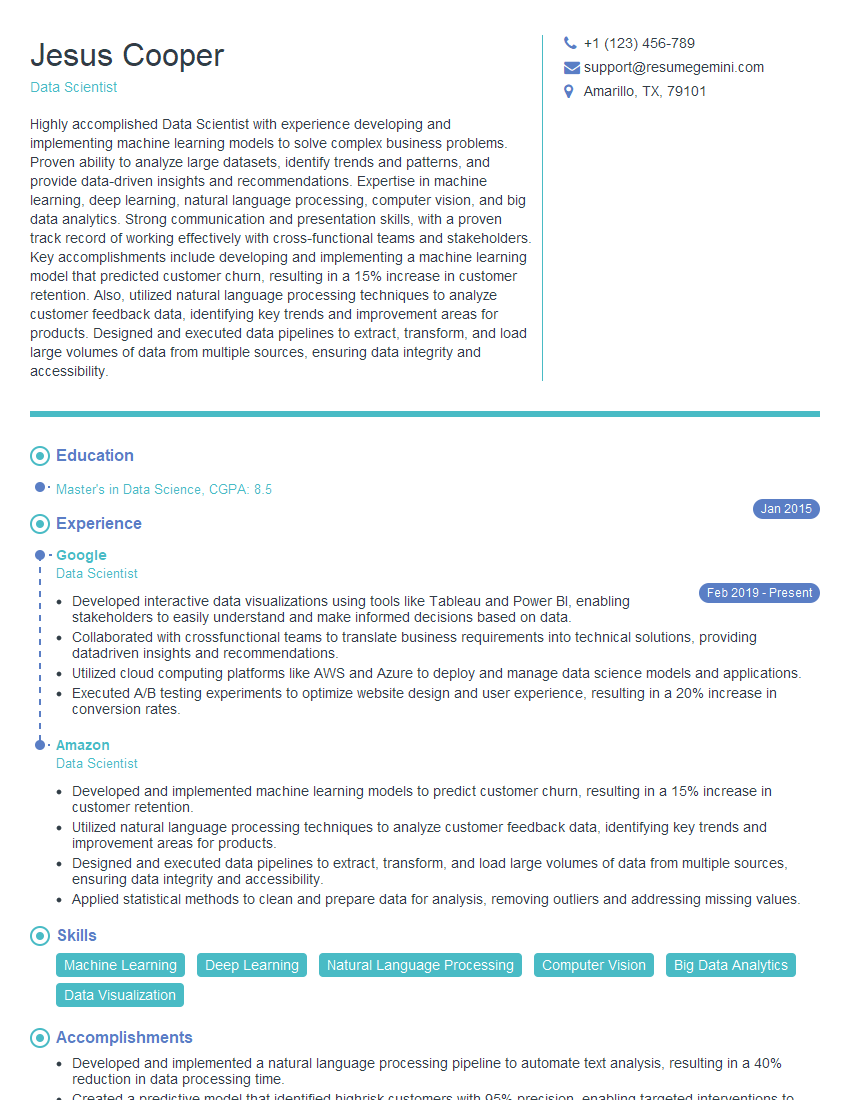
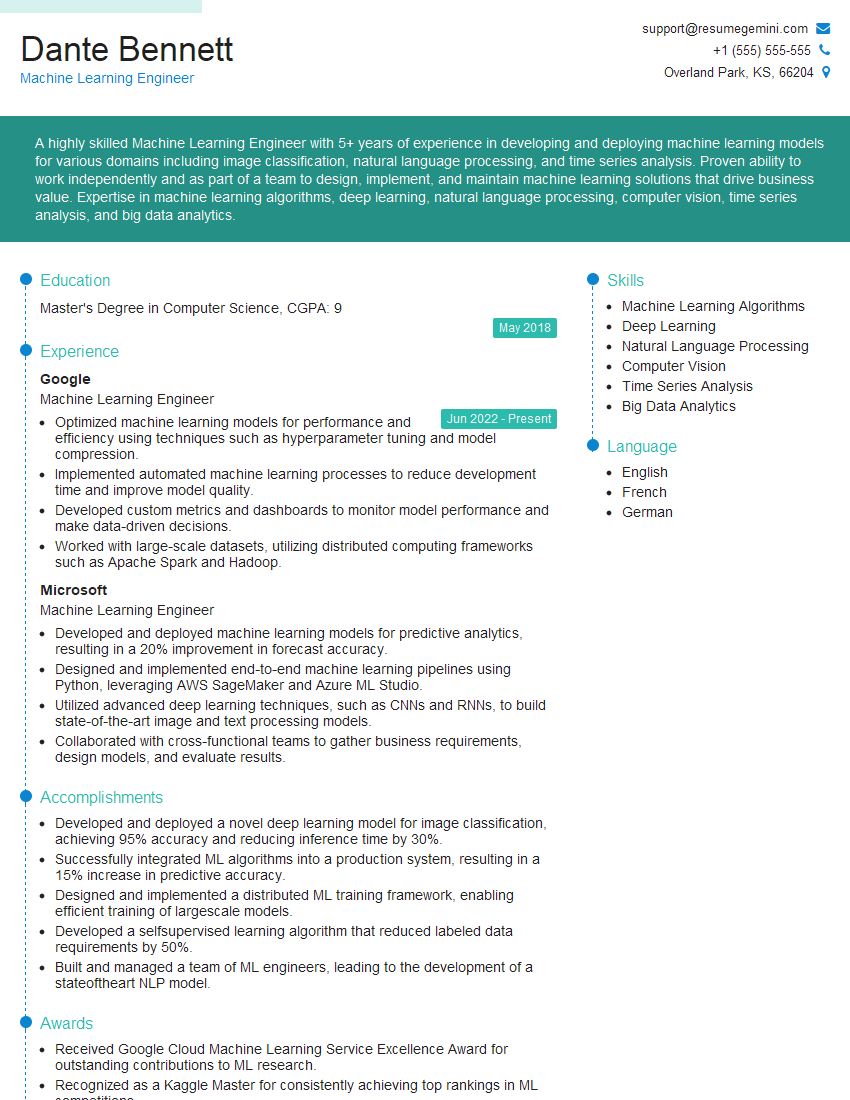
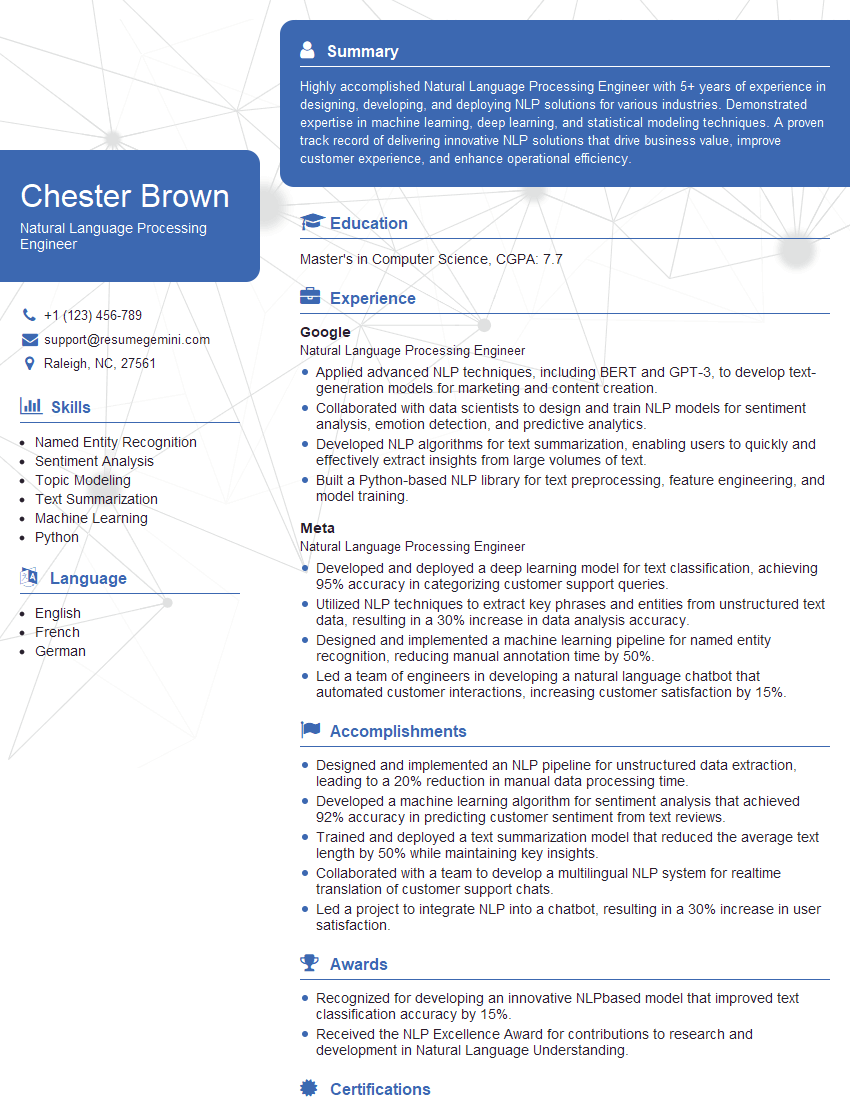
Mastering Artificial Intelligence in Production is crucial for accelerating your career in this rapidly evolving field. Demonstrating expertise in deploying, monitoring, and maintaining AI systems is highly sought after by employers. To maximize your job prospects, create an ATS-friendly resume that effectively showcases your skills and experience. We highly recommend using ResumeGemini to build a professional and impactful resume. ResumeGemini provides a streamlined process and offers examples of resumes tailored to Artificial Intelligence in Production, ensuring your application stands out.
Explore more articles
Users Rating of Our Blogs
Share Your Experience
We value your feedback! Please rate our content and share your thoughts (optional).
What Readers Say About Our Blog
Very informative content, great job.
good