Interviews are opportunities to demonstrate your expertise, and this guide is here to help you shine. Explore the essential Wood Fence Construction interview questions that employers frequently ask, paired with strategies for crafting responses that set you apart from the competition.
Questions Asked in Wood Fence Construction Interview
Q 1. Describe your experience with different types of wood used in fence construction.
Choosing the right wood for a fence is crucial for its longevity and aesthetic appeal. Different woods offer varying levels of durability, resistance to rot and insects, and aesthetic qualities. My experience encompasses a wide range of species.
- Cedar: A popular choice due to its natural resistance to rot and insects, beautiful reddish hue, and relatively easy workability. It’s a premium option, reflecting in its cost.
- Redwood: Similar to cedar in its durability and resistance, redwood boasts a rich, reddish-brown color. It’s also a premium choice, known for its longevity.
- Pine: A more affordable option, pine is readily available and relatively easy to work with. However, it’s more susceptible to rot and insect damage, requiring treatment with preservatives for extended lifespan. Pressure-treated pine is a common, cost-effective choice.
- Pressure-Treated Lumber: This isn’t a specific wood type, but a process. Various woods (like pine or fir) are treated under pressure with preservatives to significantly increase their resistance to rot, decay, and insect infestation. This is crucial for posts and ground-contact components.
- Cypress: A naturally durable wood that’s resistant to rot and decay, making it a great choice for areas with high humidity. It’s often used in coastal regions.
The choice depends on the budget, desired aesthetic, and the local climate. For example, in a humid climate, I’d recommend cedar or cypress; for a budget-friendly option, treated pine is a practical solution.
Q 2. What are the common methods for setting fence posts?
Setting fence posts correctly is paramount for a sturdy and long-lasting fence. The method chosen depends on soil conditions and the fence’s height and design. I typically employ several methods:
- Digging Holes: This is the most common method. Holes are dug, typically using a post hole digger, to a depth of at least one-third the post’s height above ground. The bottom of the hole is often widened slightly for better stability.
- Using a Post Hole Auger (Powered): For larger projects or harder ground, a powered auger makes the process faster and easier. This significantly speeds up the post setting process for efficiency.
- Setting Posts in Concrete: For maximum stability, especially in unstable soil, posts are set in concrete. The hole is dug, the post is positioned plumb, and quick-setting concrete is poured around it. This provides excellent support and longevity.
- Drive-in Posts: These are designed to be driven directly into the ground using a sledgehammer or specialized equipment. Ideal for soft ground and less demanding fence types.
No matter the method, ensuring the posts are plumb (perfectly vertical) and properly spaced is crucial for a straight, strong fence. I always use a level and a measuring tape to check regularly.
Q 3. Explain the process of building a post and rail fence.
A post and rail fence is a classic, rustic style known for its simplicity and elegance. Construction involves the following steps:
- Layout and Post Setting: First, plan the fence line, marking post locations at regular intervals. Then, set the posts using one of the methods described earlier, ensuring they are plumb and aligned.
- Rail Placement: Horizontal rails are attached to the posts. The number of rails depends on the fence’s height and desired aesthetic. Typically, rails are mortised (cut into) or bolted to the posts.
- Fastening: Using galvanized lag screws or bolts ensures a strong and long-lasting connection. Pre-drilling pilot holes prevents the wood from splitting.
- Leveling and Alignment Checks: Throughout the process, continual checks using a level and string line ensure that posts and rails are straight and level.
- Finishing (Optional): The fence can be stained, sealed, or painted for added protection and visual appeal.
For example, for a taller fence, I might use larger posts and add extra rails for stability. The choice of wood also greatly influences the overall look and durability of the final project. Properly spaced posts and securely fastened rails are critical for this fence type.
Q 4. How do you ensure proper fence alignment and leveling?
Maintaining proper alignment and leveling is vital for a professional-looking and structurally sound fence. My approach involves these key steps:
- String Line: A string line stretched taut along the planned fence line serves as a reference point for post placement and ensures alignment.
- Level: A level is constantly used to check the plumbness (vertical alignment) of each post. A laser level greatly increases accuracy and speed.
- Measuring Tape: Precise measurements ensure consistent spacing between posts and rails, maintaining the fence’s overall straightness.
- Post Adjustment: If posts are out of alignment or not level, adjustments can be made by carefully repositioning the post in the hole or using shims to level it.
- Temporary Bracing: Temporary bracing helps keep the posts straight and in position while the concrete sets or the fence is being built.
For example, a slight slope in the terrain would require adjusting post depth to maintain a consistent fence height. Without careful attention to alignment and leveling, the fence may look unprofessional and be structurally weakened.
Q 5. What are the different types of fence gates and their installation methods?
Fence gates come in various styles, each with its own installation method. Common types include:
- Swing Gates: These are the most common type, hinging on one or both sides of the fence posts. Installation involves attaching hinges to the gate and posts, ensuring proper clearance for swinging.
- Sliding Gates: These gates slide along a track, typically suitable for wider openings. Installation requires a sturdy track system with rollers attached to the gate.
- Walk-Through Gates: These smaller gates are often used for pedestrian access, incorporated into the fence itself. Installation is similar to swing gates, but on a smaller scale.
Installation methods vary based on the gate type and material. Swing gates require precise hinge placement and latch installation. Sliding gates demand accurate track alignment and roller adjustments to ensure smooth operation. Regardless of the type, I always emphasize safety and functionality in the installation process, using proper fasteners and ensuring secure operation.
Q 6. Explain your experience with using power tools in fence construction.
Power tools significantly improve efficiency and precision in fence construction. My experience encompasses various tools:
- Post Hole Digger (Powered): Makes digging holes for posts much faster and easier, particularly in challenging soil conditions.
- Circular Saw: Used for cutting lumber to the precise lengths required for posts and rails.
- Drill/Driver: Essential for pre-drilling holes to prevent wood splitting and for driving screws or bolts to fasten components.
- Reciprocating Saw (Sawzall): Useful for cutting through thicker materials or making more intricate cuts.
- Miter Saw: Provides accurate angled cuts for mitered corners, improving the fence’s aesthetics.
Safety is paramount when operating power tools. I always use appropriate safety gear, such as safety glasses, ear protection, and work gloves. Proper maintenance of the tools ensures they operate efficiently and safely.
Q 7. How do you address uneven terrain during fence installation?
Uneven terrain presents a challenge in fence construction, requiring careful planning and execution. My strategy involves:
- Grading and Leveling: In some cases, minor grading might be necessary to create a more level base for the fence. This involves removing or adding soil to create a more consistent surface.
- Varying Post Depths: Instead of a uniform post depth, the depth is adjusted to compensate for the slope. Posts on higher ground require less depth, while posts on lower ground need deeper holes for proper support.
- Step-Down Approach: For significant slopes, a step-down approach might be necessary, creating tiered sections of fencing. This maintains a consistent fence height while accommodating the uneven terrain.
- Post Placement Precision: Careful placement of the posts is vital. Using a level ensures the posts are plumb, and careful measurements guarantee consistent rail placement and overall fence alignment.
For example, on a steep slope, a step-down approach using strategically placed posts and varying rail lengths creates a visually appealing and functional fence. Ignoring uneven terrain would result in a fence that is unstable and aesthetically unpleasing.
Q 8. What safety measures do you implement on a fence construction site?
Safety is paramount on any construction site, and wood fence building is no exception. We begin with a thorough site survey to identify potential hazards like underground utilities, uneven terrain, or overhanging branches. Then, we implement several key measures:
- Personal Protective Equipment (PPE): All team members are required to wear safety glasses, gloves, steel-toed boots, and hard hats. We provide appropriate hearing protection when using power tools.
- Tool Safety: Power tools are regularly inspected and maintained. We follow manufacturer’s instructions for safe operation and ensure proper grounding. Tools are stored safely when not in use.
- Fall Protection: When working at heights, we utilize harnesses and appropriate fall protection systems. This is crucial, especially when installing fence posts.
- Emergency Preparedness: We have a designated first-aid kit on-site and all team members are trained in basic first aid and CPR. We also have clear emergency contact information readily available.
- Site Organization: The work area is kept clean and organized to prevent tripping hazards. Materials are stored properly to avoid accidents. We use caution tape to clearly delineate work zones.
For example, on a recent project near a busy road, we implemented additional safety measures, including traffic cones and a flagger to direct traffic around our work area. This proactive approach ensured the safety of both our crew and the public.
Q 9. Describe your experience with reading and interpreting construction blueprints.
Reading and interpreting blueprints is a fundamental skill for any fence contractor. I’m proficient in deciphering various blueprint notations, including those related to dimensions, materials, post placement, and gate configurations. I’m experienced in working with both hand-drawn and CAD blueprints. I meticulously review all aspects of a blueprint before starting a project, including:
- Site Dimensions and Topography: Understanding the property lines and any existing features like slopes or obstacles is critical for accurate fence placement.
- Fence Design: The blueprint details the type of fence, its height, the style of posts and rails, and the location of gates.
- Material Specifications: The blueprint typically specifies the type and dimensions of the lumber, posts, and fasteners to be used.
- Post Locations: Precise post placement is crucial for a structurally sound fence. The blueprint shows the spacing and exact locations for each post.
For instance, I recently worked on a project with a complex curved fence line. The blueprint indicated the precise radius and required the use of specialized techniques and curved posts to achieve the desired aesthetic and structural integrity. My experience allowed me to correctly interpret these details and execute the plan flawlessly.
Q 10. How do you calculate the materials needed for a fence project?
Calculating materials accurately is essential to avoid waste and delays. The process involves several steps:
- Measure the Perimeter: Precisely measure the length of the fence line, accounting for any curves or angles.
- Determine Post Spacing: This varies depending on the type of fence and local codes, but generally ranges from 6 to 8 feet. Divide the total fence length by the post spacing to determine the number of posts needed.
- Calculate Rail Length: Determine the number of rails and their length based on the fence height and post spacing.
- Calculate Lumber Quantity: Based on the fence length, height, and rail spacing, calculate the total linear feet of lumber required for the rails and any additional components like decorative elements.
- Account for Waste: Always add a percentage (typically 10-15%) to account for cuts, imperfections, and potential errors.
- Fasteners: Estimate the number of fasteners (screws, nails, etc.) needed based on the number of posts, rails, and other components.
Example: A 100-foot fence with 8-foot post spacing would need approximately 13 posts (100/8 ≈ 12.5, rounded up). If the fence is 6 feet high with three horizontal rails, the total rail length would be approximately 390 feet (13 posts * 3 rails * 10 feet/post).
Q 11. What are the common issues encountered during fence repair, and how do you address them?
Common fence repair issues include:
- Rotting or Damaged Posts: Exposure to weather can cause wood to rot. We assess the damage and either repair or replace the affected posts, ensuring proper anchoring.
- Loose or Damaged Rails: Rails can loosen or become damaged due to weathering, impact, or settling. We tighten loose fasteners or replace damaged rails.
- Sagging Fence Sections: Sagging often indicates a problem with the posts or insufficient bracing. We reinforce the posts, add bracing, or replace damaged sections.
- Gate Issues: Gates can become misaligned, difficult to open or close, or have damaged hinges or latches. We realign gates, repair or replace hinges and latches, and ensure proper operation.
- Pest Infestation: Termites or other pests can damage the wood. We identify the extent of the infestation and may need to treat or replace affected sections.
Addressing these issues: We begin with a thorough inspection to determine the cause and extent of the damage. We then develop a repair plan, selecting appropriate materials and techniques. For example, if a post is severely rotted, we’ll replace it, ensuring the new post is properly set in concrete and aligned with the existing fence line. For minor repairs, we might use wood filler to repair cracks or tighten loose fasteners.
Q 12. What are the local building codes and regulations regarding fence construction?
Local building codes and regulations vary significantly. It’s crucial to check with the local building department before starting any fence project. Common regulations include:
- Height Restrictions: Maximum fence height is often specified, varying based on zoning and location (e.g., near property lines or streets).
- Setback Requirements: The distance the fence must be set back from property lines or streets is often regulated.
- Material Specifications: Regulations might specify allowable materials, treatments, and construction methods.
- Gate Requirements: Codes often dictate requirements for gate size, placement, and safety features (e.g., self-closing mechanisms).
- Permitting: In some areas, a permit might be required before construction can begin.
I always make it a point to thoroughly research and understand the specific codes and regulations applicable to each project. Failure to comply can result in fines or even require demolition of non-compliant fences. I maintain an updated knowledge base on local building codes and readily access them during the planning phase of any project.
Q 13. How do you handle customer complaints or project changes?
Handling customer complaints and project changes professionally is essential. I approach these situations with a focus on open communication and problem-solving.
- Active Listening: I listen carefully to the customer’s concerns, ensuring I fully understand their perspective.
- Transparency: I clearly explain the situation, outlining possible solutions and their implications.
- Collaboration: I work collaboratively with the customer to find mutually agreeable solutions.
- Documentation: All changes or agreements are documented in writing to avoid misunderstandings.
For example, if a customer requests a change to the fence design mid-project, I’ll assess the impact on the timeline and budget. I’ll provide a revised estimate and schedule, ensuring the customer is fully informed and agrees to the changes before proceeding. If a complaint arises, I investigate thoroughly, address the issue promptly, and strive to exceed customer expectations to restore their confidence.
Q 14. Describe your experience with different fence staining and sealing techniques.
I’m experienced with various fence staining and sealing techniques, understanding that the best choice depends on the type of wood, desired aesthetic, and budget.
- Staining: Staining enhances the natural beauty of the wood while offering limited protection from the elements. We use high-quality stains, applying them according to the manufacturer’s instructions to ensure even coverage. Different stains provide varying levels of opacity, from transparent to semi-transparent to solid.
- Sealing: Sealing offers better protection against moisture, UV damage, and insect infestation. We use high-quality sealants, following application instructions carefully to avoid issues such as bubbling or uneven coverage. Sealants can be water-based or oil-based, each with its own advantages and disadvantages.
- Techniques: We employ various application techniques, including brush application, spray application, and roller application, choosing the method best suited to the project and the chosen finish. Proper preparation of the wood surface, including sanding and cleaning, is crucial for optimal results.
For example, for a redwood fence, we might opt for a semi-transparent stain to enhance the natural reddish hue while providing moderate protection. For a cedar fence in a particularly harsh climate, we might apply a high-quality, oil-based sealant for superior protection against moisture and UV degradation. We always discuss options with the customer to ensure the chosen finish meets their expectations and budget.
Q 15. Explain the process of installing a privacy fence.
Installing a privacy fence is a multi-step process requiring careful planning and execution. Think of it like building with giant LEGOs, but with more precision! It begins with surveying the area, marking the fence line, and ensuring you have all necessary permits. Next, you’ll dig post holes, typically using a post hole digger, to the appropriate depth (depending on soil type and local regulations, usually at least 3 feet deep). Then, you set the posts, ensuring they’re plumb (perfectly vertical) and stable using concrete. Once the concrete sets, you attach the rails horizontally to the posts, making sure they are level and spaced evenly. Finally, you attach the fence boards vertically to the rails, ensuring proper spacing and overlap for privacy. We typically use galvanized nails or screws for durability and weather resistance. Throughout the entire process, accurate measurements and attention to detail are key to ensure a structurally sound and aesthetically pleasing fence.
- Site Survey and Planning: Accurately measuring the perimeter and identifying any obstacles.
- Post Hole Digging and Setting: Ensuring posts are plumb and set in concrete for stability.
- Rail Installation: Attaching horizontal rails to the posts, ensuring levelness and even spacing.
- Board Attachment: Attaching the fence boards to the rails, maintaining consistent spacing and overlap.
Career Expert Tips:
- Ace those interviews! Prepare effectively by reviewing the Top 50 Most Common Interview Questions on ResumeGemini.
- Navigate your job search with confidence! Explore a wide range of Career Tips on ResumeGemini. Learn about common challenges and recommendations to overcome them.
- Craft the perfect resume! Master the Art of Resume Writing with ResumeGemini’s guide. Showcase your unique qualifications and achievements effectively.
- Don’t miss out on holiday savings! Build your dream resume with ResumeGemini’s ATS optimized templates.
Q 16. How do you manage a fence construction crew?
Managing a fence construction crew involves clear communication, organization, and delegation. It’s like conducting an orchestra – each member has a specific role to play, and it all needs to be coordinated seamlessly. I begin by clearly outlining the project scope, timeline, and safety procedures to each team member. I assign tasks based on individual skill sets and experience. Daily briefings keep everyone informed of the day’s goals and progress, addressing any issues promptly. Maintaining a positive and collaborative work environment is also crucial. Regular check-ins allow me to offer support and guidance, ensuring quality control and adhering to safety protocols. For instance, on a recent project, I had one team focused on digging post holes, another on setting the posts, and a third on installing the fence boards. This division of labor not only sped up the process but also increased efficiency.
- Clear Communication: Daily briefings and open dialogue to address concerns.
- Task Delegation: Assigning tasks based on individual skills and experience.
- Safety First: Emphasizing safety protocols and proper equipment use.
- Quality Control: Regular inspections to ensure adherence to standards.
Q 17. What are the different types of fence foundations?
Fence foundations are crucial for long-term stability. The type of foundation depends largely on the soil conditions, fence height, and local codes. The most common types include:
- Surface Mounting: Suitable for lightweight fences in stable soil conditions. Posts are directly set into the ground and secured with gravel or concrete around the base. This is the least labor-intensive option but offers less stability. Think of this like simply placing a toy house on the ground.
- Post and Concrete: The most common method. Posts are set in holes filled with concrete, ensuring robust support for the entire fence. This offers excellent stability and longevity. Similar to building a house with a proper foundation.
- Sleeved Posts: Posts are encased in steel sleeves or sonotubes filled with concrete. This provides additional protection and support, especially in challenging soil conditions. This is extra reinforcement for stability, like using steel beams to support a bridge.
- Concrete Footings: For larger fences or those in unstable soil, concrete footings are poured before the posts are set. This provides the most stable foundation. Think of this as a very substantial foundation for a skyscraper.
Q 18. How do you determine the appropriate spacing between fence posts?
Determining the appropriate spacing between fence posts is crucial for structural integrity. Too far apart, and the fence will sag; too close, and it’s wasteful. The spacing depends primarily on the fence height and the type of wood used. A common rule of thumb is to space posts 6-8 feet apart for standard height fences (4-6 feet tall) using pressure treated lumber. For taller fences or areas with potential for high winds, closer spacing is recommended, perhaps every 6 feet or even less. I always account for gate placement, ensuring that posts are positioned for proper gate support and to avoid uneven sections. In particularly windy regions, using a sturdier post and closer spacing is paramount to prevent fence damage. It’s important to consider the weight of the fence materials and the load they put on the posts.
Q 19. How do you ensure the longevity and durability of a wood fence?
Ensuring the longevity and durability of a wood fence involves careful material selection and proper construction techniques. It’s like building a sturdy ship that can withstand the storms. Using pressure-treated lumber is essential to protect against rot and insect damage. Properly sealing the wood with a high-quality stain or sealant will further protect the wood from moisture and UV damage. Regular maintenance, such as cleaning and resealing every few years, will significantly extend the fence’s lifespan. Properly setting the posts and ensuring they are plumb and leveled will also contribute significantly to longevity. Using high-quality galvanized fasteners further mitigates corrosion. Taking these preventative measures minimizes the chances of requiring early repairs or replacements. Think of this as regular car maintenance to ensure its longevity.
Q 20. Describe your experience with using different types of fasteners in fence construction.
My experience with fasteners in fence construction is extensive. The choice of fastener depends on the application and the type of wood. Galvanized nails and screws are the most common choices due to their resistance to rust and corrosion. For pressure-treated lumber, I usually opt for hot-dipped galvanized fasteners for superior corrosion protection. For hardwoods, which can be harder to penetrate, I might use longer screws or even structural screws for added strength. In areas prone to high winds or heavy snow load, using specialized structural screws and even additional bracing is crucial to improve structural integrity. I avoid using ordinary nails where possible due to their susceptibility to rust and potential for weakening over time. In my experience, using the correct fastener makes all the difference for a secure, long-lasting fence. For example, I’ve seen fences built with regular nails that have failed within a few years, compared to a fence built with galvanized screws that remained intact for decades.
Q 21. How do you deal with challenging weather conditions during fence installation?
Challenging weather conditions can significantly impact fence installation. It’s like sailing a boat in a storm; you need to adapt to the conditions. High winds can make it difficult to keep posts plumb and can even damage partially constructed fences. Heavy rain can saturate the ground, making it difficult to dig post holes and potentially compromising the concrete setting process. Extreme temperatures (very hot or very cold) can also affect the efficiency of the construction crew and the performance of materials. To mitigate these issues, I plan projects to avoid inclement weather whenever possible. If unavoidable, safety is paramount. I use appropriate safety measures such as providing the crew with rain gear, ensuring secure footing, and delaying work when conditions are too dangerous. Flexible scheduling is also essential, allowing me to adapt to unexpected weather events, while using weather-resistant materials and techniques. In extreme conditions, I will halt the work until conditions improve to ensure safety and quality.
Q 22. What are the steps involved in repairing a damaged fence section?
Repairing a damaged fence section depends heavily on the type and extent of the damage. Minor repairs, like replacing a single broken board, are straightforward. More extensive damage might require replacing multiple boards or even entire fence posts. Let’s outline a process for a common scenario: replacing a damaged fence board.
- Assessment: Carefully examine the damaged area. Determine if the damage is isolated to a single board or if adjacent boards or posts are affected. Check for rot or insect infestation which might necessitate more extensive repairs.
- Material Selection: Choose a replacement board matching the existing fence’s wood type, dimensions, and finish. Consider pre-treating the wood with a preservative to extend its lifespan.
- Removal: Carefully remove the damaged board using a pry bar or hammer and nail puller. Be cautious not to damage adjacent boards or posts.
- Preparation: If needed, lightly sand the ends of the adjacent boards to ensure a snug fit for the new board. Make sure the posts are still firmly in place and vertical.
- Installation: Insert the new board into the existing framework. Secure it using galvanized nails or screws, ensuring they are driven straight to avoid splitting the wood. For a professional look, countersink the fasteners slightly and fill the holes with wood filler.
- Finishing: Apply a protective sealant or stain to match the existing fence, protecting the new board from the elements.
For more significant damage, such as a rotted post, the process becomes more involved and may necessitate digging out the old post, setting a new one in concrete, and then replacing the affected sections of fencing.
Q 23. How do you estimate the cost of a fence project?
Estimating the cost of a fence project requires a detailed breakdown of materials, labor, and potential unforeseen expenses. I typically use a step-by-step approach:
- Measurements: Precisely measure the perimeter of the area to be fenced. Account for any gates, curves, or changes in terrain.
- Material Costs: Determine the quantity of lumber, posts, concrete, fasteners, and any other materials needed. Obtain current pricing from local suppliers.
- Labor Costs: Estimate the labor hours required based on the project’s complexity and size. Consider factors like digging post holes, setting posts in concrete, and assembling the fence itself. Include your hourly rate or subcontractor costs.
- Permits and Fees: Check with local authorities about necessary permits and associated fees. These can vary significantly by location.
- Contingency: Always add a contingency of 10-15% to account for unforeseen issues such as damaged materials, difficult terrain, or unexpected delays.
For example, if materials cost $1000, labor is estimated at $800, and permits are $50, a 15% contingency adds $225 ($1000+$800+$50 = $1850; $1850*0.15 = $277.50; rounding up to $225). The total estimated cost becomes $2075.
Providing a detailed written estimate to clients ensures transparency and builds trust.
Q 24. What software or tools do you use for fence design or project management?
While there isn’t specific fence design software I routinely use, I rely on several tools for project management and visualization. I use a combination of:
- SketchUp or similar CAD software: For complex designs or visualizing the final product for clients. This helps to accurately represent the final fence design.
- Spreadsheet software (Excel or Google Sheets): To manage material lists, track costs, and schedule tasks. This aids in maintaining project organization and budget tracking.
- Project Management Apps (Asana, Trello): To collaborate with teams, schedule tasks, and monitor project progress. These streamline workflow and communication, especially on larger projects.
- Measuring tape, level, and calculator: Essential tools for on-site measurements, ensuring accurate post placement, and material calculations.
Combining these tools ensures efficient project management and allows me to provide clients with accurate estimates and a clear vision of the project.
Q 25. Describe a time you had to troubleshoot a problem during a fence installation.
During a recent installation, we encountered unexpected bedrock only a few inches below the surface. Our initial plan involved using post hole diggers, but we quickly realized this wasn’t feasible. The problem wasn’t just the difficulty of digging; it would’ve compromised the structural integrity of the posts if we’d forced them into the bedrock.
To troubleshoot, I first consulted with a colleague who suggested using a post hole auger attachment for a drill. This allowed us to drill precise holes, circumventing the bedrock. We then used concrete to secure the posts for stability. The project experienced a minor delay, but the quality of the final product was not compromised. This emphasized the importance of adaptability and having backup solutions for unexpected site conditions.
Q 26. How do you maintain quality control throughout a fence project?
Maintaining quality control is paramount. My approach involves several key steps:
- Careful Material Selection: Sourcing high-quality lumber and other materials from reputable suppliers is crucial. I always inspect materials upon delivery to ensure they meet specifications and are free of defects.
- Precise Measurement and Layout: Accurate measurements and a well-planned layout are fundamental. Using a laser level to ensure posts are perfectly plumb and straight significantly improves the final product’s quality.
- Proper Installation Techniques: I meticulously follow best practices during installation, ensuring posts are set correctly in concrete, boards are aligned and securely fastened, and gates operate smoothly.
- Regular Inspections: Throughout the project, I conduct regular inspections to identify and address any potential issues promptly. This proactive approach prevents minor problems from escalating.
- Client Communication: Keeping clients informed about progress and addressing any concerns promptly builds trust and allows for adjustments as needed.
My commitment to these steps ensures that every fence project meets the highest standards of quality and craftsmanship.
Q 27. What are your strengths and weaknesses as a wood fence installer?
My strengths lie in my meticulous attention to detail, problem-solving skills, and my ability to communicate effectively with clients. I pride myself on delivering high-quality work that exceeds expectations. I am adept at adapting to unexpected challenges on-site, ensuring projects are completed efficiently and to the highest standard.
A weakness, perhaps, is my perfectionism. Sometimes, this can lead to spending extra time on smaller details, which could potentially impact project timelines. However, I’m actively working on balancing my meticulousness with efficient time management techniques.
Q 28. Where do you see yourself in five years in the fence construction industry?
In five years, I see myself as a respected leader in the fence construction industry, possibly managing a small team. I envision myself continuing to refine my skills and expertise, potentially specializing in more complex or high-end fence designs. I’m keen to explore incorporating sustainable and eco-friendly materials and techniques into my projects, contributing to environmentally conscious construction practices. Ultimately, I aim to build a strong reputation for quality, reliability, and customer satisfaction.
Key Topics to Learn for Wood Fence Construction Interview
- Site Preparation and Surveying: Understanding land grading, proper measurements, and stake placement for accurate fence alignment.
- Post Installation: Techniques for setting posts (using post hole diggers, concrete, etc.), ensuring proper depth and stability for longevity.
- Rail and Board Attachment: Methods for attaching rails to posts (using screws, lag bolts, etc.) and securing fence boards for a professional finish. Understanding different rail configurations.
- Material Selection and Usage: Knowledge of different wood types (pressure-treated, cedar, redwood), their properties, and suitability for various applications. Understanding board dimensions and grading.
- Gate Installation: Installing various gate types (swing, sliding), ensuring proper alignment, functionality, and security.
- Safety Procedures and Regulations: Understanding and adhering to OSHA safety standards, proper use of tools and equipment, and local building codes.
- Problem-solving and Troubleshooting: Identifying and resolving common issues like uneven terrain, damaged materials, and gate malfunctions. Understanding how to adapt to unexpected challenges on-site.
- Estimating and Project Management: Basic understanding of material estimation, project timelines, and budgeting.
- Tools and Equipment: Familiarity with essential tools (post hole diggers, levels, saws, drills, etc.) and their proper usage.
- Finishing and Maintenance: Techniques for staining, sealing, and maintaining wood fences to ensure longevity and aesthetic appeal.
Next Steps
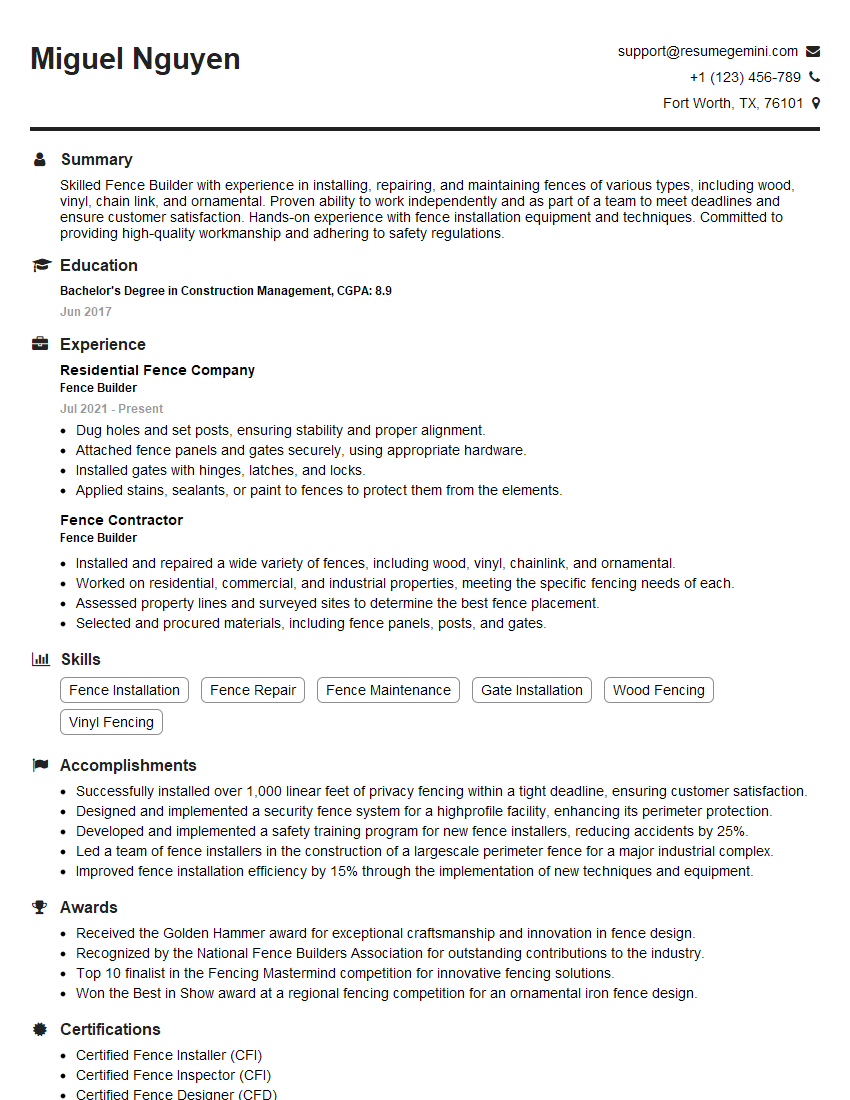
Mastering wood fence construction opens doors to a rewarding career with opportunities for advancement and specialization. A strong understanding of these core principles will significantly boost your interview performance. To maximize your job prospects, create an ATS-friendly resume that highlights your skills and experience effectively. ResumeGemini is a trusted resource to help you build a professional and impactful resume that catches the eye of recruiters. Examples of resumes tailored to Wood Fence Construction are available to guide you through the process.
Explore more articles
Users Rating of Our Blogs
Share Your Experience
We value your feedback! Please rate our content and share your thoughts (optional).
What Readers Say About Our Blog
Very informative content, great job.
good